Tavira’s Dragons & Their Relatives

Image
Image

Grove Koger

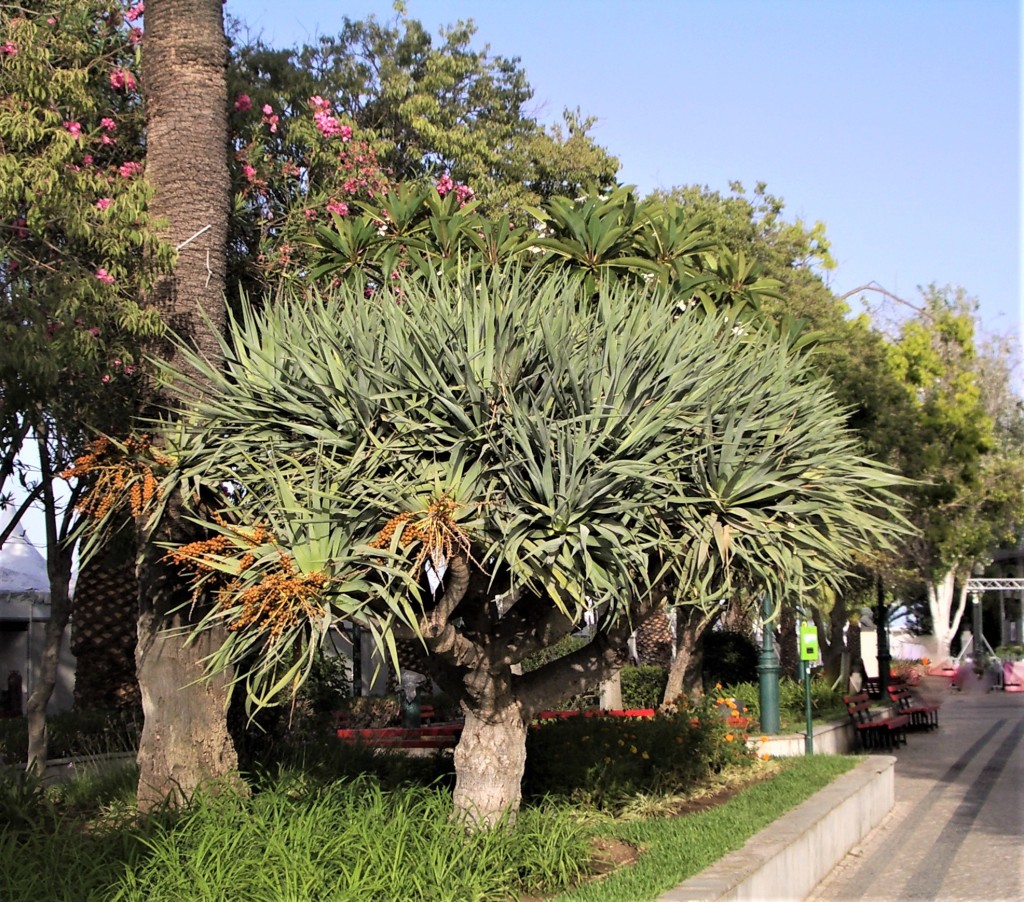
When we paid a second visit to the little southern Portuguese community of Tavira in 2023, the sights we planned to revisit included the town’s handsome dragon trees.

Growing in a little riverside park a few hundred feet from our hotel, the two trees probably go unnoticed by most of the town’s residents and visitors, but they’re a botanical delight for those who pause to look at them carefully or take time to learn more about them.

The dragon tree, or Dracaena draco, is native to southwest Morocco, the island nation of Cape Verde, the Spanish archipelago of the Canary Islands, and the Portuguese archipelago of Madeira. Scientists think that it was introduced to another Portuguese archipelago, the Azores, by Portuguese travelers from Cape Verde several centuries ago. Over time, the widely separated populations have developed into several subspecies.

Image

Dragon trees are evergreens with pithy trunks, and can reach as much as 60 feet or so in height and 20 feet in circumference. They also have an unusual and distinctive growth pattern. After ten or fifteen years, the tree blooms and grows multiple branches, each one of which then grows more branches after another long period, with the result that its crown spreads wider and wider, as if the tree were growing upside-down. As John Mercer writes in Canary Islands: Fuerteventura (David & Charles, 1973), the “dense vivid green upon the pale grey, with a patch of the darkest shadow on the ground below, make a fresh, cool sight even amongst the other trees.”

The trees’ small fruit have a red resin that was once used in pigments and traditional medicines. The indigenous inhabitants of the Canary Islands, the Guanches and the Canarios, carved shields from the trees’ bark, and I’m sure took advantage of the shade that Mercer refers to.  

Reading about dragon trees in Visit Native Flora of the Canary Islands, by Miguel Ángel Cabrera Pérez (Everest, 1999), I’ve learned that a separate species of the tree has been identified on Gran Canaria Island and designated Dracaena tamaranae. This “new” species, found on the southern (and geologically oldest) section of the island, apparently shares characteristics with such East African species as Dracaena ombet and Dracaena schizantha, as well as an Arabian species, Dracaena serrulate. Botanists speculate that specimens may have reached the island millions of years ago in the Miocene period.

Image

I don’t know when Tavira’s dragon trees were planted, but the oldest specimen on the Canary island of Tenerife is known as El Drago Milenario, and, at an estimated 1,000 to 5,000 years of age, it may be the oldest in the world. At 69 feet in height, with a circumference of about 66 feet, it may be the largest as well. That’s it you see above in a photograph by Mike Peel (www.mikepeel.net), reproduced courtesy of Wikimedia Commons. And should you find yourself on Tenerife, you can take a closer look by visiting the Parque del Drago, Icod de los Vinos, on the north shore of the island.

There was once another ancient specimen on the island, one examined by famed geographer and naturalist Alexander von Humboldt in 1799. Sadly enough, it was destroyed during a storm in 1867. According to John Mercer’s Canary Islanders (Rex Collings, 1980), the Guanches once “venerated” this particular tree, “seeing it as a protective spirit. Used by the Spaniards as a boundary post when dividing up the land amongst themselves in 1496 …, its well-authenticated measures were 75ft high, 78ft around the trunk.” Botanical artist Marianne North followed in Humboldt’s footsteps in 1875, discovering that the once-sacred tree had “tumbled into a mere dust-heap” with “nothing but a few bits of bark remaining.” However, she found “some very fine successors about the island,” one of which you see in her painting at the bottom of today’s post. And following in both sets of footsteps, A. Samler Brown added in the 1922 edition of Brown’s Madeira, Canary Islands, and Azores  (Simpkin) that “a cutting [was] still growing in one of the conservatories at Kew.”

The many people who stroll by Tavira’s dragon trees probably take them for granted, but the trees are members of a distinguished family, and worthy of our attention.

Image

If you’d like to subscribe to World Enough, enter your email address below:

And if you’ve enjoyed today’s post, please share!

Thinking about Atlantis

Image

Grove Koger

I don’t know of any myth in the Western World that has attracted so much ink as that of Atlantis, the great island that supposedly sank into the ocean sometime in the distant past.

However, the word myth can have several different meanings, and it’s important to understand what kind we’re talking about in discussing Atlantis. (That’s it at the top of today’s post in a map by Jesuit scholar Athanasius Kircher, who’s oriented his map with north at the bottom).

Plato’s retelling of the story appears in two of his dialogues, Timaeus and Critias, the latter of which lacks a conclusion. Plato provides the story with a pedigree, claiming to base his information on the works of Athenian statesman Solon, who is said to have visited Egypt in the 5th century BCE. However, we have only Plato’s word for what his source might have learned.

Image

The truth is that Atlantis seems to have sprung full-blown from the head of Plato (seen above in a Roman copy of a bust by Silanion) in much the same manner that Athena was thought to have sprung from the head of her father, Zeus. Plato’s dialogues constitute the very first mentions of the island, which he described as lying “in front of … the Pillars of Hercules.” These pillars are usually understood to be promontories at the western end of the Mediterranean Sea, but—and this is only one of the many, many buts in the story of Atlantis—ancient authorities placed the pillars in any number of places, and even, on occasion, considered them to be metaphors. (For details, I encourage you to consult the entry in the invaluable online Atlantipedia.)

In any case, it’s important to keep in mind that the story of Atlantis has no precursors. It seems fairly obvious that Plato was teaching a lesson about the ideal state and about what happens when the citizens of that state turn away from the ideals that have sustained it. However, his story has been seized upon by subsequent philosophers, novelists, archaeologists (many of them amateurs), and crackpots, with the result that a small library could be filled to overflowing with their works.

Image

The most popular location for Atlantis has proven to be the eastern North Atlantic Ocean, largely due to the modern identification of the Pillars of Hercules with Gibraltar in the north and Monte Hacho (or possibly Jebel Musa) in the south. As a result, prime candidates for the remains of the lost island have included three of the archipelagoes of Macaronesia—the Canary Islands, Madeira, and the Azores. A. Samler Brown, for instance, dealt a little too carelessly with the subject in early editions of his guidebooks. More recently, some archaeologists have seized upon the catastrophic eruption of the volcano at the Greek island of Santorini, or Thera, which occurred some 3,600 years ago. However, they overlook the central point that Atlantis didn’t erupt, it sank.  

Among novelists, Jules Verne described how his travelers visited the ruins of Atlantis in Twenty Thousand Leagues under the Sea (1869-70), and Pierre Benoit placed his character Antinea, a descendant of the rulers of Atlantis, rather ingeniously in a cave in the Sahara Desert in his 1919 novel Atlantida. More recently, Lawrence Durrell suggested in his 1953 travel memoir Reflections on a Marine Venus that “islomanes”—those “who find islands somehow irresistible”—are “direct descendants of the Atlanteans, and it is towards the lost Atlantis that their subconscious yearns throughout their island life.” And on and on …

Image

Several years ago, realizing that few writers of any stripe have dealt Plato’s inner life, I wrote a modest story I called “An Incident from the Childhood of Plato.” But when I submitted it to a market I thought I had a good working relationship with, I received a remarkably obtuse response. The editor suggested that I was trivializing Plato’s use of the myth, and that the physical actions I describe were simply unrealistic. It hadn’t occurred to me that I was trivializing anything at all, since, quite the contrary, I had connected the myth with what I thought could have been a profoundly important childhood experience. In addition, the physical events I describe in the story were perfectly consistent with reality, as I proved to the editor when I provided him with links to several news reports of similar events. In any case, I went on to submit the story to the publication Altered Reality, whose perceptive editor accepted it within a couple of days. You can read it here.

□□□

If you’d like to subscribe to World Enough, enter your email address below:

And if you’ve enjoyed today’s post, please share!

A. Samler Brown & Macaronesia

Image
Image

Grove Koger

A few individuals stand out among the authors and publishers of early travel guidebooks, particularly Karl Baedeker (1801-1859), whose name became practically synonymous with such works.

Unlike Baedeker, A(lfred) Samler Brown is now almost forgotten, but he pioneered English-language guidebooks covering Macaronesia—the Canary Islands (which are part of Spain) and Madeira and the Azores (which are part of Portugal).

According to what little information I’ve been able to track down, Brown was born in 1859. At some point, he moved to Tenerife in the Canary Islands, perhaps for his health, and built a house in the capital city of Santa Cruz de Tenerife. He’s said to have become the first resident to travel on the island in an automobile.

Image

Brown’s book was titled Madeira and the Canary Islands, with the subtitle A Practical and Complete Guide for the Use of Invalids and Tourists, and was published in 1889. The fourth edition (1896) included several pages on the Azores, and the sixth (1901), with the number of those pages significantly increased, was published as Madeira and Canary Islands, with the Azores. The guides included discussions of climatic conditions, lodging, food, and every other aspect of life on the islands that might be of interest to English-speaking travelers.

So influential was Brown that he was nominated Caballero de Merito Militar by King Alfonso XIII of Spain for his work in popularizing the Canaries.

Image

By the time of Brown’s death on July 17, 1936, his guide had run through 14 editions—an accomplishment that he seems to have been quite proud of. I own a copy of the twelfth (1922) edition, whose title has become Brown’s Madeira, Canary Islands, and Azores. Brown notes that the “First Edition of this Guide consisted of 111 pages and included 10 maps in one colour, but no plans, diagrams, sketches or meteorological tables. The present volume contains 496 pages, 22 maps and plans in three colours, 2 diagrams, 12 sketches and 11 meteorological tables in addition to many other tables of shipping, public coaches, etc.”

Brown seems to have been one of the first authors to include advertisements in his guidebooks, and my 1922 edition contains quite a few pages of them, including intriguing ones for Olsen’s Alexandra Hotel and Pension in Santa Cruz (“English, French and German Spoken”) and the Société Anonyme des Tramways Électriques de Tenerife. For anyone studying the social life of the islands in the late nineteenth and early twentieth centuries, his guides are indispensable.

Image

Brown notes in one of his guide’s introductory pages that “the article on the ‘Sunken Continent of Atlantis’ has been re-written.” In the article itself, he explains that it had been “highly imaginative, purposely so, for which reason the author’s knuckles have more than once been rapped. The reader who studies it as it is will take notice that it confines itself strictly to scientific data and that the task of imagining things is left to him and—to Plato.”

I should add that, in 1893, Brown began publication of another series of guidebooks, one devoted to Southern and (over time) East Africa. The series, which used much the same cover image of palm trees as Brown’s earlier guides, seems to have been a family affair, because through 1936, G.G. Brown is listed as co-author with A.S. Brown. After the latter’s death, the authorship is credited solely to G.G. Brown, while A. Gordon-Brown is identified as author beginning in 1940. (I haven’t been able to find out where A. Samler Brown was born, but I wonder whether he might have been South African.) The series was published under the sponsorship of the Union Castle Mail Steamship Company, which ran passenger and cargo ships between Europe and Africa.

(For much of the information in today’s post, I’m indebted to an entry in John Reid Young’s blog Travel Stories in Tenerife and the Canary Islands and the entry for Brown in the Portuguese version of Wikipedia.) 

Image

If you’d like to subscribe to World Enough, enter your email address below:

And if you’ve enjoyed today’s post, please share!

Defining & Redefining Macaronesia

Image
Image

Grove Koger

The first time I ran across the term “Macaronesia,” I assumed it must be a misprint for “Macronesia,” and that the term must refer to some grouping of large (“macro”) islands. Micronesia, after all, is a region of small (“micro”) islands in the Pacific Ocean. 

But I was wrong. Macaronesia is indeed the correct term and is derived from the Greek phrase makárōn nēsoi, meaning “fortunate isles” or “isles of the blessed”—an enticing but largely mythological reference to the islands that lie, or might lie, west of the Strait of Gibraltar in what we know today as the Atlantic Ocean. In this sense, they were a land of perpetual summer, and, according to Pliny the Elder, abounded in “fruit and birds of every kind.”

Image

But pinning down the term’s modern meaning isn’t quite so simple. The term “Macaronesia” was apparently coined by British botanist Philip Barker-Webb (1793-1854), who included three archipelagoes—Madeira, the Selvagens and the Canary Islands—in the designation, all of them lying off the coast of Northwest Africa. However, later botanists added the Azores, which lie nearly 900 miles west of Portugal, and Cabo Verde, which lies more than 300 miles west of westernmost Africa. (I’m indebted for this information to the authors of “Restructuring of the ‘Macaronesia’ Biogeographic Unit: A Marine Multi-Taxon Biogeographical Approach” in Scientific Reports.)

Of these five groups, Madeira, the Selvagens (which are administered from Madeira), and the Azores are part of Portugal, the Canary Islands are part of Spain, and Cape Verde, which was once a colony of Portugal, is now an independent nation.

Image

If you look at the map at the top of today’s post, however, you’ll notice how widely separated some of them are; the Azores, for instance, are more than 1,500 miles from Cape Verde, and Cape Verde itself is about 1,000 miles from the Canaries. Does it really make sense to group them together?

The authors of “Restructuring of the ‘Macaronesia’ Biogeographic Unit” don’t think so, writing that they “found no support for the current concept of Macaronesia as a coherent marine biogeographic unit.” They reached their conclusion after considering six kinds of marine life, and in light of what they found, they suggested removing Cape Verde and giving it “status of a biogeographical subprovince within the West African Transition province.” They also suggested removing the Azores and establishing them as their own ecoregion, and establishing a new ecoregion made up of Madeira, the Selvagens, and the Canary Islands.

Image

While the scientific terminology involving biogeographical regions may not be familiar, the thrust of the authors’ comments is clear: Philip Barker-Webb got it right, and in his honor, the authors suggest calling the new ecoregion Webbnesia.

□□□

The map at the top of today’s post was created by ArnoldPlaton and is reproduced courtesy of Wikimedia Commons.The first photograph, of a mountain village in Madeira, is by ArunSwamiPersaud (pixabay.com) and is reproduced courtesy of Needpix.com. The second photograph, showing a typical scene in the Selvagens, is by Coimbra68 and is reproduced courtesy of Wikimedia Commons, while the third photograph, taken by laurajane (pixabay.com), is of Tenerife in the Canary Islands, and is reproduced courtesy of Needpix.com.

□□□

If you’ve enjoyed today’s post, please share!