-
-
Beatboard

Inspiration
The hardest part of a short comedy often happens before anyone presses record. You need a setup that lands quickly, a turn that feels earned, a punchline with the right timing, and enough direction for performers to know how to play it.
Most generative video tools jump straight to the finished output. That can be exciting, but it also hides the decisions underneath. If one joke or beat is wrong, changing it can mean starting over.
We built Beatboard to focus on the part before production: making the structure visible, playable, and easy to carry into a real shoot.
What it does
Beatboard turns three inputs, a premise, target runtime, and comedy style, into a timed interactive storyboard.
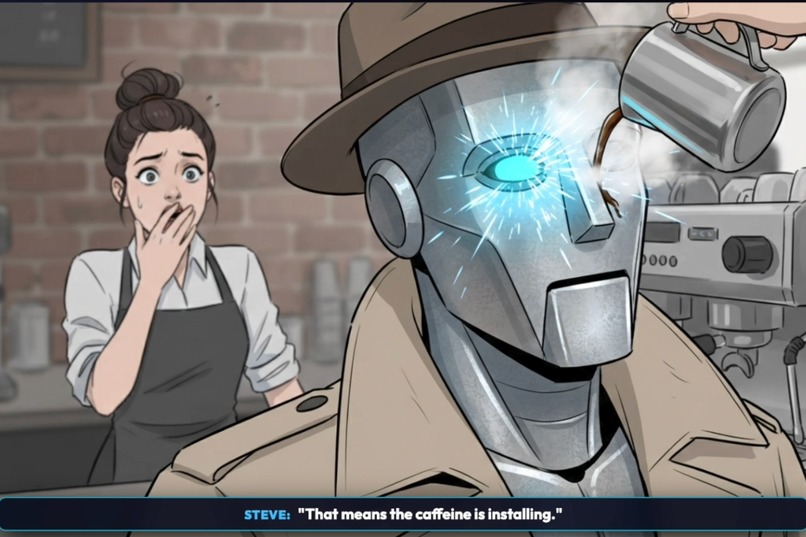
It plans the cast, setting, dialogue, actions, camera framing, performance direction, and relationships between beats. It then generates a storyboard frame for each beat, gives the characters distinct voices, and assembles everything into a playable animatic.
Beatboard also lets creators look at the same scene through four lenses:
- Storyboard shows what happens.
- Context shows what each character knows.
- Subtext shows what the characters really mean or want.
- Supertext shows what the audience is meant to understand and why the comedy works.
When the board is ready, Beatboard can export a Shoot Pack PDF with the storyboard, dialogue, timing, camera cues, performance notes, and cast information for use during production.
Creators can also revise a specific beat. Beatboard follows its dependency graph to determine what else is affected instead of blindly regenerating the entire project.
How we built it
Beatboard uses a React + Vite frontend with a Python FastAPI backend.
A planning agent retrieves the selected comedy style grammar from ClickHouse, then uses Gemini to create a structured beat graph containing characters, dialogue, timing, production cues, and dependencies.
Google image generation creates the storyboard panels, and Google Cloud Text-to-Speech gives each character a distinct voice. Media assets are stored in Google Cloud Storage.
ClickHouse acts as Beatboard's production memory. It stores sessions, active beats, dependencies, style grammars, and revision history. The agent queries that state before planning or revising, so the stored production context directly affects what it does next.
The frontend brings everything together into the animatic, the four directorial lenses, production guidance, a ClickHouse memory inspector, and the downloadable Shoot Pack.
Challenges we ran into
The biggest challenge was keeping one coherent production across several nondeterministic AI services.
Characters and locations had to remain recognizable across separately generated storyboard frames. Dialogue also had to fit an actual 15- or 30-second runtime without speeding up the voices unnaturally. We solved that by measuring the generated TTS duration and shortening the script when necessary.
We also had to make model output predictable enough to drive a real application. That meant using strict schemas, deterministic timing and assembly, cached assets, and graceful fallbacks when generation failed.
Dependency-aware revision created another challenge: changing one beat should not automatically rebuild everything. We needed to model relationships such as setups, punchlines, escalation, and callbacks explicitly enough for Beatboard to determine the smallest affected part of the storyboard.
Accomplishments that we're proud of
We're proud that Beatboard became a complete workflow rather than a collection of AI features.
A short brief becomes a structured, illustrated, voiced, timed, and playable production plan. Two performers can hear the scene, understand how to play it, inspect its hidden layers, and leave with a practical document they can use during the shoot.
We're especially proud of the Context, Subtext, and Supertext lenses, which let creators see the same scene from three different directorial perspectives without changing the storyboard itself.
We also built dependency-aware revisions, natural-duration dialogue, distinct character voices, persistent production memory in ClickHouse, resilient media generation, and a one-click production handoff.
What we learned
We learned that agentic cinema does not have to mean generating every final frame.
There is a lot of creative leverage in pre-production, where an agent can help turn an idea into something humans can understand, rehearse, challenge, and ultimately perform themselves.
We also learned that storing data is not the same as giving an agent memory. ClickHouse became meaningful when Beatboard started querying its style rules, dependencies, current versions, and revision history before deciding what to do next.
Finally, we learned that reliable creative software needs both probabilistic and deterministic systems. Gemini can make creative decisions, but schemas, measured audio timing, explicit dependencies, caching, and deterministic assembly are what turn those decisions into a dependable product.
What's next for Beatboard
Next, we want Beatboard to become a richer shared pre-production space without losing its simplicity.
That includes reusable character and visual bibles, real-time collaboration, alternate takes, side-by-side versions, additional comedy structures, more languages and voices, and direct handoff into common production and editing tools.
Longer term, Beatboard's production memory could learn how a particular team works and which structures, performances, and pacing choices tend to succeed for them, while still leaving the final creative decisions with the people making the scene.
Built With
- clickhouse
- fastapi
- gemini
- googlecloudstorage
- googlecloudtts
- imagen3
- javascript
- python
- react
- vite


Log in or sign up for Devpost to join the conversation.