-
-
Replaceable

Inspiration
Most predictions about AI and jobs are static. They give you a list, a score, or a headline about which jobs are "safe" or "at risk."
But AI capabilities keep changing. A prediction that makes sense today may look very different six months from now.
I wanted to build something that treats the future of work as a living system, not a one-time forecast.
That became Replaceable: a visual map of work that remembers what it previously believed, incorporates new evidence, and updates when that evidence actually changes the picture.
What it does
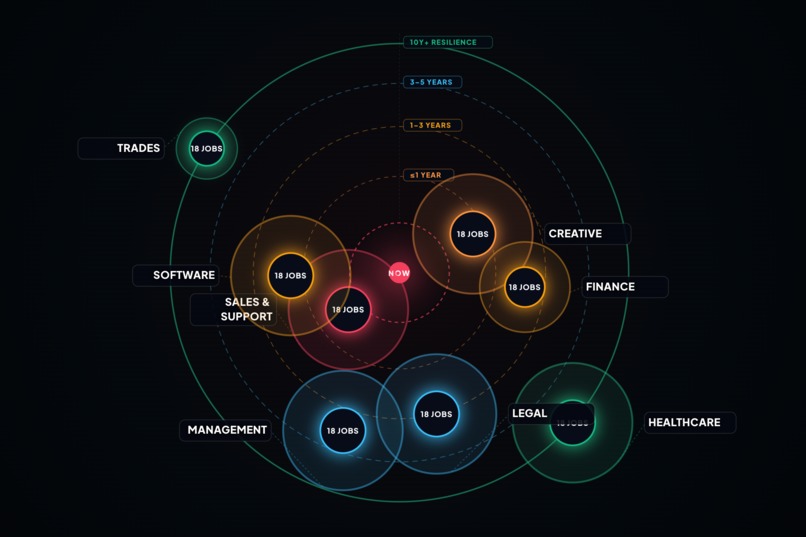
Replaceable maps 144 occupations across eight sectors according to how soon AI may materially reduce demand for that work.
The closer a job is to NOW, the sooner that impact may arrive. Larger circles represent greater uncertainty.
You can move from a broad sector into role groups, individual jobs, and finally the anatomy of a job: what AI already does well, what it is closing in on, and what still depends heavily on people.
The important part is that the map is not frozen.
When new evidence about AI capabilities appears, Replaceable retrieves the jobs and tasks it relates to, reassesses the affected occupations, and records what changed and why.
The result is not just a prediction. It is a memory of how the prediction evolves.
How we built it
CockroachDB Cloud is the persistent memory behind Replaceable.
It stores occupations, job components, evidence, current assessments, and reassessment history. Vector embeddings let the system retrieve the occupational knowledge most relevant to new evidence instead of reconsidering the entire map every time.
We used CockroachDB Distributed Vector Indexing for semantic retrieval, the official CockroachDB Managed MCP Server to inspect and work with the database during development, and ccloud CLI to provision and manage the cloud infrastructure.
On AWS, Bedrock Titan Embeddings converts evidence into semantic vectors, while Amazon Nova Pro reasons over retrieved occupational context and determines whether an existing assessment should change.
The application runs on AWS Lambda behind API Gateway, with a lightweight FastAPI backend and a custom browser-based spatial interface.
Challenges we ran into
The hardest challenge was making uncertainty understandable without turning Replaceable into another dashboard full of numbers.
Early versions had too much information competing for attention. We eventually reduced the interface to one spatial rule: distance from NOW represents replacement horizon, while circle size represents uncertainty.
Another challenge was designing the memory system so that new evidence did not simply overwrite an old prediction. We wanted Replaceable to preserve the previous assessment, the new assessment, and the reason for the change.
We also had to distinguish between evidence and interpretation. Sources can tell us what AI can do, but the replacement horizon itself is Replaceable's assessment based on that evidence.
Accomplishments that we're proud of
We built a working, deployed system where the visualization and agentic memory are directly connected.
A new capability signal can trigger semantic retrieval from CockroachDB, identify the relevant work, be evaluated through Bedrock, update an occupation's horizon, and persist the reassessment for later inspection.
The demo makes that visible with QA Automation Engineer: its assessment changes from 1–3 years to within 1 year, the job moves closer to NOW, and the previous assessment remains visible in Recent Changes.
We are also proud that the interface makes a fairly complex idea explorable without requiring users to understand embeddings, agents, or databases first.
What we learned
The most useful form of agentic memory is not simply storing more context.
It is remembering enough structure to answer: What did we believe before? What new information matters? What should change because of it?
We also learned that uncertainty needs to be part of the product itself. Predictions about AI and work should not pretend to have precision that the evidence cannot support.
Finally, visualization can make memory tangible. Watching a job physically move toward NOW communicates an updated assessment more immediately than another generated paragraph would.
What's next for Replaceable
The next step is to turn Replaceable from a curated map into a continuously maintained view of how work is changing.
That means bringing in more high-quality evidence, expanding occupational coverage, improving task-level grounding, and letting the memory accumulate a meaningful history of how assessments evolve over time.
Ultimately, Replaceable could answer a more useful question than simply, "Will AI replace my job?"
It could show which parts of the work are changing, what evidence caused the change, how uncertain the outlook is, and how that outlook has evolved.
Built With
- apigateway
- awsbedrock
- awslambda
- ccloud
- cockroachdb
- fastapi
- javascript
- managedmcp
- python
- vectorsearch


Log in or sign up for Devpost to join the conversation.