Official code for "Mixture of Frames Policy: Multi-Frame Action Denoising for Bimanual Mobile Manipulation".
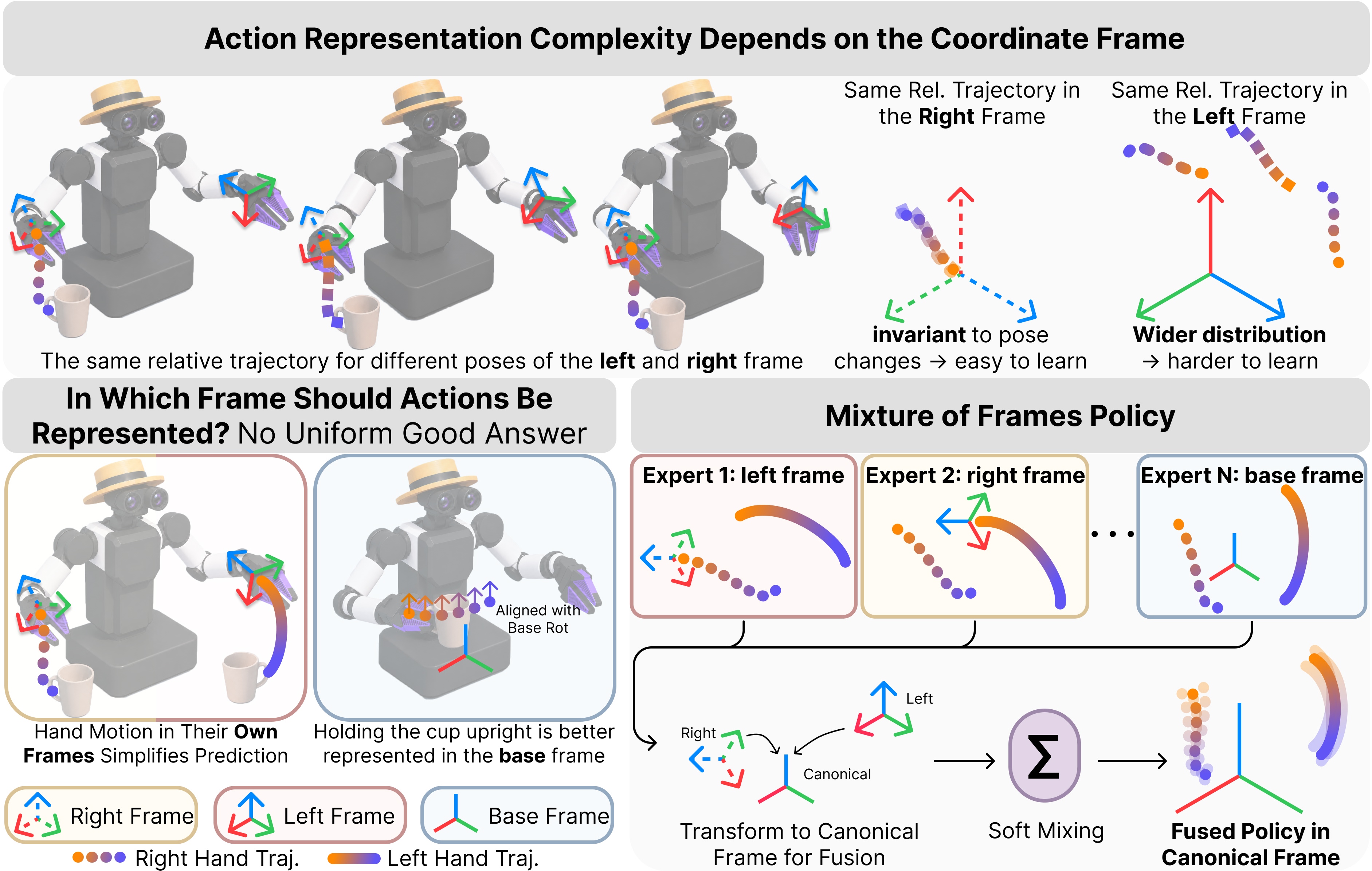
Mixture of Frames (MoF) is a diffusion policy that denoises each action in several reference frames at once — a base-relative frame, the left and right end-effector frames, and a trajectory-relative frame — and fuses the per-frame predictions either with a learned per-timestep router (MoF-MoE) or with a uniform average (MoF-Ensemble). Denoising in multiple frames exposes the policy to several complementary action parameterizations of the same motion, which improves bimanual mobile-manipulation performance over any single frame.
This repository contains the simulation experiments from the paper, on the
BiGym (RBY1) and DexMimicGen task suites. The real-world experiments
(Appendix F, a DiT + HoMMI stack) live in the
mof_hommi submodule — clone with
git clone --recurse-submodules, or git submodule update --init --recursive mof_hommi in
an existing checkout.
Clone the repository and cd into it, then:
# 1. System packages for MuJoCo
sudo apt install -y libosmesa6-dev libgl1-mesa-glx libglfw3 patchelf

# 2. Create and activate the conda environment (all version pins live here)
mamba env create -f conda_environment.yaml   # or: conda env create -f ...
conda activate mof

# 3. Install the MoF stack into the active env
bash install.sh
install.sh installs this package plus the pinned robosuite / robomimic /
robosuite-task-zoo / DexMimicGen / BiGym sources into the active conda env
(it aborts if mof isn't active, so it won't pollute another env). Almost
everything is pinned in conda_environment.yaml; the one exception baked into
the script is mink==1.1.0, installed --no-deps because it requires
mujoco>=3.3.6 while this project deliberately holds mujoco==3.3.5.

The nine demonstration sets are on the HuggingFace Hub
(dian-wang/mof-datasets)
— RGB + low-dim observations only (the depth / point-cloud channels are dropped
since the released image policies never read them). Use the helper to fetch them
straight into data/:
python -m mof.scripts.download_datasets                 # all 9 tasks
python -m mof.scripts.download_datasets --tasks bigym   # all 5 BiGym  (or: --tasks dex)
python -m mof.scripts.download_datasets --tasks rby1_flip_cup two_arm_threading
python -m mof.scripts.download_datasets --list          # list tasks, paths, and task= names
It downloads to exactly the layout the task configs expect (each task= config
points at its own demos_dir, so nothing else needs setting) — after download you
can train directly with task=<task>:
data/bigym/rby1_flip_cup/*.safetensors            # FlipCup (224x224)
data/bigym/rby1_move_two_plates/*.safetensors     # the other four are native 84x84
data/bigym/rby1_store_kitchenware/*.safetensors
data/bigym/rby1_flip_sandwich/*.safetensors
data/bigym/rby1_dishwasher_load_plates/*.safetensors
data/dexmimicgen/two_arm_threading_abs.hdf5       # + three_piece_assembly / box_cleanup / drawer_cleanup
The DexMimicGen sets are already absolute-action (_abs). To regenerate them from
raw delta-action demos instead, use
mof/scripts/dexmimicgen_dataset_conversion.py:
python -m mof.scripts.dexmimicgen_dataset_conversion \
    -i data/dexmimicgen/two_arm_threading.hdf5 \
    -o data/dexmimicgen/two_arm_threading_abs.hdf5 \
-e data/dexmimicgen/two_arm_threading_eval -n 8Every paper run launches through run_async_eval.sh, which
runs training while periodically rolling out the policy for evaluation in a
separate GPU context:
CUDA_VISIBLE_DEVICES=<gpu> ./run_async_eval.sh train.py \
    --config-name=<config> task=<task> [overrides...]
Settings shared by all paper runs are baked into the configs (no override
needed): n_demo=100, dataloader.batch_size=128, a ResNet18 (timm
resnet18.tv_in1k, spatial-softmax) vision encoder at a 84→224→crop192→76
input, a DDIM scheduler (50 train / 16 inference steps), and 500 epochs.
The MoF method is fully described by four policy.* fields (all baked into
train_mof_moe for MoF-MoE):
| Field | Values | Meaning |
|---|---|---|
enabled_experts |
any subset of [base_rel_trans, left, right, rel_traj] |
which frame experts to denoise in |
canonical_space |
one of the enabled frames | the frame the shared canonical action (diffusion target + noise x_T) is expressed in; every expert's prediction is mapped into it before fusing |
router_mode |
learned | fixed_uniform |
learned per-timestep router (MoF-MoE) vs. uniform average (MoF-Ensemble) |
expert_loss_coef |
float (1.0 default, 0.0 = off) |
weight of the per-expert auxiliary loss |
The four frames are: base_rel_trans (base-relative translation, pseudo-base
from the head pose), left / right (end-effector frames), and rel_traj
(trajectory-relative).
The paper evaluates on nine simulation tasks. Each is a self-contained
task= config — shape_meta, env, task_name, and demos_dir are all baked
in, so selecting a task is just one flag and nothing else. Task selection is
orthogonal to the method config.
BiGym (RBY1) — task=bigym_rby1_<name>:
flip_cup, move_two_plates, store_kitchenware, flip_sandwich,
dishwasher_load_plates. (The observation encoder maps every task to the same
input size, so the policy sees a uniform resolution. The only difference is the
source image resolution baked into each task config — FlipCup's frames are
224×224, the other four 84×84 — which the encoder resizes; FlipCup keeps its
higher source resolution because downsampling it measurably hurts that task.)
DexMimicGen — task=dexmimicgen_<name>:
two_arm_threading, two_arm_three_piece_assembly (parallel-jaw, 20-D action),
two_arm_box_cleanup, two_arm_drawer_cleanup (dex hand, 30-D action).
The dataset class is chosen by the method config (the MoF configs use the
MoF dataset); the task config only fixes the family (BiGym vs DexMimicGen)
and the demos path. Other envs exist in
mof/env/bigym/factory.py and the get_max_steps
table in train.py; the nine above are the paper set.
Every launch is --config-name=<method> task=<task> plus any method overrides.
The task config carries task_name, demos_dir, shape_meta and the env.
# MoF-MoE on a BiGym task (FlipCup is 224 — handled by the task config)
CUDA_VISIBLE_DEVICES=0 ./run_async_eval.sh train.py \
    --config-name=train_mof_moe task=bigym_rby1_flip_cup

# MoF-Ensemble on a BiGym task
CUDA_VISIBLE_DEVICES=0 ./run_async_eval.sh train.py \
    --config-name=train_mof_ensemble task=bigym_rby1_store_kitchenware

# Single-frame (Left frame) baseline
CUDA_VISIBLE_DEVICES=0 ./run_async_eval.sh train.py \
    --config-name=train_mof_single_frame task=bigym_rby1_flip_cup \
    policy.enabled_experts=[left] policy.canonical_space=left

# MoF-MoE on a DexMimicGen task (parallel-jaw: threading/assembly;
# dex-hand: box_cleanup/drawer_cleanup)
CUDA_VISIBLE_DEVICES=0 ./run_async_eval.sh train.py \
    --config-name=train_mof_moe task=dexmimicgen_two_arm_threading
To train without async evaluation (no rollouts), launch through
run.sh instead of run_async_eval.sh.
mof/
  config/        Hydra configs — train_*.yaml (methods) + task/ (task groups)
  policy/        MixtureOfFramesPolicy (+ GramSchmidt), DP / Ensemble / MoE-DP baselines
  model/         diffusion UNet (+ MoF / ensemble variants), MoE module, vision encoder
  dataset/       per-frame replay datasets (BiGym RBY1, DexMimicGen)
  env/           BiGym + DexMimicGen environment wrappers and factories
  env_runner/    async rollout / evaluation runners
  workspace/     training loop, EMA, checkpointing, async-eval workspace
  scripts/       dataset conversion
train.py         training entrypoint     eval.py   evaluation entrypoint
run.sh           single-GPU launch       run_async_eval.sh  launch with async eval
Released under the MIT license. See LICENSE.
Built upon Diffusion Policy. The MoE-DP baseline is a faithful port of the official MoE-DP release. Tasks come from BiGym and DexMimicGen.
