<?xml version="1.0" encoding="utf-8"?><feed xmlns="http://www.w3.org/2005/Atom" ><generator uri="https://jekyllrb.com/" version="3.10.0">Jekyll</generator><link href="https://www.frank.computer/feed.xml" rel="self" type="application/atom+xml" /><link href="https://www.frank.computer/" rel="alternate" type="text/html" /><updated>2026-07-28T02:37:42+00:00</updated><id>https://www.frank.computer/feed.xml</id><title type="html">Frank Elavsky</title><subtitle>Assistant Professor of Data Science investigating accessibility and data interaction. Previously: PhD from CMU, data interaction R&amp;D at Adobe, Highsoft, Apple, Visa, + others.
</subtitle><entry><title type="html">Announcing: Skeleton 🩻, the culminating project of my PhD!</title><link href="https://www.frank.computer/blog/2026/07/announcing-skeleton.html" rel="alternate" type="text/html" title="Announcing: Skeleton 🩻, the culminating project of my PhD!" /><published>2026-07-18T00:00:00+00:00</published><updated>2026-07-18T00:00:00+00:00</updated><id>https://www.frank.computer/blog/2026/07/announcing-skeleton</id><content type="html" xml:base="https://www.frank.computer/blog/2026/07/announcing-skeleton.html"><![CDATA[<figure style="display: block; width: 90%; margin-left: auto; margin-right: auto;">
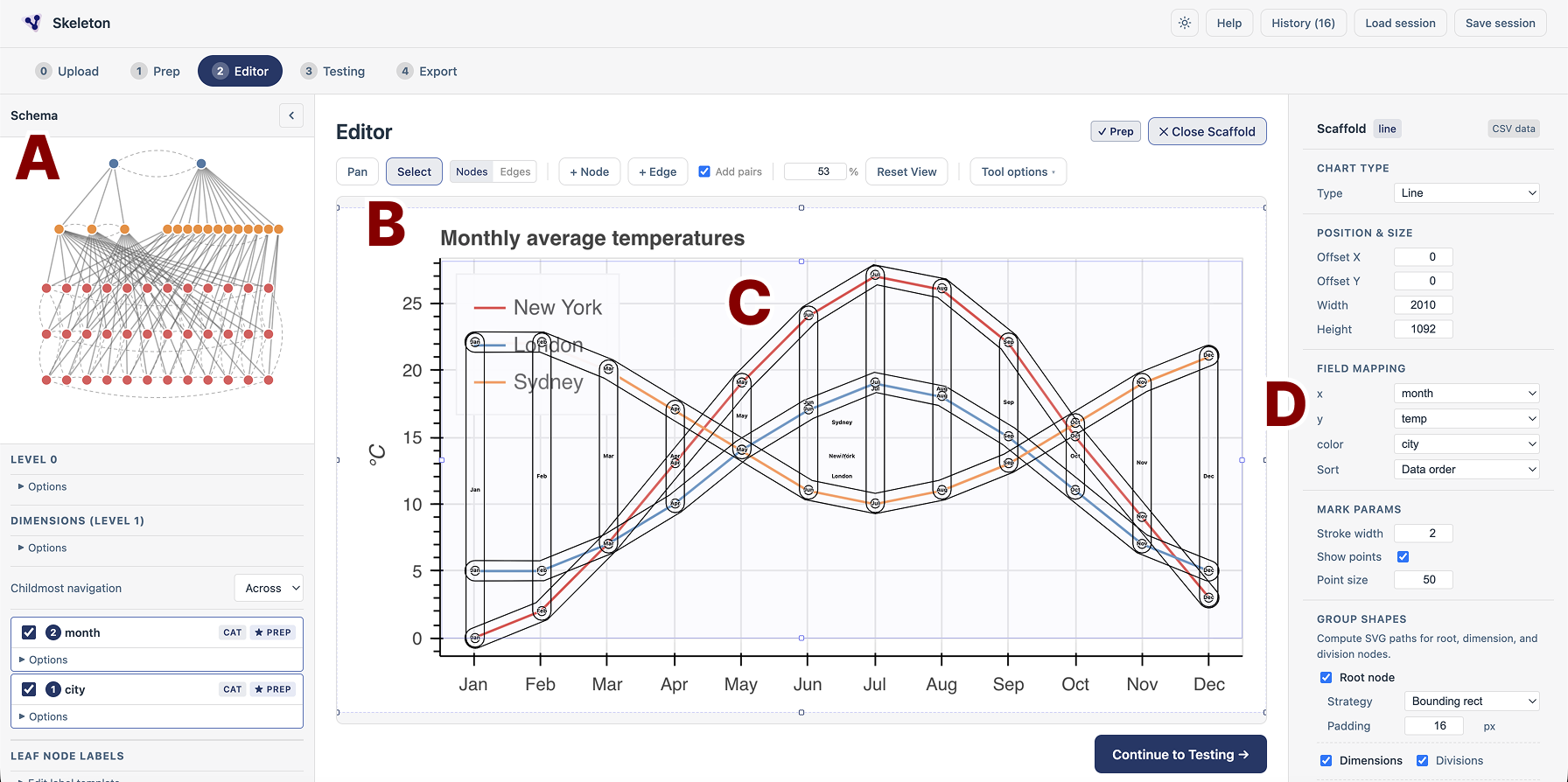
    <img src="https://www.frank.computer/images/skeleton_hero.png" alt="Skeleton’s interface. There is a tree-like structure with 3 hierarchical levels shown in the schema. In the editor, outlines shown over the 3 lines in a line chart, along with vertical bands that join the lines at each month they cross. These two shapes appear like a triple helix. On the right is a panel labeled scaffold, which has options for setting various parameters." />
    <figcaption><i>Skeleton</i> being used to build a navigation structure over a line chart. <b>A</b>: a dual tree visualization of nodes and edges built for a line chart with 3 lines, spanning over 12 months. <b>B</b>: a direct-manipulation canvas that resides over a static png image of a line chart. <b>C</b>: a skeleton-like structure of nodes, edges, and group outlines that correspond to the schema shown in (A), overlaid on the visual space of the chart in (B). <b>D</b>: controls for rapidly scaffolding the nodes, edges, and their shapes shown in (C), using Vega’s visualization engine for automatically generating spatial properties.</figcaption>
</figure>

<p>The final project of my PhD, titled “<em>Skeleton</em>: Visual Authoring of Non-visual Data Experiences” has now been fully accepted at IEEE VIS 2026. Woohoo! (<a href="https://arxiv.org/abs/2607.14579">You can check out the pre-print of the paper at this link</a>.) Depending on who you are, my reader, this announcement means different things. To my fellow academics: this is great news! VIS is the premier venue for visualization research. This will be a fantastic opportunity for me to share my work and findings with other researchers. I look forward to future chats with you all!</p>

<p>But for my fellow practitioners, why does this matter? Well, our paper outlines this a bit more (and if you’ve never read an academic paper, give it a shot!), but we oriented our work as <em>action research</em>. That means that our technical projects (the things we built) were grounded in work with practitioners. Our work was relevant to them, so I hope to you my reader, it will be relevant too.</p>

<p>Yet before I jump into a bulleted list of TL;DR takeaways, I desperately hope that whoever you are, an academic, practitioner, or someone random, that you will stick around at least for my short pre-requisite introduction to this topic first.</p>

<p>But here is the bulleted list of takeaways:</p>
<ul>
  <li>Sighted people face barriers when authoring non-visual data experiences</li>
  <li>We built a tool to visualize the data structure used to make charts and graphs navigable</li>
  <li>We built a tool that mirrors the grammar of graphics, but focuses on non-visual navigation dimensions in charts and graphs</li>
  <li>We then built a visual user interface that makes it so that a user can directly manipulate non-visual data experiences they are authoring as well as test their experiences</li>
  <li>We also had some fun with heuristic-based (non-ML) computer vision and some other neat tricks to make scaffolding navigation experiences as fast and easy as possible</li>
  <li>Lastly, our study revealed quite a lot! But our most important finding was that sighted practitioners treat non-visual experiences as equal to visuals once they can see and manipulate them. They iterate independently and substantially once they can see a design element, they treat non-visual experiences as a complex and serious space of design, and they even iterated on their visual design choices once they understood how their visuals might influence the non-visual experiences people will have of their charts!</li>
</ul>

<h2 id="a-brief-introduction-what-is-wrong-what-matters-why-accessibility-and-visualization">A brief introduction: What is wrong? What matters? Why accessibility and visualization?</h2>

<p>I finally articulate and unpack why I do this work, in length, in my thesis (which is now out in the world, officially). If you want a deeper dive, <a href="https://www.frank.computer/blog/2026/04/who-reads-dissertations.html">check it out (or my smaller baby thesis sub-docs)</a>.</p>

<p>But people who live with disabilities deserve to live full lives. They deserve to participate in their communities, in our world, in the politics that affect them, in political and civic action, in well-paying jobs, in decisions about their healthcare, and in staying informed about matters like the economy, their personal finances, academic research, local news, and more. And in our world, interacting with and being able to communicate with information is an important part living a connected, happy, healthy life. People with disabilities deserve to have access to data.</p>

<p>And yet, the problem is that people with disabilities are often not considered when software and hardware are designed. Ultimately, this means that simple access to information for someone who is sighted becomes a tedious, time-consuming, painful chore for someone who is blind. And most often, people are fully excluded from access due to how we have built our technological world.</p>

<p>But things don’t have to be this way. We can build things better. We can make our websites, tools, software, applications, and devices more accessible for people with disabilities.</p>

<p>And the good news? To some degree, people have been doing this work. This field of work is called “accessibility” work. And some people specialize in it (it is their whole thing) while others integrate it into the work they do (such as people who make data visualizations but <a href="https://www.frank.computer/chartability/">understand how to make them more accessible</a> or <a href="https://www.frank.computer/data-navigator/">leverage tools that help them do this work</a>.)</p>

<p>These people, this subset of “practitioners” who work, or want to work, on accessibility related to data interfaces are the people I set out to work with in this research project.</p>

<h2 id="my-sighted-collaborators-struggled-to-work-with-non-visual-design-materials">My sighted collaborators struggled to work with non-visual design materials</h2>

<p>We collaborated with 3 different groups of practitioners, with varying degrees of involvement in the design or development work that they were undertaking, related to making visual representations of data more accessible to people with disabilities. Our collaborators were primarily sighted, although we did also have blind co-designers who joined us in those collaborations (or who specifically helped us with our later work).</p>

<p>Part of the work of <a href="https://dig.cmu.edu/data-navigator/">making visualizations accessible is making them <em>navigable</em></a> for people who use assistive technologies. Some assistive technologies that navigate might include screen readers, keyboards, voice controls, “switches,” sip and puff devices, and more. My past project (linked above), “<a href="https://dig.cmu.edu/data-navigator/">Data Navigator</a>,” focuses on making this translation work possible. Designers and engineers can work to create non-visual and visual navigation and interaction experiences with data structures.</p>

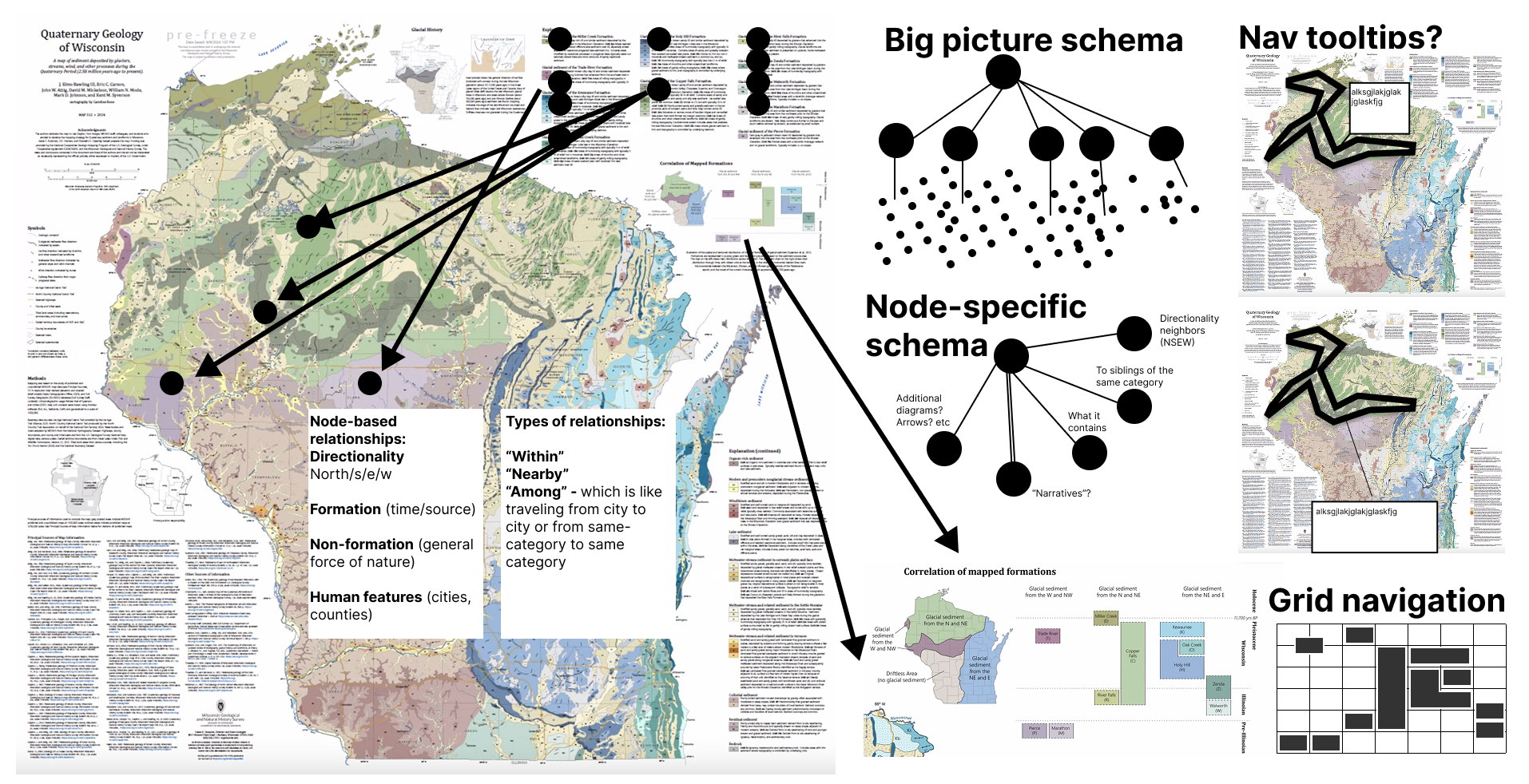
<p>However, doing this work is quite hard. Our collaborators iterated heavily in visual design tools. They used visual, diagrammatic markers and artifacts to iterate on their ideas. “If we place a navigation node here, would could navigate over to here” they might say, while laying a circle object over the first thing they’ve referenced and then dragging out an arrow from that circle onto a new area of our design space. Our collaborators reasoned about the spatial structures and experiences of their imagined end users in visual metaphors and symbols.</p>

<figure style="display: block; width: 90%; margin-left: auto; margin-right: auto;">
    <img src="https://www.frank.computer/images/skeleton_geologic.png" alt="A zoomed out view of the state of Wisconsin, encoded with a tapestry of dozens of colors and textures. Arrows annotate direction from the legend to map area, a separate area has messy, approximated graph structures laid out, a zoomed in version of a chart inside the graphic has schematics next to it titled &quot;grid navigation.&quot; An area in the upper corner demonstrates 2 different styles of drawing tooltips during navigation." />
    <figcaption>Using diagrammatic symbols and markers while designing screen reader navigation of a map, in Figma. Note: This is from our collaboration with the folks from the University of Wisconson's <a href="https://wgnhs.wisc.edu/catalog/publication/001011">Quaternary Geology of Wisconsin map</a> (and their <a href="https://data.wgnhs.wisc.edu/statewide-quaternary-online/">fantastic efforts to make this map more accessible</a>). We explain the process behind this in the paper as well as more technically via <a href="https://dig.cmu.edu/data-navigator/examples/bespoke.html">an example in our documention for Data Navigator</a>.</figcaption>
</figure>

<p>And yet, <em>building</em> these structures (enacting these designs in real, working prototypes) involved working entirely in code (in text) without any visual representation of what they were doing. Testing the designs required interacting with non-visual structures using non-visual tools: loading up a screen reader and stitching together the resulting prototype’s performance interactively, one piece at a time. Testing was not only manual, but <em>also</em> non-visual. This work became quite tedious, prone to errors, and difficult for our fellow practitioners.</p>

<h2 id="discovering-inaccessibility-for-people-without-disabilities">Discovering <em>inaccessibility</em> for <em>people without disabilities</em></h2>

<p>We needed to improve the debugging process. And the first step was recognizing that we should probably visualize the data about the system’s structure. Ironic! We are trying to make visualizations more accessible for people who are blind. To do that, we need to make non-visual experiences that can make our visualizations (or their underlying data) more accessible. Yet, because those experiences are non-visual… they are inaccessible to our sighted collaborators!</p>

<p>In the social model of disability, which is a framing that can sometimes be quite useful, we talk about how our <em>created world</em> (be that curbs on our sidewalks, the politics that govern us, or our software) produces barriers for people with disabilities. Those barriers are where a person who has a disability actually experiences that disability. (Again, note that this framing isn’t complete, but it <em>is</em> useful.) What this means is that because we have brought artificial things into the world and those artificial things are now holding some people from participation in the world, it is up to <em>us</em> (the creators) to fix these things.</p>

<p>The social model is useful because it helps us orient who is responsible, who needs to be included, and so on. Great!</p>

<p>But in the social model, the most interesting thing is actually that <em>disability is produced between a human and an interaction with something else</em>. A person in a wheelchair <em>becomes</em> disabled (unable to participate in navigating their city) when a curb blocks their path.</p>

<p>Now, in our research project with <em>Skeleton</em>, we demonstrate that even sighted people can face barriers when working with non-visual design materials. <strong>A software system, when inadequately designed, can disable anyone.</strong></p>

<h2 id="introducing-our-inspector-gadget">Introducing: Our “Inspector” gadget</h2>

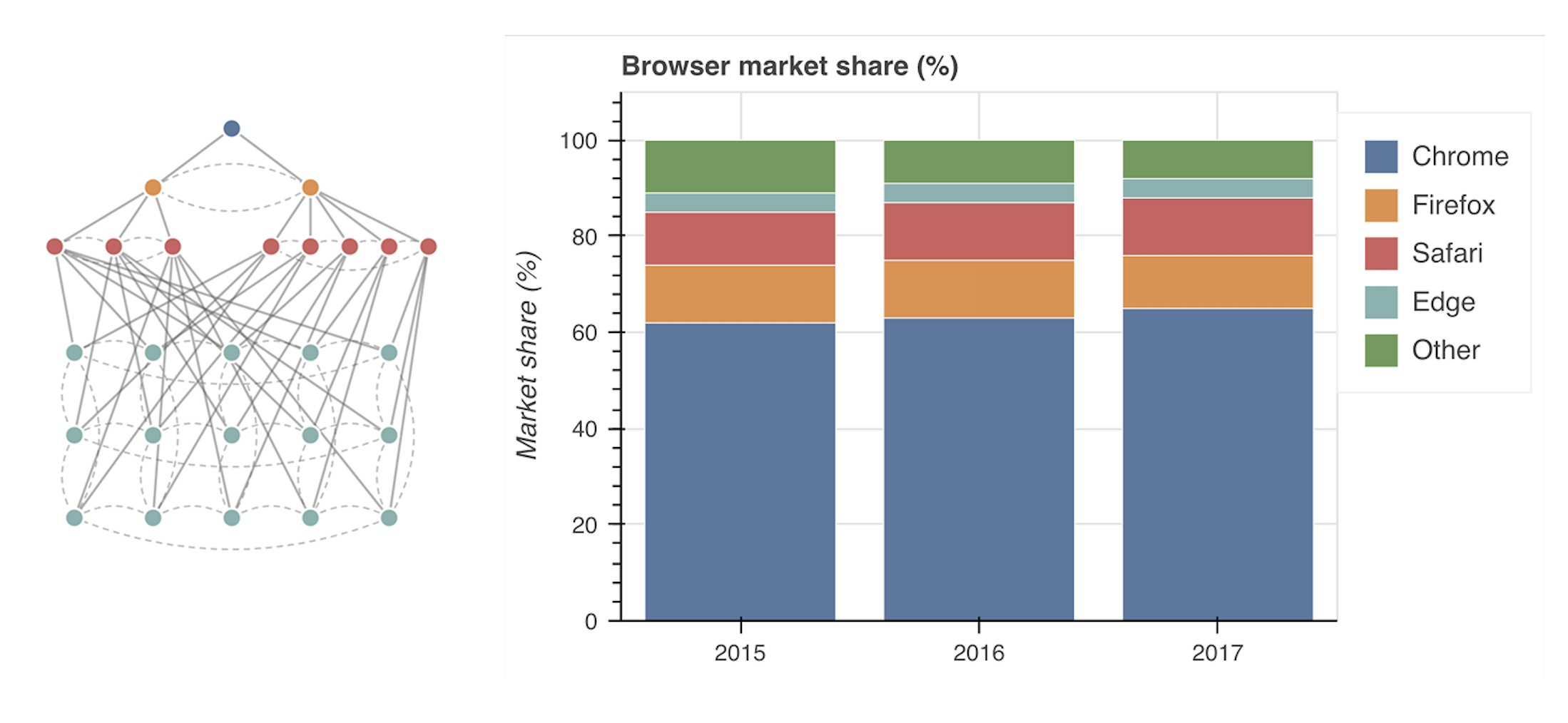
<p>To address this first issue, we built a simple tool for visualizing the structure under the hood. We call this our “<a href="https://dig.cmu.edu/data-navigator/inspector/">inspector</a>” and also built in <a href="https://dig.cmu.edu/data-navigator/inspector/examples/console-menu.html">custom console menu</a> based on our collaborative work. We figured that the first pre-requisite for any future iterations will require being able to see what navigation looks like.</p>

<p>The inspector simply shows a developer what the system “sees:” which nodes exist, and how they are connected to each other through their edges. Interestingly, there isn’t too much precedence for this in terms of accessibility. Web sites don’t expose the <a href="https://wicg.github.io/aom/">accessibility object model</a> and structure, and therefore it isn’t easy for a developer to gain a visual sense of how and where screen readers or assistive technologies will navigate, when navigating on a webpage. This is a huge issue! (So even outside of the scope of our research project, we hope that this catches on in the coming years and we can soon see screen reader and non-screen reader navigation visually over a webpage, when opening the developer tools of a browser. One can dream!)</p>

<figure style="display: block; width: 90%; margin-left: auto; margin-right: auto;">
    <img src="https://www.frank.computer/images/skeleton_inspector.png" alt="A tree view visualization and a stacked bar chart visualization. The tree view has 4 levels. The top level has 1 node, second has 2, third has 3 under the first in the second row with 5 nodes under the second node in teh second row. At the bottom level, there are 15 nodes that all connect to parents in both groups from the third row. The stacked bar chart shows three years, 2015, 16, and 17 with the browser market share for chrome, firefox, safari, edge, and other." />
    <figcaption>An example structure is visualized using our inspector (on the left) created for a stacked bar chart (on the right).</figcaption>
</figure>

<h2 id="introducing-our-alternative-dimensions">Introducing: Our alternative “Dimensions”</h2>

<p>Our “inspector” gadget is a play on <a href="https://en.wikipedia.org/wiki/Inspector_Gadget">Inspector Gadget</a>, of course. And “alternative dimensions” here is a play on alternative text, the encoding dimensions used in a grammar of graphics (that then correspond to X or Y axes, colors, and so on), and, well, <a href="en.wikipedia.org/wiki/Alternate_reality">alternative dimensions</a> (from science fiction and the sort). But our tool is called the “<a href="https://dig.cmu.edu/data-navigator/examples/understanding-dimensions.html">dimensions API</a>” and this came about out of necessity, much like our inspector did.</p>

<p>With data navigator, our primary tool for building navigation experiences, we found out relatively quickly across our own work as well as our co-design work that several “patterns” began to emerge as the dominant choices for treating different types of charts and encodings.</p>

<p>With Olli and Zong et al’s work on “Rich Screen Reader Experiences”, they came up with a multi-tree solution for navigating charts and empirically demonstrated that it was useful. In data navigator (our paper portion of the project, at least), we came up with a pattern where children nodes could share parents (or rather, be the leaves of multiple trees at once).</p>

<p>Yet, data navigator’s example patterns were wired up “by hand” in the sense that every data point had a node (or derived nodes) and edges produced manually, by typing everything out in a long and frankly complex specification. Data navigator simply uses a graph under the hood, which is cool and useful, but when it comes to charts and graphs (which often have common structures), this naturally led us to building a higher level API that enabled us to rapidly build useful structures, and especially ones with a structural correspondence to common types of visualizations.</p>

<p>We have a <a href="https://dig.cmu.edu/data-navigator/examples/understanding-dimensions.html">whole walkthrough article written on how the dimensions API</a> works that is worth exploring, in our Data Navigator docs. Also, all of our examples in our “<a href="https://dig.cmu.edu/data-navigator/bokeh-wrapper/examples/bar-chart.html">Bokeh Wrapper</a>” (a project we did that didn’t get discussed in the paper) leverage the Dimensions API and also show some of these higher-level patterns for navigation across different chart types.</p>

<p>In brief: the dimensions API enabled us to automatically scaffold navigation experiences based on commonly known inputs that are shared with charting libraries and grammars of graphics. This meant that we could then integrate data navigator into visualization libaries at a low level. Neat! (<a href="https://github.com/adobe/react-spectrum-charts/pull/822">This enabled our work with the Adobe folks, for example</a>.)</p>

<h3 id="what-is-missing-though-this-seems-great">What is missing, though? This seems great!</h3>

<p>Well, our Adobe folks are about to solve their design system chart components and we built a wrapper for Bokeh’s visualization library… so what is the problem? Isn’t the work now done?</p>

<p>No, of course not!</p>

<p>The gap that our collaborations helped us to really understand is that authoring (in code) still remains entirely non-visual. We wanted to explore what it would be like to have tooling custom-built for making it as easy as possible to design, iterate, build, test, and iterate again. We built that tool (it is what we call “Skeleton”).</p>

<h2 id="introducing-skeleton-">Introducing: Skeleton 🩻</h2>

<p>You can find a <a href="https://dig.cmu.edu/data-navigator/skeleton/">live, interactive version of Skeleton at this link</a>. We have “save” files for skeleton, too (if you want to load it at a specific view, to see the magic happen more easily than slogging through the wizard for a few minutes). You can access these from Step 0 (upload) and choosing “Load an example.” We have unprepped options (will require using the wizard) but also ready-to-go options that take you to the editor (and let you click the “scaffold” button to see the magic happen) or go straight to testing and poking around with a keyboard or text commands.</p>

<!-- [This save file loads up the editor post-wizard](https://drive.google.com/file/d/1x8jqwTcpIMiIuiRPQg2NNF2QH-7Vg5XT/view?usp=sharing) but pre-scaffold. [This save file loads up the editor post-scaffold](https://drive.google.com/file/d/1P_UyifIeyjrrv6SygotA79SO_3H6FgXn/view?usp=drive_link). (You download the zip files and then when using the skeleton app, press the "Load session" button at the top of the app.) -->

<p>Note that this is a <em>research prototype</em> that we built entirely so that we could test our ideas and run a user study. So don’t take the tool too seriously as a production-ready tool. (It isn’t.) Instead, view it as an exploration of our core question and following ideas in one place.</p>

<blockquote>
  <p><em>The</em> core question we have centers on: “What happens if sighted designers and developers can author, design, and debug non-visual navigation structures using direct manipulation of visual representations?” (Our paper breaks this question into two separate research questions, but the aggregate combo of them is this, roughly speaking.) And in order to support this core question, our UI was built around the following ideas:</p>
</blockquote>

<h3 id="idea-1-what-if-you-could-visually-manipulate-and-author-navigation-structures">Idea 1: What if you could visually manipulate and author navigation structures?</h3>
<p>Put simply: what if you could create something like what our inspector view shows, but entirely in a visual way? Right now, nodes and edges are created using code, then shown in our inspector. And yet, this code is often attempting to re-create a visual design specification. The workflow is: Navigation designed visually -&gt; handoff to developers -&gt; Developers code. But what if we cut out the middle, translational step? What if the same activities we take during the designerly phase (creating markers for navigation locations and drawing paths for navigation) automatically scaffolded the structures that Data Navigator requires? What if you could add, delete, and move around nodes and edges freely by directly manipulating these elements?</p>

<p>So, we built that. We call this view the “editor” in Skeleton.</p>

<h3 id="idea-2-what-if-you-could-auto-magically-scaffold-the-visual-part-of-a-structure-for-most-common-chart-types">Idea 2: What if you could auto-magically scaffold the visual part of a structure for most common chart types?</h3>
<p>Put simply: the inspector is what the system sees. But we also want to see another visualization: what the end user will see. And yes, many people who use navigational assistive technologies have sight! (We talk about this in our <a href="https://www.frank.computer/data-navigator/">Data Navigator paper</a> as well as demonstrate it in our section on “<a href="https://dig.cmu.edu/data-navigator/getting-started/first-chart.html#trouble-with-focus-indication">trouble with focus indication</a>” in our docs.)</p>

<blockquote>
  <p>Note: see the figure in the section below on Idea 3 to get a better sense of what the heck a focus indicator or visual outline even means.</p>
</blockquote>

<p>But navigating directly over a chart space according to the visual elements and arrangements in that space is what Mei and Pollock call “visual congruence” [<a href="https://vis.csail.mit.edu/pubs/benthic/">1</a>]. Having visual congruence is an important part of making the visual part of a visualization (and not just the underlying data or structure) accessible, too.</p>

<p>Imagine trying to navigate something you see, but you don’t know where your current “location” is. That’s the problem! We need to show users their visual location <em>as they navigate</em>.</p>

<p>This is <em>the</em> hardest part about building non-visual navigation structures (from a technical perspective, not necessarily a design perspective). Knowing where nodes <em>are actually shown visually</em> when a user navigates to one is quite difficult to figure out how to make happen. If a visualization is rendered using pixels… we don’t have access to the location data while someone navigates. Some visualization engines, like Bokeh’s, don’t expose this information. This means that our wrapper for Bokeh actually has to place the real focus over the whole chart, even though we then provide a fake internal focus within the chart (not ideal, especially for users who have a high level of zoom and are viewing a large-format chart).</p>

<p>There are a few scenarios we can engage this (organized by most-difficult to solve to easiest):</p>

<h4 id="scenario-a-sighted-end-user-has-a-pixel-image-and-wants-navigation-added">Scenario A: Sighted end user has a pixel image and wants navigation added</h4>

<p>The hardest scenario to solve for would be an end user who has some sight or partial sight, but still uses a navigational tech. We can’t get element location info let alone data information. Chart extraction methods have attempted for years to pull data out of a rendered chart, but depending on the method and circumstances, the results are prone to error. For example, if a scatterplot has overplotting, then significant data is lost. Not ideal. But computer vision could at least help find locations and reverse-engineer the element locations and data values.</p>

<h4 id="scenario-b-completely-blind-end-user-has-a-pixel-image-and-wants-navigation-added">Scenario B: Completely blind end user has a pixel image and wants navigation added</h4>

<p>In this scenario, we don’t need to place elements in any particular spot visually so long as the structure is correct for them to navigate. This unfortunately still has the same problem as before in cases of overplotting, as it still requires chart-data extraction methods. Not ideal, either but not quite as hard.</p>

<h4 id="scenario-c-dev-user-has-access-to-the-data-sends-it-to-a-visualization-library-to-render-pixels">Scenario C: Dev user has access to the data, sends it to a visualization library to render pixels</h4>

<p>In this scenario, now we are cooking. Rather than placing the burden on the end user (and likely creating an unsolvable or unideal experience), we can go one level up to the authoring process: the moment that a developer passes a dataset (and some kind of specifications) to a charting library, visualization tool, or grammar.</p>

<p>The user might be a journalist making a chart using a tool, a business analyst building a report using excel, a web developer who is leveraging a canvas-based tool like Bokeh, and so on. The “user” here isn’t an end user, but a developer- or designer-user. They have a dataset and a charting tool. And at this intersection, we can solve quite a lot of problems! (We unpack this below, because it is the hardest-to-solve scenario that we believe we can solve. But we will still outline other scenarios, those that are more ideal than this one.)</p>

<h4 id="scenario-d-dev-user-has-access-to-the-data-sends-it-to-a-visualization-library-to-render-svg">Scenario D: Dev user has access to the data, sends it to a visualization library to render SVG</h4>

<p>If we have SVG? we can reasonably extract the locations of rendered elements. This isn’t easy, per se, but relatively speaking this is trivial to solve for now.</p>

<h4 id="scenario-e-tool-maker-is-building-a-charting-library-or-tool">Scenario E: Tool-maker is building a charting library or tool</h4>

<p>In scenario E, we can also easily solve our problems. In the context of building your own charting library (like we did at Visa via Visa Chart Components or in our collaboration with the folks at Adobe building React Spectrum Charts), the library itself has access to its own rendering engine. That’s the point of the library, after all! And if you can hook into the lifecycle of drawing things, then you can figure out where those things are when it comes time for a user to navigate (even if those things are rendered in a pixel-only format).</p>

<h4 id="the-scaffolding-tool-and-solving-for-scenario-c">The “Scaffolding” tool (<em>and solving for Scenario C</em>)</h4>

<p>(Recap on this scenario: So a developer is using a tool that creates pixel-based visuals for them, say Bokeh or Excel or something. The user has their own dataset, which they use as input for their tool. After rendering, they want to make a navigation experience for users of assistive technologies.)</p>

<p>This scenario has input <em>data</em> and input <em>specification</em> (aka chart type or encodings) from our user. We believe that this is enough to automatically add visual congruence to a navigation experience!</p>

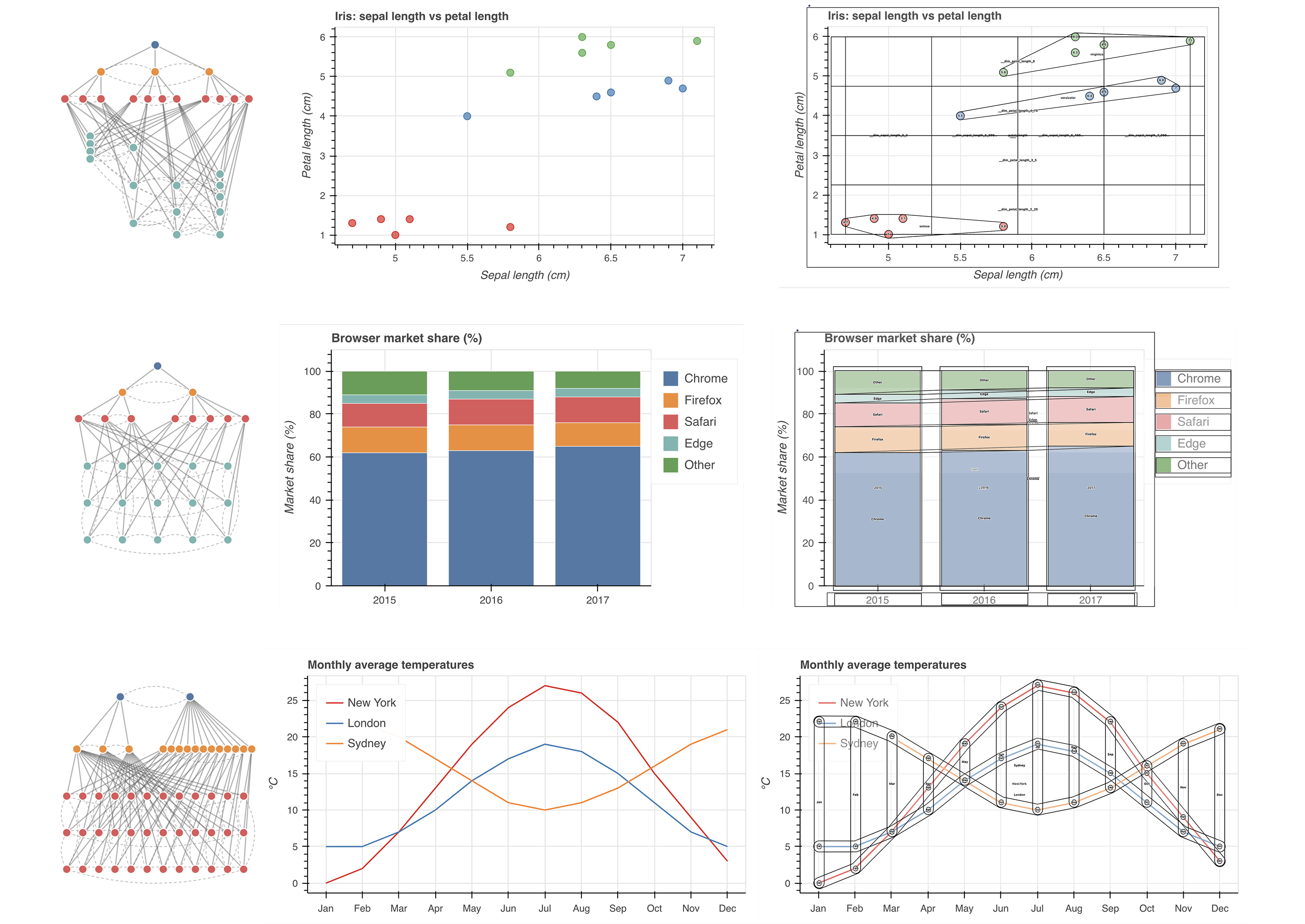
<p>This is where we had some fun ideas. Why not use another charting library to gain access to element location (by effectively replicating the user’s own visualization)? We can throw away the visualization we replicate after getting the location information we need, too. So this is just a temporary, deterministic calculation step. Visualizations all use the same fundamental math to translate a domain into a range. D3’s whole “scales” ecosystem exposes this. So, what if we just re-render a chart that mirrors the one the user started with? We did this, and it works beautifully (with one single caveat, below.)</p>

<p>For our “scaffolding engine” (as we call it), we used Vega. Vega exposes element location in their <em>view</em> model. We conjectured: what if we take input data from our users, get info about what type of visualization is rendered (or encodings used), and then not only can we automatically build a navigable structure but we could also automatically scaffold the locations of the elements in that structure!</p>

<figure style="display: block; width: 90%; margin-left: auto; margin-right: auto;">
    <img src="https://www.frank.computer/images/skeleton_scaffold.png" alt="A scatterplot, stacked bar, and line chart. Each has a graph next to it that shows nodes and edges. On the other side of each chart is a version of itself with grides, outlines, and marks that represent the various shapes and locations that the nodes and edges take over the chart's space." />
    <figcaption>Using our scaffold tool with 3 different charts. Left: the structure from our Inspector (what Data Navigator "sees"). Middle, the input chart (just made of pixels). And right, visual indicators placed over each element (all indicators are shown at once).</figcaption>
</figure>

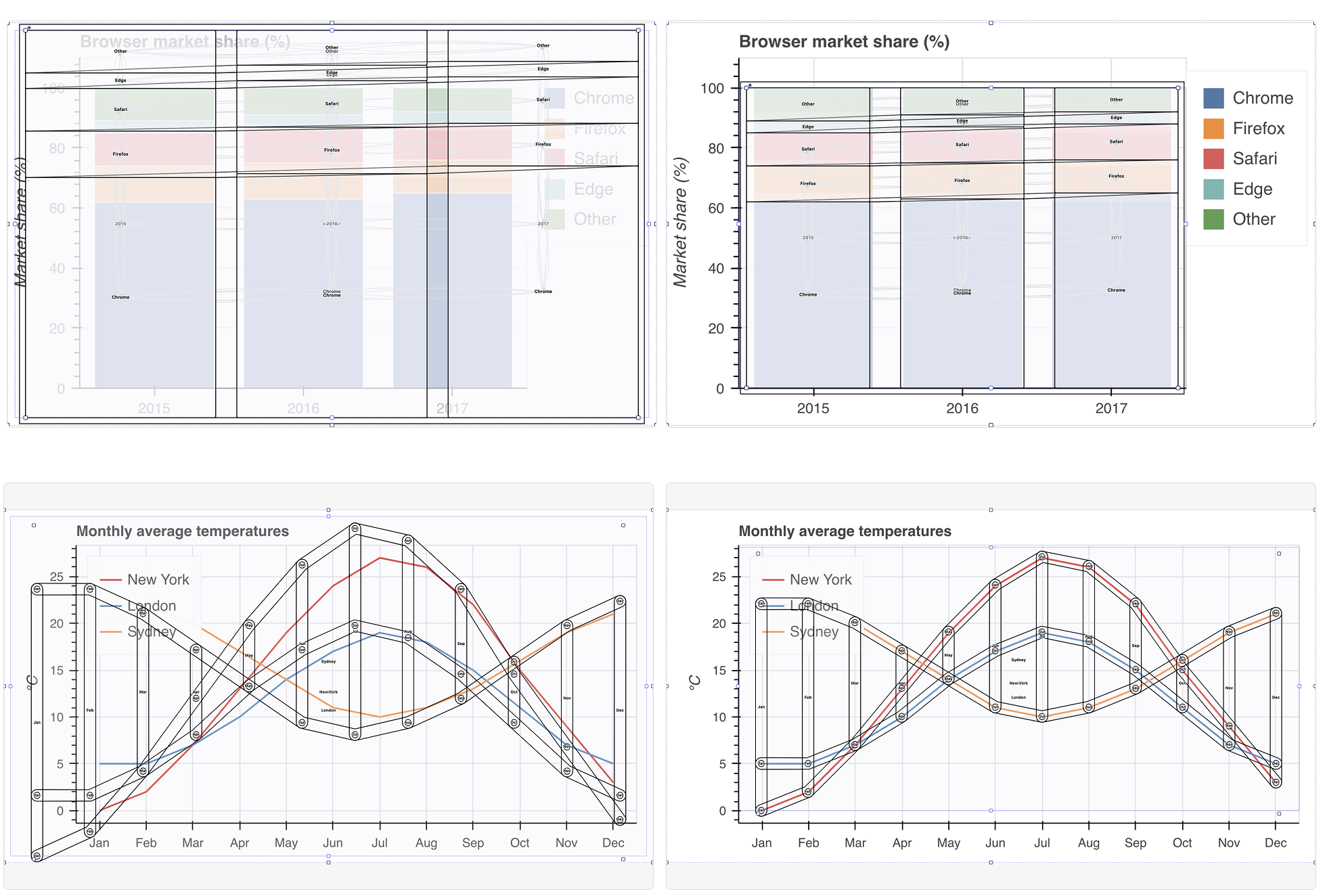
<p>Now, scaffolding isn’t actually all fun and games. We do a little bit of dark magic in order to get these outlines to fit properly. Namely, we really only used our scaffolding engine to extract mark locations, group information, and so on. We also need to solve for two other things, first: how to outline different <em>groups</em> of marks. And also: how to figure out exactly where the <em>mark space is rendered</em>. Visualization tools employ a lot of different opinions about how to pad around the mark area. Axis labels need to be considered, as well as other things like a legend, generic padding, subtitles, captions, and so on. We can’t assume that the cartesian coordinates for 0,0 on our mark space is relative to the 0,0 absolute position on our input chart!</p>

<p>For shapes and outline strategies, we simply built a generic library devoted to different geometric strategies (convex hulls with padding allowable, rect outlines, union of all child outlines, and so on).</p>

<p>For finding the padding, we do a little heuristic based (non-ml) computer vision pass, to estimate where the mark space begins. (For details about how we did this, simply see the appendix of <a href="https://arxiv.org/html/2607.14579v1#A2">our paper</a> or our <a href="https://github.com/cmudig/data-navigator/tree/main/packages/skeleton">open source code for skeleton</a>.)</p>

<figure style="display: block; width: 90%; margin-left: auto; margin-right: auto;">
    <img src="https://www.frank.computer/images/skeleton_padding.png" alt="Two visualizations, a stacked bar chart and line chart. Each visualization is shown twice, first with outlines overlaid that are slightly offset and then again with the outlines almost perfectly overlaid on the elements they represent." />
    <figcaption>Automatically computing visual congruence. First, computed layout for marks via Vega’s visualization engine plus group outlines (left) and then with with padding estimation using our non-ML computer vision approach (right) for various types of common visualizations. Average time to compute all outlines is 250ms (one time cost, up front).</figcaption>
</figure>

<h3 id="idea-3-what-if-you-could-test-navigation-without-even-using-specialized-tech-like-a-screen-reader">Idea 3: What if you could test navigation without even using specialized tech, like a screen reader?</h3>

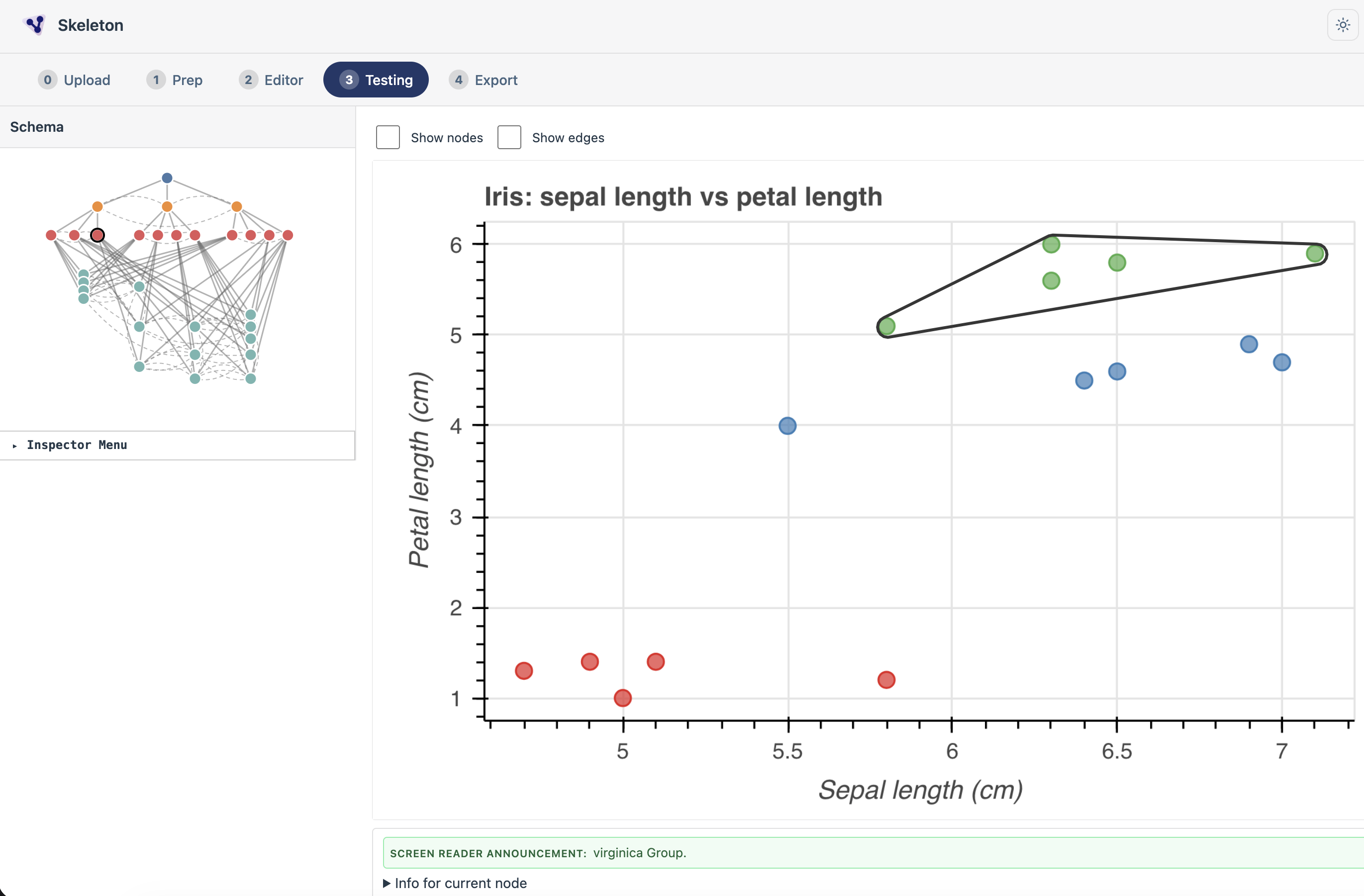
<p>Lastly, we wanted people to be able to immediately test their designs both functionally (does navigation operate as expected? do the correct relationships exist?) as well as visually (are elements in the correct location? are groups outlined in a reasonable way?) and non-visually (do the labels that are generated for a screen reader user make sense? can someone figure out how to explore this non-visually using our text and alt text alone?). And this became our testing page! No screen reader required. This page replicates chat based navigation (typing commands), keyboard nav, as well as screen reader nav (complete with visual previews of the otherwise-hidden alt text for each element).</p>

<figure style="display: block; width: 90%; margin-left: auto; margin-right: auto;">
    <img src="https://www.frank.computer/images/skeleton_testing.png" alt="An interface screenshot showing a scatterplot with a group outlined in a circular stroke shape. In the corresponding inspector view, a circle outline is shown over a node in a tree view of nodes and edges. At the bottom of the screen, a text box reads out Screen reader announcement: virginica group." />
    <figcaption>Our testing page. A visual focus indicator is shown over the chart space during navigation (center view) as well as where that node corresponds in the overall structure (shown as another focus indicator in the inspector, in the upper left). We also show screen reader labels as they would be read by a screen reader at the bottom of the testing view.</figcaption>
</figure>

<h2 id="our-study-and-findings">Our study and findings</h2>

<p>Honestly, you should read the paper for <em>all</em> the juicy details of our study. It was a blast. The study design was simple: we used our prototype for Skeleton as a “design probe” to surface qualitative insights about how people orient and reorient their work while trying to make visualizations accessible. We had users do a “test run” of the tool, where they tried to make a visualization accessible (and we intentionally included a bug fo them to possibly find). After the test run, we asked them to bring an image of a visualization they are currently or have recently worked on. At the end, we had an interview where we asked some semi-structured questions. All of our participants were visualization practitioners in some role (as engineers, designers, data scientists, or researchers).</p>

<p>Since Skeleton became the final proposed project in <a href="https://www.frank.computer/papers/2026-elavsky-dissertation.pdf">my thesis</a>, I also pontificate/reflect a bit on the chapter (chapter 6) in the thesis as well. My biggest takeaways are:</p>

<ol>
  <li>An improperly designed system can produce barriers for anyone, even people who are sighted. This means that sighted people need barriers removed and yes, even people without disabilities require our world to be accessible. “Accessibility is for everyone” has long been understood as this idea that everyone experiences situational limitations or temporary disability (or we all age into disability if we grow old enough). But in our paper, it is clear that “Accessibility is for everyone” also means that poorly designed software or a user who is trying to do work in a modality that is unfamiliar to them will require accessibility too.</li>
  <li>Making non-visual elements visual and directly manipulable shaped how sighted practitioners thought about the design problems. They stopped thinking as much about compliance or what was “required” and began to recognize that navigation is its own space of design consideration.</li>
  <li>Making non-visual elements visual, such as text read out to screen readers, led sighted practitioners to heavily iterate (independently! they were not asked to do this). They went back and forth, clearly thinking through the ideal, low-level details of a blind user’s experience navigating a data structure.</li>
  <li>Making non-visual elements visual, such as the paths and elements of a navigable structure, led sighted practitioners to heavily iterate and even reconsider their visual designs (their own charts and graphs), because they recognized the relationship between their visual design choices and the non-visual experiences that users would have.</li>
  <li>Making non-visual elements visual and directly manipulable actually influenced one practitioner to decide that navigation was a poor design choice for the specific, bespoke chart they had brought. They decided that navigation didn’t make sense for their chart and instead opted for non-design. (Really cool and surprising choice!)</li>
  <li>Ultimately, sighted practitioners think and reason about design in visual ways. And by making non-visual elements legible and interactive, we saw them re-prioritize and reconsider the design of non-visual user experiences. A step in a very interesting direction for future work and future accessibility tools!</li>
</ol>

<h2 id="whats-next">What’s next?</h2>

<p>Well, <strong>Skeleton</strong> the idea has been thoroughly tested. But <strong>Skeleton</strong> the prototype user interface has significant hurdles to overcome before it is really ready for public use. It is full of bugs and assumptions, the code is poorly optimized, and t lacks one of the most important features that will determine its success: exporting what you build with it. Right now, Skeleton let’s you import, prep, edit, and test. But you can’t export, so it is only useful as a design tool. Once we lock in on exporting functionality and build it out, it’ll become far more useful for most designers and developers. More to come!</p>]]></content><author><name></name></author><category term="visualization" /><category term="accessibility" /><category term="research" /><category term="IEEE VIS" /><category term="paper announcement" /><summary type="html"><![CDATA[My final research project looked at the barriers that sighted practitioners face when authoring non-visual data experiences. We co-designed, built tooling, built a UI prototype, and ran a study.]]></summary></entry><entry><title type="html">Final thesis complete and the three versions of ‘PhDone’</title><link href="https://www.frank.computer/blog/2026/07/three-phdones.html" rel="alternate" type="text/html" title="Final thesis complete and the three versions of ‘PhDone’" /><published>2026-07-12T00:00:00+00:00</published><updated>2026-07-12T00:00:00+00:00</updated><id>https://www.frank.computer/blog/2026/07/three-phdones</id><content type="html" xml:base="https://www.frank.computer/blog/2026/07/three-phdones.html"><![CDATA[<p>Well, it’s official: my thesis is finally accepted, published, and done. And this marks now my second of three milestones having been met for the PhD.</p>

<p>Before I unpack the three ways a PhD finishes, I want to link now to the <a href="http://reports-archive.adm.cs.cmu.edu/anon/hcii/CMU-HCII-26-103.pdf">archival version of my thesis which will live over at the Carnegie Libraries at this link</a>.</p>

<p>If you happen upon this blog post and haven’t seen my other one on, “<a href="https://www.frank.computer/blog/2026/04/who-reads-dissertations.html">Who actually reads a PhD dissertation?</a>” I also generate a bunch of versions of my thesis that are smaller and focused on certain audiences. It’s a good read and a fun chance to see how I chopped my thesis up for easier reading. Perhaps this will catch on?</p>

<p>But this short post will outline the three ways that a PhD is considered “complete” and moments where a person can consider themselves a PhD in something, officially or unofficially. I organize these three as: The Social, The Official, and the Ritual methods for being considered a PhD.</p>

<h2 id="on-the-social">On The Social</h2>

<p>When a PhD candidate is prepping for their dissertation, it is common to propose your thesis (which is often done as a talk) and then, after some time, the thesis is defended (also as a talk). The candidate is <em>socially</em> considered a PhD once they pass their defense.</p>

<p>For me, I had to <a href="https://www.frank.computer/blog/2026/04/defense-invite.html">defend my thesis publicly (which I invited folks to)</a>. I had many in attendance (maybe 100? more?). But often, a thesis defense is attended by just a small handful of people, plus the thesis committee (who are often on <em>offense</em>).</p>

<p>Passing the defense tends to result in folks announcing on social media, calling their mom, hosting a bbq, and so on. This is the moment that the rest of society sees a person as having achieved a PhD.</p>

<h2 id="on-the-official">On the Official</h2>

<p>But technically, a PhD is awarded by an institution. And this means that there is paperwork. And sometimes, like with me, I had some more work to do on my thesis before submitting it for institutional go ahead. This moment tends to be lackluster and unexciting, but it is when the actual PhD is awarded and the thesis document is published somewhere in an archival format.</p>

<p>Sometimes, this happens the same day as the defense. But in other cases, there have been stories I’ve heard where the official stuff took years. Sometimes people can even get jobs after their PhD “ends” and they are still working on their thesis document.</p>

<p>But at CMU and the HCII, I had the privilege to stay on stipend and get paid all the way up until the absolute final moments (when I need to start processing my paperwork for my next job as a professor at Cal Poly). So for us, I had the chance to polish my thesis, integrate my changes from my conditionally accepted chapter at IEEE VIS, and get a little extra pay for the 2+ months I was hanging around. I love that the day of the defense isn’t closely tied to the day the official paperwork goes through. It’s a great part of the way the system currently works.</p>

<h2 id="on-the-ritual">On the Ritual</h2>

<p>Now, the <em>coolest</em> part of the PhD is when you get “hooded” in your robes (and in places like Finland, you <a href="https://www.helsinki.fi/en/projects/conferment-ceremony-faculty-philosophy/sword-mightier-pen-doctoral-sword-finnish-curiosity">get an incredibly sick ceremonial sword and silk top hat</a>).</p>

<p>The hooding of a PhD is an ancient ritual and is when the PhD’s total journey is considered complete. However, due to the highly variable nature in which PhDs tend to be completed, it is common that a hooding takes place long after the social and official milestones are completed. For me, this will be the case.</p>

<p>I missed the deadline to be included in the PhD ceremonies at CMU by a few weeks (based on my defense) and a few months (based on my official documentation). But in my case, I am incredibly fortunate: CHI (our top research venue) is being hosted by CMU and others in Pittsburgh next year just about a week off from the time that the ceremony takes place. So I’ll be returning in June of 2027 to get my hood.</p>

<p>The hood is a fun part of the process, because you get a color that corresponds to where you got your PhD (mine has the CMU tartan pattern) in addition to a color based on your discipline. The color based on discipline tends to be regionally determined, and <a href="https://en.wikipedia.org/wiki/Academic_dress_in_the_United_States">in the United States, computer science is a philosophy degree</a>, meaning it is dark blue. <a href="https://en.wikipedia.org/wiki/Academic_dress">Dark blue elsewhere could refer to law</a> or something else.</p>

<p>But once these three milestones are met, there’s generally nothing else major worth noting. You’re PhDone three times out of three.</p>]]></content><author><name></name></author><category term="phd" /><category term="academia" /><category term="dissertation" /><summary type="html"><![CDATA[The journey towards a PhD has at least three possible endings, any of which are worth celebrating. I'll unpack those.]]></summary></entry><entry><title type="html">A selfish manifesto towards rejection of generative AI</title><link href="https://www.frank.computer/blog/2026/05/selfish-manifesto.html" rel="alternate" type="text/html" title="A selfish manifesto towards rejection of generative AI" /><published>2026-05-18T00:00:00+00:00</published><updated>2026-05-18T00:00:00+00:00</updated><id>https://www.frank.computer/blog/2026/05/selfish-manifesto</id><content type="html" xml:base="https://www.frank.computer/blog/2026/05/selfish-manifesto.html"><![CDATA[<p>I’ve heard great arguments for rejecting AI for environmental reasons (water, climate, energy) and for ethical reasons (like the theft of all digitizable intellectual property). I’ve even made those arguments myself (see previously linked blog post).</p>

<p>But I also want to suggest another angle that can be used in conjunction with these: rejecting genAI for selfish reasons.</p>

<p>For context, it is nearly the 1-year anniversary from when I authored my blog post on “<a href="https://www.frank.computer/blog/2025/05/just-a-tool.html">Stop saying that AI is just a tool and it only matters how it is used</a>”. It is easily the most successful blog post I’ve written and certainly gets more impressions than my research papers 😂. But I love it especially because it helped me form my own thoughts at a time when I felt like I was losing control of things (research budgets getting cut, anti-immigration on the rise, the impending deadline of my thesis work, future job insecurity, AI companies consolidating power across the world, facing irreversible climate disasters in my lifetime and so on).</p>

<p>Here is my small, humble manifesto for rejecting generative AI on selfish terms.</p>

<h2 id="1-defending-your-own-friction-your-own-struggle">1. Defending your own friction, your own struggle</h2>

<blockquote>
  <p>Hayao Miyazaki said it best, “if life’s hassles disappeared, you’d want them back.”</p>
</blockquote>

<p>But this is a meta-point, which the former blog itself makes: that struggling through writing is a miraculous task. And by doing it myself and not offloading my thoughts to a machine, I gained a new piece of myself that I appreciate. At a time when so much is out of my control, the ability to congeal a messy space of thinking into a structured set of thoughts brought a little order into the chaos of my life.</p>

<p>And writing isn’t just a “mirror” into your own thoughts. It is a vehicle for developing the skill of thinking and reasoning. It’s both a reflective and generative practice. You <em>create</em> thoughts through writing, not just invoke what is already in your brain. If more people who prompt their way through life realized this, we’d be taking back the frontiers of labor in our inner minds from AI companies.</p>

<h2 id="2-holding-precious-your-own-thought-making">2. Holding precious your own thought-making</h2>

<blockquote>
  <p>“What are you trying to be free of? The living? The miraculous task of it?” - Joseph Fasano</p>
</blockquote>

<p>I don’t care if a machine can think better than me. My thoughts are precious and being able to form them through writing and socializing with others currently has no equal practice. Prompting appears to give the benefits of both the writing and socializing at once, but it actually steals the benefits of doing both of these acts from us. This is because the part of these activities that matter, the friction that exists in writing and socializing, become <em>the</em> selling point of AI: it’s frictionless.</p>

<p>Anyway, best of luck to all of us as we navigate the new world we live in. We all now need to figure out which portion of our minds are worth delegating to machines on our behalf. What bits of difficulty do we want to keep in our lives, and what does it do for our sense of self?</p>

<p>One question I hold myself to is: if I wasn’t being paid to use my brain, would I still want to? And which things do I still enjoy thinking about?</p>

<p>Hullman writes that the enthusiastic pro-AI discourse strikes her as “<a href="https://statmodeling.stat.columbia.edu/2026/04/22/fraud-and-the-false-optimism-of-ai-for-science/">nihilism masquerading as optimism</a>.” And so it is worth asking ourselves: what part of our work should remain fundamentally human?</p>

<h2 id="3-focusing-on-your-own-need-for-joy-and-responsibility">3. Focusing on your own need for joy and responsibility</h2>

<p>Focusing less on tasks I can complete and the time it takes me, and more on what gives me joy to think about (even if it is hard) has been central to me. Secondary to this has been my sense of moral responsibility. Turns out, I value writing immensely. This means that generating code, a blog post, a poem, a work of fiction, a text to my wife, or even emails to coworkers are all things I’d rather do myself and have a sense of sole responsibility over.</p>

<p>I <a href="https://www.frank.computer/blog/2024/11/love-of-systems.html">enjoy deterministic systems</a>, for example. These give me a sense of self-interpretation. I can question my own thoughts when a deterministic machine fails: did I fail to construct language in the right way? Do I have assumptions about the problem or solution? But when interacting with a non-deterministic machine, like generative AI, instead I tend to focus on the machine’s own failure and randomness. I don’t gain a sense of absolute clarity in my own mind, just a fuzzy closeness that exists somewhere between my thoughts and an agent’s performance. I cannot imagine someone else holding me responsible for this fuzzy space, this broken and un-inspectable space. I enjoy sleeping at night knowing that I can be held accountable for the things I’ve chosen to do. But the things I’ve chosen to <a href="https://www.frank.computer/blog/2024/06/llms-and-thoughts.html">delegate or manage</a>? Perhaps those things failed because of my agent, “co-worker,” or minion-machine.</p>

<blockquote>
  <p>Perhaps we should start asking ourselves: what difficulty brings us joy, and what work do we want to remain responsible for?</p>
</blockquote>]]></content><author><name></name></author><category term="generative AI" /><category term="genAI" /><category term="selfish" /><category term="rejection" /><summary type="html"><![CDATA[It is completely acceptable to reject modern AI entirely on selfish grounds. Here I offer a 3-part mini-manifesto focused on why, entirely for yourself, you should consider rejecting generative AI.]]></summary></entry><entry><title type="html">Who actually reads a PhD dissertation?</title><link href="https://www.frank.computer/blog/2026/04/who-reads-dissertations.html" rel="alternate" type="text/html" title="Who actually reads a PhD dissertation?" /><published>2026-04-20T00:00:00+00:00</published><updated>2026-04-20T00:00:00+00:00</updated><id>https://www.frank.computer/blog/2026/04/who-reads-dissertations</id><content type="html" xml:base="https://www.frank.computer/blog/2026/04/who-reads-dissertations.html"><![CDATA[<blockquote>
  <p>[<strong>EDIT: 07/2026</strong>] This blog post was originally written when I first submitted my thesis for review with my committee, prior to my defense. But now, the final draft is available. All of the links below have been updated to point to the newest version of each doc (you may need to hard-refresh the page to get the newest version, in case the old one is stored in your browser cache). I am very happy with the latest draft - it is a significant improvement over the original, which was mostly a staple-job thesis in the purest sense (this now really expands several chapters and also adds a preface and postface reflection to each). I’ve also added a real, proper conclusion section as well. Exciting! Hope you enjoy and thanks to those of you who read the earlier draft and gave feedback. I really appreciate it.
Also note: the <a href="https://www.frank.computer/papers/2026-elavsky-dissertation.pdf">main thesis doc (linked here)</a> is tagged for accessibility. The others are auto-generated in python, so their accessibility is limited. Apologies for the technical limitations! And for anyone else interested, my <a href="https://github.com/frankelavsky/thesis_subdoc_generator">code for generating the subdocs for my thesis can be found here</a>.</p>
</blockquote>

<p>Well, howdy! This blog post is mostly just a fun adventure/experiment where I try to make it easier to read and engage with academic work, simply by altering the format.</p>

<p>This core idea was already the focus on my <a href="https://www.frank.computer/micro-paper">micro-paper project</a>, where I mused: is there a place for 1-2 page micro-papers in our larger academic conversation? I am conjecturing that smaller pieces of an idea, or smaller units of information, might get broader or qualitatively different engagement than longer-form, archival, written media.</p>

<p>And the opening question of this blog post: “who actually reads a PhD dissertation?” is largely answered with, “nobody except the committee.”</p>

<p>But even so… committee members don’t often even need to read the whole dissertation itself. For mine, <a href="https://www.frank.computer/papers/2026-thesis-committee_preview.pdf">this document (24 pages)</a> is really what my committee needs to focus the most on. They’ve all probably already read or are familiar with my main research projects. What they care about is how it all comes together (so basically the beginning and end parts of the document).</p>

<p>So if committee members aren’t reading the whole thing and basically nobody else does (because these things are sometimes 200 pages long), then <em>what the heck is the point of a thesis</em>? The point, of course, is to have an archival-quality record of the work and the defense made by the PhD candidate. The primary purpose of publishing a dissertation is just to show to the world that the work was done.</p>

<!-- On the one hand, do people avoid dissertations because they are highly complex? Well, perhaps. But some people are working on highly complex topics! And so... do some people avoid dissertations because they open the document and see that it is nearly 200 pages long, which would represent a significant time investment if you were there to explore, learn, or find something? -->

<p>Yet, I reckon that many different parts of the thesis are actually valuable and interesting to folks who aren’t academics or who are but are unfamiliar with my body of work. I have been stewing on a paper by Mohammadi et al, <a href="https://doi.org/10.1002/asi.23286">“Who reads
research articles?”</a> and it turns out that all kinds of people do. So then I wondered… is there a way to make my thesis more-digestible for different kinds of folks?</p>

<p>That led me to the following: <strong>What if I could generate a bunch of smaller docs from my thesis, based on assumptions I have about different kinds of readers?</strong> Would this simple change of format make my thesis more accessible and more usable? (It’s important for me to think about accessibility, after all!)</p>

<h2 id="so-what-is-my-dissertation-and-what-is-it-actually-about">So what is my dissertation and what is it actually about?</h2>

<p>My thesis is titled, <strong>Tool-making as an intervention on the accessibility of interactive data experiences</strong>. I specifically study how <em>tool-making</em> is a site for generating knowledge about how people engage with difficult practical problems. I make tools and then use those tools as a probe to understand more about authors, creators, and users of data experiences.</p>

<p>My core argument (the “thesis statement” at the heart of the dissertation) is this: “This dissertation argues that the tools practitioners use to build interactive data experiences are themselves sites where accessibility barriers are produced, prevented, or alleviated for both end users and authors. This work contributes fve tools, Chartability, Data Navigator, Skeleton, Cross-perception, and Softerware, that collectively center accessibility work on the empowerment of disabled and non-disabled practitioners across the full arc of evaluation, data navigation, analytical interaction, and personalization.”</p>

<p>My work is interesting primarily because I argue that the work practitioners do is a rich site for research. I don’t just make a proverbial “hammer” but study what sort of hammers we need, whether hammers really work, and then how people actually use them. (<a href="https://www.frank.computer/papers/2026-elavsky-dissertation.pdf">You can find the whole thesis here</a>.)</p>

<p>Well, perhaps my dissertation has piqued your interest a little? And perhaps you don’t know where to start? Well look below, and perhaps one of these categories applies to you and your interests or experiences.</p>

<p>(Below is a series of sections/subsections taken from a <a href="https://www.frank.computer/blog/2026/04/defense-invite.html">previous blog post announcing my thesis defense</a>, which of course you are welcome to attend at noon EDT on April 29th, 2026. So, please feel free to see if any of the documents are actually interesting/useful to you, especially if you fit one of the descriptions of my assumed readership below:)</p>

<h2 id="should-you-read-my-dissertation">Should <em>you</em> read my dissertation?</h2>

<p>I <em>highly</em> doubt it! But that being said, there are some pretty fun parts in it, worth a skim (depending on who you are). For the most part, my dissertation is a “stapled paper” type of thesis, where the bulk of the document is comprised of my top-papers (that are the projects I personally led and executed) inserted without editing as the main “body” chapters of the dissertation. Then, the thesis itself generally has (up front) an acknowledgements section, introduction, overview of contributions, and (at the end) some kind of summary/discussion as well as a biographical sketch.</p>

<blockquote>
  <p>🤓 📚➟📖
I’ve generated miniature versions of my thesis document, to make reading easier! The basic document has 180 pages of content (248 pages total). That’s a lot! But I wondered… would more people actually look at my thesis if the page count wasn’t so intimidating? (See below sections for these mini-docs.)</p>
</blockquote>

<p><a href="https://www.frank.computer/papers/2026-elavsky-dissertation.pdf">Here is the link to the thesis itself</a>.</p>

<p>That being said, many folks may want to check out one or some of the sections in the dissertation without having to read all of it. So here are some suggested readings for folks I know who are of different kinds:</p>

<h3 id="1-anyone-who-attends-my-thesis-defense">1. Anyone who attends my thesis defense</h3>

<blockquote>
  <p><a href="https://www.frank.computer/papers/2026-thesis-personal.pdf">Download my “personal-only” thesis doc!</a>
📚 (180 pages) ➟ 📖 (<strong>6 pages</strong>)</p>
</blockquote>

<p>Anyone who attends my thesis defense should probably check out my <strong>acknowledgements</strong> section. You’re probably in there! If you aren’t but think you should be, let me know!! I am terribly forgetful and would hate to leave out a friend, colleague, or supporter.</p>

<p>It also might be worth it to skim my <strong>biographical sketch</strong>, especially because the introduction to it pokes fun at many other bio sketches where people love to point out their origins as a genius child in high school who then ascended to harvard/MIT/etc; brilliant because of their own individual genius, of course. By contrast, I have largely been an unremarkable and unaccomplished person. I was a terrible student in high school and mostly didn’t “deserve” or earn the opportunities I had in life. And yet I did remarkable things regardless, mostly thanks to all the folks who have helped me out over the years. I hope my biography is a testament to the power of social support and that I have never really been a “main character” in my life. (Note that my own advisor joked that he wished he had paid more attention to my PhD application, because my undergraduate closed and I did poorly in high school. I probably shouldn’t have been admitted to CMU, haha. He is <em>certainly</em> from a “real” academic and technical pedigree; he would know!)</p>

<h3 id="2-you-are-a-technical-practitioner-of-some-kind-non-researcher">2. You are a technical practitioner of some kind (non-researcher)</h3>

<blockquote>
  <p><a href="https://www.frank.computer/papers/2026-thesis-toolmaker.pdf">Download my “for the toolmakers” thesis doc!</a>
📚 (180 pages) ➟ 📖 (<strong>12 pages</strong>)</p>
</blockquote>

<p>I’d recommend that anyone technical (whether a designer or developer) checks out <strong>1.2</strong>, <strong>9.1</strong>, and <strong>9.3</strong>. Pretty much everyone who works with “tools” (including AI/genAI/LLM/ML tools) should check those out (as well as my <a href="https://www.frank.computer/blog/2025/05/just-a-tool.html">blog post on tools</a>.)</p>

<h4 id="you-are-specifically-an-accessibility-practitioner">You are specifically an accessibility practitioner</h4>

<blockquote>
  <p><a href="https://www.frank.computer/papers/2026-thesis-accessibility.pdf">Download my “accessibility practitioner” thesis doc!</a>
📚 (180 pages) ➟ 📖 (<strong>69 pages</strong>)</p>
</blockquote>

<p>Definitely read 1.1 of the introduction because it has a way of thinking about accessibility work that <em>everyone</em> doing <em>any</em> accessibility work should consider: <strong>is “accessible visualization” really an oxymoron?</strong></p>

<p>I think that academic papers can be awkward to suggest, but I genuinely think that if you check out any main chapter, you should read the one on <strong>skeleton</strong>, since it is about making accessibility work more accessible for <em>sighted</em> practitioners. A lot of accessibility work is (ironically) inaccessible! We should change that. <strong>Chartability</strong> is another good read along those lines, too.</p>

<h4 id="you-are-specifically-a-visualization-practitioner">You are specifically a visualization practitioner</h4>

<blockquote>
  <p><a href="https://www.frank.computer/papers/2026-thesis-visualization.pdf">Download my “visualization practitioner” thesis doc!</a>
📚 (180 pages) ➟ 📖 (<strong>66 pages</strong>)</p>
</blockquote>

<p>Absolutely read 1.1 of the introduction: <strong>is “accessible visualization” really an oxymoron?</strong> I wrote that with visualization folks in mind. There have been some tricky, even subtle ableism in our field that I wanted to clear up before outlining my work. The part where I engage misconceptions about accessibility is worth reflecting on as well as the part where I outline what visualization is actually about.</p>

<p>I think that academic papers can be awkward to suggest, but I genuinely think that if you check out any main chapter, you should read the one on <strong>skeleton</strong>, since it is about making accessibility work more accessible for <em>sighted</em> practitioners. Chances are: that’s you. I also think that <strong>softerware</strong> should be a chapter that anyone who builds or designs visualization <em>systems</em> and <em>tools</em> should think about: how do you enable end user personalization?</p>

<h3 id="3-you-are-an-hcihaivisualizationaccessibilitytools-researcher-of-some-kind">3. You are an HCI/HAI/visualization/accessibility/”tools” researcher of some kind</h3>

<blockquote>
  <p><a href="https://www.frank.computer/papers/2026-thesis-researcher.pdf">Download my “summarized for researchers” thesis doc!</a>
📚 (180 pages) ➟ 📖 (<strong>10 pages</strong>)</p>
</blockquote>

<p>All researchers will probably benefit from at least reading chapter 3 (my <strong>overview of contributions</strong>) and my final section, <strong>who is responsible for repair?</strong> Read those in addition to any subsection below that applies to you:</p>

<h4 id="you-are-an-accessibility-researcher">You are an accessibility researcher</h4>

<blockquote>
  <p><a href="https://www.frank.computer/papers/2026-thesis-accessibility_researcher.pdf">Download my “accessibility researchers” thesis doc!</a>
📚 (180 pages) ➟ 📖 (<strong>27 pages</strong>)</p>
</blockquote>

<p>I think the introduction (<strong>sections 1.1 and 1.2</strong>) as well as the conclusion’s sections on <strong>what is a tool? (9.1)</strong> and <strong>applied accessibility research (9.2)</strong> are especially valuable, and hopefully provocative. I’ve done a good job if a few people from the ASSETS community are flustered about 9.2, in particular.</p>

<blockquote>
  <p><a href="https://www.frank.computer/papers/2026-thesis-accessibility_researcher_practitioner.pdf">Download my “accessibility researchers who care about practitioners” thesis doc!</a>
📚 (180 pages) ➟ 📖 (<strong>143 pages</strong>)</p>
</blockquote>

<p>You might want to do more practitioner-focused work (or have an interest in this), in which case I’d recommend <strong>skeleton</strong>, <strong>chartability</strong>, and <strong>softerware</strong> especially. Read <strong>data-navigator</strong> if you want to get mad that I didn’t run a user study to validate our system (challenge mode: think about whether this kind of work is valuable or not in/for accessibility research as a broader discussion).</p>

<h4 id="you-are-a-visualization-researcher">You are a visualization researcher</h4>

<blockquote>
  <p><a href="https://www.frank.computer/papers/2026-thesis-visualization_researcher.pdf">Download my “summary for visualization researchers” thesis doc!</a>
📚 (180 pages) ➟ 📖 (<strong>26 pages</strong>)</p>
</blockquote>

<p>Absolutely read 1.1 of the introduction: <strong>is “accessible visualization” really an oxymoron?</strong> I wrote that with visualization folks in mind. There have been some tricky, even subtle ableism in our field that I wanted to clear up before outlining my work. The part where I engage misconceptions about accessibility is worth reflecting on as well as the part where I outline what visualization is actually about.</p>

<p>But “visualization researcher” is a funny categorization to me. Visualization research has cognitive and perceptual scientists (our “real” science-doers), feminist and critical theorists, ethicists, interaction designers, system-builders, graphic designers, data people, and applied researchers. My thesis is mostly written from the perspective of system-building and a little bit of interaction design.</p>

<h5 id="cognitiveperception-vis-researchers">Cognitive/perception vis researchers</h5>

<blockquote>
  <p><a href="https://www.frank.computer/papers/2026-thesis-visualization_researcher_perception_interaction.pdf">Download my “perception+vis” thesis doc!</a>
📚 (180 pages) ➟ 📖 (<strong>53 pages</strong>)</p>
</blockquote>

<p>If you’re into cognitive and perceptual science, you’ll probably get little of value from this thesis (perhaps other than just to reflect on someone else’s very different methods: building systems and doing mostly qualitative work). You might enjoy <strong>cross-perception</strong>, but I have a feeling it is too technically-focused to really pique the interest of a “pure” cog/perceptual scientist.</p>

<h5 id="criticalethicshumanities-vis-researchers">Critical/ethics/humanities vis researchers</h5>

<blockquote>
  <p><a href="https://www.frank.computer/papers/2026-thesis-sexy_murder_poet.pdf">Download my “sexy murder poet” thesis doc!</a>
📚 (180 pages) ➟ 📖 (<strong>32 pages</strong>)</p>
</blockquote>

<p>That being said, the slightly-more-critical parts of my dissertation (which I enjoy the most) are found in the <strong>introduction (1.1/1.2)</strong> and <strong>discussion sections (9.1-9.3)</strong>. That might be good for the critical folks, theorists, ethicists, humanities-oriented researchers, and proper “<a href="https://philpapers.org/archive/BRITT-2.pdf">sexy murder poets</a>” of the field to check out.</p>

<h5 id="systemstools-for-vis-research">Systems/tools for vis research</h5>

<blockquote>
  <p><a href="https://www.frank.computer/papers/2026-thesis-visualization_researcher_systems.pdf">Download my “systems+vis” thesis doc!</a>
📚 (180 pages) ➟ 📖 (<strong>113 pages</strong>)</p>
</blockquote>

<p>System-builders might get value from reading <strong>data navigator</strong>, <strong>skeleton</strong>, and <strong>softerware</strong>. Maybe the whole thesis, too, to be honest. I’m this kind of researcher, so it’s all generally written with myself in mind.</p>

<h5 id="data-focused-vis-researchers">Data-focused vis researchers</h5>

<blockquote>
  <p><a href="https://www.frank.computer/papers/2026-thesis-visualization_researcher_data.pdf">Download my “data structures+vis” thesis doc!</a>
📚 (180 pages) ➟ 📖 (<strong>57 pages</strong>)</p>
</blockquote>

<p>Data people might really love <strong>data navigator</strong>, specifically if you enjoy data structures and graph theory. It’s graph theory, but for an HCI/systems/UI software problem!</p>

<h5 id="interaction-and-input-design-vis-researchers">Interaction and input design vis researchers</h5>

<blockquote>
  <p><a href="https://www.frank.computer/papers/2026-thesis-visualization_researcher_perception_interaction.pdf">Download my “interaction+vis” thesis doc!</a>
📚 (180 pages) ➟ 📖 (<strong>53 pages</strong>)</p>
</blockquote>

<p>Interaction design researchers might really enjoy the hardware work I did in <strong>cross-perception</strong>. You folks love when electronics and hardware work sneaks in. And some of our field’s existing hardware work actually has potential for accessibility work!</p>

<h5 id="graphical-design-vis-researchers">Graphical design vis researchers</h5>

<blockquote>
  <p><a href="https://www.frank.computer/papers/2026-thesis-visualization_researcher_graphic.pdf">Download my “design+vis” thesis doc!</a>
📚 (180 pages) ➟ 📖 (<strong>85 pages</strong>)</p>
</blockquote>

<p>Purely graphic designers should probably check out <strong>chartability</strong>, to apply to your own work. <strong>Skeleton</strong> isn’t a bad chapter either, since the whole idea is that we apply visualization to an accessibility problem.</p>

<h5 id="practitionerapplied-vis-researchers">Practitioner/applied vis researchers</h5>

<blockquote>
  <p><a href="https://www.frank.computer/papers/2026-thesis-visualization_applied_practitioner.pdf">Download my “practitioners+vis” thesis doc!</a>
📚 (180 pages) ➟ 📖 (<strong>106 pages</strong>)</p>
</blockquote>

<p>And folks who work with practitioners at all (in applied contexts) will probably enjoy <strong>chartability</strong>, <strong>softerware</strong>, and <strong>skeleton</strong>, in particular.</p>

<h4 id="you-are-a-visualization-and-accessibility-researcher">You are a visualization <em>and</em> accessibility researcher</h4>

<blockquote>
  <p><a href="https://www.frank.computer/papers/2026-thesis-visualization_accessibility.pdf">Download my “accessibility+vis (latest-only)” thesis doc!</a>
📚 (180 pages) ➟ 📖 (<strong>92 pages</strong>)</p>
</blockquote>

<p>You probably know my work from the main chapters (my 5 papers), but you can skim them if you want. There are some exciting new pieces in there too, that I have recently submitted for publication. You might find chapters 6 (<strong>skeleton</strong>) and 7 (<strong>cross-perception</strong>) the most interesting, as they are my latest pieces. You might also benefit from at least skimming my introduction section 1.1: <strong>is “accessible visualization” really an oxymoron?</strong></p>

<p>I’m tempted to say you should just read the whole thesis though. You’re probably among the two dozen people in the world at our intersection and if you aren’t familiar with my work or why I do it, then it’s certainly going to be enlightening as a reflection on your own work.</p>]]></content><author><name></name></author><category term="phd" /><category term="academia" /><category term="dissertation" /><category term="visualization" /><category term="accessibility" /><summary type="html"><![CDATA[(Think of this as a small experiment of sorts.)]]></summary></entry><entry><title type="html">You’re welcome to attend my thesis defense!</title><link href="https://www.frank.computer/blog/2026/04/defense-invite.html" rel="alternate" type="text/html" title="You’re welcome to attend my thesis defense!" /><published>2026-04-09T00:00:00+00:00</published><updated>2026-04-09T00:00:00+00:00</updated><id>https://www.frank.computer/blog/2026/04/defense-invite</id><content type="html" xml:base="https://www.frank.computer/blog/2026/04/defense-invite.html"><![CDATA[<p>Greetings! This is an invite to attend my thesis defense, which is a public, hybrid-friendly event. This event will not be recorded.</p>

<h2 id="details">Details</h2>
<p>April 29th, 2026 at 12pm noon Eastern Time</p>

<p>In person (NSH 4305) as well as on zoom (zoom info in calendar link below).</p>

<p>There will, of course, be refreshments and snacks at the event. Please feel free to invite others whom you believe might be interested in attending.</p>

<p>You may <a href="https://calendar.google.com/calendar/event?action=TEMPLATE&amp;tmeid=N2I5dGI0YTZtOHAwbXYxc3VqcXV0aDA2OGIgZmplQGFuZHJldy5jbXUuZWR1&amp;tmsrc=fje%40andrew.cmu.edu">add this event to your calendar using this link</a>.</p>

<blockquote>
  <p>If the google calendar link above doesn’t work, <a href="mailto:fje@cmu.edu">shoot me an email at fje@cmu.edu</a> and I’ll send you the details!</p>
</blockquote>

<blockquote class="warning">
    <p>⚠ <b>NOTE</b>:</p>
    <p>Woah there folks! I guess google calendar has a limited number of people who can sign up to a calendar event. Use this zoom URL (intentionally not encoded as a link, to avoid bots) to join at noon EDT on April 29th:</p>
    <p><code>https://cmu[DOT]zoom[DOT]us/j/2252051674?pwd=IWCIYbg6Y9cCKb9yMWc1K4eLUxOKHI.1&amp;omn=96096322845&amp;jst=2</code>.</p>
    <p>(Replace [DOT] with . in that link text, of course.)</p>
</blockquote>

<p>The talk is expected to be 45-50 minutes, followed by anywhere between 15 and 30 minutes of questions. We will likely start a couple minutes after the hour (turns out many wizards are, in fact, often late). You’re welcome to attend any part of the event that interests you.</p>

<p>My thesis is titled, “Tool-making as an intervention on the accessibility of interactive data experiences” and focuses on my research studying tools at the intersection of data visualization and accessibility.</p>

<h2 id="my-committee">My committee</h2>

<p>(This is my council of wizards, who will decide my fate. They are some of the most powerful wielders of magic in the world, in their respective disciplines!)</p>

<ul>
  <li><a href="https://www.domoritz.de/">Dominik Moritz</a>, Chair, Assistant Professor at CMU HCII</li>
  <li><a href="https://patrickcarrington.com/">Patrick Carrington</a>, Co-chair, Assistant Professor at CMU HCII</li>
  <li><a href="https://www.thecoalalab.com/kenholstein">Kenneth Holstein</a>, Assistant Professor at CMU HCII</li>
  <li><a href="https://make4all.org/portfolio/jennifer-mankoff/">Jennifer Mankoff</a>, Professor at University of Washington</li>
  <li><a href="https://www.cs.ubc.ca/~tmm/">Tamara Munzner</a>, Professor at University of British Columbia</li>
</ul>

<h2 id="dissertation-document">Dissertation Document</h2>

<p>The <a href="https://drive.google.com/file/d/1D1HJZxIsZyjj0PCxsSN8aFUKSuWR4r3t/view?usp=drive_link">dissertation draft is stored at this link</a>.</p>

<h2 id="what-is-a-thesis-defense">What is a “thesis defense?”</h2>
<p>This is a mystical event where a council of wizards decide if I am worthy of ascending to wizardhood myself. The process is relatively simple: I give an oral defense (a talk) regarding the contents of my dissertation, which is a document that represents the research journey I have taken during my PhD. At the end, the council (my “committee”) interrogates me with some questions, and then we open the floor for questions from anyone in attendance. After that, the public part of the event concludes (everyone is kicked out, including me) and the council makes their final decision. At the end, they let me know what they’ve decided. If they decide that I pass my defense, this is generally considered the point where I complete my PhD and become Dr. Frank, the Wizard 🎉 (we technically still have paperwork to do, but that is for the mystical bureaucracy).</p>

<h2 id="should-you-attend">Should you attend?</h2>
<p>Hah! Have you been to one before? It’s a proper, ancient ritual. It can be neat to see a thesis defense at least once in your life. Will I get fried by a high level spell? Which magic will I choose to defend myself with? You won’t know unless you attend! But if you’ve been to several thesis defenses before, or you have no interest in the business of wizards, then you’re absolutely welcome to skip.</p>

<h2 id="what-is-the-thesis-about">What is the thesis about?</h2>
<p>My core argument (the “thesis statement” at the heart of the dissertation) is this: “This dissertation argues that the tools practitioners use to build interactive data experiences are themselves sites where accessibility barriers are produced, prevented, or alleviated for both end users and authors. This work contributes five tools—Chartability, Data Navigator, Softerware, Cross-perception, and Skeleton—that collectively center accessibility work on the empowerment of disabled and non-disabled practitioners across the full arc of evaluation, data navigation, analytical interaction, and personalization.” My work is interesting primarily because I argue that the work practitioners do is a rich site for research. I don’t just make a proverbial “hammer” but study what sort of hammers we need, whether hammers really work, and then how people actually use them.</p>

<h2 id="should-you-read-my-dissertation">Should <em>you</em> read my dissertation?</h2>

<p>I <em>highly</em> doubt it! But that being said, there are some pretty fun parts in it, worth a skim (depending on who you are). For the most part, my dissertation is a “stapled paper” type of thesis, where the bulk of the document is comprised of my top-papers (that are the projects I personally led and executed) inserted without editing as the main “body” chapters of the dissertation. Then, the thesis itself generally has (up front) an acknowledgements section, introduction, overview of contributions, and (at the end) some kind of summary/discussion as well as a biographical sketch.</p>

<blockquote>
  <p>🤓 📚➟📖
I’ve generated miniature versions of my thesis document, to make reading easier! The basic document has 142 pages of content. That’s a lot! But I wondered… would more people actually look at my thesis if the page count wasn’t so intimidating? (See below sections for these mini-docs.)</p>
</blockquote>

<p><a href="https://drive.google.com/file/d/1D1HJZxIsZyjj0PCxsSN8aFUKSuWR4r3t/view?usp=drive_link">Here is the link to the thesis itself</a>.</p>

<p>That being said, many folks may want to check out one or some of the sections in the dissertation without having to read all of it. So here are some suggested readings for folks I know who are of different kinds:</p>

<h3 id="1-anyone-who-attends-my-thesis-defense">1. Anyone who attends my thesis defense</h3>

<blockquote>
  <p><a href="https://www.frank.computer/papers/2026-thesis-personal.pdf">Download my “personal-only” thesis doc!</a>
📚 (142 pages) ➟ 📖 (<strong>6 pages</strong>)</p>
</blockquote>

<p>Anyone who attends my thesis defense should probably check out my <strong>acknowledgements</strong> section. You’re probably in there! If you aren’t but think you should be, let me know!! I am terribly forgetful and would hate to leave out a friend, colleague, or supporter.</p>

<p>It also might be worth it to skim my <strong>biographical sketch</strong>, especially because the introduction to it pokes fun at many other bio sketches where people love to point out their origins as a genius child in high school who then ascended to harvard/MIT/etc; brilliant because of their own individual genius, of course. By contrast, I have largely been an unremarkable and unaccomplished person. I was a terrible student in high school and mostly didn’t “deserve” or earn the opportunities I had in life. And yet I did remarkable things regardless, mostly thanks to all the folks who have helped me out over the years. I hope my biography is a testament to the power of social support and that I have never really been a “main character” in my life. (Note that my own advisor joked that he wished he had paid more attention to my PhD application, because my undergraduate closed and I did poorly in high school. I probably shouldn’t have been admitted to CMU, haha. He is <em>certainly</em> from a “real” academic and technical pedigree; he would know!)</p>

<h3 id="2-you-are-a-technical-practitioner-of-some-kind-non-researcher">2. You are a technical practitioner of some kind (non-researcher)</h3>

<blockquote>
  <p><a href="https://www.frank.computer/papers/2026-thesis-toolmaker.pdf">Download my “for the toolmakers” thesis doc!</a>
📚 (142 pages) ➟ 📖 (<strong>7 pages</strong>)</p>
</blockquote>

<p>I’d recommend that anyone technical (whether a designer or developer) checks out <strong>1.2</strong>, <strong>9.1</strong>, and <strong>9.3</strong>. Pretty much everyone who works with “tools” (including AI/genAI/LLM/ML tools) should check those out (as well as my <a href="https://www.frank.computer/blog/2025/05/just-a-tool.html">blog post on tools</a>.)</p>

<h4 id="you-are-specifically-an-accessibility-practitioner">You are specifically an accessibility practitioner</h4>

<blockquote>
  <p><a href="https://www.frank.computer/papers/2026-thesis-accessibility.pdf">Download my “accessibility practitioner” thesis doc!</a>
📚 (142 pages) ➟ 📖 (<strong>50 pages</strong>)</p>
</blockquote>

<p>Definitely read 1.1 of the introduction because it has a way of thinking about accessibility work that <em>everyone</em> doing <em>any</em> accessibility work should consider: <strong>is “accessible visualization” really an oxymoron?</strong></p>

<p>I think that academic papers can be awkward to suggest, but I genuinely think that if you check out any main chapter, you should read the one on <strong>skeleton</strong>, since it is about making accessibility work more accessible for <em>sighted</em> practitioners. A lot of accessibility work is (ironically) inaccessible! We should change that. <strong>Chartability</strong> is another good read along those lines, too.</p>

<h4 id="you-are-specifically-a-visualization-practitioner">You are specifically a visualization practitioner</h4>

<blockquote>
  <p><a href="https://www.frank.computer/papers/2026-thesis-visualization.pdf">Download my “visualization practitioner” thesis doc!</a>
📚 (142 pages) ➟ 📖 (<strong>46 pages</strong>)</p>
</blockquote>

<p>Absolutely read 1.1 of the introduction: <strong>is “accessible visualization” really an oxymoron?</strong> I wrote that with visualization folks in mind. There have been some tricky, even subtle ableism in our field that I wanted to clear up before outlining my work. The part where I engage misconceptions about accessibility is worth reflecting on as well as the part where I outline what visualization is actually about.</p>

<p>I think that academic papers can be awkward to suggest, but I genuinely think that if you check out any main chapter, you should read the one on <strong>skeleton</strong>, since it is about making accessibility work more accessible for <em>sighted</em> practitioners. Chances are: that’s you. I also think that <strong>softerware</strong> should be a chapter that anyone who builds or designs visualization <em>systems</em> and <em>tools</em> should think about: how do you enable end user personalization?</p>

<h3 id="3-you-are-an-hcihaivisualizationaccessibilitytools-researcher-of-some-kind">3. You are an HCI/HAI/visualization/accessibility/”tools” researcher of some kind</h3>

<blockquote>
  <p><a href="https://www.frank.computer/papers/2026-thesis-researcher.pdf">Download my “summarized for researchers” thesis doc!</a>
📚 (142 pages) ➟ 📖 (<strong>7 pages</strong>)</p>
</blockquote>

<p>All researchers will probably benefit from at least reading chapter 3 (my <strong>overview of contributions</strong>) and my final section, <strong>who is responsible for repair?</strong> Read those in addition to any subsection below that applies to you:</p>

<h4 id="you-are-an-accessibility-researcher">You are an accessibility researcher</h4>

<blockquote>
  <p><a href="https://www.frank.computer/papers/2026-thesis-accessibility_researcher.pdf">Download my “accessibility researchers” thesis doc!</a>
📚 (142 pages) ➟ 📖 (<strong>16 pages</strong>)</p>
</blockquote>

<p>I think the introduction (<strong>sections 1.1 and 1.2</strong>) as well as the conclusion’s sections on <strong>what is a tool? (9.1)</strong> and <strong>applied accessibility research (9.2)</strong> are especially valuable, and hopefully provocative. I’ve done a good job if a few people from the ASSETS community are flustered about 9.2, in particular.</p>

<blockquote>
  <p><a href="https://www.frank.computer/papers/2026-thesis-accessibility_researcher_practitioner.pdf">Download my “accessibility researchers who care about practitioners” thesis doc!</a>
📚 (142 pages) ➟ 📖 (<strong>104 pages</strong>)</p>
</blockquote>

<p>You might want to do more practitioner-focused work (or have an interest in this), in which case I’d recommend <strong>skeleton</strong>, <strong>chartability</strong>, and <strong>softerware</strong> especially. Read <strong>data-navigator</strong> if you want to get mad that I didn’t run a user study to validate our system (challenge mode: think about whether this kind of work is valuable or not in/for accessibility research as a broader discussion).</p>

<h4 id="you-are-a-visualization-researcher">You are a visualization researcher</h4>

<blockquote>
  <p><a href="https://www.frank.computer/papers/2026-thesis-visualization_researcher.pdf">Download my “summary for visualization researchers” thesis doc!</a>
📚 (142 pages) ➟ 📖 (<strong>17 pages</strong>)</p>
</blockquote>

<p>Absolutely read 1.1 of the introduction: <strong>is “accessible visualization” really an oxymoron?</strong> I wrote that with visualization folks in mind. There have been some tricky, even subtle ableism in our field that I wanted to clear up before outlining my work. The part where I engage misconceptions about accessibility is worth reflecting on as well as the part where I outline what visualization is actually about.</p>

<p>But “visualization researcher” is a funny categorization to me. Visualization research has cognitive and perceptual scientists (our “real” science-doers), feminist and critical theorists, ethicists, interaction designers, system-builders, graphic designers, data people, and applied researchers. My thesis is mostly written from the perspective of system-building and a little bit of interaction design.</p>

<h5 id="cognitiveperception-vis-researchers">Cognitive/perception vis researchers</h5>

<blockquote>
  <p><a href="https://www.frank.computer/papers/2026-thesis-visualization_researcher_perception_interaction.pdf">Download my “perception+vis” thesis doc!</a>
📚 (142 pages) ➟ 📖 (<strong>38 pages</strong>)</p>
</blockquote>

<p>If you’re into cognitive and perceptual science, you’ll probably get little of value from this thesis (perhaps other than just to reflect on someone else’s very different methods: building systems and doing mostly qualitative work). You might enjoy <strong>cross-perception</strong>, but I have a feeling it is too technically-focused to really pique the interest of a “pure” cog/perceptual scientist.</p>

<h5 id="criticalethicshumanities-vis-researchers">Critical/ethics/humanities vis researchers</h5>

<blockquote>
  <p><a href="https://www.frank.computer/papers/2026-thesis-sexy_murder_poet.pdf">Download my “sexy murder poet” thesis doc!</a>
📚 (142 pages) ➟ 📖 (<strong>18 pages</strong>)</p>
</blockquote>

<p>That being said, the slightly-more-critical parts of my dissertation (which I enjoy the most) are found in the <strong>introduction (1.1/1.2)</strong> and <strong>discussion sections (9.1-9.3)</strong>. That might be good for the critical folks, theorists, ethicists, humanities-oriented researchers, and proper “<a href="https://philpapers.org/archive/BRITT-2.pdf">sexy murder poets</a>” of the field to check out.</p>

<h5 id="systemstools-for-vis-research">Systems/tools for vis research</h5>

<blockquote>
  <p><a href="https://www.frank.computer/papers/2026-thesis-visualization_researcher_systems.pdf">Download my “systems+vis” thesis doc!</a>
📚 (142 pages) ➟ 📖 (<strong>79 pages</strong>)</p>
</blockquote>

<p>System-builders might get value from reading <strong>data navigator</strong>, <strong>skeleton</strong>, and <strong>softerware</strong>. Maybe the whole thesis, too, to be honest. I’m this kind of researcher, so it’s all generally written with myself in mind.</p>

<h5 id="data-focused-vis-researchers">Data-focused vis researchers</h5>

<blockquote>
  <p><a href="https://www.frank.computer/papers/2026-thesis-visualization_researcher_data.pdf">Download my “data structures+vis” thesis doc!</a>
📚 (142 pages) ➟ 📖 (<strong>40 pages</strong>)</p>
</blockquote>

<p>Data people might really love <strong>data navigator</strong>, specifically if you enjoy data structures and graph theory. It’s graph theory, but for an HCI/systems/UI software problem!</p>

<h5 id="interaction-and-input-design-vis-researchers">Interaction and input design vis researchers</h5>

<blockquote>
  <p><a href="https://www.frank.computer/papers/2026-thesis-visualization_researcher_perception_interaction.pdf">Download my “interaction+vis” thesis doc!</a>
📚 (142 pages) ➟ 📖 (<strong>38 pages</strong>)</p>
</blockquote>

<p>Interaction design researchers might really enjoy the hardware work I did in <strong>cross-perception</strong>. You folks love when electronics and hardware work sneaks in. And some of our field’s existing hardware work actually has potential for accessibility work!</p>

<h5 id="graphical-design-vis-researchers">Graphical design vis researchers</h5>

<blockquote>
  <p><a href="https://www.frank.computer/papers/2026-thesis-visualization_researcher_graphic.pdf">Download my “design+vis” thesis doc!</a>
📚 (142 pages) ➟ 📖 (<strong>60 pages</strong>)</p>
</blockquote>

<p>Purely graphic designers should probably check out <strong>chartability</strong>, to apply to your own work. <strong>Skeleton</strong> isn’t a bad chapter either, since the whole idea is that we apply visualization to an accessibility problem.</p>

<h5 id="practitionerapplied-vis-researchers">Practitioner/applied vis researchers</h5>

<blockquote>
  <p><a href="https://www.frank.computer/papers/2026-thesis-visualization_applied_practitioner.pdf">Download my “practitioners+vis” thesis doc!</a>
📚 (142 pages) ➟ 📖 (<strong>76 pages</strong>)</p>
</blockquote>

<p>And folks who work with practitioners at all (in applied contexts) will probably enjoy <strong>chartability</strong>, <strong>softerware</strong>, and <strong>skeleton</strong>, in particular.</p>

<h4 id="you-are-a-visualization-and-accessibility-researcher">You are a visualization <em>and</em> accessibility researcher</h4>

<blockquote>
  <p><a href="https://www.frank.computer/papers/2026-thesis-visualization_accessibility.pdf">Download my “accessibility+vis (latest-only)” thesis doc!</a>
📚 (142 pages) ➟ 📖 (<strong>63 pages</strong>)</p>
</blockquote>

<p>You probably know my work from the main chapters (my 5 papers), but you can skim them if you want. There are some exciting new pieces in there too, that I have recently submitted for publication. You might find chapters 6 (<strong>skeleton</strong>) and 7 (<strong>cross-perception</strong>) the most interesting, as they are my latest pieces. You might also benefit from at least skimming my introduction section 1.1: <strong>is “accessible visualization” really an oxymoron?</strong></p>

<p>I’m tempted to say you should just read the whole thesis though. You’re probably among the two dozen people in the world at our intersection and if you aren’t familiar with my work or why I do it, then it’s certainly going to be enlightening as a reflection on your own work.</p>]]></content><author><name></name></author><category term="phd" /><category term="academia" /><category term="dissertation" /><category term="visualization" /><category term="accessibility" /><summary type="html"><![CDATA[Have you ever seen a real-life wizard battle? 🧙🏻‍♂️]]></summary></entry><entry><title type="html">On genAI: Was prototyping really a bottleneck?</title><link href="https://www.frank.computer/blog/2026/03/prototyping-bottleneck.html" rel="alternate" type="text/html" title="On genAI: Was prototyping really a bottleneck?" /><published>2026-03-09T00:00:00+00:00</published><updated>2026-03-09T00:00:00+00:00</updated><id>https://www.frank.computer/blog/2026/03/prototyping-bottleneck</id><content type="html" xml:base="https://www.frank.computer/blog/2026/03/prototyping-bottleneck.html"><![CDATA[<p>(This post is a part of my new mantra moving to Cal Poly SLO: “move SLO and repair things,” which is in direct tension with the mantra from the tech industry “move fast and break things” as well as a play on the abbreviation of San Luis Obispo, where I will soon work. I want to cultivate a research culture and lifestyle focused on maintenance, careful deliberation, and <em>care</em>, as defined in the feminist sense of the word.)</p>

<hr />

<p><br /></p>

<p>Ever since ChatGPT, folks have frequently remarked something along the lines of, “LLMs are so fast, now we can easily scaffold prototypes! Finally, the bottleneck is gone!” <em>Bottleneck?</em> Was the problem with prototyping the fact it took too long? Some nerd (Microsoft guy maybe?) said the even-more-ridiculous “finally the bottleneck from typing is gone” as if the speed of typing is what was holding back new ideas and features and improvement and so on.</p>

<blockquote class="warning">
    <p>⚠ <b>Warning</b>:</p>
    <p>This blog post is a response to a post on LinkedIn. The original may someday be lost in time! For now, the <a href="https://www.linkedin.com/posts/ebertini_i-am-convinced-we-are-in-a-new-era-for-visual-share-7436798122770653184-CZpP?utm_source=share&amp;utm_medium=member_desktop&amp;rcm=ACoAADDAwBkBOdoW11I9B5DHy57VfR5jIs33Kq0">post is here, by Enrico Bertini</a>.</p>
</blockquote>

<p>Enrico writes,</p>

<blockquote>
  <p>“I am convinced we are in a new era for Visual Analytics (VA) (i.e., visual interactive data interfaces), but I am not sure we have yet realized it.</p>

  <p>In VA, building and refining a prototype has always been a costly bottleneck. This is no longer true. A single skilled person can build a working prototype in a matter of hours. They can also thrash it and rebuild it within hours. Heck! They can even build three alternatives and show all of them in maybe 1-2 days. This is no small change. It’s massive.</p>

  <p>How do we deal with that?</p>

  <p>All of a sudden, an idea in my head can be transformed into a tangible prototype very quickly. This has enormous implications for applied research. If I work with a partner in a specific domain, I can quickly show something rather than talk. If I am good enough, I can even build something they can use pretty quickly.”</p>
</blockquote>

<p>I don’t want to interpret Enrico’s words too harshly or in an ungenerous way (but I could, if this was all I saw!). I think Enrico has remarked in the past on many occasions that genAI is creating new challenges. And I want to unpack some assumptions I see here in this post, as well as assumptions (and dangerous ones!) that I’ve seen many other people express.</p>

<p>One of the main challenges, before I really jump in, is that building something quickly can be good <em>if you know exactly what you are doing</em>. And this is the danger! Students haven’t learned all kinds of things about software and how to think about users, human cognition and perception, and more. And non-technologists are often unopinionated about the detailed design and engineering intricacies that someone who is more-experienced in technology comes to consider.</p>

<p><strong>But people tend to assume that the ideas they have in their head are really good, if they aren’t used to rigorously iterating on ideas.</strong></p>

<p>Sometimes… slowing down is good for <em>you</em>, the builder! And sometimes going fast is awesome, but you must absolutely know what you’re doing. (And at that point, genAI is very-rarely much of a speed-boosting tool. GenAI users tend to spend far more time checking output and logic <a href="https://arxiv.org/abs/2507.09089">compared to when they write code themselves</a>.)</p>

<p><em>So, consider this blog post a response to the least-generous interpretation that one might have of the world around us; peering at the worst-case scenario uses of genAI and not just the optimistic ones.</em></p>

<hr />

<p><br /></p>

<figure style="display: block; width: 90%; margin-left: auto; margin-right: auto;">
    <img src="https://www.frank.computer/images/slopzone.png" alt="The prototype slop zone by Frank Elavsky. Diagram. There are two axes. X axis is how technically refined an artifact is, starting low and increasing. Y axis is how intellectually refined an idea is, starting low and increasing. In the upper left (high idea refinement, low artifact refinement), an annotation says, 💡 what users want gnAI for (for their brilliant ideas), an arrow points to an area labeled (zone of missing skills). The in the bottom right an annotation says what genAI enables 🫠. Low fidelity prototypes fill the left side near the bottom (low technical refinement and ideation), mid-fidelity in the middle of the diagram, and high fidelity fills the upper right (high ideation, high technical refinement). A tiny slice in the top right corner (maxed on both axes) says no longer a prototype." />
    <figcaption><i>Artifact refinement versus idea refinement, and how prototyping fits in to the picture.</i> If you believe that prototypes are merely an idea made manifest, rather than prototypes representing a means to refine the ideas they represent, this diagram might help you realize a few things. (Namely that folks often assume what they lack are skills, when they often lack skills AND well-refined ideas...)</figcaption>
</figure>

<h2 id="is-iterative-ideation-itself-a-bottleneck">Is iterative ideation itself a bottleneck?</h2>

<p>In some contexts, slow prototyping is probably a “bottleneck,” sure. But prototyping is central to generating an understanding of the thing you’re making, questioning your assumptions, and trying to communicate the rawest components of your ideas. None of those inherently get better if you do them faster.</p>

<p>In terms of prototype “fidelity” (understood as “<a href="https://www.frank.computer/blog/2024/01/what-is-a-prototype.html">faithfulness</a>”) I reckon we need to now consider: <em>whose</em> ideas is this prototype faithful to? Is this prototype faithful to the original human creator, or are there embedded biases in this prototype’s function and construction because it was made using agentic tools/modern models?</p>

<p>An “unfaithful” prototype now has a new meaning, because we can more easily create prototypes that <em>appear</em> to be high fidelity, but may not actually be <em>faithful</em> to the intricacies of any particular idea at all.</p>

<p>This line below, in particular, I think <em>does</em> have enormous implications for applied research, but I wouldn’t necessarily assume that the implications are all good:</p>

<blockquote>
  <p>All of a sudden, an idea in my head can be transformed into a tangible prototype very quickly. This has enormous implications for applied research.</p>
</blockquote>

<p>I agree that a shift is taking place. But I don’t think we should just move forward as if the act of slowly prototyping itself was a problem to solve. I would argue that the act of prototyping (<em>especially</em> when done slowly) is still valuable as a necessary step we take as creators, attempting to make something new. (As a note, I get disappointed with the view that a “prototype” is the same as “a first attempt to create something” and not “an artifact I use to reflexively to discover+congeal my own ideas and communicate with.”)</p>

<h2 id="is-faster-communication-better">Is faster communication… <em>better</em>?</h2>

<p>I’ve written about prototypes before, and what I think much of our literature misses on the subject: that prototypes are actually a tool for <em>communicating</em>. (<a href="https://www.frank.computer/blog/2024/01/what-is-a-prototype.html">This blog post of mine on prototyping</a> was my most-visited post, before <a href="https://www.frank.computer/blog/2025/05/just-a-tool.html">my post on AI + Tools</a> came out. Funnily enough, <em>this</em> post I’m writing right now seems to be marrying the two.)</p>

<p>The fact that we can communicate <em>faster</em> isn’t necessarily good, if we don’t have a firm grasp of the idea itself in our head in the first place. One of the best parts about prototyping, to me, are the slowest parts: you draw something out with a pencil and paper, you cut out pieces of cardboard, you use some lego bricks to scaffold something, you get up to a whiteboard with a few other people and start squeaking your pens across the blank canvas together… <em>and you talk about that stuff with each other.</em> I am in love with the feeling of new thoughts forming in my head. A thought coming into being? Boring. But an existing thought refining and honing and strengthening? It’s beautiful.</p>

<p>“Prototyping” is <em>not</em> a linear pipeline that goes from an idea in your head into a material artifact that represents that idea.</p>

<p><strong>Prototyping is a method of symbol-making. And we use those symbols to communicate ideas.</strong></p>

<p>And this is why I am actually worried about prototyping that moves <em>too</em> fast. And in fact fast-prototyping-as-a-problem isn’t new! Researchers who studied “fidelity” in prototyping have long discussed how moving too quickly to higher fidelity prototyping can bias your future ideas, bias your outcomes, and ultimately produce <em>more</em> costs, not less, down the road (see this <a href="https://dl.acm.org/doi/pdf/10.1145/223500.223514">seminal summary of the great older battles on fidelity by Rudd, Stern, and Isensee</a>).</p>

<h2 id="are-genai-prototypes-anti-social">Are genAI prototypes <em>anti-social</em>?</h2>

<p>So back to Enrico’s argument here… I’m not sold that faster = better and <em>certainly</em> not sold that faster = better = cheaper (specifically responding to the sentiment in his post that it has “always been a costly bottleneck”). I think that existing literature would argue quite the opposite. To me, there are three dangers with going <em>too</em> fast: Faster = 1) more assumptions are missed in the core ideas because you have less time to validate and test fundamental bias, 2) ideas that appear already-refined become immune to questioning because they appear to be already-solved problems, and 3) less time spent socially co-constructing.</p>

<p><em>Yes!</em> You heard me: Faster prototypes can become <em>anti-social</em> prototypes. This final point (which I am making, not necessarily something I’ve read in the literature on this) is actually the most important one to make: <strong>prototypes are about symbol-making for the purpose of communicating</strong>. Forming an idea <em>with others</em> is one of my favorite activities on this earth. We’re making meaning together! How beautiful is that? Not only do we create things together, but through the process of co-creating meaning, I find myself. I gain a sense of individual <em>and</em> collective identity through co-creation.</p>

<p>I don’t just order a meal and a chef prepares it (which is the genAI design model: you, the customer, and the model, the service). Instead, I learn that I, myself, by taking action to sate my hunger can become a <em>chef-in-training</em>. By learning new ingredients, by learning how to operate tools, and through trial and error… I can gain a sense of identity beyond the customer-consumer that genAI companies want me to imagine for myself. And the best part of the self-discovery process? My partners become my line cooks, sous chef, wait staff and so on. We form a team around this new idea we create together. <em>Why would I ever want a machine learning model to replace the social aspects of making?</em> The greatest privilege of creation is finding yourself in the people you co-create with.</p>

<p>But even selfishly: If you were the only person left alive on this earth, yet you still learned how to speak, you would likely not lose your internal dialogue. You would still speak, even to yourself, to think through things. And prototyping, as an act and process (not a destination), is about that symbol-making. You’re working through whatever idea needs forming and needs new symbols for expressing. Prototypes are a form of self-socializing ideation. And their inherently symbol-rich, generative nature makes them ideal for socializing with others.</p>

<p>Enrico acknowledges the power of socializing in his post:</p>

<blockquote>
  <p>“If I work with a partner in a specific domain, I can quickly show something rather than talk. If I am good enough, I can even build something they can use pretty quickly.”</p>
</blockquote>

<p>And here is the danger: sharing something with others that is <em>too polished</em> is exactly what existing literature on prototyping warns about! You’re sharing an over-developed set of assumptions! People mostly give feedback on little cosmetic details once you show them something pretty far along. And this behavioral barrier can be overcome with a good conversation partner (who might understand that what you are showing them is potentially throw-away), but this is unsupported by current literature that observes how people interact with prototypes (that generally people, if unprompted, will give less fundamental, high-level critique and engagement if the prototype is more-polished).</p>

<p>Inviting someone to write a language with you is different than asking someone to critique a sentence you wrote. What you want, when socializing a prototype, are conversation partners who want to question your core assumptions about whatever problems you believe exist and are trying to solve. Prototyping that is low fidelity (and slower) invites this language-crafting level of engagement with peers. Higher fidelity (with LLM assistance or otherwise) invites a copyediting level of feedback. We <em>want</em> socialization on the core symbols and ideas we choose to construct! And that might always have a <em>human</em> bottleneck built into it (for as long as we humans are in charge of prototyping, that is).</p>

<h2 id="socially-constructing-meaning-is-slow-and-good">Socially constructing meaning is slow (and good!)</h2>

<p>But just to drive this home: <strong><em>socializing your idea</em> is the real value of a prototype</strong>. Socializing a raw idea is a fundamental epistemic activity that we do. The philosohpical existentialists and absurdists spoke to this: existence precedes essence. <em>We</em> give the world around us essence. <em>We</em>, the collective subject that is humanity, assign meaning to the world. Prototyping is a radical, social act of communal meaning-making.</p>

<p>And I honestly wouldn’t like ideation, as this quintessentially human act, if I only ever did it alone or with a machine that simply confirms my biases and listens to my instructions. Refining, discussing, sharing, mixing, appropriating, and fusing ideas are actions that really only come into the picture once we have a prototype in between a few people who are trying to figure something out together.</p>

<p>But <em>why</em> is socializing so important? Because our intelligence is <em>positional</em> and <em>situated</em>. We have “horizons” of knowledge, and limits, as singular beings. We are not objective. Yet through social inclusion in the act of making and forming ideas, we broaden the angles and horizons of our social constructs. And for this reason, prototypes that are socialized are simply better, more meaningful creations. I’d even argue that a prototype that isn’t socialized isn’t a prototype at all, it is just an early attempt at making something: the focus is on the <em>object</em> being made, not the idea it represents. And it’s that human socialization and collective meaning-making that turn an artifact-in-process into a prototype that is refining something outside of itself: an <em>idea-in-process</em>.</p>

<p>In “<a href="https://hci.stanford.edu/courses/cs247/2012/readings/WhatDoPrototypesPrototype.pdf">what do prototypes prototype?</a>”, Houde and Hill argue that the separation of artifact and idea is key to understanding the value of prototyping: the prototype isn’t the idea itself, it is just a symbol of the idea (hence, why I write about why fidelity = faithfulness and not something like “quality”).</p>

<p>I worry about prototypes that are <em>too</em> refined <em>too</em> soon. Will they alienate our ideas, because our ideas are less inviting for critique/reshaping at fundamental levels? (Isn’t it ironic, that using a <em>language model</em> possibly holds us back from building a truly social new set of symbols for communicating an emerging, shared space of thinking?)</p>

<p>A good prototype can be made quickly, but it <em>needs</em> to be a little bit shitty, too; it’s basically a requirement. And in terms of pure speed, the fastest prototypes I’ve ever built are still far faster than an LLM-prompted mini-app and contain far fewer baked in patterns and assumptions about what I’m trying to accomplish. The humble pen and paper, cut out pieces of paper, and lego brick styles of prototyping are all undefeated ways to build a shared set of symbols about a new idea with someone. Plus, they’re fun to collaborate with, as a design material! Until we can have easy to use, small, modular, generic, programmable soft and hard materials, doing things with smoke and mirrors and little trinkets is still my favorite way to do things.</p>

<p>Anyway, this blog post is a largely-unstructured brain-dump in response to a linkedin post. Thanks to Enrico for posting it! It certainly got my juices flowing.</p>

<p>And it <em>does</em> seem ironic to me to socialize the idea that prototyping=faster=cheaper=good (that all of these things are true and related). That seems like an idea that has been developed <em>too far</em>… it has too much fidelity, not enough prototyping. Perhaps I would recommend going back to the drawing board and re-assessing this?</p>

<hr />

<p><br /></p>

<h2 id="bonus-take-the-psychology-of-faster--better">Bonus take: the psychology of <em>faster = better</em></h2>

<p>Now, the real spicy take of mine (imagine the armchair psychologist within me saying this): I don’t think the “bottleneck” that existed was any more than simply manufactured <em>human impatience</em>. We don’t want fast because fast is actually better or cheaper. We want fast because someone convinced us that fast <em>feels more secure</em>. We have been told that fast feels <em>stronger</em>; feels <em>productive</em>. Fast makes the line go up and lines going up is a good thing.</p>

<p>But <em>fast</em> is affective and subjective more than it is objectively good. We have socially constructed why time matters and by extension we have socially constructed why faster things matter. And so the objective speed of something is actually secondary to our perception and understanding of speed. As anxiety-ridden animals, we have invented the want for things that <em>appear</em> fast, even if (by actual measurement), <a href="https://arxiv.org/abs/2507.09089">things can be just the same speed or even slower</a>.</p>

<p>We are taught not to like that our ideas and symbols are in-process, fragile, and flimsy… <em>and that we have to sit with that reality for a while before making something good and meaningful</em>. We want our ideas and symbols to appear as-congealed as possible as quickly as possible. Binary gender suffers from this problem! “Man” and “woman” are so strong and congealed and total and without nuance. <em>Yippee! We are safe from fluidity now, so long as we ascribe to a gender binary!</em></p>

<p>And so large-language models give us <em>performative fidelity</em>; a sort of false, constructed faithfulness to ideas we haven’t actually invested enough time into and haven’t socialized. If anything, they construct loyalty to under-formed ideas more than they actually construct ideas, because constructing ideas is slow and messy!</p>

<p>Large-language models then simply become yet another social function of anti-fluidity, seeking to box up a thought as soon as we have it and transform that thought into a commodified, less-flexible unit, which we can claim is an “idea” that has been “prototyped” (without any symbol-making and socialization necessary!). This brain-fart-to-built-UI pipeline is so fast that it might actually begin to convince people that their lightly-sautéed neuron-events are actually really well-thought-out, mature concepts; <em>like slapping sheepskin on a lamb</em>.</p>

<p>“Prototyping is faster now” is yet another example of the make-you-feel-less-insecure style of marketing that every modern company dreams of taking advantage of. Marketing <a href="https://www.smithsonianmag.com/history/how-advertisers-convinced-americans-they-smelled-bad-12552404/">sold us the need for deodorant by stoking human insecurity</a>, and now it’s working on the impatience and insecurities of software engineers, too.</p>

<hr />

<p><br /></p>

<p>Note: Niklas Elmqvist’s postdoc Gaby is actually running a survey right now on genAI use in visualization. Perhaps if you’re reading this post, you can be convinced to <a href="https://survey.au.dk/LinkCollector?key=7FDF493VJP1N">hop over and help them with their research by taking their survey</a>?</p>]]></content><author><name></name></author><category term="prototyping" /><category term="design" /><category term="software" /><category term="llms" /><category term="large-language models" /><category term="ai" /><category term="agentic models" /><summary type="html"><![CDATA[I keep hearing folks claim that the fact we can 'prototype' so quickly now is a good thing (thanks to modern genAI). But what if the slow parts about prototyping are actually what make it worth doing?]]></summary></entry><entry><title type="html">5 reasons why I didn’t choose an R1</title><link href="https://www.frank.computer/blog/2026/02/say-no-to-R1s.html" rel="alternate" type="text/html" title="5 reasons why I didn’t choose an R1" /><published>2026-02-18T00:00:00+00:00</published><updated>2026-02-18T00:00:00+00:00</updated><id>https://www.frank.computer/blog/2026/02/say-no-to-R1s</id><content type="html" xml:base="https://www.frank.computer/blog/2026/02/say-no-to-R1s.html"><![CDATA[<p>I cast a wide net this job market season. I wasn’t sure where the jobs would be, and I was pretty confident that things would be competitive (since the state of industry means more people who are on the fence about industry might become tempted by faculty positions). And the state of the US means that faculty positions overseas, I reckoned, would be especially competitive.</p>

<p>But I’ve been planning to get into academia since I left industry in 2021, so I wanted to really examine all of the pros and cons of the different styles of academic life I could end up living.</p>

<p><strong>Research staff at an R1:</strong> I had already done research staff work back in 2017 and 2018 at Northwestern, and I wasn’t interested in that lifestyle. It didn’t pay great, but also had no job security (I survived a big culling they did in 2018, but that motivated me to look for employment elsewhere - if the pay is lower than industry but I’m still treated as expendable, like an industry job, then why stick around?).</p>

<p><strong>Research scientist at an R1:</strong> I could have looked for the few “research scientist” roles, at places like CMU, Stanford, and so on, where you just do research 24/7 and have your own grants and agenda, but the problem with those is that you have to have a very high output level before starting, which I don’t have. And pretty much all of the openings that I saw explicitly prioritize AI/ML research over everything else (because, of course, that’s where the money is at 🙄).</p>

<p><strong>TT research faculty at an R1</strong>: Now, the tenure-track (TT) research faculty roles at R1s are tempting to me. You get tenure. That rules. And the bar for research output is lower than a pure research scientist role. And the bonus? You are expected to teach a little bit. (I love teaching.) This all seems great! And I’m sure that in an optimal environment, an R1 could be a good fit for me. However… let’s break down a few reasons why this kind of work isn’t ideal for what I want:</p>

<h2 id="5-reasons-that-tt-research-faculty-roles-at-an-r1-arent-ideal-for-me-personally">5 reasons that TT research faculty roles at an R1 aren’t ideal for me, personally</h2>

<h3 id="1-funding">1. Funding</h3>

<p>The biggest reason that R1s became less of a priority to me happened due to all of the cuts in 2025. I watched the folks who do accessibility research at UW, UC Irvine, U Mich, and many other places lose funding. Stacy Branham, one of the people I look up to the most in our little corner of the world of research, who was the co-PI of the single-most impactful grant in accessiblity research in computer science (called AccessComputing), <a href="https://www.linkedin.com/posts/stacybranham_nsfs-proposed-budget-to-congress-for-ay-activity-7334812420428713985-xdAt?utm_source=share&amp;utm_medium=member_desktop&amp;rcm=ACoAADDAwBkBOdoW11I9B5DHy57VfR5jIs33Kq0">announced last year on Linkedin</a> that the grant did not survive federal cuts.</p>

<p>Research faculty positions at R1s are expected to produce significant amounts of research. If you look at the incredible career of <a href="https://scholar.google.com/citations?user=mhmvCgsAAAAJ&amp;hl=en&amp;oi=ao">Jen Mankoff</a> (my absolute favorite person who does accessiblity/assistive tech/disability studies research), as an example, she has authored over 200 papers in the last 2 decades or so. In order to be this productive, you have to advise PhD students, whose entire “job” (aside from taking classes) centers on a joint pursuit of your research agenda and their own.</p>

<p>Research faculty <em>need</em> PhD students. And they’re <em>very expensive</em> because of how higher ed works: admin takes a big cut of all your grant money, and then you also have to pay significant premiums for the cost of your PhD student’s education. Some PhD students cost as much as 140,000 USD per year!</p>

<p>But with fewer opportunities for funding, especially since my entire agenda centers on <em>inclusion</em> of people with disabilities in data science work (which is an area the current federal administration has obliterated), that means that I will be under significant pressure to put out papers but might lack the students to help me accomplish my goals. I need to get tenure! But fewer grants means a worse tenure package and fewer grants also means fewer students, which means a lower output level. Not good! I don’t want to work 60, 70, 80 hours per week just to compensate for the state of things, most of which are beyond my control.</p>

<p>And the worst part about having fewer funding opportunities? I would need to consider if my soul was worth selling out… should I look to defense funding? Should I bring the claws of corporate capitalism deeper into the academy than it already is? Mols Sauter shook me up last year, essentially letting me know that my existing corporate relationships make me out as someone basically already on the road to being an academia-destroying poser. (Mols was much nicer than this, of course, but the reality is that I’ve already demonstrated I’m willing to partner with powerful companies who have profit-based incentives in order to do my work. This does, to some degree, participate in the “corporate capture” of academia, threatening the spirit of <em>true</em> research activities.) And as an aside, Amy Ko (who I look up to immensely) had called me “very corporate” at SIGCSE’s workshop on accessibility just about 1 month and a half previous. I basically evaporated when she said this to me. (I needed a little self-awareness awakening, in this regard.) So by the time Mols brought into question my tenuous relationships with industry, I was already reeling hard from impostor syndrome and self-doubt in terms of both how “pure” I am as a researcher and the actual ethical impact that alternative funding has had on academia.</p>

<p>And, as a little extra anxiety here: If I wanted to get a grant in accessibility… I now have to compete against the Stacy Branhams and Jen Mankoffs of the world, who are all also trying to get these big-dollar funds to help support their now-unfunded or under-funded armies of PhD students. I’d actually <em>feel bad</em> getting big grants, because there are real PhD students who need the support <em>right now</em>, as opposed to theoretical, future PhD students I’d hope to be able to support.</p>

<h3 id="2-underpaid-workers">2. Underpaid workers</h3>

<p>And speaking of PhD students… they’re grossly underpaid! I actually don’t recommend that anyone does a PhD unless they’re already unionized. CMU has been horrible and our 2 attempts to unionize have failed. I still believe in the cause, but the US Department of Labor is now in the hands of a very anti-worker set of people, whose agendas will certainly smash any new union efforts. It’s going to be very hard to get a recognized union built in the next 3 years because of Trump and his ilk.</p>

<p>So, I have to ask myself… do I really want to start a pyramid scheme? Especially one where the lower-order members of the pyramid aren’t unionized? If I <em>actually</em> wanted to run a top-down capitalistic scheme, I’d hope that my minions at least had fair pay and bargaining rights.</p>

<p>I actually left industry because of a closely-related issue here: the only clear path <em>forward</em> in my career was “up.” ICs (“individual contributors”) hit obvious ceilings of pay and freedoms, while people who take managerial paths forward end up continuing up and up in perpetuity.</p>

<p>But I don’t really like “managing.” I’ve even written extensively about how LLMs are essentially <a href="https://www.frank.computer/blog/2024/06/llms-and-thoughts.html">the perfect fantasy technology for managerial-aspiring people</a>: you go from creating things to managing them. You cease to be a chef when you order from a menu. You cease to be an artist when you commission a piece. And I enjoy the act of research, building, making, and so on.</p>

<p>I don’t really want a pyramid scheme in my future research lab, but without material equity, any culture or “vibes” I try to set won’t prevail. PhDs need fair pay, fair treatment, and… I also want to get hands-on with the work sometimes. (<a href="https://scholar.google.com/citations?user=vlgs4G4AAAAJ&amp;hl=en&amp;oi=ao">Jeff Heer</a> does this with projects like Vega and Mosaic, and I think his style of output would be entirely what I’d love to do someday, too. A mix of teaching/mentoring/advising… which is inescapably hierarchical due to a differential in expertise and experience, but also a mix of just doing things yourself, too, when you need to scratch the itch.)</p>

<h3 id="3-shallow-evaluation-of-productivity">3. Shallow evaluation of productivity</h3>

<p>This does segue into my next topic: <em>how</em> I work plays a huge role in whether or not I hit tenure. I have been speaking to Niklas Elmqvist over the last couple years, who has repeatedly offered me incredibly insightful wisdom. He has been generous sharing wisdom on general European vs American academic culture, housing, work-life expectations, and a whole lot more. But he also let me know that European assistant professorships often expect more experience than just a PhD before starting. This is mostly because their PhDs are only 3 years, which isn’t quite enough time to really build out a research profile. So, it is common to expect a postdoc, or (in the absence of a postdoc) a higher level of research output than what a European PhD student typically has, to get your foot in the door at a European “R1” slot as an assistant professor. Niklas gave me great advice on leaning into my strengths and contributions outside of purely my research profile (such as my prolific industry collaborations, influence in policy spaces, and mature career as a respected name in visualization and data science communities outside of academia). While this advice was fantastic (and, spoiler alert, helped me land somewhere I am very happy with), it also helped me to temper my expectations of places that are not quite open-minded enough to really see these strengths of mine as valuable to the academy. I don’t intend to significantly shift how I collaborate with industry partners, nor do I intend to significantly shift the kinds of impact I cultivate in my work. For this reason, my “pure” research output has been on the lower side.</p>

<p>And postdocs are great, don’t get me wrong. But <a href="https://www.frank.computer/blog/2025/04/preparing-to-leave.html">they weren’t a priority for me</a>. Other folks have pointed out that postdocs help you get experience with different institutions, can help you get more funding opportunities, and also just pump out papers. On that last point, I had 2 separate European faculty tell me that a low h-index (like mine) may simply keep me from being considered at a lot of places. They may simply filter me out early on, just based on lack of numbers. (3 of the 4 European faculty I spoke to about job market stuff mentioned my low h-index… which was a much higher rate of mentioning it than outside of Europe. Australia, Asia, and LatAm folks didn’t mention it at all and in the US it was mostly about the “shape” of my current trajectory, which looks “good,” rather than the present state of my paper citations.)</p>

<p>But my point is this: h-index scores play a huge role in some circles. I haven’t spoken to faculty who take it seriously in a one-to-one conversation, but to hear that it plays a role in filtering out candidates who aren’t deemed “mature” enough, means that it <em>is</em> a serious metric, whether or not academics openly admit it to your face.</p>

<p>What is an h-index? Glad you asked. <em>It is an abomination.</em> It is an affront to anyone who wasn’t created in a test tube from birth and trained since adolesence to produce research papers with high citation counts. To put it simply, it is a rough measurement of your paper output and times your work has been cited. Google Scholar defines it as “h-index is the largest number h such that h publications have at least h citations.” So if you have 11 papers, all of which have 10 citations each, then your h-index is 10. But if your 11th most-cited paper hits 11 citations, your h-index becomes 11.</p>

<p>There are a lot of things wrong with h-indexes, from a pure stats perspective. But from <em>my</em> perspective, it is a measurement that incentivizes only activities that participate in that metric’s improvement. As someone with a long history in data science, this ends up having an effect where people who are otherwise good people who want to do good in the world, end up only really caring about producing research (and specifically producing research <em>papers</em> that maximize their citation counts).</p>

<p>Can you have a great research career without focusing too hard on your h-index? Of course. But this single metric has shaped the entire culture of research into an <em>industry</em>. Measurement is one of the most fundamental forms of social control. And h-index is about the consolitation of behavior and activity of scholars into paper-producers. Not great.</p>

<p>For me, h-index is especially not great. My h-index is 5. And I’ve been told that 7 is minimum for TT R1 research, but 9 to 15 is considered strong.</p>

<p>But I would not have done the work that I did, on Chartability or Data Navigator, if my goal was h-index pumping. I would have been a low-effort co-author on at least 5-10 papers led by other people, instead of working with policy organizations and ensuring that my industry peers actually leverage my work. I care about the real-world impact of my research, which <em>ironically</em> is what the h-index score ideally tries to measure! Yet, in the same way that jobs filter out candidates programmatically who don’t say the magic words on their resume, without a high enough h-index, I simply won’t look good enough for a TT research faculty position <em>and</em> will have a much harder time hitting tenure. I simply should not care about shaping how the European Commission, World Health Organization, New York Times, Apple, Adobe, and 150 other open source communities and organizations actually work to make their visualizations more accessible. I simply would just have to hope that I write papers, throw them into the void, and that the resulting “citations” is a good enough proxy for “doing good in the world.”</p>

<p>Now, to be clear: h-index at its best isn’t a metric you should try to <em>game</em> so much as just a way to observe your own progress as a researcher, specifically within the scope of paper output and citations. That <em>is</em> a helpful metric, when it is a tiny part of the overall picture. But it is also primarily only useful for people who manage you but don’t have enough time to listen to you talk about how your work is being written into official guidelines for the Government of France, or something. People want <em>numbers</em> and the h-index is <em>already there</em>, so for convenience it serves that small role.</p>

<p>Now, R1s love to talk about how they value other stuff. But basically, it all boils down to <em>pumping out papers like a factory pumps out dongles</em> and getting utterly loaded with grant money. It’s papers and funding, pretty much as the two major non-negotiables. And is there an expected minimum for either, when going up for tenure at an R1? Nope.</p>

<p>And <em>that</em>, my friends is the problem. If an R1 told you up front that tenure requires 18 papers with at least 18 citations (an h-index of 18) by the time you’re up for review, combined with an expected year grant award average of 500k over your first 5 years, then I’d be able to set healthy lifestyle expectations.</p>

<p>And R1’s rightly argue: we don’t tell you exactly how to get tenure because every academic is unique! Yes, that sounds perfect. Except that they <em>actually</em> only care about papers and funding and without a clear floor or ceiling set for expectations, you are incentivized to work towards papers and grants <em>every waking moment of your life</em>. Spending time with family? Taking vacations? Having hobbies? These activities are only useful if their utility “recharges” you (intellectually, socially, and psychologically) to go out and write more papers. Otherwise, you should probably be writing papers.</p>

<p>R1s, by nature of priding themselves on being at the top of the pack, have no clearly defined floor because they don’t want <em>anyone</em> doing “the bare minimum” at any point. Infinite work is part of the culture!</p>

<h3 id="4-youre-good-at-teaching-is-a-perjorative">4. “You’re good at teaching” is a perjorative</h3>

<p>This section will be short, but both people I TA’d for while at CMU (Scott Hudson and John Stamper) remarked that I was “good at teaching.” And at the time, I took that as a compliment. (I do genuinely believe that both of them meant it in a positive way.) But after discussing my goals and options with a bunch of folks (I asked many people for advice over the last 3 or so years) and everyone who wasn’t at an R1 spoke <em>very highly</em> of teaching and the value of education, while nearly everyone at an R1 didn’t mention it at all. And there were a couple cases where folks actually told me, “oh, those professors said you’d make a good teacher? They might have been telling you that you aren’t a good researcher. People will do that.” (Again, I don’t think Scott or John meant that at all, but the culture of teaching-as-perjorative in R1s is really disappointing.)</p>

<p>In <em><a href="https://academictrap.wordpress.com/wp-content/uploads/2015/03/bell-hooks-teaching-to-transgress.pdf">Teaching to Transgress</a>,</em> the immortal bell hooks writes, “The classroom remains the most radical space of possibility in the academy.”</p>

<p>Teaching has been central to promoting my work to pracitioners, and also building relationships and collaborations. During my PhD, <a href="https://www.frank.computer/talks/">I’ve given over 100 talks, workshops, interviews, and guest lectures</a>. And teaching students, I truly believe, is one of the most important things that I can do with my time and the knowledge I’ve accrued.</p>

<h3 id="5-im-not-the-main-character-of-this-story">5. I’m not the main character of this story</h3>

<p>That final note, on the radical value of teaching, leads me to my last point: I’m not the main character of this story (my “story” being the great quest to make data science, data visualization, and information in society more accessible for people with disabilities).</p>

<p>I’ve spoken about this before in several talks (see <a href="https://youtu.be/W9LDW-t09oY?si=GpnY9y4kQzP___h-&amp;t=91">my keynote at DDD Brisbane</a>, for example): At the start of my PhD, we took a class (essentially propaganda for doing a PhD and so on) about how you should frame your great research problems like a big quest and the villain (your “big P problem”) is a terrible dragon that only you, the hero of the story, can defeat using a mythical sword (which is essentially your chosen methodology and approach to research). You are encouraged to talk about your narrative as though you’re the champion who solves all the hard problems.</p>

<p>And this is a sickness at the heart of academia: believing this lie. The hero believes they are the only one who can defeat a dragon? Obscene. And in that class, we were encouraged to talk about ourselves within the “hero’s journey” and how we “overcame” the “graveyard” of other, failed researchers who tried to solve this problem (aka, like the “Related works” section of a paper, if you will).</p>

<p>This narrative accomplishes a few things. First, you come off as an asshole. And second, downstream from that (and the solipsism embedded in the narrative), you alienate yourself from others. Individualism was a useful framing, as situated in history. It helped us build language for autonomy, rights, freedoms, agency, and so on. But individualism is a state of <em>deconstruction</em>. Individualism only exists because, in order to see it, you must <em>actively strip the subject of all meaningful connection to others</em>.</p>

<p>There are many reasons that mental health during grad school is catastrophic (again, mental health being another reason that goes with point 2 above), but alienation and the forging of your narrative as a person who is, as an “individual,” the sole hero, is a huge part of that.</p>

<p>Why is being an “individual” problematic? Because to understand something as “a being that cannot be divided further” (what “individual” literally means), you must strip all other connections and relationships from a person and observe only what remains. For human rights, or concepts like <em>independence</em>, it is actually liberating to recognize that we have the agency to free ourselves from our chains. As a <em>concept</em>, it can be useful! “Okay, so individualism is good?” you might ask.</p>

<p>No. As I said earlier, it is a state of <em>deconstruction</em>. The “individual” is a thought project: useful in philosophizing “what if?” But nobody <em>in reality</em> is actually free from all connections and relationships. We breathe the same air as other organisms, we share this literal earth and its resources, and so much more. Nothing material and real is “an individual.” We construct this ideal state of a person because it helps us understand things like “autonomy” and “freedom” and so on.</p>

<p><em>But again: the state of the “individual” can only be understood as having been theoretically stripped of all connection.</em></p>

<p>So is the individual hero even <em>real</em>? No! The hero is a fantasy within a fantasy; made up. It’s only utility is in communicating some highly-congealed, super-concentrated narrative about our own contributions to the world. (And, to some degree, we should be able to understand ourselves as actually contributing to the world around us. It’s healthy to do that!)</p>

<p>But we <em>shouldn’t be fooled:</em> we are incapable of writing a research paper without language (requires people), technology to write (requires computers made by others), and without an audience (requires readers). The community the hero saves is actually fundamentally <em>more important</em> than the hero will ever be. The community orients itself and understands the dragon as a danger, the community is where celebration takes place when victories are won. The community, in most all fiction, is also where the hero finds a place to eat, sleep, and fall in love.</p>

<p>And R1’s want you to believe that the pinnacle of selfhood is individualism. This alienation drives you towards an undistracted, selfish pursuit of glory. The R1-mindset benefits from this! R1 culture hinges on “individuals” like this.</p>

<p>This is where things get interesting: <em>Individualism</em>, ironically, is a building-block for other social order to arrange itself. Because it is a state of deconstruction, hypothetically speaking, it invites us to imagine new social orders (or… spoiler alert, re-invigorate existing ones).</p>

<p>And this is why individualism is so dangerous: if you value yourself, as a disconnected entity from others, as the highest form of being, then you will gravitate towards ideologies that serve yourself over others. Individualism, because it is a state of deconstruction, demands that something is constructed after the strings and tethers that connect us to each other have been cut. And this is why academia has made itself into a pyramid scheme! The alienated worker becomes easier to exploit. Divide and conquer made manifest in the workplace! And whether R1 faculty are conscious of this fact or not, their productivity hingest on this meta-culture remaining in power. You need a “PI” who gets money and benefits from all of the research projects and work of everyone under them that they fund. They need to have that last-author position so their h-index can do big numbers.</p>

<p>But anyone who is reasonable, who breaks from this myth, learns quickly how important community, connection, and interdependence are. Because “individualism” is a state of deconstruction… we can construct <em>better worlds</em> than hierarchies and oppressive systems. And some R1 researchers do this! Really, I know of quite a few. Again, Stacy Branham and Jen Mankoff both seem to have been successful in an R1 role despite working for equity with their workers as a priority. But the <em>industry</em> that is R1 research doesn’t incentivize this. At large, you have to work very hard against the grain not to perpetuate these oppressive systems and still, at the end of the day, be “productive” as a researcher.</p>

<p>Ultimately, my response to the “hero” narrative has always been this: my whole career in tech, and even before (as a barista, organizer, service worker, carpenter, painter, and paper boy) was in support of others and their goals and lives. I’ve always focused on empowering what other people can do. I’m the blacksmith in the village who makes a sword that might be capable of slaying dragons… <em>in the right hands</em>. But do I slay the dragon, myself? Not a chance. And in fact, many other dragons exist. So part of my work as a toolmaker has been to think more in <em>blueprints</em> that other toolmakers can follow. This has been the focus and style of my work on <a href="https://dig.cmu.edu/data-navigator/">Data Navigator</a>, for example.</p>

<p>For this reason, being a toolmaker, teaching-centric environments also make more sense as well. I highly doubt I’ll solve the big P problems that I set out to tackle. But through teaching and mentoring, p<em>erhaps someone else will</em>.</p>

<h2 id="so-why-take-the-path-of-most-resistance">So… why take the path of <em>most</em> resistance?</h2>

<p>Anyone at an R1 who looks at my profile next to a star like <a href="https://scholar.google.com/citations?user=jZa4SPIAAAAJ&amp;hl=en&amp;oi=ao">Franklin Li</a> (my fellow lab mate and someone <em>genuinely pulling it off</em> with a higher h-index than many folks have before they even go up for tenure review), it would be hard to consider me a top candidate for an open position.</p>

<p>As I was assembling my job applications last Fall, I had to prepare myself for the reality that R1s will likely not even select a candidate like myself (I had early interviews at 2, but didn’t move forward). I also had a fast, early rejection to Uni Vienna. An insider let me know I was soundly beat by people with many, many papers published <em>and</em> millions in grant money raised already. I simply do not have enough traditional research output under my belt to even get on the radar of place with high research output. And these rejections (or not even recognition enough to reject… more like <em>neglection</em> for most of them), became a signal that this is likely not be the sort of environment I’d want to get into anyway!</p>

<p>If I want to create a world where I can do hands-on research, minimal “management,” have opportunities to demonstrate my impact in more meaningful ways than simply papers/citations/grant money, promote and cultivate an environment where people who work for/with me are treated more fairly (and this is structurally incentivized), and ultimately produce students and mentees who are equipped to go out in the world and make it a better place… then an R1 is not an easy path.</p>

<p>This is why I’m thankful for a tiny little slice of universities and colleges called “PUIs” or “primarily undergraduate institutions” that still expect faculty to do research and have a research agenda. The research-focused PUIs, which you can learn more about from this fantastic tool/blog by <a href="https://cs-pui.github.io/">Evan Peck</a>, have been my priority this season.</p>

<p>One person who gave me immensely helpful perspective, nearly two years ago, was <a href="https://scholar.google.com/citations?user=ziP-50wAAAAJ&amp;hl=en">Ken Holstein</a>. Ken is among the best. He is faculty here at CMU and is massively productive as a researcher. He is truly a top intellectual in his field. But I looked at how much he worked, writing grants, constantly managing things, and so on, and wondered if that was really the sort of life I wanted to emulate. Picking his brain helped me peek into what life has been like for him in his first few years as an assistant professor.</p>

<p>And I was already curious about PUIs, but Ken let me know that a colleague of his recently started as an assistant professor at a little liberal arts college (doing research and teaching) and was “now living their best life.” Their work-life balance seemed to be far better to me than pursuing glory. (And again, no offense intended for folks that do! Really, if I thought I could pull off a career like Ken’s or Jen’s or Stacy’s, then I’d really be willing to give it a shot.)</p>

<p>But later I got advice from a whole array of folks, <a href="https://evanpeck.github.io/">Evan Peck</a>, <a href="https://crystaljjlee.com/">Crystal Lee</a>, <a href="https://jonathanzong.com/">Jonathan Zong</a>, <a href="https://gotdairyya.github.io/">Derya Akbaba</a>, <a href="https://ischool.umd.edu/directory/joel-chan/">Joel Chan</a>, <a href="https://www.laura-garrison.com/">Laura Garrison</a>, <a href="https://www.fatimakoli.com/">Fatima Koli</a>, <a href="https://miriah.github.io/">Miriah Meyer</a>, <a href="https://katta.mere.st/">Katta Spiel</a>, <a href="https://www.namwkim.org/">Nam Wook Kim</a>, <a href="https://oddletters.com/">Mols Sauter</a>, <a href="https://scholar.google.com/citations?user=3cGVmqsAAAAJ&amp;hl=en">Torsten Möller</a>, <a href="https://arvindsatya.com/">Arvind Satyanarayan</a>, <a href="https://cs.uchicago.edu/people/alex-kale/">Alex Kale</a>, <a href="https://venkateshpotluri.me/">Venkatesh Potluri</a>, <a href="https://laurasouth.com/">Laura South</a>, <a href="https://www.albertocairo.com/">Alberto Cairo</a>, and many more… and I kept getting the feeling that as long as I was willing to accept that my research output would be lower (basically because of not having PhD students), then I would most certainly be able to live a life I would be much happier with. A research-focused PUI instead of an R1 became aspirational.</p>

<p>(As a takeaway, if you’re considering an academic life and wrapping up a PhD, speak to folks who are research staff, teaching faculty, and research faculty at a variety of institution types, like R1s and PUIs, in a variety of contexts, like domestic and abroad. Because of this, I had a much better sense of what I figured would work best for me and the life I want to live. Again… individualism is a myth! I wouldn’t have made my own decisions if I didn’t have a whole community of people rooting for me and helping me to succeed.)</p>

<h2 id="my-big-announcement-ive-accepted-my-dream-job">My big announcement: I’ve accepted my dream job</h2>

<figure style="display: block; width: 90%; margin-left: auto; margin-right: auto;">
    <img src="https://www.frank.computer/images/cal-poly-selfie.jpg" alt="Me, smiling and taking a selfie on a sunny day in front of the large-lettered CAL POLY sign." />
    <figcaption>Cal Poly! I'll be an "assistant professor of data science."</figcaption>
</figure>

<p>So I want to now officially announce that I’ve accepted a job at <a href="https://www.calpoly.edu/">Cal Poly</a> (California State University Polytechnic), in San Luis Obispo. It’s a PUI that expects research. It ticks every box I could want. The faculty there have had outstanding research careers, yet the top priority for my tenure evaluation will be on my teaching. People clearly explained that I am evaluated based on having 2 “externally recognized” contributions per year: one might be a peer reviewed paper, another a grant, but I can also get creative (but <em>they let me know the floor!</em>). The master’s students and undergraduates I would be working with are top notch, the pace of life is far more balanced than an R1, and (through my interview process) it was abundantly clear that both my past industry career <em>and</em> my a-typical avenues of impact are highly valued.</p>

<p>That last part sold me on Cal Poly. <a href="https://ischool.umd.edu/directory/stephanie-valencia/">Stephanie Valencia Valencia</a>, over at UMD told me to “go where you are celebrated” and that “you will know once you’re there if you are or not.” Faculty and the students at Cal Poly saw my industry experience and style of collaboration as a huge benefit to the university. And folks with impressive research agendas spoke very highly of the level of maturity and breadth of impact from my research. It was clear to me that, unlike the R1s I had interviewed at, my past and present styles of work were considered an actual benefit. (Again: I wasn’t created in a test tube and cultivated from adolescence to produce top-cited research papers… I have a broad and varied background. It felt good to be seen for that and valued.)</p>

<p>I am a bit melancholy, to some degree, that I am not a more-typical sort of researcher with a typical profile of research, style of work, set of politics with workers, and arrangement of interests. I would have loved to imagine myself as the hero who slays the dragon at an R1 and gets all the glory. But that isn’t me. I’d be living a dishonest life if I thought that was even what I really wanted, too.</p>

<p>So here’s to a new adventure and embarking on this next arc of my story.</p>

<figure style="display: block; width: 90%; margin-left: auto; margin-right: auto;">
    <img src="https://www.frank.computer/images/cal-poly-weather.jpg" alt="Me, smiling and standing on a beach on a sunny day. I am squinting in the sunlight as the still blue water shines behind me." />
    <figcaption>And I am quite thankful that the next arc of my story is back on the west coast. The smell of the Pacific? The seafood? The mix of cuisines and culture? Oh... and temperate weather year-round? Immaculate.</figcaption>
</figure>

<p>Oh and special thanks to Dominik and Patrick, my advisors. They’ve both been nothing but supportive of me and my goals. I’m thankful for them (and Ken and Jen, both also on my committee) for being so generous with time and advice.</p>]]></content><author><name></name></author><category term="personal" /><category term="academic life" /><category term="academia" /><summary type="html"><![CDATA[Announcing: I've accepted a tenure-track research and teaching faculty position! But here's why R1s weren't a priority for me this job cycle.]]></summary></entry><entry><title type="html">Life advice to a graduating student</title><link href="https://www.frank.computer/blog/2026/02/life-advice.html" rel="alternate" type="text/html" title="Life advice to a graduating student" /><published>2026-02-05T00:00:00+00:00</published><updated>2026-02-05T00:00:00+00:00</updated><id>https://www.frank.computer/blog/2026/02/life-advice</id><content type="html" xml:base="https://www.frank.computer/blog/2026/02/life-advice.html"><![CDATA[<p>Obviously, my advice here is intended towards students who are graduating even though it is written towards myself. Some stuff I say here, like referencing my upbringing or my theology/philosophy degree, are not broadly applicable to other people.</p>

<p>But presenting this as an honest letter from myself now (about to finish a PhD) to myself 10 years ago (about to finish my undergrad) is important because many of the anxieties and the fears I had then are simply not present now. I’m also on the job market, but I’m in a completely different space (mentally, physically, socially, and materially).</p>

<h2 id="background">Background</h2>

<p>This blog post started from a few places. Every now and then a student of mine asks me for life advice (and I’ve never really formalized it). But often, the way I structure the advice is the same: internal, external, and specific advice related to our present-day philosophies and cultures of the “work-self” and “work-life” in the US and tech industry.</p>

<p>So, in order for the advice below to really make sense, I first just want to add context about myself and my past:
I am diagnosed ADHD (was diagnosed in the 90s), am also neurodivergent outside of the scope of ADHD (whatever we call that isn’t too relevant to me), I have lived with a few disabilities (one of which required multiple surgeries before I turned 19, which nearly killed me), and my family life was a mess.</p>

<p>But my mother at the time was a drug addict on social security disability and a public school teacher’s pension (which she took early). At 18, she had kicked me out, so I was on my own. My father is homeless and completely out of the picture.</p>

<p>At 19, I was recovering from a major surgery. I had no job prospects and no chance at college, but I was still on my mom’s health insurance during my surgeries (because I was still technically 18). My final surgery was 5 days before I turned 19. I barely escaped in time. (Later, Obamacare extended my insurance until 26, which definitely saved my life.)</p>

<p>But I did odd jobs and side work for a few years. I became best friends with my now-wife at a pizza shop where she was a supervisor. And I eventually got fired from that job (the only job I’ve been fired from, mind you).</p>

<p>The downward spiral that sent me on, in a roundabout way, led me to college. I volunteered with youth programs, one of which was run by my upstairs neighbor (in the duplex I was in). When I was chatting with her about my woes (like, “I can’t even keep a pizza job, what am I good for?”), she suggested that I speak to the academic dean at a small liberal arts college down in Everett. They value community work and focusing on that part of myself in an application, in addition to my inclination towards philosophy, might help me get a scholarship.</p>

<p>I did, and it paid most of my way through my 5 years.</p>

<p>But graduating was hard. I had no safety net. I also had just picked up a second degree (in “computer information systems”) to try to get a tech job, since I was pretty confident at the time that a theology and philosophy degree wouldn’t cut it.</p>

<p>So, if I could travel back in time, this is what I’d say to a student like me, full of anxiety and fear and an unhealthy amount of self-loathing:</p>

<h2 id="my-advice-to-a-soon-to-be-grad">My advice to a soon-to-be grad</h2>

<p>Over the years, I did a lot of stuff that worked out in the end. A bunch of stuff didn’t. But the first thing that I’m grateful for was getting my “internal” self sorted out, despite the fact this is a pretty self-centered (literally) set of things to think about.</p>

<h3 id="internal-stuff-akin-to-the-volition-skill-from-disco-elysium">Internal stuff (akin to the “volition” skill from disco elysium)</h3>

<p>The important parts of having a happy life (from an internal lens) have been:</p>
<ol>
  <li>knowing yourself and continuing to discover what that means</li>
  <li>knowing what you can and cannot change in your environment</li>
  <li>having a willingness to navigate the tension between pushing for something and letting something go</li>
  <li>and getting good sleep at night</li>
</ol>

<p>On knowing yourself, I often say that within me are two wolves: one that loves and one that hates. (These are both different shapes of my neuro-divergence.) Basically, this meme from <a href="https://www.facebook.com/photo/?fbid=122200662602549725&amp;set=gm.1356180386415436&amp;idorvanity=640421687991313">Qasharah Reid on facebook</a>:</p>

<figure style="display: block; width: 60%; margin-left: auto; margin-right: auto;">
    <img src="https://www.frank.computer/images/two_wolves.jpg" alt="Inside you are two wolves. A black wolf and a white wolf stare at each other with the moon behind them. The black wolf is labeled ADHD, the other Autism." />
    <figcaption>My love of data visualization (left) and my hatred for inaccessibility (right).</figcaption>
</figure>

<p>Knowing that I get bored and depressed means that I need to seek stimulation. And two pure forms of motivation within me are my appreciation for the work of people who visualize data and my frustrations with the lack of access that people with disabilities have. Love and spite have carried me through so much. <em>I’ve got that dog in me,</em> so to speak.</p>

<p>On sleep: I’ve found that creating coping mechanisms and developing strategies that get me to go to bed and wake up at the exact same times every day affects my happiness, executive function, and general brain health more than any medication. It’s pretty much the number one thing to focus on, especially if you’re doing something new and hard (like looking for or getting a job).</p>

<p>And in the workplace (and in life, really), ADHD’ers often push far too hard or dig too deep into something at the wrong times, while abandoning or letting things go that should have been finished/wrapped up/polished. And knowing this about yourself can help you decide how to move and navigate complex landscapes like tech work. Stopping yourself and saving your energy are so key.</p>

<h3 id="externalsocial-advice">External/social advice</h3>

<p>In terms of other things (outside of an internal+individualistic lens), it’s really important to also:</p>
<ol>
  <li>DeLashmutt gave you this advice and it is 100% true, but “learn when to say no, because it allows you to say yes to other things” (and how to say no well). Your rejection dysphoria, combined with the fact you are easily distracted by new things, makes it very hard to say no to things. But people won’t hate you for having other priorities sometimes. (Do remember to say yes occasionally, though! Don’t always do everything for yourself, of course!)</li>
  <li>Find happiness with the people in your life and not put yourself + your work too highly in your relationships (have hobbies, friends out of work, etc)</li>
  <li>Do things that are socially good and gratifying (advocacy, community organizing, or volunteer work) because this will remind you that you have a place in this world that isn’t centered on a job</li>
  <li>Accept the kindness of others (this is especially important because you’re the sort of ADHD’er who is heavily self-deprecating, depressed, and so on). Allowing yourself to be loved is pretty much central to a life well-lived</li>
</ol>

<h3 id="resisting-work-culture">Resisting work culture</h3>

<p>Job-specific stuff is hard though. People kept telling me during my undergrad that, “you will be just fine, you’re going to do great” when I’d remark that I was worried about my future and how I’d find work. And I genuinely felt like I was going to crash out almost every day, but especially when someone would say that. It felt so dismissive. Do they not know that my life is barely hanging on? Do they not know that I have no safety net? My next decisions might determine whether I live or die? Whether I am miserable? Whether I ruin the lives of my favorite people, who I love dearly? There is so much at stake.</p>

<p>And finding a job <em>was</em> hard, but navigating my feelings of confusion and self-discovery during and after getting a job were even harder. I didn’t want to pick the wrong line of work! I wanted to pick the perfect job, something I was happy with. I wanted to be proud of myself for once. I also needed good health insurance (I have other disabilities, so this was really important for me). I couldn’t just do part time stuff, organizing, or live like a Bohemian creator (despite pretty much only ever wanting to write fiction).</p>

<p>Practically speaking, the shortform things I learned from experience were:</p>
<ol>
  <li>Casting a wide net (applying to a lot of jobs) was good. Being open to new things was good.</li>
  <li>Working hard was good, but only because I learned new skills that opened up new doors (not because I was ever rewarded for hard work)</li>
  <li>Traveling cross-country (and willingness to move) really worked out well but it eventually burned you out. I’d pick a spot with good job prospects (and be willing to move to wherever that is), rather than bounce all around, if I could do it all again.</li>
  <li>In-person work is actually awesome because of people. You’ll get less work done than at home, but you can be more social, which has been good for you in life. You’ve met some of your best friends because of in-office work, despite being your happiest and most productive when you work from home. So don’t be afraid of in-office or hybrid work at first.</li>
</ol>

<p>The deeper advice that I wish someone had given me instead of “you’ll be fine” was this:</p>
<ol>
  <li>First, <strong>stick to your morals</strong>. You barely survived (because of luck!!) getting a job out of college that probably would have pressured you to do really terrible things. Instead, you chose work where you can look back and not have an overwhelming sense of crushing regret. You said no to projects at some of your jobs that also would have led to regret. You can stand up and say you are uncomfortable with something. And you can push back on things, too. Often times, it seemed like you were the only one to say things. But every time you did, someone thanked you (in the moment or later) about the fact that you had a backbone. Don’t let that go because you’re afraid of getting fired.</li>
  <li>Second, continuing that: <strong>don’t overvalue any job, ever</strong>. It’s good you pushed really hard to learn skills. Definitely put yourself in situations where you need to swim up to the surface. You thrived in those environments. But also, I’m happy because I either left places that sucked or worked to make sucky places good. So treat every single job, no matter how important it seems, as equally or less important than a waste facilities engineer or garbage collector. Software engineers might get paid more than those jobs, but that doesn’t mean that software engineers are “better” people. Those jobs are often difficult and thankless but central to a functioning society. Nobody dreams of having those jobs and nobody who has them treats their job like their whole personality. Whatever job you get, you should have the same attitude about it (it’s just a job).</li>
  <li>Building on that: <strong>Separate yourself from the personality of your job</strong>. You are a whole person and your work is more of a duty to yourself and society than it is some kind of mystical calling or reflection of your value. Inner value comes from you and your ability to love yourself. Outer value is often superfluous, but not meaningless, either. So seek connection with folks who know (or want to know) the whole collection of who you are, and not just people who want to judge you based on your work.</li>
  <li>Work less towards jobs focused on titles, positions, and identities. Simply <strong>work towards agency and material outcomes that make you happy in life</strong>. For me professionally, this is why I did a PhD: it allowed me more agency to act on my agenda (which I didn’t figure out and lock in on for several years - so it was really good that I waited to start one). Material outcomes and agency in my life right now looks like: having enough space for a gaming room with my partner, being able to take care of our dog and cat and give them a good life, having a queen-sized bed, having an espresso machine, being able to afford medical bills, working 40 hours or less every week (and mostly from home), and so on.</li>
  <li>On identity: <strong>Don’t try to “become” someone. Just try to do things.</strong> The depression and internalized ableism that I’ve had to overcome over the years made me recognize that wanting to “be” something was shallow. I kept wanting a title or some external measure that validated me. What you can do and what you have are far more important than who you think you “are.” And I’d even argue that seeking external validation, for it’s own sake, is destructive. It kept me, at many points in my life, from doing things. Who you are doesn’t matter, really. If you can do what is good and what you believe in and you have a good, healthy, and fun environment in your life, then you’re on the right track.</li>
</ol>

<h2 id="being-and-becoming">Being and becoming</h2>

<p>This final point has been critical for me. This is <em>ontology</em> in philosophy. And it was queer theory that helped me understand this. And queer theory is still a really useful way to reflect on my life (in addition to other things, too). Don’t discredit your theology and philosophy degree. In many, many ways, that has been more important for your happiness than the computery one (even though you <em>definitely</em> needed the computery degree to land your first job and probably also to get into your PhD program).</p>

<p>But on identity: If you take the “ship of Theseus” problem (which is, in brief: at what point, if ever, does the ship cease to be “the ship of Theseus” as wooden boards are replaced), the problem is definitely outside of the question. “The ship of Theseus” has 2 ontologically important dimensions:</p>

<p>First (and this is rarely discussed) is that it is “the ship” of Theseus. The question takes for granted what it can do. It is assumed that it sails across water. It takes Theseus from one point to the next. And the unquestioned parts of our identity are often the most important ones, in this same way: be thankful for your thinking brain, your fingers, your eyes, your ability hear and to laugh, and your motivation to do things and then make them come true. Your agency, the culmination of action you are capable of, says more about who you really are than a name could.</p>

<p>Second (the part most people care about, which is the nominative, or unique, proper noun part of the question), it is rarely discussed, but the first questions to ask about “of Theseus” are outside of the structure of the exercise: why does it matter to even have a ship named? Does Theseus own it? If it didn’t have his name, would any outcomes for Theseus (or the world) change at all? In short, does the name afford new meaning, action, or material outcomes? Rarely, this is the case. What matters are the social and cultural forces that enable Theseus and the ship, and not the relatively small question of what the ship is called. In our own lives, our identities are the same.</p>

<p>In queer theory, Judith Butler in particular, helped me understand that “being” is far less useful of an ontological focus than “becoming” is. We are changing, all the time. And we are always <em>in transition</em>. We are <em>performing</em> being, which in aggregate, is <em>becoming</em> something of a self, of who we <em>will be</em>. Knowing who we <em>are</em> in the present is only useful if it helps us direct the trajectory of where we are going, and who we are <em>becoming</em>.</p>

<p>And in that sense, trying to gain a title or job position is almost entirely meaningless once you finally gain it. If you are climbing a mountain to reach the peak, then you have superficially invented an end to yourself. A peak is only useful as a place to rest or reflect or change course (more like a <em>landmark</em> than a <em>destination</em>).</p>

<p>Our being is <em>socially constructed</em> and we participate in that construction.</p>

<p>And so in the ship of Theseus question, the physical construction of the ship is irrelevant. What matters more is what the ship can do (that makes it a “ship”) and then the social assignment of the proper name, who gave it, and why. It will always remain the “ship of Theseus” so long as there is a social consensus, regardless of the wood that presently holds it together.</p>

<p>Anyway, you will be just fine, you’re going to do great.</p>]]></content><author><name></name></author><category term="personal" /><summary type="html"><![CDATA[Advice I would have given to my past self, who was graduating college.]]></summary></entry><entry><title type="html">Accessibility in visualization, full course out now!</title><link href="https://www.frank.computer/blog/2026/01/ova.html" rel="alternate" type="text/html" title="Accessibility in visualization, full course out now!" /><published>2026-01-30T00:00:00+00:00</published><updated>2026-01-30T00:00:00+00:00</updated><id>https://www.frank.computer/blog/2026/01/ova</id><content type="html" xml:base="https://www.frank.computer/blog/2026/01/ova.html"><![CDATA[<p>Check out my introduction video here:</p>

<div style="position:relative; overflow: hidden; width: 100%; padding-top: 56.25%;">
    <!-- <iframe title="vimeo-player" src="https://player.vimeo.com/video/1156863139?h=9b7ac82d97" width="640" height="360" frameborder="0" referrerpolicy="strict-origin-when-cross-origin" allow="autoplay; fullscreen; picture-in-picture; clipboard-write; encrypted-media; web-share"   allowfullscreen></iframe> -->
  <iframe style="position: absolute; top: 0; left: 0; bottom: 0; right: 0; width: 100%; height: 100%;" src="https://player.vimeo.com/video/1156863139?h=9b7ac82d97" title="vimeo video player" frameborder="0" allow="accelerometer; autoplay; clipboard-write; encrypted-media; gyroscope; picture-in-picture; web-share" allowfullscreen=""></iframe>
</div>
<p><br /></p>

<p>And please, go and view the whole course online over at the <a href="https://openvisualizationacademy.org/courses/accessibility-in-data-visualization/introduction/introduction/">Open Visualization Academy</a>.</p>

<p>As part of the release, I also helped to audit and give feedback on the accessibility of the Open Visualization Academy, which you can find more details about in their <a href="https://openvisualizationacademy.org/accessibility/">accessibility statement</a>.</p>]]></content><author><name></name></author><category term="personal" /><summary type="html"><![CDATA[In collaboration with Alberto Cairo's Open Visualization Academy, I have released a full course on accessibility in visualization.]]></summary></entry><entry><title type="html">Recap: 2025</title><link href="https://www.frank.computer/blog/2026/01/recap-2025.html" rel="alternate" type="text/html" title="Recap: 2025" /><published>2026-01-19T00:00:00+00:00</published><updated>2026-01-19T00:00:00+00:00</updated><id>https://www.frank.computer/blog/2026/01/recap-2025</id><content type="html" xml:base="https://www.frank.computer/blog/2026/01/recap-2025.html"><![CDATA[<p>I want to start off this little recap by stressing that I <em>know</em> I am privileged. I have no doubt. I have had a wonderful year, full of friends and adventures. The world felt like it had begun to disintegrate in 2025, and yet I found a universe of hope in it, too.</p>

<p>I had a packed year. In some ways, I look back and wonder how I got anything done at all! I got to visit many amazing cities all over: Anaheim, DC, Miami, New York, (a secret location), Vienna, Melbourne, Brisbane, Sydney, and Auckland. 10 big city trips in one year? I’ll probably never top this. And honestly? It was a bit more traveling than I would have wanted. But it was lovely. And Shelby got to tag along for all of these trips, at least in part, except for Miami (which we had both already done together years ago).</p>

<p>But 2025 was good. I think any one of these sections below would have been a highlight of a year, so 2025 was really just dozens of years in one.</p>

<h2 id="the-early-months-pure-horror-and-sigcse-crushing-my-soul">The early months: Pure horror (and SIGCSE crushing my soul)</h2>
<p><em>Jan - Apr</em></p>

<p>I won’t write too much here, but the first two months of 2025 were painful. Trump taking office, the cuts to research, ramping up ICE raids, the overall social chaos that ensued… it was not good. It still isn’t good (and in many ways <em>worse</em>), but it came as a bit of a shock at the time.</p>

<p>And <a href="https://sigcse2025.sigcse.org/details/sigcse-ts-2025-affiliated-events/4/Accessibility-and-Disability-in-CS-Education">SIGCSE</a> happened in Pittsburgh (that’s the Special Interest Group for Computer Science Education). There was an all-day workshop on accessibility and I got my admission paid for by CMU because I had a short talk accepted. I was starry-eyed to be able to attend. Many people I have looked up to for years were there. These were the people I had hoped to come into community with (transitioning from industry to academia was hard, but transitioning from visualization to accessibility has been even harder).</p>

<p>My talk was okay. I was nervous talking about how I am a practitioner who researchers with practitioners, and how education matters for my work. I am not sure it landed with that crew (again: accessibility folks are lovely, but getting “in” with the academic community is quite hard when you’re not totally aligned with them already). I could tell it didn’t land because not a single person was remotely interested in talking about practitioners learning. My takeaway is that “CS education” is very clearly, culturally speaking, about <em>formal</em> education and not all of the other settings where education takes place (for better or worse). I also won’t unpack my insecurities here, but I had a conversation that filled me with so much impostor syndrome that I was physically depressed for a whole month after.</p>

<p>But the <em>real</em> theme of the day emerged as time went on. The big concerns for everyone were about federal cuts to research and the <a href="https://www.ada.gov/topics/title-ii/">impending Title II changes</a> for public universities. (So, in some way it really wasn’t a big deal whether or not my talk was informative/helpful/etc. That doesn’t mean my impostor syndrome didn’t flare up, though! I felt very “corporate” and like some kind of non-academic in that space.)</p>

<h2 id="adobe--quansight-collaborations">Adobe + Quansight collaborations</h2>
<p><em>Jan - Mar</em></p>

<p><em>Good</em> news about the first two months? My collabs with Adobe and Quansight were both going really well. At Adobe, we were working on some neat stuff for their open source library. At Quansight, we had just openly published our <a href="https://bokeh-a11y-audit.readthedocs.io/">200+ page evaluation of Bokeh’s accessibility</a>. That report is a big deal. Nobody has openly shared something like that before, which is pretty special.</p>

<h2 id="travel-anaheim-for-talks-at-csun-finally-good-donuts-and-some-much-needed-sun">Travel: Anaheim for talks at CSUN, finally good donuts, and some much-needed sun</h2>
<p><em>Mar 10 - 16</em></p>

<p><a href="https://www.csun.edu/cod/conference">CSUN</a> happened. (CSUN is short for the California State University of Northridge’s Assistive Technology Conference.) I gave a talk with the Highsoft folks (with Ted Gies from Elsevier) on our work making visualizations more personalizeable. This was the pre-paper-talk talk on our work I dubbed “softerware.” I think it went well (at the very least we all had fun). I also gave a short talk about my work in a session on making diagrams more accessible.</p>

<figure>
    <img src="https://www.frank.computer/images/stevie_wonder_2025.jpeg" alt="Stevie Wonder, holding a microphone, surrounded by fans at CSUN." style="display: block; width: 60%; margin-left: auto; margin-right: auto;" />
    <figcaption>Stevie Wonder makes an appearance almost every year! I didn't take a photo personally, so credit to this shot goes to <a href="https://www.linkedin.com/pulse/csun-assistive-technology-conference-2025-paul-j-adam-883tc/">Paul Adams</a> over on linkedin.</figcaption>
</figure>

<p>And Shelby and I <em>finally</em> had good donuts, after years of not being able to enjoy some together. Trust me when I say that Dunkin has <em>destroyed</em> good donut culture everywhere except the west coast. God bless Los Angeles for holding strong against the sloppification of donut culture. (For the record, we got a wide variety from the Donuttery in Huntington Beach. 10/10 donuts.)</p>

<figure>
    <img src="https://www.frank.computer/images/donuts.png" alt="A box of donuts." style="display: block; width: 60%; margin-left: auto; margin-right: auto;" />
    <figcaption>Real donuts, not that hog wash garbage they sell at Dunkin or whatever crap seems to be popular at those places that sell over-topped donuts for 6+ USD each. These were *classic* and *utterly flawless*. I hope to go back someday.</figcaption>
</figure>

<h2 id="thesis-proposal-i-passed">Thesis proposal (I passed!)</h2>

<p><em>Apr 18</em></p>

<p>I passed my thesis proposal! Woo! (5 days before my birthday, a present to myself hehe.)</p>

<figure>
    <img src="https://www.frank.computer/images/thesis_proposal.jpg" alt="I am standing in the front of the room, leaning on the podium." style="display: block; width: 60%; margin-left: auto; margin-right: auto;" />
    <figcaption>I had fun, despite having pretty cerebral engagement by my committee (Huge thanks to Dominik Moritz, Patrick Carrington, Ken Holstein, Jen Mankoff, and Tamara Munzner).</figcaption>
</figure>

<p>One of the best parts was “camping out” and completely unplugging in order to get my thesis proposal written in time. I don’t have pics from this part (because of the unplugging), but it was very nice. I hope to turn this into a tradition for future writing sessions, if I can. Next time, maybe a cabin on the top of a mountain or something would be nice.</p>

<h2 id="travel-washington-dc-for-a-talk-at-umd-and-a-very-good-day-off">Travel: Washington DC for a talk at UMD and a very good day off</h2>

<p><em>Apr 29 - May 1</em></p>

<p>Joel over at UMD’s HCIL invited me to give a proto job talk, which I very much enjoyed. Everyone was generous with feedback, even critical. I had another bout of impostor syndrome here because I was asked (in regards to my mention of my tech industry funding), “why not just get a job in industry? why work in academia?” It’s a hard question to wrestle with, especially when the temptation to return always exists (and <em>especially</em> with the current state of things right now).</p>

<p>But academia does think a bit too highly of itself. The desire for a “pure” environment where people pursue theory and knowledge unbounded by profit or military incentives <em>is</em> something we would have in a healthy environment. But we don’t have that! And asking someone (whose work is very much not profit-driven, like myself) why they don’t get a job that “makes money” in industry is essentially asking someone why they are doing the work they are doing at all. (Accessibility work is something that many companies want, but few are willing to fully fund for themselves. I cannot do the work that I want to do full-time in an industry role, unless it is explicitly set up for “foundational” and not “product” focused research and innovation.)</p>

<p>Shelby and I also enjoyed a great evening + following day in Washington DC. We did museums and then poked around Georgetown (and went to a really lovely cat cafe!!).</p>

<h2 id="pycon-in-pittsburgh">Pycon in Pittsburgh</h2>

<p><em>May 16</em></p>

<p>Gave a wonderful talk, with Pavithra from Quansight, at Pycon US, which was in Pittsburgh this year. It was great to talk to the Python community about accessibility and visualization, which is something that the Python ecosystem (writ-large) has not really considered.</p>

<p>You can catch <a href="youtube.com/watch?si=YD7-U1MxGfdgXFSI&amp;v=WZMo6QG1j98&amp;feature=youtu.be">our Pycon talk on youtube</a>, if you want.</p>

<h2 id="travel-miami-for-a-talk-at-outlier-board-games-and-cuban-bakeries">Travel: Miami for a talk at Outlier, board games, and cuban bakeries</h2>

<p><em>June 9 - 15</em></p>

<p>I was invited down to Outlier in Miami, both for a talk on <em>Softerware</em> (this time expanding from my CSUN talk which was <em>what</em> we did into <em>why</em> and <em>now what</em>).</p>

<figure>
    <img src="https://www.frank.computer/images/outlier.jpg" alt="Me, standing up on a stage and smiling." style="display: block; width: 60%; margin-left: auto; margin-right: auto;" />
    <figcaption>Outlier was packed with amazing speakers. I am honored to have been one of the ones who could steal the stage. You can find my <a href="https://www.youtube.com/watch?v=IleWP0gCeOc">Softerware talk on Youtube</a>.</figcaption>
</figure>

<blockquote>
  <p>For context: Outlier is the premier, boutique industry conference for data visualization. In the past we had Eyeo and Tapestry, which were both centered on non-corporate explorations of data visualization. For the most part, this allowed the community to really experiment, celebrate, and innovate in beautiful ways. We don’t quite have that anymore, but Outlier is close.</p>
</blockquote>

<p>I had a paid trip to fly down to record our course introductions for the <a href="https://openvisualizationacademy.org/">Open Visualization Academy</a> (which opens Jan 31st!) the day before Outlier started. Then I stayed 3 extra days after recording, so I could attend Outlier. The Outlier folks paid a small speaker’s fee, so in the end it was basically a free trip (since the fee helped with food and the extra stay).</p>

<p>I played a lot of board games during the in-between moments of sessions, and near the end at Alberto Cairo’s house. This, and the unbelievably cheap and delicious Cuban baked goods, were the highlight of the trip without a doubt. Alan Wilson brought some lovely games that he would pull out between sessions (or when we wanted to skip).</p>

<figure>
    <img src="https://www.frank.computer/images/cuban_bakery.jpg" alt="A pair ground ham sandwiches and a box filled with curly fries and an empanada." style="display: block; width: 60%; margin-left: auto; margin-right: auto;" />
    <figcaption>Get this: two sandwiches, an empanada, and a huge tray of curly fries was less than 12 USD after tax. Unreal value. A mountain of food. I would be eating here constantly if I lived in Miami.</figcaption>
</figure>

<p>I have been playing board games online (on tabletop simulator, mostly) now with Alberto and Alan for several years. It was a delight to play with them for the first time in person.</p>

<figure>
    <img src="https://www.frank.computer/images/cthulu.jpg" alt="A group of friends, smiling with a large game board between them full of colorful plastic pieces shaped like horrible monsters." style="display: block; width: 60%; margin-left: auto; margin-right: auto;" />
    <figcaption>I won the match, but to be fair nobody new that my faction benefitted the most from a table of people who haven't played before and were nervous to take action. Also: Andy and Alberto here are micro-celebs in visualization, so this was a pretty star-studded cast, if I do say so.</figcaption>
</figure>

<h2 id="summer-of-commissioned-art-bbq-making-an-open-course-for-ova-dutch-babies-family-stuff-designing-a-tabletop-game-and-elden-ring-co-op">Summer of commissioned art, bbq, making an open course for OVA, Dutch babies, “family stuff,” designing a tabletop game, and Elden Ring co-op</h2>
<p><em>Jun - Aug</em></p>

<p>The summer was packed. For Shelby’s birthday, I commissioned art of Shishky and Pizzelle. We had a neighborhood pig roast (and a huge storm hit, it was amazingly messy and fun). I put together my course for the Open Visualization Academy. I baked many Dutch babies, for some reason. (You can check out <a href="https://www.instagram.com/frankelavsky/">my insta</a> for the deets here, it was all documented.)</p>

<figure>
    <img src="https://www.frank.computer/images/commissions.png" alt="Two pieces of art, one of Shishky and one of Pizzelle, drawn in a medieval cartoonish style. The art is trimmed like an illuminated manuscript, full of filigree and fine details. Shishky is looking at a crown on the ground saying Oh Wow while Pizza is standing on her hind legs, smiling, while asking Would you like to battle?" style="display: block; width: 60%; margin-left: auto; margin-right: auto;" />
    <figcaption>Illuminated Icons of Saint Shishky and Blessed Knight Pizzelle.</figcaption>
</figure>

<p>But the biggest thing that happened was that Shelby had a major surgery (rather unexpected and serious, but it went well). I won’t talk about it here on the blog, but it was pretty much life-altering (in a good way). At the time, it was quite stressful, but the surgeon did a perfect job and her recovery went without a hitch.</p>

<p>For the recovery, I took off 4 weeks to help her with everything you could think of. It was a blast and in some ways, I think I’d be a decent caregiver. But in the meantime (while she was recovering in the early stages especially), I couldn’t get an ounce of work done. At the time, I was still pretty racked with nerves.</p>

<p>So I built a little tabletop game to keep me distracted. We played it, it was a blast (and I even started coding it up for fun too).</p>

<figure>
    <img src="https://www.frank.computer/images/board_game.jpg" alt="An array of printed pages of rules, little printed cutouts of figures and creatures, a board assembled with tokens and strings, and some dice." style="display: block; width: 60%; margin-left: auto; margin-right: auto;" />
    <figcaption>My tabletop game prototype for my little project I'm calling "Hero's Wizard" where you play a wizard who is supporting a main character, The Hero. You have to assemble a crew of followers, navigate a 3-Act story along a random path of decision points, and then destroy (or join) the evil forces that threaten the free world. It's based roughly on Slay the Spire's core mechanics (random, rogue-like, deck builder) but there is a light fantasy narrative at play, and it's a spell builder and party builder more than a deck builder, strictly speaking.</figcaption>
</figure>

<p>And then we installed mods for Elden Ring (that allowed co-op without invasions) and played the entire base game and DLC together. It was stupendous and might go down as one of my favorite memories playing a video game (second to the greatest: showing her Fallout New Vegas during our first Winter Moon in 2013 but beating out our first date together, which was playing FF7).</p>

<figure>
    <img src="https://www.frank.computer/images/elden.jpg" alt="Two characters, posing absurdly with their arms outward. One is kneeling in front of the other as they both face forward. The flower of the defeated Malenia is behind us." style="display: block; width: 60%; margin-left: auto; margin-right: auto;" />
    <figcaption>Shelby started a tradition where we would pose like <a href="https://dragonball.fandom.com/wiki/Ginyu_Force">Ginyu Force</a> characters after defeating a major boss together. I cackled every time (because I was always so focused on the fight that I'd forget she is already posing the moment it dies) before joining her for our victory emote. (This one is after defeating Malenia, which we did on our first try lmaooo.)</figcaption>
</figure>

<h2 id="travel-new-york-city-for-a-talk-at-smashing-conf-broadway-pizza-and-getting-an-exclusive-tour-of-barnard-college">Travel: New York City for a talk at Smashing Conf, Broadway, Pizza, and getting an exclusive tour of Barnard College</h2>
<p><em>Oct 6 - 9</em></p>

<p>I am quite fortunate this year to have a paid trip to New York to speak at Smashing Conf alongside my brilliant former co-worker from Visa, <a href="https://www.linkedin.com/in/lilachmanheim/">Lilach</a> (also known as Layla). <a href="https://www.linkedin.com/feed/update/urn:li:activity:7322652849845280769/">Visa did a big push this year</a> and open-sourced the rest of their design system as well as over-hauled many of the patterns, materials, resources, and approach for the Visa Chart Library.</p>

<p>I believe it was Srini or someone else who posted to Linkedin, which gained traction in the larger design community, and after I posted how proud of everyone I was, eventually the legendary <a href="https://www.linkedin.com/in/vitalyfriedman/">Vitaly Friedman</a> reached out to me to ask if I would be willing to speak about the accessibility work I did for Visa years before. Of course, I said yes but with an important stipulation (since I was no longer at Visa): I then schemed a situation where Layla and I could give a talk together and each get a little trip to New York out of it, too. (We wanted to get Jaime in on it as well, but alas, logistics couldn’t work out!)</p>

<p>Our talk went well. Layla had outrageously good slides and our Q/A after with Vitaly was really thoughtful and well done. The staff were lovely during coordination and the event itself, and it was a wonderful chance to meet many other folks, too. Being able to speak at Smashing was an honor, and I hope that in the future they consider inviting me back for a solo talk on accessibility and visualization (and let me dig deeper!).</p>

<figure>
    <img src="https://www.frank.computer/images/smashing.jpg" alt="Layla, Vitaly, and I on stage." style="display: block; width: 60%; margin-left: auto; margin-right: auto;" />
    <figcaption>There is a tradition where Vitaly jokes with the speakers before you give your talk, and it is almost always improv. Once the recording goes live, I need to recall this moment to see if I was even remotely funny.</figcaption>
</figure>

<p>I brought Shelby along and we had a blast. We enjoyed a Broadway show, Death Becomes Her (amazing) and had a wide range of good food (including the famous <a href="https://maps.app.goo.gl/4CyBaM7SiMdiYcy7A">L’Industrie Pizza</a> in Brooklyn). We met with Cindy Bennett for dinner (so great to see her) as well as met up for coffee with Fatima Koli, an aquaintance-turned-immediate-bestie who gave us a little tour of her lab, working space, and the faculty lounge at Barnard College. Note: getting anywhere on Columbia required permission, they have guards posted all over! So we got to “sneak” in (albeit officially in the proper way) and get a tour. I applied for a faculty position there just a couple days before, so it also felt extra special.</p>

<h2 id="fall-of-24-job-applications-baking-walks-and-co-teaching-visualization">Fall of 24 job applications, baking, walks, and co-teaching visualization</h2>

<p><em>Sep - Dec</em></p>

<p>The Fall was packed, outside of our special trips. I applied to 24 faculty jobs (which is no joke, these things require a non-trivial amount of writing per job when you apply) and co-taught <a href="https://dig.cmu.edu/courses/2025-fall-datavis.html">Data Visualization</a> with Dominik.</p>

<p>Shelby and I had some lovely walks while the weather was perfect (in Pittsburgh there are about 2 to 3 weeks in Fall that are perfect weather combined with stunning seasonal beauty). And I also started taking baking more seriously, re-learning all the basics from scratch and working my way through Forkish’s outstanding book on bread baking <a href="https://kensartisan.com/flour-water-salt-yeast"><em>Flour, Water, Salt, Yeast</em></a>. In fact, as of writing this blog: it is currently Jan 16th at 4:22 in the morning and I am folding a poolish white bread to take into the DIG Lab.</p>

<figure>
    <img src="https://www.frank.computer/images/bread.png" alt="Two crusty loaves of white bread on a cooling rack." style="display: block; width: 60%; margin-left: auto; margin-right: auto;" />
    <figcaption>Some poolish bread I am proud of. The light fermentation smells amazing (too bad you can't smell photos).</figcaption>
</figure>

<p>Baking bread has been a beautiful way for me to re-connect and re-invent something I’ve been doing for over 20 years. My breads always lacked a certain spark. When I started baking back in 2006 at my second job in high school (I was a <em>doughboy</em> at the French bakery La Vie en Rose in my hometown, Anacortes), the loaves were robust, with a thick crust, and had a hearty maillard darkness to them. My bread at home never looked that good.</p>

<p>But this year, we got a 6.5 qt Dutch oven, which helps immensely. And I’m still only about halfway through Forkish’s book, but I’ve certainly improved my technique far beyond where I’ve ever been because of it. It’s a great book.</p>

<h2 id="travel-vienna-for-a-workshop--2-workshop-talks-at-ieee-vis-fine-dining-and-many-good-friends">Travel: Vienna for a workshop + 2 workshop talks at IEEE VIS, fine dining, and many good friends</h2>

<p><em>Oct 28 - Nov 8</em></p>

<p>I traveled to Vienna for IEEE VIS and Shelby and I took a pre-conference vacation beforehand. It was an outstanding trip. Vienna is one of the most beautiful cities I’ve ever seen and we had pretty great food there (they have a lovely Japanese food scene that speckles the city). We also had a particular pizza (a “carbonara” pizza) in the napoletana style of crust, combined with two amazing desserts (one was a biscoff tiramisu, which felt illegally good). Over the course of the trip, I had that non-traditional pizza and tiramisu 4 times (seriously!) because it was such an easy suggestion when picking a place to meet up with someone.</p>

<figure>
    <img src="https://www.frank.computer/images/vienna_pizza.jpg" alt="Two char-bubbled pizzas with beautifully stretchy, yeasty, fluffy crusts." style="display: block; width: 60%; margin-left: auto; margin-right: auto;" />
    <figcaption>Lovely pizza, the kind that you can't really get delivered (best eaten fresh). The one furthest in this photo is the "carbonara" which had some cuts of salty ham and a white sauce. It was delicious, with a smokey and deep umami taste.</figcaption>
</figure>

<figure>
    <img src="https://www.frank.computer/images/vienna_tiramisu.jpg" alt="A complicated looking dessert with a small persimmon on top of a fluffy frosting with a brown coloring." style="display: block; width: 60%; margin-left: auto; margin-right: auto;" />
    <figcaption>Probably one of the best desserts I've ever had. I feel like the biscoff on top is cheating, but it was unbelievably good.</figcaption>
</figure>

<p>We had an impromptu night where we failed to find the location of one of our reservations and instead stumbled on a dead-end cloister of an old monastery with practically no lighting at all. A kindly monk (who I am calling a monk only for the sake of having a more-fitting character in our story at this location), informed us that our destination was a painful 10 minute walk around the block and up a nearby street. Instead, there was a warm glow of light on the other side of the cloister where a small, nice looking restaurant sat. We decided to walk up and see if we could get seats. To our surprise, we saw the Michelin mark as we approached (and I later found out it was, indeed, a Michelin guide restaurant). So, we decided to do fine dining that night, even though it wasn’t on the itinerary for the trip. They had seats (miraculous) because a party had cancelled. We had a lovely time and the serendipity of it felt quite special.</p>

<p>Shelby went home as VIS officially started. And during the conference, seeing friends and colleagues gave me life. Our accessibility workshop was packed, both my talks (a paper and closing “keynote”) were quite fun (and I should probably record the state of the art keynote I did, it was pretty good this year).</p>

<figure>
    <img src="https://www.frank.computer/images/accessvis_workshop.jpeg" alt="Me, up in front of a room, with slides behind me that say How do descriptions bias a person that is blind?" style="display: block; width: 60%; margin-left: auto; margin-right: auto;" />
    <figcaption>Me, giving a short talk about <a href="https://arxiv.org/abs/2508.12192">our little paper on LLMS, bias, and visualization descriptions</a>.</figcaption>
</figure>

<p>A standout conversation I had was seeing Alex Kale and Arvind Satyanarayan both speaking at a little table together and walking up to join them. (I’m sure neither of them know this, but they’re both two of the small handful of people I look up to the most in our community. They’re fiercely curious and generous with their time and ideas; a good combination to have.)</p>

<p>We immediately started on one of my favorite topics: <em>theory</em>. In all my PhD, I had hoped for more conversations like these. And they happened here and there, in our design mini course all of us PhD students took or in some sidebar with <a href="https://jtaylor.lgbt/">Jordan</a> or <a href="https://cella.io/">Cella</a> or <a href="https://hcii.cmu.edu/people/franchesca-franky-spektor">Franky</a>. But to have a visualization-focused dive into theory with two people who I look up to? It cured my brain.</p>

<p>All the pent-up impostor syndrome I had gained while applying to jobs, getting CHI rejections, and my two encounters earlier in the year (SIGCSE AND HCIL) washed away. I realized that unless I am horribly mistaken in my ability to talk with people (and horribly mistaken in how I think that conversation went), I’ll probably always have a place in this little slice of academia.</p>

<p>We weren’t pretentious, but in the wrong company any one of us could have come across that way. But it was a cool glass of water to un-pretentiously and freely talk about topics like <a href="https://arxiv.org/abs/2508.06751">Alex’s outstanding latest short paper</a>, or what I was calling the “humility” of <a href="https://dl.acm.org/doi/10.1145/3468505">generative theories of HCI research</a> (building on a thread Arvind first discussed). I genuinely feel like we were all using our brain cells and our neurons were actively growing together. It was lovely.</p>

<p>And after VIS, I thought to myself, “maybe I’ll be able to make it…” I have some really decent friends here in this community now, too. So yeah, I will probably be okay.</p>

<figure>
    <img src="https://www.frank.computer/images/jonathan_me.jpg" alt="Jonathan Zong and I, smiling and taking a really well framed selfie while on an escalator heading down into a subway station." style="display: block; width: 60%; margin-left: auto; margin-right: auto;" />
    <figcaption>Jonathan Zong and I. He's one of my favorite humans in the world and I'm glad we get to work at this little intersection of accessibility and visualization together.</figcaption>
</figure>

<h2 id="the-flu-i-caught-the-flu">The flu! I caught the flu.</h2>

<p><em>Nov 8 - 12</em></p>

<p>Just after my trip, lo and behold I didn’t feel well. My flight home felt extra uncomfortable. I took a combined covid + flu rapid test at home and (to my great surprise) tested positive for the flu. I was vaccinated! I thought I would be fine. But, as I later found out, the variant that was going around was <em>especially</em> bad. Good thing I was vaccinated, or it would have been much worse for me. I was a little sick, very groggy, but overall okay. I had it bad for about 4 days and then just a cough for about 10 more. I didn’t test positive again after the first day and never had a temp, so I think it was really mild for me.</p>

<p>But as someone who is immuno-compromised at times, getting sick can be quite scary! Luckily, my first flu since probably 2010 or so, didn’t go badly.</p>

<h2 id="travel-a-job-talk-and-the-best-smash-burgers-ever">Travel: A job talk and the best smash burgers ever</h2>

<p><em>Nov 18 - 20</em></p>

<p>Well, I had my first in-person interview for a faculty position later that month. It was so wonderful. I can’t say where, but I think it went well and had a great time. I gave my first official job talk, which I think was alright. I definitely still need work, but it wasn’t bad.</p>

<p>And at about that time, I had found a mythical-tier smashburger joint 2 hours north of Pittsburgh in Erie, PA <em>in a gas station</em>. It’s called <a href="https://maps.app.goo.gl/mzGmTW1r95kFLvp39">Bro Man’s Sammiches</a> and takes the title of best smash I’ve ever had. It was a perfect date, too. It felt totally random and the food and service (at the <em>gas station</em>, lest I remind you) was flawless. That may have been the most American meal I’ve ever had. It ruled.</p>

<figure>
    <img src="https://www.frank.computer/images/smash.jpg" alt="A smash burger viewed from the side and held upside down." style="display: block; width: 60%; margin-left: auto; margin-right: auto;" />
    <figcaption>Look at the paper-thin lace on this! Crispy, juicy, perfection.</figcaption>
</figure>

<h2 id="travel-australia-for-4-dev-conferences-in-3-cities-and-making-a-lifetime-of-memories">Travel: Australia for 4 dev conferences in 3 cities (and making a lifetime of memories)</h2>

<p><em>Dec 1 - 12</em></p>

<p>Ah, a lifetime has been lived in December alone. YOW! Conferences reached out to me back in the summer (or spring?) to take part in a 12-day, 3 city “tour” across Australia, all expenses paid, with some 20 other speakers, to give talks at their developer conferences.</p>

<blockquote>
  <p>For context, YOW! is the premier developer conference in Australia and has been running for a couple decades now.</p>
</blockquote>

<p>Of course, I had to say “yes.” A paid tour like this is the stuff of legends. So on December 1st, I left home and on the 3rd arrived in Melbourne. We did Brisbane and Sydney after that as a small cohort of the same 20-something speakers. Many of us became good friends, and some folks I really do hope to stay in touch with as the years go by. I connected with the anti-AI radicals, the secret communists and socialists of the group, the not-so-secret D&amp;D player, the micro-celeb podcaster, and all the coffee fanatics among us. It was a beautiful group of humans to travel with.</p>

<figure>
    <img src="https://www.frank.computer/images/yow.jpg" alt="Me, standing on stage as I am gesturing to some visualizations behind me. The slide shown says Don't Rely on Color Alone." style="display: block; width: 60%; margin-left: auto; margin-right: auto;" />
    <figcaption>I have some hilarious, different action shots of me, on stage, talking. This one is probably the best "normal" one though.</figcaption>
</figure>

<p>I spent time with Larene and Damian (Damian works for YOW as their technical director), who are my overseas besties (we had tons of adventures back when I visited Melbourne in 2023 and I’ve been friends with Larene since 2019 or so). Damian also managed to loop me into doing a closing keynote (aka “locknote”) at DDD Brisbane, which is one of my favorite talks I’ve ever given, “Tool-making, for good and evil,” which you can watch below:</p>

<div style="position:relative; overflow: hidden; width: 100%; padding-top: 56.25%;">
  <iframe style="position: absolute; top: 0; left: 0; bottom: 0; right: 0; width: 100%; height: 100%;" src="https://www.youtube.com/embed/W9LDW-t09oY?si=fnWsKpKawhkwozmX&amp;cc_lang_pref=en&amp;cc_load_policy=1" title="YouTube video player" frameborder="0" allow="accelerometer; autoplay; clipboard-write; encrypted-media; gyroscope; picture-in-picture; web-share" allowfullscreen=""></iframe>
</div>
<p><br /></p>

<p>(The talk was a bit raw, but the spirit of what is there I hope to really build out over the years. It <em>was</em> my most-complimented talk ever. People seemed to really love it.)</p>

<p>On the 10th, Shelby arrived in Sydney and the real fun began. She took a day to settle in and then on the next, I played hookie for a day from the conference so we could adventure a bit. We had unreal food and I spoiled her with some really nice shoes. Also (thanks to Sarah from the YOW! crew for inspo), I bought Shelby a nice outfit and had it shipped to our hotel in time for our double date doing fine dining on the Sydney waterfront with Larene and Damian. The clothes, shoes, and a surprise dessert at dinner were all part of my anniversary gift to her. We made it past our 13th year! It’s all good luck from here on out.</p>

<figure>
    <img src="https://www.frank.computer/images/anniversary_date.png" alt="Shelby, Larene, Damian, and I taking a selfie at the Sydney waterfront." style="display: block; width: 60%; margin-left: auto; margin-right: auto;" />
    <figcaption>Our international besties.</figcaption>
</figure>

<p>I posted a bit more about this night over on Instagram, but the summary can be thus: it was perfect, in every way.</p>

<h2 id="travel-winter-mooning-in-auckland-new-zealand">Travel: Winter-mooning in Auckland, New Zealand</h2>

<p><em>Dec 12 - 18</em></p>

<p>For context here, Shelby and I have had a tradition since our wedding that we call the “winter moon.” This was, of course, just our “honeymoon” the first time we did it. But when we got married, I actually took the whole month of January off, so we could just enjoy each other. We had our wedding reception some 2 weeks after our ceremony and after our “official” honeymoon trip (we took the train down to Disney and back for Christmas). But that month was perfect - a peek into what life could be like whenever we both retire and decide to just laze about for the rest of our lives (if such a thing happens). My friend, Stephen Van Etten, first told me about this strategy for a honeymoon: you act exactly how you want your “garden of eden” to be: whatever a perfect life with them will look like once you’ve figured it all out.</p>

<p>But we evolved the tradition into “winter-mooning” where we will often spend an extended period of time just enjoying each other, completely. Maybe we take a little trip to my friend Erickson’s family cabin on an icy lake? Maybe we play a new video game from start to finish? Or maybe we go to Auckland, New Zealand!</p>

<p>After Australia, we took a “real” vacation in Auckland for 6 days. It was, of course, far too short. I would have liked another week at least (we didn’t even get to Hobbiton or the south island at all!). 2 other couples from YOW, Katharine and Aaron and Roy and Anouk, both did a south island adventure in camper vans (all 3 of us couples planned these trips separately, which is quite funny to me).</p>

<p>But the highlights of the trip were 2-fold: first, that Auckland has, per capita, probably some of the best food we’ve ever had. We didn’t miss! Every meal we ate was top tier. I had the second-best smash burger I’ve ever had, we had the best fried chicken we’ve ever had (samoan-korean fried chicken), incredible dumplings, the best cocktails we’ve ever had (top 1, 2, and 3 slots all taken by Auckland), and the best pour-over coffee I’ve ever had (we did a tasting at a place with an award winning barista).</p>

<p>The second highlight was our day-trip doing wineries and a dinner date on Waiheke island. That was magical. We concluded that wine tours are massively overrated and probably something that only bored, wealthy boomers do when they need a break from whatever cruise they’re planning next. But it was still a fun thing to try for the first time. And our dinner was utter magic. I frantically tried to find a place for us for dinner a few nights before we arrived. I wanted it to be nice, didn’t have to be fine dining or anything, but the goal was to catch the sun setting over the pacific. I wanted to see the water from wherever we chose to eat. And we got fine dining <em>and</em> a sunset view.</p>

<p>We also got a bonus: the winery (and restaurant) is called Mudbrick and they had a little cat, named “Mud” who was a stray who showed up one day and now occasionally graces the guests while they enjoy their night of fancy food and drinks. Mud was an angel and easily made the already perfect night ascend into the realms of the sublime. I couldn’t have planned that the restaurant’s favorite stray cat would not only show up but then choose to lay near <em>us</em> the whole night!</p>

<figure>
    <img src="https://www.frank.computer/images/mudbrick.jpg" alt="Shelby and I taking a selfie in front of an open view of the water as the sun is setting." style="display: block; width: 60%; margin-left: auto; margin-right: auto;" />
    <figcaption>I was reading elevation maps and checking tide tables and sunset times to get this little sunset meal experience! Worth it.</figcaption>
</figure>

<p>One of the funniest parts of the whole trip was post-dinner we had ferry tickets to ride back to Auckland on the last reserved ferry for the night, but the cabbies on the little island were unbelievably chaotic. We called a cab, 20 minutes later (no cab), called a different company for a different cab. And then <em>another</em> 20 minutes later our first cab arrived! We barely made the ferry (had to run on full stomachs across the dark docks, while pretty toasty, to catch our little ferry boat at the last minute!). <em>It was a blast.</em></p>

<h2 id="final-notes">Final notes</h2>

<p>2025, despite being arguably one of the best complete years of our lives, was pretty difficult in many ways. I had some of my biggest doubts about myself and this PhD this year, nearly ready to quit at a few points. I haven’t felt proud of work that I’ve done in quite a long time, possibly since my time at Visa. Baking bread and making a tabletop game, despite being small subjects in this blog post, reminded me that I can make things I’m proud of. I had many paper rejections this year and am filled with immense dread thinking (at this moment, early in the morning on Jan 16th) that not only is there a possibility that I won’t get a job this year in academia, but I might not be able to get an industry job, either. Freelancing would be a hard life. But 2025 did help me with this: at Smashing and YOW I met people whose whole thing has been freelancing, some for 30+ years. And I know with confidence that there is plenty of work out there to be done. So even in the “worst” case scenario, we will probably be okay.</p>

<p>Deciding we wanted to move overseas (fairly confidently, might I add) and then discovering that faculty jobs overseas (especially in Europe) are nearly impossible to get straight out of a PhD, was relatively depressing. There’s a strange lack of faith and trust in people across Europe, compared to America.</p>

<p>Our fine dining in Austria, and our Austria trip in general, was a bit eye-opening. For context, when Shelby and I do fine dining, we like to charm our servers. We want to befriend them by the end of the night. It’s a fun game, which I highly recommend doing whenever you go out to fine dining (by this, I mostly mean where you pick the “chef’s menu and pairing” and get 5-7 courses of anywhere between 7-20 dishes, combined with wine or sake or whatever). But we befriended the server quickly, they were easy going and interested in America. They were born and raised in Vienna and huge into football (the European kind) but also a fan of the Steelers (hilarious) and American football. When we asked why, they said that it was because there weren’t “blood” rivalries, like you find with European football. “In Europe,” they explained, “you can’t hate the Italians or British or whoever, despite atrocities of the past. But you can hate their sports teams. Americans don’t understand this. But here, you might not have your children wear certain colors, because that may represent a team you hate and your whole family has hated. It’s generational.” I pondered if this was why everyone in Europe seems allergic to color in fashion; they’re always just in blacks, greys, or tans.</p>

<p>But that conversation made me recognize something: not that “young” America can’t be full of generational hate, like our Austrian server seemed to believe, but rather that there are advantages to a country with a young story. We aren’t bound to traditions of hate that date back 1000 years, even though hate is here (and boy, is it violently strong right now). But we can beat the hate of our present day in ways that the Viennesse who stop their children from wearing violet or green might not believe in.</p>

<p>Food also reminded me that America is actually awesome. Pittsburgh has a “low” variety and quality of cuisines, in my opinion, and yet utterly smokes most major cities in Europe. Some places in Europe do specific things well, but what I’ve learned is that as you travel, you begin to recognize the genuine beauty of America’s youth as a country and culture. Just as one example: We aren’t afraid of Asian food, like they are in Norway. Believe me, I was shocked to hear from folks at Highsoft (when we were there in 2024) who had never tried the local Thai restaurant, which was one of only 4 restaurants in the small village of Vik (and 1 of those restaurants is a gas station!). “Really? You’ve never tried it?” I thought to myself.</p>

<p>The willingness to break from monocultural “tradition” and explore the beauty of someone else’s culture is deeply engrained in me, as an American. Growing up in the Pacific Northwest, we had waves of Chinese, Japanese, Vietnamese, and Korean immigration over our short post-settler history. That combined with present-day migrant, seasonal workers from Mexico each year and our food growing up was amazing. The cuisines that immigrant communities brought, adapted, and experimented with pretty much established in my head this assumption that complex cuisines are part of life and the evolution of cuisine is more important than some fantasy about “authentic” or “true” traditional experiences. I simply took for granted how special it is to live somewhere that hasn’t spent hundreds of years doing things the same way. We are constantly remaking cuisine, all the time. Everywhere in the US, it’s our immigrant communities who push the boundaries of “American” food. We are all better off for it, whether our families have been here 100 years or just showed up.</p>

<p>The final thing that made me appreciate the US, and in a way I’ve never done before, was a post on social media of a mundane, but beautiful, picture of New York City during sunrise. (This, of course, was posted in the midst of everything the Federal Government and ICE is doing right now.) The post simply said something along the lines of, “cities always outlast their empires.”</p>

<p>And I thought of Vienna. <em>My</em> family, as far back as I can trace it, left the Austrio-Hungarian empire for the US in the late 1800s, after slavery in the US was abolished and people started heading west. My family were fleeing the mountains of now-Slovakia, when the encroaching pogroms of the east and the weakening of the empire they curently were living under made dashed hopes for a safe and bright future.</p>

<p>And originally, I used to think to myself that perhaps I was pursuing a “family tradition” where we bail on an empire before it falls and seek refuge elsewhere. But <em>Vienna</em> still stands, despite their empires. New York City survived the Dutch and the British, it will absolutely outlive the United States. The cities matter. The people within those cities matter. Empires? Empires don’t matter. Empires come and go.</p>

<p>A well-traveled friend in the PhD program said to me at a going-away party for another friend, “there is fascism everywhere” (or something equivalent). He said this because I told him I was hoping for a research faculty position abroad.</p>

<p>And it fully dawned on me: I shouldn’t keep running because I think fascism is here and will destroy us. This next phase of our lives should be about growing roots and cultivating a garden. I need to move somewhere I want to believe in, rather than always running from something bad. <em>Not from, but towards.</em></p>

<p>I would rather fight for a community with the fierceness that the Twin Cities are fighting ICE right now than continue to run. The US has wonderful people in it and fantastic cities. The concept of “America” and the utter depravity of our federal government cannot even fathom how to desecrate the sanctity of everyday life. What is beautiful here will endure.</p>

<p>It is probably for this reason (that our beautiful, little diverse pockets all over the US are holy ground) that the federal government, racists, white supremacists, and the worst people among us are so incensed. I’d be mad too, if I knew no love and witnessed an untouchable, beautiful, immortal good whose very existence exposed how necrotized my body had become. Fascists are all wanna-be necromancers, rotting away, worshipping fantasies of bones and flesh they’ve conjured up in their minds.</p>

<p>In any case, here’s to hoping I land somewhere wonderful this coming year. Stay tuned.</p>

<p>My final note is this: I couldn’t have had this year without the PhD. The flexibility it afford me was exactly why I left an industry role. I’m sure I’ll look fondly back on 2025 for many years. I’m glad I survived it.</p>]]></content><author><name></name></author><category term="personal" /><summary type="html"><![CDATA[My most adventurous year yet. This year, without any doubt, I know that the PhD was worth it.]]></summary></entry></feed>