The post Top 7 Companies Helping Businesses Turn Artificial Intelligence Ideas Into Working Systems appeared first on Asjava.
]]>Building systems that really work takes more than machine learning. You need software engineering to connect things, data infrastructure to feed the models, integration with whatever platforms already exist, and deployment pipelines that don’t break. That’s why businesses partner with technology firms that can turn AI concepts into systems that actually do something.
Why AI Ideas Often Fail Before Reaching Production
AI projects start with presentations. Someone shows slides. Builds a proof-of-concept. Everyone gets excited. Then reality hits. Data quality sucks. Infrastructure isn’t ready. Integration turns into a nightmare. Nobody planned for model maintenance. The gap between “it works in a notebook” and “it works in production” kills most ideas.
Common Barriers to Building Working AI Systems
Good ideas stall because of technical barriers nobody thought about up front. Systems have to work with existing data, existing platforms, and existing workflows. If the engineering architecture isn’t right, projects stop moving fast. Typical obstacles include:
- Limited data infrastructure for AI projects;
- Difficulty integrating models with existing systems;
- Lack of engineering support for deployment;
- Challenges scaling AI solutions;
- Ongoing maintenance of machine learning models.
These problems explain why companies reach for partners who have built real systems before.
How We Selected the Companies
AI companies play different roles. Some are software engineering partners. Some consult. Some sell platforms. For this list, we picked firms that help businesses build working AI systems, not just talk about them.
Selection Criteria
Building AI systems requires machine learning expertise, software engineering, and data infrastructure working together. Companies need experience with production environments, not just prototypes. The following criteria were used to evaluate companies:
- Experience building production AI systems;
- Strong software engineering capabilities;
- Integration with business platforms;
- Infrastructure for AI deployment;
- Experience with real business use cases.
These separate the firms that deliver from the ones that just pitch well.
1. Avenga

Avenga provides AI services as part of its broader software engineering work. They help businesses turn ideas into production systems, treating AI as one piece of the larger engineering puzzle rather than something separate.
AI System Development Capabilities
The company combines machine learning development, cloud infrastructure, and enterprise software engineering. That mix matters when you’re trying to build systems that actually run in production, not just demo well. They think about architecture, data, and what happens after launch. Key areas of expertise include:
- AI architecture and system design;
- Machine learning development;
- Integration of AI with enterprise platforms;
- AI data infrastructure;
- Cloud environments for AI deployment.
This builds systems that survive contact with real business operations.
2. Intellias
Intellias works on AI-enabled digital platforms. They’re a technology consulting and software engineering firm that treats AI as part of product development.
AI Product Engineering
The company builds AI into systems from the start, not as something bolted on later. They think about how models interact with interfaces, where data comes from, and what happens when things break. Their focus areas include:
- Machine learning product development;
- Predictive analytics systems;
- AI features for digital platforms;
- Computer vision applications.
A product-first approach means systems actually ship.
3. SoftServe

SoftServe is a global IT consulting and software engineering firm with serious AI depth. Healthcare, finance, manufacturing, retail. They’ve seen enough industries to know that AI ideas look different everywhere, but the engineering challenges repeat.
AI Consulting And Engineering
The company builds AI systems in environments where complexity is normal. Systems have history. Data lives in weird places. SoftServe brings both strategic thinking and engineering chops to that mess. Their focus areas include:
- Generative AI development;
- Natural language processing systems;
- Computer vision solutions;
- AI data platforms.
For organizations with existing infrastructure, they know how to add without breaking.
4. N-iX

N-iX is a technology consulting and software engineering firm with strong data engineering. Their AI work connects directly to platforms and analytics systems.
AI And Data Engineering
The company builds AI systems on a solid data infrastructure. They think about pipelines, scalability, and what happens when data volumes grow. That engineering focus means systems don’t fall over after launch. Core areas include:
- Machine learning development;
- Predictive analytics systems;
- Data engineering infrastructure;
- AI automation solutions.
For systems that depend on data, that foundation matters.
5. Itransition

Itransition is a software engineering and consulting company with full-cycle AI capabilities. They help businesses move from idea to implementation.
AI Implementation Expertise
The company covers the whole arc: figuring out what makes sense, building the models, connecting them to existing systems, and keeping everything running. Fewer handoffs means fewer things fall through cracks. Core areas include:
- AI consulting and strategy;
- Machine learning development;
- AI application integration;
- Predictive analytics platforms.
An end-to-end approach reduces the gaps where projects die.
6. Scale AI

Scale AI provides infrastructure for AI model development. They’re not a services firm. They help companies build better training data pipelines.
AI Infrastructure For Model Development
The company focuses on the data side of building AI systems. Labeling platforms. Training data infrastructure. Pipelines for generative AI. Their stuff handles the grunt work so teams can focus on models. Core areas include:
- Training data infrastructure;
- AI data labeling platforms;
- Generative AI data pipelines;
- Machine learning data management.
For teams that need better data, Scale provides the foundation.
7. Seldon
Seldon builds platforms for deploying and managing machine learning models. They focus on the operational side of AI systems.
AI Deployment Platforms
The company provides tools for getting models into production and keeping them there. Deployment systems. Model monitoring. MLOps infrastructure. Their platform handles what happens after the model is built. Core areas include:
- Machine learning deployment systems;
- Model monitoring platforms;
- MLOps infrastructure;
- AI model lifecycle management.
For organizations operationalizing AI, Seldon provides the tools.
Key Considerations Before Building AI Systems
Building AI systems isn’t just about models. It’s about data, infrastructure, and what happens after launch.
What Businesses Should Evaluate
According to our analysts, teams should assess these factors before starting:
- Data quality and availability;
- Integration with existing systems;
- Infrastructure for AI workloads;
- Engineering support for deployment;
- Monitoring of AI systems.
These determine whether systems actually work or just cause problems.
Final Thoughts
Turning AI ideas into working systems means bridging the gap between concepts and production. The companies above combine machine learning, software engineering, and data infrastructure to do exactly that. Pick the one that matches how your team builds.
The post Top 7 Companies Helping Businesses Turn Artificial Intelligence Ideas Into Working Systems appeared first on Asjava.
]]>The post Toronto’s Tech Backbone: 6 Software Firms Powering Enterprise Digital Transformation appeared first on Asjava.
]]>For organizations running business-critical systems, the choice of development partner carries serious weight. These systems process customer transactions, manage supply chains, and handle sensitive data. They cannot fail. They must scale with growth. They need to evolve as markets shift.
The firms profiled here have earned their reputations through years of consistent delivery. They’ve served Canadian enterprises across multiple sectors. They’ve built systems that matter. And they’ve maintained the client relationships that only come from getting it right again and again.
What Makes a True Toronto Market Leader
Before examining specific companies, understanding what distinguishes genuine local authorities helps frame your evaluation.
Canadian enterprise case studies demonstrate real capability
Serving organizations like Bell Canada, major financial institutions, and government agencies requires a level of reliability that general experience cannot guarantee. Past success in similar contexts predicts future performance.
Ten-plus years of delivering business-critical systems builds institutional knowledge
Longevity in this market means surviving multiple technology cycles, economic shifts, and changing client expectations. Firms that endure have learned what works.
Customer satisfaction leadership shows consistent execution
Perfect or near-perfect client scores are rare in this industry. They indicate disciplined processes, transparent communication, and genuine commitment to outcomes.
Local presence enables responsive partnership
Toronto-based teams meet when needed, understand the regional business context, and maintain relationships that distance weakens.
Six Toronto Firms Leading Enterprise Digital Transformation
1. Euristiq

Euristiq has established itself as a definitive partner for Canadian organizations undertaking complex digital transformations. Their approach combines technical depth with rigorous security protocols and documented client success. They also deliver enterprise-grade software with documented success and perfect client satisfaction, confirmed by 10/10 survey scores.
Their impact includes a document verification service adopted by the Government of Canada and major financial institutions, now used by Canadians for online government access and identity verification via mobile, ensuring secure data processing.
They handle business-critical systems for demanding sectors like national telecom (Bell Canada) and financial transactions (Interac).
Their technical expertise spans complex IoT, demonstrated by an AWS-powered telematics platform for a London insurer, which analyzes video and real-time vehicle data, reducing client insurance expenses by 25%. They also developed Bluetooth-connected Android/iOS apps for L&B Altimeters (over 100,000 units sold globally), enabling altimeter configuration and digital logbooks. Furthermore, they created a scalable remote IoT device management platform with a public API for third-party innovation.
Credentials include ISO 27001:2022 certification and AWS Advanced Tier partnership, offering objective proof of security and cloud expertise. Euristiq is the gold standard for organizations needing enterprise solutions with Canadian success and excellent service.
2. Direct Impact Solutions
Direct Impact Solutions serves enterprises with specific workflow needs, emphasizing operational understanding before coding. Their experience spans regulated industries like healthcare, finance, and government, where systems handle sensitive data, ensure compliance, and maintain audit trails.
A strong Toronto presence allows for responsive, face-to-face partnership, accelerating decision-making. They prioritize operational continuity through phased integration, building secure modern applications atop existing databases for immediate value while gradual transformation occurs.
Regulatory expertise ensures systems meet compliance standards quickly, avoiding extended review cycles.
3. Architech
For over two decades, Architech has served the Canadian market, building deep cross-sector expertise. Their comprehensive capabilities suit organizations undergoing significant transformation.
Long-term client relationships and hundreds of modern applications for enterprise brands demonstrate consistent value. Architecture choices consider both current and future needs. Cross-industry experience, from financial services to the public sector, provides a valuable perspective; solutions learned in one sector often apply to others.
The return of key technology leaders, CTO Jeevan Varughese and Head of Engineering Robin Jerome, strengthens their practice, bringing enhanced data engineering and mobile expertise and signaling commitment to Toronto market leadership. Design thinking ensures adoption; Architech balances robust engineering with intuitive user experiences.
4. Osedea

Montreal-based Osedea strongly serves enterprise clients across Eastern Canada, focusing on manufacturing, automation, and construction.
A partnership with Boston Dynamics allows Osedea to deliver cutting-edge automation, bridging physical and digital worlds with platforms like the Spot robot. This is valuable where robotics and enterprise systems intersect.
Rapid iteration, including AI auditing weeks and four-week sprints for production-ready prototypes, prevents expensive detours.
Human-centric design ensures industrial adoption, leading to lower training costs and higher productivity as factory workers embrace user-friendly systems.
Osedea’s Industry 4.0 expertise offers proven solutions for manufacturing challenges like quality control, computer vision inspection, and autonomous navigation.
5. Kloudville

Mississauga-based Kloudville streamlines complex operational workflows for major enterprises like telecom providers and distributors. Founded by BSS/OSS veterans from ConceptWave and Objectel, their expertise ensures a deep understanding of sector challenges.
Canadian case studies show their platforms manage partner lifecycles, product catalogs, and order fulfillment for large telecom clients, serving as an operational backbone. Deployment is flexible, offering public/private cloud, on-premise, or hybrid models to meet client security and control needs.
6. Iversoft
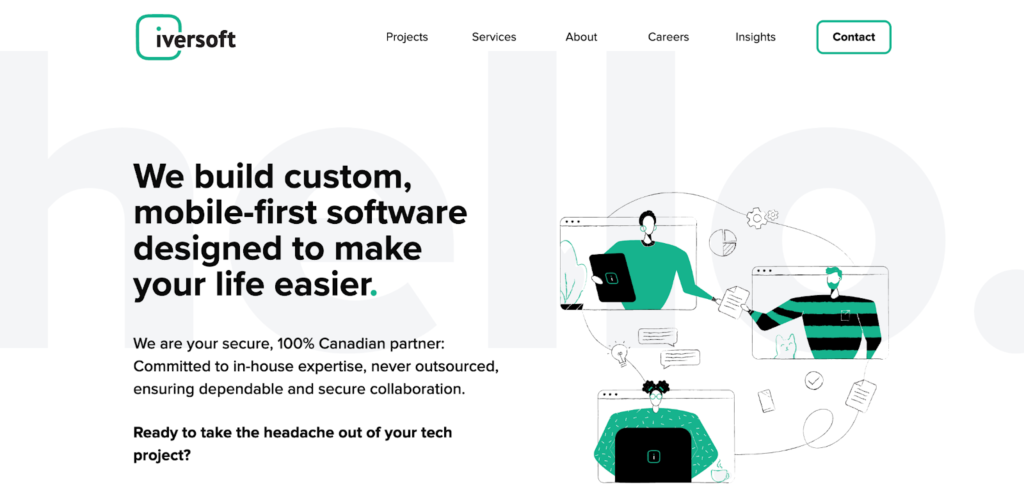
Iversoft, a mobile development firm based in Ottawa and Toronto, operates like a “studio as a service,” aiming for long-haul partnerships. They’re all about being transparent, focusing on the user, and offering flexible team support so you don’t have to deal with the headaches of permanent hiring.
They keep things super visible with real-time updates and weekly sprints. Thanks to their mobile-first mindset, they consistently roll out solid native and cross-platform apps. The best part? Iversoft kicks things off with a consultation to nail down the challenges and recommend the best tech right from the jump, which saves everyone a ton of money on fixes later.
Why Local Market Leadership Matters
Choosing Toronto-based firms with documented enterprise success offers specific advantages.
Understanding of Canadian regulatory context reduces risk. PIPEDA compliance, provincial privacy rules, and sector-specific regulations are familiar territory. Partners don’t need education on basic requirements.
- Time zone alignment enables real-time collaboration. Complex discussions happen during business hours, not across overnight email threads. Decisions move faster.
- Face-to-face meetings build stronger relationships. When critical issues arise, in-person conversations resolve them more effectively than video calls. Local presence enables this.
- Accountability is easier to enforce. Firms with local reputations to protect and physical offices in the city have more at stake than remote operators.
The Value of Ten-Plus Years Delivering Critical Systems
Longevity in this market signals specific capabilities.
Survived multiple technology cycles. Firms that have been delivering since the early 2010s have navigated the cloud shift, mobile revolution, and AI emergence. They adapt without losing core competence.
Build institutional knowledge about what fails. Experience includes learning from mistakes. Firms that endure have figured out which approaches don’t work.
Maintained client relationships through leadership changes. Enterprise clients undergo constant personnel shifts. Partners who retain relationships through these transitions have demonstrated value that transcends individual champions.
Developed processes that scale. Serving enterprise clients for a decade requires repeatable methodologies. These firms have refined their approaches through hundreds of projects.
The post Toronto’s Tech Backbone: 6 Software Firms Powering Enterprise Digital Transformation appeared first on Asjava.
]]>The post Coursiv Trustpilot Rating Explained: 4.4 Stars From 68K Reviews appeared first on Asjava.
]]>We analyzed hundreds of Coursiv reviews on Trustpilot to understand what users actually think. This deep dive covers the real user experience, common praise, frequent complaints, and whether the rating reflects genuine value.
If you’re considering Coursiv’s AI courses or wondering if those 4.4 stars are legitimate, this breakdown gives you the full picture from actual users.
Overview
Coursiv positions itself as an “AI gym” for complete beginners. The platform teaches practical AI skills through bite-sized daily lessons covering tools like ChatGPT, MidJourney, DALL-E, and Google Gemini.
Their signature offering is the 28-Day AI Challenge, designed for busy professionals who want hands-on AI training without technical prerequisites. Each lesson takes 5-10 minutes and focuses on real-world applications rather than theory.
The platform operates across iOS, Android, and web (coursiv.io), serving over 800,000 learners. Users complete daily challenges, earn certificates, and track progress through gamified learning paths.
Coursiv targets professionals aged 45+ who feel left behind by AI developments, career changers exploring new skills, and small business owners wanting to reduce outsourcing costs. The emphasis stays firmly on practical application over academic concepts.
The Details
Coursiv’s structure revolves around short, actionable lessons. The 28-Day AI Challenge covers different AI tools each week, building from basic ChatGPT prompting to advanced image generation with MidJourney and Stable Diffusion.
Daily challenges include guided playbooks with templates and workflows users can immediately apply to their work. The platform tracks streaks and awards certificates upon completion, appealing to users who respond well to gamification.
Beyond the flagship 28-day program, Coursiv offers shorter 14-day challenges and specialized tracks like the No Code Challenge. All content focuses on practical skills rather than technical theory.
The learning approach emphasizes “doing” over watching. Users interact directly with AI tools during lessons rather than passively consuming video content. This hands-on method appears frequently in positive Coursiv reviews on Trustpilot.
What Users Say
The Coursiv Trustpilot reviews reveal consistent themes about user experience and learning outcomes.
“It shows how important it is to use ChatGPT, because with the right question and a specific question, you can get a more precise and desired answer. Also, it was the first time I heard and learned that there are two versions of ChatGPT. It’s great for knowledge, and I like that it.”
- Suzana, Trustpilot (November 2025) Read full review
Many users appreciate the practical focus on prompt engineering and tool-specific techniques.
“Initially I was hesitant to try this out (admittedly I have an immediate hesitation for social media-recommended things I have to pay for) but decided to try. If anything, I’d be out however much I paid, which was doable. I’ve been really enjoying the lessons. Short, concise, focused on 1 thing. Easy to do between tasks. I found myself taking notes based off of the things I’ve been learning.”
- Lara, Trustpilot (December 2025) Read full review
The bite-sized format consistently receives praise from busy professionals who struggle with longer courses.
“Hands on is always best for me. I love being able to walk through the process and learn what these different AIs can do. I put all AI into one bucket before this course. Coursiv has shown me what the different tools can do for me.”
- Chris, Trustpilot (January 2026) Read full review
Users frequently mention discovering the distinct capabilities of different AI tools, moving beyond basic ChatGPT usage.
“I enjoy learning about new things and technology. Coursiv is a great resource for learning about AI and how to implement its many uses into any project that you are creating. This was a great experience and I recommend giving it a try. You learn something new and it can be a powerful tool to advance your business/career and ultimately lead to a better income.”
- DaxHeaton, Trustpilot (November 2025) Read full review
Career advancement and business application appear as common motivations among satisfied users.
“My experience with Coursiv has been outstanding from start to finish. The platform is extremely user-friendly, organized, and efficient, making the entire process smooth and stress-free. What truly stood out was their responsiveness and genuine commitment to helping users succeed.”
- Marines, Trustpilot (November 2025) Read full review
Customer support quality receives consistent mention in positive reviews.
“Coursiv is a fantastic learning platform—easy to use, well-organized, and full of clear, high-quality lessons. The content is practical, the instructors explain things well, and the support team is quick to help. Highly recommend!”
- Cheryl Holiday, Trustpilot (November 2025) Read full review
Platform usability and content organization get frequent positive mentions across Coursiv Trustpilot reviews.
Even experienced users find value in the structured approach:
“TBH, I’ve worked in AI academically and professionally since 1982. I’m taking the course to polish my skills as a user, but especially to assess its value as a resource to be recommended to family, friends, and clients and students in my consulting/training business.”
- silkpeirce, Trustpilot (November 2025) Read full review
Pros and Cons
Pros: – Genuinely beginner-friendly with zero technical prerequisites – Short 5-10 minute lessons fit busy schedules – Hands-on practice with real AI tools during lessons – Covers multiple AI platforms beyond just ChatGPT – Strong customer support responsiveness – Gamified progress tracking maintains engagement – Practical templates and workflows included – Available across all devices
Cons: – Content may be too basic for users with existing AI experience – Limited advanced topics for users wanting deeper technical knowledge
The Coursiv rating reflects a platform that delivers on its core promise of making AI accessible to beginners. Most criticism centers on content depth rather than quality or delivery.
Is It Worth It?
The 4.4-star Coursiv Trustpilot rating appears to accurately reflect user satisfaction, particularly among the target demographic of AI beginners and busy professionals.
One reviewer offers balanced perspective:
“I greatly enjoyed completing the Coursiv AI Mastery course. Whilst I know some critics have complained it is very basic, that’s the beauty of the course… it starts off with the fundamentals. It’s easy to follow with plenty of exercises to practice with each of the AI tools, and the structure of the course enables you to gradually build up your knowledge. The completion certificates for each course are a nice touch. I believe this course could greatly benefit many other people who are interested in learning more about AI, and I encourage folks to give it a try. Please note though, it is probably best to see what you can find for free on platforms like YouTube as this may give you all you are after rather than paying for Coursiv, which may give you more than what you really need. For me, the cost was more than worth it.”
- Craig Bounds, Trustpilot (January 2026) Read full review
This review captures the value proposition well. Coursiv works best for people who prefer structured, guided learning over free but scattered YouTube content. The platform excels at taking complete beginners from curious to confident with practical AI skills.
The coursiv rating on Trustpilot suggests genuine user satisfaction rather than artificial inflation. Reviews consistently mention specific features, learning outcomes, and practical applications rather than generic praise.
For professionals who need practical AI skills quickly and prefer guided learning, the investment appears worthwhile based on user feedback. Those comfortable with self-directed learning might find adequate free resources elsewhere.
Ready to see if Coursiv’s approach works for you? Check out their 28-Day AI Challenge and join the 800,000+ learners building practical AI skills through daily practice.
The post Coursiv Trustpilot Rating Explained: 4.4 Stars From 68K Reviews appeared first on Asjava.
]]>The post How to Scale Link Acquisition for SaaS Without Burning Your Brand appeared first on Asjava.
]]>What “Burning Your Brand” Really Means in Link Building
The phrase “burning your brand” gets thrown around in SEO circles, but what does it actually mean? In short, it’s what happens when your link-building tactics cause long-term damage to your search visibility, your customer trust, or both.
Getting Links from Spammy, Unrelated Websites
One of the fastest ways to hurt your brand is to publish links on irrelevant or low-quality websites. Google’s algorithms have evolved to spot patterns in spammy link schemes. If your domain ends up in a toxic neighborhood, you may see ranking drops, manual actions, or a loss of credibility in your industry.
Over-Optimized Anchors That Look Unnatural
Using exact-match anchor text for every link, especially for high-volume keywords, raises red flags. It doesn’t look natural, and it signals manipulation. A pattern of keyword-stuffed anchor text not only looks bad to Google but also feels forced to human readers, damaging user perception.
Using Services That Don’t Care About Relevance or Audience
There’s no shortage of cheap providers offering backlinks, but not every SaaS link building agency follows best practices. Some rely on link farms or PBNs with no concern for your industry, audience, or brand voice. These shortcuts may deliver temporary gains, but they often result in long-term damage that’s difficult to undo.
Losing Trust With Google — and With Your Users
If you build your backlink profile using shortcuts, you risk triggering Google penalties. But it’s not just about search engines. Users are increasingly savvy. If sketchy websites promote your brand or use questionable language in links, you lose credibility fast.
Why SaaS Companies Struggle to Scale Safely
SaaS companies often feel pressure to scale fast. SEO offers a low-cost, high-ROI path, so ramping up link building quickly is tempting. But several issues can derail the process:
- Tight timelines. Founders want results immediately, which leads to rushed decisions and risky partnerships.
- Outsourced campaigns. Many teams hand off SEO without knowing what the agency is doing.
- Niche challenges. Some SaaS products target small or technical markets, making quality placements harder to find.
- Confusing metrics. Teams chase link volume instead of focusing on quality, relevance, or traffic impact.
Without a clear plan, it’s easy to chase the wrong numbers and miss warning signs until damage occurs.
4 Rules for Scaling Link Building Without Risk
Scaling your link acquisition safely doesn’t mean slowing down. It means creating systems and setting standards that protect your brand and increase visibility in the right places. Working with a reliable SaaS link building agency can make this process more efficient, as long as the focus stays on quality and relevance.
Only Build Links on Relevant, High-Traffic Websites
The first rule: focus on relevance and real traffic. Place links on websites that your target customers actually read. This not only protects your brand but also improves referral traffic and recognition. Stick to industry blogs, credible news sites, and publications aligned with your product.
Avoid “Guest Post Farms” and PBN-Like Networks
Stay away from sites that accept every guest post without review. These “guest post farms” exist to sell backlinks and offer little value. They often have weak content, poor editing, and excessive outbound links. If a site only exists to sell links, it’s a red flag.
PBNs follow the same pattern. Their owners build networks to game rankings. Google frequently penalizes these setups, and working with them can harm your SEO.
Use Branded or Natural Anchors — Not Just Exact-Match Keywords
Anchor text plays a key role in how Google evaluates links. A natural profile includes branded terms, long-tail phrases, and generic anchors like “click here.” Relying too much on exact-match keywords like “best project management software” looks unnatural and can hurt your SEO.
Mix your anchors. Use your company name, product name, or related phrases that fit naturally in the content. This makes your links look authentic and credible.
Work With Partners Who Let You Approve Every Link Before It Goes Live
When you work with a SaaS link-building agency, make sure you can review every placement before it goes live. This gives you control over site quality, anchor usage, and link context.
A trustworthy agency offering SaaS link building services provides full transparency and lets you approve each link. If they refuse to show previews or hide their site list, that’s a red flag. You don’t want your brand ending up on low-quality or irrelevant sites.
What a Safe, Scalable Link Building System Looks Like
Sustainable link building at scale doesn’t rely on hacks. Effective SaaS link building services use repeatable processes that focus on value, consistency, and quality control. Here’s what a healthy system typically includes:
- Prospecting filters. Set clear criteria to find relevant, high-quality sites.
- Outreach strategy. Personalize pitches for guest posts or PR to build real connections.
- Content that adds value. Share useful, well-written content that fits the target audience.
- Clear reporting. Track link locations, anchor text, and traffic to improve results.
- Ongoing cleanup. Audit links, remove harmful ones, and refresh outdated placements.
Many SaaS link-building services now offer these systems as part of their standard workflow. Choose providers that focus on quality over quantity and understand the nuances of SaaS SEO.
Final Thoughts: Grow Smart, Not Desperate
To scale link acquisition without damaging your reputation, stay focused on relevance, control, and quality. Work with a SaaS link building agency that understands your audience and avoids risky shortcuts. Your long-term growth depends on smart decisions.
The post How to Scale Link Acquisition for SaaS Without Burning Your Brand appeared first on Asjava.
]]>The post AI Tools for Recruiting Java Developers: Streamlining the Hiring Process appeared first on Asjava.
]]>The Role of AI in Java Recruitment
AI has emerged as a powerful tool in recruitment across various industries, and its application in hiring Java developers is no exception. Companies are increasingly using AI to manage the recruitment process by automating many of the manual tasks traditionally handled by human recruiters. This includes resume screening, candidate matching, and skill assessments.
With AI for Java recruitment, companies can analyze large volumes of data in real time, quickly identifying candidates who possess the necessary skills, certifications, and experience. These AI-driven tools filter out unqualified applicants and highlight the top talent, ensuring that recruitment teams focus on the best-suited candidates for the role.
Streamlining the Hiring Process with AI Tools
The tech hiring process can often be complex, requiring in-depth evaluations of technical skills and coding abilities. AI tools designed for Java jobs help streamline this process by offering automated assessments and skill tests that measure a candidate’s proficiency in Java programming.
For instance, AI-powered platforms can generate quizzes or coding challenges that simulate real-world Java problems, allowing recruiters to gauge the candidates’ problem-solving abilities. By using these AI-driven assessments, companies can more accurately predict how well a candidate will perform in the actual job.
Moreover, Java jobs AI tools for hiring developers with AI can automate the scheduling of interviews, track candidate progress, and provide instant feedback, all of which help reduce the time and effort involved in recruitment.
AI-Powered Assessments: Enhancing Candidate Evaluation
One of the biggest challenges in hiring Java developers is evaluating their technical skills effectively. Traditional methods of assessing candidates through interviews or manual tests can be subjective and time-consuming. AI tools, however, offer a more objective approach by providing data-driven insights into candidates’ abilities.
An example of such a tool is the descriptive essay about my mother https://www.customwritings.com/howtowrite/post/descriptive-essay-mother/ feature, which allows companies to create and administer customized quizzes that test the specific Java skills required for the job. These assessments can cover topics like object-oriented programming, Java frameworks, and debugging, ensuring that candidates are evaluated comprehensively. Learn more about how this AI-driven tool can assist in recruitment at AI for answering multiple choice questions.
By utilizing AI-powered assessments, recruiters can ensure that only the most capable Java developers move forward in the hiring process, ultimately improving the quality of hires.
Benefits of Hiring Developers with AI
Incorporating AI into the recruitment process for Java jobs offers numerous benefits. Firstly, it significantly speeds up the hiring timeline by automating repetitive tasks such as resume screening and interview scheduling. This allows recruitment teams to focus on more strategic aspects of hiring, such as evaluating soft skills or cultural fit.
Secondly, AI tools reduce human bias by focusing on objective criteria such as technical ability and work experience. This ensures that the most qualified candidates are selected based on their merits, promoting fairness in the recruitment process.
Finally, AI tools provide a more accurate way to assess a candidate’s potential for success in the role. By using data-driven evaluations, companies can predict how well a candidate will perform in real-world Java development tasks, reducing the risk of hiring mismatches.
Conclusion
AI tools are reshaping the recruitment landscape for Java developers by automating key processes and providing deeper insights into candidates’ abilities. By using AI for Java recruitment, companies can streamline the hiring process, reduce the time to hire, and ensure they bring the best talent on board. From automated assessments to skill-based quizzes, AI is revolutionizing how companies find and evaluate Java developers. To enhance your recruitment strategy, explore more about at AI for answering multiple choice questions.
The post AI Tools for Recruiting Java Developers: Streamlining the Hiring Process appeared first on Asjava.
]]>The post Mastering TestNG: Installation to Advanced Techniques appeared first on Asjava.
]]>Once your environment is prepped, it’s time to start writing some code. We’ll explore TestNG’s annotation-based approach, making test development a breeze. Say goodbye to convoluted setups and hello to elegant, readable tests. With our tests written, it’s time to put them to the test. We’ll learn how to execute our tests using a variety of methods, from simple command-line execution to seamless integration with your favorite IDE and even leveraging Ant tasks for automation.
Armed with a solid understanding of TestNG’s capabilities, you’re now equipped to tackle testing challenges with confidence. Whether you’re a seasoned developer or just starting out, TestNG empowers you to write efficient, comprehensive tests that ensure the quality and reliability of your code.
TestNG Tutorial and Example – A Comprehensive Journey
Embarking on your journey into software testing with TestNG opens doors to a world of efficient and comprehensive testing practices. Whether you’re just starting or seeking to refine your skills, understanding TestNG essentials is crucial. In this guide, we’ll walk through everything you need to know, from setting up TestNG to executing tests and exploring advanced techniques.
- Setup and Installation: Before diving into TestNG, it’s essential to ensure your environment is set up correctly. TestNG requires JDK 5 or higher. You’ll need to download the latest TestNG release from the official website and follow the installation instructions provided. Once installed, you’ll have access to a suite of tools and libraries essential for testing Java applications;
- Writing Your First Tests: With TestNG, writing tests becomes intuitive and straightforward. Unlike traditional testing frameworks, TestNG leverages annotations to define test methods, making the process more streamlined and readable. We’ll explore how to write simple test codes using TestNG, covering basic annotations like @Test, @BeforeMethod, and @AfterMethod;
- Test Execution: Executing tests with TestNG is a breeze, whether through the command line, IDE integration, or build automation tools like Ant or Maven. We’ll walk through the different methods of running TestNG tests, including configuring test suites, executing tests via command-line interfaces, and integrating TestNG with popular IDEs like IntelliJ IDEA and Eclipse.
Prerequisites
Ensure JDK 5 or higher is installed.
TestNG Download and Installation
Download the latest TestNG release from here and extract the zip. Key components include:
- Testng-5.14.1.jar (essential for project setup);
- Documentation;
- Example codes;
- Source codes;
- Readme.
Start your TestNG journey with examples and documentation.
Just a Simple Test Code Using TestNG
No need to extend specific classes or enforce naming conventions. Simply use the @Test annotation.() method is invoked before test methods.
Run Test with Command
Configure TestNG using testng.xml. Run tests using:
java -ea -classpath .;testng-5.14.1.jar org.testng.TestNG testng.xmlRun TestNG Test with IDE
For IntelliJ IDEA, add unit test to TestNG configuration via Tools->Run.
Run TestNG Test with Ant
Use Ant task to run tests. Example Ant project XML provided.
Conclusions
Executing tests should be a joy, not a chore. With TestNG, you’ve got options galore – command line, IDE integration, you name it.
TestNG isn’t just about the basics. We’ve taken you on a journey into the realm of advanced techniques – parameterized tests, test dependencies, and more. Armed with these tricks up your sleeve, you’ll be unstoppable
The post Mastering TestNG: Installation to Advanced Techniques appeared first on Asjava.
]]>The post Dive into Web Services with CXF: A Hello World Primer appeared first on Asjava.
]]>From setting up your development environment to implementing the web service interface, deploying the service server, and validating its functionality with a client application, we’ll cover everything you need to kickstart your web services journey with confidence. So, without further ado, let’s dive into the fascinating world of Apache CXF and unleash the potential of web services development!
Apache CXF Overview
Apache CXF, an open-source Web services framework, combines the strengths of Celtix and XFire projects. It offers robust support for JAX-WS, Binding, DataBinding, and diverse transport implementations. Its adaptable architecture seamlessly integrates XML and non-XML bindings such as JSON and CORBA, making it a versatile choice for modern web service development.
Prerequisites
Ensure JDK and CXF latest version are installed.
- Project Setup: Create a Java project in IDE, adding necessary CXF libraries to the classpath;
- Define Web Service Interface: Create “IHelloWorld” interface with a “sayHi” method annotated with @WebService;
- Implement Web Service: Create “HelloWorldImpl” class implementing the interface, annotated with @WebService;
- Web Service Server Creation: Use “JaxWsServerFactoryBean” to create server endpoints, set service class, bean, and address. Start the server;
- Client Setup: Create “Client” class to call the web service remotely using “JaxWsProxyFactoryBean”;
- Run the Client: Execute the client main method to verify the web service functionality.
Get ready to embark on an exhilarating web services adventure with Apache CXF! This guide is your passport to the thrilling world of web service development, where creativity meets coding. From setting up your development environment to unleashing your first web service into the digital wild, you’re about to dive deep into the innovative realm of Apache CXF.
Conclusion
By following the roadmap laid out in this tutorial, you’ve not only equipped yourself with valuable skills but also forged a sturdy foundation for future exploration and experimentation in the exhilarating world of web services development.
As you venture forth on your coding odyssey, remember that Apache CXF is a treasure trove of features and capabilities waiting to be unleashed. Don’t hesitate to dive deeper into its vast documentation, tap into the vibrant community resources, and explore additional tutorials to broaden your horizons and discover new avenues in web services development.
The post Dive into Web Services with CXF: A Hello World Primer appeared first on Asjava.
]]>The post TestNG Tutorial and Example – Suite Test appeared first on Asjava.
]]>What is a Test Suite?
A test suite is a collection of test cases that are intended to test a specific behavior or set of behaviors of a software program. It is essentially a group of related tests that are executed together. This allows for more efficient testing, as multiple tests can be run at once without the need for manual intervention.
In TestNG, a test suite is represented by an XML file, which contains the configuration for the tests to be run. This separation of suite configuration from the actual test code allows for more flexibility, as changes to the suite can be made without affecting the code base.
Creating a Test Suite in TestNG
To create a test suite in TestNG, we first need to create an XML file with the .xml extension. This file will contain the configuration for our suite, including the tests to be run and any parameters or dependencies.
Defining a Suite
The first step in creating a test suite is to define it using the <suite> tag. This tag has two attributes: name and verbose. The name attribute is used to give a name to the suite, while the verbose attribute specifies the level of logging to be displayed during the execution of the suite.
For example, we can define a suite named “Suite1” with a verbose level of 1 as follows:
<suite name="Suite1" verbose="1">

    ...

</suite>
Adding Tests to the Suite
Once we have defined our suite, we can add tests to it using the <test> tag. This tag also has a name attribute, which is used to give a name to the test.
Within the <test> tag, we can specify the classes that contain the actual test code using the <classes> tag. Each class should be specified using the <class> tag with the name attribute set to the fully qualified name of the class.
For example, if we have two test classes named “tutorialSimpleTest1” and “ParameterSample”, we can add them to our suite as follows:
<test name="SimpleTest1">

    <classes>

        <class name="tutorialSimpleTest1"/>

    </classes>

</test>

<test name="SimpleTest2">

    <classes>

        <class name="ParameterSample"/>

    </classes>

</test>
Running the Suite
To run our test suite, we can use the TestNG command line tool with the -suitename option. For example, if our suite is named “Suite1”, we can run it using the following command:
java org.testng.TestNG -suitename Suite1
This will execute all the tests in the suite in the order they are defined in the XML file.

Example Suite – Suite1
To better understand how to create and run a test suite in TestNG, let’s take a look at an example suite – Suite1. This suite contains two tests: SimpleTest1 and SimpleTest2, each with their own set of test cases.
The complete XML configuration for this suite is as follows:
<!DOCTYPE suite SYSTEM "http://testng.org/testng-1.0.dtd">

<suite name="Suite1" verbose="1">

    <test name="SimpleTest1">

        <classes>

            <class name="tutorialSimpleTest1"/>

        </classes>

    </test>

    <test name="SimpleTest2">

        <classes>

            <class name="ParameterSample"/>

            <class name="ParameterTest"/>

        </classes>

    </test>

</suite>
Let’s break down this configuration and understand what each part does.
Defining the Suite
The first line of our XML file is the DOCTYPE declaration, which specifies the type of document we are creating. In this case, it is a TestNG suite.
Next, we have the <suite> tag with the name and verbose attributes set to “Suite1” and 1 respectively.
Adding Tests to the Suite
Within the <suite> tag, we have two <test> tags – one for SimpleTest1 and one for SimpleTest2. Each test has its own set of classes specified using the <classes> tag.
For SimpleTest1, we have only one class – tutorialSimpleTest1. This class contains the test cases for SimpleTest1.
For SimpleTest2, we have two classes – ParameterSample and ParameterTest. These classes contain the test cases for SimpleTest2, with ParameterTest being dependent on ParameterSample.
Running the Suite
To run this suite, we can use the TestNG command line tool as mentioned earlier. The output of running this suite would look something like this:
Suite 1

Total tests run: 4, Failures: 0, Skips: 0
This indicates that all four test cases in the suite were executed successfully.
Conclusion
In this tutorial, we have explored the concept of test suites in TestNG and provided an example of how to create and run a suite. We have seen how test suites can make automated testing more efficient, flexible, and organized. With this knowledge, you can now start creating your own test suites in TestNG and improve your testing process.
The post TestNG Tutorial and Example – Suite Test appeared first on Asjava.
]]>The post Using SAX Parser to Read XML Files in Java appeared first on Asjava.
]]>Prerequisites
Before we dive into the details of using the SAX parser, there are a few prerequisites that you need to have in place. First and foremost, you will need to have the Java Development Kit (JDK) installed on your system. The JDK includes the Java Runtime Environment (JRE), which is necessary for running Java applications. Additionally, you will need a text editor or an integrated development environment (IDE) such as Eclipse or NetBeans to write and run your Java code.
Giving the following XML document
In order to demonstrate how to read XML files using the SAX parser, we will be using a sample XML document. You can either create your own XML file or use the one provided below:
Planning
2 weeks
Development
4 weeks
Testing
2 weeks
Save this XML document to your local disk for later use.
How to Read XML file via SAX Parser in Java?
Now that we have our prerequisites in place and a sample XML document to work with, let’s dive into the steps for reading XML files using the SAX parser in Java.
Step 1: Create a class that extends DefaultHandler
The first step is to create a Java class that extends the DefaultHandler class. This class provides default implementations for all the methods defined in the ContentHandler, DTDHandler, EntityResolver, and ErrorHandler interfaces. These methods are used by the SAX parser to handle different types of events that occur while parsing an XML document.
Step 2: Override the necessary methods
There are five methods defined in the DefaultHandler class that you may need to override in order to handle specific events during the parsing process. These methods are:
- startDocument(): This method is called at the beginning of the parsing process;
- endDocument(): This method is called at the end of the parsing process;
- startElement(String uri, String localName, String qName, Attributes attributes): This method is called when the parser encounters the start of an element in the XML document;
- endElement(String uri, String localName, String qName): This method is called when the parser encounters the end of an element in the XML document;
- characters(char[] ch, int start, int length): This method is called when the parser encounters character data within an element.
You can override these methods in your class to perform custom actions based on the events that occur during the parsing process.
Step 3: Create the corresponding Java bean
In order to store the data from the XML document, we need to create a Java bean that represents the structure of the XML elements. In our example, we will create a Phase class with attributes for the phase ID, name, and duration.
Step 4: The code to Read XML file via SAX Parser in Java
Now that we have our class and bean set up, we can write the code to read the XML document using the SAX parser. The following code snippet shows how this can be done:
// Create an instance of the SAXParserFactory
SAXParserFactory factory = SAXParserFactory.newInstance();
// Create an instance of the SAXParser
SAXParser saxParser = factory.newSAXParser();
// Create an instance of your custom handler class
CustomHandler handler = new CustomHandler();
// Parse the XML document using the handler
saxParser.parse(“path/to/xml/file”, handler);
// Get the list of phases from the handler
List phases = handler.getPhases();
In this code, we first create an instance of the SAXParserFactory class, which is responsible for creating instances of the SAXParser class. We then use the SAXParser to parse the XML document, passing in the path to the file and an instance of our custom handler class. Finally, we can retrieve the list of phases from the handler and use them as needed.

Output after parsing XML via SAX
After running the code above, we should have a list of Phase objects containing the data from our XML document. We can then use this data to perform any necessary operations or display it in a user interface. For example, we could print out the names and durations of each phase in the list:
for (Phase phase : phases) {

    System.out.println(phase.getName() + ": " + phase.getDuration());

}

This would produce the following output:

Planning: 2 weeks

Development: 4 weeks

Testing: 2 weeks
Conclusion
In this tutorial, we have discussed how to read XML files using the SAX parser in Java. We first covered the prerequisites for using the SAX parser, including having the JDK and a text editor or IDE installed. We then provided a sample XML document for testing purposes. Next, we went through the steps for reading XML files using the SAX parser, which involved creating a custom handler class, overriding necessary methods, and creating a corresponding Java bean. Finally, we showed how to retrieve and use the data from the XML document after parsing it with the SAX parser. With this knowledge, you should now be able to efficiently read and manipulate XML data in your Java applications.
The post Using SAX Parser to Read XML Files in Java appeared first on Asjava.
]]>The post Sorting a Map by Key in Java Programming appeared first on Asjava.
]]>What are Maps in Java?
Before we dive into sorting a map by key, let’s first understand what maps are and how they work in Java. A map is an interface defined in the Java Development Kit (JDK), and it represents a collection of key-value pairs. It is part of the java.util package and is implemented by various classes such as HashMap, TreeMap, and LinkedHashMap.
A map allows you to store and retrieve values based on their corresponding keys. This makes it useful for representing relationships between different objects, where each object has a unique identifier or key. For example, you could use a map to store student names and their corresponding grades, with the student names being the keys and the grades being the values.
Types of Maps in Java
As mentioned earlier, there are several implementations of the Map interface in Java. Each implementation has its own unique characteristics and is suitable for different use cases. Let’s take a brief look at some of the commonly used map implementations in Java:
- HashMap: This is the most commonly used map implementation in Java. It uses a hash table to store the key-value pairs, which allows for fast retrieval of values based on their keys. However, the elements in a HashMap are not stored in any particular order;
- TreeMap: This implementation uses a red-black tree data structure to store the key-value pairs. Unlike HashMap, the elements in a TreeMap are sorted according to their keys. This makes it useful for scenarios where you need to retrieve the elements in a specific order.
Apart from these main implementations, there are also other specialized map implementations such as IdentityHashMap, RenderingHints, WeakHashMap, and more. Each of these implementations has its own unique characteristics and is suitable for specific use cases.

Sorting a Map by Key in Java
Now that we have a basic understanding of maps in Java, let’s explore different ways to sort a map by its keys. We will use the following map as an example throughout this article:
Map grades = new HashMap();

grades.put("John", 85);

grades.put("Mary", 92);

grades.put("Bob", 78);

grades.put("Alice", 90);
Using HashMap to Sort a Map by Key
The first approach we will look at is using the HashMap class to sort a map by key. As mentioned earlier, HashMap does not guarantee any particular order for its elements. However, we can use the keySet() method to get a set of all the keys in the map and then sort them using the Arrays.sort() method. Let’s see how this works in code:
Object[] keys = grades.keySet().toArray();

Arrays.sort(keys);

for (Object key : keys) {

    System.out.println(key + ": " + grades.get(key));

}
In the above code, we first convert the set of keys into an array using the toArray() method. Then, we use the Arrays.sort() method to sort the keys in ascending order. Finally, we iterate over the sorted keys and print out the corresponding values from the map.
Using TreeMap to Sort a Map by Key
The second approach we will look at is using the TreeMap class to sort a map by key. Unlike HashMap, TreeMap maintains its elements in sorted order according to their keys. This makes it an ideal choice for sorting a map by key. Let’s see how this works in code:
TreeSet keys = new TreeSet(grades.keySet());

for (String key : keys) {

    System.out.println(key + ": " + grades.get(key));

}
Conclusion
Sorting a map by key is a common task in Java programming. In this article, we explored different ways to achieve this, including using HashMap, TreeMap, and generic types. Each approach has its own advantages and is suitable for different use cases. It is important to understand the characteristics of each map implementation in order to choose the most appropriate one for your specific needs.
The post Sorting a Map by Key in Java Programming appeared first on Asjava.
]]>