-
-
Logo
-
Review Screen
-
Dashboard Home Screen- with simulated data


Inspiration + What it does
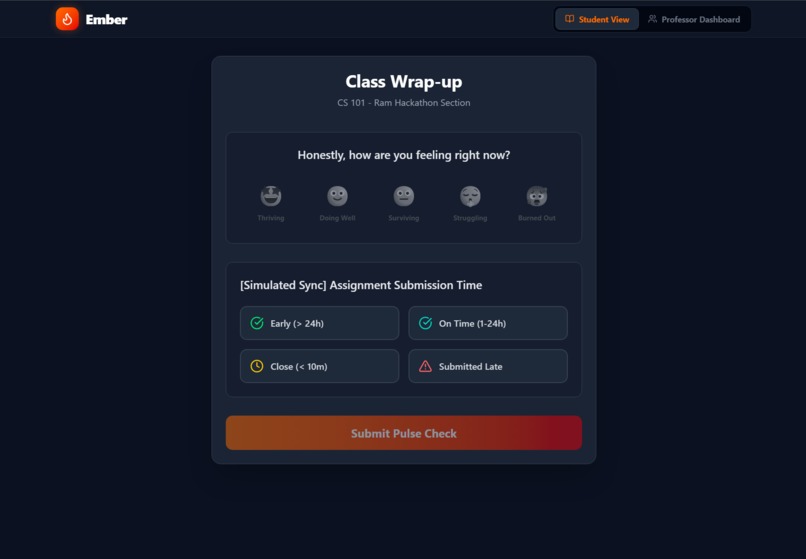
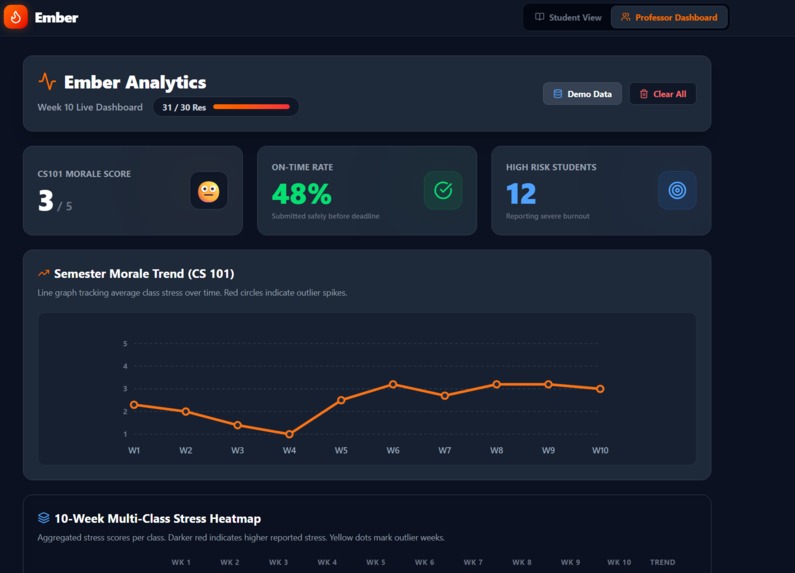
The inspiration for Ember came from a common college experience: the disconnect between student stress and professor awareness. Often, students are severely burned out, but professors don't realize the class is struggling until midterms are failed or assignments are missed. We built Ember to bridge this gap. Ember is a real-time, interactive dashboard that allows students to do a quick 5-second "pulse check" at the end of class, rating their burnout level and logging their assignment submission times. On the other side, professors get a live, bird's-eye view of the class's morale, identifying exactly when students are thriving and when they are dangerously overwhelmed.
How we built it + challanges
We built the frontend of our application using React and styled it with Tailwind CSS to create a sleek, modern dark-mode interface. For the backend, we integrated Firebase Firestore to handle live data synchronization, ensuring that the professor's dashboard updates the exact millisecond a student hits submit on their phone. One of our biggest technical challenges was building the custom visualizations—like the interactive SVG sparkline charts and the 10-week multi-class heatmap—and making sure they scaled perfectly on both massive presentation screens and tiny mobile devices. We also faced the challenge of writing a local, rule-based insight engine that mathematically correlates late submissions with high burnout scores.
What we learned
Throughout this hackathon, we learned an incredible amount about handling real-time data streams and managing complex React states. Building the custom charts from scratch taught us how to manipulate SVGs dynamically based on user input. Most importantly, we learned how to translate raw, numeric data into meaningful, human-centric insights, proving that a simple, fast feedback loop can make a massive difference in education.
What's next for Ember
Looking forward, we want to build a seamless backend API integration with Learning Management Systems like Blackboard, completely automating the collection of submission timing data without requiring manual student input. To make the pulse check even more frictionless, we plan to develop a dedicated Chrome extension that automatically prompts students for a one-click burnout rating immediately after they submit an assignment online. Finally, we aim to implement a robust authentication system featuring separate, secure accounts for administrators and professors, allowing universities to easily manage multiple classes, professors, and semesters of historical data on a larger scale.


Log in or sign up for Devpost to join the conversation.