-
-
-
-
-
-
-

Youtube Factcheck
-
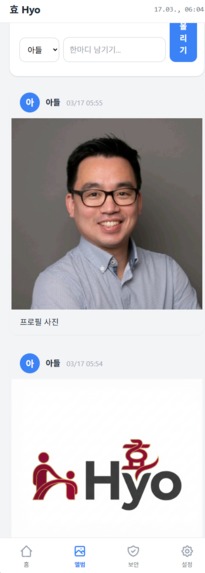
landingpage - feed - news and album of family
-
-
-


Inspiration
효 (孝) — from the Chinese character 孝. There is no English word for it. "Filial piety" comes close, but sounds like a museum label. 효 is simpler than that. It's the duty and love a child carries toward their parents. Not because they're told to. Because they can't not. In Korea, 효 once meant living under the same roof. Cooking for them. Being there when they call. But what happens when 효 lives in Zürich and your parents age in Seoul? My mother has Parkinson's. Her voice is soft — sometimes too soft for my father to hear. She walks with a walker. My father has joint problems and is losing his hearing. All their children live abroad. 8,500 km. 8 hours of time difference. They complement each other. She remembers things. He can still move freely. Together, they manage. For now. Lately, the questions are changing. Not "how are you" — but: "Son, should I reply to this email? It says my account will be deleted." That was a phishing scam. She almost clicked. "Can you explain this insurance letter?" He used to handle all the paperwork. Now the font is too small and the language too bureaucratic. "What was the medication the doctor changed?" She remembers the old one. Not the new one. The prescription is somewhere in a drawer. These are questions they never had to ask. They're becoming more frequent. And every unanswered one chips away at something — not just capability, but dignity. Meanwhile, scams are more sophisticated than ever. Government forms moved online. The bus schedule became an app. Every month, another thing that used to be simple becomes a barrier. How are your parents doing? When did you last call them?
What it does
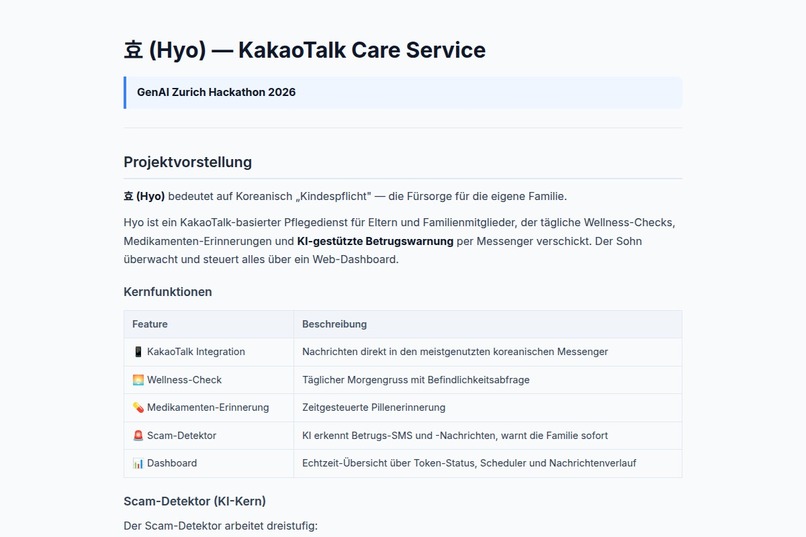
Hyo is an AI care layer that lives inside KakaoTalk — the only app my parents have used for 10 years. No new app. No new interface. Just a chat contact that feels like family. For my mother: She forwards a suspicious email. The bot replies in 5 seconds: "This is a scam. Do not reply." She photographs an insurance letter, says "보관해줘" — save this. The AI reads it, categorizes it, stores it encrypted. When I need it at 3am from Zürich, I find it in the Family Safe. For my father: Galaxy Buds amplify my mother's soft voice so he can hear her across the kitchen. The same Buds deliver his morning briefing — weather, medication reminder, and: "Your son sent you something." A photo from Zürich, with a note. Not an algorithm. His son. For safety: When his Galaxy Watch detects no movement for 45 minutes, it vibrates gently: "괜찮으세요?" — Are you okay? He taps yes. The system stands down. I never even know it happened. Safety without surveillance. For me: One dashboard. Wellness trends, health data, Family Safe documents, alerts. Not their chat logs — their wellbeing. From 8,500 km away. The feature that matters most? A channel called "아들이 보낸 것" — What your son sent. Twice a week, I pick an article, a photo, a voice message. Technology doesn't replace presence. But it can carry 효.
How we built it
I should be clear about something: I'm a dentist. I run a dental practice in Zug, Switzerland. Three months ago, I couldn't write a line of code. I'm what I call a "certified non-programmer." Everything I build, I build through conversation with Claude — a methodology I call Vibe Coding. No IDE. No Stack Overflow. Just a clear problem, a conversation, and the willingness to iterate until it works. In the last two months, I built a fullstack AI orchestration system called Ambientwork — for my dental practice. Staff coordination, inventory management, voice-controlled interfaces, multi-agent AI workflows. It's in active development, with new features shipping every week. The foundation runs, the first modules are live, and the system grows alongside our daily practice. I would have called this completely unimaginable 90 days ago. Hyo uses the same engine. Because orchestrating care for a 70-year-old household in Seoul isn't that different from orchestrating a dental practice in Zug. Architecture: Three layers — Safety (Galaxy Watch, fall detection, 3-step emergency escalation to Korean 119), Comfort (medication reminders, news explainer, scam detection, YouTube fact-checking), and Family (daily wellness check, curated content channel, encrypted Family Safe). Integration: KakaoTalk via Kakao i Open Builder. Samsung ecosystem — Galaxy Buds for hearing amplification and audio I/O, Galaxy Watch for health and haptics, SmartThings for home sensors. All consumer hardware, nothing proprietary. Adaptive interface: The bot outputs differently per parent — audio via Buds for my father (hearing), large visual cards for my mother (motor limitations). One system, two personalized experiences. Built to scale from two parents to thousands of households.
Challenges we ran into
I'm not a programmer. That's not self-deprecation — it's the core constraint. Every architectural decision needs to be robust enough that a dentist can maintain it from 8,500 km away. If I can't explain it to Claude in conversation, it doesn't get built. That turned out to be a feature, not a bug: the system is simple because it has to be. The Telegram trap. We initially designed for Telegram — then discovered nobody over 40 in Korea uses it. KakaoTalk is the only option, which meant learning an entirely new developer ecosystem. Safety without surveillance. The hardest design challenge: How do you keep parents safe without making them feel watched? Our answer: parents never see a dashboard. They see a chat contact. The son sees trends, not transcripts. "그만해줘" (stop this) shuts everything down instantly. The hearing-voice paradox. Father can't hear, mother can't speak loudly. Most solutions address one or the other. Galaxy Buds with Ambient Sound solve both — amplification for him, close microphone for her. The first "wow moment" has nothing to do with AI. Trust across cultures. Korean seniors and data privacy is a sensitive topic. But more importantly: my parents need to understand and choose this system, not have it installed on them.
Accomplishments that we're proud of
It's already running — somewhere else. The AI system behind Hyo isn't theoretical. The same platform is being built for my dental practice in Zug — Ambientwork. It's not finished. It's in active development. But the foundation is live, the first modules work, and every week it does more than the week before. That's the point: this isn't vaporware with a pitch deck. It's a system that grows through daily use with real people. A dentist built this. Two months ago, I had never written a fullstack application. Today I have a multi-service architecture with authentication, real-time data streams, and AI orchestration — in active development, already supporting real workflows. Vibe Coding isn't a gimmick. It's proof that the barrier to building software has fundamentally shifted. Nothing new to learn. My parents' interface is KakaoTalk — the app they've used for a decade. The Buds are "just earphones." The Watch is "just a watch." The intelligence is invisible. That's the product. The Discovery Sprint Playbook. We formalized how to observe, understand, and configure the system for new households — 6 categories, decision matrices, structured evening reviews. What started as "how do I prepare for the April trip" became the onboarding process for every future Hyo customer.
What we learned
Build for the relationship, not the individual. We started building "a bot for seniors." The breakthrough: my parents' core problem isn't technology — it's communication with each other. Father can't hear, mother can't speak loudly. The best feature isn't AI. It's Ambient Sound on a pair of earbuds. The best interface is no interface. My parents don't need a new app. They don't need a tutorial. They need KakaoTalk to do one more thing. The moment you ask a 70-year-old to download something, you've already lost. Every feature that survived our design process passes one test: can my mother use it without me in the room? Fewer devices, more trust. Every device is a failure point you can't fix from 8,500 km away. Everything we deploy must be low-maintenance, easy to buy at any Korean electronics store, and simple enough that my parents never need to think about it. If it needs troubleshooting, it's the wrong solution. 효 can't be automated. The curated "What your son sent" channel outweighs every smart feature combined. An algorithm can suggest articles. Only a son can say "I saw this and thought of you." You don't need to be a programmer to build meaningful software. You need a problem you care about deeply enough to sit through 200 iterations. The tools exist now. The barrier isn't technical. It's giving a damn.
What's next for Hyo
April 2026 — Seoul. 7-day deployment with the two most important users in my life. Day 1–2 is pure observation — structured, documented, deliberate. Day 3–7: Buds, Watch, KakaoTalk bot, Family Safe. Leaving with the feeling: "This helps us" — not "this watches us." Months 2–6 — Validation. Remote feature deployment from Zürich. News explainer, YouTube fact-checker, phishing detection, SmartThings sensors. 6 months of real data with real users. Then — the question. 7 million Koreans live abroad. South Korea is the fastest-aging society in the OECD. Japan, Germany, the US — the same story everywhere. Is Hyo a son's project, or a product? The answer depends on whether it works. Not in a demo. At my parents' kitchen table. 효. Because distance shouldn't mean the end of devotion.
What changed in the middle of building Hyo— and why
"아들이 보낸 것" became a family album
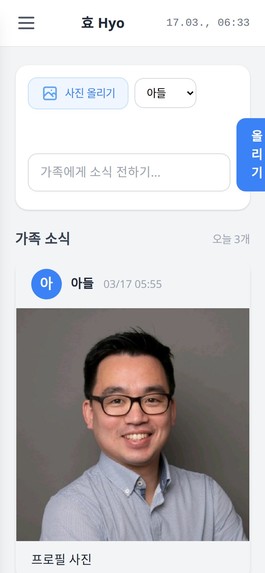
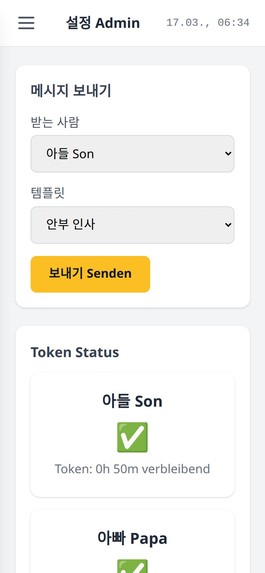
The original concept was a curated one-way channel: the son picks content, twice a week. We killed it — because 효 isn't just one son's duty. My sister is in Canada, my brother in Tokyo, grandchildren scattered across time zones. So it became 가족 앨범: anyone can post photos and news. At 20:00 KST, parents get a summary via KakaoTalk. The whole family can say "I thought of you" — not just the son.
Local AI → Google Gemini
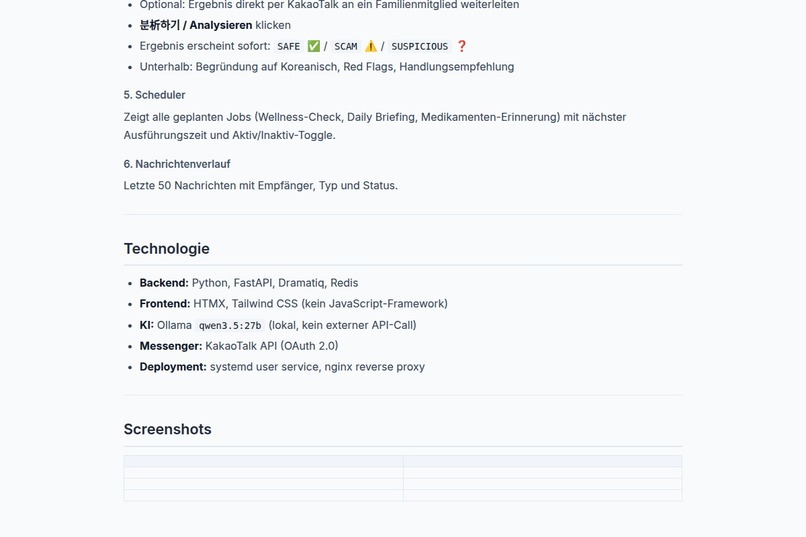
We planned local-only AI (Ollama qwen3.5:27b). Then we tested Korean scam detection. "택배 배송 실패" (delivery failed) is the #1 Korean phishing template — a local 27B model doesn't catch the cultural nuance. Gemini 3.1 Pro does. We split into two tiers: Flash (free) for summaries, Pro (paid) for judgment calls. The privacy tradeoff is real — we accepted it because a missed scam is worse.
YouTube — from bullet point to core feature
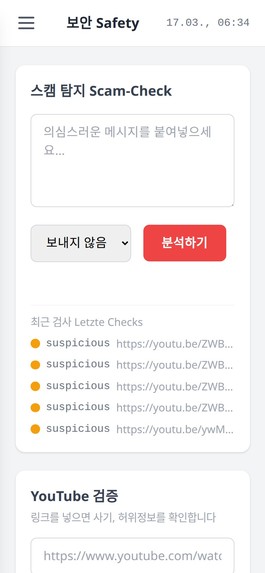
My father watches Korean YouTube for hours. Health advice, financial tips — some excellent, some "drink this herb tea to cure diabetes." He can't tell the difference. So we built a full 2-stage pipeline: transcript extraction → Flash summary → Pro fact-check with specific quotes and citations. Not "this video is bad" — but "the speaker claims X, which contradicts Y." This wasn't in the original plan. It became a priority because it's a daily, real threat.
Four dashboard iterations in one session
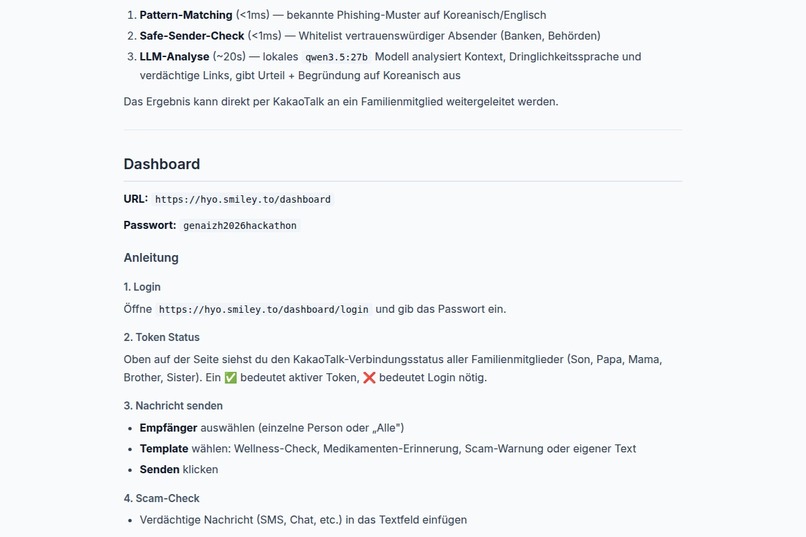
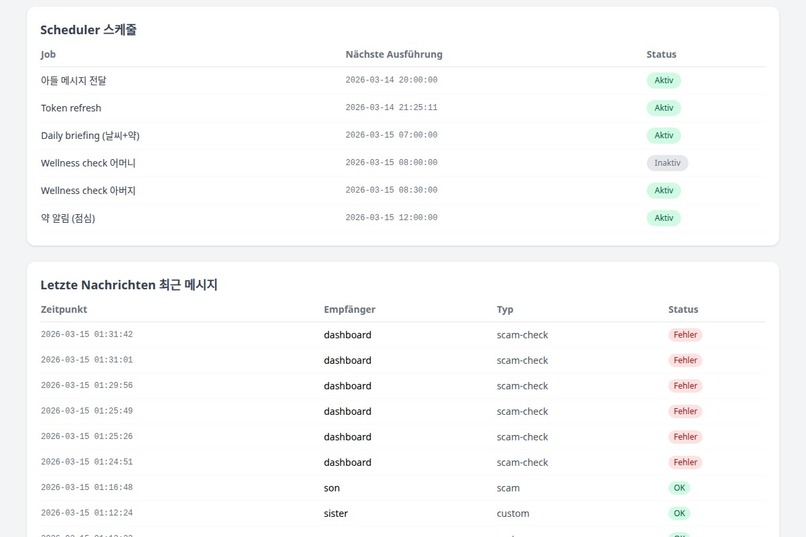
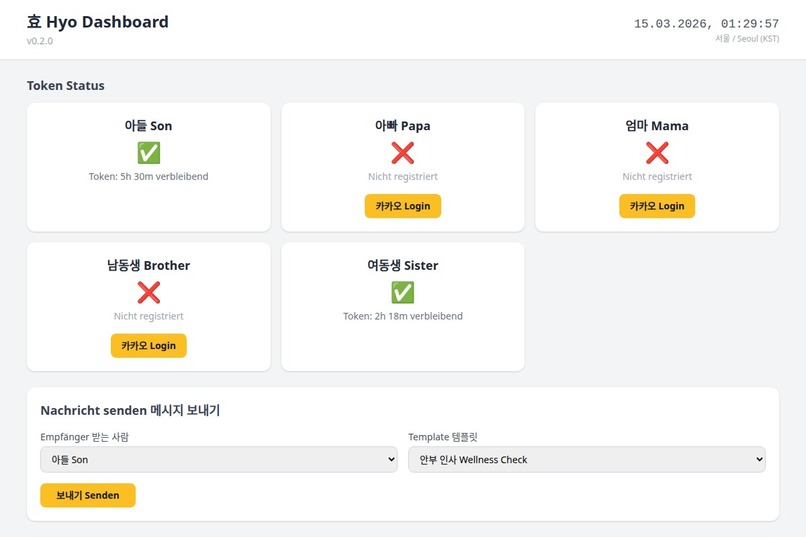
Long scroll page → collapsible sections → bottom tab bar → hamburger side menu. Each version was killed by a real usability problem: too much scrolling, font too small, bottom tabs colliding with Android navigation buttons. The lesson: designing for elderly users isn't making things bigger — it's showing fewer things at once. Final result: 3 pages, 18px base font, hamburger menu from the left.
The KakaoTalk wall
The pitch promised "no new app, just a chat contact." Reality: KakaoTalk requires a registered Korean business entity (사업자등록증) for full API access. No Swiss company, no hackathon team — a Korean entity filing Korean taxes. Without it, you only get "Send to Self." No chatbot, no receiving messages, no interactive forwarding.
This shaped everything. We built the dashboard because KakaoTalk won't let us be a chat contact — yet. Galaxy Watch, SmartThings, the conversational bot from the pitch — all blocked by the same gate. For a hackathon, registering a Korean company is disproportionate. So we built around it.
Our priorities
- Does it work on my parents' phone? Not in a demo — does the Korean arrive readable, does the message make sense at 6am in Seoul.
- Does the family stay connected? The album matters more than the scam detector. This is a family product that happens to include security.
- Does the AI actually help? Local Ollama → Gemini wasn't a technical upgrade. It was choosing "my mother gets a correct warning" over "the architecture looks impressive."
- Can a dentist maintain this from Zürich? If I can't debug it from 8,500 km through a conversation with Claude, it doesn't ship.
The pitch ended with: "효. Because distance shouldn't mean the end of devotion." The code says the same thing — just with more edge cases.


Log in or sign up for Devpost to join the conversation.