-
-
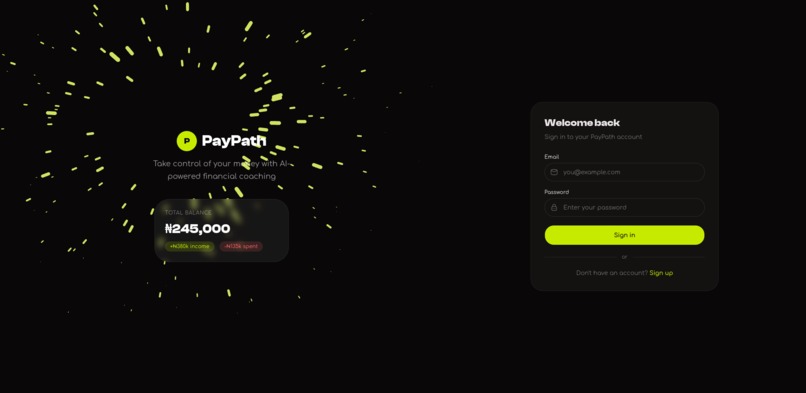
The Beautifully crafted Login Page
-
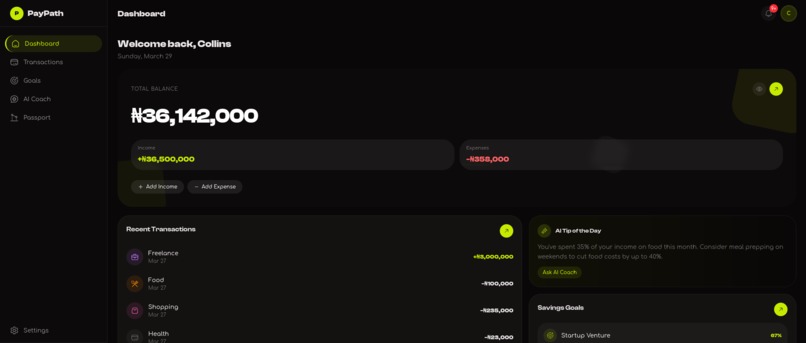
The Dashboard Page
-
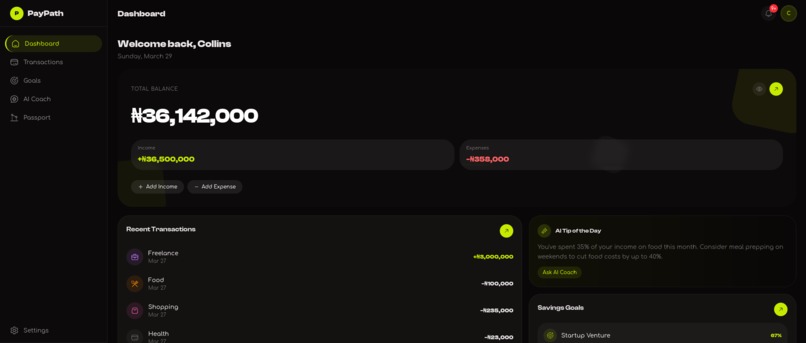
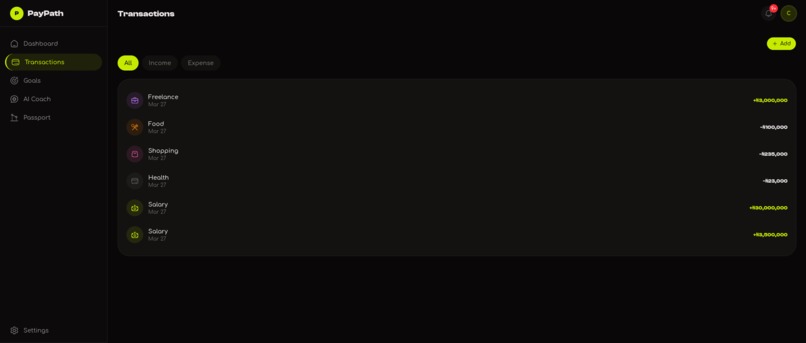
Transaction History page
-
-
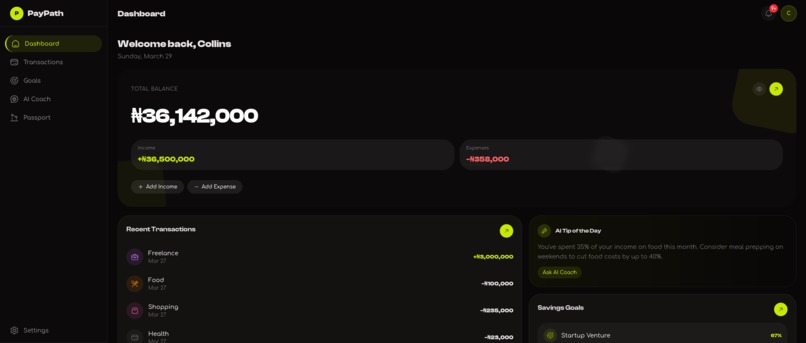
The Goals Page
-

The AI Coach Chatroom
-

The Financial Passport Page


Inspiration
Managing personal finances is difficult. Between informal income streams, mobile money fragmentation, and zero visibility into daily spending habits, most people are flying blindly with their money. We built PayPath because financial clarity should be a default.
What it does
PayPath is our mobile-first AI-powered personal finance app that helps users take control of their money through:
- Transaction Logging — Track income and expenses with smart categorization
- Dashboard Overview — Real-time snapshot of balance, spending trends, and financial health
- Goals Tracking — Set savings targets and monitor progress with visual progress bars
- AI Coaching — A conversational AI that answers financial questions, checks affordability in real time, and gives personalized money tips
- Financial Passport — A proprietary scoring system that grades your financial behavior and awards badges as you improve ## How we built it
- Frontend: Next.js 14 (App Router) + TypeScript + Tailwind CSS, organized around feature-based routing — auth, dashboard, transactions, goals, AI chat, and passport. State is managed via Zustand stores per domain.
- Backend: Node.js + TypeScript with an Express-style route/controller/service architecture. Prisma ORM handles all database interactions, with separate services for auth, transactions, goals, AI context, and passport scoring.
- AI Layer: Claude API powers the coaching engine, fed with user financial context via a dedicated context.service.ts that assembles transaction history, goals, and passport scores before each prompt. Infrastructure: CI/CD via GitHub Actions with separate deploy pipelines for frontend (Vercel) and backend. The repo follows a clean mono-repo structure with /frontend and /backend at the root.
Challenges we ran into
- AI Context Window Management — Feeding the right financial context to the AI without blowing token limits required careful pruning of transaction history and smart summarization in context.service.ts
- Real-Time Affordability Checks — Building the affordability widget to respond dynamically to user queries while keeping latency low was a significant backend and prompt engineering challenge
- Team Coordination at Speed — 5 engineers, hard deadline, multiple parallel workstreams. Keeping frontend and backend contracts in sync without constant blockers required tight API contract definition upfront
- Financial Passport Scoring Logic — Designing a scoring algorithm that felt meaningful and motivating rather than arbitrary took multiple iterations across the team
Accomplishments that we're proud of
- Shipped a fully functional AI-powered finance app end-to-end in hackathon time
- The Financial Passport system : a novel, gamified approach to financial health scoring
- Clean, production-grade codebase with CI/CD, PR templates, and a real team workflow.
- An AI coaching experience that feels contextual and personal, not generic
What we learned
- Prompt engineering for finance requires domain specificity
- Designing financial UX for mobile-first African users means prioritizing speed, offline resilience, and simplicity over feature density
- Building with a large team under deadline pressure forces better documentation habits



Log in or sign up for Devpost to join the conversation.