-
-
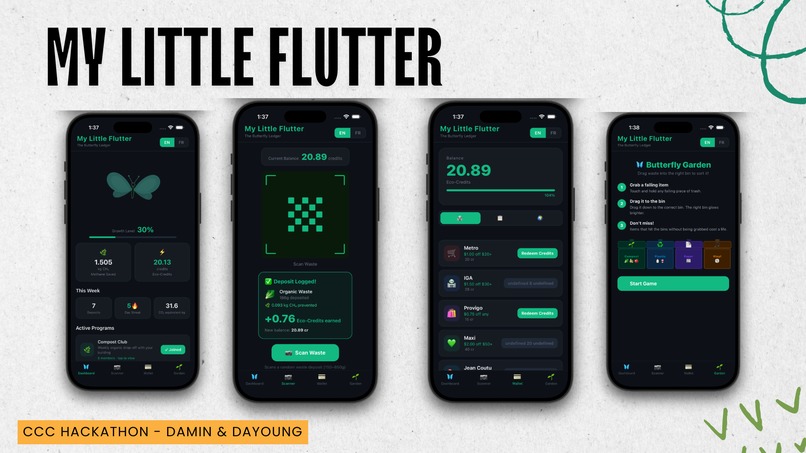
My Little Flutter Mobile UI

🦋 My Little Flutter: a small movement becoming big
Inspiration
This project started 12,000 kilometers away. Growing up in South Korea, recycling wasn't a chore — it was a cultural norm. You wash it, weigh it, sort it. The country recycles 95% of its food waste. Then I moved into a Toronto high-rise and encountered the "High-Rise Gap": a diversion rate stuck at 27%, not because residents don't care, but because the system gives them no reason to believe their effort matters. During a documentary screening at this hackathon's workshops, I watched a young girl try everything — sorting, writing letters to ambassadors, walking her neighbourhood — only to be told "stop, it's not going to work" by a peer, and to receive polite, empty responses from officials. She was hurt. But she kept going, driven by a sincerity the system lacked. My Little Flutter is built for her. It's for everyone whose small action has ever been dismissed.
What it does
My Little Flutter is a Smart Municipal Waste Ledger that transforms individual sorting acts into verifiable, city-level climate data — and tangible rewards. How it works:
Low-cost QR-coded stickers are placed on existing green bins in high-rise buildings (pennies per unit, zero new infrastructure) A resident scans the sticker with our React Native app when they deposit waste The app logs the deposit in a Spring Boot backend ledger and calculates the exact methane reduction of that act (1 kg diverted = 0.5 kg CH₄ prevented) The resident's on-screen "Butterfly" grows, visualizing their cumulative impact Eco-Credits accumulate and convert to real-world rewards: TTC passes, grocery vouchers, and discounts at Live Green Toronto–certified businesses
How we built it
Frontend: React Native (Expo) — multilingual UI supporting English, Korean, French, and Mandarin. A growing butterfly animation tied to the user's methane-reduction score. Backend: Java Spring Boot — a secure REST API acting as a municipal-grade waste transaction ledger. Core algorithm calculates per-deposit methane savings and aggregates data at the building level. Infrastructure logic: QR sticker system designed to sit on top of Toronto's existing green bin program — augmenting it, not replacing it.
Challenges we ran into
Verification: The current system relies on user honesty. Building a trust model without hardware is a real tension we're still working through. Municipal integration: Linking Eco-Credits to utility bills or property tax rebates requires city policy cooperation — something we've mapped but not yet secured. Scope management: It was tempting to solve everything. We deliberately scoped down to the feedback loop problem, which is the most tractable gap.
Accomplishments that we're proud of
A FULL mobile application! Built a functional Spring Boot API and React Native frontend over a single hackathon weekend Implemented a real methane-reduction algorithm grounded in emissions data Designed multilingual support from day one — not as an afterthought Mapped a realistic partnership and funding path through the Circular Food Innovators Fund and Live Green Toronto Told a human story that connects a Seoul kitchen habit to a Toronto apartment to a global methane target
What we learned
That the problem isn't apathy — it's invisibility. When people can't see their impact, sincerity fades. The girl writing letters to ambassadors didn't stop because she stopped caring; she stopped when the system stopped responding. Our job as technologists is to make the system respond. We also learned how deeply the Four Lenses framework shapes good design. Equity isn't a checkbox — in a city where 40% of residents speak a first language other than English, a system that only speaks English has already failed.
What's next for My Little Flutter
Hardware integration: Partner with IoT weight sensor providers to automate deposit verification on green bins Municipal pilot: Launch a "Waste Innovation Sandbox" in a high-density neighbourhood (Liberty Village or North York) in partnership with the City of Toronto's 3Rs Ambassador Program Credit expansion: Work with Loblaws and Sobeys (both with Net-Zero commitments) to sponsor Eco-Credits as branded grocery vouchers Policy pathway: Advocate for municipal linkage between Eco-Credits and utility bill reductions or property tax rebates
Four Lenses Applied
LensApplicationEquity & Justice Full multilingual support (Korean, French, Mandarin, Spanish). Designed for high-rise communities where immigrant and racialized residents are overrepresented.
Practical Lens QR stickers on existing bins. React Native + Spring Boot stack. Deployable city-wide in weeks. Funded by the landfill tipping fee savings it generates.
Two-Eyed Seeing Western data science (CH₄ algorithms, methane ledger) combined with Indigenous stewardship values — the "Butterfly Effect" as a framework for acting across seven generations.
Systems Approach One kitchen habit → building ledger → TransformTO Net Zero targets → Canada's 2030 Methane Reduction goals → global 1.5°C threshold.
Built With
- expo.io
- java
- javascript
- react-native
- rest-api
- spring-boot


Log in or sign up for Devpost to join the conversation.