Ad
Skip to content
Read full article about: US War Department CTO says Anthropic's AI models "pollute" the supply chain with built-in ethics

Emil Michael, the US Department of War's chief technology officer, made clear that classifying Anthropic as a supply chain risk is an ideologically motivated move. Claude models "pollute" the supply chain because they have a "different policy preference" baked into them, Michael told CNBC. He pointed to Anthropic's "constitution," a ruleset emphasizing ethics and safety, which he said could result in soldiers receiving "ineffective weapons, ineffective body armor, ineffective protection." The measure was "not meant to be punitive," he added.

Anthropic is the first US company to receive this classification, which is normally reserved for foreign adversaries. The AI company is suing over the designation and has drawn support from Microsoft, OpenAI, and Google employees, as well as former US military personnel. Anthropic has previously pushed back against its own AI models being used for US mass surveillance and autonomous weapons.

The administration has already signaled its intent to control AI along ideological lines by enacting regulations targeting so-called "woke AI," framed as a commitment to political neutrality. The approach echoes the Chinese government's own efforts to exert political control over AI models.

Comment Source: CNBC

Copilot Health marks Microsoft's entry into the AI health race alongside OpenAI and Anthropic

Microsoft is launching Copilot Health, an AI health assistant that pulls data from wearables, medical records, and lab results to deliver personalized health advice. Long term, the company says it’s working toward “medical superintelligence.”

Read full article about: Claude can now create interactive charts and visualizations directly in chat

Anthropic has launched a new beta feature for its AI chatbot Claude: the ability to generate interactive diagrams, charts, and visualizations directly within the conversation. The feature builds on a preview called "Imagine with Claude" from last fall, combining it with the existing "Artifacts" functionality - but embedded right in the chat flow instead of in a side panel, and labeled as "temporary," according to Anthropic.

Claude decides on its own when a visualization would be helpful, though users can also request one directly. Examples include interactive compound interest curves, an interactive decision tree, and a clickable periodic table. The feature is available across all pricing tiers.

Ad
Read full article about: ChatGPT still leads the chatbot market but its dominance is slipping as Google's Gemini gains ground

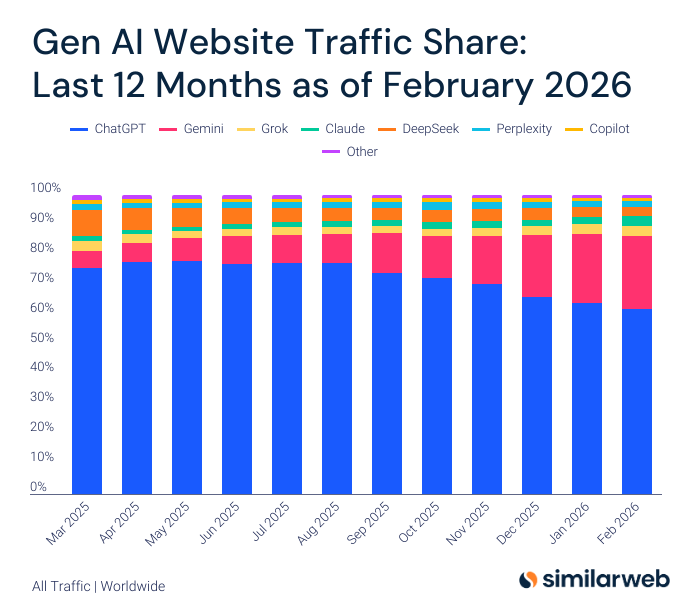
ChatGPT still dominates the chatbot market, but its lead is shrinking. New data from Similarweb shows OpenAI's chatbot accounted for just 61.7 percent of global AI web traffic in February 2026, down from 75.7 percent twelve months earlier. The biggest winner is Google Gemini, which more than quadrupled its share from 5.7 percent to 24.4 percent over the same period. Grok (3.4 percent) and Claude (3.3 percent) have overtaken DeepSeek (3.2 percent) for the first time, claiming third and fourth place. Claude crossed the three percent mark for the first time in February, though it's much stronger in the B2B market, according to a separate study.

Image
ChatGPT still leads overall, but Google Gemini has closed the gap significantly. These figures only cover web traffic. | Image: Similarweb

In absolute numbers, ChatGPT recorded 5.35 billion visits in February, while Gemini pulled in 2.11 billion. Grok came in at 298.5 million visits, Claude at 290.3 million, Deepseek at 246.4 million, and Perplexity at 153.8 million. Microsoft's Copilot stagnated at 1.1 percent market share, though that only reflects the web version. Microsoft's actual share of the enterprise market is likely much higher.

Meta's JEPA architecture outperforms standard AI methods in noisy medical imaging

Researchers have presented an AI model for cardiac ultrasound based on Meta’s JEPA architecture that outperforms common methods such as masked autoencoder or contrastive learning, according to their benchmarks.

Ad

Nvidia steps into the open-source AI gap that OpenAI, Meta, and Anthropic left behind

An SEC filing reveals that Nvidia plans to spend $26 billion on open-weight AI models over the next five years. The move doubles as a strategic response to the growing dominance of Chinese open-source models – and a way to keep developers locked into Nvidia’s hardware ecosystem.

Read full article about: Google's new Ask Maps lets you search for places in plain language using Gemini AI

Google has introduced "Ask Maps," a conversational feature powered by its Gemini models. Users can ask questions in plain language, like "Is there a public tennis court with lights on that I can play at tonight?" or "My phone is dying — where can I charge it without having to wait in a long line for coffee?" The feature taps into data from more than 300 million locations and reviews from over 500 million contributors.

Results show up on a personalized map based on past searches and saved places. Users can book tables, save or share locations, and jump into navigation directly. Ask Maps is rolling out first in the US and India on Android and iOS, with a desktop version on the way.

Google also announced "Immersive Navigation," a revamped turn-by-turn system with a 3D view of surroundings, including buildings, overpasses, and lane markings. Gemini models generate the visuals by analyzing Street View and aerial imagery.

Immersive Navigation launches first in the US, expanding to more iOS and Android devices, CarPlay, Android Auto, and cars with built-in Google over the coming months.

Read full article about: OpenAI is reportedly planning to integrate its video AI Sora into ChatGPT

OpenAI is reportedly planning to fold its video AI Sora directly into ChatGPT. So far, Sora has only been available as a standalone mobile and web app. OpenAI originally pitched it as a viral hit and potential TikTok alternative, a strategy that seemed to work early on, partly thanks to massive copyright infringements.

That momentum didn't last. According to The Information, the app has slid from No. 1 to No. 165 in the Apple App Store since launching last fall. CEO Sam Altman reportedly admitted internally that hardly anyone was sharing videos publicly. Rolling Sora into ChatGPT might fix that: with around 920 million weekly active users, the move would naturally drive more video generation. The standalone app will stick around for now, The Information reports.

Google already offers video generation in Gemini, though with tight capacity limits and only for paying subscribers. OpenAI will likely go a similar route: the company is strapped for compute, burns through cash supporting the roughly 95 percent of free ChatGPT accounts, and video generation is especially resource-hungry.

Ad