
A Thread Pool is a collection of pre-created, reusable threads that are kept ready to perform tasks. Instead of creating a new thread every time you need to run something (which is costly in terms of memory and CPU), a thread pool maintains a fixed number of threads. When a task is submitted:
- If a thread is free, it immediately picks up the task and runs it.
- If all threads are busy, the task waits in a queue until a thread becomes available.
- After finishing a task, the thread does not die. It goes back to the pool and waits for the next task.
Real World Analogy
Think of a call center:
- A company has 10 operators (thread pool size = 10).
- When customers call, available operators handle them.
- If all operators are busy, new customers wait in a queue until someone is free.
- Operators don’t leave after one call, they stay and handle more calls.
Benefits of Thread Pool
- Better Performance: Threads are reused instead of being created and destroyed repeatedly.
- Faster Response Time: Tasks don’t need to wait for a new thread to be created.
- Reusability: Threads remain alive after finishing tasks and are reused for future tasks.
- Resource Management: Limits the number of concurrent threads, preventing OutOfMemoryError or CPU overload.
Thread Pool Initialization
When we initialize a thread pool:
- A fixed number of worker threads are created (e.g., 3).
- These threads are kept idle, waiting for tasks.
- A task queue is set up to hold submitted tasks until a worker is free.
Thread Pool Working
Here is the step by step working of thread pool.
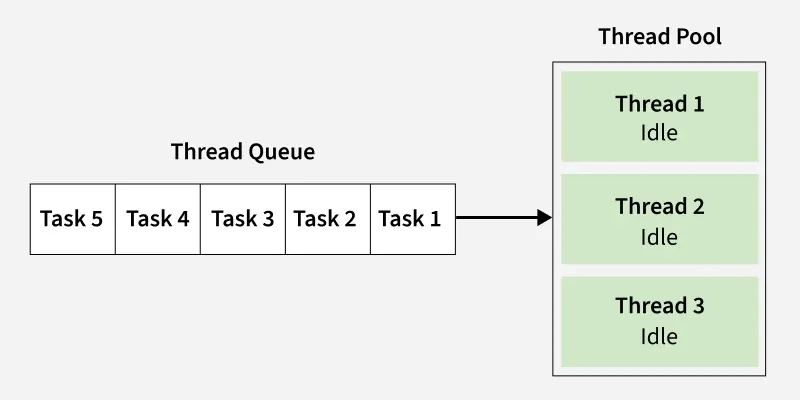
Step 1: Idle State
- Tasks are submitted and placed in the Task Queue.
- Worker threads exist but are idle until work arrives.
Step 2: Task Assignment
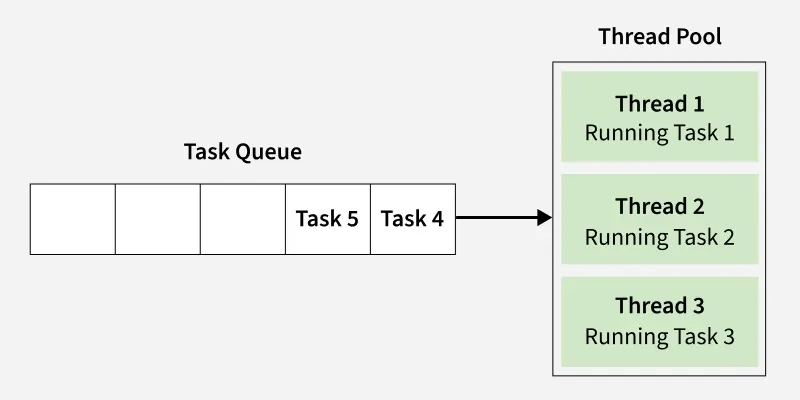
- Each idle thread picks a task from the queue.
- Example: Thread 1 -> Task 1, Thread 2 -> Task 2, Thread 3 -> Task 3
- Remaining tasks (Task 4, Task 5) wait in the queue.
Step 3: Thread Reuse
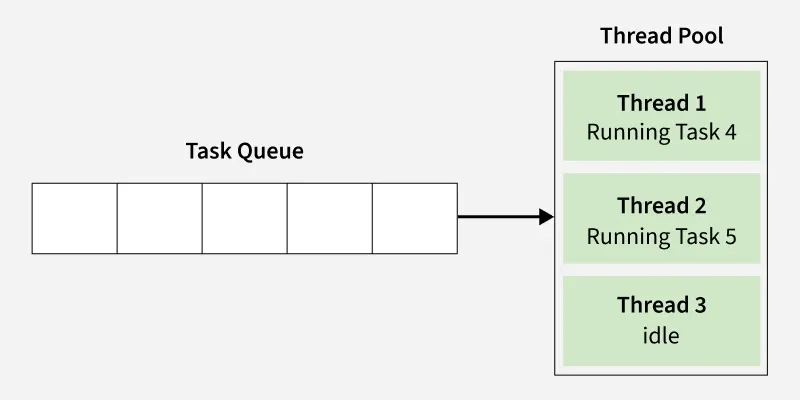
- Once a thread completes its current task, it becomes idle again.
- It immediately takes the next waiting task from the queue.
- Example: Thread 1 -> Task 4, Thread 2 -> Task 5, Thread 3 -> Idle (no tasks left)
Code Example: Simple Thread Pool
import java.util.concurrent.BlockingQueue;
import java.util.concurrent.LinkedBlockingQueue;

// Worker thread that executes tasks
class Worker extends Thread {
    private final BlockingQueue<Runnable> taskQueue;
    private static final Runnable POISON_PILL = () -> {};

    public Worker(BlockingQueue<Runnable> queue, String name) {
        super(name);
        this.taskQueue = queue;
    }

    public void run() {
        try {
            while (true) {
                Runnable task = taskQueue.take();

                if (task == POISON_PILL) {
                    break; // stop worker
                }

                try {
                    task.run();
                } catch (Exception e) {
                    System.out.println("Task error: " + e.getMessage());
                }
            }
        } catch (InterruptedException e) {
            Thread.currentThread().interrupt();
        }
    }
}

// Thread Pool Implementation
class SimpleThreadPool {
    private final BlockingQueue<Runnable> taskQueue;
    private final Worker[] workers;
    private volatile boolean isShutdown = false;
    private static final Runnable POISON_PILL = () -> {};

    public SimpleThreadPool(int poolSize) {
        taskQueue = new LinkedBlockingQueue<>();
        workers = new Worker[poolSize];

        for (int i = 0; i < poolSize; i++) {
            workers[i] = new Worker(taskQueue, "Worker-" + (i + 1));
            workers[i].start();
        }
    }

    // Submit task
    public void submit(Runnable task) throws InterruptedException {
        if (!isShutdown) {
            taskQueue.put(task); // safer than offer()
        } else {
            throw new IllegalStateException("ThreadPool is shutdown");
        }
    }

    // Shutdown pool gracefully
    public void shutdown() {
        isShutdown = true;

        // Send stop signal to all workers
        for (int i = 0; i < workers.length; i++) {
            try {
                taskQueue.put(POISON_PILL);
            } catch (InterruptedException e) {
                Thread.currentThread().interrupt();
            }
        }

        // Wait for workers to finish
        for (Worker worker : workers) {
            try {
                worker.join();
            } catch (InterruptedException e) {
                Thread.currentThread().interrupt();
            }
        }
    }
}

// Test Program
public class ThreadPoolDemo {
    public static void main(String[] args) {
        SimpleThreadPool pool = new SimpleThreadPool(3);

        try {
            for (int i = 1; i <= 5; i++) {
                int taskId = i;

                pool.submit(() -> {
                    System.out.println("Executing Task " + taskId + " by " + Thread.currentThread().getName());
                    try {
                        Thread.sleep(1000);
                    } catch (InterruptedException e) {
                        Thread.currentThread().interrupt();
                    }
                });
            }
        } catch (InterruptedException e) {
            Thread.currentThread().interrupt();
        }

        pool.shutdown();
        System.out.println("All tasks completed.");
    }
}
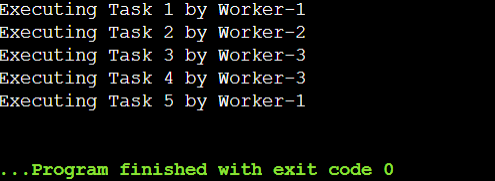
Output:
Thread Pool methods
Here is the table of thread pool methods.
| Method | Purpose |
|---|---|
| submit(Runnable task) | Adds a task into the queue for execution by worker threads. |
| shutdown() | Gracefully stops the thread pool → no new tasks accepted, workers stop after finishing current tasks. |
| shutdownNow() (optional) | Immediately interrupts workers and clears pending tasks. |
| getQueueSize() (optional) | Returns how many tasks are waiting in the queue. |
| getActiveCount() (optional) | Returns number of threads currently executing tasks. |
