H – Heather (1)

Image (bell) heather or ling

My kingdom, by Robert Louis Stevenson

My Kingdom
DOWN by a shining water well
I found a very little dell,
No higher than my head.
The heather and the gorse about
In summer bloom were coming out,
Some yellow and some red.

read the rest of My kingdom here

Image

yellow gorse growing in Heddon’s Valley, North Devon (UK). When the sun shine warms it, it smells of something akin to coco-nut/vanilla – lovely

G – Ginkgo (2) a haiku

a haiku by Judith Gorgone

PAPERCUT
shadow of a ginkgo tree
oriental papercut
cast by April sun

(reproduced by kind permission of Judith Gorgone)
who is a running a haiku-writing contest for children in the U.S., closing date (Earthday) 15 November 2007

Painted Ginkgo leaves lend themselves as a printing medium or you can use them as a negative stencil

Image

G – Ginkgo (1)

Image

written by Johann Wolfgang von Goethe

Gingko
This leaf from a tree in the East,
Has been given to my garden.
It reveals a certain secret,
Which pleases me and thoughtful people.

Does it represent One living creature
Which has divided itself ?
Or are these Two, which have decided,
That they should be as One ?

To reply to such a Question,
I found the right answer :
Do you notice in my songs and verses
That I am One and Two ?

And a different version:

GINKGO BILOBA

The leaf of this Eastern tree
Which has been entrusted to my garden
Offers a feast of secret significance,
For the edification of the initiate.

Is it one living thing
That has become divided within itself?
Are these two who have chosen each other,
So that we know them as one?

I think I have found the right answer
To these questions;
Do my songs not make you feel
That I am both one and twain?

in the original German:

Dieses Baums Blatt, der von Osten
Meinem Garten anvertraut,
Gibt geheimen Sinn zu kosten,
Wie’s den Wissenden erbaut.
Ist es ein lebendig Wesen,
Das sich in sich selbst getrennt?
Sind es zwei, die sich erlesen,
Dasz man sie als Eines kennt?

Solche Frage zu erwidern,
Fand ich wohl den rechten Sinn:
Fühlst du nicht an meinen Liedern,
Dasz ich Eins und doppelt bin?

and in French:

GINKGO BILOBA

La feuille de cet arbre, qui, de l’orient,
Est confié à mon jardin.
Offre un sens caché
Qui charme l’initié.

Est-ce un être vivant
Qui s’est scindé en lui-même ?
Sont-ils deux qui se choisissent
Si bien qu’on les prend pour un seul ?

Pour répondre à ces questions,
Je crois avoir la vraie manière :
Ne sens-tu pas, à mes chants
Que je suis à la fois un et double ?

For further reading about the ginkgo

R – Rose (1)

Image

Hendecasyllabics by Algernon Charles Swinburne

In the month of the long decline of roses
I, beholding the summer is dead before me,
set my face to the sea and journeyed silent,
gazing eagerly where above the sea mark
flame as fierce as the fervid eyes of lions
half divided the eyelids of the sunset;
Till I heard as it were a noise of waters
moving tremulous under feet of angels
multitudinous, out of all the heavens;
Knew the fluttering wind, the fluttered foliage,
shaken fitfully, full of sound and shadow;
and saw, trodden upon by noiseless angels,
long mysterious reaches fed with moonlight,
sweet sad straits in a soft subsiding channel,
blown about by the lips of winds I knew not,
winds not born in the north nor any quarter,
winds not warm with south nor any sunshine:
heard between them a voice of exultation,
‘Lo, the summer is dead, the sun is faded,
even like as a leaf the year is withered,
all the fruits of the day from all her branches
gathered, neither is any left to gather.
…….

read all of Hendecasyllabics here

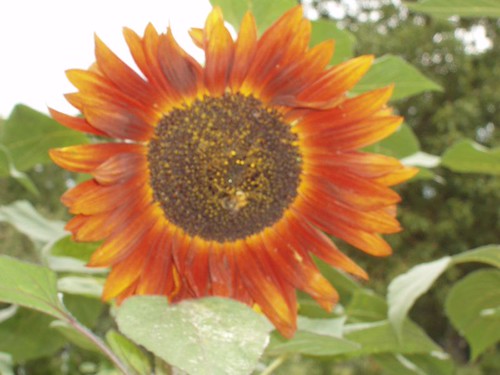
S – sunflower

Image 

Cripple, by Carl Sandburg

…….

I said to myself
I would rather have been a tall sunflower
Living in a country garden
Lifting a golden-brown face to the summer,
Rain-washed and dew-misted,
Mixed with the poppies and ranking hollyhocks,
And wonderingly watching night after night
The clear silent processionals of stars.

read all of Cripple here

L – lemons

YELLOW

In the beginning

Oho – long before that

When light was deciding who should be in and who should be out of spectrum

Yellow was in trouble

………………..
Naturally, by a sudden change of hue

Green saw the light, and Yellow got in

Worked out fine

Yellow got lemons

And Green got limes

by Ken Nordine

listen to a recording of Ken Nordine reading “Yellow”

Image

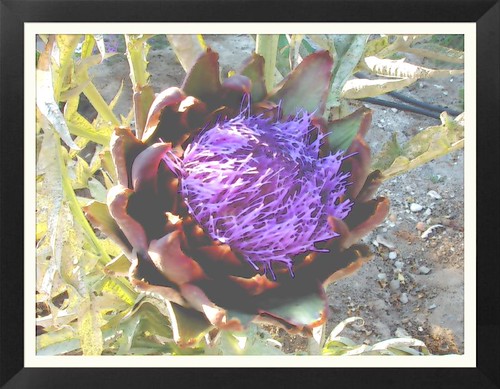
A – artichoke

Image

To a Gardener, by Robert Louis Stevenson

……
Nor thence be missed the speary heads
of artichoke; nor thence the bean
that gathered innocent and green
outsavours the belauded pea.
These tend, I prithee; and for me,
thy most long-suffering master, bring
in April, when the linnets sing
and the days lengthen more and more,
at sundown to the garden door.
And I, being provided thus,
shall, with superb asparagus,
a book, a taper, and a cup
of country wine, divinely sup.

Read all of To a gardener here

* esculents – suitable for eating, edible
* pease-cods – the pod of the pea

Writing in the fourth century AD, Palladius, an agricultural author recommended that a cat be kept in an artichoke patch to keep away rodents and moles.

Image

FotoSketcher - 200507100002_artichoke.JPG

P – Pumpkin

Cinderella goes to the ball

“Good evening, child,” said the visitor in a sharp clear voice, at the same time nodding kindly across the firelight. “You seem to be in trouble. What is the matter?”
“I wish,” sobbed Cinderella. “I wish,” she began again, and again she choked. This was all she could say for weeping.
“You wish, dear, that you could go to the ball; is it not so?”
“Ah, yes!” said Cinderella with a sigh.
“Well, then,” said the visitor, “be a good girl, dry your tears, and I think it can be managed. I am your godmother, you must know, and in younger days your mother and I were very dear friends.” She omitted, perhaps purposely, to add that she was a Fairy; but Cinderella was soon to discover this too. “Do you happen to have any pumpkins in the garden?” her godmother asked.
Cinderella thought this an odd question. She could not imagine what pumpkins had to do with going to a ball. But she answered that there were plenty in the garden-a whole bed of them in fact.

Image
“Then let us go out and have a look at them.”
They went out into the dark garden to the pumpkin patch, and her godmother pointed to the finest of all with her wand.
“Pick that one,” she commanded.
Cinderella picked it, still wondering. Her godmother opened a fruit knife that had a handle of mother-of-pearl. With this she scooped out the inside of the fruit till only the rind was left; then she tapped it with her wand, and at once the pumpkin was changed into a beautiful coach all covered with gold.
“Next we must have horses,” said her godmother mother. “The question is, Have you such a thing as a mouse trap in the house?”
Cinderella ran to look into her mouse trap, where she found six mice all alive. Her godmother, following, told her to lift the door of the trap a little way, and as the mice ran out one by one she gave each a tap with her wand, and each mouse turned at once into a beautiful horse-which made a fine team of six horses, of a lovely grey, dappled with mouse colour.
Now the trouble was to find a coachman.
“I will go and see,” said Cinderella, who had dried her tears and was beginning to find this great fun, “if there isn’t such a thing as a rat in the rat trap. We can make a coachman of him.”
“You are right, dear,” said her godmother; “run and look.”
Cinderella fetched her the rat trap. There were three large rats in it. The Fairy chose one of the three because of his enormous whiskers, and at a touch he was changed into a fat coachman.
Next she said: “Go to the end of the garden; and there in the corner of the wall behind the watering-pot, unless I am mistaken, you will find six lizards. Bring them to me.”
Cinderella had no sooner brought them than her godmother changed them into six footmen, who climbed up at once behind the coach with their bedizened liveries, and clung on as though they had been doing nothing else all their lives.
The Fairy then said to Cinderella: “Hey now, child! This will do to go to the ball with, unless you are hard to please.”
“Indeed, yes,” answered Cinderella. “But how can I go, as I am, in these horrid clothes?”
“You might have given me credit for thinking of that too!” Her godmother did but touch her with her wand, and on the instant her rags were transformed into cloth of gold and silver, all be-spangled with precious stones. She felt her hair creeping up into curls, and tiring and arranging itself in tiers, on the topmost of which a double ostrich feather grew from a diamond clasp that caught the rays of the old lady’s wand and shot them about the garden, this way and that, making the slugs and snails crawl to shelter.
“But the chief mark of a lady,” said her godmother, eying her with approval, “is to be well shod,” and so saying she pulled out a pair of glass slippers, into which Cinderella poked her toes doubtfully, for glass is not as a rule an accommodating material for slippers. You have to be measured very carefully for it.
But these fitted to perfection: and thus arrayed from top to toe, Cinderella had nothing more to do but kiss her godmother, thank her, and step into the coach, the six horses of which were pawing the cabbage beds impatiently.
“Good-bye, child!” said her godmother. “But of one thing I must warn you seriously. I have power to send you thus to the ball, but my power lasts only until midnight. Not an instant beyond midnight must you stay there. If you over-stay the stroke of twelve, your coach will become but a pumpkin again, your horses will change back into mice, your footmen into lizards, and your ball dress shrink to the same rags in which I found you.”

you can read the whole story of Cinderella here