

 Posts
Posts


Showing posts with label college completion. Show all posts
Showing posts with label college completion. Show all posts
Monday, July 30, 2012
They [ STILL! ] Do What They Do!! ;D
When I read this article, it made my blood boil! Amazing that this junk makes it into print!
(Since it's Monday, you may want to put reading this one on hold...)
Is Algebra Necessary?
NYTimes Sunday Review, Opinion Pages
I agree with rknop that
"the core of his argument is the ultimate in anti-intellectualism"


Monday, July 26, 2010
we're number 12
The United States used to lead the world in the number of 25- to 34-year-olds with college degrees. Now it ranks 12th among 36 developed nations.
[snip]
“We spend a fortune recruiting freshmen but forget to recruit sophomores,” Michael McPherson, president of the Spencer Foundation, said at the meeting.
[snip]
“We led the world in the 1980s, but we didn’t build from there,” he said. “If you look at people 60 and over, about 39-40 percent have college degrees, and if you look at young people, too, about 39-40 percent have college degrees. Meanwhile, other countries have passed us by.”
Canada now leads the world in educational attainment, with about 56 percent of its young adults having earned at least associate’s degrees in 2007, compared with only 40 percent of those in the United States. (The United States’ rate has since risen slightly.)
While almost 70 percent of high school graduates in the United States enroll in college within two years of graduating, only about 57 percent of students who enroll in a bachelor’s degree program graduate within six years, and fewer than 25 percent of students who begin at a community college graduate with an associate’s degree within three years.
[snip]
The problem begins long before college, according to the report released Thursday.
“You can’t address college completion if you don’t do something about K-12 education,” Mr. Kirwan said.
Once a Leader, U.S. Lags in College Degrees
By TAMAR LEWIN
Published: July 23, 2010
Tuesday, December 1, 2009
"deep shift in the makeup of unions"
in the Times:
Economix: Union Members Getting More Educated
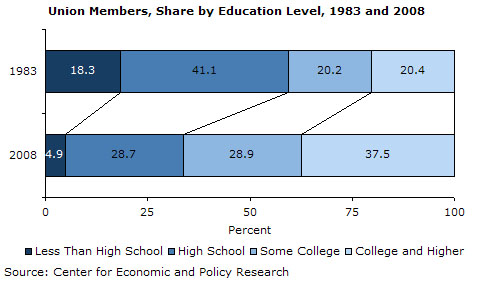
The 2002 Census shows that "more than one-quarter" of adults hold a college degree.
Amongst union members, that figure is 37.5%.
A study has found that just one in 10 union members is in manufacturing, while women account for more than 45 percent of the unionized work force.
The study, by the Center for Economic Policy Research, a Washington-based group, found that union membership is far less blue-collar and factory-based than in labor’s heyday, when the United Automobile Workers and the United Steelworkers dominated.
[snip]
About 48.9 percent of union members are in the public sector, up from 34 percent in 1983. About 61 percent of unionized women are in the public sector, compared to 38 percent for men.
[snip]
The study found that 38 percent of union members had a four-year college degree or more, up from 20 percent in 1983. Just under half of female union members (49.4 percent) have at least a four-year degree, compared with 27.7 percent for male union members.
[snip]
The percentage of men in unions has dropped sharply, to 14.5 percent in 2008, from 27.7 percent in 1983, while the percentage for women dropped more slowly, to 13 percent last year, from 18 percent in 1983. For the work force over all, the percentage of workers in unions dropped to 12.4 percent last year, from 20.1 percent in 1983.
Economix: Union Members Getting More Educated

The 2002 Census shows that "more than one-quarter" of adults hold a college degree.
Amongst union members, that figure is 37.5%.
Wednesday, August 12, 2009
factoids
from The Condition of Education 2009:
homeschooling
college
Looking next at college enrollment, the percentage of students who enroll in college right after high school increased from 49 percent in 1972 to 67 percent in 2007.
Approximately 58 percent of first-time students seeking a bachelor’s degree or its equivalent and attending a 4-year institution full time in 2000–01 completed a bachelor’s degree or its equivalent at that institution within 6 years
Briefing on the Condition of Education 2009
the condition of education web site
- In 2007, 6.7 million or 13.6 percent of public school students received special education services.
- The ratio of students to teachers, which is sometimes used as a proxy measure for class size, declined between 1990 and 2006, from 17.6 to 15.9 students per teacher for all regular public schools
- Total expenditures per student in fall enrollment in public elementary and secondary schools rose 31 percent in constant dollars between 1989–90 and 2005–06, from $8,627 to $11,293
- [F]or 17-year-olds, the average reading score was higher in 2008 than in 2004, but was not measurably different from the score in 1971
- [F]or 17-year-olds, the average [mathematics] score in 2008 was not measurably different from the scores in either 2004 or 1973.
- about three-quarters of the 2003 freshman class graduated from public high schools on time in 2006
homeschooling
- In 2007, about 1.5 million, or 2.9 percent of all school-aged children in the United States were homeschooled.
- This number has increased from 850,000 in 1999 and 1.1 million in 2003.
- In 2007, 36 percent of parents of homeschooled children cited a desire to provide religious or moral instruction as the most important reason for homeschooling their child, followed by 21 percent who cited concerns about school environments, and 17 percent who were dissatisfied with academic instruction.
college
Looking next at college enrollment, the percentage of students who enroll in college right after high school increased from 49 percent in 1972 to 67 percent in 2007.
Approximately 58 percent of first-time students seeking a bachelor’s degree or its equivalent and attending a 4-year institution full time in 2000–01 completed a bachelor’s degree or its equivalent at that institution within 6 years
- the top field for bachelor's degree earners was business, which accounted for 21 percent of degrees awarded.
- Social science and history was the next largest field at 11 percent;
- followed by education and health professions and related sciences, each of which accounted for 7 percent of degrees awarded;
- the next largest fields were psychology and visual and performing arts at 6 percent each;
- followed by engineering, communication, and the biological sciences at 5 percent each.
- This is about $10,000 more than those with an associate's degree,
- About $16,000 more than those who had completed high school, and
- About twice as much as those who did not earn a high school diploma.
Briefing on the Condition of Education 2009
the condition of education web site
Thursday, April 9, 2009
SAT scores & retention: UC Irvine
Second-Year Freshman Retention Rates by Mean SAT Composite Score (pdf file)
Have just begun looking into this.
Have just begun looking into this.
Sunday, June 24, 2007
helicopter parents & the $40,000 tuition bill
from Steve H:
We know a family whose child may not make it through college; I believe the parent is in debt for at least $40,000.* Middle class income. When we look at colleges I'm going to want to know a school's college completion rate and success rate at placement in graduate programs. I don't want to pay $40,000 (make that borrow $40,000) for gatekeeping.
Paying $22,000/yr for gatekeeping in my middle & high school will be quite enough.
We've also been told that Cornell's entry-level science courses are particularly brutal. You send your science kid to Cornell, and by second semester freshman year he's majoring in sociology.
At least, that's what we've heard. Assuming it's true, C. won't be applying to Cornell.
Ed says NYU has a fantastic record getting its undergraduates into graduate programs, fyi. That's good to hear. Our big perk in life is that C. can attend NYU for free if he's accepted. We pay taxes on the tuition fee, but that's it.
On the other hand, although I've thought the helicopter parent meme was a crock ever since I heard the words, last weekend my sister-in-law, a professor in a nursing program, told me she has parents calling her up constantly to tell her their child is sick and can't come to clinic; can she give them a do-over; etc.
I find that bizarre.
Ed says he's never heard from a parent in his entire career. Of course, he did once hear from a psychiatrist that one of his students wanted to murder him along with a couple of other professors. (That's another story.)
His brother said Bryn Mawr hears from parents, but I have no sympathy for Bryn Mawr given what it's charging. Of course if parents are calling their kids in sick, my feeling is the kid better be in the hospital even with the $40,000 bill.
sheesh
accountability at the graduate level
Interestingly, graduate-level programs probably have quite a bit of accountability.
Ed is the head of the Institute of French Studies, which awards Ph.D.s. The university closely tracks placement of their graduates in assistant professorships. One year the statistics got messed up so it looked as if they hadn't placed their new Ph.Ds in jobs, and Ed heard from the administration right away.
I'm going to try to get him to look into what kinds of accountability exists for undergraduate education in general.
accountability in schools of design
Gosh, I wish I could remember the conversation Ed had with our friend who is an architect on the Ground Zero buildings....
He was talking about the point at which gatekeeping should begin.
I think he said that in the field of design, professor-as-gatekeeper should start in early graduate school. Assuming I'm remembering this correctly, I believe he said that by then a professor in a good school of design can easily distinguish different levels of talent and accomplishment, and that the job market in design is so competitive that it is an absolute waste of money to pusue an advanced degree in design if your professors don't think you can make it.
It's possible he said this about undergraduate programs like RISD's, but I don't think so. I have the distinct impression he put the gatekeeping function pretty far down the line. I definitely recall finding what he said both useful and commonsensical. It made sense to me both as a person who once attended graduate school and as a person who may one day be trying to pay for graduate school.
In any case, I dislike surrogate gatekeeping. Medical schools don't need Cornell to help them winnow out applicants.
speaking of medical schools
One of our administrators is friends with a high-level administrator at a medical school. (I think the friend may be a dean.)
He said that across the board the best colleges produce students with the best standardized test scores. This is true without fail.
None of this stuff is a mystery.
And no medical school needs undergraduate institutions to make their choices for them.
* In this case the problem is almost certainly that the student simply is not prepared for college level work. Of course, this raises the question of whether the college should be taking the parent's money, and I don't know the answer to that since I don't know what the student's scores and grades were.
Parents are paying customers, not helicopters. The college should teach and the parents should parent. For the astronomical amounts that colleges charge, they should not expect parents to pay the bill and go away.
Little (big) Johnnie or Suzie might drop out after $40,000+ is spent with absolutely nothing to show for it. The presumption that the onus falls completely on the student is a cop-out. Johnnie or Suzie might deserve to flunk out, or it could be that the school takes their money and tosses them into the deep end of the pool.
Many parents would be more than happy to let their kids figure it out on their own after they hit 18, but not when it's costing them $40,000+ a year. And colleges should worry more about their flunk-out rate after a highly competitive application process. [ed.: exactly]
Most colleges aren't lowering their standards to recruit students. They get to pick the best for their school. Then they demand extraordinary amounts of money to teach the kids in a sink or swim environment. Then they want the parents to pay the bills and go away.
It won't happen. The problem isn't about growing up, it's about getting something for your money.
We know a family whose child may not make it through college; I believe the parent is in debt for at least $40,000.* Middle class income. When we look at colleges I'm going to want to know a school's college completion rate and success rate at placement in graduate programs. I don't want to pay $40,000 (make that borrow $40,000) for gatekeeping.
Paying $22,000/yr for gatekeeping in my middle & high school will be quite enough.
We've also been told that Cornell's entry-level science courses are particularly brutal. You send your science kid to Cornell, and by second semester freshman year he's majoring in sociology.
At least, that's what we've heard. Assuming it's true, C. won't be applying to Cornell.
Ed says NYU has a fantastic record getting its undergraduates into graduate programs, fyi. That's good to hear. Our big perk in life is that C. can attend NYU for free if he's accepted. We pay taxes on the tuition fee, but that's it.
On the other hand, although I've thought the helicopter parent meme was a crock ever since I heard the words, last weekend my sister-in-law, a professor in a nursing program, told me she has parents calling her up constantly to tell her their child is sick and can't come to clinic; can she give them a do-over; etc.
I find that bizarre.
Ed says he's never heard from a parent in his entire career. Of course, he did once hear from a psychiatrist that one of his students wanted to murder him along with a couple of other professors. (That's another story.)
His brother said Bryn Mawr hears from parents, but I have no sympathy for Bryn Mawr given what it's charging. Of course if parents are calling their kids in sick, my feeling is the kid better be in the hospital even with the $40,000 bill.
sheesh
accountability at the graduate level
Interestingly, graduate-level programs probably have quite a bit of accountability.
Ed is the head of the Institute of French Studies, which awards Ph.D.s. The university closely tracks placement of their graduates in assistant professorships. One year the statistics got messed up so it looked as if they hadn't placed their new Ph.Ds in jobs, and Ed heard from the administration right away.
I'm going to try to get him to look into what kinds of accountability exists for undergraduate education in general.
accountability in schools of design
Gosh, I wish I could remember the conversation Ed had with our friend who is an architect on the Ground Zero buildings....
He was talking about the point at which gatekeeping should begin.
I think he said that in the field of design, professor-as-gatekeeper should start in early graduate school. Assuming I'm remembering this correctly, I believe he said that by then a professor in a good school of design can easily distinguish different levels of talent and accomplishment, and that the job market in design is so competitive that it is an absolute waste of money to pusue an advanced degree in design if your professors don't think you can make it.
It's possible he said this about undergraduate programs like RISD's, but I don't think so. I have the distinct impression he put the gatekeeping function pretty far down the line. I definitely recall finding what he said both useful and commonsensical. It made sense to me both as a person who once attended graduate school and as a person who may one day be trying to pay for graduate school.
In any case, I dislike surrogate gatekeeping. Medical schools don't need Cornell to help them winnow out applicants.
speaking of medical schools
One of our administrators is friends with a high-level administrator at a medical school. (I think the friend may be a dean.)
He said that across the board the best colleges produce students with the best standardized test scores. This is true without fail.
None of this stuff is a mystery.
And no medical school needs undergraduate institutions to make their choices for them.
* In this case the problem is almost certainly that the student simply is not prepared for college level work. Of course, this raises the question of whether the college should be taking the parent's money, and I don't know the answer to that since I don't know what the student's scores and grades were.
Tuesday, April 10, 2007
Common Algebra II Test
Nine States announced that they will give a common test for algebra II starting next year. Achieve.org is helping design the test.
Arkansas, Kentucky, Indiana, Maryland, Massachusetts, New Jersey, Ohio, Pennsylvania, and Rhode Island will share standards and the tests, and are expected to release scores on the test to colleges.
Apparently, this is being driven by the recent research that showed students that pass algebra II are more likely to succeed in college. U.S. News carried this article today.
This seems like a great idea. Now I need to lobby my State Dept of Ed to join in. If the colleges find it useful, I hope it puts pressure on many more states to join the group.
Arkansas, Kentucky, Indiana, Maryland, Massachusetts, New Jersey, Ohio, Pennsylvania, and Rhode Island will share standards and the tests, and are expected to release scores on the test to colleges.
Apparently, this is being driven by the recent research that showed students that pass algebra II are more likely to succeed in college. U.S. News carried this article today.
This seems like a great idea. Now I need to lobby my State Dept of Ed to join in. If the colleges find it useful, I hope it puts pressure on many more states to join the group.
Monday, January 29, 2007
Compete America
“In many critical disciplines, particularly in math, science and engineering, 50% or more of the post-graduate degrees at U.S. universities are awarded to foreign nationals.”I learned of Compete America from a newscast reporting on an immigration story. This story centered on a proposal to lift the cap on the annual number of H-1B visas issued, currently at 65,000. H-1B visas apply to foreign professionals who may work in certain occupations -- such as engineering, biotechnology and computer science -- where enough qualified Americans are unavailable.
Compete America
From their website:
Compete America is a coalition of over 200 corporations, universities, research institutions and trade associations committed to assuring that U.S. employers have the ability to hire and retain the world’s best talent. America’s race to innovate and produce the next generation of products and services for the world market requires highly educated, inventive and motivated professionals. While many of the world’s top engineers, educators, scientists and researchers are citizens of the United States, a significant number are not. America’s scientific, economic and technological leadership has been aided by the many outstanding contributions of foreign nationals. Compete America believes it is in the United States’ economic interest to provide world-class education and job training, while maintaining a secure and efficient immigration system that welcomes talented foreign professionals.
Members include Microsoft, Intel and NAFSA; Association of International Educators (not sure who they are).
Their website includes state by state statistics on foreign students enrolled in graduate university programs.
Here’s another provocative fact:
By 2010, if current trends continue, more than 90 percent of all scientists and engineers in the world will be living in Asia.
Is this an indictment of the quality of our math education? Regarding the often quoted statistic that approximately one-fourth of US college students require remedial assistance, how many of those remedial students were educated outside the US? For math, probably none.
Friday, January 26, 2007
Math Panel -- College Readiness
On Nov 5, the National Math Panel devoted an entire session to American Student Readiness for College-Level Mathematics. Arthur VanderVeen, Exec. Director for College Readiness at the College Board presented studies and recommendations from research they have been collecting. (The College Board is the organization that administers the SAT exams and AP courses.) A Transcript for Nov 5 in .pdf is now available at the U.S Dept of Ed website. He refers repeatedly to what must be a powerpoint presentation, but that isn't available, so I have to guess at some of the references.
VanderVeen recounts the dismal state of college readiness -- unacceptable levels of students needing remediation and the low college completion stats for students that need remedial math (only 27% will earn a bachelor's degree). In 2003, the CB began an effort to define pre-collegiate standards and frameworks that could help coordinate or align middle and high schools with college expectations.
Second, the CB felt they needed "a framework to increase the number and diversity of students who were prepared and ready with the skills they would need to succeed in AP." The CB put together an advisory committee made up of teachers, ed school people, college math teachers, research mathematicians, curriculum specialists, etc.
Here's where things get a little sticky. The CB committee put together a sequence of standards from middle school through pre-calculus. The committe "permuted" those expectations to "offer an alternative framework of six integrated courses to support those states and districts that are using an integrated approach to math education."
Hmm. This has me worried -- is the CB going integrated on us? Worse, VanderVeen goes on to highlight the inclusion of statistics and data analysis in the courses. The purpose is to increase courses outside of a math major -- business, science, health science, and finance. The are looking for a decrease in repetition that is seen in traditional sequences. They have developed very specific standards, although these are not available to us through the ed.gov website.
Specific standards sounds good. Especially if it defines algebraic skills. But part of what CB is doing is "to align to national and state content standards as well as the NSF integrated curriculum." VanderVeen switches gears at this point to discuss extensive surveys of what is taught at the best high schools, where things don't mesh between high school and college. While much of this is interesting, there are no real surprises. High school -- college alignment is pretty poor across the country.
But it's the statistics/data inclusion that raised the most heated exchanges between the panel and VanderVeen. Dr. Loveless starts the questioning and really probes the statistics issue. VanderVeen states that 15% of the math instructional calendar in HS should be devoted to statistics and data analysis.
15%???
Loveless points out that the curriculum is already a mile wide and inch deep. Doesn't this exacerbate the problem. Wu says there aren't 15 days available to add another topic. We don't do the basic stuff well enough as it is. This is "fatal" to math achievement. Vern Williams jumps in:
I've left out a lot of information. The ACT was also there. That could be another post.
But I'm stunned by this. If the CB backs off their high standards in the SAT and AP, where will that leave us? Is the SAT and AP a bellwether for the future of math education? Is this the right direction for US math education and what can we do about it?
VanderVeen recounts the dismal state of college readiness -- unacceptable levels of students needing remediation and the low college completion stats for students that need remedial math (only 27% will earn a bachelor's degree). In 2003, the CB began an effort to define pre-collegiate standards and frameworks that could help coordinate or align middle and high schools with college expectations.
Second, the CB felt they needed "a framework to increase the number and diversity of students who were prepared and ready with the skills they would need to succeed in AP." The CB put together an advisory committee made up of teachers, ed school people, college math teachers, research mathematicians, curriculum specialists, etc.
Here's where things get a little sticky. The CB committee put together a sequence of standards from middle school through pre-calculus. The committe "permuted" those expectations to "offer an alternative framework of six integrated courses to support those states and districts that are using an integrated approach to math education."
Hmm. This has me worried -- is the CB going integrated on us? Worse, VanderVeen goes on to highlight the inclusion of statistics and data analysis in the courses. The purpose is to increase courses outside of a math major -- business, science, health science, and finance. The are looking for a decrease in repetition that is seen in traditional sequences. They have developed very specific standards, although these are not available to us through the ed.gov website.
Specific standards sounds good. Especially if it defines algebraic skills. But part of what CB is doing is "to align to national and state content standards as well as the NSF integrated curriculum." VanderVeen switches gears at this point to discuss extensive surveys of what is taught at the best high schools, where things don't mesh between high school and college. While much of this is interesting, there are no real surprises. High school -- college alignment is pretty poor across the country.
But it's the statistics/data inclusion that raised the most heated exchanges between the panel and VanderVeen. Dr. Loveless starts the questioning and really probes the statistics issue. VanderVeen states that 15% of the math instructional calendar in HS should be devoted to statistics and data analysis.
15%???
Loveless points out that the curriculum is already a mile wide and inch deep. Doesn't this exacerbate the problem. Wu says there aren't 15 days available to add another topic. We don't do the basic stuff well enough as it is. This is "fatal" to math achievement. Vern Williams jumps in:
Maybe one reason why students need more advanced courses to become successful in college is because so many things have been taken out of the basic courses because of the addition of topics like data analysis. I can't understand why data analysis would be a part of a geometry couse. American students are extremely weak in geometry. In many cases, that is the only proof-based course, or at least it used to be a proof-based course, that students get. So, of all places, why sould data analysis be included in geometry?The day ends with this basic dispute hanging.
I've left out a lot of information. The ACT was also there. That could be another post.
But I'm stunned by this. If the CB backs off their high standards in the SAT and AP, where will that leave us? Is the SAT and AP a bellwether for the future of math education? Is this the right direction for US math education and what can we do about it?
Monday, January 8, 2007
preparing for collegiate success
I just came across information from the U.S. Dept of Ed, called the Tool Box Revisited. This was issued about a year ago (February 2006). What caught my attention is this passage:
"The highest level of mathematics reached in high school continues to be a key marker in precollegiate momentum, with the tipping point of momentum toward a bachelor's degree now firmly above Algebra 2. But in order for that momentum to pay off, earning credits in truly college-level mathematics on the postsecondary side is de regeur."
"By the end of the second calendar year of enrollment, the gap in credit generation in college-level mathematics between those who eventually earned bachelor's degrees and those who didn't is 71 to 38 percent."
I think what this report is saying, someone correct me if I've miss interpreted, is that unless you take "truly" college level math in high school, not pseudo, higher-order thinking skills with real world applications, your chances of getting ANY bachelor's degree is about 38%. Yikes!
"The highest level of mathematics reached in high school continues to be a key marker in precollegiate momentum, with the tipping point of momentum toward a bachelor's degree now firmly above Algebra 2. But in order for that momentum to pay off, earning credits in truly college-level mathematics on the postsecondary side is de regeur."
"By the end of the second calendar year of enrollment, the gap in credit generation in college-level mathematics between those who eventually earned bachelor's degrees and those who didn't is 71 to 38 percent."
I think what this report is saying, someone correct me if I've miss interpreted, is that unless you take "truly" college level math in high school, not pseudo, higher-order thinking skills with real world applications, your chances of getting ANY bachelor's degree is about 38%. Yikes!
Wednesday, January 3, 2007
college prep

eduwonk links to The College Puzzle, a blog on college preparation that I suspect will become a regular read for me:
My blog discusses the important and complex subjects of college completion, college success, student risk factors (for failing), college readiness, academic preparation. I will explore the pieces of the puzzle that heavily influence, if not determine, college outcomes and success rates of college students. Furthermore, I've spent a great deal of time analyzing the messages that students receive about college preparation. I'll explore those messages and their roles in college outcomes.
Here are two of the factoids I've been looking for:
Only 22 percent of entering community-college students who want a four-year degree actually get one, nationwide. At minimally selective four-year colleges, fewer than half finish their degree. Too many students are not staying in college.
Ed said the other day that what we need to know about Irvington kids isn't how many go to college (practically everyone), but how many graduate from college in 4 to 6 years. I keep hearing about Irvington High School graduates who've dropped out of college after a year. I now know of at least 5 kids myself.
The plan is for the kids to go back, and I'm sure they will go back.
But it worries me that any "unplanned leaves" are happening at all.
In any case, affluent suburban schools should certainly be keeping track of their college graduation rate.
Author bio:
Michael W. Kirst is Professor Emeritus of Education and Business Administration at Stanford University since 1969.
Dr. Kirst received his Ph.D. in political economy and government from Harvard. Before joining the Stanford University faculty, Dr. Kirst held several positions with the federal government, including Staff Director of the U.S. Senate Subcommittee on Manpower, Employment and Poverty. He was a former president of the California State Board of Education.. His book From High School to College with Andrea Venezia was published by Jossey Bass in 2004.
Answers in the Toolbox
Answers in the Toolbox Revisited:
The report does show that of all eighth graders in 1988:
- 78% graduated on time in 1992 with a standard diploma;
- 53% entered postsecondary education directly from high school;
- 48% persisted from their first to their second year of postsecondary study;
- 35% earned a bachelor’s or associate degree by December 2000.
Subscribe to:
Posts (Atom)
