After a week of wondering, Red Hat has confirmed that someone broke in and compromised their security. Although It doesn’t appear the attacker was able to retrieve the passphrase used to sign Fedora packages, the team is switching to new keys. In a separate intrusion the attacker tampered with and signed OpenSSH packages for RHEL. While it’s good to get the full story, no one is happy how long it took Red Hat to release these details.
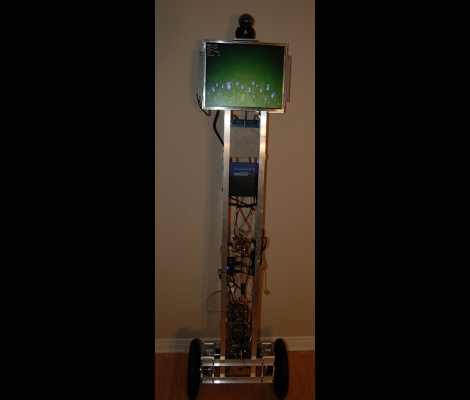
Meet TIPI, the Telepresence Interface by Pendulum Inversion. TIPI is something of a surrogate, giving physical presence to telecommuters by balancing an LCD screen and camera atop its six foot frame. The user has full control of the robot’s movement, with their own camera image shown on the display so that others interacting with the bot will with whom they are conversing.
A pair of 12.5″ wheels connec to DC motors via a gear box with a 37:1 ratio. These specs are necessary to recover from a sudden 20 degree loss of equilibrium, quite impressive for a bot of this stature. An Orangutan SVP board monitors a two-axis accelerometer and a gyroscope for accurate positioning data. This board automatically keeps balance, while taking user commands from a second control, a Beagle Board. The Beagle Board handles the communications, including sending and receiving the video signals, and delivering incoming position control data to the Orangutan. Separating the two systems guards against a screen-shattering fall by making sure the hardware likely to face slow-down or lockup is physically separate from that responsible for balance.
It started with a simple need: keep tabs on SparkFun Electronics’ in-house kegerator so the beer won’t run out at inopportune times. But of course SparkFun and “simple need” make strange bedfellows…throw beer in the mix, and you know this can’t end well. The result, as you might imagine, reads like a who’s-who of electronics hackery buzzwords.
They’ve assembled a nice build tutorial on how this all went together, including code, example circuits, an explanation of some of the sensors used, and links to other tutorials for such things as Twittering and persistent storage in EEPROM using Arduino. Not to mention the eye candy: a custom Arduino shield (solder mask and all), custom acrylic tap handle, custom SparkFun pint glasses. They never do anything halfway, do they?
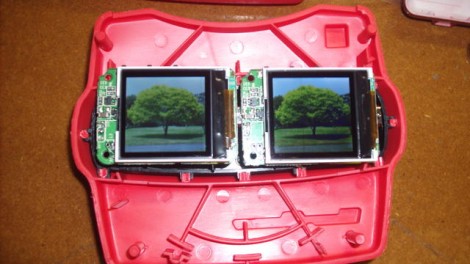
Who could forget the stereoscopic goodness of a View-Master? [Tuttle] put a modern flair on the classic optical device by adding two 1.5″ LCD screens. The screens replace the film disk of the original, showing slightly different images to produce a 3D effect. No word on a camera rig used to take the original images, but for our money this a great way to make something out of those useless key chain picture frames.
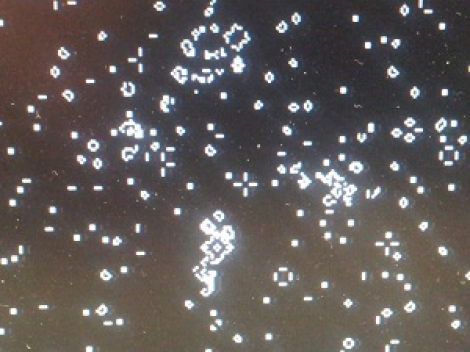
We’re going to have to take [Mike's] word for it that he built Conway’s Game of Life with high-definition video output. That’s because this screenshot is his only proof and it looks a bit fuzzy to us. But we are interested in the project which used an FPGA to generate a 1080p VGA output of the classic programming challenge.
One of the biggest benefits of using an FPGA for this application is the hardware’s parallel processing ability. For every frame of the game, the area around each living cell must be analyzed to produce the next evolutionary step. Most of the time this means processing all of the pixels in the playing area, which is the case here. [Mike] is using VHDL to program a Papilio Plus which has a Spartan 6 chip on it. He separated his code into the different components when writing about it. This makes it easy to find the chunks relating to the game if that’s what you’re interested in. If you just want to see how he implemented the VGA interface that’s well documented as well.
If you’re not familiar, Conway’s Game of Life has simple rules regarding when a cell will live, die, or be reborn. As [Mike] points out, every programmer should give it a shot at some point. We’ve seen many iterations from the very large to the very small.