What are you working on? Kindle Scribe
Buy used:
$30.92
FREE delivery Friday, May 8. Details
Or fastest delivery Wednesday, May 6. Details
Used: Good | Details
Sold by Snow_flakes
Condition: Used: Good
Access codes and supplements are not guaranteed with used items.
Only 1 left in stock - order soon.
Added to

Sorry, there was a problem.

There was an error retrieving your Wish Lists. Please try again.

Sorry, there was a problem.

List unavailable.
Kindle app logo image

Download the free Kindle app and start reading Kindle books instantly on your smartphone, tablet, or computer - no Kindle device required.

Read instantly on your browser with Kindle for Web.

Using your mobile phone camera - scan the code below and download the Kindle app.

QR code to download the Kindle App

  • Aristarchus of Samos: The Ancient Copernicus (Dover Books on Astronomy)

Follow the author

Get new release updates & improved recommendations
Something went wrong. Please try your request again later.

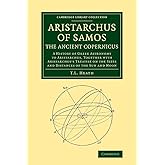
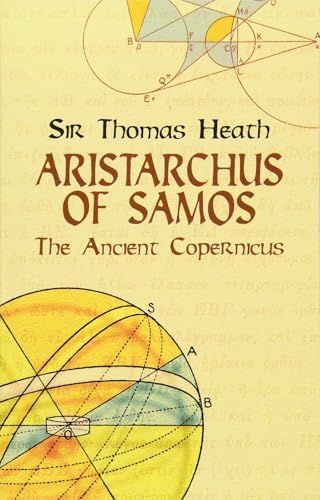
Aristarchus of Samos: The Ancient Copernicus (Dover Books on Astronomy) Paperback – December 9, 2004

4.8 out of 5 stars (19)

"A most welcome addition to the literature of astronomical history." — Nature
"A most important contribution to the early history of Greek thought and a notable monument of English scholarship." —
Journal of Hellenic Studies
This classic work traces Aristarchus of Samos's anticipation by two millennia of Copernicus's revolutionary theory of the orbital motion of the earth. Heath's history of astronomy ranges from Homer and Hesiod to Aristarchus and includes quotes from numerous thinkers, compilers, and scholasticists from Thales and Anaximander through Pythagoras, Plato, Aristotle, and Heraclides. 34 figures.
Books with Buzz
Discover the latest buzz-worthy books, from mysteries and romance to humor and nonfiction. Explore more

Editorial Reviews

About the Author

Thomas Little Heath: Bringing the Past to Life
Thomas Little Heath (1861–1940) was unusual for an authority on many esoteric, and many less esoteric, subjects in the history of mathematics in that he was never a university professor. The son of an English farmer from Lincolnshire, Heath demonstrated his academic gifts at a young age; studied at Trinity College, Cambridge, from 1879 to 1882; came away with numerous awards; and obtained the top grade in the 1884 English Civil Service examination. From that foundation, he went to work in the English Treasury, rose through the ranks, and by 1913, was permanent secretary to the Treasury, effectively the head of its operations. He left that post in 1919 at the end of the first World War, worked several years at the National Debt office, and retired in 1926.

During all of that time, however, he became independently one of the world's leading authorities on the history of mathematics, especially on the history of ancient Greek mathematics. Heath's three-volume edition of Euclid is still the standard, it is generally accepted that it is primarily through Heath's great work on Archimedes that the accomplishments of Archimedes are known as well as they are.

Dover has reprinted these and other books by Heath, preserving over several decades a unique legacy in the history of mathematical scholarship.

In the Author's Own Words:
"The works of Archimedes are without exception, monuments of mathematical exposition; the gradual revelation of the plan of attack, the masterly ordering of the propositions, the stern elimination of everything not immediately relevant to the purpose, the finish of the whole, are so impressive in their perfection as to create a feeling akin to awe in the mind of the reader." — Thomas L. Heath

Product details

  • Publisher ‏ : ‎ Dover Publications
  • Publication date ‏ : ‎ December 9, 2004
  • Language ‏ : ‎ English
  • Print length ‏ : ‎ 448 pages
  • ISBN-10 ‏ : ‎ 0486438864
  • ISBN-13 ‏ : ‎ 978-0486438863
  • Item Weight ‏ : ‎ 15.7 ounces
  • Dimensions ‏ : ‎ 5.25 x 0.75 x 8 inches
  • Best Sellers Rank: #7,278,683 in Books (See Top 100 in Books)
  • Customer Reviews:
    4.8 out of 5 stars (19)

About the author

Follow authors to get new release updates, plus improved recommendations.
Sir Thomas Little Heath
Brief content visible, double tap to read full content.
Full content visible, double tap to read brief content.

Discover more of the author’s books, see similar authors, read book recommendations and more.

Sponsored

Customer reviews

4.8 out of 5 stars
19 global ratings
Sponsored

Top reviews from the United States

  • Reviewed in the United States on February 1, 2014
    Format: PaperbackVerified Purchase
    Apart from the quote by Archimedes in his Sandreckoner,
    and much later comments by Plutarch and Vitruvius, this is
    it. You see Aristarchus here as a brilliant mind, and a fussy geometer
    who also invented the method to determine pi that was followed
    up by Archimedes.
    Heath was a mathematician, who did not fully understand the
    significance of this man who showed that the Sun was so much bigger
    than the Earth, so that it was only reasonable that Earth went round the Sun.
    Then the lack of an annual parallax showed that the stars were at vast distances.
    Sadly the result was screwed up by Hipparchos, who exactly like Tycho after
    him, thought that if he couldn't measure a parallax it was zero, rather than
    a very small number..
    If anyone wants to argue for theoreticians over observers, this issue is
    the best example.
    The quotes from ancient astronomers and philosophers were fun.
    I did try once to set the record straight about Anaxagoras who started
    the investigation of physical measurements in the sky, but the whole
    story really needs setting down in a popular book.

    8 people found this helpful
    Report
  • Reviewed in the United States on November 7, 2016
    Format: KindleVerified Purchase
    Interesting read that fills in a few historical blanks for me. It expands on the spectrum of scientific inquiry from the Francis Bacon method and Scientific Method that was the historical starting point for scientific inquiry as taught when I was in college.
    2 people found this helpful
    Report
  • Reviewed in the United States on January 11, 2016
    Format: Paperback
    The first part of this book is a competent survey of what the doxographic literature has to say about early astronomy. This is almost all speculative rather than observational or computational, except for some statements about cycles, like the common period stated by Oenopides for solar years and lunar months. But before we can make computational models we must have some feeling for what we are modeling, and it is useful to model the earth and planets as spheres. The importance of geocentrism vs. heliocentrism is exaggerated, I think. This is similar to how popular accounts of quantum mechanics fuss over waves vs. particles, rather than actually doing quantum mechanics.

    The second part of this book is a commentary on and translation of Aristarchus's "On the sizes and distances of the sun and moon". I don't know how important this is in the history of astronomy; my interest is in its mathematics. Aristarchus is talking about intersections of spheres, cones, and planes, and is doing proto-trigonometry. Moreover, he is working with inequalities of ratios, and proves the equivalent of things like the sine of 1 degree being greater than 1/20 and less than 1/18.

    Heath has a mastery of all the classical literature. There are few scholars now who have both the command of mathematics and astronomy that Heath had and the command of the doxographic literature and ancient writers like Strabo, Theon of Smyrna, Seneca, Geminus, Cleomedes, Ptolemy, Proclus, Macrobius, Martianus Capella, Censorinus, etc. The way to be great like this is to read attentively all extant ancient mathematical, astronomical, and physical works, and because this is so overwhelming a task there are few people who can do what Heath did. Moreover, writing about ancient astronomy doesn't just demand one to be able to follow the geometric reasoning, but to be at home doing the computations to say when eclipses occur and things like that: as a mathematician I can follow the proofs in Aristarchus, but I don't have any feeling for how one actually did ancient astronomy. The only book I've found that looks like it can teach this is Evans, The History and Practice of Ancient Astronomy, which I will have to read cover to cover if I ever do any work in the history of astronomy.

    Because Heath is the only English translation and nearly the only English commentary on Aristarchus, if you get stuck now you have to struggle through the text rather than checking someone else's explanation. It would be a useful project to work out a close reading of Aristarchus and draw new diagrams; this would certainly be a worthy article for a publication like the American Mathematical Monthly.

    By the way, it took me some time to figure out that "Let a plane be carried through AB" means "Let us be given a plane that contains the line AB", and this is any plane containing the line, not some particular plane. I took time to become comfortable with the diagrams because cones and spheres are being talked about, which made me expect perspective diagrams, but in fact the diagrams are on a plane.
    7 people found this helpful
    Report
  • Reviewed in the United States on November 20, 2017
    I wanted to read Aristarchus's proof and see his initial axioms. The book also gave me a better idea of how we know what we know and how we know what was lost. The rest of the book was not as interesting as I hoped it would be. History of Astronomy from Thales to Kepler was a better read in this respect.
    2 people found this helpful
    Report
  • Reviewed in the United States on May 15, 2010
    Format: Paperback
    Although this book contains much historical background, the highlight, in my opinion, is the complete translation of Aristarchus' only extant work, On the distances and sizes of the sun and moon (c. -270). I am going to summarise this work here. My summary will contain all the main results of the treatise, and indicate what is essentially Aristarchus' derivations. However, my summary will be a simplification in that I will assume that the sun lights up exactly half the moon, whereas Aristarchus knows that this is not quite true and so has a small correction factor in the calculations to account for this.

    I will use this notation: E, M, S are the centers of the earth, moon and sun respectively, and E', M', S' are points on their apparent perimeters.

    The ratio of the distances from the earth to the moon and from the earth to the sun can be determined by measuring the angle MES at half moon. For at half moon the angle EMS=90° and the angle MES is measurable, so we know all angles of this triangle and thus the ratios of its sides.

    The ratio of the sizes of the moon and the sun can then be inferred at a solar eclipse. For at a solar eclipse, the moon precisely covers the sun. Thus EMM' is similar to ESS', with the scaling factor discovered above, i.e. SS':MM'::ES:EM.

    The ratio of the distance of the moon to its size can be inferred from its angular size. For the angle EMM'=90° and the angle MEM' is measurable, so we know all angles of this triangle and thus the ratios of its sides.

    These distances can be related to the radius of the earth at a lunar eclipse. For the shadow that the earth casts on the moon is about two moon-diameters wide. To incorporate this information into a similar triangles setup, let O be the point beyond the moon from which the earth has the same angular size as the sun (i.e. precisely blocks out the sun). Then SS':EE'::OS:OE. Now the algebra gets a little bit involved. We want to know the LHS so we have to reduce the RHS to a number, which we will do by expressing both OS and OE in terms of OM. From above we know SS':MM', and now we have OS:OM::SS':2MM', which enables us to express OS in terms of OM. To express OE in terms of OM we first note that OE=OM+EM. From above we know how to express EM in terms of ES, or, if we prefer, MS. But again from OS:OM::SS':2MM' we know OS=OM+MS in terms of OM, so we know MS in terms of OM, so we are done. OS:OE is now some multiple of OM over some multiple of OM, i.e. a number, so we have found SS':EE', i.e. we have expressed the size of the sun (and thereby the size of the moon, of course) in terms of the size of the earth.
    7 people found this helpful
    Report

Top reviews from other countries

Translate all reviews to English
  • Amazon Customer
    5.0 out of 5 stars Clássicos
    Reviewed in Brazil on February 7, 2025
    Excelente livro.
    Report
  • Stephen Hasbrouck Jr.
    5.0 out of 5 stars See the Stars!!
    Reviewed in Canada on March 18, 2019
    Format: PaperbackVerified Purchase
    Interesting gems in this!
  • A. J. S. White
    5.0 out of 5 stars Interesting and well written account
    Reviewed in the United Kingdom on July 29, 2015
    A real hero of the astronomical world - definitely a man ahead of his time. A pity Ptolemy was such a dominant character and Aristarchus' work was largely forgotten for 1500 years