Shop Mateina
Kindle Unlimited
Unlimited reading. Over 5 million titles. Learn more
OR
$12.99 with 41 percent savings
Print List Price: $22.00 Image

These promotions will be applied to this item:

Some promotions may be combined; others are not eligible to be combined with other offers. For details, please see the Terms & Conditions associated with these promotions.

You've subscribed to ! We will preorder your items within 24 hours of when they become available. When new books are released, we'll charge your default payment method for the lowest price available during the pre-order period.
Update your device or payment method, cancel individual pre-orders or your subscription at
Your Memberships & Subscriptions

How it works

  1. Choose your delivery method
  2. Send now or schedule for later
  3. Add your personal message
  4. Recipients can read on any device

These ebooks can only be redeemed by recipients in the US. Redemption links and eBooks cannot be resold.

Added to

Sorry, there was a problem.

There was an error retrieving your Wish Lists. Please try again.

Sorry, there was a problem.

List unavailable.
Kindle app logo image

Download the free Kindle app and start reading Kindle books instantly on your smartphone, tablet, or computer - no Kindle device required.

Read instantly on your browser with Kindle for Web.

Using your mobile phone camera - scan the code below and download the Kindle app.

QR code to download the Kindle App

Sponsored
  • Thinking, Fast and Slow
  • Think Like a Monk, Thinking Fast and SlowAmazon Live Books
  • 5 VIDEOS

Follow the author

Get new release updates & improved recommendations
Something went wrong. Please try your request again later.

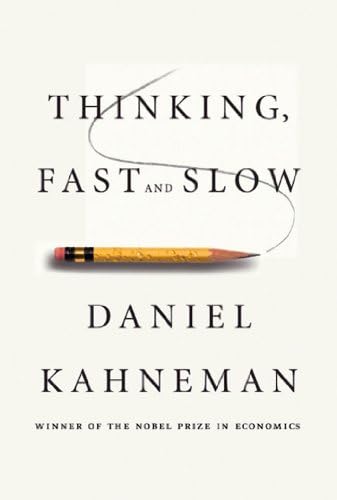
Thinking, Fast and Slow Kindle Edition

4.6 out of 5 stars (48,088)

*Major New York Times Bestseller
*More than 2.6 million copies sold
*One of
The New York Times Book Review's ten best books of the year
*Selected by
The Wall Street Journal as one of the best nonfiction books of the year
*Presidential Medal of Freedom Recipient
*Daniel Kahneman's work with Amos Tversky is the subject of Michael Lewis's best-selling
The Undoing Project: A Friendship That Changed Our Minds

In his mega bestseller, Thinking, Fast and Slow, Daniel Kahneman, world-famous psychologist and winner of the Nobel Prize in Economics, takes us on a groundbreaking tour of the mind and explains the two systems that drive the way we think.

System 1 is fast, intuitive, and emotional; System 2 is slower, more deliberative, and more logical. The impact of overconfidence on corporate strategies, the difficulties of predicting what will make us happy in the future, the profound effect of cognitive biases on everything from playing the stock market to planning our next vacation—each of these can be understood only by knowing how the two systems shape our judgments and decisions.

Engaging the reader in a lively conversation about how we think, Kahneman reveals where we can and cannot trust our intuitions and how we can tap into the benefits of slow thinking. He offers practical and enlightening insights into how choices are made in both our business and our personal lives—and how we can use different techniques to guard against the mental glitches that often get us into trouble. Topping bestseller lists for almost ten years,
Thinking, Fast and Slow is a contemporary classic, an essential book that has changed the lives of millions of readers.

Sponsored

Great on Kindle
Great Experience. Great Value.
iphone with kindle app
Putting our best book forward
Each Great on Kindle book offers a great reading experience, at a better value than print to keep your wallet happy.

Explore your book, then jump right back to where you left off with Page Flip.

View high quality images that let you zoom in to take a closer look.

Enjoy features only possible in digital – start reading right away, carry your library with you, adjust the font, create shareable notes and highlights, and more.

Discover additional details about the events, people, and places in your book, with Wikipedia integration.

Get the free Kindle app: Link to the kindle app page Link to the kindle app page
Enjoy a great reading experience when you borrow the Kindle edition of this book with your Kindle Unlimited membership. Learn more about Great on Kindle, available in select categories.

Customers also bought or read

Loading...

From the Publisher

Praise for Thinking, Fast and Slow

Thinking Fast and Slow Daniel Kahneman

Thinking Fast and Slow Daniel Kahneman

Thinking Fast and Slow Daniel Kahneman

Editorial Reviews

Amazon.com Review

Amazon Best Books of the Month, November 2011: Drawing on decades of research in psychology that resulted in a Nobel Prize in Economic Sciences, Daniel Kahneman takes readers on an exploration of what influences thought example by example, sometimes with unlikely word pairs like "vomit and banana." System 1 and System 2, the fast and slow types of thinking, become characters that illustrate the psychology behind things we think we understand but really don't, such as intuition. Kahneman's transparent and careful treatment of his subject has the potential to change how we think, not just about thinking, but about how we live our lives. Thinking, Fast and Slow gives deep--and sometimes frightening--insight about what goes on inside our heads: the psychological basis for reactions, judgments, recognition, choices, conclusions, and much more. --JoVon Sotak

Excerpt. © Reprinted by permission. All rights reserved.

Thinking, Fast and Slow

By Daniel Kahneman

Farrar, Straus and Giroux

Copyright © 2011 Daniel Kahneman
All right reserved.

ISBN: 9780374275631
THINKING, FAST AND SLOW (Chapter 1)The Characters of the Story

To observe your mind in automatic mode, glance at the image below.

Figure 1

Your experience as you look at the woman's face seamlessly combines what we normally call seeing and intuitive thinking. As surely and quickly as you saw that the young woman's hair is dark, you knew she is angry. Furthermore, what you saw extended into the future. You sensed that this woman is about to say some very unkind words, probably in a loud and strident voice. A premonition of what she was going to do next came to mind automatically and effortlessly. You did not intend to assess her mood or to anticipate what she might do, and your reaction to the picture did not have the feel of something you did. It just happened to you. It was an instance of fast thinking.

Now look at the following problem:

17 × 24

You knew immediately that this is a multiplication problem, and probably knew that you could solve it, with paper and pencil, if not without. You also had some vague intuitive knowledge of the range of possible results. You would be quick to recognize that both 12,609 and 123 are implausible. Without spending some time on the problem, however, you would not be certain that the answer is not 568. A precise solution did not come to mind, and you felt that you could choose whether or not to engage in the computation. If you have not done so yet, you should attempt the multiplication problem now, completing at least part of it.

You experienced slow thinking as you proceeded through a sequence of steps. You first retrieved from memory the cognitive program for multiplication that you learned in school, then you implemented it. Carrying out the computation was a strain. You felt the burden of holding much material in memory, as you needed to keep track of where you were and of where you were going, while holding on to the intermediate result. The process was mental work: deliberate, effortful, and orderly--a prototype of slow thinking. The computation was not only an event in your mind; your body was also involved. Your muscles tensed up, your blood pressure rose, and your heart rate increased. Someone looking closely at your eyes while you tackled this problem would have seen your pupils dilate. Your pupils contracted back to normal size as soon as you ended your work--when you found the answer (which is 408, by the way) or when you gave up.

Two Systems

Psychologists have been intensely interested for several decades in the two modes of thinking evoked by the picture of the angry woman and by the multiplication problem, and have offered many labels for them. I adopt terms originally proposed by the psychologists Keith Stanovich and Richard West, and will refer to two systems in the mind, System 1 and System 2.

  • System 1 operates automatically and quickly, with little or no effort and no sense of voluntary control.
  • System 2 allocates attention to the effortful mental activities that demand it, including complex computations. The operations of System 2 are often associated with the subjective experience of agency, choice, and concentration.

    The labels of System 1 and System 2 are widely used in psychology, but I go further than most in this book, which you can read as a psychodrama with two characters.

    When we think of ourselves, we identify with System 2, the conscious, reasoning self that has beliefs, makes choices, and decides what to think about and what to do. Although System 2 believes itself to be where the action is, the automatic System 1 is the hero of the book. I describe System 1 as effortlessly originating impressions and feelings that are the main sources of the explicit beliefs and deliberate choices of System 2. The automatic operations of System 1 generate surprisingly complex patterns of ideas, but only the slower System 2 can construct thoughts in an orderly series of steps. I also describe circumstances in which System 2 takes over, overruling the freewheeling impulses and associations of System 1. You will be invited to think of the two systems as agents with their individual abilities, limitations, and functions.

    In rough order of complexity, here are some examples of the automatic activities that are attributed to System 1:

  • Detect that one object is more distant than another.
  • Orient to the source of a sudden sound.
  • Complete the phrase "bread and..."
  • Make a "disgust face" when shown a horrible picture.
  • Detect hostility in a voice.
  • Answer to 2 + 2 = ?
  • Read words on large billboards.
  • Drive a car on an empty road.
  • Find a strong move in chess (if you are a chess master).
  • Understand simple sentences.
  • Recognize that a "meek and tidy soul with a passion for detail" resembles an occupational stereotype.

    All these mental events belong with the angry woman--they occur automatically and require little or no effort. The capabilities of System 1 include innate skills that we share with other animals. We are born prepared to perceive the world around us, recognize objects, orient attention, avoid losses, and fear spiders. Other mental activities become fast and automatic through prolonged practice. System 1 has learned associations between ideas (the capital of France?); it has also learned skills such as reading and understanding nuances of social situations. Some skills, such as finding strong chess moves, are acquired only by specialized experts. Others are widely shared. Detecting the similarity of a personality sketch to an occupational stereotype requires broad knowledge of the language and the culture, which most of us possess. The knowledge is stored in memory and accessed without intention and without effort.

    Several of the mental actions in the list are completely involuntary. You cannot refrain from understanding simple sentences in your own language or from orienting to a loud unexpected sound, nor can you prevent yourself from knowing that 2 + 2 = 4 or from thinking of Paris when the capital of France is mentioned. Other activities, such as chewing, are susceptible to voluntary control but normally run on automatic pilot. The control of attention is shared by the two systems. Orienting to a loud sound is normally an involuntary operation of System 1, which immediately mobilizes the voluntary attention of System 2. You may be able to resist turning toward the source of a loud and offensive comment at a crowded party, but even if your head does not move, your attention is initially directed to it, at least for a while. However, attention can be moved away from an unwanted focus, primarily by focusing intently on another target.

    The highly diverse operations of System 2 have one feature in common: they require attention and are disrupted when attention is drawn away. Here are some examples:

  • Brace for the starter gun in a race.
  • Focus attention on the clowns in the circus.
  • Focus on the voice of a particular person in a crowded and noisy room.
  • Look for a woman with white hair.
  • Search memory to identify a surprising sound.
  • Maintain a faster walking speed than is natural for you.
  • Monitor the appropriateness of your behavior in a social situation.
  • Count the occurrences of the letter a in a page of text.
  • Tell someone your phone number.
  • Park in a narrow space (for most people except garage attendants).
  • Compare two washing machines for overall value.
  • Fill out a tax form.
  • Check the validity of a complex logical argument.

    In all these situations you must pay attention, and you will perform less well, or not at all, if you are not ready or if your attention is directed inappropriately. System 2 has some ability to change the way System 1 works, by programming the normally automatic functions of attention and memory. When waiting for a relative at a busy train station, for example, you can set yourself at will to look for a white-haired woman or a bearded man, and thereby increase the likelihood of detecting your relative from a distance. You can set your memory to search for capital cities that start with N or for French existentialist novels. And when you rent a car at London's Heathrow Airport, the attendant will probably remind you that "we drive on the left side of the road over here." In all these cases, you are asked to do something that does not come naturally, and you will find that the consistent maintenance of a set requires continuous exertion of at least some effort.

    The oft en-used phrase "pay attention" is apt: you dispose of a limited budget of attention that you can allocate to activities, and if you try to go beyond your budget, you will fail. It is the mark of effortful activities that they interfere with each other, which is why it is difficult or impossible to conduct several at once. You could not compute the product of 17 × 24 while making a left turn into dense traffic, and you certainly should not try. You can do several things at once, but only if they are easy and undemanding. You are probably safe carrying on a conversation with a passenger while driving on an empty highway, and many parents have discovered, perhaps with some guilt, that they can read a story to a child while thinking of something else.

    Everyone has some awareness of the limited capacity of attention, and our social behavior makes allowances for these limitations. When the driver of a car is overtaking a truck on a narrow road, for example, adult passengers quite sensibly stop talking. They know that distracting the driver is not a good idea, and they also suspect that he is temporarily deaf and will not hear what they say.

    Intense focusing on a task can make people effectively blind, even to stimuli that normally attract attention. The most dramatic demonstration was offered by Christopher Chabris and Daniel Simons in their book The Invisible Gorilla. They constructed a short film of two teams passing basketballs, one team wearing white shirts, the other wearing black. The viewers of the film are instructed to count the number of passes made by the white team, ignoring the black players. This task is difficult and completely absorbing. Halfway through the video, a woman wearing a gorilla suit appears, crosses the court, thumps her chest, and moves on. The gorilla is in view for 9 seconds. Many thousands of people have seen the video, and about half of them do not notice anything unusual. It is the counting task--and especially the instruction to ignore one of the teams--that causes the blindness. No one who watches the video without that task would miss the gorilla. Seeing and orienting are automatic functions of System 1, but they depend on the allocation of some attention to the relevant stimulus. The authors note that the most remarkable observation of their study is that people find its results very surprising. Indeed, the viewers who fail to see the gorilla are initially sure that it was not there--they cannot imagine missing such a striking event. The gorilla study illustrates two important facts about our minds: we can be blind to the obvious, and we are also blind to our blindness.

    Plot Synopsis

    The interaction of the two systems is a recurrent theme of the book, and a brief synopsis of the plot is in order. In the story I will tell, Systems 1 and 2 are both active whenever we are awake. System 1 runs automatically and System 2 is normally in a comfortable low-effort mode, in which only a fraction of its capacity is engaged. System 1 continuously generates suggestions for System 2: impressions, intuitions, intentions, and feelings. If endorsed by System 2, impressions and intuitions turn into beliefs, and impulses turn into voluntary actions. When all goes smoothly, which is most of the time, System 2 adopts the suggestions of System 1 with little or no modification. You generally believe your impressions and act on your desires, and that is fine--usually.

    When System 1 runs into difficulty, it calls on System 2 to support more detailed and specific processing that may solve the problem of the moment. System 2 is mobilized when a question arises for which System 1 does not offer an answer, as probably happened to you when you encountered the multiplication problem 17 × 24. You can also feel a surge of conscious attention whenever you are surprised. System 2 is activated when an event is detected that violates the model of the world that System 1 maintains. In that world, lamps do not jump, cats do not bark, and gorillas do not cross basketball courts. The gorilla experiment demonstrates that some attention is needed for the surprising stimulus to be detected. Surprise then activates and orients your attention: you will stare, and you will search your memory for a story that makes sense of the surprising event. System 2 is also credited with the continuous monitoring of your own behavior--the control that keeps you polite when you are angry, and alert when you are driving at night. System 2 is mobilized to increased effort when it detects an error about to be made. Remember a time when you almost blurted out an offensive remark and note how hard you worked to restore control. In summary, most of what you (your System 2) think and do originates in your System 1, but System 2 takes over when things get difficult, and it normally has the last word.

    The division of labor between System 1 and System 2 is highly efficient: it minimizes effort and optimizes performance. The arrangement works well most of the time because System 1 is generally very good at what it does: its models of familiar situations are accurate, its short-term predictions are usually accurate as well, and its initial reactions to challenges are swift and generally appropriate. System 1 has biases, however, systematic errors that it is prone to make in specified circumstances. As we shall see, it sometimes answers easier questions than the one it was asked, and it has little understanding of logic and statistics. One further limitation of System 1 is that it cannot be turned off. If you are shown a word on the screen in a language you know, you will read it--unless your attention is totally focused elsewhere.

    Conflict

    Figure 2 is a variant of a classic experiment that produces a conflict between the two systems. You should try the exercise before reading on.

    Figure 2

    You were almost certainly successful in saying the correct words in both tasks, and you surely discovered that some parts of each task were much easier than others. When you identified upper-and lowercase, the left-hand column was easy and the right-hand column caused you to slow down and perhaps to stammer or stumble. When you named the position of words, the left-hand column was difficult and the right-hand column was much easier.

    These tasks engage System 2, because saying "upper/lower" or "right/left" is not what you routinely do when looking down a column of words. One of the things you did to set yourself for the task was to program your memory so that the relevant words (upper and lower for the first task) were "on the tip of your tongue." The prioritizing of the chosen words is effective and the mild temptation to read other words was fairly easy to resist when you went through the first column. But the second column was different, because it contained words for which you were set, and you could not ignore them. You were mostly able to respond correctly, but overcoming the competing response was a strain, and it slowed you down. You experienced a conflict between a task that you intended to carry out and an automatic response that interfered with it.

    Conflict between an automatic reaction and an intention to control it is common in our lives. We are all familiar with the experience of trying not to stare at the oddly dressed couple at the neighboring table in a restaurant. We also know what it is like to force our attention on a boring book, when we constantly find ourselves returning to the point at which the reading lost its meaning. Where winters are hard, many drivers have memories of their car skidding out of control on the ice and of the struggle to follow well-rehearsed instructions that negate what they would naturally do: "Steer into the skid, and whatever you do, do not touch the brakes!" And every human being has had the experience of not telling someone to go to hell. One of the tasks of System 2 is to overcome the impulses of System 1. In other words, System 2 is in charge of self-control.

    Illusions

    To appreciate the autonomy of System 1, as well as the distinction between impressions and beliefs, take a good look at figure 3.

    This picture is unremarkable: two horizontal lines of different lengths, with fins appended, pointing in different directions. The bottom line is obviously longer than the one above it. That is what we all see, and we naturally believe what we see. If you have already encountered this image, however, you recognize it as the famous Müller-Lyer illusion. As you can easily confirm by measuring them with a ruler, the horizontal lines are in fact identical in length.

    Figure 3

    Now that you have measured the lines, you--your System 2, the conscious being you call "I"--have a new belief: you know that the lines are equally long. If asked about their length, you will say what you know. But you still see the bottom line as longer. You have chosen to believe the measurement, but you cannot prevent System 1 from doing its thing; you cannot decide to see the lines as equal, although you know they are. To resist the illusion, there is only one thing you can do: you must learn to mistrust your impressions of the length of lines when fins are attached to them. To implement that rule, you must be able to recognize the illusory pattern and recall what you know about it. If you can do this, you will never again be fooled by the Müller-Lyer illusion. But you will still see one line as longer than the other.

    Not all illusions are visual. There are illusions of thought, which we call cognitive illusions. As a graduate student, I attended some courses on the art and science of psychotherapy. During one of these lectures, our teacher imparted a morsel of clinical wisdom. This is what he told us: "You will from time to time meet a patient who shares a disturbing tale of multiple mistakes in his previous treatment. He has been seen by several clinicians, and all failed him. The patient can lucidly describe how his therapists misunderstood him, but he has quickly perceived that you are different. You share the same feeling, are convinced that you understand him, and will be able to help." At this point my teacher raised his voice as he said, "Do not even think of taking on this patient! Throw him out of the office! He is most likely a psychopath and you will not be able to help him."

    Many years later I learned that the teacher had warned us against psychopathic charm, and the leading authority in the study of psychopathy confirmed that the teacher's advice was sound. The analogy to the Müller-Lyer illusion is close. What we were being taught was not how to feel about that patient. Our teacher took it for granted that the sympathy we would feel for the patient would not be under our control; it would arise from System 1. Furthermore, we were not being taught to be generally suspicious of our feelings about patients. We were told that a strong attraction to a patient with a repeated history of failed treatment is a danger sign--like the fins on the parallel lines. It is an illusion--a cognitive illusion--and I (System 2) was taught how to recognize it and advised not to believe it or act on it.

    The question that is most oft en asked about cognitive illusions is whether they can be overcome. The message of these examples is not encouraging. Because System 1 operates automatically and cannot be turned off at will, errors of intuitive thought are oft en difficult to prevent. Biases cannot always be avoided, because System 2 may have no clue to the error. Even when cues to likely errors are available, errors can be prevented only by the enhanced monitoring and effortful activity of System 2. As a way to live your life, however, continuous vigilance is not necessarily good, and it is certainly impractical. Constantly questioning our own thinking would be impossibly tedious, and System 2 is much too slow and inefficient to serve as a substitute for System 1 in making routine decisions. The best we can do is a compromise: learn to recognize situations in which mistakes are likely and try harder to avoid significant mistakes when the stakes are high. The premise of this book is that it is easier to recognize other people's mistakes than our own.

    Useful Fictions

    You have been invited to think of the two systems as agents within the mind, with their individual personalities, abilities, and limitations. I will oft en use sentences in which the systems are the subjects, such as, "System 2 calculates products."

    The use of such language is considered a sin in the professional circles in which I travel, because it seems to explain the thoughts and actions of a person by the thoughts and actions of little people inside the person's head. Grammatically the sentence about System 2 is similar to "The butler steals the petty cash." My colleagues would point out that the butler's action actually explains the disappearance of the cash, and they rightly question whether the sentence about System 2 explains how products are calculated. My answer is that the brief active sentence that attributes calculation to System 2 is intended as a description, not an explanation. It is meaningful only because of what you already know about System 2. It is shorthand for the following: "Mental arithmetic is a voluntary activity that requires effort, should not be performed while making a left turn, and is associated with dilated pupils and an accelerated heart rate."
    Similarly, the statement that "highway driving under routine conditions is left to System 1" means that steering the car around a bend is automatic and almost effortless. It also implies that an experienced driver can drive on an empty highway while conducting a conversation. Finally, "System 2 prevented James from reacting foolishly to the insult" means that James would have been more aggressive in his response if his capacity for effortful control had been disrupted (for example, if he had been drunk).

    System 1 and System 2 are so central to the story I tell in this book that I must make it absolutely clear that they are fictitious characters. Systems 1 and 2 are not systems in the standard sense of entities with interacting aspects or parts. And there is no one part of the brain that either of the systems would call home. You may well ask: What is the point of introducing fictitious characters with ugly names into a serious book? The answer is that the characters are useful because of some quirks of our minds, yours and mine. A sentence is understood more easily if it describes what an agent (System 2) does than if it describes what something is, what properties it has. In other words, "System 2" is a better subject for a sentence than "mental arithmetic." The mind--especially System 1--appears to have a special aptitude for the construction and interpretation of stories about active agents, who have personalities, habits, and abilities. You quickly formed a bad opinion of the thieving butler, you expect more bad behavior from him, and you will remember him for a while. This is also my hope for the language of systems.

    Why call them System 1 and System 2 rather than the more descriptive "automatic system" and "effortful system"? The reason is simple: "Automatic system" takes longer to say than "System 1" and therefore takes more space in your working memory. This matters, because anything that occupies your working memory reduces your ability to think. You should treat "System 1" and "System 2" as nicknames, like Bob and Joe, identifying characters that you will get to know over the course of this book. The fictitious systems make it easier for me to think about judgment and choice, and will make it easier for you to understand what I say.

    Speaking of System 1 and System 2

    "He had an impression, but some of his impressions are illusions."

    "This was a pure System 1 response. She reacted to the threat before she recognized it."

    "This is your System 1 talking. Slow down and let your System 2 take control."

    THINKING, FAST AND SLOW Copyright © 2011 by Daniel Kahneman


    Continues...
    Excerpted from Thinking, Fast and Slow by Daniel Kahneman Copyright © 2011 by Daniel Kahneman. Excerpted by permission.
    All rights reserved. No part of this excerpt may be reproduced or reprinted without permission in writing from the publisher.
    Excerpts are provided by Dial-A-Book Inc. solely for the personal use of visitors to this web site.

Product details

  • ASIN ‏ : ‎ B00555X8OA
  • Publisher ‏ : ‎ Farrar, Straus and Giroux
  • Accessibility ‏ : ‎ Learn more
  • Publication date ‏ : ‎ October 25, 2011
  • Edition ‏ : ‎ 1st
  • Language ‏ : ‎ English
  • File size ‏ : ‎ 5.4 MB
  • Screen Reader ‏ : ‎ Supported
  • Enhanced typesetting ‏ : ‎ Enabled
  • X-Ray ‏ : ‎ Enabled
  • Word Wise ‏ : ‎ Enabled
  • Print length ‏ : ‎ 401 pages
  • ISBN-10 ‏ : ‎ 9781429969352
  • ISBN-13 ‏ : ‎ 978-1429969352
  • Page Flip ‏ : ‎ Enabled
  • Best Sellers Rank: #3,004 in Kindle Store (See Top 100 in Kindle Store)
  • Customer Reviews:
    4.6 out of 5 stars (48,088)

About the author

Follow authors to get new release updates, plus improved recommendations.
Daniel Kahneman
Brief content visible, double tap to read full content.
Full content visible, double tap to read brief content.

Daniel Kahneman (Hebrew: דניאל כהנמן‎, born March 5, 1934) is an Israeli-American psychologist notable for his work on the psychology of judgment and decision-making, as well as behavioral economics, for which he was awarded the 2002 Nobel Memorial Prize in Economic Sciences (shared with Vernon L. Smith). His empirical findings challenge the assumption of human rationality prevailing in modern economic theory. With Amos Tversky and others, Kahneman established a cognitive basis for common human errors that arise from heuristics and biases (Kahneman & Tversky, 1973; Kahneman, Slovic & Tversky, 1982; Tversky & Kahneman, 1974), and developed prospect theory (Kahneman & Tversky, 1979).

In 2011, he was named by Foreign Policy magazine to its list of top global thinkers. In the same year, his book Thinking, Fast and Slow, which summarizes much of his research, was published and became a best seller. He is professor emeritus of psychology and public affairs at Princeton University's Woodrow Wilson School. Kahneman is a founding partner of TGG Group, a business and philanthropy consulting company. He is married to Royal Society Fellow Anne Treisman.

In 2015 The Economist listed him as the seventh most influential economist in the world.

Bio from Wikipedia, the free encyclopedia. Photo by see page for author [Public domain], via Wikimedia Commons.

Customer reviews

4.6 out of 5 stars
48,088 global ratings
Sponsored

Customers say

Customers find this book highly informative and engaging, with amazing research and great insights into how the brain makes decisions. Moreover, the writing quality is excellent, with one customer noting it's written for a lay audience, and they consider it worth the investment of time and pages. The book is easy to understand the concepts and forces readers to think differently. However, the readability and pacing receive mixed reviews, with some finding it readable while others describe it as a hard read that drags on longer than expected.
AI Generated from the text of customer reviews

Select to learn more

1952 customers mention content, 1777 positive, 175 negative
Customers find the book engaging and life-changing, describing it as a marvelous and very interesting read.
...got into some statistical and philosophical nuances, but overall a great book and important read for anyone wanting to understand how people think.Read more
Great read that may seem difficult at first, but the book itself is a staple for anyone looking to improve their overall quality of life and also...Read more
Excellent book Kind of long, but nevertheless fascinating. Pioneer in neuroeconomics (together with Amos T). Introduced the notion of cognitive bias....Read more
Good read. Really makes you think about how you think. It is a book that must be read carefully. The insights are sophisticated and meaningful....Read more
959 customers mention informative, 902 positive, 57 negative
Customers find the book highly informative and insightful, praising its amazing research and valuable perspective.
Excelent book! Inteligent. Intriguing. Insightful. Finally, a great book to understand the human behavior in economics and finance....Read more
...Informative and useful on a personal level as well. Reading the book I was often stopped in my tracks by its stunning revelations and insights....Read more
Excellent book, very insightful. Viewing the thinking process in a whole new way now. Highly recommend!Read more
Very indepth and good information. I enjoy reading books that challenge me to stretch myself. Would recommend others to read this book.Read more
456 customers mention thought-provoking, 431 positive, 25 negative
Customers find the book thought-provoking and intellectually stimulating, providing great insights into how the brain makes decisions and forcing readers to think differently.
...The book had the potential to be useful and thought provoking by delving into issues like racism and sexism, but the author seemed to shy away from...Read more
Great read. Very thought provoking and engaging. It's interesting to think about how we react with our world and what influences our decisions.Read more
This was a fascinating look at decision making, both intuitive and thoughtful. He explained the process by which we can make such bad decisions....Read more
Excellent. Thought-provoking.Read more
297 customers mention writing quality, 252 positive, 45 negative
Customers praise the writing quality of the book, noting it is excellently written by a tremendously gifted author who is very knowledgeable in his field.
A very dense book. But well written. The first third could be a book on its own. Then it takes those concepts and drives deeper. Then deeper still....Read more
...Is there a way to rein our mental horses? Very well written, engaging, based on solid research, spiced with a bit of irony book on ultimately...Read more
...The content is as described. It is well-written and compelling without being technical--you see the cathedral without the scaffolding....Read more
...This very well written book will enlighten and entertain the reader, especially if the reader is not exposed to the full range of research relating...Read more
179 customers mention value for money, 166 positive, 13 negative
Customers find the book extremely valuable, noting that it's worth all 500+ pages and well worth the effort to get through.
...It’s a serious read but worth the effort. Now that I’ve read Thinking Fast and Slow, I gotta do some writing of my own....Read more
This book takes a bit of time and effort but it is without a doubt worth it. Learning about how something works is the best way to improve.Read more
Great book, worth the read for anyone wanting better insight into decision making for business or personal reasons. No hesitation.Read more
...Then deeper still. What a cool job Kahneman has had. Well worth it if you want to know the "why" behind some of the seemingly irrational...Read more
172 customers mention complexity, 134 positive, 38 negative
Customers find the book's concepts easy to understand and appreciate its readability, noting that it makes decision-making easier. One customer mentions it's particularly accessible for non-statisticians.
He nails the material, but in a modest way that is easy to understand....Read more
...is able to put out his information in such great stories that are easy to follow and digest, and you'll never be able to think the same way again.Read more
Excellent content and an easy, seamless read! This book is great for anyone who wants to gain insight on how we make decisions....Read more
Starts slow, technical and perhaps a bit redundant....Read more
457 customers mention readability, 237 positive, 220 negative
Customers have mixed opinions about the book's readability, with some finding it clear and substantial, while others describe it as very hard to read and painful to get through.
...This book is easy to read and strikes an impressive balance; it preserves much of the evidence and logic found in his academic works, but presents...Read more
Not an easy read but compelling and incredibly revealing. Daniel Kahneman's research is painstaking and, where he has doubts - honest....Read more
...It breaks down how we think in a way that is clear and eye opening, showing the difference between fast instinctive thinking and slower more...Read more
Interesting subject, but difficult read. Writing style did not hold my intrerest. Made me drowsy after reading a few pages....Read more
169 customers mention pacing, 80 positive, 89 negative
Customers have mixed opinions about the pacing of the book, with some finding it engaging while others describe it as slow and tedious to read.
...it's dense though, not a quick read, or a page-turner. but there is so much to learn....Read more
Thinking, Fast and Slow provides valuable insight into how the human (your) mind works through complex decision making....Read more
...Warning, it is not a fast read like those written by Malcolm Gladwell, Daniel Pink, or Charles Duhigg....Read more
...how mind works, what the author calls System I and System II, one is fast, emotional, but don't analyze deeply the complex problems of our world,...Read more
Excited
5 out of 5 stars
Excited
In good condition other than having a slight dent on the back bottom portion of the book
Thank you for your feedback
Sorry, there was an error
Sorry we couldn't load the review

Top reviews from the United States

  • Reviewed in the United States on June 15, 2020
    Format: PaperbackVerified Purchase
    Thoughtful, applicable, insightful, entertaining. I enjoyed dissecting the numerous thought experiments and studies for merit that I could apply to my everyday thinking.

    System 1 and System 2 form the backbone of this book.

    System 1 is impulsive, and provides heuristic and intuitive guesses and reactions to stimuli without prompting. It can't be turned off. Why You See Is All There Is (WYSIATI). But it's also responsible for remarkably well-tuned intuitions, fast information-processing, "muscle memory," pattern-matching, intensity matching, face & situation recognition, and much of what makes human minds human. Author Daniel Kahneman points out situations in which System 1 is scientifically poor, including statistics (like the difference between 0.01% and 0.001%), random events, weighting time & duration in retrospect.

    System 2 is more calculated, requires devoted effort and concentration in rationalizing & making decisions. It assigns value to past events, keeps score, questions bias, and carries out more intensive, deliberate calculations involving more data. It's like fetching data from main memory, rather than relying on the cache.

    Kahneman's prose is rich with examples and experimental case studies, from visceral phenomena like pleasure vs. pain tolerance, and the tendency to derive general from specific, rather than the specific from the general (statistic).... to logic fallacies like optimism in planning, misjudging statistics, underestimating sampling, and sunk costs. He gives simple, easy-to-remember names to a lot of the phenomena he observed in studies, like the peak-end rule that describes how humans tend to judge pain or pleasure of a past event based on an average of how it ended and the peak of the experience, neglecting duration. He also provides solutions and checks & balances that can help us reduce bias, where possible. For example, to mitigate the planning fallacy, he writes:

    1.) Identify an appropriate reference class.
    2.) Obtain the statistics of the reference class. Use the statistics to generate a baseline prediction.
    3.) Use specific information about the case to adjust the baseline prediction, if there are particular reasons to expect the optimistic bias to be more of less pronounced in this project than in others of the same type.

    The author's life experiences, from serving as an evaluator in the Israeli defense forces to publishing papers as a professor, inform many of the studies and give them a human element and interest to which I could easily relate. I also appreciate his emotion, adding exclamation points to the observations that surprised him, or proved him wrong. He writes in an unassuming, humble, curious way that made each anecdote or cited study a joy to read.

    Finally, I thought he -- and his editors -- divided the book brilliantly. Chapters are short, usually 8~16 pages, and they always concentrate on some nugget or fallacy that could be later referenced by a single term, like "anchoring," "regression to the mean," "the fourfold pattern," or "the halo effect." He builds up knowledge brick by brick, experiment by experiment, that after a few nights of reading, you begin to recognize fallacies and patterns in everyday life by the terms Kahneman has assigned to them.

    My favorite part of each chapter is the end: a short section of quotations that describe and use key terms from the chapter, in an everyday, relatable way.

    There are too many topics and quotes to list them all. Some of my favorites:

    "The best we can do is a compromise: learn to recognize situations in which mistakes are likely and try harder to avoid significant mistakes when the stakes are high. The premise of this book is that it is easier to recognize other people's mistakes than our own."

    "Self-control requires attention and effort."

    "His System 1 constructed a story, and his System 2 believed it. It happens to all of us."

    "They didn't want more information that might spoil their story. WYSIATI."

    "We often compute much more than we want or need. I call this excess computation the mental shotgun. It is impossible to aim at a single point with a shotgun because it shoots pellets that scatter, and it seems almost equally difficult for System 1 not to do more than System 2 charges it to do."

    "Money-primed people become more independent than they would be without the associative trigger."

    "He was asked whether he thought the company was financially sound, but he couldn't forget that he likes their product."

    "Our aim in the negotiation is to get them anchored on this number."

    "Let's make it clear that if that is their proposal, the negotiations are over. We do not want to start there."

    "When the evidence is weak, one should stick with the base rates."

    "They added a cheap gift to the expensive product, and made the whole deal less attractive. Less is more in this case."

    "System 1 can deal with stories in which the elements are causally linked, but it is weak in statistical reasoning."

    "The experiment shows that individuals feel relieved of responsibility when they know that others have heard the same request for help."

    "We can't assume that they will really learn anything from mere statistics. Let's show them one or two representative individual cases to influence their System 1."

    "But those with the most knowledge are often less reliable. The reason is that the person who acquires more knowledge develops an enhanced illusion of her skill and becomes unrealistically overconfident."

    "The question is not whether these experts are well trained. It is whether their world is predictable."

    "The research suggests a surprising conclusion: to maximize predictive accuracy, final decisions should be left to formulas, especially in low-validity environments."

    "In this view, people often (but not always) take on risky projects because they are overly optimistic about the odds they face."

    "A well-run organization will reward planners for precise execution and penalize them for failing to anticipate difficulties, and for failing to allow for difficulties that they could not have anticipated --the unknown unknowns."

    "She is the victim of a planning fallacy. She's assuming a best-case scenario, but there are too many different ways for the plan to fail, and she cannot foresee them all."

    "He weighs losses about twice as much as gains, which is normal."

    "Think like a trader! You win a few, you lose a few."

    "Decision makers tend to prefer the sure thing over the gamble (they are risk averse) when the outcomes are good. They tend to reject the sure thing and accept the gamble (they are risk seeking) when both outcomes are negative."

    "We are hanging on to that stock just to avoid closing our mental account at a loss. It's the disposition effect."

    "The salesperson showed me the most expensive car seat and said it was the safest, and I could not bring myself to buy the cheaper model. It felt like a taboo tradeoff."

    "Did he really have an opportunity to learn? How quick and how clear was the feedback he received on his judgments?"

    "We want pain to be brief and pleasure to last. But our memory, a function of System 1, has evolved to represent the most intense moment of an episode of pain or pleasure (the peak) and the feelings when the episode was at its end. A memory that neglects duration will not serve our preference for long pleasure and short pains."

    There are many, many more. Read the book for yourself and enjoy the wisdom!

    79 people found this helpful
    Report
  • Reviewed in the United States on January 12, 2014
    Format: KindleVerified Purchase
    Thinking, Fast and Slow by Daniel Kahneman

    “Thinking, Fast and Slow” is a fascinating look at how the mind works. Drawing on knowledge acquired from years of research in cognitive and social psychology, Nobel Prize Winner, Dr. Daniel Kahneman delivers his magnum opus on Behavioral Economics. This excellent book focuses on the three key sets of distinctions: between the automatic System 1 and the effortful System 2, between the conception of agents in classical economics and in behavioral economics, and between the experiencing and the remembering selves. This enlightening 512-page book is composed of thirty-eight chapters and broken out by the following five Parts: Part I. Two Systems, Part II. Heuristics and Biases, Part III. Overconfidence, Part IV. Choices, and Part V. Two Selves.

    Positives:
    1. Award-winning research. A masterpiece of behavioral economics knowledge. Overall accessible.
    2. Fascinating topic in the hands of a master. How the mind works. The biases of intuition, judgment, and decision making.
    3. Excellent format. Each chapter is well laid out and ends with a Speaking of section that summarizes the content via quotes.
    4. A great job of defining and summarizing new terms. "In summary, most of what you (your System 2) think and do originates in your System 1, but System 2 takes over when things get difficult, and it normally has the last word."
    5. Supports findings with countless research. Provides many accessible and practical examples that help readers understand the insightful conclusions.
    6. A great job of letting us what we know and to what degree. "It is now a well-established proposition that both self-control and cognitive effort are forms of mental work."
    7. You are guaranteed to learn something. Countless tidbits of knowledge throughout this insightful book and how it applies to the read world. "The best possible account of the data provides bad news: tired and hungry judges tend to fall back on the easier default position of denying requests for parole. Both fatigue and hunger probably play a role."
    8. The differences of Systems 1 and 2 and how they function with one another. "System 1 is impulsive and intuitive; System 2 is capable of reasoning, and it is cautious, but at least for some people it is also lazy." "System 1 is gullible and biased to believe, System 2 is in charge of doubting and unbelieving, but System 2 is sometimes busy, and often lazy."
    9. Important recurring concepts like WYSIATI (What You See Is All There IS). "You surely understand in principle that worthless information should not be treated differently from a complete lack of information, but WYSIATI makes it very difficult to apply that principle."
    10. Understanding heuristics and biases. "The strong bias toward believing that small samples closely resemble the population from which they are drawn is also part of a larger story: we are prone to exaggerate the consistency and coherence of what we see. The exaggerated faith of researchers in what can be learned from a few observations is closely related to the halo effect, the sense we often get that we know and understand a person about whom we actually know very little. System 1 runs ahead of the facts in constructing a rich image on the basis of scraps of evidence. A machine for jumping to conclusions will act as if it believed in the law of small numbers. More generally, it will produce a representation of reality that makes too much sense."
    11. Paradoxical results for your enjoyment. "People are less confident in a choice when they are asked to produce more arguments to support it."
    12. Understanding how our brains work, "The world in our heads is not a precise replica of reality; our expectations about the frequency of events are distorted by the prevalence and emotional intensity of the messages to which we are exposed."
    13. Wisdom. "'Risk' does not exist 'out there,' independent of our minds and culture, waiting to be measured. Human beings have invented the concept of “risk” to help them understand and cope with the dangers and uncertainties of life. Although these dangers are real, there is no such thing as 'real risk' or 'objective risk.'" Bonus. "To be useful, your beliefs should be constrained by the logic of probability."
    14. You will learn lessons that are practical. "Rewards for improved performance work better than punishment of mistakes."
    15. An interesting look at overconfidence. "Our comforting conviction that the world makes sense rests on a secure foundation: our almost unlimited ability to ignore our ignorance." "Remember this rule: intuition cannot be trusted in the absence of stable regularities in the environment."
    16. Have you ever had to plan anything in your life? Meet the planning fallacy. "This may be considered the single most important piece of advice regarding how to increase accuracy in forecasting through improved methods. Using such distributional information from other ventures similar to that being forecasted is called taking an “outside view” and is the cure to the planning fallacy."
    17. A very interesting look at Econs and Humans. "Economists adopted expected utility theory in a dual role: as a logic that prescribes how decisions should be made, and as a description of how Econs make choices."
    18. Prospect theory explained. "The pain of losing $900 is more than 90% of the pain of losing $1,000. These two insights are the essence of prospect theory."
    19. Avoiding poor psychology. "The conclusion is straightforward: the decision weights that people assign to outcomes are not identical to the probabilities of these outcomes, contrary to the expectation principle. Improbable outcomes are overweighted—this is the possibility effect. Outcomes that are almost certain are underweighted relative to actual certainty. The expectation principle, by which values are weighted by their probability, is poor psychology."
    20. Great stuff on well being.
    21. An excellent Conclusions chapter that ties the book up comprehensively.

    Negatives:
    1. Notes not linked up.
    2. No formal separate bibliography.
    3. Requires an investment of time. Thankfully, the book is worthy of your time.
    4. The book overall is very well-written and accessible but some topics are challenging.
    5. Wanted more clarification on how Bayes's rules work.

    In summary, a masterpiece on behavioral economics. Dr. Kahneman shares his years of research and provides readers with an education on how the mind works. It requires an investment of your time but it so well worth it. A tremendous Kindle value don't hesitate to get this book. I highly recommend it!

    Further suggestions: "Subliminal" by Leonard Mlodinow, "Incognito" by David Eagleman, "Switch" by Chip and Dan Heath, “Drive: The Surprising Truth about What Motivates Us” by Daniel H. Pink, “Blink” by Malcolm Gladwell, “The Power of Habit” by Charles Duhigg, “Quiet: The Power of Introverts in a World That Can't T Stop Talking” by Susan Cain, "The Social Animal" by David Brooks, "Who's In Charge" Michael S. Gazzaniga, "The Belief Instinct" by Jesse Bering, "50 Popular Beliefs that People Think Are True" by Guy P. Harrison, "The Believing Brain" by Michael Shermer, "Predictably Irrational" by Dan Ariely, "Are You Sure?" by Ginger Campbell, and "Mistakes Were Made But Not By Me" by Carol Tavris.
    114 people found this helpful
    Report

Top reviews from other countries

Translate all reviews to English
  • Vijit Singh
    5.0 out of 5 stars As per my expectations
    Reviewed in the United Arab Emirates on September 24, 2021
    Format: HardcoverVerified Purchase
    Hard cover. Very good quality. Finished reading first two chapters. The book essentially talks about how the mind works. This is helpful in identifying our biases and actively countering them. So definitely a read for those who are interested in understanding how does our brain impact our actions.
  • Manageris
    5.0 out of 5 stars Un ouvrage de référence, à lire et à méditer en prenant son temps
    Reviewed in France on November 24, 2012
    Même si l'expression est un cliché, disons-le sans hésitation : ce livre est un must. D'abord, songez au prestige que vous vous attirerez en glissant, au hasard d'une conversation, que vous êtes en train de lire un ouvrage signé d'un prix Nobel d'économie ! Mais surtout, cet ouvrage constitue une plongée des plus passionnantes dans les arcanes de l'esprit humain, sous la conduite d'un guide qui, en plus de sa profonde érudition et de son expertise, n'oublie jamais d'être accessible, pratique, voire drôle ! Plus d'une fois, au détour d'une page, vous vous surprendrez à penser : « Bien sûr, c'est cela ! », tant les démonstrations de Daniel Kahneman font écho à notre expérience quotidienne, aux mécanismes psychiques avec lesquels nous nous débattons dans notre for intérieur.

    Au fil des chapitres, l'auteur passe en revue les merveilles et les nombreux travers de la pensée intuitive, cette « star masquée » qui, sans que nous le réalisions, prend bien souvent le dessus sur notre esprit rationnel : hyper-sensibilité à l'environnement extérieur et à une kyrielle de biais (effet de halo, excès de confiance, etc.), tendance à poser ses conclusions d'emblée et à chercher ensuite les raisons qui les justifient, oubli des principes statistiques les plus élémentaires... Sans être inaccessible, le chapitre sur la théorie des perspectives - le domaine qui a valu à l'auteur son prix Nobel - est plus pointu et s'adresse aux lecteurs soucieux d'entrer dans le détail d'une théorie à la pointe des réflexions actuelles sur la prise de décision.

    Fort de ses plus de 500 pages, ce livre est un ouvrage de référence, à lire et à méditer en prenant son temps, car un contenu d'une telle richesse ne se digère pas en quelques heures.
    Report
  • Ted-Tsuyoshi
    5.0 out of 5 stars A truly eye-opening, insightful book !!
    Reviewed in Japan on July 17, 2024
    Although the behaviorial economics economics is right now thrown doubt on because of either faked or dubious experimental records by a couple of scholars, this book impresses me with its coherent, convincing argument which reconciles with what I have been feeling about irraationality of human beings. However, that might be exactly what " System 1" of me tells me, though. This book teaches us how to exercise our "System 2" to put things in perspective so that we can enjoy more well-being as well as life satisfaction.
  • Yumiko
    5.0 out of 5 stars ⭐️⭐️⭐️⭐️⭐️ wissenschaftlich fundiert, kulturell prägend, intellektuell bereichernd.

    Reviewed in Germany on August 27, 2025
    ⭐️⭐️⭐️⭐️⭐️ (5/5)

    „Thinking, Fast and Slow“ – Meilenstein der Psychologie und Ökonomie

    📌 Kurzfazit

    Kahneman, Nobelpreisträger für Wirtschaft, fasst in diesem Werk jahrzehntelange Forschung zu kognitiven Verzerrungen, Entscheidungsfindung und Heuristiken zusammen. Er erklärt die Dynamik zwischen zwei Denksystemen – dem schnellen, intuitiven „System 1“ und dem langsamen, analytischen „System 2“. Das Buch ist ein Standardwerk für alle, die verstehen wollen, warum Menschen oft irrational entscheiden.

    📚 Inhalt in Kürze

    System 1: schnell, automatisch, intuitiv

    System 2: langsam, reflektiert, kontrolliert

    Heuristiken und Biases: Verfügbarkeitsheuristik, Anker-Effekt, Verlustaversion, Overconfidence

    Anwendungen: Wirtschaft, Politik, Alltagsentscheidungen

    Erklärung, warum klassische ökonomische Modelle (Homo oeconomicus) nicht ausreichen

    🔬 Wissenschaftliche Relevanz

    Stärken:

    Umfassende Darstellung der Arbeit von Kahneman & Tversky – Grundlage der Verhaltensökonomie.

    Beeinflusst Ökonomie, Psychologie, Politikwissenschaft, Medizin und Management.

    Viele Erkenntnisse empirisch mehrfach bestätigt.

    Schwächen:

    Kritik in den letzten Jahren an der Replizierbarkeit mancher sozialpsychologischer Studien.

    Sehr dicht und anspruchsvoll geschrieben – kein „leichter“ Ratgeber.

    👉 Fazit Wissenschaft: Trotz Kritik an einzelnen Studien bleibt das Buch ein wissenschaftlicher Eckpfeiler, weil es ein Paradigma veränderte.

    🌍 Kulturelle Relevanz

    Weltbestseller, über 10 Mio. verkaufte Exemplare.

    Hat das Denken über Rationalität, Politik, Wirtschaft und Finanzen verändert.

    Populär in Management- und Leadership-Literatur, aber auch in Journalismus und Politik zitiert.

    Hat Begriffe wie „System 1 & 2“ in den kulturellen Mainstream gebracht.

    💭 Meine persönliche Meinung

    Positiv: Tiefgründig, brillant, lehrreich. Eines der wenigen Bücher, die wirklich das Denken verändern können.

    Kritisch: Stellenweise schwerfällig, fast akademisch – nicht jedermanns Lesestil.

    Für mich: Pflichtlektüre, wenn man menschliches Verhalten verstehen will – intellektuell fordernd, aber lohnend.

    🎯 Fazit

    Thinking, Fast and Slow ist ein epochales Werk, das die Psychologie und Wirtschaft nachhaltig geprägt hat. Es erklärt, warum wir oft systematisch falsch entscheiden – und liefert ein Vokabular, um darüber nachzudenken.

    ⭐️⭐️⭐️⭐️⭐️ – 5 von 5 Sternen
    Weil: wissenschaftlich fundiert, kulturell prägend, intellektuell bereichernd.
  • Alex Mantzouris
    5.0 out of 5 stars A must read. Well done!
    Reviewed in Australia on February 18, 2026
    A must read. Great book.fast delivery. To thank you.

Report an issue


Does this item contain inappropriate content?
Do you believe that this item violates a copyright?
Does this item contain quality or formatting issues?