Calcworkshop

Login
  • Home
  • Reviews
  • Courses
    • Algebra I & II
      • Intro Algebra
      • Solving Equations
      • Exponents
      • Polynomials
      • Factoring
      • Rationals
      • Graphing Linear Equations
      • Systems of Equations
      • Radicals
      • Functions & Statistics
    • Geometry
      • Basic Geometry
      • Reasoning & Proofs
      • Congruent Triangles
      • Quadrilaterals
      • Similarity
      • Triangles & Trig
      • Circles
      • Polygons & Circles
      • Volume & Surface Area
      • Transformations
    • Pre-Calculus
      • Trigonometry
        • Trigonometric Functions
        • Radian Measure
        • Graphing Trig Functions
        • Trig Identities
        • Trig Equations
        • Law of Sines and Cosines
        • Vector Applications
        • Polar Equations
        • Complex Numbers
      • Math Analysis
        • Intro to Math Analysis
        • Functions and Graphs
        • Expos and Logs
        • Polynomial Functions
        • Rational Functions
        • Conic Sections
        • Series & Sequences
    • Calculus 1, 2, & 3
      • Business Calculus
      • Calculus 1
        • PreCalc Review
        • Limits
        • Derivatives
        • Application of Derivatives
        • Integrals
        • Final Exam
      • Calculus 2
        • Integrals
        • Applications of Integrals
        • Diff-EQs
        • Polar Functions
        • Parametric and Vector Functions
        • Sequences and Series
        • Final Exam
      • Calculus 3
        • Vectors and The Geometry of Space
        • Vector Functions
        • Partial Derivatives
        • Multiple Integrals
        • Vector Calculus
        • Final Exam
    • Statistics & Prob
      • Exploring Data
      • Probability
      • Discrete Distribution
      • Continuous Distribution
      • Joint Distribution
      • Confidence Interval
      • Hypothesis Testing
      • Linear Regression
    • Discrete Math
      • Logic
      • Proofs
      • Sets
      • Number Theory
      • Functions
      • Combinatorics
      • Relations
      • Trees & Graphs
    • Linear Algebra
      • Linear Equations
      • Matrix Algebra
      • Determinants
      • Vector Spaces
      • Eigenvalues and Eigenvectors
      • Orthogonality and Least Squares
      • Symmetric Matrices
      • Final Exam
    • Diff-EQs
      • Intro to DiffEqs
      • First Order Differential Equations
      • Second Order Differential Equations
      • Series Solutions
      • Laplace Transform
      • Systems of Differential Equations
      • Final Exam
    • Praxis
  • FAQs
  • About
  • Contact
  • Login
Home » Exponents » Scientific Notation

How to do Scientific Notation?
25 Surefire Examples!

// Last Updated: January 20, 2020 - Watch Video //


What is Scientific Notation?

Jenn (B.S., M.Ed.) of Calcworkshop® teaching scientific notation

Jenn, Founder Calcworkshop®, 15+ Years Experience (Licensed & Certified Teacher)

Scientific Notation, is a way for us to write and use very large or very small numbers easily.

In fact, you’ll quickly see that working in Scientific Notation enables us to work effectively all while avoiding careless mistakes with decimals.

To begin, we must understand how to read and write a number in scientific notation. As Math is Fun, so nicely points out, a number written in scientific notation has two parts:

The digits followed by x10 to a power

Next, we will discover the Scientific Notation Rules that we must follow to Convert to Scientific Notation or from Scientific Notation to Decimal Form (or Standard Form).

Using positive and negative powers of 10 to calculate numbers

Scientific Notation is Based on Powers of 10

The first step in converting from scientific notation to decimal form is to ask yourself, “How many places do I need to move the decimal point?”

We do this by looking at the exponent (power).

If the power is positive, you move to the right, and if the power is negative you move to the left!

Now, if we want to convert from a decimal into Scientific Notation, or the power of 10, we still need to ask the same basic question…

…how many places do I need to move the decimal point?

We want the decimal point to be behind one single digit, other than zero, so we must move the decimal from its current location by counting places.

But this time, if we move the decimal left the power will be positive, and if we move the decimal right, the power will be negative.

Don’t worry; all will make sense once you see it in action.

Trust me!
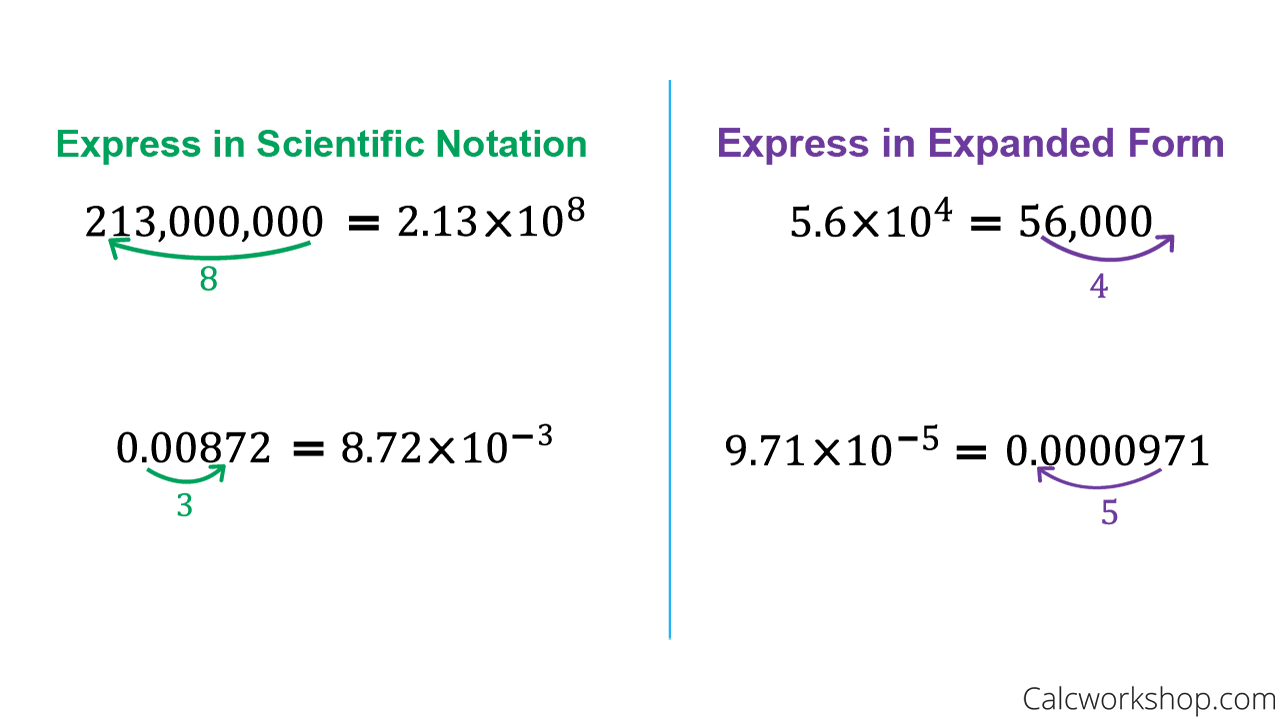
Writing numbers in scientific notation or expanded decimal form

Scientific Notation Examples

But, the efficiency of Scientific Notation isn’t limited to writing numbers, we can also perform Operations with Scientific Notation!

What type of operations?

Adding, Subtracting, Multiplying and Dividing with Scientific Notation.

We will walk through countless examples, and be able to use Scientific Notation efficiently, without the use of a calculator. But, it is important to note, that if you do use a calculator or math program, sometimes you will see an “E” instead of “x 10”, but don’t fear… they mean the same thing!

Scientific Notation (How-To) – Video

Get access to all the courses and over 450 HD videos with your subscription

Monthly and Yearly Plans Available

Get My Subscription Now

Still wondering if CalcWorkshop is right for you?
Take a Tour and find out how a membership can take the struggle out of learning math.


Calcworkshop

© 2026 Calcworkshop LLC / Privacy Policy / Terms of Service

  • About
  • Reviews
  • Courses
  • Plans & Pricing

Advertisement