Calcworkshop

Login
  • Home
  • Reviews
  • Courses
    • Algebra I & II
      • Intro Algebra
      • Solving Equations
      • Exponents
      • Polynomials
      • Factoring
      • Rationals
      • Graphing Linear Equations
      • Systems of Equations
      • Radicals
      • Functions & Statistics
    • Geometry
      • Basic Geometry
      • Reasoning & Proofs
      • Congruent Triangles
      • Quadrilaterals
      • Similarity
      • Triangles & Trig
      • Circles
      • Polygons & Circles
      • Volume & Surface Area
      • Transformations
    • Pre-Calculus
      • Trigonometry
        • Trigonometric Functions
        • Radian Measure
        • Graphing Trig Functions
        • Trig Identities
        • Trig Equations
        • Law of Sines and Cosines
        • Vector Applications
        • Polar Equations
        • Complex Numbers
      • Math Analysis
        • Intro to Math Analysis
        • Functions and Graphs
        • Expos and Logs
        • Polynomial Functions
        • Rational Functions
        • Conic Sections
        • Series & Sequences
    • Calculus 1, 2, & 3
      • Business Calculus
      • Calculus 1
        • PreCalc Review
        • Limits
        • Derivatives
        • Application of Derivatives
        • Integrals
        • Final Exam
      • Calculus 2
        • Integrals
        • Applications of Integrals
        • Diff-EQs
        • Polar Functions
        • Parametric and Vector Functions
        • Sequences and Series
        • Final Exam
      • Calculus 3
        • Vectors and The Geometry of Space
        • Vector Functions
        • Partial Derivatives
        • Multiple Integrals
        • Vector Calculus
        • Final Exam
    • Statistics & Prob
      • Exploring Data
      • Probability
      • Discrete Distribution
      • Continuous Distribution
      • Joint Distribution
      • Confidence Interval
      • Hypothesis Testing
      • Linear Regression
    • Discrete Math
      • Logic
      • Proofs
      • Sets
      • Number Theory
      • Functions
      • Combinatorics
      • Relations
      • Trees & Graphs
    • Linear Algebra
      • Linear Equations
      • Matrix Algebra
      • Determinants
      • Vector Spaces
      • Eigenvalues and Eigenvectors
      • Orthogonality and Least Squares
      • Symmetric Matrices
      • Final Exam
    • Diff-EQs
      • Intro to DiffEqs
      • First Order Differential Equations
      • Second Order Differential Equations
      • Series Solutions
      • Laplace Transform
      • Systems of Differential Equations
      • Final Exam
    • Praxis
  • FAQs
  • About
  • Contact
  • Login
Home » Functions and Statistics » Permutations and Combinations

What are Permutations and Combinations?
15 Powerful Examples!

// Last Updated: January 20, 2020 - Watch Video //


Have you ever wondered what the difference is between permutations and combinations?
Jenn (B.S., M.Ed.) of Calcworkshop® introducing permutations and combinations

Jenn, Founder Calcworkshop®, 15+ Years Experience (Licensed & Certified Teacher)

A permutation is an arrangement of items in a particular order. In other words, Placement or Position matter.

For example, imagine you are trying to arrange pictures on a wall. This means that the arrangement of the pictures is dependent on order: 1st, 2nd, 3rd, etc.

A combination is an arrangement of items without regard to order. In other words, you Couldn’t Care Less about the order you’re just interested in counting groups.

So to review…when the order doesn’t matter, we use Combinations and when the order does matter it is a Permutation, as Math is Fun nicely summarizes.
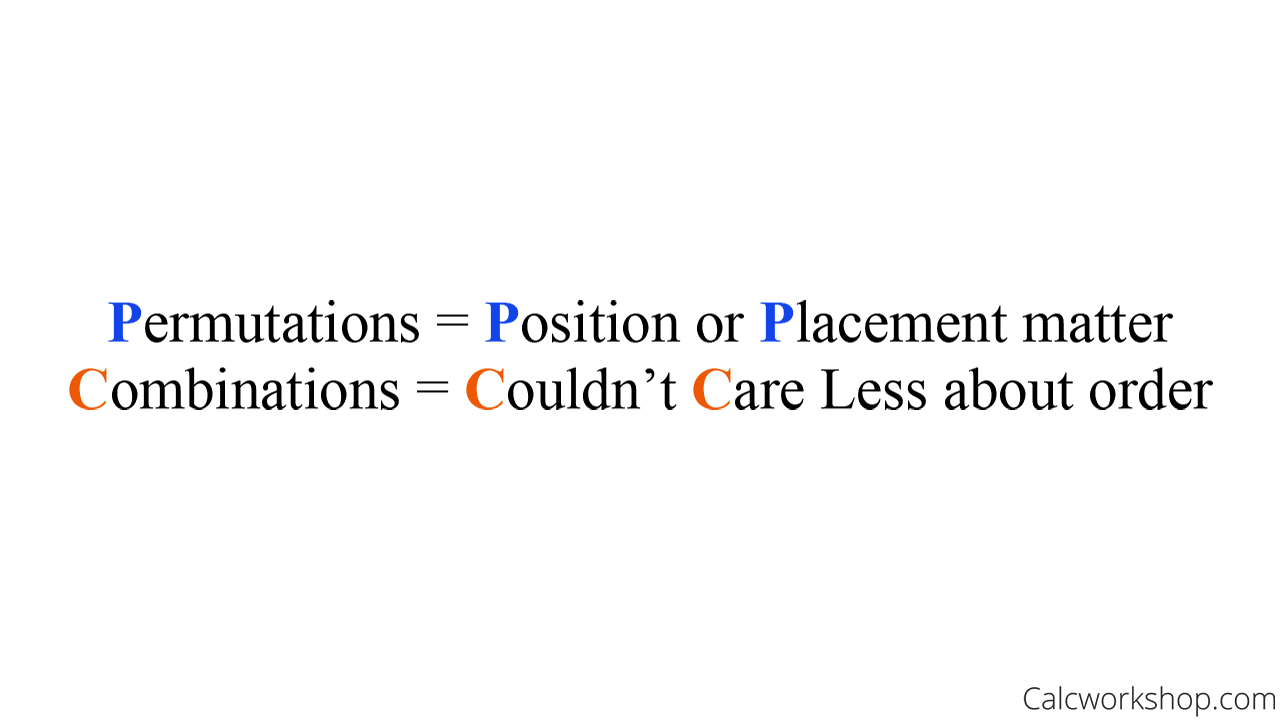
Easy way to remember permutations and combinations

Differences between Permutations and Combinations

Both permutations and combinations are grounded in the fundamental counting principal which proves that multiplication is a great way to quickly count the number of ways a certain thing can happen.

Furthermore, both combinations and permutations will utilize factorials. A factorial is the multiplication of a series of descending natural numbers and helps us in creating the formulas for how to calculate permutations and combinations.

Together we will learn the notation used for permutations and combinations and how to apply these formulas for when repetition is and isn’t allowed.

What this means, is that sometimes we are allowed to repeat numbers or items, and other times we must reduce the number of available choices each time. This happens when you are playing card games, arranging letters in a word where you can only use each letter once, or when you are trying to select positions.
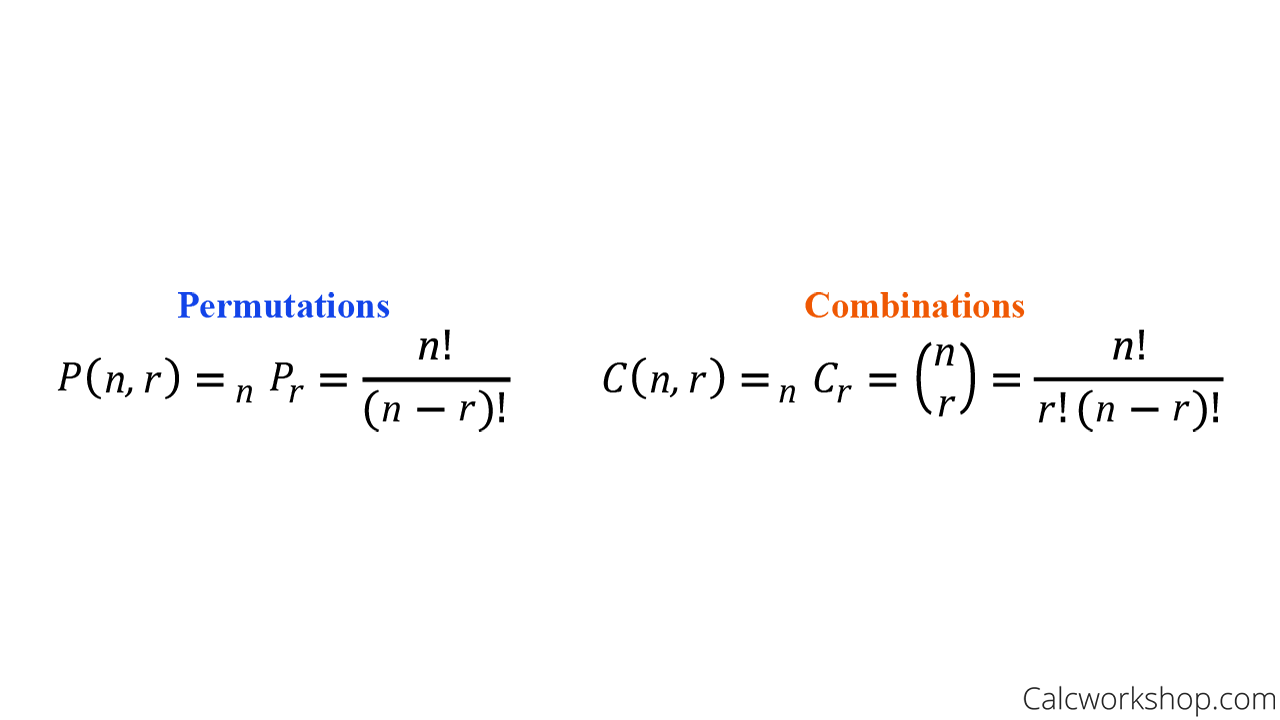
Notation and formula for calculating combinations and permutations

Formulas for Finding Permutations and Combinations

We will also learn how to determine when to use permutations or combinations without repetition based on the given problem, and be able to quickly establish the number of possible outcomes.

Permutations and Combinations – Video

Get access to all the courses and over 450 HD videos with your subscription

Monthly and Yearly Plans Available

Get My Subscription Now

Still wondering if CalcWorkshop is right for you?
Take a Tour and find out how a membership can take the struggle out of learning math.


Calcworkshop

© 2026 Calcworkshop LLC / Privacy Policy / Terms of Service

  • About
  • Reviews
  • Courses
  • Plans & Pricing

Advertisement