Calcworkshop

Login
  • Home
  • Reviews
  • Courses
    • Algebra I & II
      • Intro Algebra
      • Solving Equations
      • Exponents
      • Polynomials
      • Factoring
      • Rationals
      • Graphing Linear Equations
      • Systems of Equations
      • Radicals
      • Functions & Statistics
    • Geometry
      • Basic Geometry
      • Reasoning & Proofs
      • Congruent Triangles
      • Quadrilaterals
      • Similarity
      • Triangles & Trig
      • Circles
      • Polygons & Circles
      • Volume & Surface Area
      • Transformations
    • Pre-Calculus
      • Trigonometry
        • Trigonometric Functions
        • Radian Measure
        • Graphing Trig Functions
        • Trig Identities
        • Trig Equations
        • Law of Sines and Cosines
        • Vector Applications
        • Polar Equations
        • Complex Numbers
      • Math Analysis
        • Intro to Math Analysis
        • Functions and Graphs
        • Expos and Logs
        • Polynomial Functions
        • Rational Functions
        • Conic Sections
        • Series & Sequences
    • Calculus 1, 2, & 3
      • Business Calculus
      • Calculus 1
        • PreCalc Review
        • Limits
        • Derivatives
        • Application of Derivatives
        • Integrals
        • Final Exam
      • Calculus 2
        • Integrals
        • Applications of Integrals
        • Diff-EQs
        • Polar Functions
        • Parametric and Vector Functions
        • Sequences and Series
        • Final Exam
      • Calculus 3
        • Vectors and The Geometry of Space
        • Vector Functions
        • Partial Derivatives
        • Multiple Integrals
        • Vector Calculus
        • Final Exam
    • Statistics & Prob
      • Exploring Data
      • Probability
      • Discrete Distribution
      • Continuous Distribution
      • Joint Distribution
      • Confidence Interval
      • Hypothesis Testing
      • Linear Regression
    • Discrete Math
      • Logic
      • Proofs
      • Sets
      • Number Theory
      • Functions
      • Combinatorics
      • Relations
      • Trees & Graphs
    • Linear Algebra
      • Linear Equations
      • Matrix Algebra
      • Determinants
      • Vector Spaces
      • Eigenvalues and Eigenvectors
      • Orthogonality and Least Squares
      • Symmetric Matrices
      • Final Exam
    • Diff-EQs
      • Intro to DiffEqs
      • First Order Differential Equations
      • Second Order Differential Equations
      • Series Solutions
      • Laplace Transform
      • Systems of Differential Equations
      • Final Exam
    • Praxis
  • FAQs
  • About
  • Contact
  • Login
Home » Integrals » Improper Integrals

Improper Integrals
A Guide to Taming Infinity

// Last Updated: April 11, 2024 - Watch Video //


What do you do with infinity?

Namely, what do you do when a definite integral has an interval that is infinite or where the function has infinite discontinuity?

Both of these scenarios are called Improper Integrals.

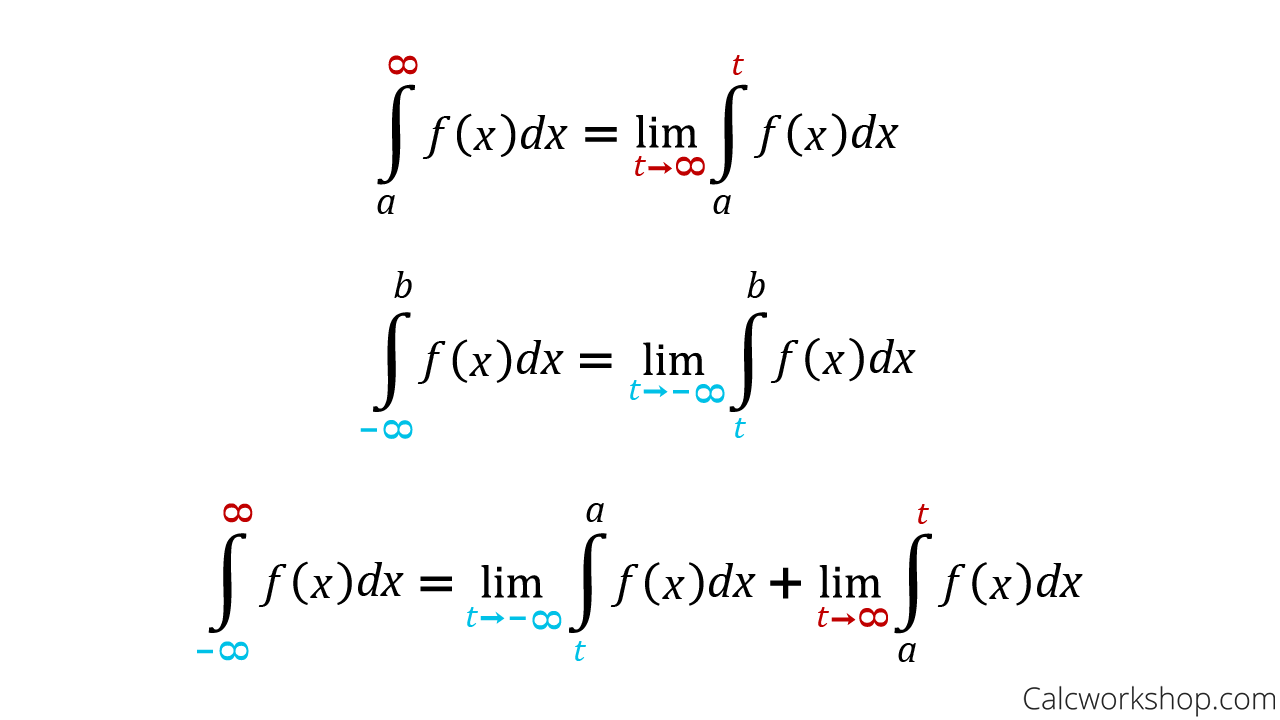
Now, an Improper Integral is a definite integral that cannot be computed using normal Riemann integral techniques, according to Wolfram Alpha. Therefore, we are going to have to develop ways of replacing infinite or undefined limits with finite values.

There are two types of Improper Integrals:

  • Definition of an Improper Integral of Type 1 – when the limits of integration are infinite
  • Definition of an Improper Integral of Type 2 – when the integrand becomes infinite within the interval of integration.
How to evaluate infinite intervals and discontinuous integrands

Changing Improper Integrals to Limits of Integrals

We will walk through five examples of Improper Integrals and see how we change our integral into a limit expression, which enables us to approach infinity and determine convergence and divergence.

Moreover, it is important to note that sometimes it is also beneficial to use the direct comparison theorem when dealing with improper integrals, as there are instances when the exact value of the improper integral cannot be found.

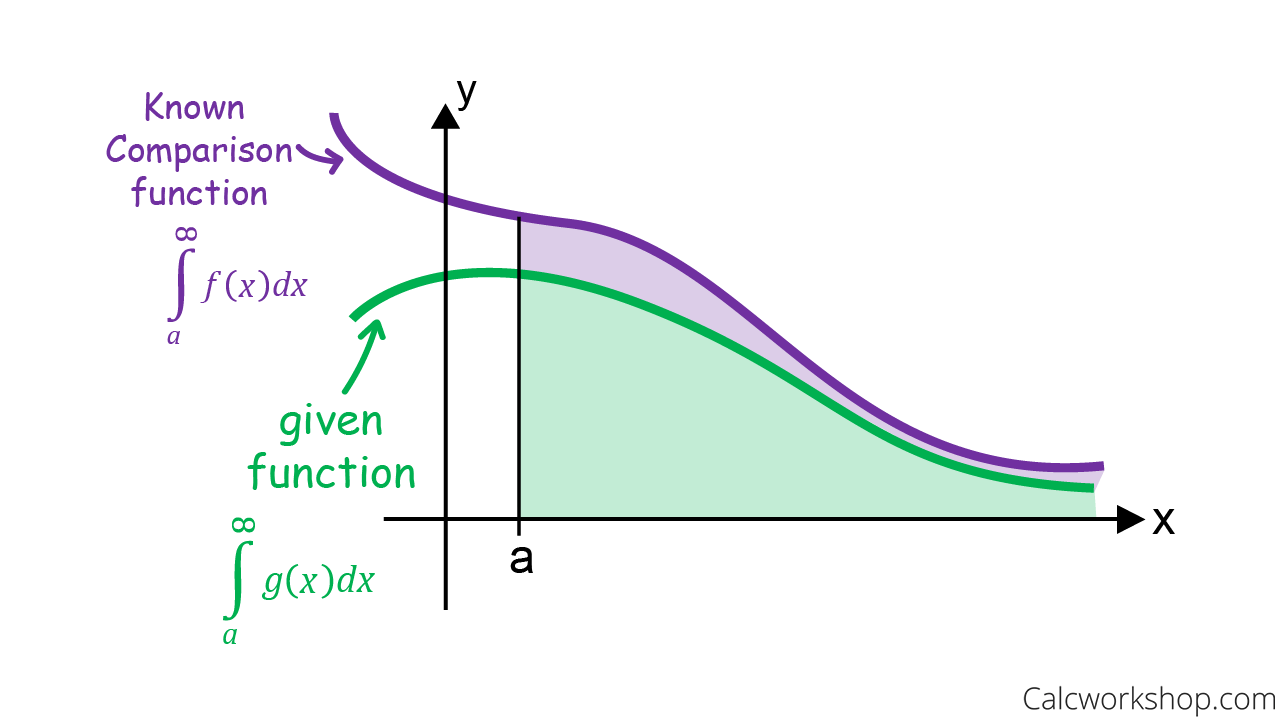
The idea behind the comparison test for improper integrals is to graph our integral function and then compare it with a graph of a known expression that is similar to the one we are asked to integrate.

Then graph our two functions, ensuring that our chosen comparison function is above, or on top, whereas our given function is underneath, or on the bottom.
Understanding the Comparison Test for Improper Integrals

Comparison Theorem for Improper Integrals

Now we use the comparison theorem to determine convergence or divergence.

  • If the area under the graph of our given function (the one on the bottom) is infinite than the area under the comparison function (the one on top) will also yield an infinite area. Therefore, both functions diverge.
  • If we can show that the area under the comparison function (curve on top) is finite, then the area under our given function (curve on the bottom) is too; thus convergent.

We will go into much greater depth into the concept of comparison, and the comparison test, as it pertains to convergence in our sequences and series unit.

Improper Integrals Video
Improper-Integrals-Example

Get access to all the courses and over 450 HD videos with your subscription

Monthly and Yearly Plans Available

Get My Subscription Now

Still wondering if CalcWorkshop is right for you?
Take a Tour and find out how a membership can take the struggle out of learning math.

Calcworkshop

© 2026 Calcworkshop LLC / Privacy Policy / Terms of Service

  • About
  • Reviews
  • Courses
  • Plans & Pricing

Advertisement