Calcworkshop

Login
  • Home
  • Reviews
  • Courses
    • Algebra I & II
      • Intro Algebra
      • Solving Equations
      • Exponents
      • Polynomials
      • Factoring
      • Rationals
      • Graphing Linear Equations
      • Systems of Equations
      • Radicals
      • Functions & Statistics
    • Geometry
      • Basic Geometry
      • Reasoning & Proofs
      • Congruent Triangles
      • Quadrilaterals
      • Similarity
      • Triangles & Trig
      • Circles
      • Polygons & Circles
      • Volume & Surface Area
      • Transformations
    • Pre-Calculus
      • Trigonometry
        • Trigonometric Functions
        • Radian Measure
        • Graphing Trig Functions
        • Trig Identities
        • Trig Equations
        • Law of Sines and Cosines
        • Vector Applications
        • Polar Equations
        • Complex Numbers
      • Math Analysis
        • Intro to Math Analysis
        • Functions and Graphs
        • Expos and Logs
        • Polynomial Functions
        • Rational Functions
        • Conic Sections
        • Series & Sequences
    • Calculus 1, 2, & 3
      • Business Calculus
      • Calculus 1
        • PreCalc Review
        • Limits
        • Derivatives
        • Application of Derivatives
        • Integrals
        • Final Exam
      • Calculus 2
        • Integrals
        • Applications of Integrals
        • Diff-EQs
        • Polar Functions
        • Parametric and Vector Functions
        • Sequences and Series
        • Final Exam
      • Calculus 3
        • Vectors and The Geometry of Space
        • Vector Functions
        • Partial Derivatives
        • Multiple Integrals
        • Vector Calculus
        • Final Exam
    • Statistics & Prob
      • Exploring Data
      • Probability
      • Discrete Distribution
      • Continuous Distribution
      • Joint Distribution
      • Confidence Interval
      • Hypothesis Testing
      • Linear Regression
    • Discrete Math
      • Logic
      • Proofs
      • Sets
      • Number Theory
      • Functions
      • Combinatorics
      • Relations
      • Trees & Graphs
    • Linear Algebra
      • Linear Equations
      • Matrix Algebra
      • Determinants
      • Vector Spaces
      • Eigenvalues and Eigenvectors
      • Orthogonality and Least Squares
      • Symmetric Matrices
      • Final Exam
    • Diff-EQs
      • Intro to DiffEqs
      • First Order Differential Equations
      • Second Order Differential Equations
      • Series Solutions
      • Laplace Transform
      • Systems of Differential Equations
      • Final Exam
    • Praxis
  • FAQs
  • About
  • Contact
  • Login
Home » Integrals » Integration Rules

Integration Rules
Simplifying Calculus Problems

// Last Updated: January 22, 2020 - Watch Video //


Wouldn’t it be awesome if there were some useful rules for finding antiderivatives?

Good thing there are Integration Formulas!
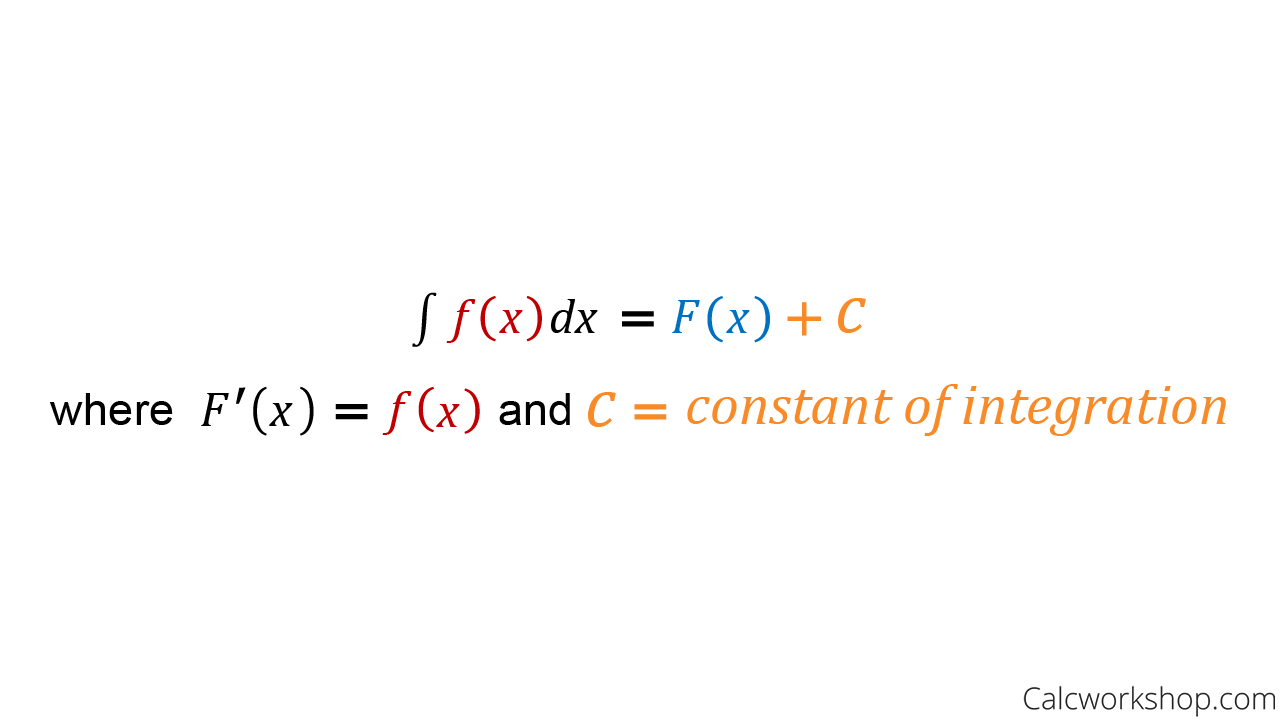
notation for antiderivatives

Indefinite Integral Notation


Okay, so we already know that integration, or antidifferentiation, is nothing more than calculating the area under the curve.

We saw how to approximate the area in our study of Riemann Sums and Sigma Notation, but now it’s time to expand upon our knowledge to include Integration properties and techniques.

As we learn the basic integration rules, we will learn the difference between an indefinite integral and a definite integral.

What’s the difference, you may ask?

Fundamental theorem enables us to compute integrals easily

Sum and Difference Property of Integrals

Well, an indefinite integral represents a function and allows us to determine the relationship between the original function and its derivative. Whereas, a definite integral represents a number and identifies the area under the curve for a specified region.

While most people nowadays use the words antidifferentiation and integration interchangeably, according to Wikipedia, antidifferentiation is the process we use when we are asked to evaluate an indefinite integral; having to add a constant “C” to our answer.

Whereas integration is a way for us to find a definite integral or a numerical value.

But all in all, no matter what you call it (i.e., antidifferentiation or integration) the formulas or integration rules that you will learn in this video will show you how to get the answer you seek!
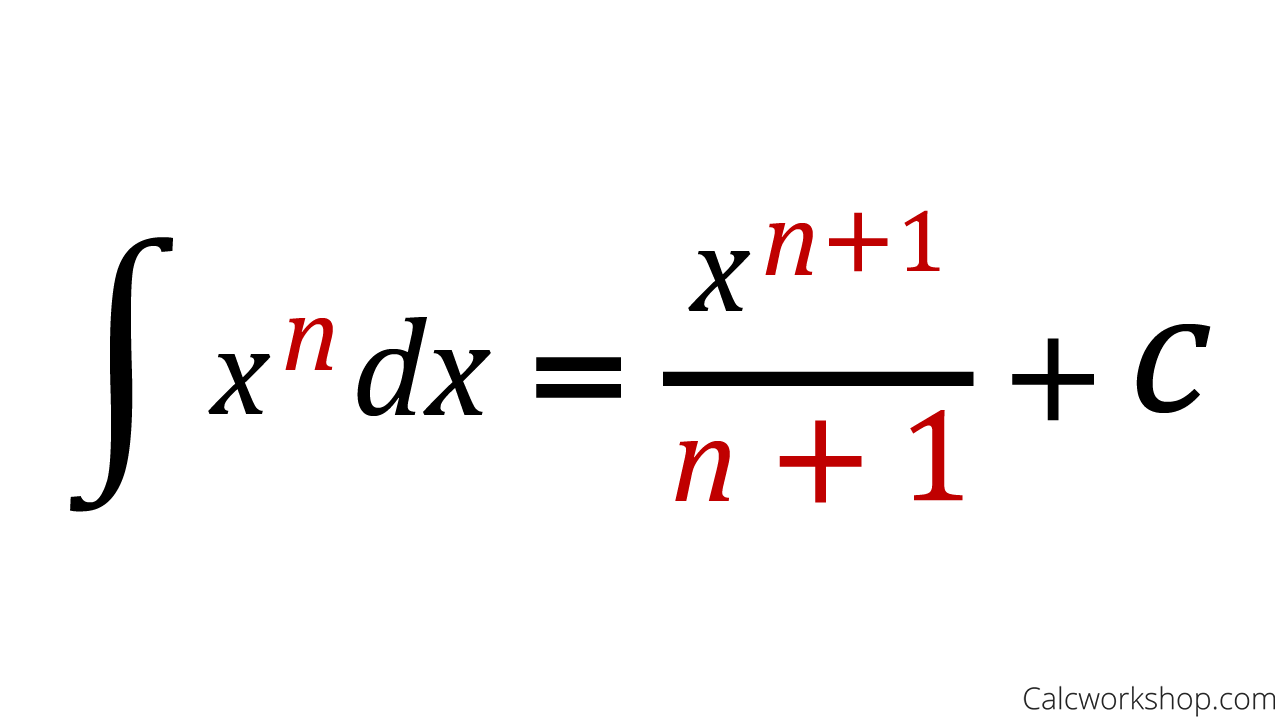
notation and process for evaluating indefinite integrals

Integration Formula

To help us in learning these basic rules, we will recognize an incredible connection between derivatives and integrals.

When we differentiate we multiply and decrease the exponent by one but with integration, we will do things in reverse.

In other words, we will increase the exponent by one and divide.

Together we will practice our Integration Rules by looking at nine examples of indefinite integration and five examples dealing with definite integration.

It’s going to be fun!

Video Tutorial w/ Full Lesson & Detailed Examples
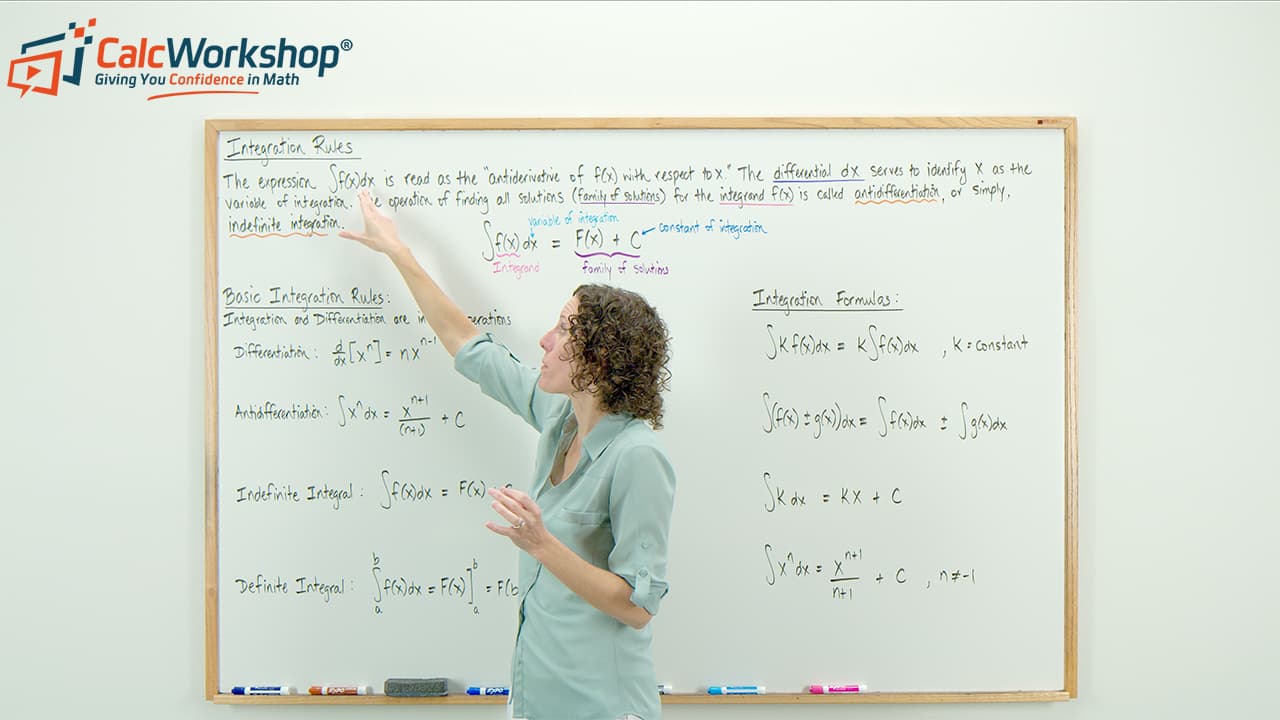
calcworkshop jenn teaching integration rules

Get access to all the courses and over 450 HD videos with your subscription

Monthly and Yearly Plans Available

Get My Subscription Now

Still wondering if CalcWorkshop is right for you?
Take a Tour and find out how a membership can take the struggle out of learning math.

Calcworkshop

© 2026 Calcworkshop LLC / Privacy Policy / Terms of Service

  • About
  • Reviews
  • Courses
  • Plans & Pricing

Advertisement