Calcworkshop

Login
  • Home
  • Reviews
  • Courses
    • Algebra I & II
      • Intro Algebra
      • Solving Equations
      • Exponents
      • Polynomials
      • Factoring
      • Rationals
      • Graphing Linear Equations
      • Systems of Equations
      • Radicals
      • Functions & Statistics
    • Geometry
      • Basic Geometry
      • Reasoning & Proofs
      • Congruent Triangles
      • Quadrilaterals
      • Similarity
      • Triangles & Trig
      • Circles
      • Polygons & Circles
      • Volume & Surface Area
      • Transformations
    • Pre-Calculus
      • Trigonometry
        • Trigonometric Functions
        • Radian Measure
        • Graphing Trig Functions
        • Trig Identities
        • Trig Equations
        • Law of Sines and Cosines
        • Vector Applications
        • Polar Equations
        • Complex Numbers
      • Math Analysis
        • Intro to Math Analysis
        • Functions and Graphs
        • Expos and Logs
        • Polynomial Functions
        • Rational Functions
        • Conic Sections
        • Series & Sequences
    • Calculus 1, 2, & 3
      • Business Calculus
      • Calculus 1
        • PreCalc Review
        • Limits
        • Derivatives
        • Application of Derivatives
        • Integrals
        • Final Exam
      • Calculus 2
        • Integrals
        • Applications of Integrals
        • Diff-EQs
        • Polar Functions
        • Parametric and Vector Functions
        • Sequences and Series
        • Final Exam
      • Calculus 3
        • Vectors and The Geometry of Space
        • Vector Functions
        • Partial Derivatives
        • Multiple Integrals
        • Vector Calculus
        • Final Exam
    • Statistics & Prob
      • Exploring Data
      • Probability
      • Discrete Distribution
      • Continuous Distribution
      • Joint Distribution
      • Confidence Interval
      • Hypothesis Testing
      • Linear Regression
    • Discrete Math
      • Logic
      • Proofs
      • Sets
      • Number Theory
      • Functions
      • Combinatorics
      • Relations
      • Trees & Graphs
    • Linear Algebra
      • Linear Equations
      • Matrix Algebra
      • Determinants
      • Vector Spaces
      • Eigenvalues and Eigenvectors
      • Orthogonality and Least Squares
      • Symmetric Matrices
      • Final Exam
    • Diff-EQs
      • Intro to DiffEqs
      • First Order Differential Equations
      • Second Order Differential Equations
      • Series Solutions
      • Laplace Transform
      • Systems of Differential Equations
      • Final Exam
    • Praxis
  • FAQs
  • About
  • Contact
  • Login
Home » Transformations » Translation Rules

Translation Rules
Simply Explained w/ 5 Examples!

// Last Updated: January 21, 2020 - Watch Video //


What are the translation rules?
Jenn (B.S., M.Ed.) of Calcworkshop® teaching translation rules

Jenn, Founder Calcworkshop®, 15+ Years Experience (Licensed & Certified Teacher)

Well, mathematically speaking, they’re the critical ingredients for isometric movements within a rigid body.

Now that may sound confusing at first, but that’s why we’re going to take this step-by-step in today’s geometry lesson.

So let’s get started!

A translation is sometimes referred to as a slide, shift, or glide as it maps (moves) all points of a figure the same distance and in the same direction.

In other words, imagine you put your right hand down on a flat surface. This is your preimage. Without changing the shape of your hand, you slide your hand along the surface to a new location. This is your image.

That’s all there is to translations… slide an object, without changing its shape, to a new location.

This means that a translation is an isometric transformation which means that the preimage and image are congruent figures, as ck-12 accurately states.

So how do we represent translations mathematically?

We use vectors to represent a translation. Which means we need direction (up, down, left, or right) and magnitude (length of units).

There are three ways we describe a translation:

  1. Words
  2. Coordinate Notation
  3. Component Form of a Vector

As seen in the example below, we will learn how to take a preimage (triangle ABC) and translate it using vectors to find its image (triangle A’B’C’).
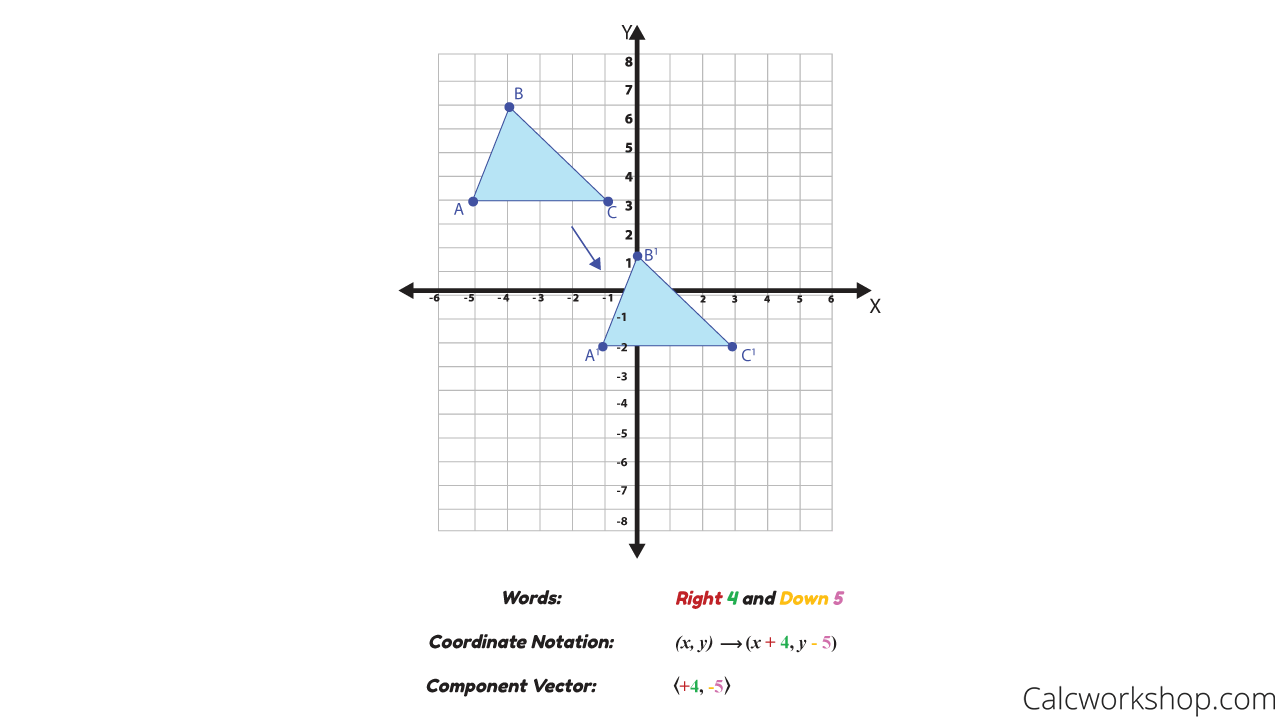
translation notation

Translation Notation

In the following video, you’ll learn how to represent a translation, draw an interpretation given a transformation formula, and also discover how composite reflections can be represented as a translation.

In fact, two back-to-back reflections over parallel lines equals one translation.

Therefore, allowing us to discover a formula for calculating the distance between the original figure and the final image.
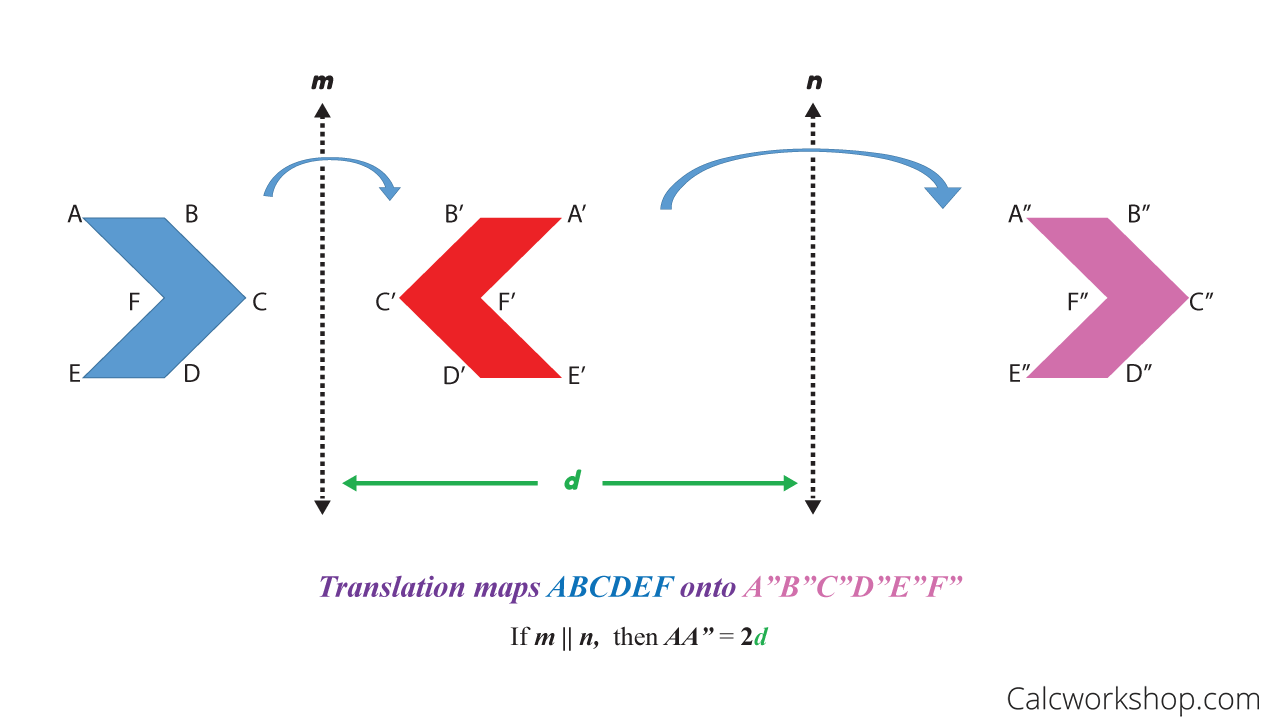
composition of reflections over two parallel lines

Composition of Reflections Over Two Parallel Lines

Video – Lesson & Examples

38 min

  • Introduction to translations
  • 00:00:27 – What is a translation? How do we describe a translation? (Examples #1-2)
  • Exclusive Content for Member’s Only
  • 00:12:12 – Describe the translation in words, coordinate notation, and component vector form (Example #3)
  • 00:20:56 – Graph the transformation given the translation rule (Example #4)
  • 00:30:09 – How do two consecutive reflections equals one translation?
  • 00:40:27 – Identify the following given consecutive reflections (Example #5)
  • Practice Problems with Step-by-Step Solutions
  • Chapter Tests with Video Solutions

Get access to all the courses and over 450 HD videos with your subscription

Monthly and Yearly Plans Available

Get My Subscription Now

Still wondering if CalcWorkshop is right for you?
Take a Tour and find out how a membership can take the struggle out of learning math.


Calcworkshop

© 2026 Calcworkshop LLC / Privacy Policy / Terms of Service

  • About
  • Reviews
  • Courses
  • Plans & Pricing

Advertisement