Image

Looking At A Bike Built For The Apocalypse

So-called bug out cars are a rather silly venture that serve little purpose more than snagging your jumper. The odds of a car working well through a nuclear winter are rather minimal. But what about a bicycle? On paper it’s a better choice, with extreme efficiency, reliability, and runs off whatever sustenance you can find in the barren landscape of a collapsed society. But [Seth] over at Berm Peak proved an apocalypse bike is at least as silly as a bug out car.

While a utilitarian bike fit for a cross-country trek across a nuclear wasteland can certainly be a reasonable venture, this particular bicycle is not that. This three wheeled monstrosity of a bicycle (is it still a bicycle if it has three wheels?) was built by [TOMO] for the Bespoked bike show’s apocalypse buildoff. It placed second among a number of strange bikes with features ranging from pedal driven circular saws to beer keg grills. But this particular example of apocalypse bike is easily the strangest example of the lot.

Continue reading “Looking At A Bike Built For The Apocalypse”

Image

GameCube Dock For Switch, Revisited

While modern game consoles are certainly excellent, there is still something magical about the consoles of yore. So why not bring the magical nostalgia of a GameCube controller to the Switch series of consoles?

This isn’t [Dorison Hugo’s] first attempt at building a Switch dock, but with seven years of development, there are a lot of updates in the project to unpack. One version allows the user to play on the Switch’s screen instead of on a docked display, and another comes with a mechanical lock to prevent the console from being stolen. But what really caught our eye is the modifications made to the OEM Switch docks.

As it turns out, there is enough space inside a Switch dock to stuff in four GameCube ports. Short of spinning a custom board, the trick was picking the right commercial adapter to start with. The Wii U branded adapter [Dorison] was using wouldn’t fit. However, a rather small third-party adapter from Input Integrity got the job done. Space was still rather tight, and the ports needed to be removed from the board to fit. Some cables with simple connectors on the GameCube connector side make cable management a bit simpler later. Holes have to be very neatly cut into the front of the Switch dock to complete the look, with the mods held in with some superglue, epoxy, and hot glue.

Shortly after the completion of the dock, the Switch 2 was released, so naturally, that dock went through a similar process. While there is more internal space for cable management on this iteration of the console, there is too little space for the ports to fit without modification. Shaving off a few millimeters from the top of the ports allows them to fit inside the case, but makes cutting professional-looking holes in the front panel all the more challenging. Unfortunately, there is no good way to connect the adapter’s USB cable to the dock’s PCB, so an extra USB cable became necessary.

Regardless of any imperfections, both modified docks look excellent, with near-OEM quality!

Continue reading “GameCube Dock For Switch, Revisited”

Image

Bike Spokes, Made Of Rope

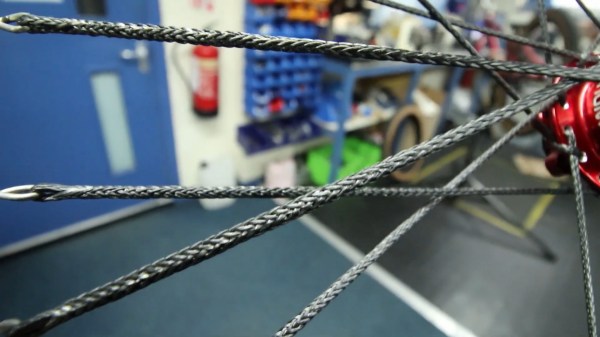
We know this one is a few years old, but unless you’re deep into the cycling scene, there’s a good chance this is the first time you’ve heard of [Ali Clarkson’s] foray into home made rope spokes. 

The journey to home-made rope spoke begun all the way back in 2018, shortly after the company Berd introduced their very expensive rope spokes. Berd’s spokes are made of a hollow weaved ultrahigh molecular weight polyethylene (UHMWPE) rope with very low creep. They claim wheels stronger than steel spoke equivalents at a fraction of the weight. Naturally forum users asked themselves, “well why can’t we make our own?” As it turns out, there are a handful of problems with trying this at home.

Continue reading “Bike Spokes, Made Of Rope”

Image

Making A Mountain Bike Data Acquisition System

Professional mountain bike racing is a rather bizarre sport. At the highest level, times between podiums will be less than a second, and countless hours of training and engineering go into those fractions of seconds. An all too important tool for the world cup race team is data acquisition systems (DAQ). In the right hands, they can offer an unparalleled suspension tune for a world cup racer. Sadly DAQs can cost thousands of dollars, so [sghctoma] built one using little more then potentiometer and LEGO. 

The hardware is a fairly simple task to solve. A simple Raspberry Pi Pico setup is used to capture potentiometer data. By some simple LEGO linkage and mounts, this data is correlated to the bikes’ wheel travel. Finally, everything is logged onto an SD card in a CSV format. Some buttons and a small AMOLED provide a simple user interface wrapped in a 3D printed case.

Continue reading “Making A Mountain Bike Data Acquisition System”

Image

What Happens When A Bug Rears Its Head At Mach Two?

While some may see amateur rocketry as little more than attaching fins to a motor and letting it fly, it is, in fact, rocket science. This fact became very clear to [BPS.space] when a parachute deployed on a rocket traveling at approximately Mach 1.8. 

The rocket design is rather simple — essentially just 3D printed fins glued onto a motor with a nose-cone for avionics. A single servo and trim tab provide a modicum of roll control, and a parachute is mounted in the nose along with a homing beacon for faster recovery. Seemingly, the only thing different about this flight is properly validated telemetry and GPS antennae.

After a final ground check of the telemetry and GPS signal quality, everything is ready for what seems like a routine launch. However, somewhere around Mach 1.8, the parachute prematurely deploys, ripping apart the Kevlar rope holding together the three rocket sections. Fortunately, the booster and avionics sections could be recovered from the desert.

Continue reading “What Happens When A Bug Rears Its Head At Mach Two?”

Image

An Open Source Electromagnetic Resonance Tablet

Drawing tablets have been a favorite computer peripheral of artists since its inception in the 1980s. If you have ever used a drawing tablet of this nature, you may have wondered, how it works, and if you can make one. Well, wonder no longer as [Yukidama] has demonstrated an open source electromagnetic resonance (EMR) drawing tablet build!

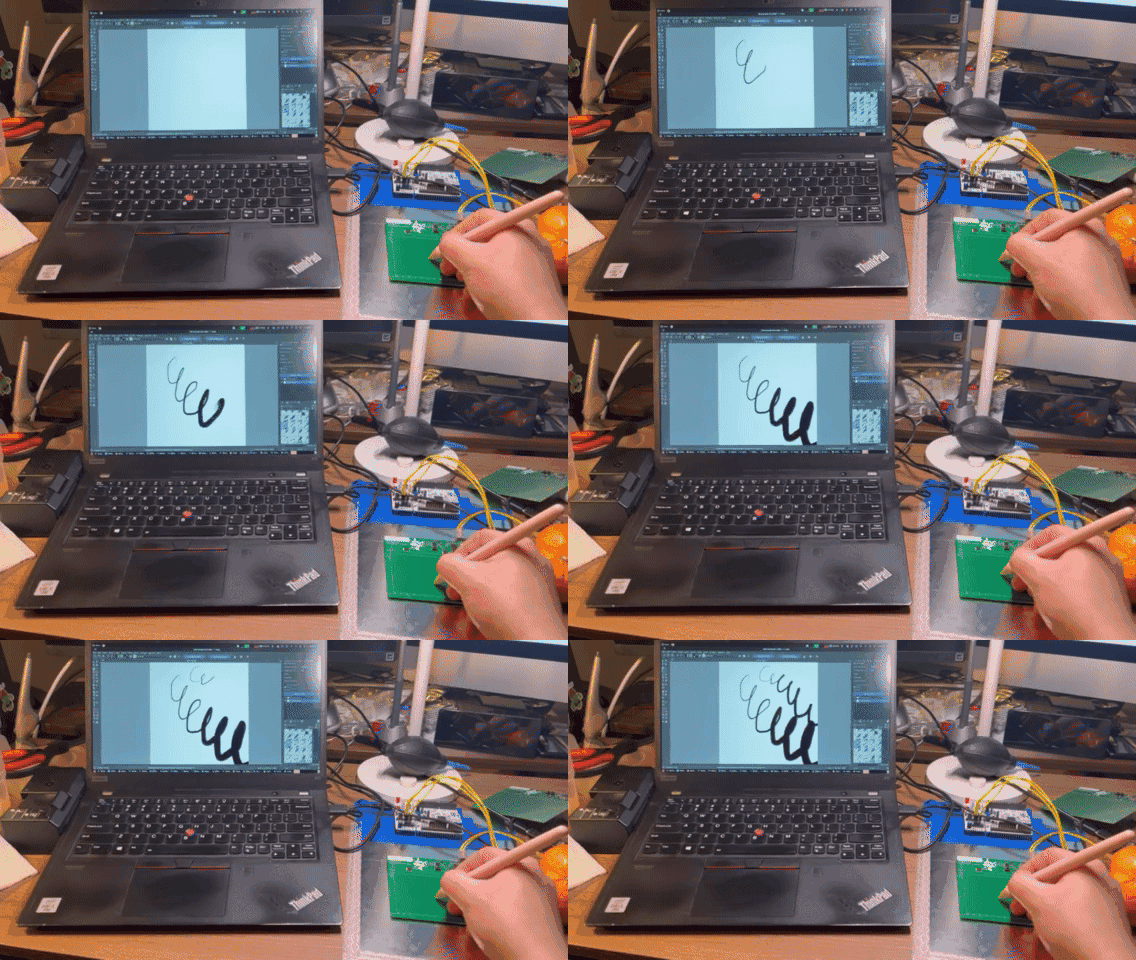
The principle of simple EMR tablets is quite straight forward. A coil in the tablet oscillates from around 400 kHz to 600 kHz. This induces a current inside a coil within the pen at its resonant frequency. This in turn, results in a voltage spike within the tablet around the pen’s resonant frequency. For pressure sensing, a simple circuit within the pen can shift its resonant frequency, which likewise is picked up within the tablet. The tablet’s input buttons work in similar ways!

But this is merely one dimensional. To sample two dimensions, two arrays of coils are needed. One to sample the horizontal axis, and one the vertical. The driver circuit simply sweeps over the array and samples every coil at any arbitrary speed the driver can achieve.

Finally, [Yukidama] made a last demo by refining the driver board, designed to drive a flexible circuit containing the coils. This then sits behind the screen of a Panasonic RZ series laptop, turning the device into a rather effective drawing tablet!

If tablets aren’t your style, check out this drawing pen. 

Continue reading “An Open Source Electromagnetic Resonance Tablet”

Image

Playing Factorio On A Floppy Disk Cluster

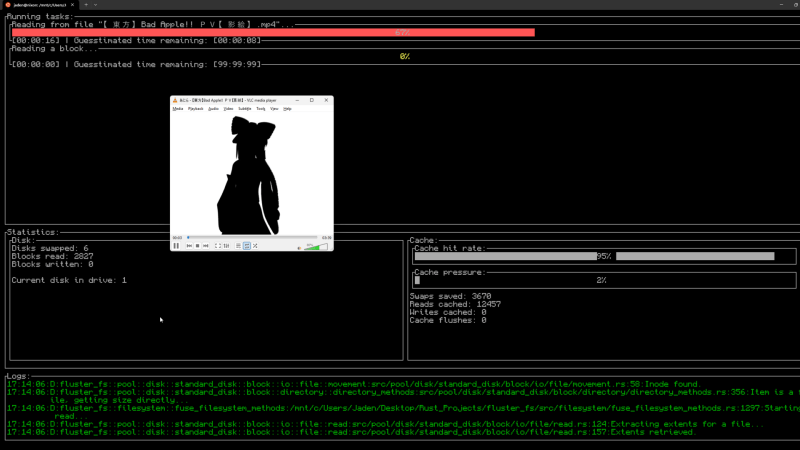
While a revolutionary storage system for their time, floppy disks are not terribly useful these days. Though high failure rates and slow speeds are an issue, for this project, the key issue is capacity. That’s because [DocJade’s] goal is playing the video game Factorio off floppy disks. 

Storing several gigabytes of data on floppy disks is a rather daunting challenge. But instead of using a RAID array, only a single reader and a custom file system is deployed in this setup. A single disk is dedicated to storing pool information allowing for caching of file locations, reducing disk swaps. The file system can also store single files across multiple disks for storage of larger files. Everything mounts in fuse and is loosely POSIX compliment, but lacks some features like permissions and links.

With the data stored across thousands of disks, the user is prompted to insert a new disk when needed. This ends up being the limiting factor in read and write speeds, rather than the famously slow speeds of floppies. In fact, it takes about a week to load all of Factorio in this manner, even after optimizations to reduce disk swaps. Factorio is also one of the few games that could be installed in this manner, as it loads most of the game into memory at launch. Many other games that dynamically load textures and world maps would simply crash when a chunk is not immediately available.

Not a Factorio fan? No worries, you could always install modern Linux on a floppy!

Continue reading “Playing Factorio On A Floppy Disk Cluster”