Image

Portable CRT TV Becomes Retro Cyberdeck

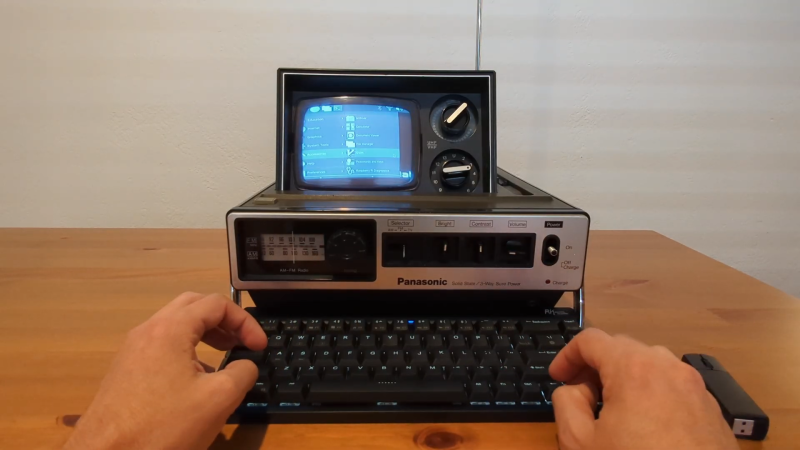
These days, it’s pretty easy to slap together a single-board computer and a cheap LCD screen to whip up a cool cyberdeck fast. But what if you wanna go more retro? [Manu] found a portable TV straight out of the original Blade Runner film, and decided this would be the perfect base for a cyberdeck rocking a whole-ass CRT screen.

The build started with a Panasonic TR-545 television. Back in the day, it took many large batteries to power this thing up—no surprise given how power hungry CRTs are. This gave [Manu] a neat opportunity to sneak all the new cyberdeck hardware into the original battery tray, including a new lithium-ion battery pack that is much more compact than the original. A Raspberry Pi 5 is running the show, computer-wise, and it’s hooked up to an HDMI RF modulator that allows the video output signal to be hooked up to the TV’s original antenna input. It’s not the cleanest way to go, but it allowed [Manu] to make the mod entirely reversible. All the new hardware slots neatly into the repurposed battery tray, and can be removed quite easily without damage to this vintage specimen. Even the keyboard fits nicely into the setup, as [Manu] was able to find a suitable 60% layout foldable unit right off the shelf.

Check out the slide deck for more details on the build, but be warned—it’s a 241 MB PDF. Bonus points if you calculate what that would cost to store on a hard drive in 1979 when the Panasonic TR-545 was on the market. We’ve seen a similar build before, too, with a classic black & white Magnavox unit. If you like squinting at a tiny blurry screen, a CRT cyberdeck is absolutely the way to go. Just be warned that the other screenwriters at your local coffee shop will be more interested in your hardware than whatever you’re actually working on. Good luck with your next pitch all the same. Video after the break.
Continue reading “Portable CRT TV Becomes Retro Cyberdeck”

Image

Custom Clamshell Cyberdeck Shows Off Underlighting

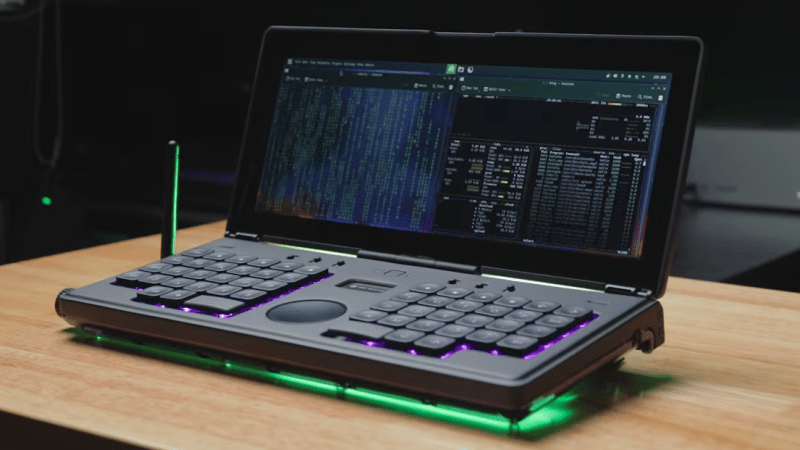
Cyberdecks are great projects, and [Salim Benbouziyane]’s scratch-built CM Deck is a fantastic specimen. It’s a clamshell-style cyberdeck with custom split keyboard, trackpad, optional external WiFi antenna, and some slick underlighting thanks to a translucent bottom shell. There’s even a hidden feature that seems super handy for a cyberdeck: a special USB-C port that, when plugged in to another host (like another computer), lets the cyberdeck act as an external keyboard and trackpad for that downstream machine.

Image
The CM Deck is built around the Raspberry Pi Compute Module 5, which necessitates a custom PCB but offers more design freedom.

Notably, the CM Deck is custom-built around the Raspberry Pi Compute Model 5. When we first peeped the CM5 the small size was striking, but of course that comes at the cost of having no connectors, supporting hardware, or heat management. That’s something [Salim] embraced because it meant being able to put connectors exactly where he wanted them, and not have to work around existing hardware. A custom PCB let him to lay out his cyberdeck with greater freedom, less wasted space, and ultimately integrate a custom-built keyboard (with RP2040 and QMK firmware).

Even the final enclosure is custom-made, with 3D printing being used to validate the design and PCBway providing finished plastic shells in addition to manufacturing the PCBs. [Salim] admits that doing so was an indulgence, but his delight at the quality of the translucent purple undercarriage is palpable.

[Salim]’s video (embedded below) is a deep dive into the whole design and build process, and it’s a great watch for anyone interested in the kind of work and decisions that go into making something like this. Experienced folks can expect to nod in sympathy when [Salim] highlights gotchas like doing CAD work based on the screen’s drawings, only to discover later that the physical unit doesn’t quite match.

The GitHub repository contains the design files for everything, so give it a browse if you’re interested. [Salim] is no stranger to clean builds, so take a moment to admire his CRT-style Raspberry Pi terminal as well.

Continue reading “Custom Clamshell Cyberdeck Shows Off Underlighting”

Image

An Event Badge Re-Imagined As A Cyberdeck

We’re used to handheld Linux devices of varying usefulness appearing on a regular basis, but there’s something about the one in a video from [Rootkit Labs] which sets it aside from the herd. It’s a fork of a conference badge.

The WHY2025 badge had pretty capable hardware, with an ESP32-P4, a really nice screen, and the lovely SolderParty keyboard. Here it’s been forked, to become a carrier board for their previous project, the Flipper Blackhat. This is a Linux add-on for the Flipepr Zero, and it seems that plenty of people wanted it in a more useful context. The result is something that looks a lot like a WHY badge, but running Linux.

It’s a great shame when badges end up lying unused after the event, and ones like the WHY 2025 badge are a serious effort to make something that endures. Here, the badge endures in spirit by being forked and re-engineered, and we like it a lot. The full video is below the break.

Continue reading “An Event Badge Re-Imagined As A Cyberdeck”

Image

Damaged Pocket Computer Becomes Portable Linux Machine

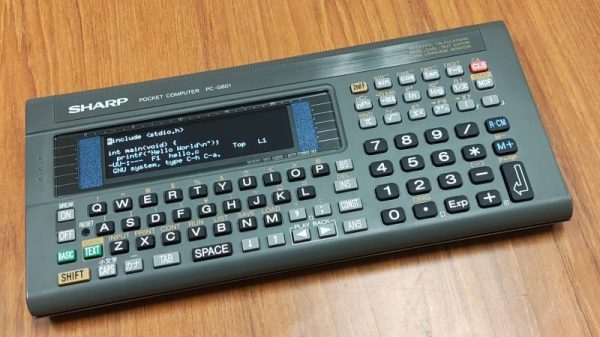
The Sharp PC-G801 was an impressive little pocket computer when it debuted in 1988. However, in the year 2025, a Z80-compatible machine with just 8 kB of RAM is hardly much to get excited about. [shiura] decided to take one of these old machines and upgrade it into something more modern and useful.

The build maintains the best parts of the Sharp design — namely, the case and the keypad. The original circuit board has been entirely ripped out, and a custom PCB was designed to interface with the membrane keypad and host the new internals. [shiura] landed on the Raspberry Pi Zero 2W to run the show. It’s a capable machine that runs Linux rather well and has wireless connectivity out of the box. It’s paired with an ESP32-S3 microcontroller that handles interfacing all the various parts of the original Sharp hardware. It also handles the connection to the 256×64 OLED display. The new setup can run in ESP32-only mode, where it acts as a classic RPN-style calculator. Alternatively, the Pi Zero can be powered up for a full-fat computing experience.

The result of this work is a great little cyberdeck that looks straight out of the 1980s, but with far more capability. We’ve seen a few of these old pocket computers pop up before, too.

Continue reading “Damaged Pocket Computer Becomes Portable Linux Machine”

Image

A Pentium In Your Hand

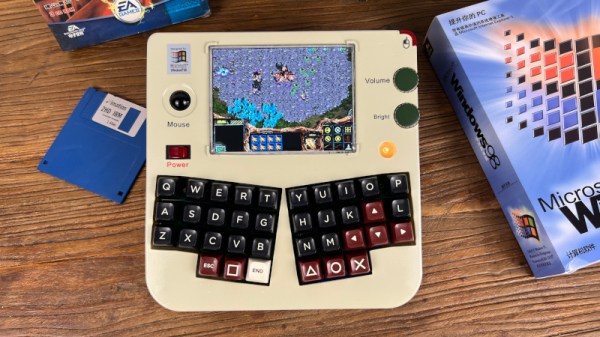
Handheld computers have become very much part of the hardware hacker scene, as the advent of single board computers long on processor power but short on power consumption has given us the tools we need to build them ourselves. Handheld retrocomputers face something of an uphill struggle though, as many of the components are over-sized, and use a lot of power. [Changliang Li] has taken on the task though, putting an industrial Pentium PC in a rather well-designed SLA printed case.

Aside from the motherboard there’s a VGA screen, a CompactFlash card attached to the IDE interface, and a Logitech trackball. As far as we can see the power comes from a USB-C PD board, and there’s a split mechanical keyboard on the top side. It runs Windows 98, and a selection of peak ’90s games are brought out to demonstrate.

We like this project for its beautiful case and effective use of parts, but we’re curious whether instead of the Pentium board it might have been worth finding a later industrial PC to give it a greater breadth of possibilities, there being few x86 SBCs. Either way it would have blown our minds back in ’98, and we can see it’s a ton of fun today. Take a look at the machine in the video below the break.

Continue reading “A Pentium In Your Hand”

Image

Building A Clamshell Writer Deck

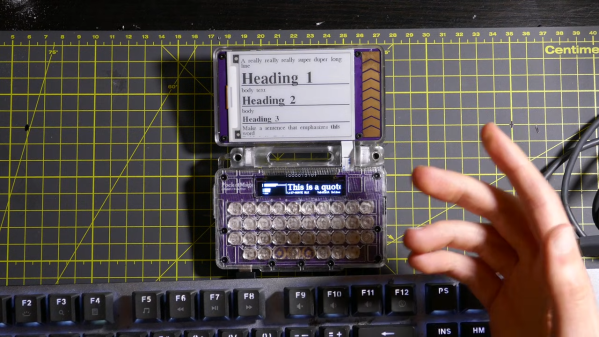
Most of us do our writing on computers these days, but the modern computing environment does present a lot of distractions. That’s let to the concept of the writer deck, a simplified device intended more specifically for word processing tasks. [Ashtf] has built a great example of the form with a modified version of the PocketMage device.

The PocketMage is a clamshell PDA device that [Ashtf] has been working on for some time. It’s powered by an ESP32, hooked up to a nice e-ink display. In its basic form, it’s not the ideal device for doing serious writing work, mostly because of its tiny keyboard. However, [Ashtf] has since added external keyboard support, which completely changes the game. With the use of a small USB C to USB A adapter, you can hook up any conventional USB keyboard that you like to best attain your maximum typing speed.

The result is a compact, simple device that lets you type away without distractions. If your latest fanfic isn’t coming along quickly enough because you keep losing focus to social media, perhaps this is a route you might like to go. [Ashtf] also included Markdown support so you can create richer documents on the device while operating in what is still fundamentally a text-only environment.

It’s neat to build custom devices that suit your own personal productivity needs. If you dig the PocketMage, you might like to check out the design files on Github. We’ve featured some other fun writer decks before, too. Video after the break.

Continue reading “Building A Clamshell Writer Deck”

Image

Handheld PC Build Is Pleasantly Chunky

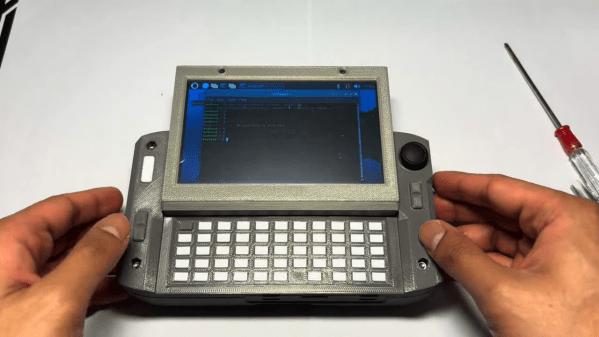
The cool thing about building your own computer is that you don’t have to adhere to industry norms of form and function. You can build whatever chunky, awesome thing your heart desires, and that’s precisely what [Rahmanshaber] did with the MutantC cyberdeck.

The build is based around a Raspberry Pi Compute Module 4. If you’re unfamiliar with the Compute Module, it’s basically a Raspberry Pi that has been designed specifically for easy integration into a larger carrier PCB. In this case, the carrier PCB interfaces all the other necessary gear to make this a fully functional computer. The PCB is installed inside a vaguely-rectangular 3D-printed enclosure, with a 5-inch TFT LCD on a sliding mount. Push the screen up, and it reveals a small-format keyboard for text entry. There’s also a hall-effect joystick and a couple of buttons for mouse control to boot. [Rahmanshaber] has designed the computer to run off a couple of different battery packs—you can use a pair of 18650 cells if you like, or switch to lager 21700 cells if you want greater capacity for longer running time.

If you want a portable Raspberry Pi cyberdeck, you might find this to be a great inspiration. We’ve featured many other designs in this vein before, too. Video after the break.
Continue reading “Handheld PC Build Is Pleasantly Chunky”