Image

VGA Output From A PIC18

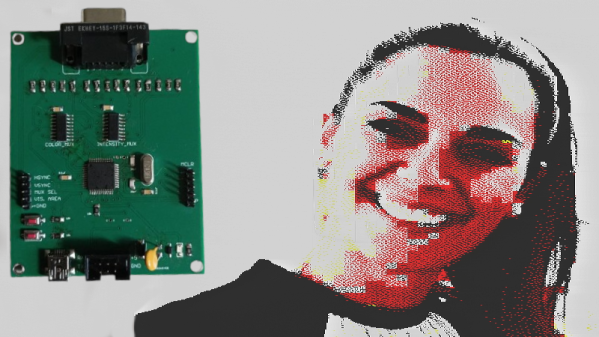
In the maker world, it’s the Arduino and ESP32 lines that get the lion’s share of attention. However, you can do fantastic things with PIC chips, too, if you put the dev time in—it’s just perhaps less likely another maker has done so before you. A great example is this VGA output project from [grecotron].

A PIC18F47K42 is perhaps not the first part you would reach for to pursue any sort of video-based project. However, with the right techniques, you can get the 8-bit microcontroller pumping out the pixels surprisingly well. [grecotron] was able to get the chip outputting to a VGA monitor at a resolution of 360 x 480 with up to 16 colors. It took some careful coding to ensure the chip could reliably meet the timing requirements for the standard and to get HSYNC, VSYNC, and the color signals all dancing in harmony. Aiding in this regard was that the chip was clocked with a 14.3182 MHz crystal to make it easy to divide down from all the internal timers as needed. Supporting hardware is light, too—primarily consisting of a VGA connector, a couple of multiplexers, and resistor ladder DACs for the color signals. Files are on Github for those interested in deeper detail on the work.

VGA output is possible to implement on all kinds of microcontrollers—and even a bunch of raw logic if you know what you’re doing. If you’re pursuing your own video output wizardry, be sure to let us know on the tipsline.
Image

Designing A Pen Clip That Never Bends Out Of Shape

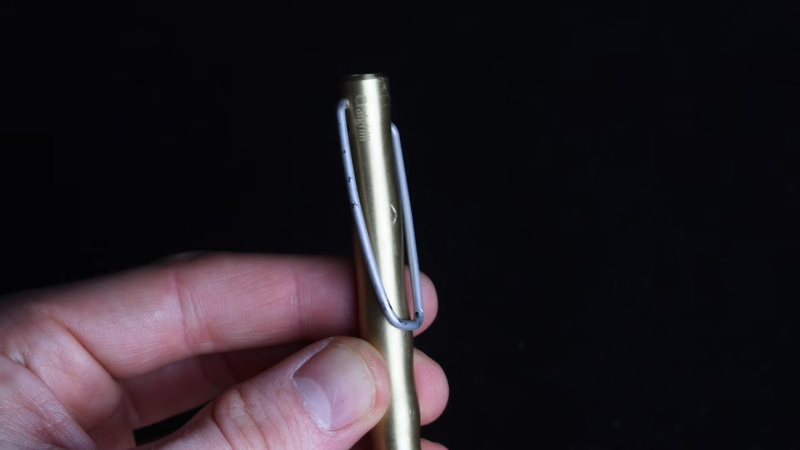
If you’ve ever used a ballpoint pen with a clip on the top, you’ve probably noticed they bend pretty easily. The clip relies on you only bending it a small amount to clip it on to things; bend it too far, and it ends up permanently deformed. [Craighill] decided to develop a pen clip that didn’t suffer this ugly malady. 

Image
The wire clip design easily opens wide because the spring wire is not actually deforming much at all. Credit: YouTube video, via screenshot

The problem with regular pen clips comes down to simple materials science. Bend the steel clip a little bit, and the stress in the material remains below the elastic limit—so it springs back to its original shape. Push it too far, though, and you’ll end up getting into the plastic deformation region, where you’ve applied so much stress that the material is permanently deformed.

[Craighill] noted this problem, and contemplated whether a better type of clip was possible. An exploration of carabiner clips served to highlight possible solutions. Some carabiners using elastically-deformed closures that faced the same problem, while others used more complicated spring closures or a nifty bent-wire design. This latter solution seemed perfect for building a non-deforming pen clip. The bent wire is effectively a small spring, which allows it to act as a clip to hold the pen on to something. However, it’s also able to freely rotate out from the pen body, limiting the amount of actual stress put on the material itself, which stops it entering the plastic deformation region that would ruin it.

It’s some neat materials science combined with a pleasant bit of inventing, which we love to see. Sometimes there is joy to be had in contemplating and improving even the simplest of things. Video after the break.

Continue reading “Designing A Pen Clip That Never Bends Out Of Shape”

Image

Color Mixing Spray Paint On The Fly

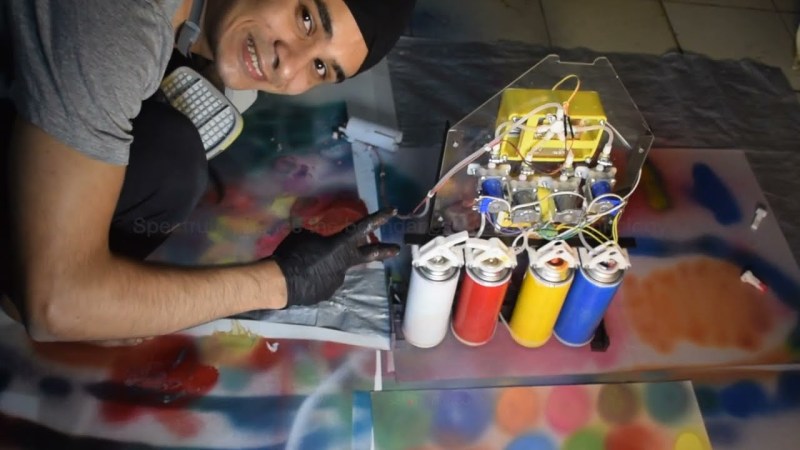
One of the problems with being a graffiti artist is that you have to carry around a different spray can for each color you intend to use. [Sandesh Manik] decided to solve this problem by building a rig that can produce a wider range of colors by mixing the paint from several cans at once. Check it out in the video below.

The project is called Spectrum. It uses four off-the-shelf spray paint cans—colored red, blue, yellow, and white—and mixes them to create a wider range of colors. All four cans are hooked up to a single output nozzle via a nest of tubing and a four-to-one tube manifold.  Key to controlling the flow of paint is a custom device which [Sandesh] calls the “rotary pinch valve,” with one fitted to the feed line coming from each spray can. These valves use a motor-driven lever to pinch a plastic tube shut, allowing them to control the paint flow. This design keeps the mechanism and paint completely separate, which was important to stop paint from fouling the valves in short order. It also prevents backflow, which keeps the paint going towards the outlet and prevents ugly messes. By quickly actuating the valve, the paint flow from each can is modulated to mix various colors as desired.

Continue reading “Color Mixing Spray Paint On The Fly”

Image

Recreating Mega Man’s Mega Buster

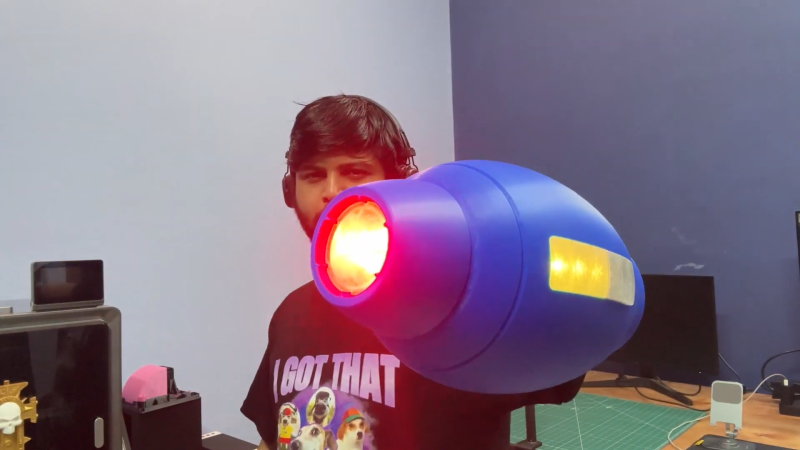
Mega Man is a popular video game character who is perhaps most notable for having a sort of lasery-type blaster for an arm. A real hand cannon, if you will. It’s officially called the Mega Buster, and [Arnov Sharma] recently recreated it for cosplay purposes.

Key to any good cosplay build is getting the visuals right, and [Arnov] achieved that well. The Mega Buster was first recreated in Fusion 360, scaled to an appropriate size to fit [Arnov]’s arm. It was 3D printed in several sections, with the body including a grab handle and fire button inside, and the side panel and blaster nozzle having provision for installing LEDs. The former is the blaster’s “power meter” which shows how many shots it has left until it runs out of energy, with the blaster able to fire six times before needing to cooldown. A Raspberry Pi Pico controls the LEDs and provides sound effects with the aid of a PAM8403 class D amplifier module and a small speaker.

The 3D files are available on Instructables for the curious. Perhaps by virtue of its arm-mounted nature, this build reminds us of the venerable Pip Boy from Fallout, of which we’ve seen many grand recreations before. Video after the break.

Continue reading “Recreating Mega Man’s Mega Buster”

Image

Displaying The Rainbow

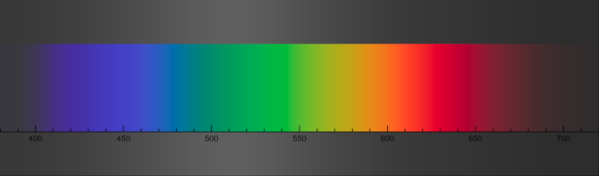
True or false? Your green laser pointer is more powerful than your red one. The answer is almost certainly false. They are, most likely, the same power, but your eye is far more sensitive to green, so it seems stronger. [Brandon Li] was thinking about how to best represent colors on computer screens and fell down the rabbit hole of what colors look like when arranged in a spectrum. Spoiler alert: almost all the images you see of the spectrum are incorrect in some way. The problem isn’t in our understanding of the physics, but more in the understanding of how humans perceive color.

Perception may start with physics, but it also extends to the biology of your eye and the psychology of your brain. What follows is a lot of math that finally winds up with the CIE 1931 color space diagram and the CIE 2012 system.

Continue reading “Displaying The Rainbow”

Image

Microfluidic Display Teaches The Basics

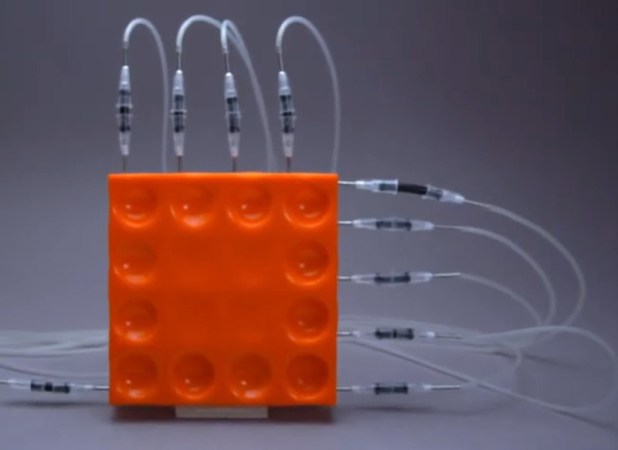
We’ve always been interested in fluidic logic and, based on [soiboi’s] videos, he is too. His latest shows how to use silicone and a vacuum to build a multiplexed dot matrix display. This is a fascinating look at how you design with air instead of electrons.

Just like a regular display, it isn’t efficient to control each element separately. Usually, it’s better to multiplex such that 16 “pixels” need only row and column air valves. Just as you might use transistors, the project uses “air transistors” to build logic gates.

Continue reading “Microfluidic Display Teaches The Basics”

Image

Smoothie Bikes Turned Into Game Controllers

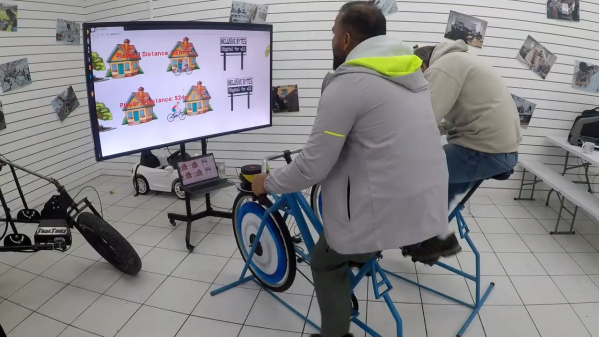
Smoothie bikes are a great way to make a nutritious beverage while getting a workout at the same time. [Tony Goacher] was approached by a local college, though, which had a problem with this technology. Namely, that students were using them and leaving them filthy. They posed a simple question—could these bikes become something else?

[Tony’s] solution was simple—the bikes would be turned into game controllers. This was easily achieved by fitting a bi-color disc into the blender assembly. As the wheel on the bike turns, it spins up the blender, with the disc inside. An ESP32 microcontroller paired with a light sensor is then able to count pulses as the disc spins, getting a readout of the blender’s current RPM. Working backwards, this can then be calculated out into the bike’s simulated road speed and used to play a basic game on an attached Raspberry Pi. Notably, the rig is setup such that the Raspberry Pi and one bike connect to an access point hosted by the other bike.  This is helpful, because it means neither bike has too many dangling cables that could get caught up in a wheel or chain.

We’ve seen many amusing game peripherals over the years, from salad spinners to turntables. Video after the break.

Continue reading “Smoothie Bikes Turned Into Game Controllers”