Image

Disposable Vape Becomes Breath-Activated Synth

Makers and hardware hackers have been collecting disposable vapes for some time now, usually to salvage their batteries or the unique displays many models now come with. But you can also repurpose them for other ends, such as playing music. [Becky Stern]’s vape synth is a perfect example of this.

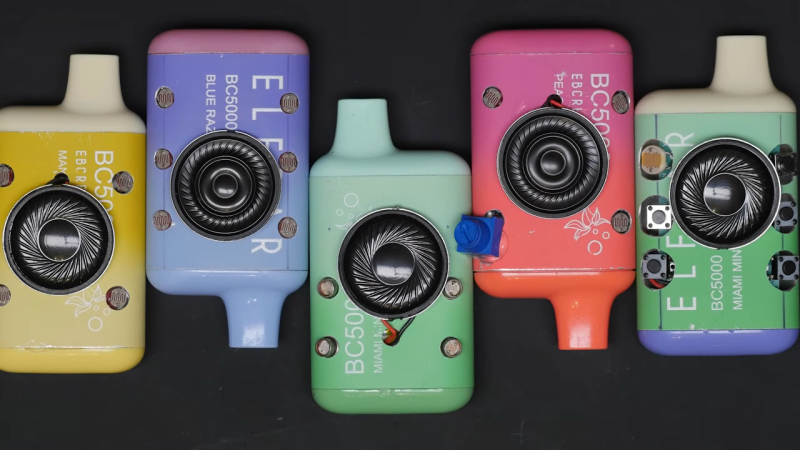
The build started with an ElfBars BC5000 vape. [Becky] notes there may be similar models under different names out there that would work just as well. The vape is effectively gutted for parts, with the LiPo cell, USB charging board, and the low-pressure sensor the main things that remain. These parts are combined with a drop-in 555 synthesizer circuit complete with speaker, which has its pitch controlled by a series of six photoresistors. When the low pressure sensor is triggered by inhalation, the 555 circuit is triggered, and operates at a pitch depending on the resistance of the photoresistor stack.

The output of the vape synth is kind of shrill, and frankly a little bit annoying — which is somehow rather fitting for what it is. If you want to make a better-sounding synth at home, we’ve featured such projects, you’re just unlikely to fit them entirely within the housing of a disposable vape.

Continue reading “Disposable Vape Becomes Breath-Activated Synth”
Image

Analog Siren For Psychedelic Soundscapes

For better or worse, there are a few instruments that have been pigeonholed into specific genres of popular music. For example, banjos are often heard in bluegrass or folk, harmonicas in blues, and a sick horn section will take many of us immediately to third wave ska. Similarly, there are certain styles of synthesizers tied to various genres and if you’re a fan a certain sub-genre of reggae you’ll be familiar with the dub siren. This unique analog synth has a few tricks up its sleeve and [Jakub] shows us how he built his.

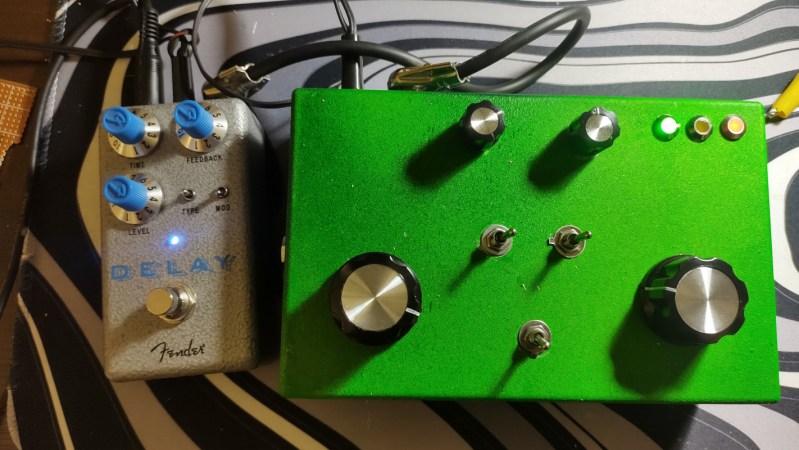
He’s calling this build the Sirenotron, and its based on the venerable 555 timer It also features an LFO built on an LM358, with triangle and square wave modes, plus an additional “acid mode” for the square wave which adds a single capacitor to the circuit but makes a big difference in the sound. Like any siren synth, there are potentiometers to control pitch and the pulse rate of the siren as well and another switch controls whether it is outputting sound or not. He’s also included the ability to control it with a foot pedal so he can use it while playing the bass guitar during live shows.

[Jakub] has gone through several prototypes before getting to this stage, and not only uses it when playing dub but also creates psychedelic soundscapes in a side project of his where it also fits right in. He’s also made the schematics available for anyone who wants to reproduce it or build on his design.

We’re always interested in a unique synthesizer build around here, and some of our favorites include this synth built from Sega Genesis parts and this one controlled more like a woodwind instrument.

Continue reading “Analog Siren For Psychedelic Soundscapes”

Image

2025 Component Abuse Challenge: Pushing A 555 To The Limit

The humble 555 timer has its origins back in the early 1970s as the NE555, a bipolar integrated circuit. Over the years it has spawned a range of derivatives, including dual versions, and ones using CMOS technology. Have these enhancements improved the performance of the chip significantly? [MagicWolfi] has been pushing the envelope in an effort to see just how fast an astable 555 can be.

The Microchip MIC1555 may be the newest of the bunch, a 5-pin CMOS SOT-23 which has lost the frequency control and discharge pins of the original. It’s scarcely less versatile though, and it’s a fine candidate for an oscillator to push. We see it at a range of values for the capacitor and resistor in an astable configuration, each of which is tested across the supply voltage range. It’s rated as having a maximum frequency of 5 MHz, but with a zero Ohm resistor and only the parasitic capacitance of an open circuit, it reaches the giddy heights of 9.75 MHz. If we’re honest we find this surprising, but on reflection the chip would never be a first choice for super-fast operation.

We like it that someone’s managed to tie in the 555 to the contest, and given that it still has a few days to run at the time of writing, we’re hoping some of you might be inspired to enter one of your own.

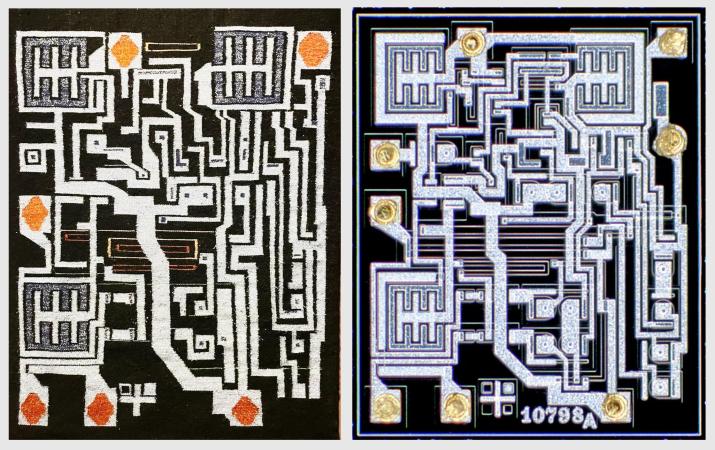
The weaving is on the left, a microphoto of the chip die is on the right.

The 555 As You’ve Never Seen It: In Textile!

The Diné (aka Navajo) people have been using their weaving as trade goods at least since European contact, and probably long before. They’ve never shied from adopting innovation: churro sheep from the Spanish in the 17th century, aniline dies in the 19th, and in the 20th and 21st… integrated circuits? At least one Navajo Weaver, [Marilou Schultz] thinks they’re a good match for the traditional geometric forms. Her latest creation is a woven depiction of the venerable 555 timer.

Image
“Popular Chip” by Marilou Schultz. Photo courtesy of First American Art Magazine, via righto.com

This isn’t the first time [Marilou] has turned an IC into a Navajo rug; she’s been weaving chip rugs since 1994– including a Pentium rug commissioned by Intel that hangs in USA’s National Gallery of Art–but it’s somehow flown below the Hackaday radar until now. The closest thing we’ve seen on these pages was a beaded bracelet embedding a QR code, inspired by traditional Native American forms.

That’s why we’re so thankful to [VivCocoa] for the tip. It’s a wild and wonderful world out there, and we can’t cover all of it without you. Are there any other fusions of tradition and high-tech we’ve been missing out on? Send us a tip.

Image

2025 One Hertz Challenge: Digital Clock Built With Analog Timer

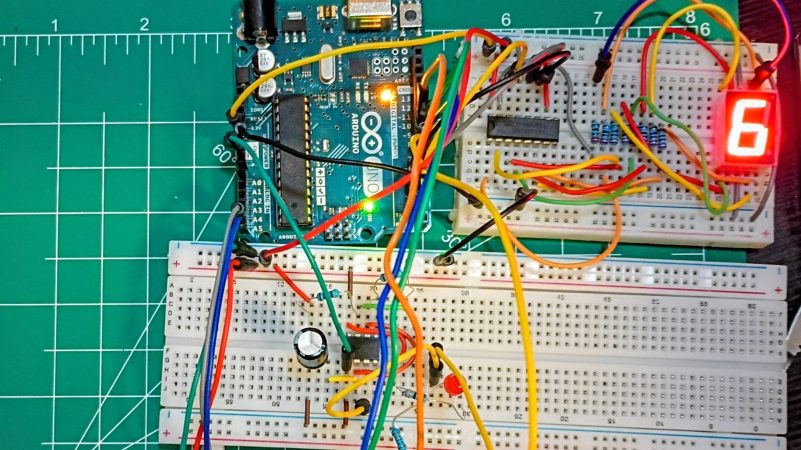
You can use a microcontroller to build a clock. After all, a clock is just something that counts the passage of time. The only problem is that microcontrollers can’t track time very accurately. They need some kind of external timing source that doesn’t drift as much as the microcontroller’s primary clock oscillator. To that end, [Josh] wanted to try using a rather famous IC with his Arduino to build a viable timepiece.

[Josh]’s idea was straightforward—employ a 555 timer IC to generate a square wave at 1 Hz. He set up an Arduino Uno to count the pulses using edge detection. This allowed for a reliable count which would serve as the timebase for a simple 24-hour clock. The time was then displayed on an OLED display attached over I2C, while raw pulses from the 555 were counted on a 7-segment display as a useful debugging measure. Setting the time is easy, with a few pushbuttons hooked up to the Arduino for this purpose.

[Josh] claims a drift of “only ~0.5 seconds” but does not state over what time period this drift occurs. In any case, 555s are not really used for timekeeping purposes in this way, because timers based on resistor-capacitor circuits tend to drift a lot and are highly susceptible to temperature changes. However, [Josh] could easily turn this into a highly accurate clock merely by replacing the 555 square wave input with a 1PPS clock source from another type of timer or GPS device.

We’ve had quite a few clocks entered into the One Hertz Competition already, including this hilariously easy Nixie clock build. You’ve got until August 19 to get your own entry in, so wow us with your project that does something once a second!

Image

2025 One Hertz Challenge: A 555, But Not As We Know It

We did explicitly ask for projects that use a 555 timer for the One Hertz Challenge, but we weren’t expecting the 555 to be the project. Yet, here we are, with [matt venn]’s Open Source 1Hz Blinky, that blinks a light with a 555 timer… but not one you’d get from Digikey. 

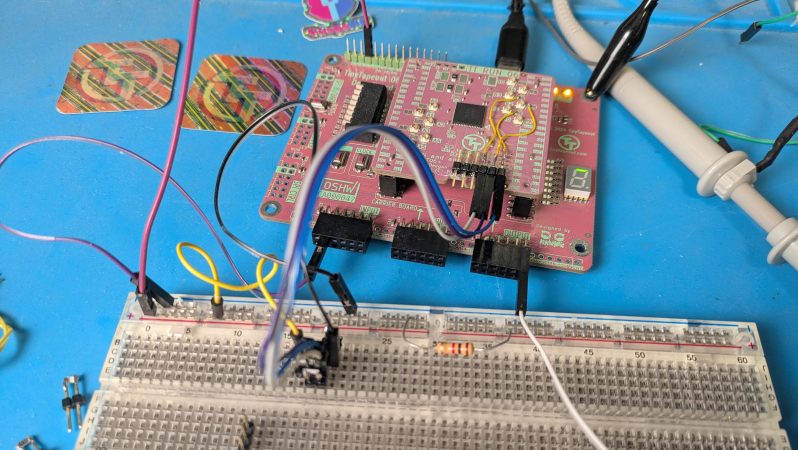
Hooking a 555 to blink an LED at one hertz is a bog-simple, first-electronics-project type of exercise, unless you have to make the 555 first. Rather than go big, as we have seen before, [matt venn] goes very small, with a 555 implemented on a tiny sliver of Tiny Tapeout 6.

We’ve covered projects using that tapeout before, but in case you missed it, Tiny Tapeout gives space to anyone to produce ASICs on custom silicon using an open Process Design Kit, and we have [matt venn] to thank for it. The Tiny Tapeout implementation of the 555 was actually designed by [Vincent Fusco].

Of course wiring it up is a bit more complicated than dropping in a 555 timer to the circuit: the Tiny Tapeout ASIC must be configured to use that specific project using its web interface.  There’s a demo video embedded below, with some info about the project– it’s not just a blinking LED, so it’s worth seeing. The output isn’t exactly One Hertz, so it might not get the nod in the Timelord category, but it’s going to be a very strong competitor for other 555-based projects– of which we could really use more, hint-hint. You’ve got until August 19th, if you think you can use a 555 to do something more interesting than blink an LED.

Continue reading “2025 One Hertz Challenge: A 555, But Not As We Know It”