Image

Google Unveils New Process For Installing Unverified Android Apps

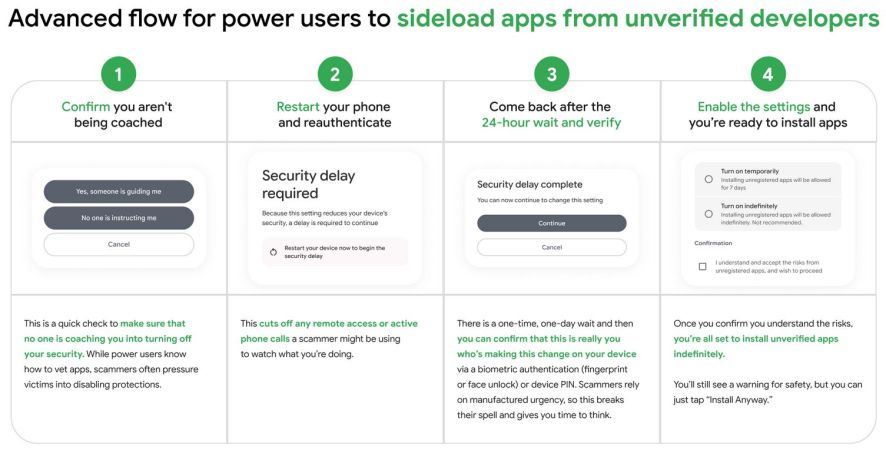
It’s no secret that Google really doesn’t like it that people are installing Android applications from any other source than the Play Store. Last year they proposed locking everyone into their official software repository by requiring all apps to be signed by verified developers, an identity which would be checked against a Google-maintained list. After a lot of pushback a so-called ‘advanced flow’ for installing even unsigned APKs would be implemented, and we now know how this process is supposed to work.

Instead of the old ‘allow installing from unknown sources’ toggle, you are now going to have to dig deep into the Developer Options, to tap the Allow Unverified Packages setting and confirm that nobody is forcing you to do this. This starts a ‘security delay’ of twenty-four hours after you restart the device, following which you can finally enable the setting either temporarily or permanently. It would seem these measures are in place to make it more difficult for a scammer to coerce a user into installing a malicious app — whether or not that’s a realistic concern or not, we’re not sure.

When we last covered this issue this ‘advanced flow’ had just been introduced as an appeasement option. In addition to this a limited free developer account was also pitched, which now turns out to allow for up to only 20 device installations. If you want more than this, you have to pay the $25 fee and provide your government ID.

Although Google’s public pitch is still that this is ‘for user security’, it will also mean that third-party app stores are swept up in these changes, with developers who publish on these stores subject to the same verification rules. This means that Android users will have to learn quickly how to enable this new option as it will be rolled out to more countries over the coming months.

The reality is that scammers will simply work around this issue by buying up already verified developer accounts. At the same time, it’ll cripple third-party app stores and indie developers who had intended to distribute their Android app by simply providing an APK download.

Image

What Is A Computer?

On the podcast, [Tom] and I were talking about the new generation of smartphones which are, at least in terms of RAM and CPU speed, on par with a decent laptop computer. If so, why not just add on a screen, keyboard, and mouse and use it as your daily driver? That was the question posed by [ETA Prime] in a video essay and attempt to do so.

Our consensus was that it’s the Android operating system holding it back. Some of the applications you might want to run just aren’t there, and on the open side of the world, even more are missing. Is the platform usable if you can’t get the software you need to get your work done?

But that’s just the computer-as-a-tool side of the equation. The other thing a computer is, at least to many of our kind of folk, is a playground. It’s a machine for experimenting with, and for having fun just messing around. Android has become way too polished to have fun, and recent changes on the Google side of things actively prevent you from installing arbitrary software. The hardware is similarly too slimmed-down to allow for experimentation.

Looking back, these have been the same stumbling blocks for the last decade. In 2018, I was wondering aloud why we as a community don’t hack on cell phones, and the answer then was the same as it is now – the software is not friendly to our kind. You can write phone apps, and I have tried to do so, but it’s just not fun.

The polar opposites of the smartphone-as-computer are no strangers in our community. I’m thinking of the Linux single-board computers, or even something like a Steam Deck, all of which are significantly less powerful spec-wise than a flagship cell phone, but which are in many ways much more suitable for hacking. Why? Because they make it easy to do the things that we like to do. They’re designed to be fun computers, and so we use them.

So for me, a smartphone isn’t a computer, but oddly enough it’s not because of the hardware. It’s because what I want out of a computer is more than Turing completeness. What I want is the fun and the freedom of computering.

Hackaday Links Column Banner

Hackaday Links: February 22, 2026

We’ll start things off this week with some breaking news from NASA: just days after the space agency announced the Artemis II crew was preparing to blast off towards the Moon as soon as March 6th, a new problem with the Space Launch System rocket has pushed the launch back indefinitely. According to NASA Administrator Jared Isaacman, problems encountered while loading helium into the Interim Cryogenic Propulsion Stage (ICPS) necessitate rolling the massive rocket back to the Vehicle Assembly Building (VAB) for diagnosis and repair.

The logistics of shuffling the vehicle 6.8 kilometers (4.2 miles) from the pad to the VAB is going to eat up at least a week, and sending it back the other way is naturally just as much of a production. Add in the time they’ll need to actually figure out what’s wrong with the ICPS and make the necessary repairs, and it’s easy to see why a March launch is almost certainly off the table. It’s frustrating to see the Artemis II mission get delayed this close to launch, but sending humans into space isn’t the sort of thing you can cut corners on.

Continue reading “Hackaday Links: February 22, 2026”

Image

Astronomy Live On Twitch

Although there are a few hobbies that have low-cost entry points, amateur astronomy is not generally among them. A tabletop Dobsonian might cost a few hundred dollars, and that is just the entry point for an ever-increasing set of telescopes, mounts, trackers, lasers, and other pieces of equipment that it’s possible to build or buy. [Thomas] is deep into astronomy now, has a high-quality, remotely controllable telescope, and wanted to make it more accessible to his friends and others, so he built a system that lets the telescope stream on Twitch and lets his Twitch viewers control what it’s looking at.

The project began with overcoming the $4000 telescope’s practical limitations, most notably an annoyingly short Wi-Fi range and closed software. [Thomas] built a wireless bridge with a Raspberry Pi to extend connectivity, and then built a headless streaming system using OBS Studio inside a Proxmox container. This was a major hurdle as OBS doesn’t have particularly good support for headless operation.

Continue reading “Astronomy Live On Twitch”

Image

Google Is Building A New OS

Windows, macOS, and Linux are the three major desktop OSs in today’s world. However, there could soon be a new contender, with Google stepping up to the plate (via The Verge).

You’ve probably used Google’s operating systems before. Android holds a dominant market share in the smartphone space, and ChromeOS is readily available on a large range of notebooks intended for lightweight tasks. Going forward, it appears Google aims to leverage its experience with these products and merge them into something new under the working title of “Aluminium OS.”

The news comes to us via a job listing, which sought a Senior Product Manager to work on a “new Aluminium, Android-based, operating system.” The hint is in the name—with speculation that the -ium part of Aluminium indicates its relationship to Chromium, the open-source version of Chrome. The listing also indicated that the new OS would have “Artificial Intelligence (AI) at the core.” At this stage, it appears Google will target everything from cheaper entry level hardware to mid-market and premium machines.

It’s early days yet, and there’s no word as to when Google might speak more officiously on the topic of its new operating system. It’s a big move from one of the largest tech companies out there. Even still, it will be a tall order for Google to knock off the stalwart offerings from Microsoft and Apple in any meaningful way. Meanwhile, if you’ve got secret knowledge of the project and they forget to make you sign an NDA, don’t hesitate to reach out!

Image

Android Developer Verification Starts As Google Partially Retreats On Measures

In a recent blog post Google announced that the early access phase of its Android Developer Verification program has commenced, as previously announced. In addition to this new announcement Google also claims to be taking note of the feedback it has been receiving, in particular pertaining to non-commercial developers for whom these new measures are incredibly inconvenient. Yet most notable is the ’empowering experienced users’ section, where Google admits that to developers and ‘power users’ the intensive handholding isn’t required and it’ll develop an ‘advanced flow’ where unverified apps can still be installed without jumping through (adb) hoops. Continue reading “Android Developer Verification Starts As Google Partially Retreats On Measures”

Image

What Happened To Running What You Wanted On Your Own Machine?

When the microcomputer first landed in homes some forty years ago, it came with a simple freedom—you could run whatever software you could get your hands on. Floppy disk from a friend? Pop it in. Shareware demo downloaded from a BBS? Go ahead! Dodgy code you wrote yourself at 2 AM? Absolutely. The computer you bought was yours. It would run whatever you told it to run, and ask no questions.

Today, that freedom is dying. What’s worse, is it’s happening so gradually that most people haven’t noticed we’re already halfway into the coffin.

Continue reading “What Happened To Running What You Wanted On Your Own Machine?”