Image

Self-healing CMOS Imager To Withstand Jupiter’s Radiation Belt

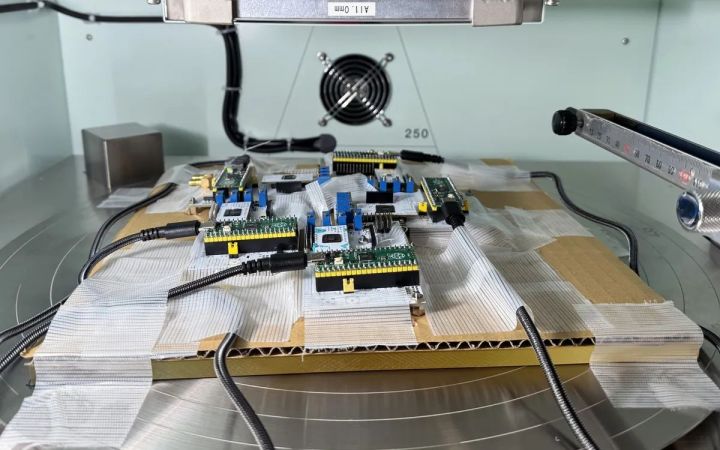
Ionizing radiation damage from electrons, protons and gamma rays will over time damage a CMOS circuit, through e.g. degrading the oxide layer and damaging the lattice structure. For a space-based camera that’s inside a probe orbiting a planet like Jupiter it’s thus a bit of a bummer if this will massively shorted useful observation time before the sensor has been fully degraded. A potential workaround here is by using thermal energy to anneal the damaged part of a CMOS imager.

The first step is to detect damaged pixels by performing a read-out while the sensor is not exposed to light. If a pixel still carries significant current it’s marked as damaged and a high current is passed through it to significantly raise its temperature. For the digital logic part of the circuit a similar approach is used, where the detection of logic errors is cause for a high voltage pulse that should also result in annealing of any damage.

During testing the chip was exposed to the same level of radiation to what it would experience during thirty days in orbit around Jupiter, which rendered the sensor basically unusable with a massive increase in leakage current. After four rounds of annealing the image was almost restored to full health, showing that it is a viable approach.

Naturally, this self-healing method is only intended as another line of defense against ionizing radiation, with radiation shielding and radiation-resistant semiconductor technologies serving as the primary defenses.
Image

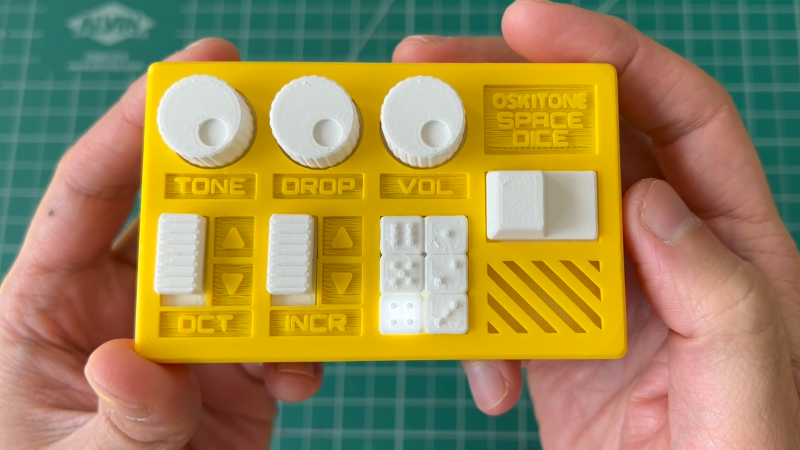
Playful ‘Space Dice’ Kit Shows Off Clever Design

[Tommy] at Oskitone has been making hardware synth kits for years, and his designs are always worth checking out. His newest offering Space Dice is an educational kit that is a combination vintage sci-fi space laser sound generator, and six-sided die roller. What’s more, as a kit it represents an effort to be genuinely educational, rather than just using it as a meaningless marketing term.

There are several elements we find pretty interesting in Space Dice. One is the fact that, like most of [Tommy]’s designs, there isn’t a microcontroller in sight. Synthesizers based mostly on CMOS logic chips have been a mainstay of DIY electronics for years, as have “electronic dice” circuits. This device mashes both together in an accessible way that uses a minimum of components.

ImageThere are only three chips inside: a CD4093 quad NAND with Schmitt-trigger inputs used as a relaxation oscillator, a CD4040 binary counter used as a prescaler, and a CD4017 decade counter responsible for spinning a signal around six LEDs while sound is generated, to represent an electronic die. Sound emerges from a speaker on the backside of the PCB, which we’re delighted to see is driven not by a separate amplifier chip, but by unused gates on the CD4093 acting as a simple but effective square wave booster.

In addition, [Tommy] puts effort into minimizing part count and complexity, ensuring that physical assembly does not depend on separate fasteners or adhesives. We also like the way he uses a lever assembly to make the big activation button — mounted squarely above the 9 V battery — interface with a button on the PCB that is physically off to the side. The result is an enclosure that is compact and tidy.

We recommend checking out [Tommy]’s concise writeup on the design details of Space Dice for some great design insights, and take a look at the assembly guide to see for yourself the attention paid to making the process an educational one. We love the concept of presenting an evolving schematic diagram, which changes and fills out as each assembly step is performed and tested.

Watch it in action in a demo video, embedded just below. Space Dice is available for purchase but if you prefer to roll your own, all the design files and documentation are available online from the project’s GitHub repository.

Continue reading “Playful ‘Space Dice’ Kit Shows Off Clever Design”

Image

2025 One Hertz Challenge: Square Waves The Way You Want ‘Em

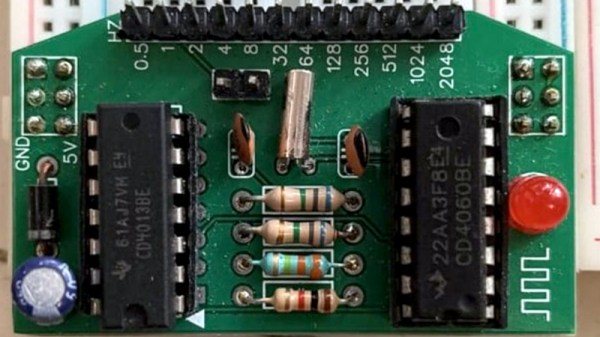
On an old fashioned bench a signal generator was once an indispensable instrument, but has now largely been supplanted by the more versatile function generator. Sometimes there’s a less demanding need for a clock signal though, and one way that might be served comes from [Rupin Chheda]’s square wave generator. It’s a small PCB designed to sit at the end of a breadboard and provide handy access to a range of clocks.

On the board is a crystal oscillator running at the usual digital clock frequency of 32.768 kHz, and a CMOS divider chain. This provides frequencies from 2048 Hz down to 0.5 Hz for good measure. It’s a simple but oh-so-useful board, and we can imagine more than a few of you finding space for it on your own benches.

This project is part of our awesome 2025 One Hertz Challenge, celebrating all the things which strut their stuff once a second. It’s by no means the first to feature a 32.768 kHz divider chain, and if you have a similar project there’s still time to enter.

Image

How Shrinking Feature Size Made Modern Wireless Work

If you’re living your life right, you probably know what as MOSFET is. But do you know the MESFET? They are like the faster, uninsulated, Schottky version of a MOSFET, and they used to rule the roost in radio-frequency (RF) silicon. But if you’re like us, and you have never heard of a MESFET, then give this phenomenal video by [Asianometry] a watch. In it, among other things, he explains how the shrinking feature size in CMOS made RF chips cheap, which brought you the modern cellphone as we know it.

The basic overview is that in the 1960s, most high-frequency stuff had to be done with discrete parts because the bipolar-junction semiconductors of the time were just too slow. At this time, MOSFETs were just becoming manufacturable, but were even slower still. The MESFET, without its insulating oxide layer between the metal and the silicon, had less capacitance, and switched faster. When silicon feature sizes got small enough that you could do gigahertz work with them, the MESFET was the tech of choice.

As late as the 1980s, you’d find MESFETs in radio devices. At this time, the feature size of the gates and the thickness of the oxide layer in MOSFETs kept them out of the game. But as CPU manufacturers pushed CMOS features smaller, not only did we get chips like the 8086 and 80386, two of Intel’s earliest CMOS designs, but the tech started getting fast enough for RF. And the world never looked back.

If you’re interested in the history of the modern monolithic RF ICs, definitely give the 18-minute video a watch. (You can skip the first three or so if you’re already a radio head.) If you just want to build some radio circuits, this fantastic talk from [Michael Ossmann] at the first-ever Supercon will make you an RF design hero. His secrets? Among them, making the most of exactly these modern everything-in-one-chip RF ICs so that you don’t have to think about that side of things too hard.

Thanks [Stephen] for the tip!

Continue reading “How Shrinking Feature Size Made Modern Wireless Work”

Image

Probably The Simplest Sequencing Synth

With inexpensive microntrollers capable of the most impressive feats of sound synthesis, it’s not so often we see projects that return to an earlier style of electronic music project. The 1-bit synth from [Electroagenda] takes us firmly into that territory, employing that most trusty of circuits, a 555.

It’s a time-honored circuit, a 555 provides a note clock that drives a 4017 that functions as a sequencer. This switches in a set of voltage dividers, which in turn control another 555 oscillator that produces the notes. It’s a fun toy straight from the 1970s, right down to the protoboard and hookup wire construction. There’s a demo video with some lovely beeps below, and we think most of you should have what it takes to make your own.

If you’re seeking more inspiration, may we introduce you to our Logic Noise series?

Continue reading “Probably The Simplest Sequencing Synth”

Image

Single-Stepping The 6502 Processor

Although marketing folk and laypeople may credit [Steve Jobs] as the man behind the success of Apple, those in the tech world know the real truth that without [Steve Wozniak] nothing would have ever gotten off the ground during the early days of the computer company. As an exhibit of his deep knowledge of the machines he was building, take a look at this recreation of a circuit by [Anders] which allows the 6502 processor to step through instructions one at a time, originally designed by [Woz] himself, even though there are still myths floating around the Internet that this type of circuit can’t work.

Like a lot of Internet myths, though, there’s a kernel of truth at the middle. The original 6502 from the mid-70s had dynamic registers, meaning they would lose their values if the chip was run below a critical clock speed. Since single-stepping the processor is much lower than this speed, it seems logical that this might corrupt the data in the registers. But if the clock is maintained to the registers the processor can be halted after each instruction, allowing even the original 6502 to go through its instructions one at a time.

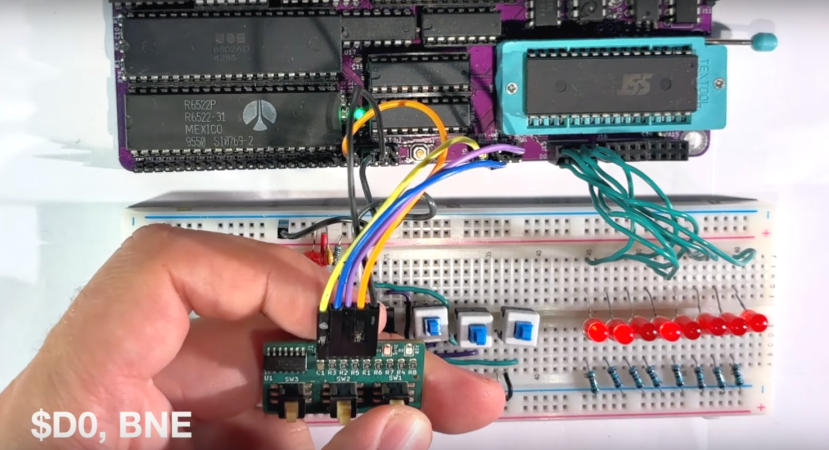
[Anders]’s project sets up this circuit originally laid out by [Steve Wozniak] but updates it a bit for the modern times. Since the technology of the era would have been TTL, modern CMOS logic requires pull-up resistors to keep any inputs from floating. The key design of the original circuit is a set of flip-flops which latch the information on the data bus, and a switch that can be pressed to let the processor grab its next instruction, as well as a set of LEDs that allow the user to see the value on the data bus directly.

Of course, a computer processor of this era would be at a major handicap without a way to debug code that it was running, so there are even dedicated pins that allow this functionality to occur. Perhaps the Internet myth is a bit overblown for that reason alone, but [Anders] is no stranger to the 6502 and has developed many other projects that demonstrate his mastery of the platform.

Continue reading “Single-Stepping The 6502 Processor”

Image

Op-Amp Challenge: MOSFETs Make This Discrete Op Amp Tick

When it comes to our analog designs, op-amps tend to be just another jellybean part. We tend to spec whatever does the job, and don’t give much of a thought as to the internals. And while it doesn’t make much sense to roll your own op-amp out of discrete components, that doesn’t mean there isn’t plenty to be learned from doing just that.

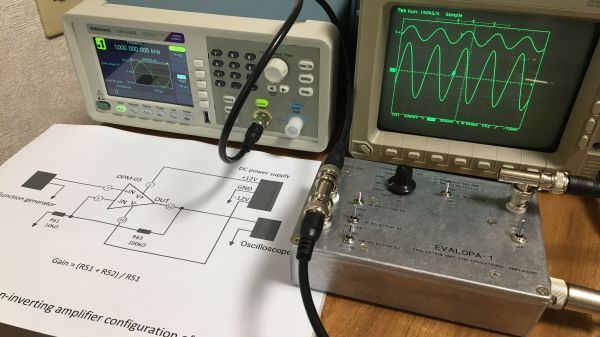
While we’re more accustomed to seeing [Mitsuru Yamada]’s digital projects, he’s no stranger to the analog world. In fact, this project is a follow-on to his previous bipolar transistor op-amp, which we featured back in 2021. This design features MOSFETs rather than BJTs, but retains the same basic five-transistor topology as the previous work, with a differential pair input stage, a gain stage, and a buffer stage. Even the construction of the module is similar, using his trademark perfboard and ultra-tidy wiring.

Also new is a flexible evaluation unit for these discrete op-amp modules. This very sturdy-looking circuit provides an easy way to configure the op-amp for testing in inverting, non-inverting, and transimpedance mode, selecting from a range of feedback resistors, and even provides a photodiode input. The video below shows the eval unit in action with the CMOS module, as well as highlights the excellent construction [Mitsuru Yamada] is known for.

Looking for some digital goodness? Check out the PERSEUS-8, a 6502 machine we wish had been a real product back in the day.

Continue reading “Op-Amp Challenge: MOSFETs Make This Discrete Op Amp Tick”