Image

This Week In Security: Second Verse, Worse Than The First

Isn’t there some claim events come in threes? After the extremely rare leak of the iOS Coruna exploit chain recently, now we have details from Google on a second significant exploit in the wild, dubbed Darksword.

Like Coruna, Darksword appears to have followed the path of government security contractors, to different government actors, to crypto stealer. It appears to focus on exploits already fixed in modern iOS releases, with most affecting iOS 18 and all patched by iOS 26.3.

Going from almost no public examples of modern iOS exploits to two in as many weeks is wild, so if mobile device security is of interest, be sure to check out the Google write-up.

Another FBI Router Warning

The second too early to be retro – but too important to ignore – repeat security item is a second alert by the FBI cautioning about end-of-life consumer network hardware under active exploitation, with the FBI tracking almost 400,000 device infections so far.

Like the warning two weeks ago, the FBI calls out a handful of consumer routers – but this time they’re devices that may actually still be service in some of our homes (or our less cutting edge friends and family), calling out devices from Netgear, TP-Link, D-Link, and Zyxel:

  • Netgear DGN2200v4 and AC1900 R700
  • TP-Link Archer C20, TL-WR840N, TL-WR849N, and WR841N
  • D-Link DIR-818LW, 850L, and 860L
  • Zyxel EMG6726-B10A, VMG1312-B10D, VMG1312-T20B, VMG3925-B10A, VMG3925-B10C, VMG4825-B10A, VMG4927-B50A, VMG8825-T50K

While many of these devices are over ten years old, they still support modern networking – some of them even supporting 802.11ac (also called Wi-Fi 5).  Unfortunately, since support has been ended by the manufacturers, publicly disclosed vulnerabilities have not been patched (and now never will be, officially) Continue reading “This Week In Security: Second Verse, Worse Than The First”
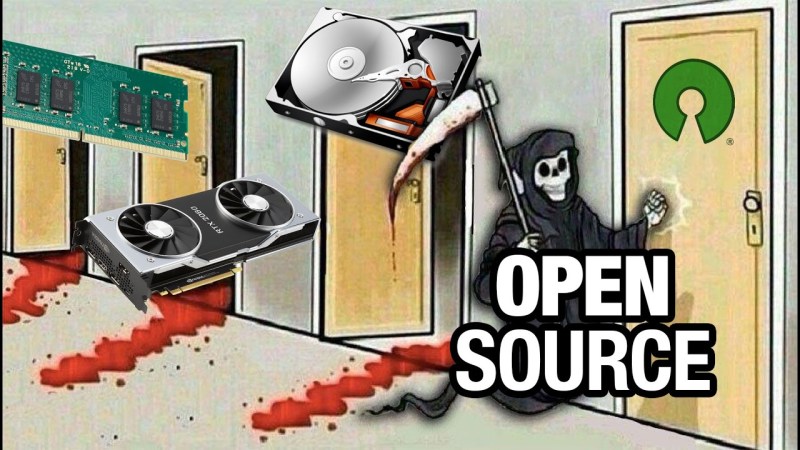

A grim reaper knocking on a door labelled "open source"

What About The Droid Attack On The Repos?

You might not have noticed, but we here at Hackaday are pretty big fans of Open Source — software, hardware, you name it. We’ve also spilled our fair share of electronic ink on things people are doing with AI. So naturally when [Jeff Geerling] declares on his blog (and in a video embedded below) that AI is destroying open source, well, we had to take a look.

[Jeff]’s article highlights a problem he and many others who manage open source projects have noticed: they’re getting flooded with agenetic slop pull requests (PRs). It’s now to the point that GitHub will let you turn off PRs completely, at which point you’ve given up a key piece of the ‘hub’s functionality. That ability to share openly with everyone seemed like a big source of strength for open source projects, but [Jeff] here is joining his voice with others like [Daniel Stenberg] of curl fame, who has dropped bug bounties over a flood of spurious AI-generated PRs.

It’s a problem for maintainers, to be sure, but it’s as much a human problem as an AI one. After all, someone set up that AI agent and pointed at your PRs. While changing the incentive structure– like removing bug bounties– might discourage such actions, [Jeff] has no bounties and the same problem. Ultimately it may be necessary for open source projects to become a little less open, only allowing invited collaborators to submit PRs, which is also now an option on GitHub.

Combine invitation-only access with a strong policy against agenetic AI and LLM code, and you can still run a quality project. The cost of such actions is that the random user with no connection to the project can no longer find and squash bugs. As unlikely as that sounds, it happens! Rather, it did. If the random user is just going to throw their AI agent at the problem, it’s not doing anybody any good.

First they came for our RAM, now they’re here for our repos. If it wasn’t for getting distracted by the cute cat pictures we might just start to think vibe coding could kill open source. Extra bugs was bad enough, but now we can’t even trust the PRs to help us squash them!

Continue reading “What About The Droid Attack On The Repos?”

Image

This Week In Security: Anthropic, Coinbase, And Oops Hunting

Anthropic has had an eventful couple weeks, and we have two separate write-ups to cover. The first is a vulnerability in the Antropic MCP Inspector, CVE-2025-49596. We’ve talked a bit about the Module Context Protocol (MCP), the framework that provides a structure for AI agents to discover and make use of software tools. MCP Inspector is an Open Source tool that proxies MCP connections, and provides debugging information for developers.

MCP Inspector is one of those tools that is intended to be run only on secure networks, and doesn’t implement any security or authentication controls. If you can make a network connection to the tool, you can control it. and MCP Inspector has the /sse endpoint, which allows running shell commands as a feature. This would all be fine, so long as everyone using the tool understands that it is not to be exposed to the open Internet. Except there’s another security quirk that intersects with this one. The 0.0.0.0 localhost bypass.

The “0.0.0.0 day exploit” is a bypass in essentially all the modern browsers, where localhost can be accessed on MacOS and Linux machines by making requests to 0.0.0.0. Browsers and security programs already block access to localhost itself, and 127.0.0.1, but this bypass means that websites can either request 0.0.0.0 directly, or rebind a domain name to 0.0.0.0, and then make requests.

Continue reading “This Week In Security: Anthropic, Coinbase, And Oops Hunting”

Image

Track Your GitHub Activity With This E-Ink Display

If you’re a regular GitHub user you’ll be familiar with the website’s graphical calendar display of activity as a grid. For some of you it will show a hive of activity, while for others it will be a bit spotty. If you’re proud of your graph though, you’ll want to show it off to the world, and that’s where [HarryHighPants]’ Git Contributions E-Ink Display comes in. It’s a small desktop appliance with a persistent display, that shows the current version of your GitHub graph.

At its heart is an all-in-one board with the display and an ESP32 on the back, with a small Li-Po cell. It’s all put in a smart 3D printed case. The software is the real trick, with a handy web interface from which you can configure your GitHub details.

It’s a simple enough project, but it joins a growing collection which use an ESP32 as a static information display. The chip is capable of more though, as shown by this much more configurable device.

Image

The Billionth Repository On GitHub Is Really Shitty

What’s the GitHub repository you have created that you think is of most note? Which one do you think of as your magnum opus, the one that you will be remembered by? Was it the CAD files and schematics of a device for ending world hunger, or perhaps it was software designed to end poverty? Spare a thought for [AasishPokhrel] then, for his latest repository is one that he’ll be remembered by for all the wrong reasons. The poor guy created a repository with a scatalogical name, no doubt to store random things, but had the misfortune to inadvertently create the billionth repository on GitHub.

At the time of writing, the 💩 repository sadly contains no commits. But he seems to have won an unexpectedly valuable piece of Internet real estate judging by the attention it’s received, and if we were him we’d be scrambling to fill it with whatever wisdom we wanted the world to see. A peek at his other repos suggests he’s busy learning JavaScript, and we wish him luck in that endeavor.

We think everyone will at some time or another have let loose some code into the wild perhaps with a comment they later regret, or a silly name that later comes back to haunt them. We know we have. So enjoy a giggle at his expense, but don’t give him a hard time. After all, this much entertainment should be rewarded.

Image

This Week In Security: Target Coinbase, Leaking Call Records, And Microsoft Hotpatching

We know a bit more about the GitHub Actions supply chain attack from last month. Palo Alto’s Unit 42 has been leading the charge on untangling this attack, and they’ve just released an update to their coverage. The conclusion is that Coinbase was the initial target of the attack, with the open source agentkit package first (unsuccessfully) attacked. This attack chain started with pull_request_target in the spotbugs/sonar-findbugs repository.

The pull_request_target hook is exceptionally useful in dealing with pull requests for a GitHub repository. The workflow here is that the project defines a set of Continuous Integration (CI) tests in the repository, and when someone opens a new Pull Request (PR), those CI tests run automatically. Now there’s an obvious potential problem, and Github thought of it and fixed it a long time ago. The GitHub Actions are defined right in the repository, and letting any pull request run arbitrary actions is a recipe for disaster. So GitHub always uses actions as they are defined in the repository itself, ignoring any incoming changes in the PR. So pull_request_target is safe now, right? Yes, with some really big caveats.

Image

The simplest security problem is that many projects have build scripts in the repository, and those are not considered part of GitHub Actions by GitHub. So include malicious code in such a build script, make it a PR that runs automatically, and you have access to internal elements like organization and repository secrets and access tokens. The most effective mitigation against this is to require approval before running workflows on incoming PRs.

So back to the story. The spotbugs/sonar-findbugs repository had this vulnerability, and an attacker used it to export secrets from a GitHub Actions run. One of those secrets happened to be a Personal Access Token (PAT) belonging to a spotbugs maintainer. That PAT was used to invite a throwaway account, [jurkaofavak], into the main spotbugs repository. Two minutes after being added, the [jurkaofavak] account created a new branch in spotbugs/spotbugs, and deleted it about a second later. This branch triggered yet another malicious CI run, now with arbitrary Github Actions access rather than just access through a build script. This run leaked yet another Personal Access Token, belonging to a maintainer that worked on both the spotbugs and reviewdog projects. Continue reading “This Week In Security: Target Coinbase, Leaking Call Records, And Microsoft Hotpatching”

Image

FLOSS Weekly Episode 784: I’ll Buy You A Poutine

This week Jonathan Bennett and Dan Lynch talk with François Proulx about Poutine, the Open Source security scanner for build pipeline vulnerabilities. This class of vulnerability isn’t as well known as it should be, and threatens to steal secrets, or even allow for supply chain attacks in FLOSS software.

Poutine does a scan over an organization or individual repository, looking specifically for pipeline issues. It runs on both GitHub and GitLab, with more to come!

Continue reading “FLOSS Weekly Episode 784: I’ll Buy You A Poutine”