Image

How I 3D Printed My Own Lego-Compatible Train Bridges

Lego train sets have been available for decades, now. The Danish manufacturer long ago realized the magic of combining its building block sets with motors and plastic rails to create real working railways for children and adults to enjoy. Over the years, Lego has innovated through several generations of trains, from classic metal-rail systems to the more modern IR and later Bluetooth-controlled versions. The only thing largely missing over all that time, though…? A bridge!

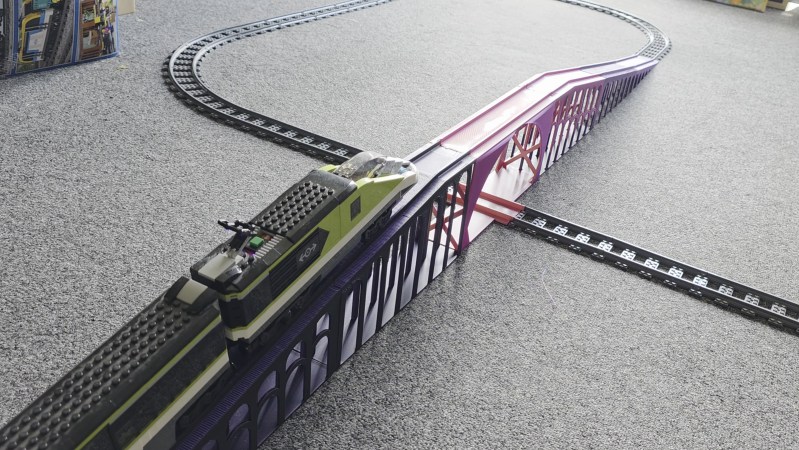
Yes, Lego has largely neglected to build any bridges for its mainstream train lineup. There are aftermarket solutions, and innovative hacks invented by the community, all with their own limitations and drawbacks. This glaring oversight, though, seemed like a perfect opportunity to me. It was time to fire up the 3D printer and churn out a fully-realized Lego rail bridge of my very own.

Bridges Are Hard

Image
I’ve experimented with building Lego rail bridges before, using standard track and household objects like cardboard, books, and beer. Unfortunately, it can be very difficult to support the track evenly at the joints which occur every 150mm, and derailments are common. Credit: author

There’s actually a good reason Lego bridges aren’t a big thing in the company’s own product lineup, beyond a few obscure historical parts. This is probably because they aren’t very practical. Lego locomotives are not particularly strong haulers, nor do they have excellent grip on the rails, and this makes them very poor at climbing even mild grades. Any official Lego bridge would have to be very long with a shallow slope just to allow a train to climb high enough to clear a locomotive on a track below. This would end up being an expensive set that would probably prove unpopular with the casual Lego train builder, even if the diehard enthusiasts loved it. 

There are third-party options available out there. However, most rely on standard Lego track pieces and merely combine them with supports that hold them up at height. This can work in some cases, but it can be very difficult to do cool things like passing a Lego train under a bridge, for example. It can be hard to gain enough height, and the short length of Lego track pieces makes it hard to squeeze a locomotive between supports. Continue reading “How I 3D Printed My Own Lego-Compatible Train Bridges”
Image

Is This The World’s Smallest N-Scale Train Layout?

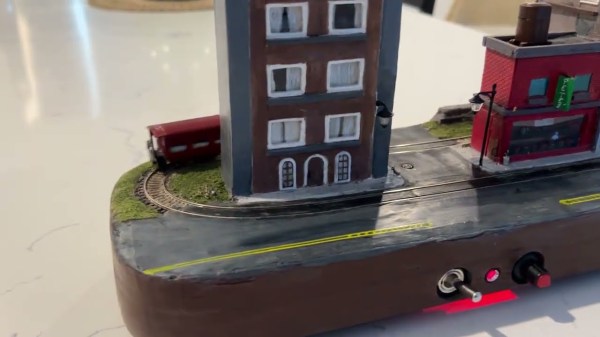
There’s just something about miniature worlds — they’re just so relaxing to look at and ponder. Think you don’t have ample room for a model train layout at your place? You may not be thinking small enough. [Peter Waldraff] knows a thing or two about hiding train layouts inside of furniture (that’s one solution), but this time, he’s built a track in plain sight that’s meant to sit on the bookshelf. The whole thing is just 5.5″ x 12″.

This N-scale layout was three years in the making, mostly because [Peter] was waiting for just the right little powered chassis to come along. For the layout, [Peter] started by creating custom flexible track by removing pieces with a sharp knife. He glued down the track to pink foam and used nails to hold it in place while the glue dried. He also built a wood frame around the base to stabilize it and hold some of the electronic components, including a switch made from an old ballpoint pen.

Then it was time to start decorating the thing, beginning with a couple of buildings made from more pink foam that are both lit up with LEDs. Eventually, [Peter] added a bunch of details like streetlights, animals, and garbage cans that really make the layout pop. As far as the engine goes, [Peter] picked up a Tomytec TM-TR02 on eBay and built a trolley out of two broken cars. [Peter]’s build is something you just have to see for yourself — fortunately for you, the build and demo video is after the break.

Like we said, [Peter]’s usual territory is hiding train layouts in end tables and coffee tables and the like, so it’s nice to see what he can do given different constraints.

Continue reading “Is This The World’s Smallest N-Scale Train Layout?”

Image

Model Train Delivers Fresh Coffee

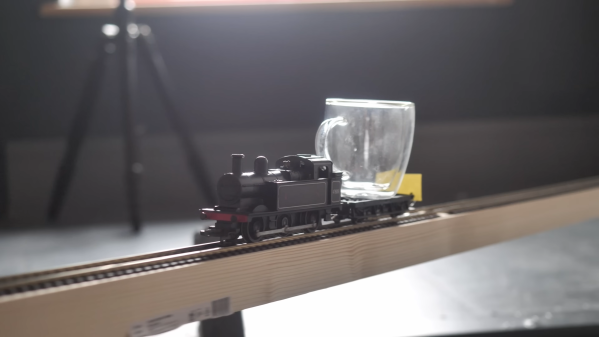
Model trains are good fun, though few of them serve any purpose beyond amusement or authentic railway simulation. [ProjectAir] decided to put his model train to practical use by having it deliver fresh espresso, and faced plenty of difficult challenges along the way.

It sounds simple, but the practicalities of the task proved difficult. After all, even a slight wobble is enough to tip a coffee cup off a small train. Automating everything from the railway itself to the kitchen coffee machine was no mean feat either. Plus, the aim was to deliver coffee from a downstairs kitchen up to an upstairs office. This meant finding a way to get the train to climb a steep staircase and to carry the coffee over a 20-meter journey without losing the caffeinated beverage in the process. That required the construction of a fancy train elevator to do the job — an impressive accomplishment on its own.

The final system is a joy to watch. Having a train roll into the upstairs workshop with a fresh brew certainly beats having to go all the way downstairs for a cup. Just don’t think about the fact that moving the coffee machine upstairs might have been a quicker solution.

Continue reading “Model Train Delivers Fresh Coffee”

Image

I’ve Been Printing On The Dragon Railroad…

We know many people who put much effort into building model train setups. But [Rambros] has an entire set 3D printed, and the files are open source, so you can print your own or modify it to suit you. When we first read “complete open source ecosystem,” we thought it might have been a bit of hyperbole, but it isn’t. The S-scale set includes two locomotives, a tanker, a box car, a hopper car, and a gondola car. There are different sections of track, customizable with Fusion 360. The “Dragon Railway” takes a few mechanical parts and electronics, of course. You can see one of several videos about the system below.

You can control the whole system using Bluetooth and a smartphone. The electronics are pretty simple, consisting of an ESP32 board, some motor drivers, N20 motors, and a few miscellaneous parts. We expect it would be compatible with other off-the-shelf S scale tracks and cars, but we don’t know that for sure.

Although you’ll need Fusion 360 to customize, there are plenty of ready-made STL files if you want to get started quickly. Some of the track items, like the crossing and turnout are not customizable, anyway. One particularly  impressive item is a printed auto-coupler; while a small item, getting that to work reliably with printed parts seems like it may be the most difficult part of the whole thing.

Maybe an OLED display would be the next thing? We’ve seen other printed trains, but this seems like a real labor of love.

Continue reading “I’ve Been Printing On The Dragon Railroad…”

Image

A Concealed Model Railway Rises To The Occasion

Occasional pieces of furniture serve little purpose other than to fill a space and maybe display a prized ornament or two. Who hasn’t got a relative with one two many small tables or display stands overfilling the available space!

If you visit [Peter Waldraff]’s house though, those pieces of furniture may not be what they seem. His display pedestal for example hides an N gauge railway layout that rises from the depths on a system of pulleys, with the action triggered by moving the vase displayed on its top. The vase conceals a magnet, which operates a reed switch that in turn controls the winch motor.

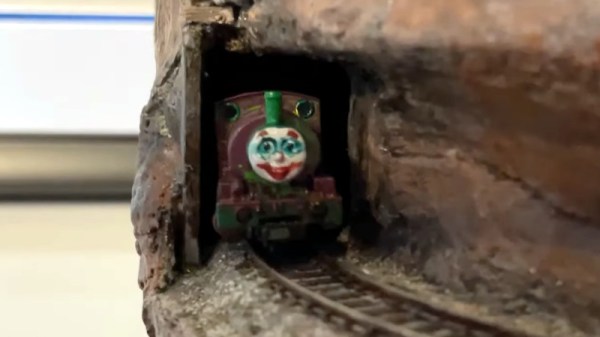
The layout is a loosely Batman themed train chase, with concentric spirals of track forming a continuous loop on which two trains run. There’s an ingenious arrangement with a reed switch and a piece of dead track to ensure that the chasing train is always held to ensure a gap between them. The landscaping is of a set of cliffs with a model of Wayne manor at the top, and there’s even a LED-lit Batmobile. One of the locomotives is recognisably based on a character from the Thomas the Tank Engine books.

All in all we like the ingenuity of this layout, but if you like it too then we’ve got a treat for you. Sharp-eyed readers will remember that this isn’t the first such project from Peter.

Continue reading “A Concealed Model Railway Rises To The Occasion”

Image

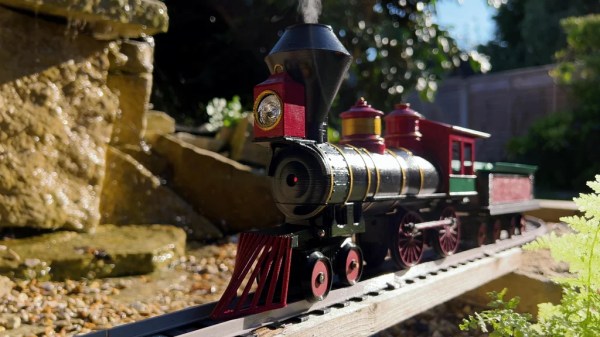
3D Print Yourself A Tiny Steam Train Complete With Smoke Effects

Model trains are fun, but sometimes little whirring motors in electric models feel a long way from the hulking metal beasts of the real railways. [Lewis] of [DIY Machines] adds back some of the flavor with this little steam train build, smoke effects included!

The body of the train itself is 3D printed in PLA. It’s designed to O-gauge scale, and comes complete with models for 3D printed track as well. The parts are given a coat of paint to better approximate the finish of the real thing; sometimes bare plastic just won’t suffice, after all.

Propulsion is thanks to an onboard battery and a simple gearmotor, driven by a HG7881 motor driver. An ESP32-CAM is responsible for running the show, allowing the train to be commanded wirelessly. As a bonus, the camera is mounted in the very front of the train, allowing one to watch a livestream of its progress about the tracks. Meanwhile, the smoke effect is thanks to a small water atomizer fitted in the train’s chimney, which makes the train look that little bit more authentic.

The combination of a self-powered train and 3D-printed tracks is a compelling one. [Lewis] has been able to leave his PETG 3D-printed track outside for over two years and it’s still in working order. That’s not something easy to achieve when using metal rails to deliver power.

Overall, this is a fun way to get into building your own model trains, and is a lot more hands-on than simply buying pre-built models from a store. From there, the sky is really the limit for your creativity! Video after the break.

Continue reading “3D Print Yourself A Tiny Steam Train Complete With Smoke Effects”

Image

Coffee Table Railroad Flips To Hide The Fun

The livingroom coffee table has long been a favorite realm of the model railroad. But what to do when you actually want to have coffee? [Peter Waldraff] has come up with a most eloquent answer to the problem by designing a coffee table model railroad capable of turning the world upside down.

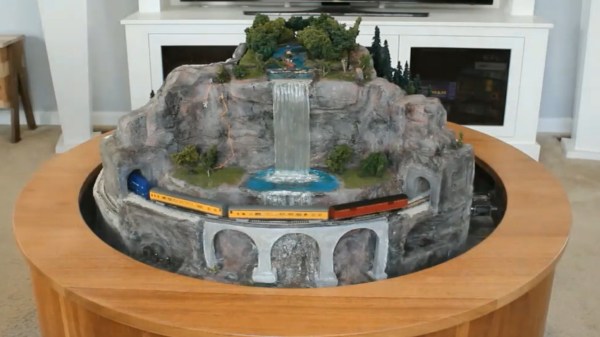
ImageThis isn’t [Peter’s] first rodeo. In his demo video below he shows off a coffee table train he built 20 years ago using a rectangular layout under glass. This time the circular design means a spherical volume can rotate around two skateboard bearing pivot points, revealing the mountainous scene on one side and the boring old wood table on the other. But what happens to the N-scale train itself when gravity is reversed? There’s a brilliant solution to that!



The frame of the coffee table includes an outer loop for train storage. Before flipping the model upside-down, the train itself is sent to this siding for safe keeping. In an earlier build video we can glimpse the latching mechanism that uses a solenoid and is actuated by a magnet in the center of the table. A clever use of toggle bolts (sometimes known as butterfly anchors for securing things on drywall) has them transfer power to the outer ring of storage track when their spring-loaded arms come in contact with some screw heads on the other side of the gap. The source of the electricity is a rechargeable Makita power tool battery in a hidden chamber within the mountain.

Of course we’ve seen other hideaway coffee table trains like this lovely hand-carved version. But you have to admire how [Peter] managed to incorporate everything into a self contained unit here, without the needing to store a removable cover. If you are someone who wants to always show off your handy work, that’s where a perspex box coffee table design comes into play.

Continue reading “Coffee Table Railroad Flips To Hide The Fun”