Image

Artemis II Agenda Keeps Moon-Bound Crew Busy

With the launch of Artemis II from Cape Canaveral potentially just weeks away, NASA has been releasing a steady stream of information about the mission through their official site and social media channels to get the public excited about the agency’s long-awaited return to the Moon. While the slickly produced videos and artist renderings might get the most attention, even the most mundane details about a flight that will put humans on the far side of our nearest celestial neighbor for the first time since 1972 can be fascinating.

ImageThe Artemis II Moon Mission Daily Agenda is a perfect example. Released earlier this week via the NASA blog, the document seems to have been all but ignored by the mainstream media. But the day-by-day breakdown of the Artemis II mission contains several interesting entries about what the four crew members will be working on during the ten day flight.

Of course, the exact details of the agenda are subject to change once the mission is underway. Some tasks could run longer than anticipated, experiments may not go as planned, and there’s no way to predict technical issues that may arise.

Conversely, the crew could end up breezing through some of the planned activities, freeing up time in the schedule. There’s simply no way of telling until it’s actually happening.

With the understanding that it’s all somewhat tentative, a look through the plan as it stands right now can give us an idea of the sort of highlights we can expect as we follow this historic mission down here on Earth.

Continue reading “Artemis II Agenda Keeps Moon-Bound Crew Busy”

Image

Practice Makes Perfect: The Wet Dress Rehearsal

If you’ve been even casually following NASA’s return to the Moon, you’re likely aware of the recent Wet Dress Rehearsal (WDR) for the Artemis II mission. You probably also heard that things didn’t go quite to plan: although the test was ultimately completed and the towering Space Launch System (SLS) rocket was fully loaded with propellant, a persistent liquid hydrogen leak and a few other incidental issues lead the space agency to delay further testing for at least a month while engineers make adjustments to the vehicle.

This constitutes a minor disappointment for fans of spaceflight, but when you’re strapping four astronauts onto more than five million pounds of propellants, there’s no such thing as being too cautious. In fact, there’s a school of thought that says if a WDR doesn’t shake loose some gremlins, you probably weren’t trying hard enough. Simulations and estimates only get you so far, the real thing is always more complex, and there’s bound to be something you didn’t account for ahead of time.

Continue reading “Practice Makes Perfect: The Wet Dress Rehearsal”

Hackaday Links Column Banner

Hackaday Links: January 18, 2026

Looking for a unique vacation spot? Have at least $10 million USD burning a hole in your pocket? If so, then you’re just the sort of customer the rather suspiciously named “GRU Space” is looking for. They’re currently taking non-refundable $1,000 deposits from individuals looking to stay at their currently non-existent hotel on the lunar surface. They don’t expect you’ll be able to check in until at least the early 2030s, and the $1K doesn’t actually guarantee you’ll be selected as one of the guests who will be required to cough up the final eight-figure ticket price before liftoff, but at least admission into the history books is free with your stay.

Mars One living units under regolith
This never happened.

The whole idea reminds us of Mars One, which promised to send the first group of colonists to the Red Planet by 2024. They went bankrupt in 2019 after collecting ~$100 deposits from more than 4,000 applicants, and we probably don’t have to tell you that they never actually shot anyone into space. Admittedly, the Moon is a far more attainable goal, and the commercial space industry has made enormous strides in the decade since Mars One started taking applications. But we’re still not holding our breath that GRU Space will be leaving any mints on pillows at one-sixth gravity.

Speaking of something which actually does have a chance of reaching the Moon on time — on Saturday, NASA rolled out the massive Space Launch System (SLS) rocket that will carry a crew of four towards our nearest celestial neighbor during the Artemis II mission. There’s still plenty of prep work to do, including a dress rehearsal that’s set to take place in the next couple of weeks, but we’re getting very close. Artemis II won’t actually land on the Moon, instead performing a lunar flyby, but it will still be the first time we’ve sent humans beyond Low Earth Orbit (LEO) since Apollo 17 in 1972. We can’t wait for some 4K Earthrise video.

Continue reading “Hackaday Links: January 18, 2026”

Image

Measuring The Mighty Roar Of SpaceX’s Starship Rocket

SpaceX’s Starship is the most powerful launch system ever built, dwarfing even the mighty Saturn V both in terms of mass and total thrust. The scale of the vehicle is such that concerns have been raised about the impact each launch of the megarocket may have on the local environment. Which is why a team from Brigham Young University measured the sound produced during Starship’s fifth test flight and compared it to other launch vehicles.

Published in JASA Express Letters, the paper explains the team’s methodology for measuring the sound of a Starship launch at distances ranging from 10 to 35 kilometers (6 to 22 miles). Interestingly, measurements were also made of the Super Heavy booster as it returned to the launch pad and was ultimately caught — which included several sonic booms as well as the sound of the engines during the landing maneuver.

Continue reading “Measuring The Mighty Roar Of SpaceX’s Starship Rocket”

Image

Watch SLS 3D Printed Parts Become Printed Circuits

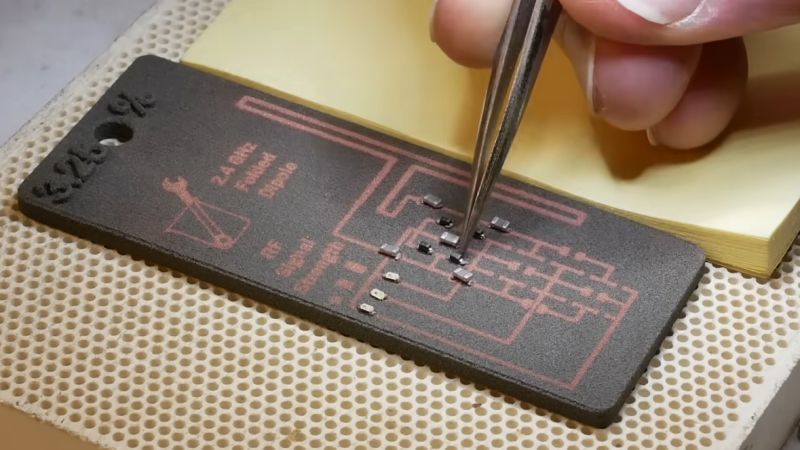
[Ben Krasnow] of the Applied Science channel recently released a video demonstrating his process for getting copper-plated traces reliably embedded into sintered nylon powder (SLS) 3D printed parts, and shows off a variety of small test boards with traces for functional circuits embedded directly into them.

Here’s how it works: The SLS 3D printer uses a laser to fuse powdered nylon together layer by layer to make a plastic part. But to the nylon powder, [Ben] has added a small amount of a specific catalyst (copper chromite), so that prints contains this catalyst. Copper chromite is pretty much inert until it gets hit by a laser, but not the same kind of laser that sinters the nylon powder. That means after the object is 3D printed, the object is mostly nylon with a small amount of (inert) copper chromite mixed in. That sets the stage for what comes next.

Continue reading “Watch SLS 3D Printed Parts Become Printed Circuits”

Image

Cold Metal Fusion For 3D Printing

When you see the term cold fusion, you probably think about energy generation, but the Cold Metal Fusion Alliance is an industry group all about 3D printing metal using Selective Laser Sintering (SLS) printers. The technology promoted by Headmade Materials typically involves using a mix of metal and plastic powder. The resulting part is tougher than you might expect, allowing you to perform mechanical operations on it before it is oven-sintered to remove the plastic.

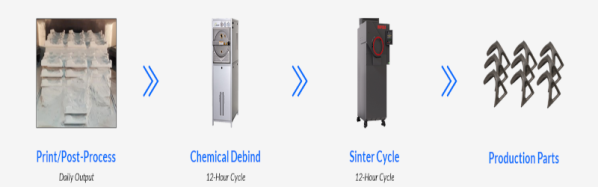
The key appears to be the patented powder, where each metal particle has a thin polymer coating. The low temperature of the laser in the SLS machine melts the polymer, binding the metal particles together. After printing, a chemical debinding system prepares the part — which takes twelve hours. Then, you need another twelve hours in the oven to get the actual metal part.

You might wonder why we are interested in this. After all, SLS printers are unusual — but not unheard of — in home labs. But we were looking at the latest offerings from Nexa3D and realized that the lasers in their low-end machines are not far from the lasers we have in our shops today. The QLS230, for example, operates at 30 watts. There’s plenty of people reading this that have cutters in that range or beyond out in the garage or basement.

We aren’t sure what a hobby setup would look like for the debinding and the oven steps, but it can’t be that hard. Maybe it is time to look at homebrew SLS printers again. Of course, the powder isn’t cheap and is probably hard to replace. We saw a 20 kg tub of it for the low price of €5,000. On the other hand, that’s a lot of powder, and it looks like whatever doesn’t go into your part can be reused so the price isn’t as bad as it sounds. We’d love to see someone get some of this and try it with a hacked printer.

We have seen homebrew SLS printers. There’s also OpenSLS that, coincidentally, uses a laser cutter. It wouldn’t be cheap or easy, but being able to turn out metal parts in your garage would be quite the payoff. Be sure to keep us posted on your progress.

Image

NASA Aces Artemis I, But The Journey Has Just Begun

When NASA’s Orion capsule splashed down in the Pacific Ocean yesterday afternoon, it marked the end of a journey that started decades ago. The origins of the Orion capsule can be tracked back to a Lockheed Martin proposal from the early 2000s, and development of the towering Space Launch System rocket that sent it on its historic trip around the Moon started back in 2011 — although few at the time could have imagined that’s what it would end up being used for. The intended mission for the incredibly powerful Shuttle-derived rocket  changed so many times over the years that for a time it was referred to as the “Rocket to Nowhere”, as it appeared the agency couldn’t decide just where they wanted to send their flagship exploration vehicle.

ImageBut today, for perhaps the first time, the future of the SLS and Orion seem bright. The Artemis I mission wasn’t just a technical success by about pretty much every metric you’d care to use, it was also a public relations boon the likes of which NASA has rarely seen outside the dramatic landings of their Mars rovers. Tens of millions of people watched the unmanned mission blast off towards the Moon, a prelude to the global excitement that will surround the crewed follow-up flight currently scheduled for 2024.

As NASA’s commentators reminded viewers during the live streamed segments of the nearly 26-day long mission around the Moon, the test flight officially ushered in what the space agency is calling the Artemis Generation, a new era of lunar exploration that picks up where the Apollo left off. Rather than occasional hasty visits to its beautiful desolation, Artemis aims to lay the groundwork for a permanent human presence on our natural satellite.

With the successful conclusion of the Artemis I, NASA has now demonstrated effectively two-thirds of the hardware and techniques required to return humans to the surface of the Moon: SLS proved it has the power to send heavy payloads beyond low Earth orbit, and the long-duration flight Orion took around our nearest celestial neighbor ensured it’s more than up to the task of ferrying human explorers on a shorter and more direct route.

But of course, it would be unreasonable to expect the first flight of such a complex vehicle to go off without a hitch. While the primary mission goals were all accomplished, and the architecture generally met or exceeded pre-launch expectations, there’s still plenty of work to be done before NASA is ready for Artemis II.

Continue reading “NASA Aces Artemis I, But The Journey Has Just Begun”