Image

Analog Video From An 8-Bit Microcontroller

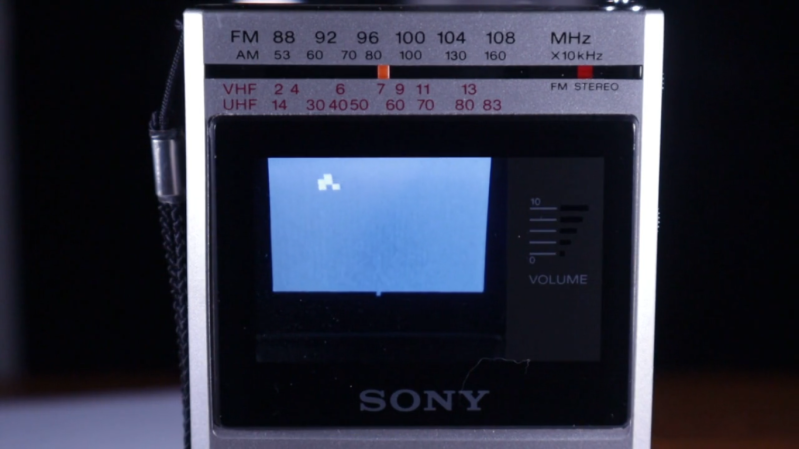
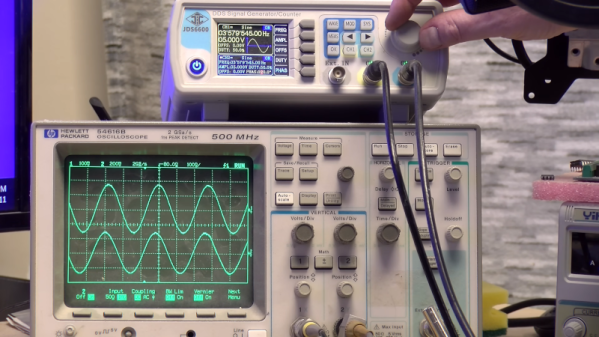
Although the CRT has largely disappeared from our everyday lives, there was a decades-long timeframe when this was effectively the only display available. It’s an analog display for an analog world, and now that almost everything electronic is digital, these amazing pieces of technology are largely relegated to retro gaming and a few other niche uses. [Maurycy] has a unique CRT that’s small enough to fit in a handheld television, but since there aren’t analog TV stations anymore, he decided to build his own with nothing but an 8-bit microcontroller and a few other small parts.

Continue reading “Analog Video From An 8-Bit Microcontroller”

Image

Portable CRT TV Becomes Retro Cyberdeck

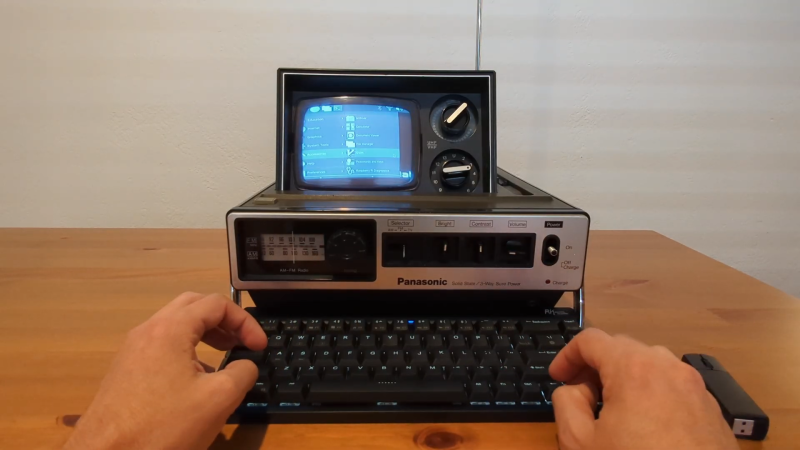
These days, it’s pretty easy to slap together a single-board computer and a cheap LCD screen to whip up a cool cyberdeck fast. But what if you wanna go more retro? [Manu] found a portable TV straight out of the original Blade Runner film, and decided this would be the perfect base for a cyberdeck rocking a whole-ass CRT screen.

The build started with a Panasonic TR-545 television. Back in the day, it took many large batteries to power this thing up—no surprise given how power hungry CRTs are. This gave [Manu] a neat opportunity to sneak all the new cyberdeck hardware into the original battery tray, including a new lithium-ion battery pack that is much more compact than the original. A Raspberry Pi 5 is running the show, computer-wise, and it’s hooked up to an HDMI RF modulator that allows the video output signal to be hooked up to the TV’s original antenna input. It’s not the cleanest way to go, but it allowed [Manu] to make the mod entirely reversible. All the new hardware slots neatly into the repurposed battery tray, and can be removed quite easily without damage to this vintage specimen. Even the keyboard fits nicely into the setup, as [Manu] was able to find a suitable 60% layout foldable unit right off the shelf.

Check out the slide deck for more details on the build, but be warned—it’s a 241 MB PDF. Bonus points if you calculate what that would cost to store on a hard drive in 1979 when the Panasonic TR-545 was on the market. We’ve seen a similar build before, too, with a classic black & white Magnavox unit. If you like squinting at a tiny blurry screen, a CRT cyberdeck is absolutely the way to go. Just be warned that the other screenwriters at your local coffee shop will be more interested in your hardware than whatever you’re actually working on. Good luck with your next pitch all the same. Video after the break.

Continue reading “Portable CRT TV Becomes Retro Cyberdeck”

Image

A TV Transmitter From An STM32

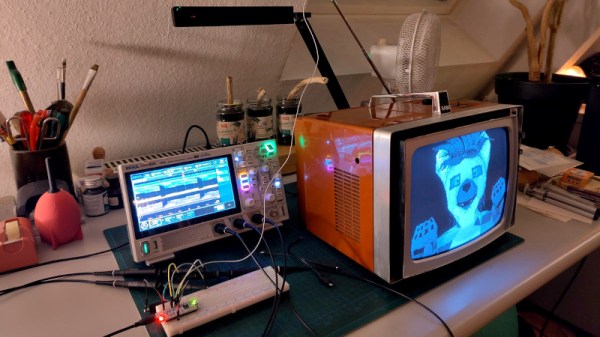
Analog TV may have shuffled off its mortal coil years ago, but there are still plenty of old CRT TV sets around that could receive it. [Kris Slyka] has just such a device, and decided to feed it something from an STM32 microcontroller. An STM32G431, to be precise, and they’re doing it using the on-chip hardware rather than in software.

This unexpected feat is made possible by clever use of the internal oscillators and analog multiplexer. The video itself is generated using the MCU’s DAC, and fed into the on-board op-amp multiplexer which is switched at the VHF transmission frequency. This creates the required VHF TV transmission, but without audio. This component comes by abusing another peripheral, the internal RC oscillator for the USB. This is frequency modulated, and set to the required 5.5 MHz spacing from the vision carrier for the TV in question. It doesn’t (yet) generate the PAL color sub-carrier so for now it’s black and white only, but maybe someone will figure out a way.

We like unexpected out-of-spec uses of parts like these microcontrollers, and we especially like analog TV hereabouts. We marked its very final moments, back in 2021.

Image

One Hundred Years Of Telly

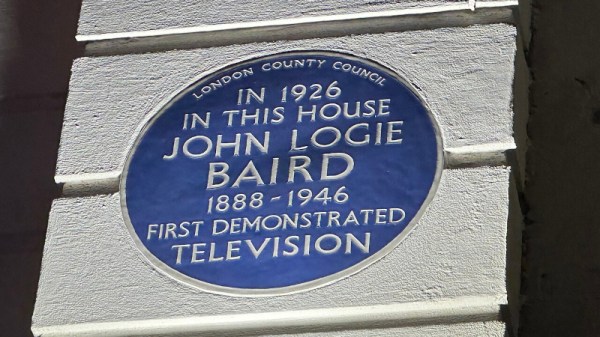
Today marks an auspicious anniversary which might have passed us by had it not been for [Diamond Geezer], who reminds us that it’s a hundred years since the first public demonstration of television by John Logie Baird. In a room above what is today a rather famous Italian coffee shop in London’s Soho, he had assembled a complete mechanical TV system that he demonstrated to journalists.

Television is one of those inventions that owes its genesis to more than a single person, so while Baird was by no means the only one inventing in the field, he was the first to demonstrate a working system. With mechanical scanning and just 30 lines, it’s hardly HD or 4K, but it does have the advantage of being within the reach of the constructor.

Perhaps the saddest thing about Baird and his system is that while he was able to attract the interest of the BBC in it, when the time came for dedicated transmissions at a higher resolution, his by then partly mechanical system could not compete and he faded into relative obscurity. Brits instead received EMI’s 405 line system, which persisted until the very start of the 1980s, and eventually the German PAL colour system in the late 1960s.

So head on down to Bar Italia if you can to raise a coffee to his memory, and should you wish to have a go at Baird-style TV for yourself, then you may need to print yourself a disk.

Header image: Matt Brown, CC BY 2.0.

Image

How Do PAL And NTSC Really Work?

Many projects on these pages do clever things with video. Whether it’s digital or analogue, it’s certain our community can push a humble microcontroller to the limit of its capability. But sometimes the terminology is a little casually applied, and in particular with video there’s an obvious example. We say “PAL”, or “NTSC” to refer to any composite video signal, and perhaps it’s time to delve beyond that into the colour systems those letters convey.

Know Your Sub-carriers From Your Sync Pulses

A close-up on a single line of composite video from a Raspberry Pi.

A video system of the type we’re used to is dot-sequential. It splits an image into pixels and transmits them sequentially, pixel by pixel and line by line. This is the same for an analogue video system as it is for many digital bitmap formats. In the case of a fully analogue TV system there is no individual pixel counting, instead the camera scans across each line in a continuous movement to generate an analogue waveform representing the intensity of light. If you add in a synchronisation pulse at the end of each line and another at the end of each frame you have a video signal.

But crucially it’s not a composite video signal, because it contains only luminance information. It’s a black-and-white image. The first broadcast TV systems as for example the British 405 line and American 525 line systems worked in exactly this way, with the addition of a separate carrier for their accompanying sound. Continue reading “How Do PAL And NTSC Really Work?”

Image

The Miracle Of Color TV

We’ve often said that some technological advancements seemed like alien technology for their time. Sometimes we look back and think something would be easy until we realize they didn’t have the tools we have today. One of the biggest examples of this is how, in the 1950s, engineers created a color image that still plays on a black-and-white set, with the color sets also able to receive the old signals. [Electromagnetic Videos] tells the tale. The video below simulates various video artifacts, so you not only learn about the details of NTSC video, but also see some of the discussed effects in real time.

Creating a black-and-white signal was already a big deal, with the video and sync presented in an analog AM signal with the sound superimposed with FM. People had demonstrated color earlier, but it wasn’t practical for several reasons. Sending, for example, separate red, blue, and green signals would require wider channels and more complex receivers, and would be incompatible with older sets.

Continue reading “The Miracle Of Color TV”

Image

Tiny Little TV Runs On ESP32

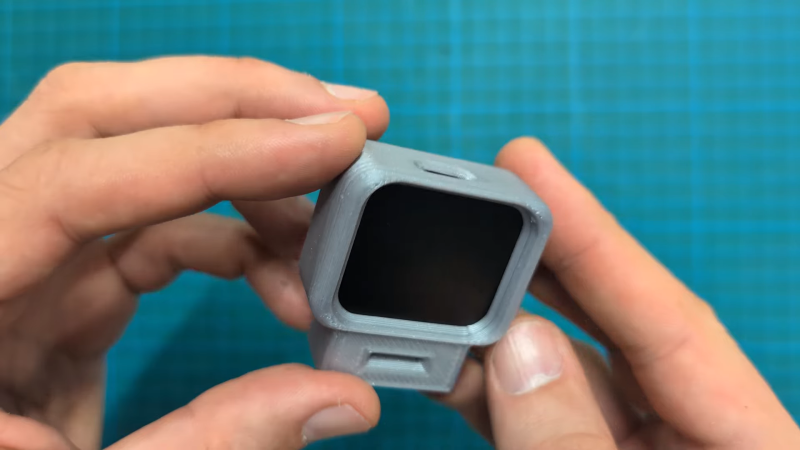
Few of us keep big old cathode ray tubes in the house anymore, but we can still appreciate the form factor of the classic TV. Indeed, the Tinytron from [t0mg] is a neat little tchotchke in this vein — a miniature TV that you could just about fit on a keyring.

[t0mg] wanted this project to be quick and easy to put together. It starts with an ESP32-S3-LCD-1.69 from Waveshare. It’s an all-in-one dev module which combines the microcontroller with a small screen right out of the box. You just have to solder a single six pin header to hook it up with an SD card reader and battery, and you’re done with the electronics. Even the case is a cinch to build, with four 3D printed components that can be spat out of a Prusa MK4S in just half an hour. Programming it can be done via a web browser. Just about the only thing it’s missing is a speaker — this TV is video only.

To watch things on the Tinytron, you just have to prepare them properly and drop them on the SD card. [t0mg] provides a web page for transcoding the video files, although you can do it yourself locally with ffmpeg if you prefer.

If you’re looking for a silly gift for a TV-obsessed friend, you could probably whip up a Tinytron in a couple hours or less. It reminds us of another great project, the tiny Simpsons replica TV that endlessly plays the greatest cartoon on Earth.

Continue reading “Tiny Little TV Runs On ESP32”