
   __ __         __            ___
  / // /__ _____/ /__  ___ _  / _ \___ ___ __
 / _  / _ `/ __/  '_/ / _ `/ / // / _ `/ // /
/_//_/\_,_/\__/_/\_\  \_,_/ /____/\_,_/\_, /
retro edition                         /___/
Now optimized for embedded devices!!
| About | Successes | Retrocomputing guide | Email Hackaday |
[Killerdark] has built a simple remote for his toddler to control videos on a PC. He gutted a USB number pad, built a new enclosure with the necessary buttons clearly labeled, and mapped the buttons in software. He could have possibly done better with larger color coded buttons, but really, it seems to work well as is. This reminds us of the giant iPod remote from back in 2006. Good job [Killerdark]
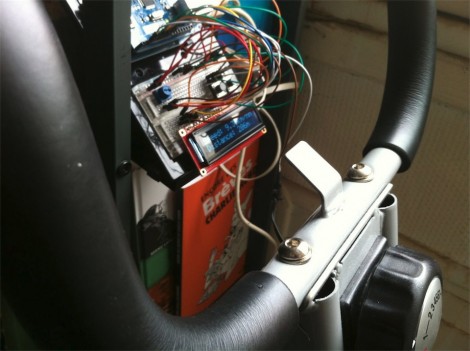
It will be easy to keep your exercise routine on track if you don’t have to do anything at all to log your workouts. [Reefab] developed this add-on hardware for his exercise bike that automatically logs his workout on the Internet.
He’s using RunKeeper to store and display the workout data. They offer a token-based API which [Reefab] implemented in his Arduino sketch. The hardware to grab data from the exercise bike is quite simple to set up. A rare-earth magnet was added to the fly-wheel with a reed switch positioned next it in order to measure the number and speed of rotations. This is exactly how a consumer bicycle computer works, needing just one accurate measurement corresponding to how far the bike travels with each revolution of that wheel.
In addition to the networked-logging feature [Reefab] included a character display so you can follow your speed and distance data during the workout.

September 5th marks the fifth anniversary of Hack a Day. We hope you’ve had as much fun hacking, reading, and sending us stories as we’ve had sharing them with everyone.
Whether you destroyed your hard drives or built your own web server we tried to keep things interesting over the past year. It was easy at times because of cool parking meter hacks, great advances in the world of hackintosh, and steam powered pleasure devices. But we couldn’t have done any of it without you. So keep reading, don’t forget to send us your hacks, and we’ll serve up the latest and juciest as we find it. We thought about putting up a list of the best hacks we’ve covered over the last five years. We’d rather hear what you think, so please leave a comment to let us know what your favorites have been.

Here’s a quick prototype from [Travis Goodspeed]. It’s a smart card built around an MSP430 microcontroller. We’ve used the MSP430 in the past because of its low power demands. He says this business card currently supports 1.8V to 3.3V, but a future design will have 5V as well. Technologies like Java Card exist for running applets on smart cards, but a familiar microcontroller like the MSP430 could certainly make development much faster. Knowing [Travis], there’s a reader somewhere about to go through some serious fuzzing.

[the4est] put together this quick how to for making a laser based light bulb night light. First, you need to break out the black glass base of the bulb and remove the filament. Scrub the inside of the bulb and pour in the paraffin. Once it sets, you can break the glass, leaving a solid wax bulb. Hollow out the inside, insert a laser pointer, and you’ll have fine glowing night light.
