- Questionnaires
Creating a questionnaire: How-tos, templates, and tips


Jump to:
What is a questionnaire?
A questionnaire is a research tool that contains a series of questions used to gain information from respondents about their opinions, experiences, and behaviors. Questionnaires may elicit quantitative or qualitative data(opens in a new tab or window) and be delivered online, by phone, on paper, or in person.
First developed by Sir Francis Galton, a British anthropologist, questionnaires feature open-ended questions, closed-ended questions, or a combination of both. Open-ended questions enable respondents to elaborate on their answers, while closed-ended questions provide respondents with a fixed set of responses they can choose from.

Questionnaires are widely applied by individuals and organizations in diverse industries. Some of the most popular questionnaires are used in the following:
- Market research
- Employee engagement
- Customer satisfaction
- Dissertations and research papers
- Health and psychological assessments
When designed and executed well, they serve a vital role in determining the quality of data and insights you receive from your intended audience.
Questionnaire vs survey
Questionnaires and surveys are often used interchangeably. However, they mean two different things.
A questionnaire is a specific survey instrument for collecting or recording information about a subject. All questions are standardized, which means respondents are presented with the same questions in the same order.
Meanwhile, a survey is a broader term for gathering, analyzing, and interpreting data. It uses questionnaires but also includes sampling, data analysis(opens in a new tab or window), observations, and other methods to find out more about a group of people.
In other words, the survey is the research process you’re conducting, and the questionnaire is the tool you’re using to do it.
Types of questionnaires and their purposes
Questionnaires come in different types, each with its own purpose and unique benefits. Understanding the various types of questionnaires is important for capturing the right data and analyzing it to draw meaningful insights. Below are the different questionnaire types based on the method of delivery.
Online questionnaire
Possibly the most common type of questionnaire, online questionnaires are designed and administered via email and other online channels. This method can be cost-effective and easy to distribute for small and large groups.
Since it’s self-paced, participants can answer on their own time, which may lead to more accurate responses. However, questionnaires sent online may be limited to populations that have access to the Internet, thereby affecting the variation of the data collected.
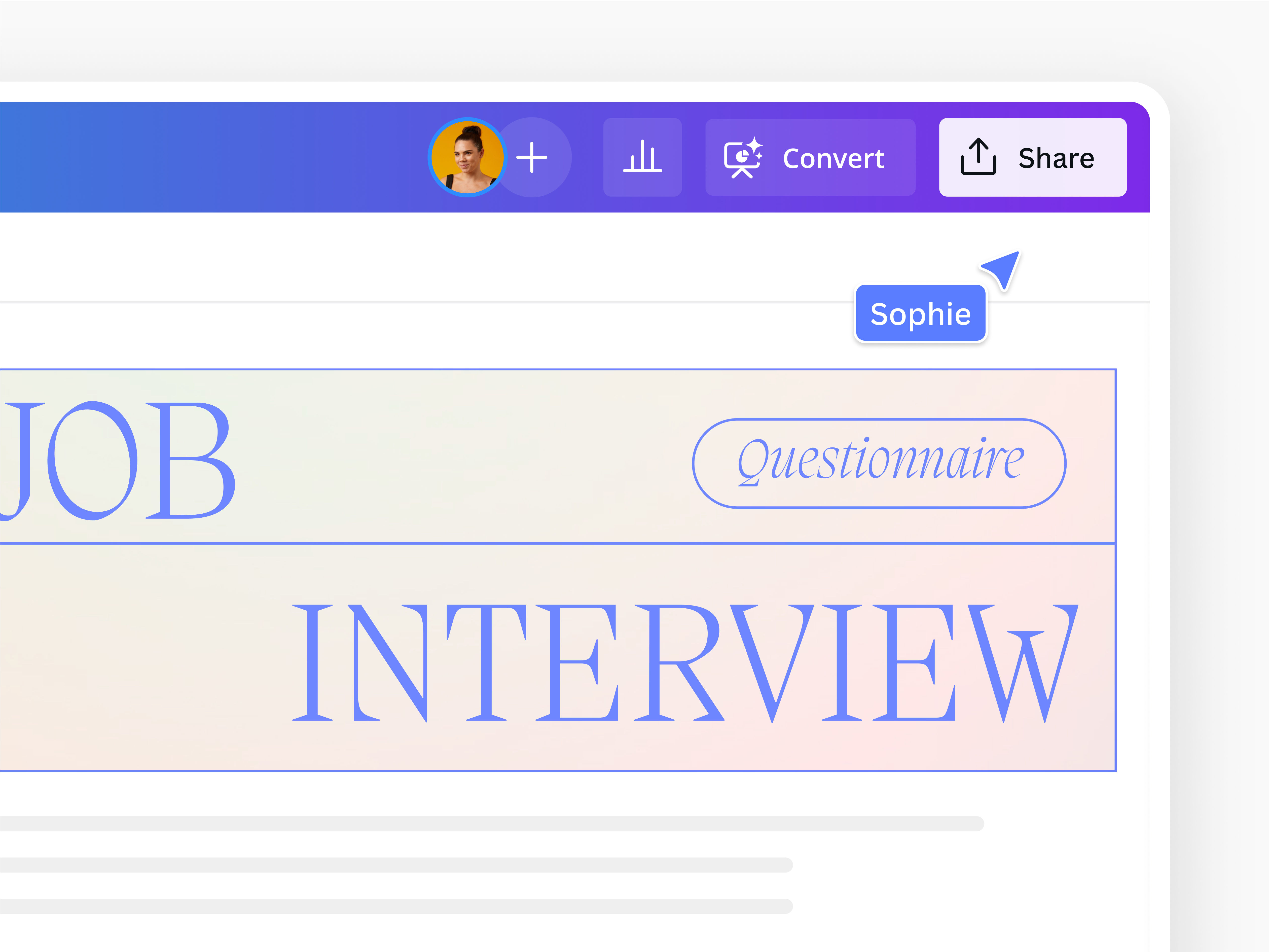
Preview of the Share option in Canva Docs. Share your questionnaire via email or a link.
Mail questionnaire
Mail or postal questionnaires are conducted in pen-and-paper format. Respondents receive the same set of questions through the mail that can be filled in and mailed back to the researcher or organization that sent them.
Given the lack of incentive for respondents to participate, this type of questionnaire has a relatively lower response rate and is becoming obsolete.
Telephone questionnaire
Here, a researcher directly calls respondents and delivers the questionnaire over the phone. This method works well when you only have a couple of questions that need quick answers. Note that some participants may hesitate to divulge as much information over a telephone conversation.
Generally, you may not be able to collect as many responses as other questionnaire types, which could result in a sample that doesn’t wholly represent the larger population.
In-person questionnaire
With in-person questionnaires, researchers communicate directly with respondents by traveling to their homes or workplaces and asking the questions already listed in the questionnaire.
This face-to-face interaction lets you better understand the context of the respondent’s answers by observing verbal and non-verbal cues that help you interpret the information obtained from the conversation. However, this method requires plenty of logistical preparation, with its success greatly depending on the skills of the interviewer.
What to include in a questionnaire?
While the structure and content of a questionnaire may look different depending on the research objectives, a few key components should always be included.
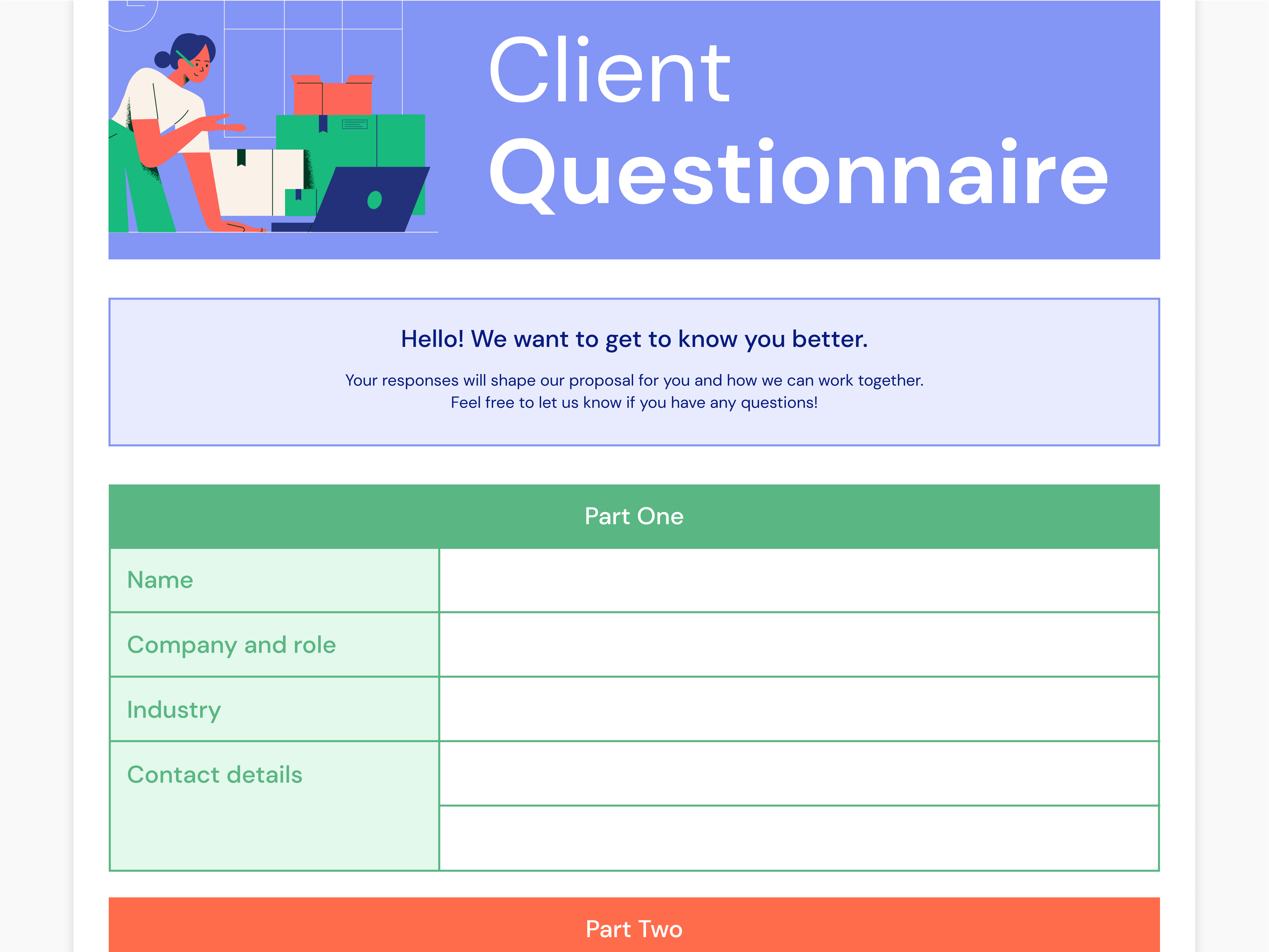
Example of a client questionnaire that shows the title, introduction, and questions about the participant.
The title of your questionnaire is a crucial starting point, as it establishes the tone and gives a general idea of the questionnaire’s purpose. It should be straightforward, informative, and compelling enough to encourage respondents to participate and provide valuable responses.
Following the title, the introductory section is the next important component of a questionnaire. It serves to welcome respondents and give further context about the purpose and significance of the questionnaire.
Here, briefly describe the questions respondents will answer to set their expectations. You can spell out the importance of their feedback, how it will be used, and estimate how long the questionnaire will take to complete.
Also include an informed consent statement(opens in a new tab or window), assuring respondents that their participation is voluntary and that any information they provide will be kept confidential.
Demographic questions collect basic demographic information about participants, such as age, gender, civil status, education level, and occupation. This information helps researchers better analyze responses and grasp the various perspectives of respondents.
Keep in mind to only ask questions that are relevant to your research objectives. Some demographic questions can be sensitive, so ask as politely as possible and give respondents the option to leave them unanswered if they prefer.
Instructions are specific guidelines to help participants navigate and accomplish the questionnaire correctly. Clarity is critical here to avoid confusion and ensure respondents understand what is being asked.
Provide explicit instructions on how respondents should answer each question or section of the questionnaire, especially if there are diverse question formats throughout the questionnaire.
In addition, avoid terminology and use simple, easy-to-understand language to ensure consistent and reliable responses from all participants.
Questions are the core of your questionnaire. They directly seek the necessary information required for your research and are used to solicit both quantitative and qualitative data.
Some examples of survey questions include multiple-choice, dichotomous, open-ended, and pictorial questions, among others. Choosing an appropriate survey question type depends on the data you need, but using a thoughtful mix of questions is ideal to avoid respondent fatigue(opens in a new tab or window).
It’s also important to organize your questions in a logical flow to make your questionnaire easy to follow and keep participants engaged. Lastly, ensure your questions are straight to the point and avoid using jargon or acronyms for respondents to figure out.
Your conclusion is where you wrap up your questionnaire. This section gives you the opportunity to thank respondents for their participation, inform them of when and how the results will be shared, and advise them about any next steps.
You may also provide your contact details, such as your email address or phone number should respondents have any concerns or clarifications about your questionnaire.
Remember, a well-crafted conclusion can leave a positive lasting impression on respondents. It can help them feel valued and more willing to participate the next time you need their help in future surveys.
Question types in questionnaires
Various question types form the backbone of any questionnaire. Each type serves a specific purpose in collecting quantitative and qualitative data. In this section, we delve into the kinds of questions you can employ in your questionnaire to extract the most valuable and meaningful insights from respondents.
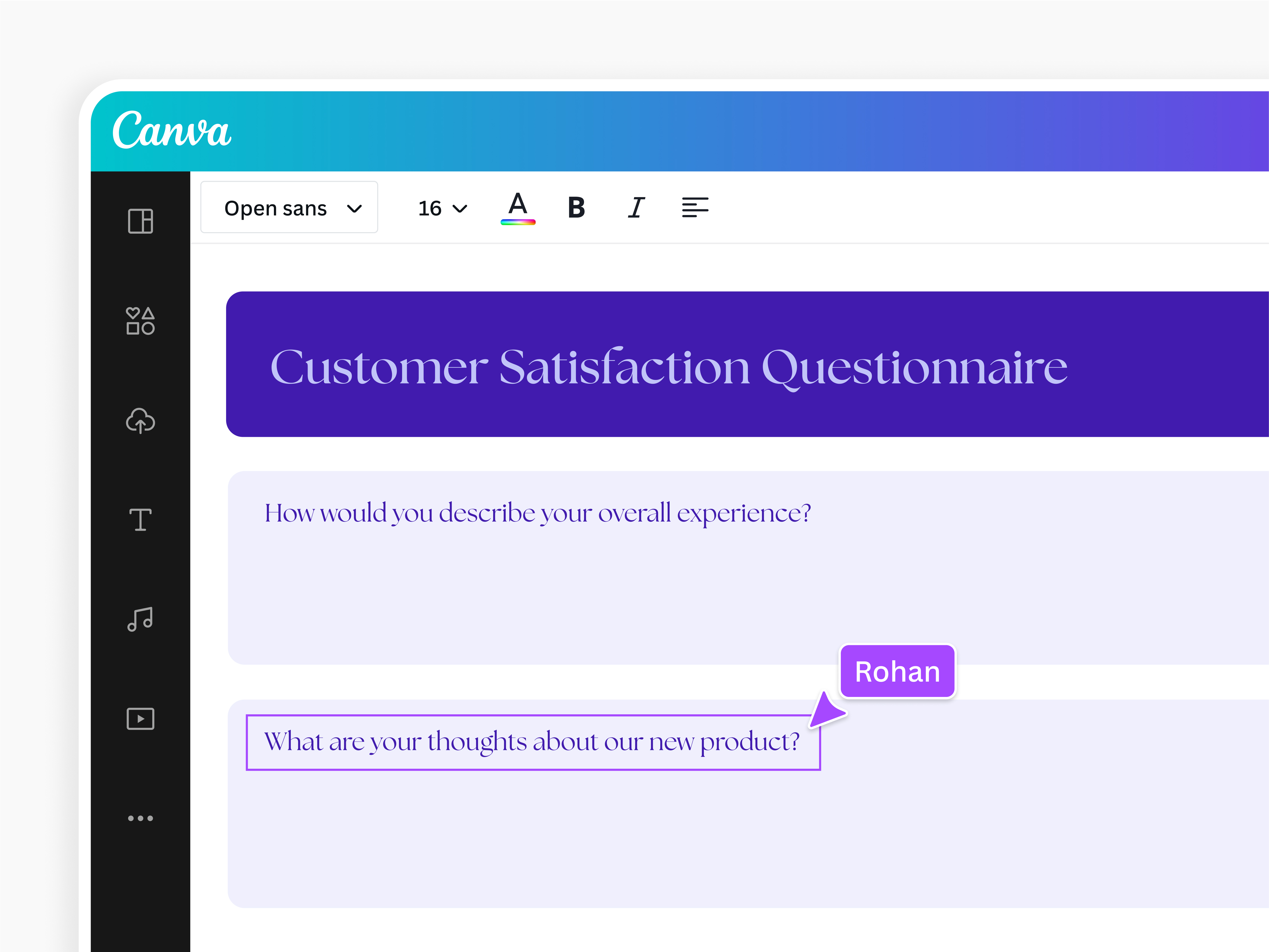
Examples of questions to measure customer satisfaction.
Open-ended or free-form questions allow respondents to answer each item in the questionnaire in their own words with little to no restrictions. Here, respondents are free to elaborate their thoughts, feelings, and opinions through paragraphs, essays, or a few sentences.
Use open-ended questions in your questionnaire when gathering qualitative responses for your research. They provide a better context for the research data by helping you see things from a respondent’s perspective.
Here are some examples of open-ended questions that could be included in your questionnaire:
- How was your overall experience?
- What are your thoughts about our new product?
- Please share any additional comments or feedback you have about our services.
Closed-ended questions come with a predefined list of answer options to choose from. Unlike the previous type, closed-ended questions require respondents to answer with a straightforward Yes/No, True/False, and the like, depending on their thoughts, experiences, and knowledge.
Closed-ended questions are perfect for quantitative research, as it lets you compile statistical information that can be analyzed quickly. They can be divided into subcategories, like dichotomous, multiple-choice, and more, which we’ll discuss next.
Below are some examples of closed-ended questions often used in a questionnaire:
- Did our team meet your expectations? (Yes/No)
- How often do you visit our website? (Daily, Weekly, Monthly)
A dichotomous question is a type of closed-ended question that offers only two possible answer options, such as Yes/No or Agree/Disagree. Participants then select one of the two opposing statements as a response to the question.
Dichotomous questions are the simplest and fastest way to obtain short, concise, and direct answers in your questionnaire. Some examples of dichotomous questions include:
- Did you enjoy this workshop? (Yes/No)
- I feel satisfied with the service I received. (Agree/Disagree)
- Our emails are informative and helpful. (True/False)
Another type of closed-ended question, a multiple-choice question urges respondents to choose at least one or more (depending on the instructions) responses from a given list of answer options.
A multiple-choice question typically includes the following:
- Stem - the specific question being asked
- Answer - the correct response
- Distractors - other possible answer options
Here is an example of a multiple-choice question often employed in a questionnaire:
- Which of the following social media platforms do you use regularly? (A) Facebook, (B) Instagram, (C) X (formerly Twitter), (D) TikTok, (E) None of the above.
In a questionnaire, scaling questions require participants to evaluate their views, attitudes, or sentiments about a topic within a predetermined numerical scale. This scale includes a range of answer options along a spectrum, allowing participants to rank their level of agreement or satisfaction with a particular statement.
One example is a Likert scale(opens in a new tab or window) question where the usual responses are strongly agree, agree, neutral, disagree, and strongly disagree. Typically, response categories are assigned numerical codes, with numerical values explicitly defined for that particular study. For instance:
- 1 - Strongly agree
- 2 - Agree
- 3 - Neutral
- 4 - Disagree
- 5 - Strongly disagree
Pictorial questions are a unique type of question used in questionnaires where images are part of the question or answer options. This question type is easy to use, allowing respondents to quickly select an answer without overthinking. This method is best used for visual learners, specifically for participants of a younger age group.
An excellent example of a pictorial question is in mental health surveys. Here, you display a series of images depicting different emotions (happy, sad, angry), then respondents choose the image that best represents how they currently feel.
Question wording
Choosing the right words and phrases to form a question is key to conveying the meaning and purpose of the question to respondents and ensuring everyone interprets the question in the same manner. Even minor changes in wording can significantly alter the answers you receive.
Keep the following in mind when coming up with survey questions to ask:
Be accurate and specific
First, it’s essential to ask specific questions that all participants will be able to answer. If the question is unclear, they may choose any answer and skew your questionnaire results.
For open-ended questions, make it clear to respondents that they can answer using their own words. Specify the kind of answer required, whether describing an experience or sharing first impressions about a new product or campaign. If a question is closed-ended, remember to include all possible answer options and that each option is distinct and mutually exclusive.
Stick with clear, simple language
Generally, questions that use clear and straightforward language are more easily understood by participants. Formulate questions with your target audience in mind. Consider their understanding of the subjects and language used in your questionnaire, and tailor your questions accordingly. Avoid technical words, jargon, and unfamiliar abbreviations to ensure readability and clarity.
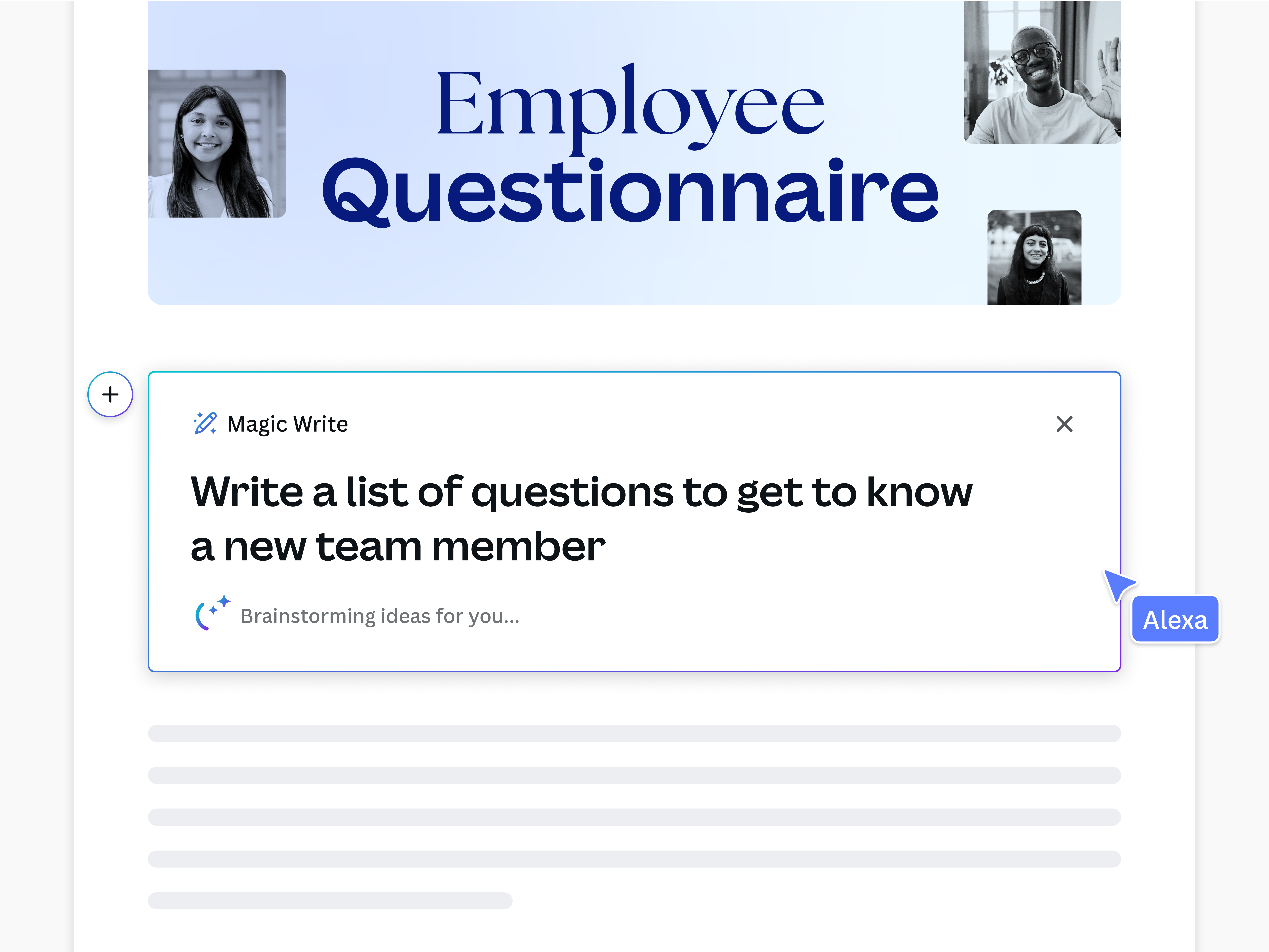
Canva’s Magic Write can be used to craft simple, specific questions.

Ask one question at a time
While it’s tempting to ask multiple questions simultaneously, sticking to a certain topic will likely yield more meaningful results. Ask one question at a time and avoid double-barreled questions. Double-barreled questions ask two things in one question, confusing and frustrating respondents.
An example of a double-barreled question is, Do you agree or disagree that the President is adept at handling domestic and foreign policy?
This question is difficult to answer, as respondents may have conflicting opinions on domestic and foreign policy. In this example, it would be better to ask two individual questions. Having one question about domestic policy and another about foreign policy can better capture the respondent’s true answers.
Avoid biased questions
When thinking of good survey questions, always stay unbiased as possible. Avoid asking questions that suggest you seek a specific answer or response. Consider modifying the wording of your question so as not to lead respondents in a particular direction.
Furthermore, assess if certain words or phrases may be viewed as offensive or embarrassing, which can lead to respondents withdrawing their participation or deliberately giving poor responses. It’s best to keep your questions brief, concise, and focused on the topic.
How to make a questionnaire
Crafting an effective questionnaire requires balancing well-crafted questions and the right structure. Below is a step-by-step guide on how to write a questionnaire that’s comprehensive, engaging, and meets your research objectives.

The first step in developing a questionnaire is defining the purpose and scope of your research. This step is crucial, as the intent of your questionnaire will determine the type, wording, and order of your questions.
Before you start writing, ask the following:
- What are the objectives? What are you trying to achieve?
- Who are your target respondents?
- How should you deliver the questionnaire? Online, on paper, or face-to-face?
- What questions do you need to ask to obtain the information required?
You’ll find that keeping your research objectives in mind throughout all phases of your questionnaire survey - from the first draft to subsequent revisions - eases the writing and organization process.
Once you’ve decided on your survey questions, think of a way to word those questions to extract the most accurate data from your respondents. Do you want an in-depth explanation that gives deep insights into the respondent’s background? Or do you want straightforward answers that can be easily segmented and analyzed? The type of questions you use in your questionnaire will determine the quality and accuracy of the responses you receive.
The order of your questions significantly affects the responses you receive in your questionnaire. Arrange your questions in a logical and sequential order, ensuring a smooth flow throughout the questionnaire. Include page breaks to signify transitions between different sections.
Additionally, begin with simple and non-sensitive questions when making your questionnaire. These questions should be easy to answer and warm up the respondent, making them more willing to participate in the survey. You can shift to lengthier, more complex questions later on.
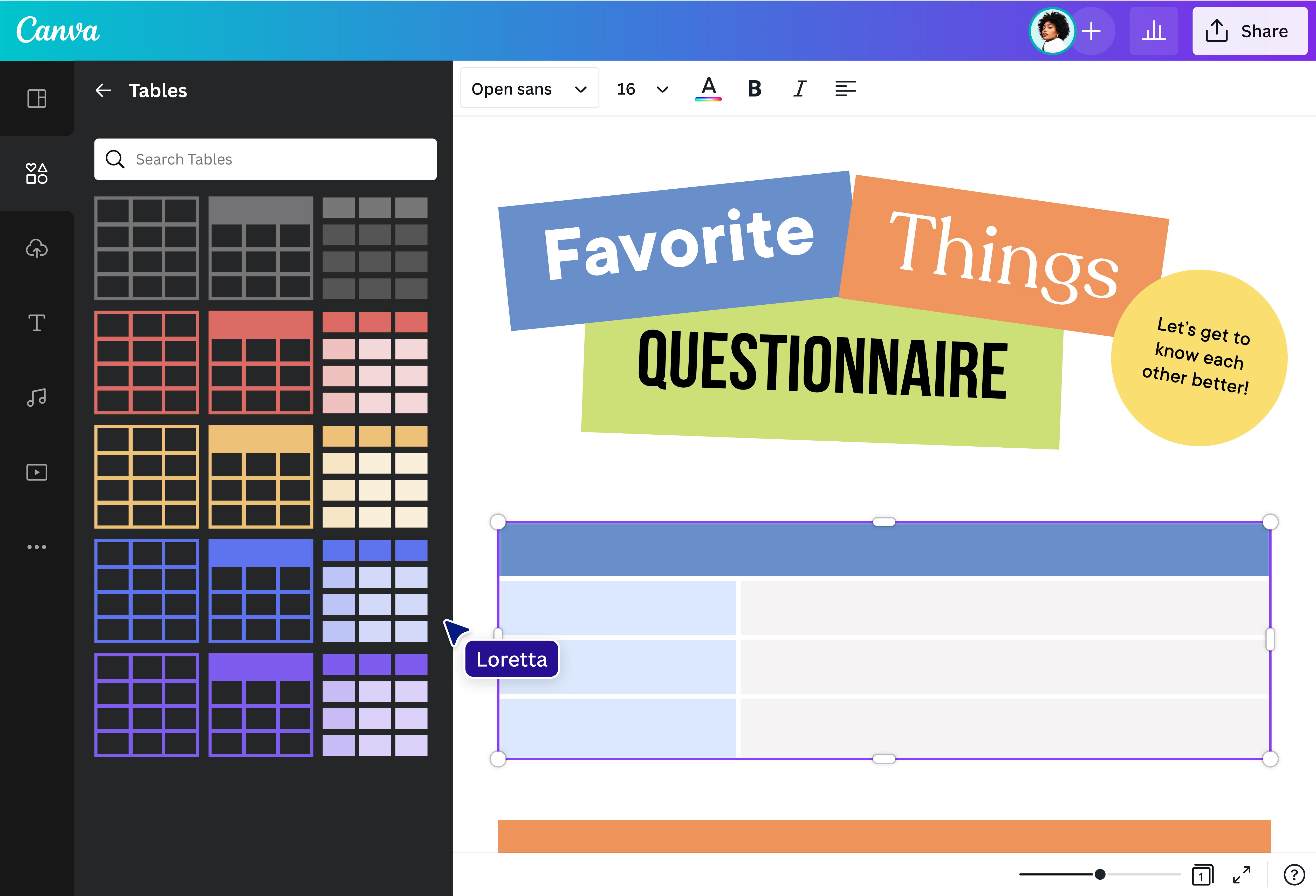
Start drafting your questionnaire with pre-built questionnaire templates across various categories, from customer satisfaction and employee feedback to market research. Browse questionnaire examples from Canva Docs(opens in a new tab or window) and narrow your choices according to theme, style, and color. Then, set your questions chronologically and stylishly on your document.
Surveys don’t need bells and whistles to attract participants as long as it has a clear and organized questionnaire format. Customize your chosen template and turn it into a well-structured visual document. Pick a font that’s common and easy on the eyes, such as Arial or Helvetica. Use a text size that’s appropriate for respondents of all abilities. Remember to limit the number of questions per page to avoid overwhelming respondents. Lastly, use visual aids to illustrate your questions more clearly.
Always pretest your questionnaire before sending it to respondents. Pilot testing helps catch errors in your questionnaire regarding grammar, formatting, and content. You can answer your questionnaire or ask teammates, family members, or friends to review your document. Once you receive feedback, revise your questionnaire before releasing it to your target audience.
Get inspired with questionnaire templates
Creating a questionnaire might sound easy until you have to formulate questions, determine the format, write quality content, and figure out the design. With free questionnaire templates on Canva, you can find inspiration for all kinds of survey questionnaires—so you never have to start from scratch! Pick a questionnaire layout below, then customize every element to suit your style and content.


All you need in a questionnaire maker
Make a questionnaire online without any complicated software. Explore our tools and features to craft a free questionnaire that effectively meets your research objectives. Design, edit, collaborate on, and share your document seamlessly with Canva’s free online questionnaire creator!

Great on any device
With responsive Docs, create, view, and edit your doc on any device. Perfect for when you're on the go.

Visual library for visual Docs
Seamlessly add visuals like graphs, tables, images, videos, graphics, and more, all available within your doc.

Collaborate in real-time
Work with teams and build on ideas with comments and emoji reactions. Keep sync sessions on track with a timer.

Magic Write your first draft, fast
Beat writer's block and skip ahead to your first draft with a single text prompt on Magic Write.

Share your work effortlessly
Share a link to your doc and control your team’s access. Track activity, views, and comments via Insights (Pro).

Enhance engagement with Scrollables
Instantly turn your static doc to an interactive experience with scrollable designs that capture attention.
Questionnaire best practices
Questionnaires are a valuable tool for gathering thoughts and feedback from a particular target audience. These four best practices can enhance your questionnaire’s quality and impact and achieve the desired results.
Filter respondents
A good questionnaire starts with a qualifying question to screen respondents and ensure they're qualified to participate. If, for instance, you’re developing a questionnaire sample for students. You need input only from students, so your qualifying question should be, Are you a student? If yes, the respondent can proceed with answering the questions. If not, politely express your thanks and let the respondent know they cannot complete the questionnaire.
Filtering respondents is important to ensure that only relevant participants are included in the survey. This practice enhances the accuracy of your research. Additionally, it saves time and resources by eliminating responses from those who don’t meet the criteria.
Include a consent statement
At the beginning of your questionnaire, include a brief consent statement. This statement informs respondents about the survey’s objectives, explains the benefits and risks of participation, and assures them that any answers they provide will be kept confidential.
In your statement, emphasize that participation is voluntary and respondents can opt out without obligation. This empowers respondents to make an informed decision about their involvement, with all relevant information presented upfront.
Create translated versions
If you are administering your questionnaire to a broad group of respondents, take into account multiple language variations. Some respondents may have a different primary language than yours or may not be proficient. Consider the languages your respondents are likely to be comfortable with, and if needed, maintain versions of your questionnaire in different languages to communicate effectively with the right audience.
Consider future applications
The objectives of your questionnaire and its possible long-term uses are closely intertwined. Having a clear plan for maximizing your questionnaire - currently and in the future - is essential. Do you intend for it to be a stand-alone questionnaire? For instance, evaluating employee engagement for a company event. Or do you plan to reuse it for future events or incorporate it into regular employee feedback forms?
Understanding your questionnaire's potential subsequent applications will influence what type of questions you choose, how they're worded, and when they're delivered.
Questionnaire FAQs
A good questionnaire design means having valid, reliable, engaging, and concise questions. A valid questionnaire asks what it intends to ask, ensuring participants understand the purpose of the question. It should be reliable, using unambiguous language throughout the content.
A good questionnaire should also be interesting enough to engage respondents through diverse question formats. Finally, effective questionnaires are concise and focused, offering straightforward questions that respect respondents’ time while still gathering all the necessary data.
A questionnaire is a widely used research tool due to its quick, efficient, and cost-effective approach to collecting ample information from a sample of people. This method effectively measures the respondents' behaviors, preferences, attitudes, and opinions. It can consist of open-ended and closed-ended questions, letting researchers collect qualitative and quantitative data.
Though questionnaires are vital to research, there are pros and cons to using these tools to collect information. Some of the many advantages of questionnaires are cost-efficiency, speed, and easy analysis. Specifically, questionnaires delivered online are nearly effortless. You can gather results in a few hours without hiring surveyors to administer your questionnaire.
On the other hand, you risk having inaccurate information with a questionnaire since it’s impossible to guarantee that respondents will answer all your questions and always be truthful. Knowing about the advantages and disadvantages of questionnaires helps you determine whether they align well with your research requirements.
Was this page helpful?
Get the pulse of your audience with a questionnaire