
Lambda functions are small anonymous functions, meaning they do not have a defined name. These are small, short-lived functions used to pass simple logic to another function.
- Contain only one expression.
- Result of that expression is returned automatically (no return keyword needed).
In this example, a lambda function is defined to convert a string to its upper case using upper().
a = 'GeeksforGeeks'
upper = lambda x: x.upper()
print(upper(a))
Output
GEEKSFORGEEKS
Explanation:
- 'a' store the string 'GeeksforGeeks'.
- upper is a lambda function that takes an argument x and returns x.upper().
- upper(a) applies the lambda to a, converting it to uppercase.
Syntax
In Python, lambda functions are created using the lambda keyword. Below is the syntax:
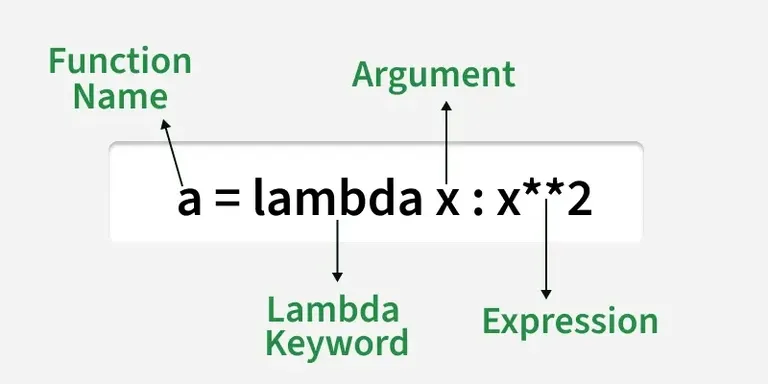
- Function name (a): Stores the lambda function so it can be reused later.
- Lambda keyword (lambda): Defines an anonymous (inline) function in Python.
- Argument (x): The input value passed to the lambda function.
- Expression (x**2): The operation performed on the argument and returned as the result.
Use Cases of Lambda Functions
1. Using with Condition Checking
A lambda function can use conditional expressions (if-else) to return different results based on a condition.
check = lambda x: "Positive" if x > 0 else "Negative" if x < 0 else "Zero"
print(check(5))
print(check(-3))
print(check(0))
Output
Positive
Negative
Zero
Explanation:
- The lambda function takes x as input.
- It uses nested if-else statements to return "Positive," "Negative," or "Zero."
Below example checks divisibility by 2 and returns "Even" or "Odd" accordingly.
check = lambda x: "Even" if x % 2 == 0 else "Odd"
print(check(4))
print(check(7))
Output
Even
Odd
Explanation:
- The lambda checks if a number is divisible by 2 (x % 2 == 0).
- Returns "Even" for true and "Odd" otherwise.
2. Using with List Comprehension
Lambda functions can be combined with list comprehensions to apply the same operation to multiple values in a compact way.
func = [lambda arg=x: arg * 10 for x in range(1, 5)]
for i in func:
    print(i())
Output
10
20
30
40
Explanation:
- lambda function multiplies each element by 10.
- list comprehension iterates through li and applies the lambda to each element.
3. Using for Returning Multiple Results
Although a lambda can contain only one expression, it can still return multiple results by combining them into a tuple.
calc = lambda x, y: (x + y, x * y)
res = calc(3, 4)
print(res)
Output
(7, 12)
Explanation: lambda function performs both addition and multiplication and returns a tuple with both results.
4. Using with filter()
filter() function uses a lambda expression to select elements from a list that satisfy a given condition, such as keeping only even numbers.
c = [1, 2, 3, 4, 5, 6]
even = filter(lambda x: x % 2 == 0, c)
print(list(even))
Output
[2, 4, 6]
Explanation:
- The lambda function checks if a number is even (x % 2 == 0).
- filter() applies this condition to each element in nums.
5. Using with map()
map() function applies a lambda expression to each element of a list and returns a new list with the transformed values.
a = [1, 2, 3, 4]
double = map(lambda x: x * 2, a)
print(list(double))
Output
[2, 4, 6, 8]
Explanation:
- The lambda function doubles each number.
- map() iterates through a and applies the transformation.
6. Using with reduce()
reduce() function repeatedly applies a lambda expression to elements of a list to combine them into a single result.
from functools import reduce
a = [1, 2, 3, 4]
mul = reduce(lambda x, y: x * y, a)
print(mul)
Output
24
Explanation:
- The lambda multiplies two numbers at a time.
- reduce() applies this operation across the list.
To know the difference between def keyword and Lambda function, refer to this article, def vs lambda.
