Thank you to Christophe (F4DAN) for writing in about his new project called Wavelingo, an AI real-time shortwave radio translator. The software currently works with the KiwiSDR web SDR network. Christophe has a live public example running at wavelingo.app, however, with a 60-second timeout due to hosting cost constraints. Christophe writes:
Are you listening to a QSO in a foreign language on your transceiver? Click on the closest SDR (KiwiSDR fleet for now, more SDR to come in the future), and get real-time translations.
I opened a telegram channel to share updates and feedbacks on this projects - and provide support.
VLF (Very Low Frequency) refers to signals in the 3–30 kHz range. Software-defined radios like the SDRplay RSPdx can pick up these signals with an appropriate antenna.
Over on YouTube, @electronics.unmessed has uploaded a video showing how you can build a high-performing VLF loop using a single loop of wire and a balun. The one-turn design results in a naturally low impedance at low frequencies. A balun is then added to step up the impedance, resulting in impedance compatibility with an SDR.
The video explains the concepts behind VLF loops using an equivalent circuit model and shows how conductor thickness offers little benefit above 10 kHz (though wide sheet conductors can add ~3 dB), larger loops scale with area but 2 m is a good indoor compromise, extra turns help small loops but underperform a single turn with a proper transformer, and alternative ferrite mixes give little improvement over standard choke cores. Ultimately, it is concluded that a one-turn loop with a well-chosen balun is one of the most effective designs.
If you're interested in similar content, there are also several other interesting videos on the @electronics.unmessed channel about VLF antennas, mag loop antennas, SDR reception, and more.
Over on YouTube Amateur Radio VK3YE has uploaded a video showing his 'HF Helper' project. The HF Helper is a tunable HF filter and attenuator that helps improve HF reception when in the presence of strong overloading signals. VK3YE writes:
Using an RTL-SDR.COM dongle (genuine model V4) and a computer with SDR Sharp you can get quite good reception of HF signals. However reception can sometimes be spoiled by overload from signals on or away from the desired reception frequency. The 'HF Helper' presented here can reduce these problems. And you can use it in conjunction with a QRP transmitter to form a simple transmitting station.
RTL SDR HF Helper improves reception
Also as a bonus, in a related video VK3YE also shows the RTL-SDR Blog V4 being used on SDR Touch on an Android phone for portable HF, VHF and UHF reception.
The latest August edition of the RadioWorld Magazine has included an article by James Careless about the use of software defined radios for shortwave radio listening. RadioWorld is a magazine targeted towards radio broadcast owners, managers and engineers all over the world. The article explores SDRplay and RTL-SDR Blog V4 units from the perspective of a shortwave listener new to software defined radios, comparing them to his high-end Sangean ATS-909X2 shortwave digital receiver.
Thank you to Ihar Yatsevich for writing in and sharing with us his open-source WSPR beacon project. The WSPR beacon consists of a custom PCB with ATMega328 microcontroller, GPS module, single transistor amplifier, and Si5351 with TCXO.
The result is a very simple, portable WSPR beacon that can be heard all over the world. However, it appears that no band filters are built into this, so you will need to add a bandpass filter for the WSPR band that you are using.
WSPR (Weak Signal Propagation Reporter) (pronounced "whisper") is an amateur radio digital HF mode designed to be decodable even if the signal is received with very low power. Because of this design, even low-power transmitters can be received from all over the world. It can also be used to help determine HF radio propagation conditions as WSPR reception reports are typically automatically uploaded to wsprnet.
If you are interested, Ihar has written about his project in more detail over on Reddit.
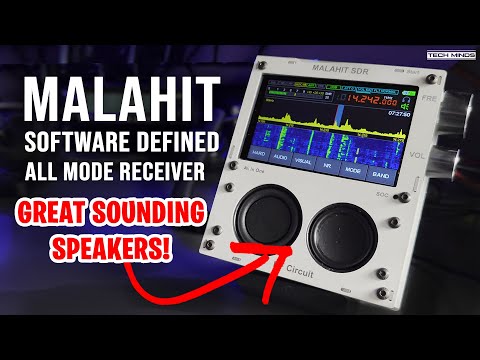
Over on the Tech Minds YouTube channel, Matt has uploaded a new review and demonstration of a Malahiteam DSP1 SDR Receiver 50KHz - 2GHz. This particular unit appears to be a Chinese clone unit which is actually called a 'Malahit SDR'. The Russian company Malahiteam makes the original units, and they come in a different enclosure and feature the full Malahiteam logo.
In the video Matt shows this version of the Malahit DSP1 in action, noting that the built-in speakers sound great and that RF performance seems to be good. He does however note that the enclosure is a bit cheap, being built out of PCB boards, and that the top encoder knob sometimes doesn't work properly. Overall Matt mentions that he probably wouldn't buy it at the current ~US$180 price point, noting that better newer models like the DSP2 and DSP3 already exist.
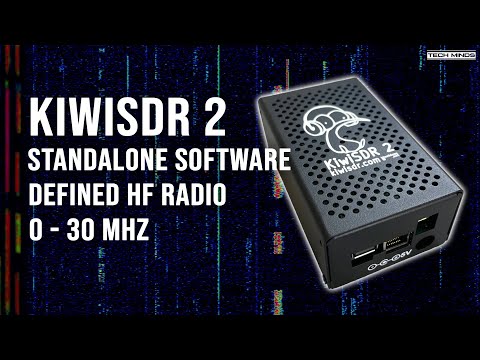
Earlier this year the KiwiSDR 2 became available for purchase and began shipping out to customers. The KiwiSDR 2 is an upgraded version of the original KiwiSDR with the main upgrades being an enhanced RF front end and the addition of a digital attenuator.
Over on the Tech Minds YouTube channel, Matt received his KiwiSDR 2 and uploaded a review and demonstration of the product. In the video, Matt shows the external ports of the KiwiSDR and discusses the differences between the KiwiSDR 2 and the original version. Matt goes on to show how to set up the KiwiSDR 2 and shows it receiving through it's web-based receiving software.
KiwiSDR is a 14-bit wideband RX-only HF software-defined radio created by John Seamons (ZL/KF6VO). The KiwiSDR has up to 32 MHz of bandwidth, so it can receive the entire 10 kHz - 30 MHz VLF/LF/MW/HF spectrum all at once. Other than the specifications, the main interesting feature about the KiwiSDR is that it is designed to be operated entirely as an online web-based SDR which is accessed over a network connection. Owners can optionally share their KiwiSDRs online with anyone who wants to access it, which also allows for interesting distributed applications, such as TDoA direction finding, which allows users to pinpoint the location of unknown HF transmissions such as numbers stations.
KiwiSDR 2 - A Standalone Software Defined HF Radio Receiver
Back in August 2023 we posted about the pre-announcement of the KiwiSDR 2, an upgraded version of the original KiwiSDR. Most of the upgrades are minor or due to some chips becoming EOL. The main upgrades are an enhanced RF front end and the addition of a digital attenuator. One change is also the manufacturing country. Instead of being manufactured in China, the KiwiSDR 2 is now manufactured in New Zealand.
The new KiwiSDR 2 can be purchased from kiwisdr.nz. Pricing is $648 NZD ($395 USD) for the full KiwiSDR 2 cape + Beaglebone and enclosure set. The cape by itself is also available for $484 NZD ($295 USD). Currently the second production run is selling, and a third production run is in progress.
Previously the original KiwiSDR sold for $299 USD. Considering inflation, component changes and additions, and the change to a more expensive country to manufacture in, the price increase seems reasonable.
KiwiSDR is a 14-bit wideband RX only HF software defined radio created by John Seamons (ZL/KF6VO). The KiwiSDR has up to 32 MHz of bandwidth, so it can receive the entire 10 kHz - 30 MHz VLF/LF/MW/HF spectrum all at once. Other than the specifications, the main interesting feature about the KiwiSDR is that it is designed to be operated entirely as an online web based SDR which is accessed over a network connection. Owners can optionally share their KiwiSDRs online with anyone who wants to access it, which also allows for interesting distributed applications, such as TDoA direction finding, which allows users to pinpoint the location of unknown HF transmissions such as numbers stations.