RED HAT
Kubernetes Native Java and
Eclipse MicroProfile (plus other things)
Mark Little, VP Engineering, Red Hat
Who am I?
● Research into fault-tolerant distributed systems since 1986
○ Arjuna, Argus, Isis/Horus, Emerald, Xerox, …
○ DCE, DCOM, CORBA, HTTP, Web Services, …
● Implemented world’s first 100% Java transaction service in 1995
○ Yes, we’re still using it today!
● Active in OMG, OASIS, W3C, JCP, GGF and others
○ Co-author of a number of specifications and standards
● Visiting Professor at Newcastle and Lyon
● Industry ...
○ Various startups
○ Bluestone Distinguished Engineer, HP Distinguished Engineer
○ JBoss CTO in 2009
● These days spend far too much time on conference calls, meetings etc!
2
Overview
● Why Java in the age of Kubernetes and Linux Containers?
○ Java is dead, right?
● Why did Enterprise Java need to change?
○ Kubernetes and Immutability
○ Incompatibilities with Java and Application Containers
● Eclipse MicroProfile
○ Eclipse Jakarta EE
● Quarkus and principles behind it may be a game changer
○ Optimised for immutable architectures
○ Can work in constrained environments, e.g., low memory footprint
3
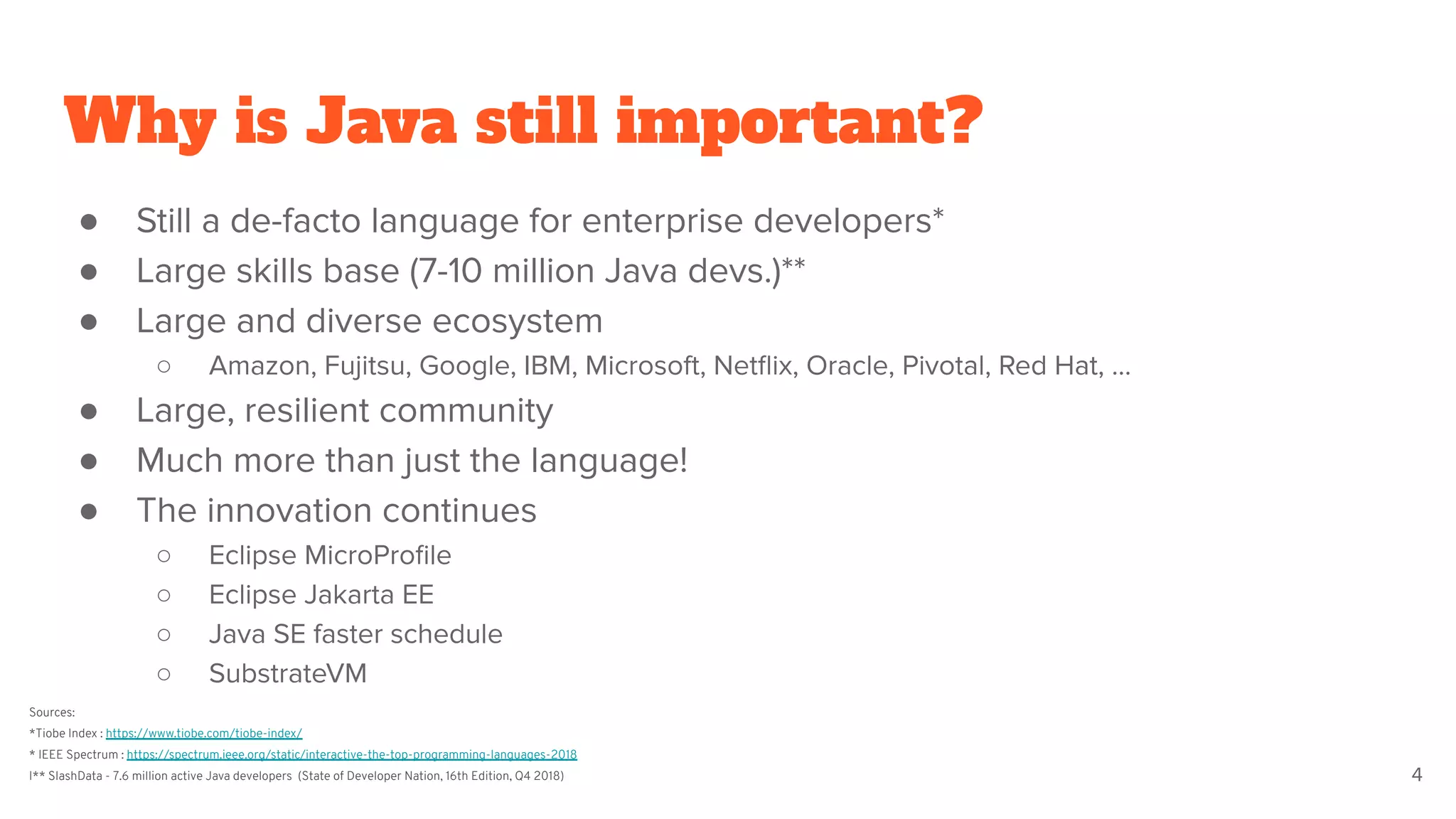
Why is Java still important?
● Still a de-facto language for enterprise developers*
● Large skills base (7-10 million Java devs.)**
● Large and diverse ecosystem
○ Amazon, Fujitsu, Google, IBM, Microsoft, Netflix, Oracle, Pivotal, Red Hat, …
● Large, resilient community
● Much more than just the language!
● The innovation continues
○ Eclipse MicroProfile
○ Eclipse Jakarta EE
○ Java SE faster schedule
○ SubstrateVM
4
Sources:
*Tiobe Index : https://www.tiobe.com/tiobe-index/
* IEEE Spectrum : https://spectrum.ieee.org/static/interactive-the-top-programming-languages-2018
I** SlashData - 7.6 million active Java developers (State of Developer Nation, 16th Edition, Q4 2018)
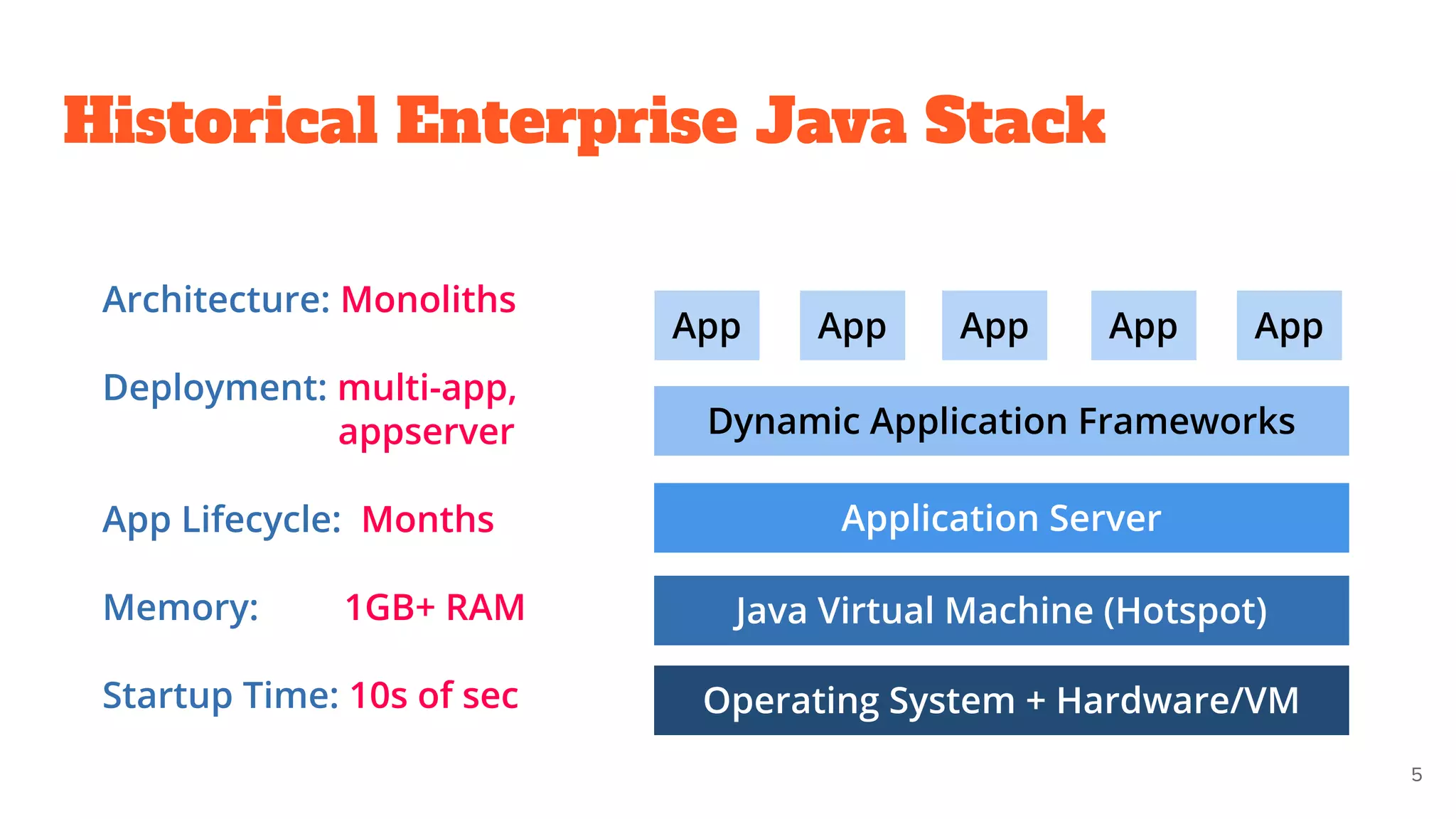
Historical Enterprise Java Stack
5
Operating System + Hardware/VM
Java Virtual Machine (Hotspot)
Application Server
App App App App App
Dynamic Application Frameworks
Architecture: Monoliths
Deployment: multi-app,
appserver
App Lifecycle: Months
Memory: 1GB+ RAM
Startup Time: 10s of sec
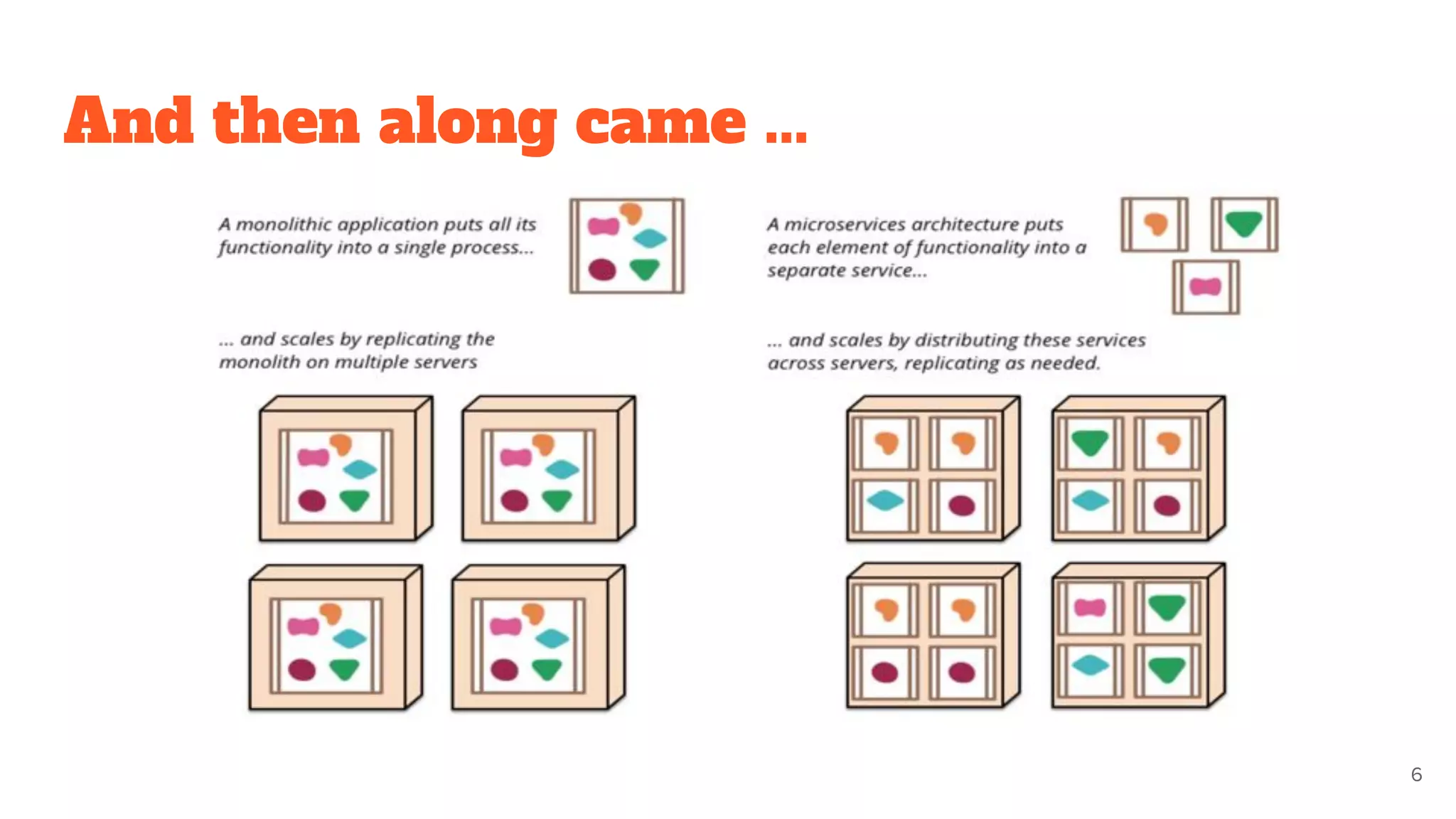
And then along came ...
6
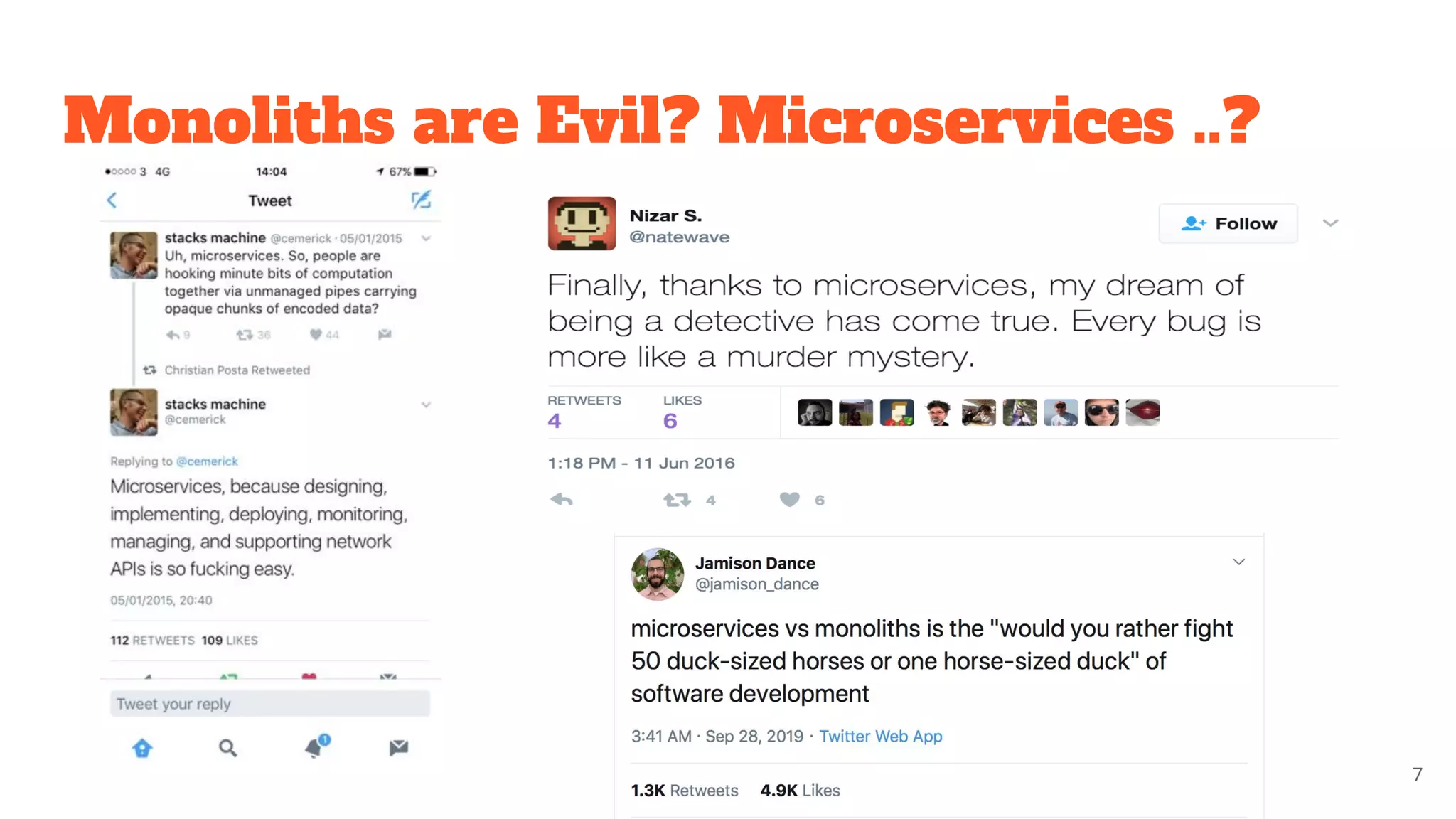
Monoliths are Evil? Microservices ..?
7
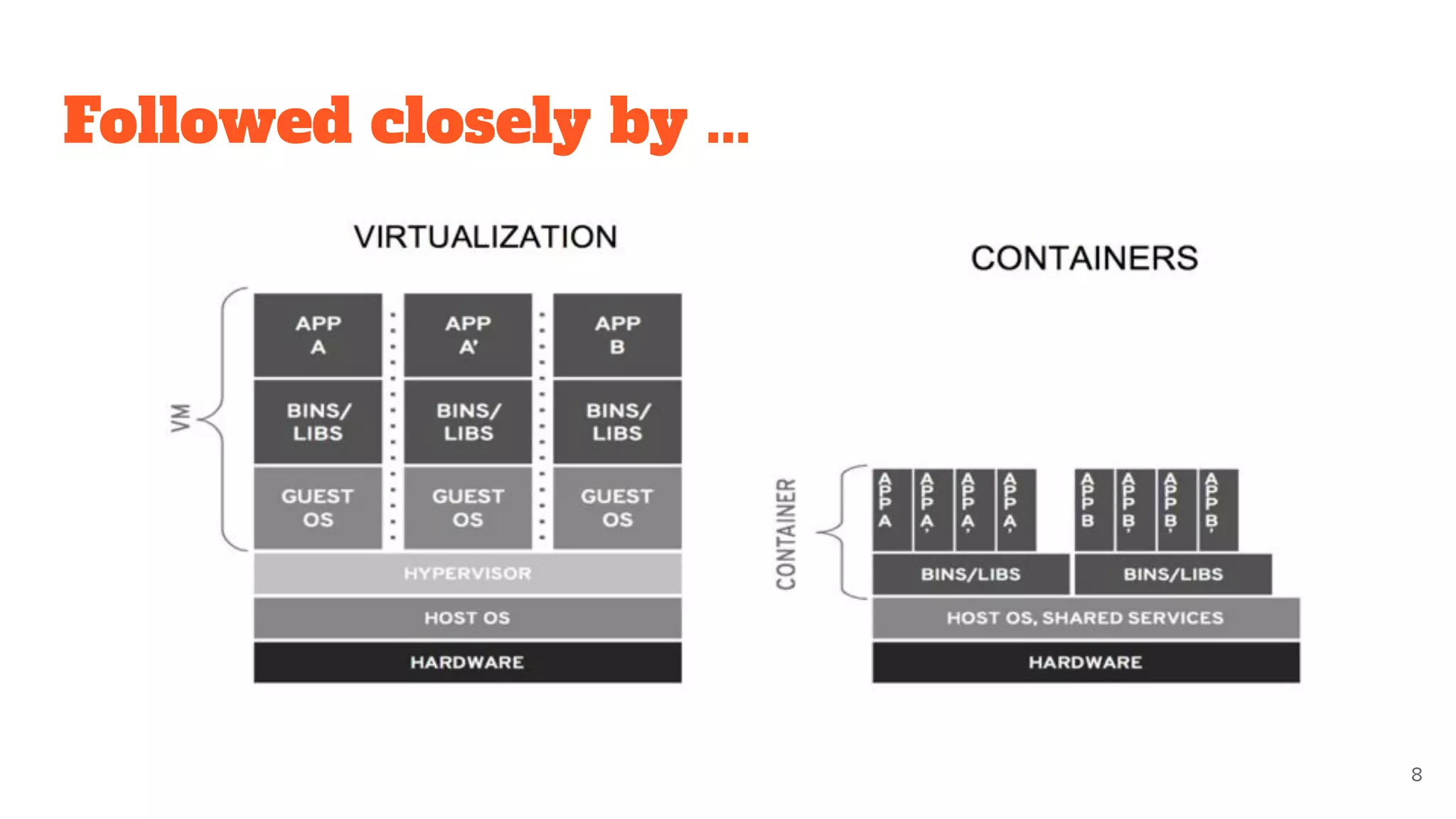
Followed closely by ...
8
And then … Kubernetes
● Open source project from Google
● The de facto standard for cluster management for Linux containers
● Packages Orchestration, service discovery, load balancing
○ All behind a simple REST API
● Immutable architectures
9
The “Java Problem”
● Designed for throughput at the expense of footprint
● Intended to be long running, less focus on startup speed
● Rich dynamic behavior built around mutable bare-metal systems
○ … yet Linux containers are primarily immutable
○ … frameworks and stacks built to leverage key Java capabilities such as dynamism
● Java is trying to pivot (JPMS, AOT, Graal, etc)
○ … but architectural changes to frameworks are required to truly benefit
10
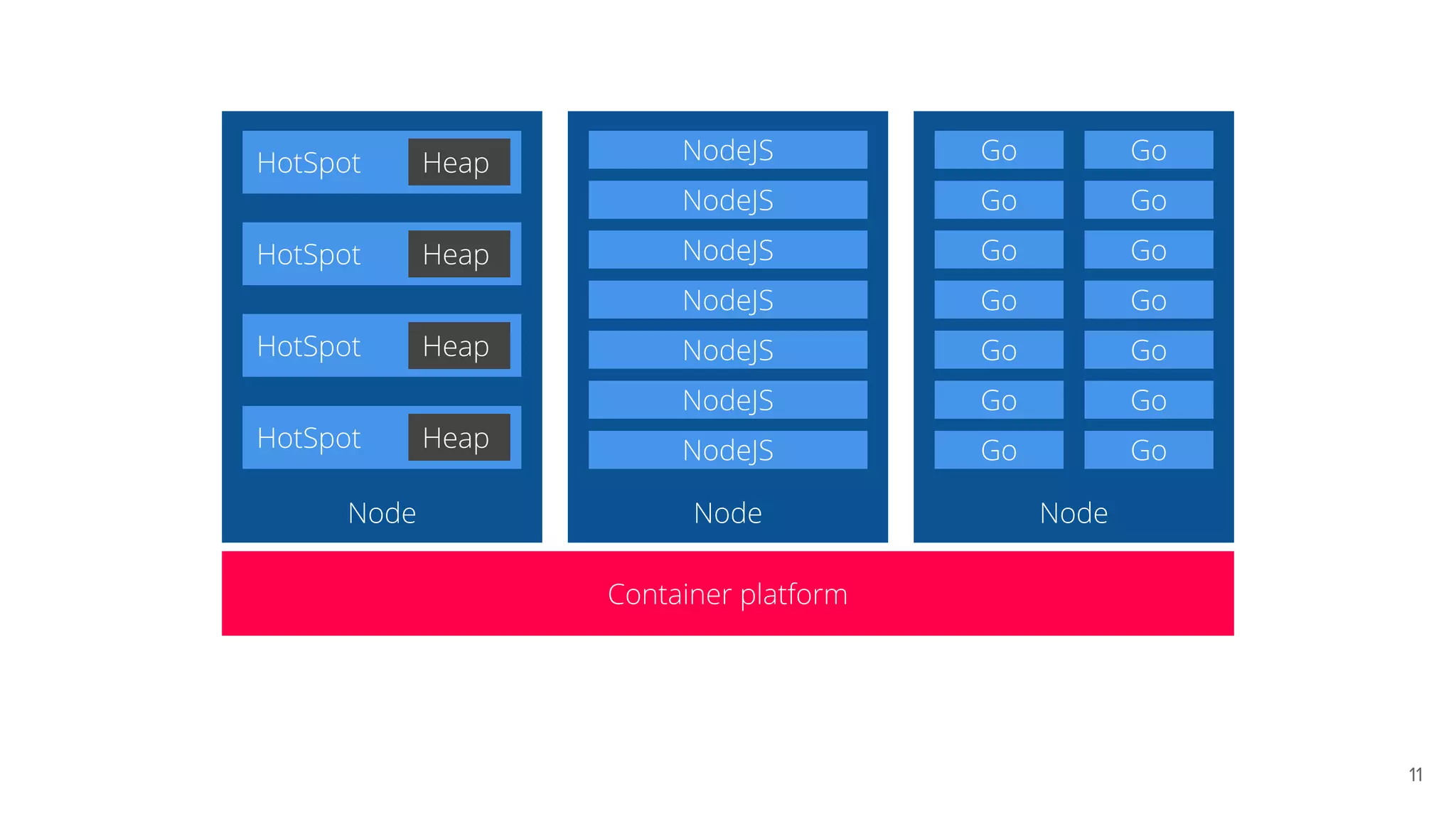
11
Container platform
Node
NodeJS
NodeJS
NodeJS
NodeJS
NodeJS
NodeJS
NodeJS
Node
Go Go
Go Go
Go Go
Go Go
Go Go
Go Go
Go Go
Node
HotSpot Heap
HotSpot Heap
HotSpot Heap
HotSpot Heap
Why footprint matters in the cloud
● Memory is more important than throughput on containers
○ It’s more expensive (requires permanence), unlike CPU cycles
● Microservices multiply overhead cost
○ One app becomes N microservices (e.g. 20 microservices ~= 20GB today!)
● If we do nothing Java alternatives will take over (eventually)
○ Go, Python, Node, PHP, Rust etc. do not have this problem
12
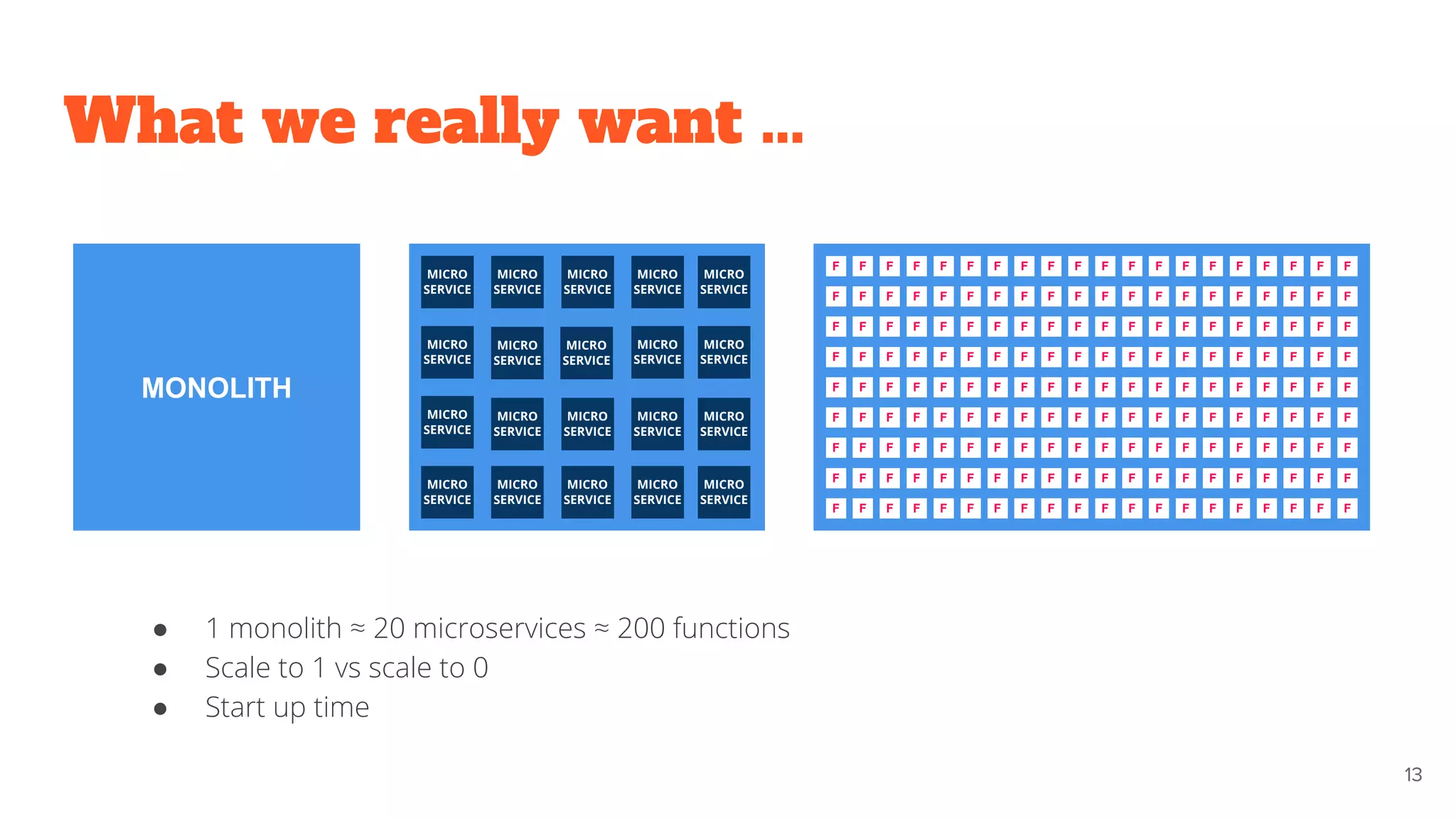
What we really want ...
13
● 1 monolith ≈ 20 microservices ≈ 200 functions
● Scale to 1 vs scale to 0
● Start up time
MONOLITH
MICRO
SERVICE
MICRO
SERVICE
MICRO
SERVICE
MICRO
SERVICE
MICRO
SERVICE
MICRO
SERVICE
MICRO
SERVICE
MICRO
SERVICE
MICRO
SERVICE
MICRO
SERVICE
MICRO
SERVICE
MICRO
SERVICE
MICRO
SERVICE
MICRO
SERVICE
MICRO
SERVICE
MICRO
SERVICE
MICRO
SERVICE
MICRO
SERVICE
MICRO
SERVICE
MICRO
SERVICE
F FFFFFFFFF
F FFFFFFFFF
F FFFFFFFFF
F FFFFFFFFF
F FFFFFFFFF
F FFFFFFFFF
F FFFFFFFFF
F FFFFFFFFF
F FFFFFFFFF
F FFFFFFFFF
F FFFFFFFFF
F FFFFFFFFF
F FFFFFFFFF
F FFFFFFFFF
F FFFFFFFFF
F FFFFFFFFF
F FFFFFFFFF
F FFFFFFFFF
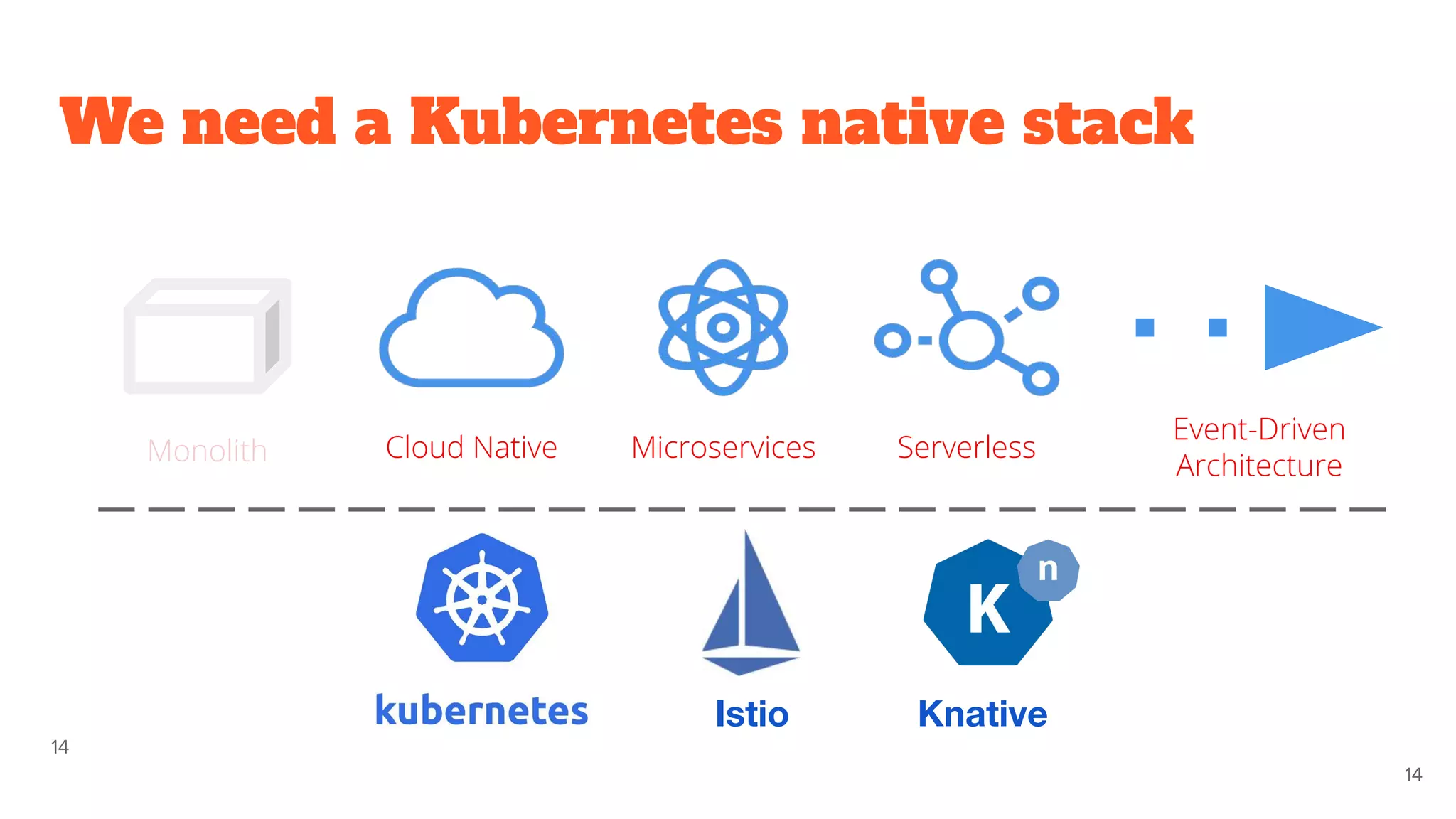
We need a Kubernetes native stack
14
14
Monolith Cloud Native Microservices Serverless
Event-Driven
Architecture
Istio Knative
It starts with the JVM
● Linux container aware JVM efforts
○ Memory utilisation
○ Processor utilisation
● OpenJDK evolved to work better with Linux Containers
○ Shenandoah GC
● Eclipse OpenJ9 performance improvements
○ JIT-as-a-Service
● Compiled Java?
○ gcj
○ … Dalvik?
○ Avian
○ Excelsior JET
○ GraalVM
● JVM improvements are necessary but not sufficient 15
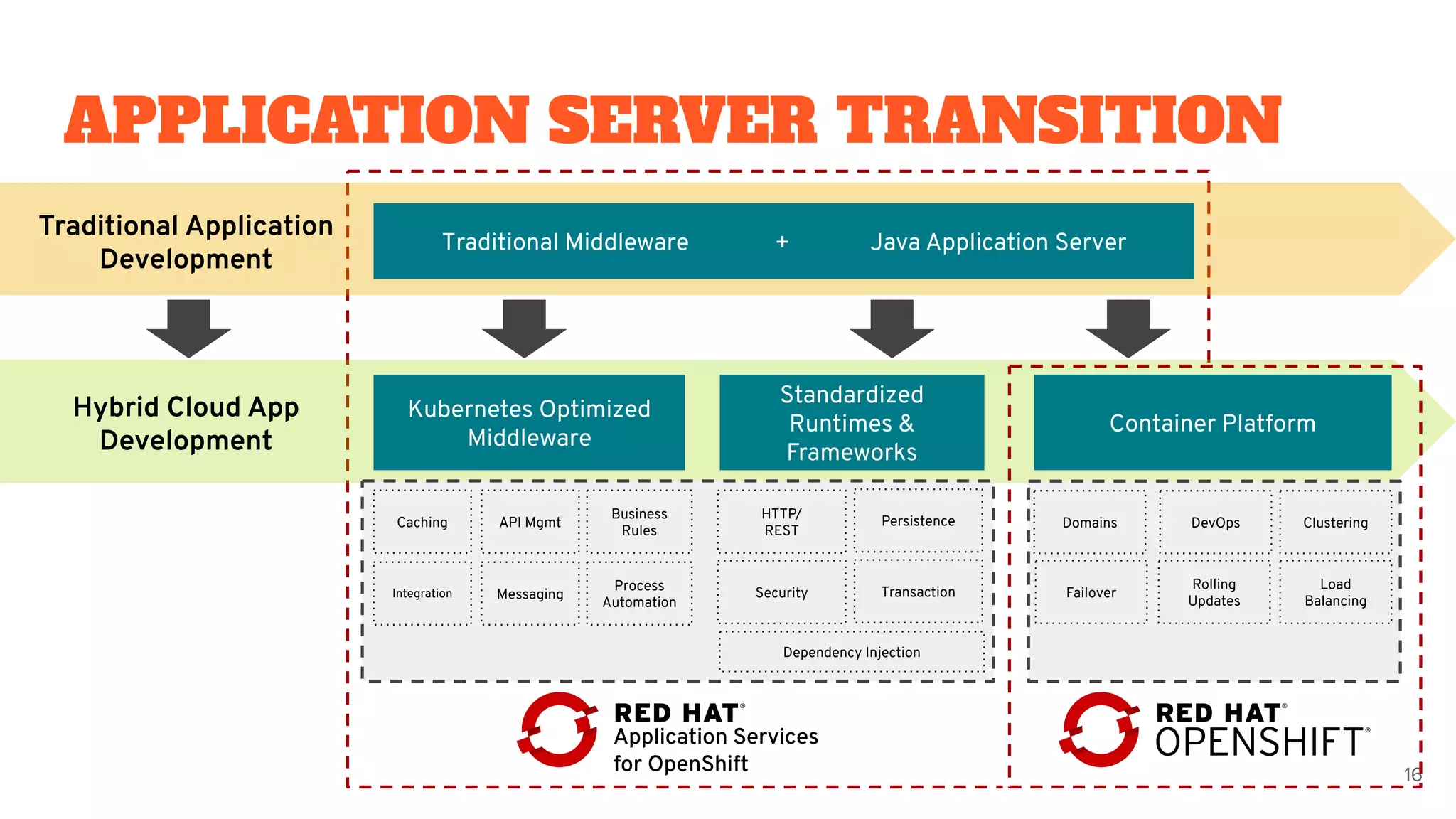
APPLICATION SERVER TRANSITION
16
Traditional Application
Development
Standardized
Runtimes &
Frameworks
Kubernetes Optimized
Middleware
Application Services
for OpenShift
Hybrid Cloud App
Development
Container Platform
Caching API Mgmt
Business
Rules
HTTP/
REST
Persistence
Process
Automation
Integration Messaging TransactionSecurity
Dependency Injection
Domains DevOps Clustering
Load
Balancing
Failover
Rolling
Updates
Traditional Middleware + Java Application Server
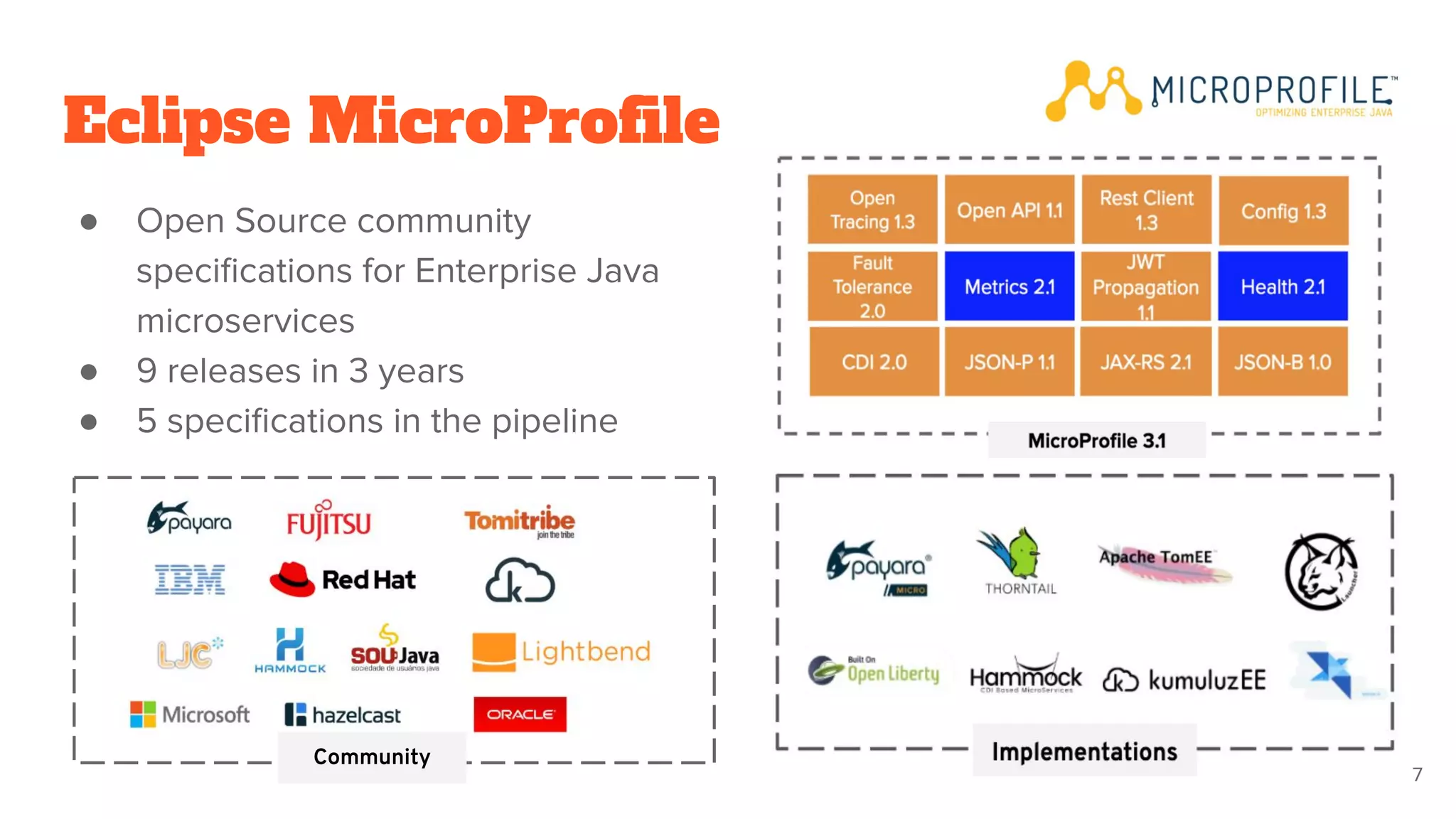
Eclipse MicroProfile
● Open Source community
specifications for Enterprise Java
microservices
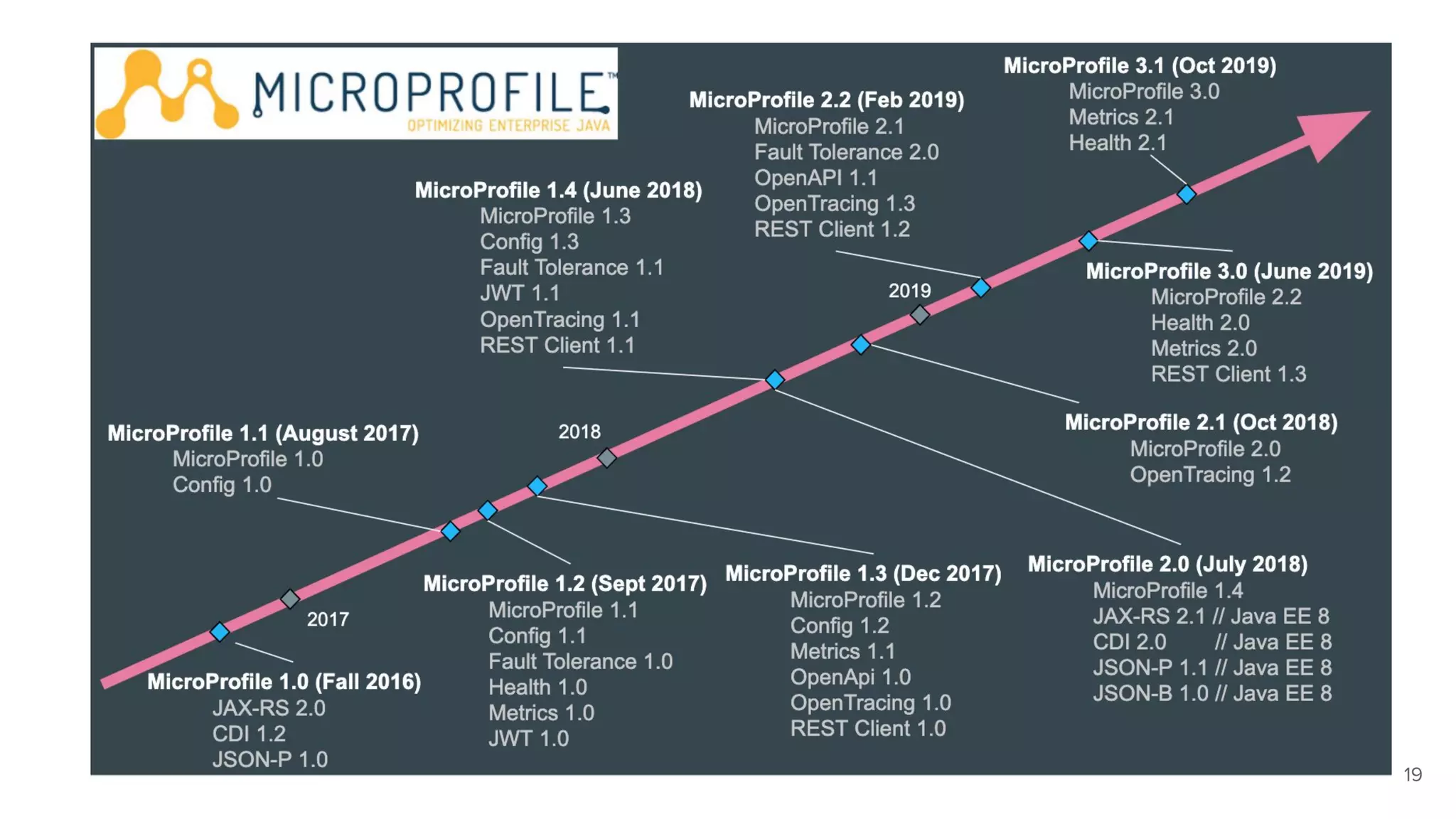
● 9 releases in 3 years
● 5 specifications in the pipeline
17
Community
Image
19
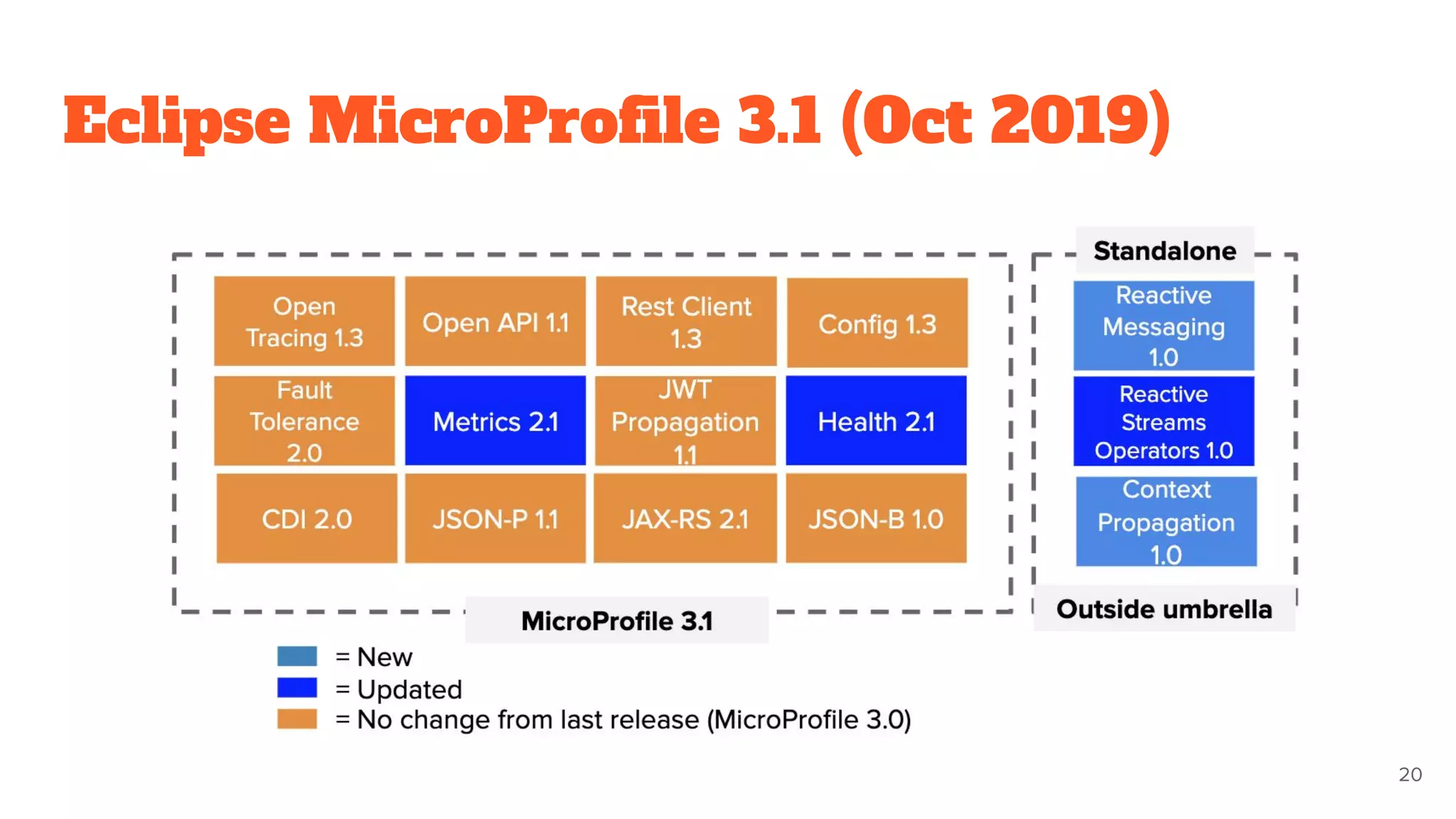
Eclipse MicroProfile 3.1 (Oct 2019)
20
Roadmap items
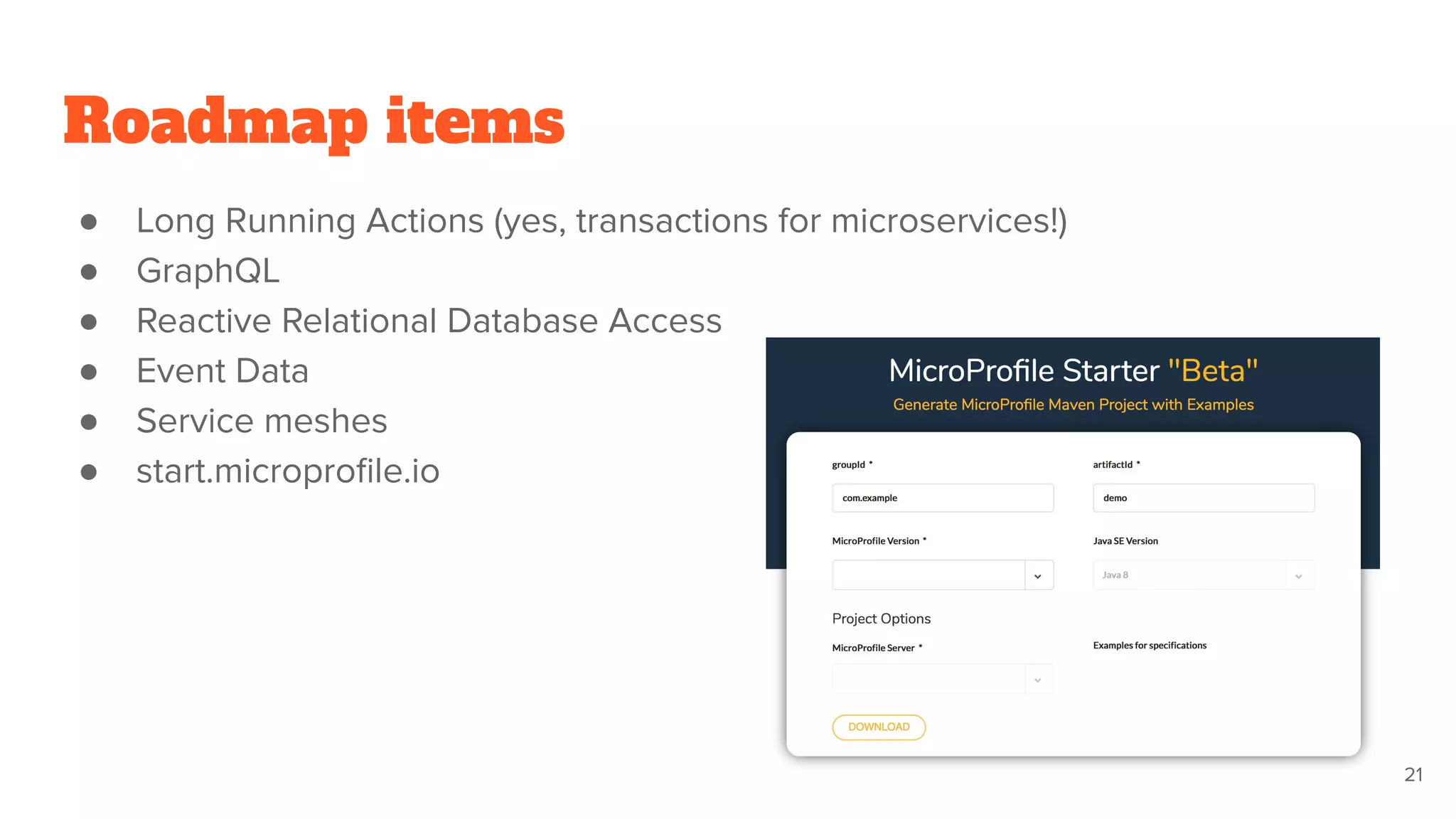
● Long Running Actions (yes, transactions for microservices!)
● GraphQL
● Reactive Relational Database Access
● Event Data
● Service meshes
● start.microprofile.io
21
22
Image
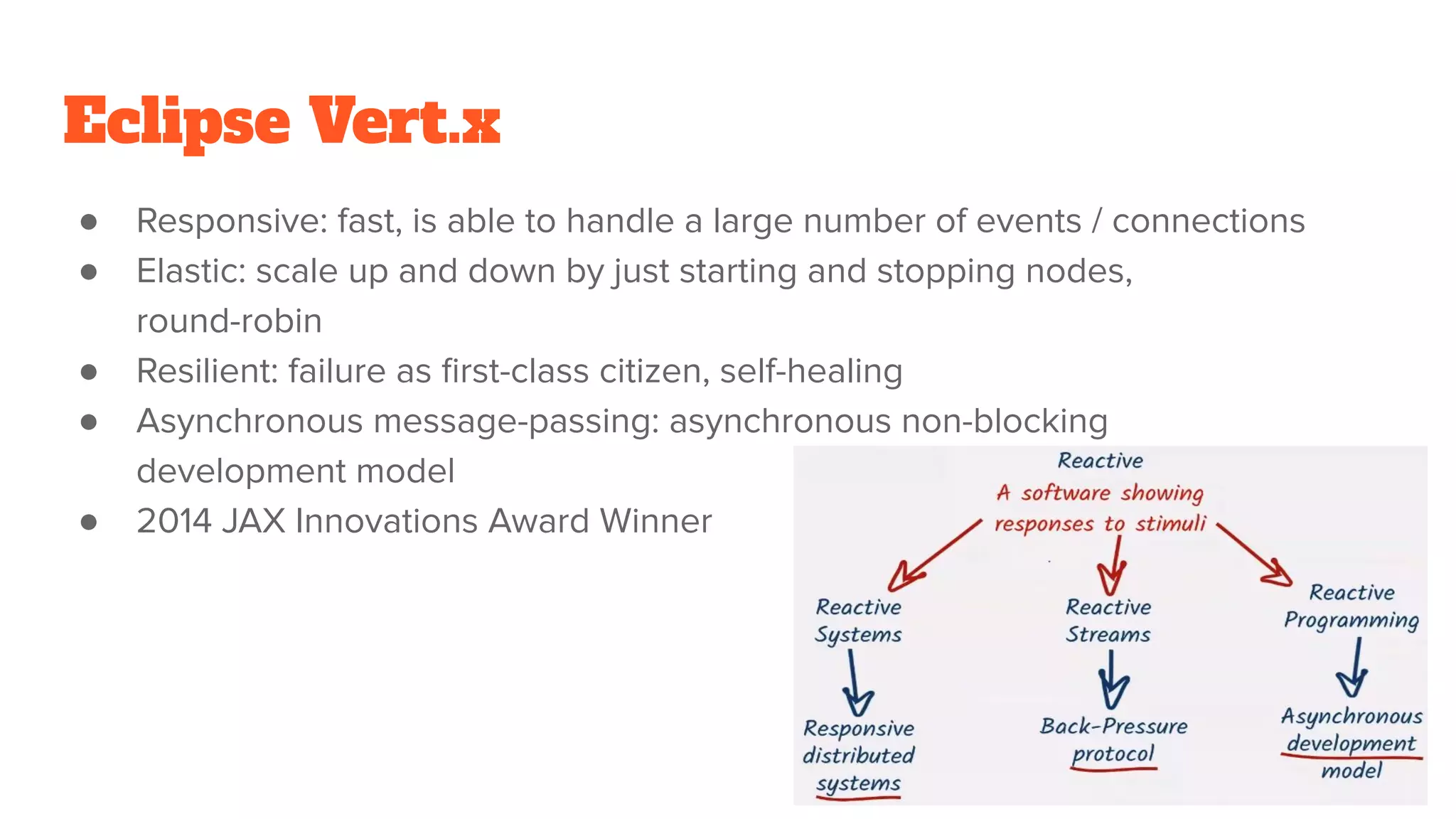
Eclipse Vert.x
● Responsive: fast, is able to handle a large number of events / connections
● Elastic: scale up and down by just starting and stopping nodes,
round-robin
● Resilient: failure as first-class citizen, self-healing
● Asynchronous message-passing: asynchronous non-blocking
development model
● 2014 JAX Innovations Award Winner
24
25
26
WHAT IS QUARKUS?
QUARK: elementary particle / US: hardest thing in computer science
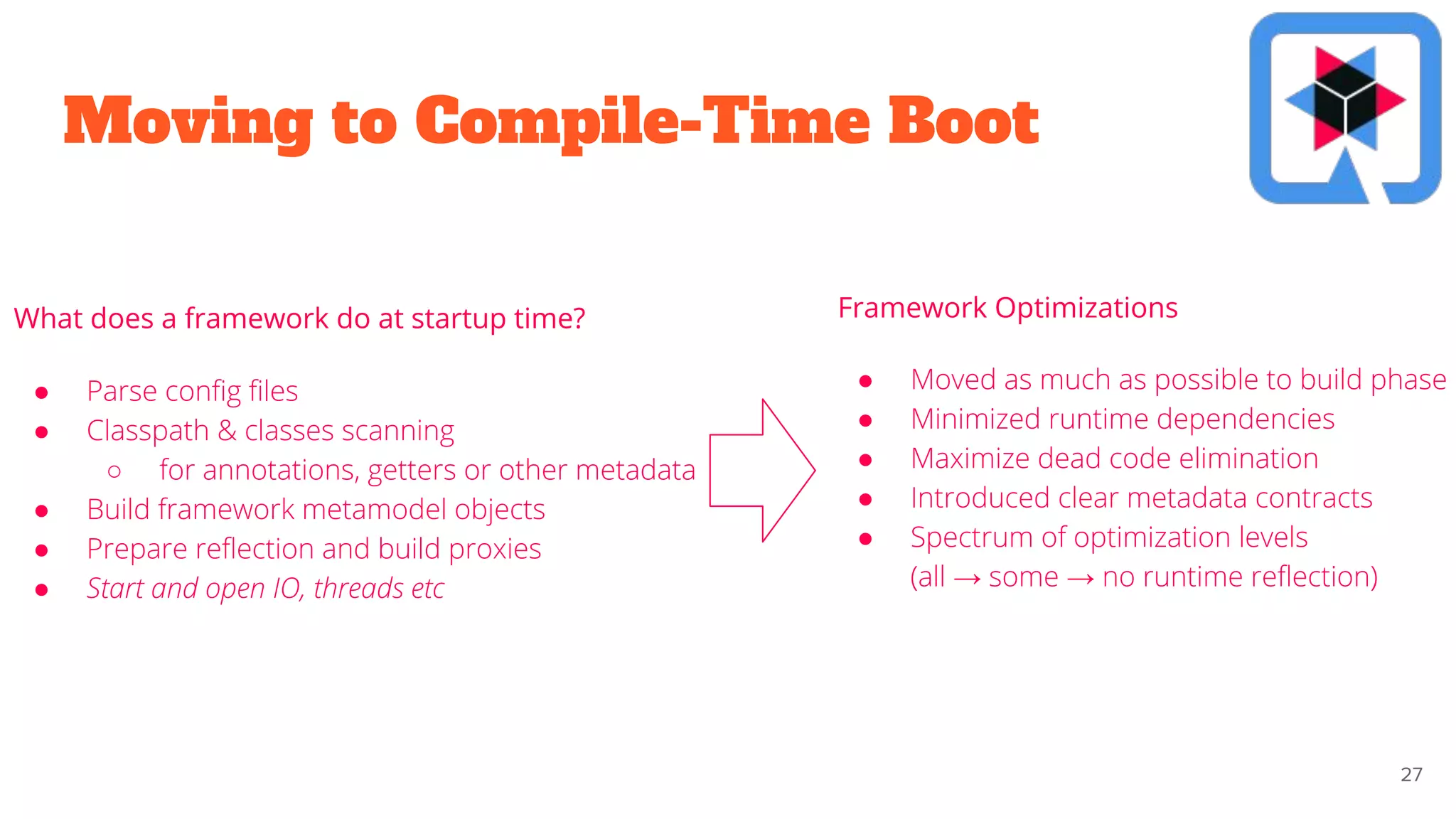
Moving to Compile-Time Boot
27
What does a framework do at startup time?
● Parse config files
● Classpath & classes scanning
○ for annotations, getters or other metadata
● Build framework metamodel objects
● Prepare reflection and build proxies
● Start and open IO, threads etc
● Moved as much as possible to build phase
● Minimized runtime dependencies
● Maximize dead code elimination
● Introduced clear metadata contracts
● Spectrum of optimization levels
(all → some → no runtime reflection)
Framework Optimizations
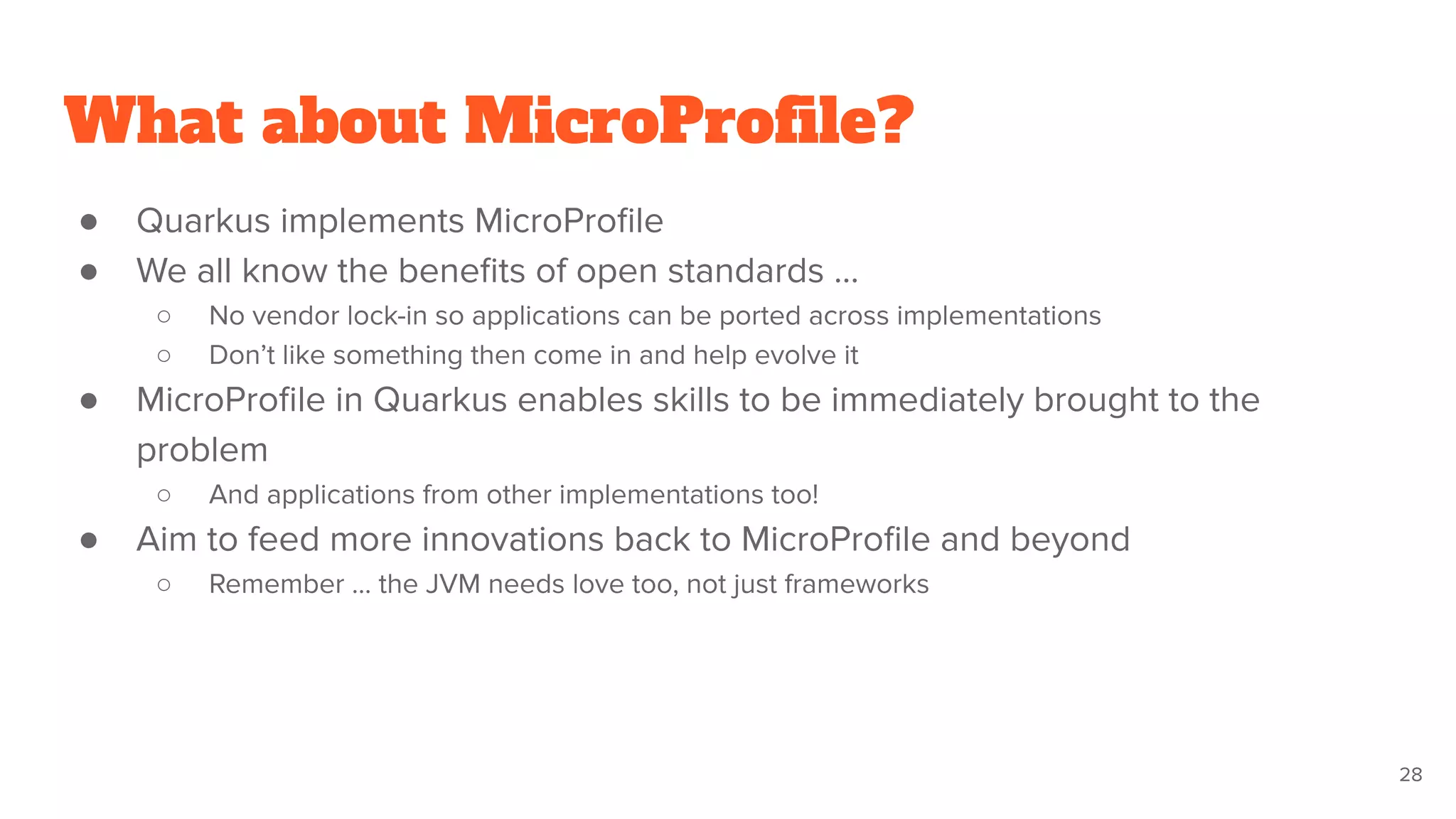
What about MicroProfile?
● Quarkus implements MicroProfile
● We all know the benefits of open standards …
○ No vendor lock-in so applications can be ported across implementations
○ Don’t like something then come in and help evolve it
● MicroProfile in Quarkus enables skills to be immediately brought to the
problem
○ And applications from other implementations too!
● Aim to feed more innovations back to MicroProfile and beyond
○ Remember … the JVM needs love too, not just frameworks
28
29
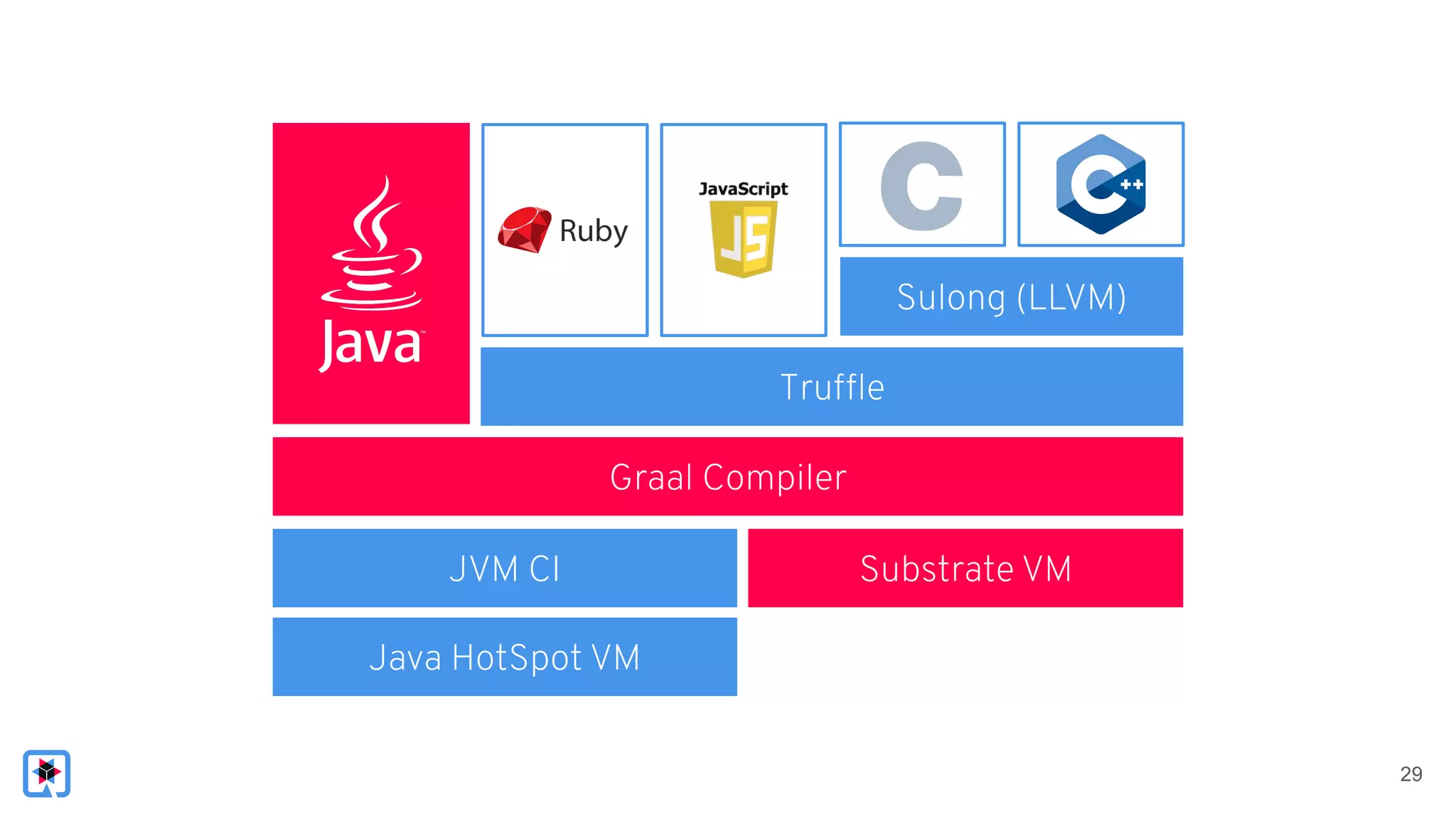
JVM CI
Sulong (LLVM)
Truffle
Graal Compiler
Substrate VM
Java HotSpot VM
Benefit No. 1: Developer Joy
30
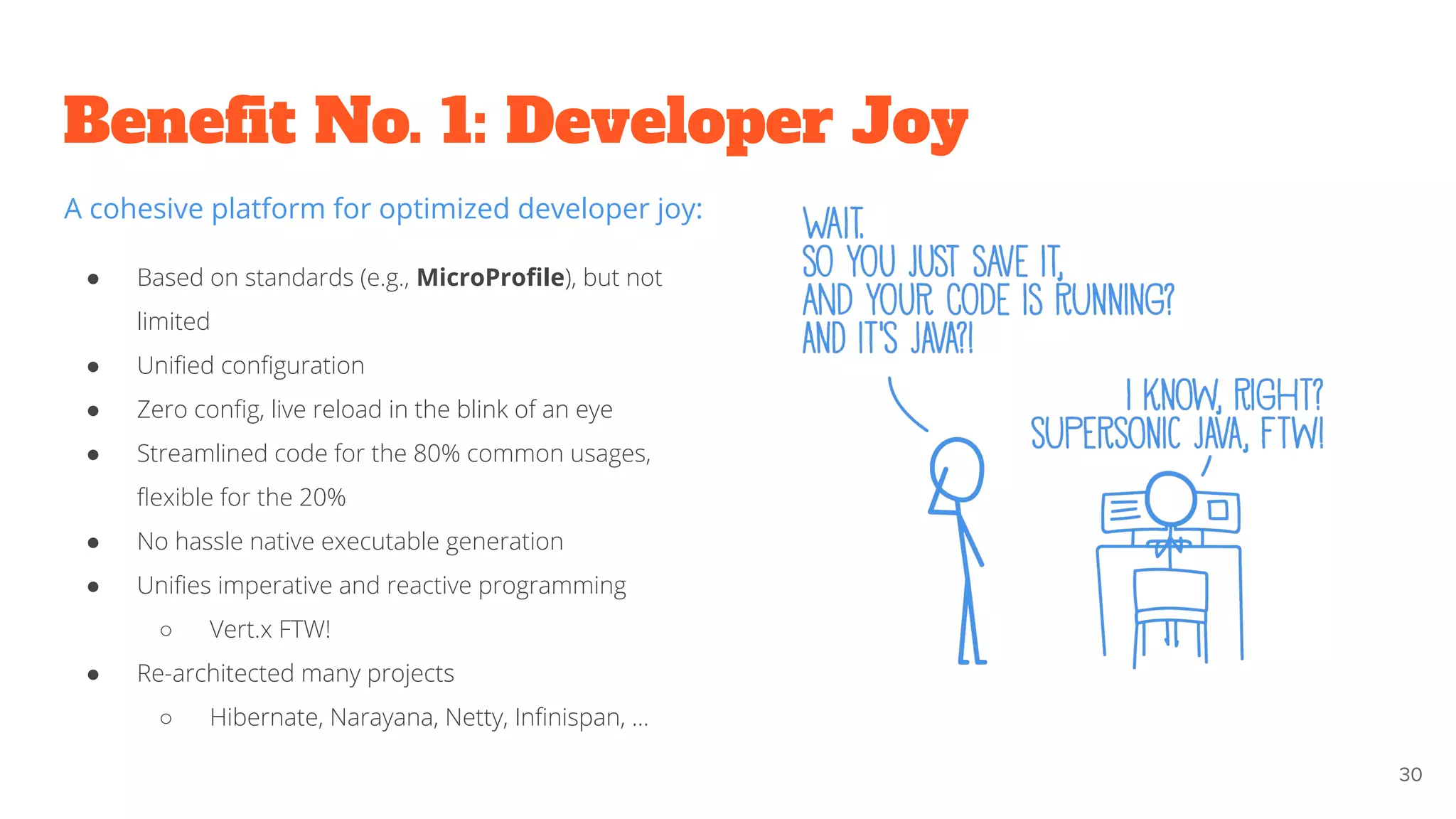
A cohesive platform for optimized developer joy:
● Based on standards (e.g., MicroProfile), but not
limited
● Unified configuration
● Zero config, live reload in the blink of an eye
● Streamlined code for the 80% common usages,
flexible for the 20%
● No hassle native executable generation
● Unifies imperative and reactive programming
○ Vert.x FTW!
● Re-architected many projects
○ Hibernate, Narayana, Netty, Infinispan, ...
Benefit No. 2: Supersonic Subatomic Java
31
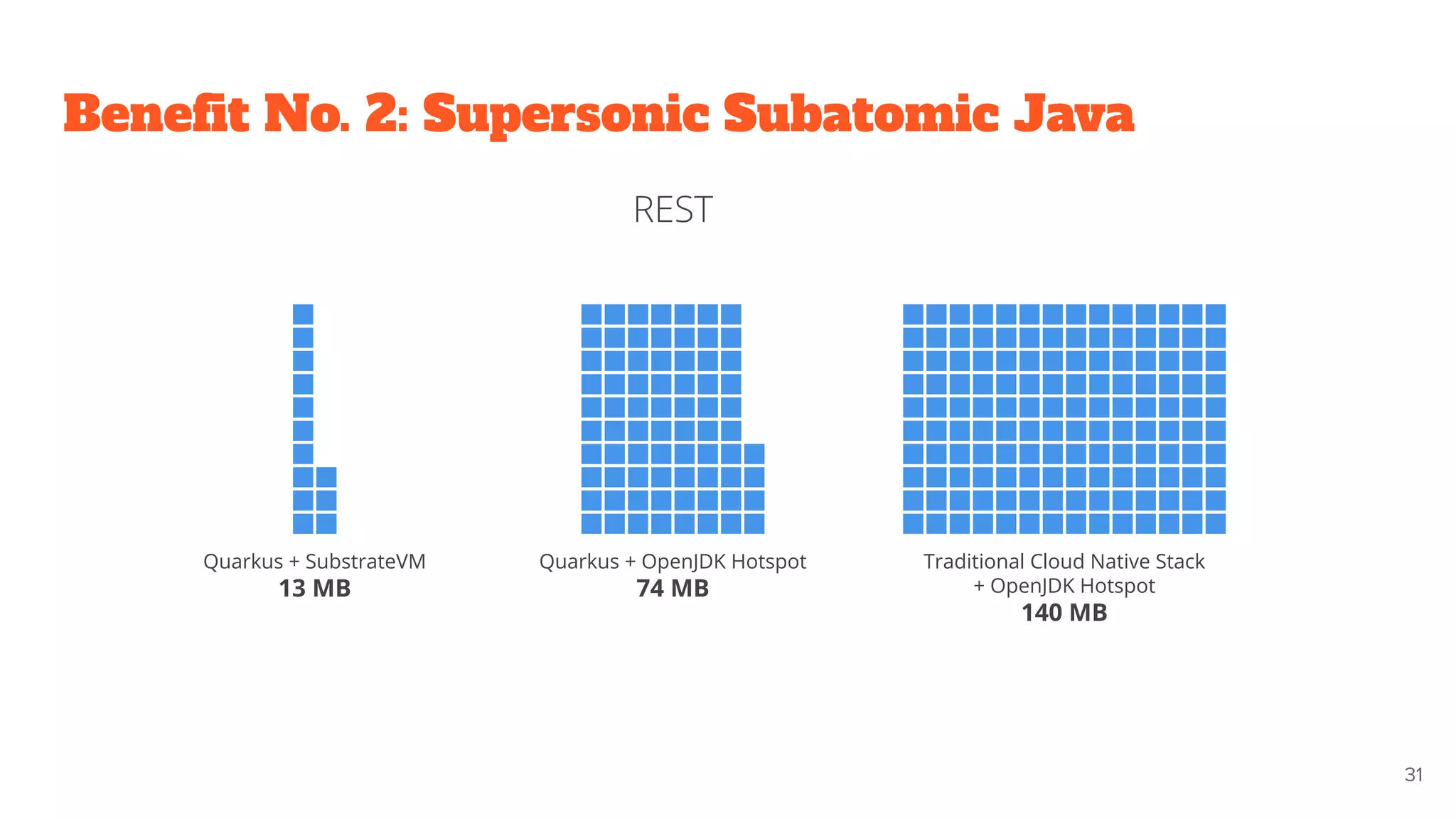
Quarkus + SubstrateVM
13 MB
Quarkus + OpenJDK Hotspot
74 MB
Traditional Cloud Native Stack
+ OpenJDK Hotspot
140 MB
REST
Benefit No. 2: Supersonic Subatomic Java
32
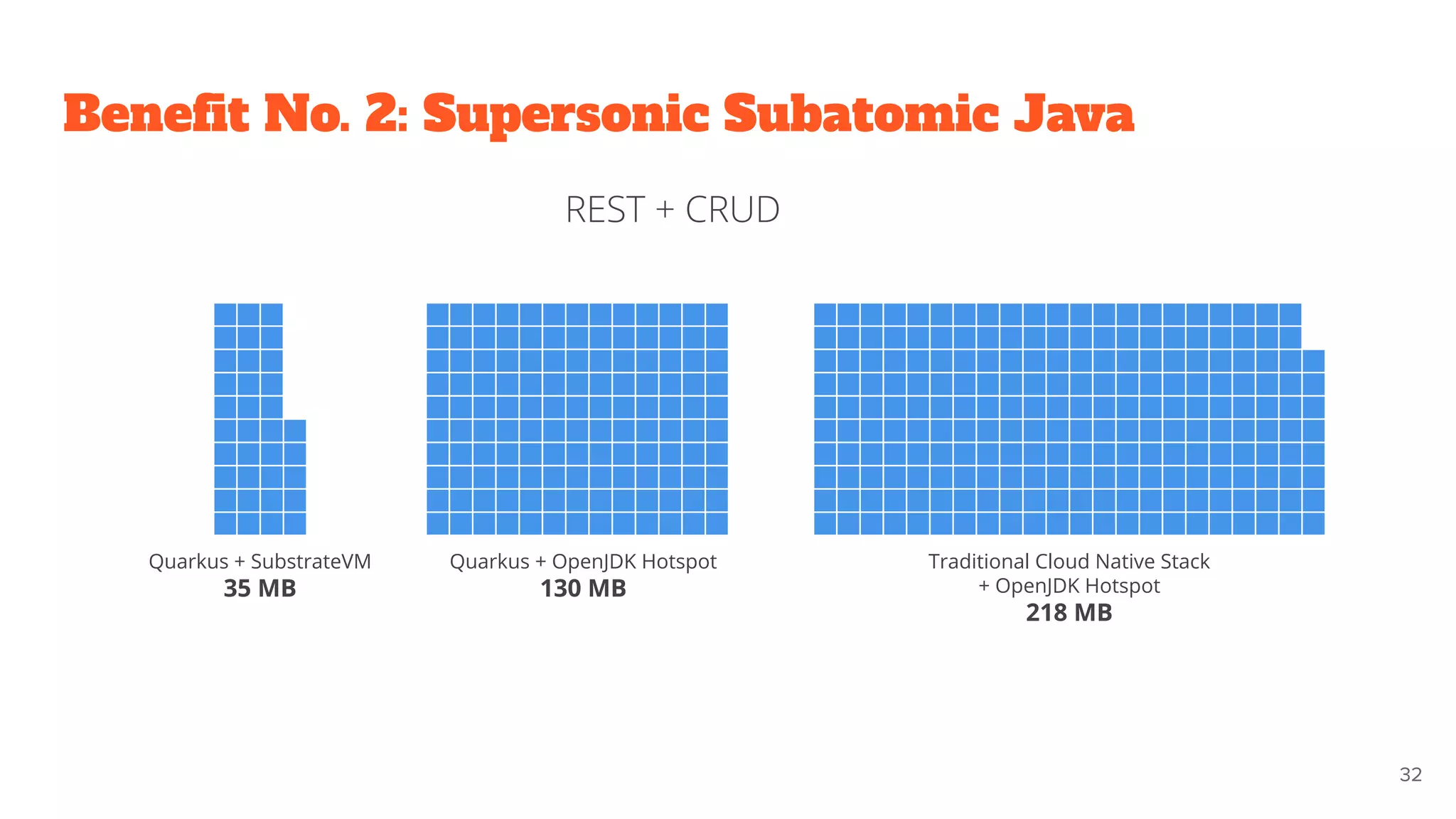
REST + CRUD
Quarkus + SubstrateVM
35 MB
Quarkus + OpenJDK Hotspot
130 MB
Traditional Cloud Native Stack
+ OpenJDK Hotspot
218 MB
Benefit No. 2: Supersonic Subatomic Java
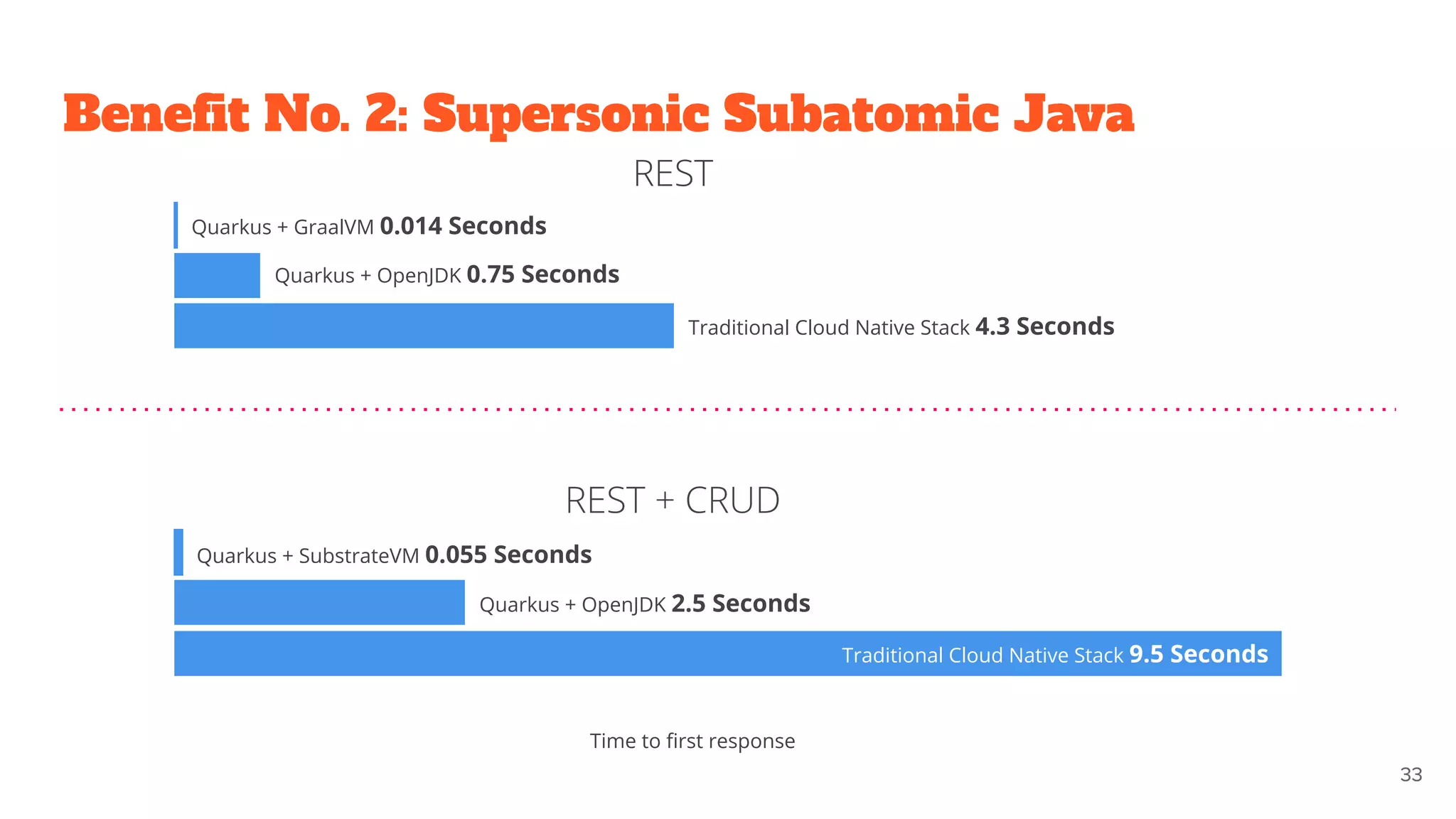
3333Boot + First Response Time (in seconds)
Quarkus + GraalVM 0.014 Seconds
REST
REST + CRUD
Quarkus + OpenJDK 0.75 Seconds
Quarkus + SubstrateVM 0.055 Seconds
Quarkus + OpenJDK 2.5 Seconds
Traditional Cloud Native Stack 9.5 Seconds
Traditional Cloud Native Stack 4.3 Seconds
Time to first response
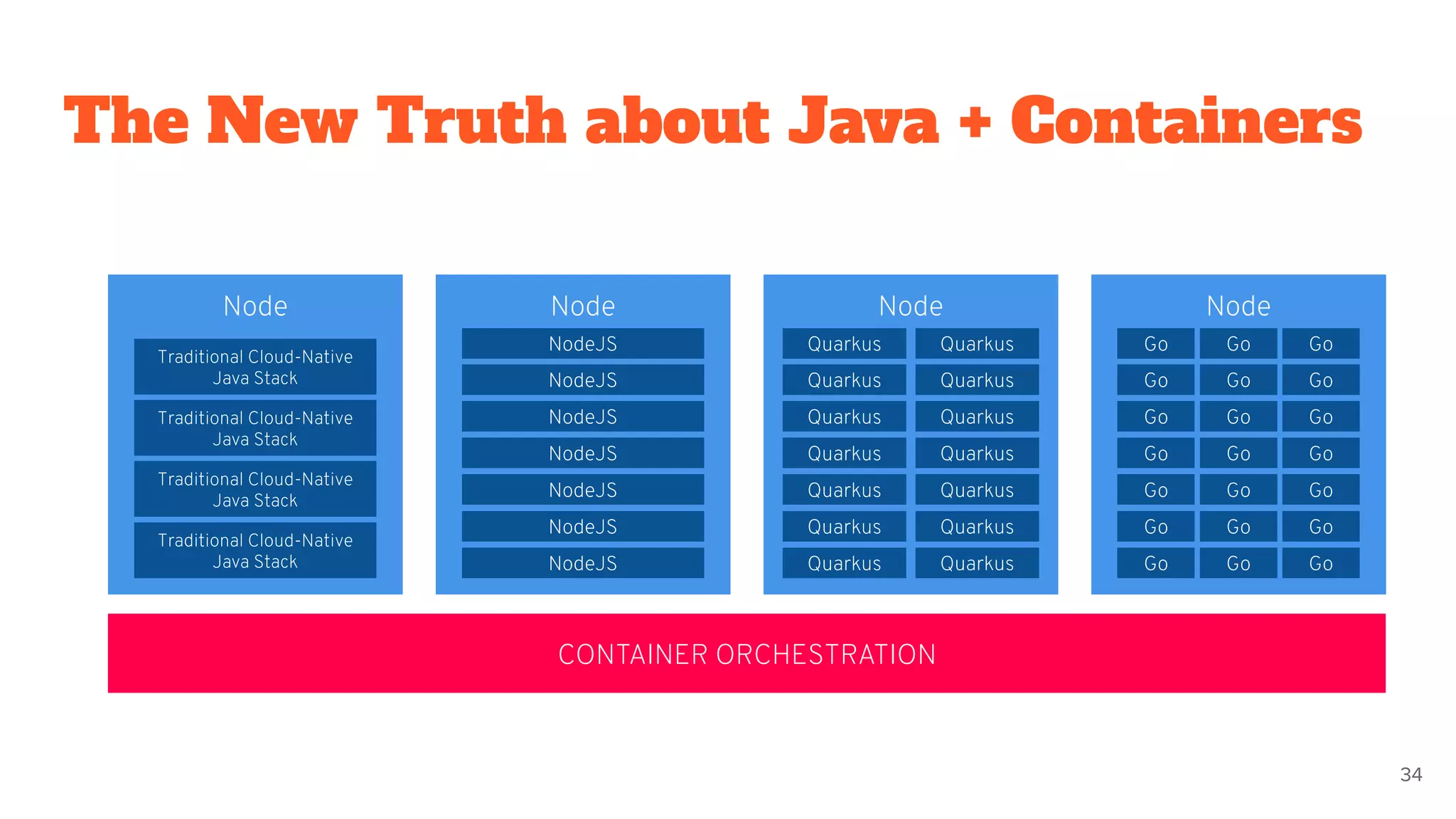
The New Truth about Java + Containers
34
CONTAINER ORCHESTRATION
NodeNode
Traditional Cloud-Native
Java Stack
Traditional Cloud-Native
Java Stack
Traditional Cloud-Native
Java Stack
Traditional Cloud-Native
Java Stack
Node
NodeJS
NodeJS
NodeJS
NodeJS
NodeJS
NodeJS
NodeJS
Go Go Go
Go Go Go
Go Go Go
Go Go Go
Go Go Go
Go Go Go
Go Go Go
Node
Quarkus
Quarkus
Quarkus
Quarkus
Quarkus
Quarkus
Quarkus
Quarkus
Quarkus
Quarkus
Quarkus
Quarkus
Quarkus
Quarkus
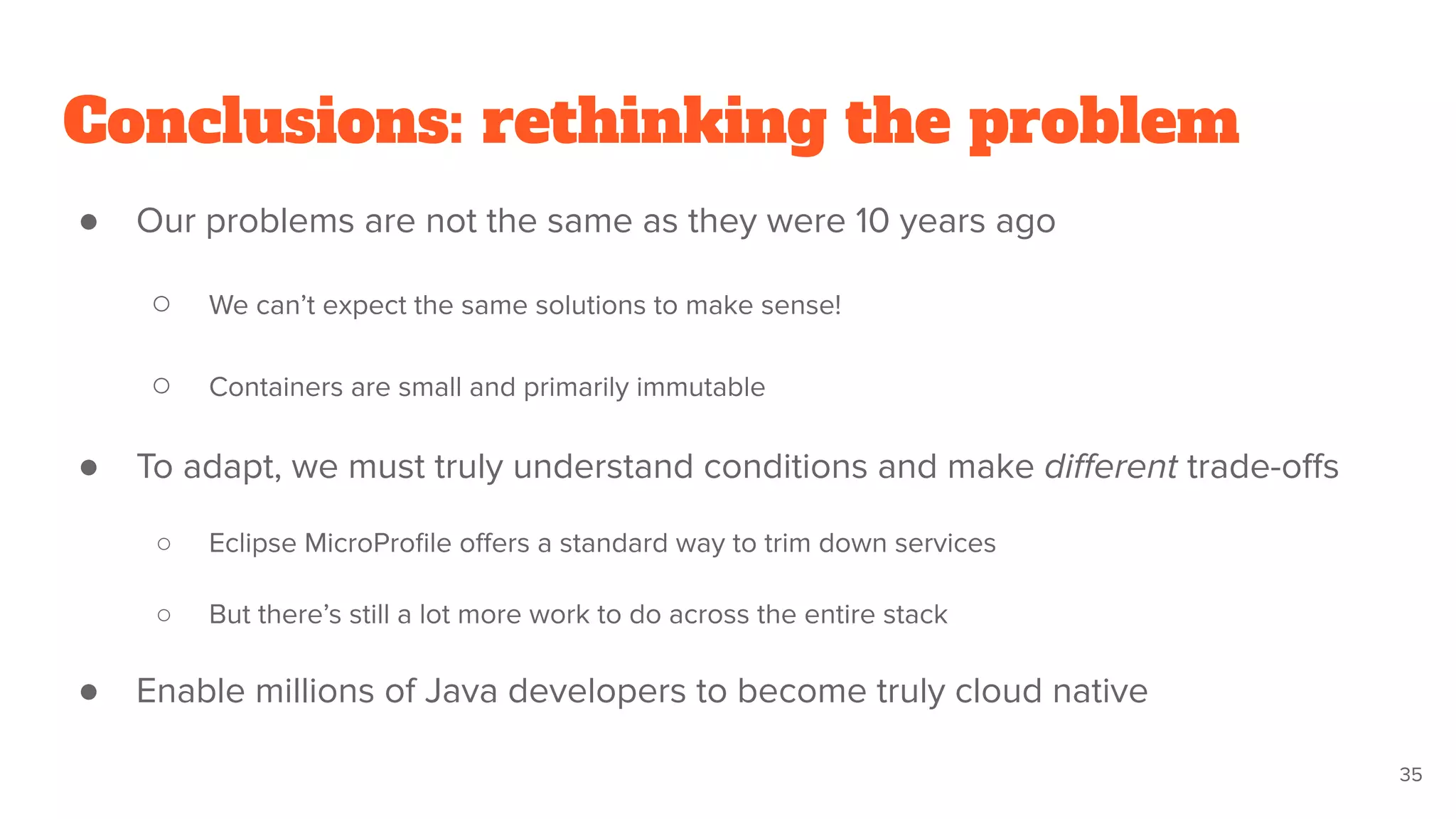
Conclusions: rethinking the problem
● Our problems are not the same as they were 10 years ago
○ We can’t expect the same solutions to make sense!
○ Containers are small and primarily immutable
● To adapt, we must truly understand conditions and make different trade-offs
○ Eclipse MicroProfile offers a standard way to trim down services
○ But there’s still a lot more work to do across the entire stack
● Enable millions of Java developers to become truly cloud native
35

Kubernetes Native Java and Eclipse MicroProfile | EclipseCon Europe 2019

  • 1.
    RED HAT Kubernetes NativeJava and Eclipse MicroProfile (plus other things) Mark Little, VP Engineering, Red Hat
  • 2.
    Who am I? ●Research into fault-tolerant distributed systems since 1986 ○ Arjuna, Argus, Isis/Horus, Emerald, Xerox, … ○ DCE, DCOM, CORBA, HTTP, Web Services, … ● Implemented world’s first 100% Java transaction service in 1995 ○ Yes, we’re still using it today! ● Active in OMG, OASIS, W3C, JCP, GGF and others ○ Co-author of a number of specifications and standards ● Visiting Professor at Newcastle and Lyon ● Industry ... ○ Various startups ○ Bluestone Distinguished Engineer, HP Distinguished Engineer ○ JBoss CTO in 2009 ● These days spend far too much time on conference calls, meetings etc! 2
  • 3.
    Overview ● Why Javain the age of Kubernetes and Linux Containers? ○ Java is dead, right? ● Why did Enterprise Java need to change? ○ Kubernetes and Immutability ○ Incompatibilities with Java and Application Containers ● Eclipse MicroProfile ○ Eclipse Jakarta EE ● Quarkus and principles behind it may be a game changer ○ Optimised for immutable architectures ○ Can work in constrained environments, e.g., low memory footprint 3
  • 4.
    Why is Javastill important? ● Still a de-facto language for enterprise developers* ● Large skills base (7-10 million Java devs.)** ● Large and diverse ecosystem ○ Amazon, Fujitsu, Google, IBM, Microsoft, Netflix, Oracle, Pivotal, Red Hat, … ● Large, resilient community ● Much more than just the language! ● The innovation continues ○ Eclipse MicroProfile ○ Eclipse Jakarta EE ○ Java SE faster schedule ○ SubstrateVM 4 Sources: *Tiobe Index : https://www.tiobe.com/tiobe-index/ * IEEE Spectrum : https://spectrum.ieee.org/static/interactive-the-top-programming-languages-2018 I** SlashData - 7.6 million active Java developers (State of Developer Nation, 16th Edition, Q4 2018)
  • 5.
    Historical Enterprise JavaStack 5 Operating System + Hardware/VM Java Virtual Machine (Hotspot) Application Server App App App App App Dynamic Application Frameworks Architecture: Monoliths Deployment: multi-app, appserver App Lifecycle: Months Memory: 1GB+ RAM Startup Time: 10s of sec
  • 6.
    And then alongcame ... 6
  • 7.
    Monoliths are Evil?Microservices ..? 7
  • 8.
  • 9.
    And then …Kubernetes ● Open source project from Google ● The de facto standard for cluster management for Linux containers ● Packages Orchestration, service discovery, load balancing ○ All behind a simple REST API ● Immutable architectures 9
  • 10.
    The “Java Problem” ●Designed for throughput at the expense of footprint ● Intended to be long running, less focus on startup speed ● Rich dynamic behavior built around mutable bare-metal systems ○ … yet Linux containers are primarily immutable ○ … frameworks and stacks built to leverage key Java capabilities such as dynamism ● Java is trying to pivot (JPMS, AOT, Graal, etc) ○ … but architectural changes to frameworks are required to truly benefit 10
  • 11.
    11 Container platform Node NodeJS NodeJS NodeJS NodeJS NodeJS NodeJS NodeJS Node Go Go GoGo Go Go Go Go Go Go Go Go Go Go Node HotSpot Heap HotSpot Heap HotSpot Heap HotSpot Heap
  • 12.
    Why footprint mattersin the cloud ● Memory is more important than throughput on containers ○ It’s more expensive (requires permanence), unlike CPU cycles ● Microservices multiply overhead cost ○ One app becomes N microservices (e.g. 20 microservices ~= 20GB today!) ● If we do nothing Java alternatives will take over (eventually) ○ Go, Python, Node, PHP, Rust etc. do not have this problem 12
  • 13.
    What we reallywant ... 13 ● 1 monolith ≈ 20 microservices ≈ 200 functions ● Scale to 1 vs scale to 0 ● Start up time MONOLITH MICRO SERVICE MICRO SERVICE MICRO SERVICE MICRO SERVICE MICRO SERVICE MICRO SERVICE MICRO SERVICE MICRO SERVICE MICRO SERVICE MICRO SERVICE MICRO SERVICE MICRO SERVICE MICRO SERVICE MICRO SERVICE MICRO SERVICE MICRO SERVICE MICRO SERVICE MICRO SERVICE MICRO SERVICE MICRO SERVICE F FFFFFFFFF F FFFFFFFFF F FFFFFFFFF F FFFFFFFFF F FFFFFFFFF F FFFFFFFFF F FFFFFFFFF F FFFFFFFFF F FFFFFFFFF F FFFFFFFFF F FFFFFFFFF F FFFFFFFFF F FFFFFFFFF F FFFFFFFFF F FFFFFFFFF F FFFFFFFFF F FFFFFFFFF F FFFFFFFFF
  • 14.
    We need aKubernetes native stack 14 14 Monolith Cloud Native Microservices Serverless Event-Driven Architecture Istio Knative
  • 15.
    It starts withthe JVM ● Linux container aware JVM efforts ○ Memory utilisation ○ Processor utilisation ● OpenJDK evolved to work better with Linux Containers ○ Shenandoah GC ● Eclipse OpenJ9 performance improvements ○ JIT-as-a-Service ● Compiled Java? ○ gcj ○ … Dalvik? ○ Avian ○ Excelsior JET ○ GraalVM ● JVM improvements are necessary but not sufficient 15
  • 16.
    APPLICATION SERVER TRANSITION 16 TraditionalApplication Development Standardized Runtimes & Frameworks Kubernetes Optimized Middleware Application Services for OpenShift Hybrid Cloud App Development Container Platform Caching API Mgmt Business Rules HTTP/ REST Persistence Process Automation Integration Messaging TransactionSecurity Dependency Injection Domains DevOps Clustering Load Balancing Failover Rolling Updates Traditional Middleware + Java Application Server
  • 17.
    Eclipse MicroProfile ● OpenSource community specifications for Enterprise Java microservices ● 9 releases in 3 years ● 5 specifications in the pipeline 17 Community
  • 19.
  • 20.
  • 21.
    Roadmap items ● LongRunning Actions (yes, transactions for microservices!) ● GraphQL ● Reactive Relational Database Access ● Event Data ● Service meshes ● start.microprofile.io 21
  • 22.
  • 24.
    Eclipse Vert.x ● Responsive:fast, is able to handle a large number of events / connections ● Elastic: scale up and down by just starting and stopping nodes, round-robin ● Resilient: failure as first-class citizen, self-healing ● Asynchronous message-passing: asynchronous non-blocking development model ● 2014 JAX Innovations Award Winner 24
  • 25.
  • 26.
    26 WHAT IS QUARKUS? QUARK:elementary particle / US: hardest thing in computer science
  • 27.
    Moving to Compile-TimeBoot 27 What does a framework do at startup time? ● Parse config files ● Classpath & classes scanning ○ for annotations, getters or other metadata ● Build framework metamodel objects ● Prepare reflection and build proxies ● Start and open IO, threads etc ● Moved as much as possible to build phase ● Minimized runtime dependencies ● Maximize dead code elimination ● Introduced clear metadata contracts ● Spectrum of optimization levels (all → some → no runtime reflection) Framework Optimizations
  • 28.
    What about MicroProfile? ●Quarkus implements MicroProfile ● We all know the benefits of open standards … ○ No vendor lock-in so applications can be ported across implementations ○ Don’t like something then come in and help evolve it ● MicroProfile in Quarkus enables skills to be immediately brought to the problem ○ And applications from other implementations too! ● Aim to feed more innovations back to MicroProfile and beyond ○ Remember … the JVM needs love too, not just frameworks 28
  • 29.
    29 JVM CI Sulong (LLVM) Truffle GraalCompiler Substrate VM Java HotSpot VM
  • 30.
    Benefit No. 1:Developer Joy 30 A cohesive platform for optimized developer joy: ● Based on standards (e.g., MicroProfile), but not limited ● Unified configuration ● Zero config, live reload in the blink of an eye ● Streamlined code for the 80% common usages, flexible for the 20% ● No hassle native executable generation ● Unifies imperative and reactive programming ○ Vert.x FTW! ● Re-architected many projects ○ Hibernate, Narayana, Netty, Infinispan, ...
  • 31.
    Benefit No. 2:Supersonic Subatomic Java 31 Quarkus + SubstrateVM 13 MB Quarkus + OpenJDK Hotspot 74 MB Traditional Cloud Native Stack + OpenJDK Hotspot 140 MB REST
  • 32.
    Benefit No. 2:Supersonic Subatomic Java 32 REST + CRUD Quarkus + SubstrateVM 35 MB Quarkus + OpenJDK Hotspot 130 MB Traditional Cloud Native Stack + OpenJDK Hotspot 218 MB
  • 33.
    Benefit No. 2:Supersonic Subatomic Java 3333Boot + First Response Time (in seconds) Quarkus + GraalVM 0.014 Seconds REST REST + CRUD Quarkus + OpenJDK 0.75 Seconds Quarkus + SubstrateVM 0.055 Seconds Quarkus + OpenJDK 2.5 Seconds Traditional Cloud Native Stack 9.5 Seconds Traditional Cloud Native Stack 4.3 Seconds Time to first response
  • 34.
    The New Truthabout Java + Containers 34 CONTAINER ORCHESTRATION NodeNode Traditional Cloud-Native Java Stack Traditional Cloud-Native Java Stack Traditional Cloud-Native Java Stack Traditional Cloud-Native Java Stack Node NodeJS NodeJS NodeJS NodeJS NodeJS NodeJS NodeJS Go Go Go Go Go Go Go Go Go Go Go Go Go Go Go Go Go Go Go Go Go Node Quarkus Quarkus Quarkus Quarkus Quarkus Quarkus Quarkus Quarkus Quarkus Quarkus Quarkus Quarkus Quarkus Quarkus
  • 35.
    Conclusions: rethinking theproblem ● Our problems are not the same as they were 10 years ago ○ We can’t expect the same solutions to make sense! ○ Containers are small and primarily immutable ● To adapt, we must truly understand conditions and make different trade-offs ○ Eclipse MicroProfile offers a standard way to trim down services ○ But there’s still a lot more work to do across the entire stack ● Enable millions of Java developers to become truly cloud native 35