The Model Context Protocol (MCP): 2025 Overview of
Status, Adoption, Risks, and Governance Framework
https://modelcontextprotocol.io/docs/getting-started/intro
1. Overview and Current Status of MCP
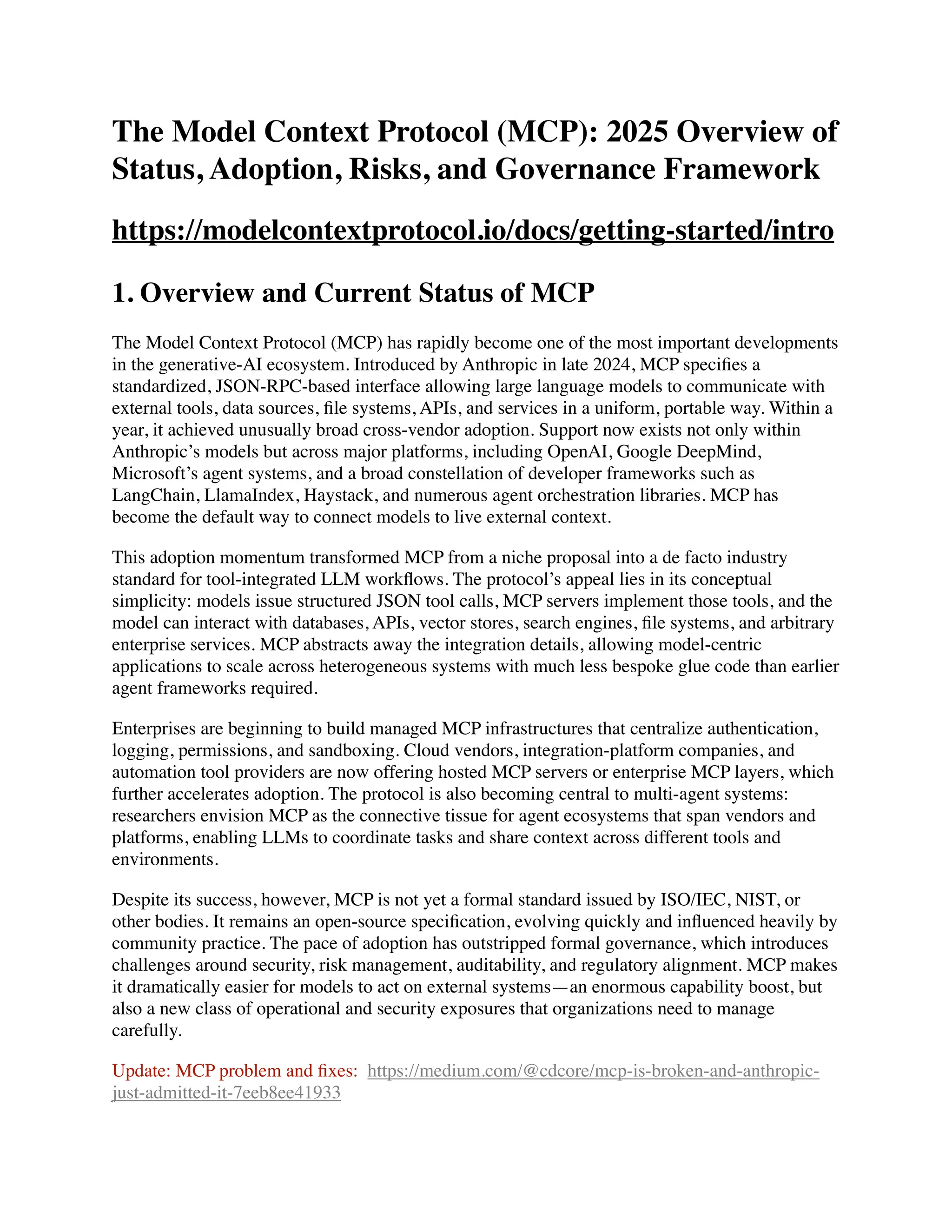
The Model Context Protocol (MCP) has rapidly become one of the most important developments
in the generative-AI ecosystem. Introduced by Anthropic in late 2024, MCP speci
fi
es a
standardized, JSON-RPC-based interface allowing large language models to communicate with
external tools, data sources,
fi
le systems, APIs, and services in a uniform, portable way. Within a
year, it achieved unusually broad cross-vendor adoption. Support now exists not only within
Anthropic’s models but across major platforms, including OpenAI, Google DeepMind,
Microsoft’s agent systems, and a broad constellation of developer frameworks such as
LangChain, LlamaIndex, Haystack, and numerous agent orchestration libraries. MCP has
become the default way to connect models to live external context.
This adoption momentum transformed MCP from a niche proposal into a de facto industry
standard for tool-integrated LLM work
fl
ows. The protocol’s appeal lies in its conceptual
simplicity: models issue structured JSON tool calls, MCP servers implement those tools, and the
model can interact with databases, APIs, vector stores, search engines,
fi
le systems, and arbitrary
enterprise services. MCP abstracts away the integration details, allowing model-centric
applications to scale across heterogeneous systems with much less bespoke glue code than earlier
agent frameworks required.
Enterprises are beginning to build managed MCP infrastructures that centralize authentication,
logging, permissions, and sandboxing. Cloud vendors, integration-platform companies, and
automation tool providers are now offering hosted MCP servers or enterprise MCP layers, which
further accelerates adoption. The protocol is also becoming central to multi-agent systems:
researchers envision MCP as the connective tissue for agent ecosystems that span vendors and
platforms, enabling LLMs to coordinate tasks and share context across different tools and
environments.
Despite its success, however, MCP is not yet a formal standard issued by ISO/IEC, NIST, or
other bodies. It remains an open-source speci
fi
cation, evolving quickly and in
fl
uenced heavily by
community practice. The pace of adoption has outstripped formal governance, which introduces
challenges around security, risk management, auditability, and regulatory alignment. MCP makes
it dramatically easier for models to act on external systems—an enormous capability boost, but
also a new class of operational and security exposures that organizations need to manage
carefully.
Update: MCP problem and
fi
xes: https://medium.com/@cdcore/mcp-is-broken-and-anthropic-
just-admitted-it-7eeb8ee41933
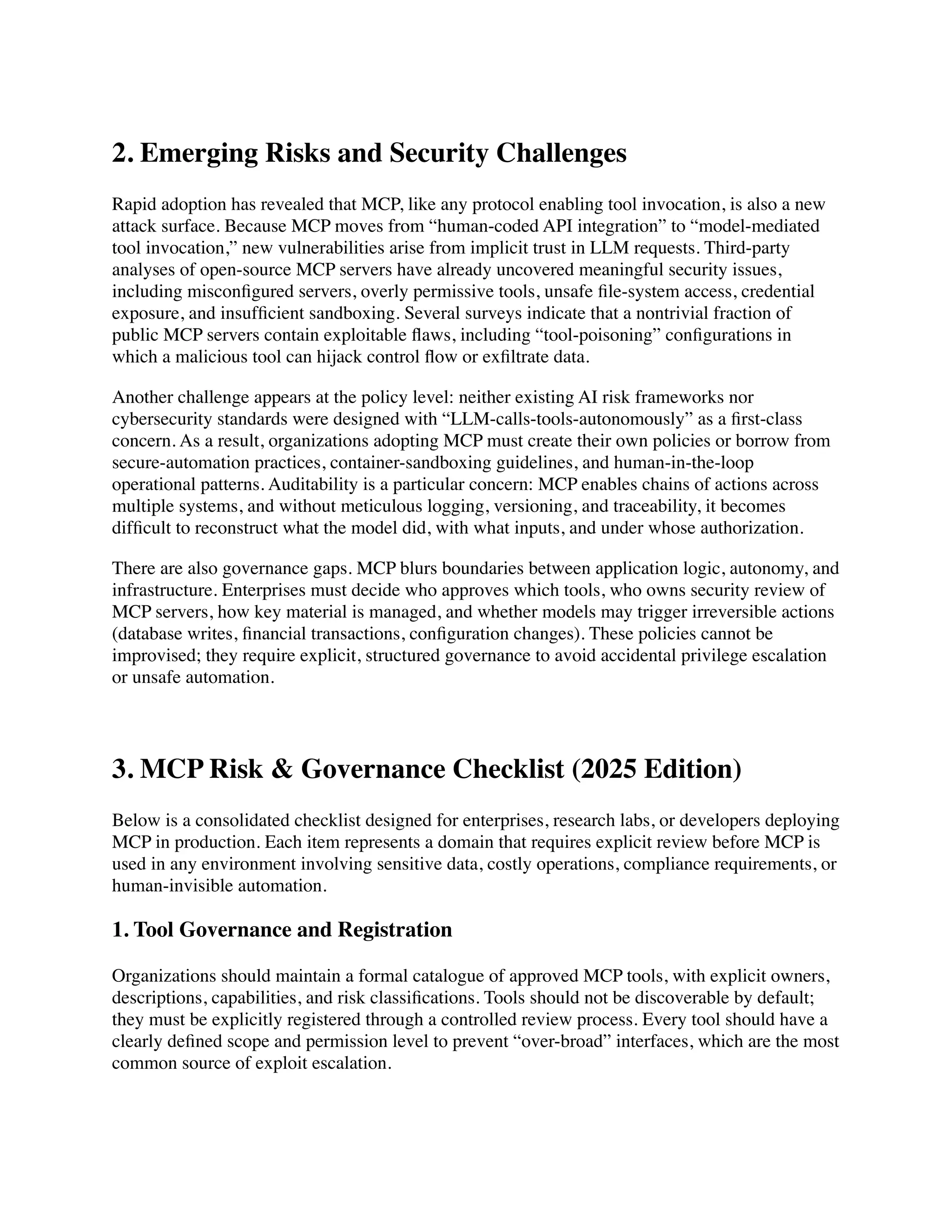
2. Emerging Risks and Security Challenges
Rapid adoption has revealed that MCP, like any protocol enabling tool invocation, is also a new
attack surface. Because MCP moves from “human-coded API integration” to “model-mediated
tool invocation,” new vulnerabilities arise from implicit trust in LLM requests. Third-party
analyses of open-source MCP servers have already uncovered meaningful security issues,
including miscon
fi
gured servers, overly permissive tools, unsafe
fi
le-system access, credential
exposure, and insuf
fi
cient sandboxing. Several surveys indicate that a nontrivial fraction of
public MCP servers contain exploitable
fl
aws, including “tool-poisoning” con
fi
gurations in
which a malicious tool can hijack control
fl
ow or ex
fi
ltrate data.
Another challenge appears at the policy level: neither existing AI risk frameworks nor
cybersecurity standards were designed with “LLM-calls-tools-autonomously” as a
fi
rst-class
concern. As a result, organizations adopting MCP must create their own policies or borrow from
secure-automation practices, container-sandboxing guidelines, and human-in-the-loop
operational patterns. Auditability is a particular concern: MCP enables chains of actions across
multiple systems, and without meticulous logging, versioning, and traceability, it becomes
dif
fi
cult to reconstruct what the model did, with what inputs, and under whose authorization.
There are also governance gaps. MCP blurs boundaries between application logic, autonomy, and
infrastructure. Enterprises must decide who approves which tools, who owns security review of
MCP servers, how key material is managed, and whether models may trigger irreversible actions
(database writes,
fi
nancial transactions, con
fi
guration changes). These policies cannot be
improvised; they require explicit, structured governance to avoid accidental privilege escalation
or unsafe automation.
3. MCP Risk & Governance Checklist (2025 Edition)
Below is a consolidated checklist designed for enterprises, research labs, or developers deploying
MCP in production. Each item represents a domain that requires explicit review before MCP is
used in any environment involving sensitive data, costly operations, compliance requirements, or
human-invisible automation.
1. Tool Governance and Registration
Organizations should maintain a formal catalogue of approved MCP tools, with explicit owners,
descriptions, capabilities, and risk classi
fi
cations. Tools should not be discoverable by default;
they must be explicitly registered through a controlled review process. Every tool should have a
clearly de
fi
ned scope and permission level to prevent “over-broad” interfaces, which are the most
common source of exploit escalation.
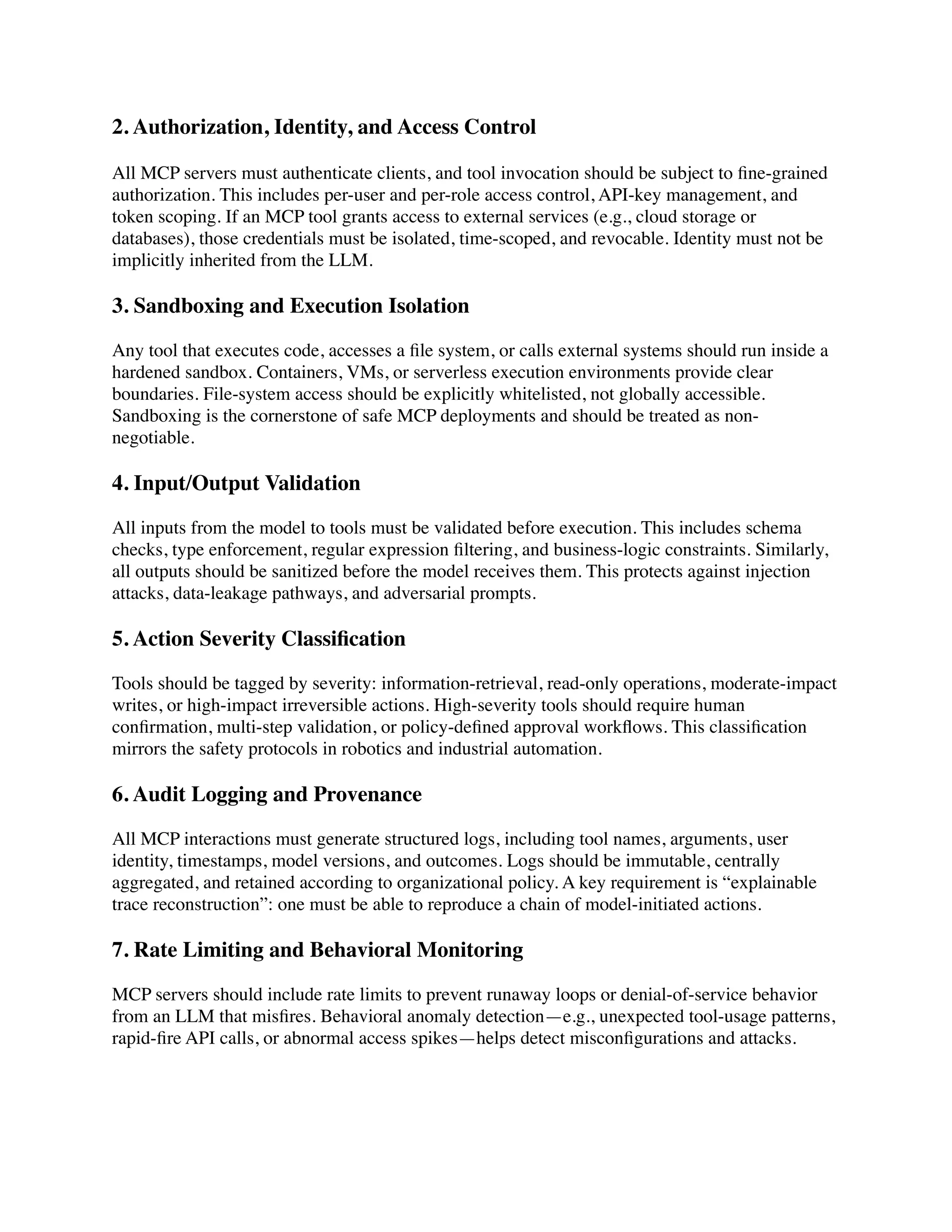
2. Authorization, Identity, and Access Control
All MCP servers must authenticate clients, and tool invocation should be subject to
fi
ne-grained
authorization. This includes per-user and per-role access control, API-key management, and
token scoping. If an MCP tool grants access to external services (e.g., cloud storage or
databases), those credentials must be isolated, time-scoped, and revocable. Identity must not be
implicitly inherited from the LLM.
3. Sandboxing and Execution Isolation
Any tool that executes code, accesses a
fi
le system, or calls external systems should run inside a
hardened sandbox. Containers, VMs, or serverless execution environments provide clear
boundaries. File-system access should be explicitly whitelisted, not globally accessible.
Sandboxing is the cornerstone of safe MCP deployments and should be treated as non-
negotiable.
4. Input/Output Validation
All inputs from the model to tools must be validated before execution. This includes schema
checks, type enforcement, regular expression
fi
ltering, and business-logic constraints. Similarly,
all outputs should be sanitized before the model receives them. This protects against injection
attacks, data-leakage pathways, and adversarial prompts.
5. Action Severity Classi
fi
cation
Tools should be tagged by severity: information-retrieval, read-only operations, moderate-impact
writes, or high-impact irreversible actions. High-severity tools should require human
con
fi
rmation, multi-step validation, or policy-de
fi
ned approval work
fl
ows. This classi
fi
cation
mirrors the safety protocols in robotics and industrial automation.
6. Audit Logging and Provenance
All MCP interactions must generate structured logs, including tool names, arguments, user
identity, timestamps, model versions, and outcomes. Logs should be immutable, centrally
aggregated, and retained according to organizational policy. A key requirement is “explainable
trace reconstruction”: one must be able to reproduce a chain of model-initiated actions.
7. Rate Limiting and Behavioral Monitoring
MCP servers should include rate limits to prevent runaway loops or denial-of-service behavior
from an LLM that mis
fi
res. Behavioral anomaly detection—e.g., unexpected tool-usage patterns,
rapid-
fi
re API calls, or abnormal access spikes—helps detect miscon
fi
gurations and attacks.
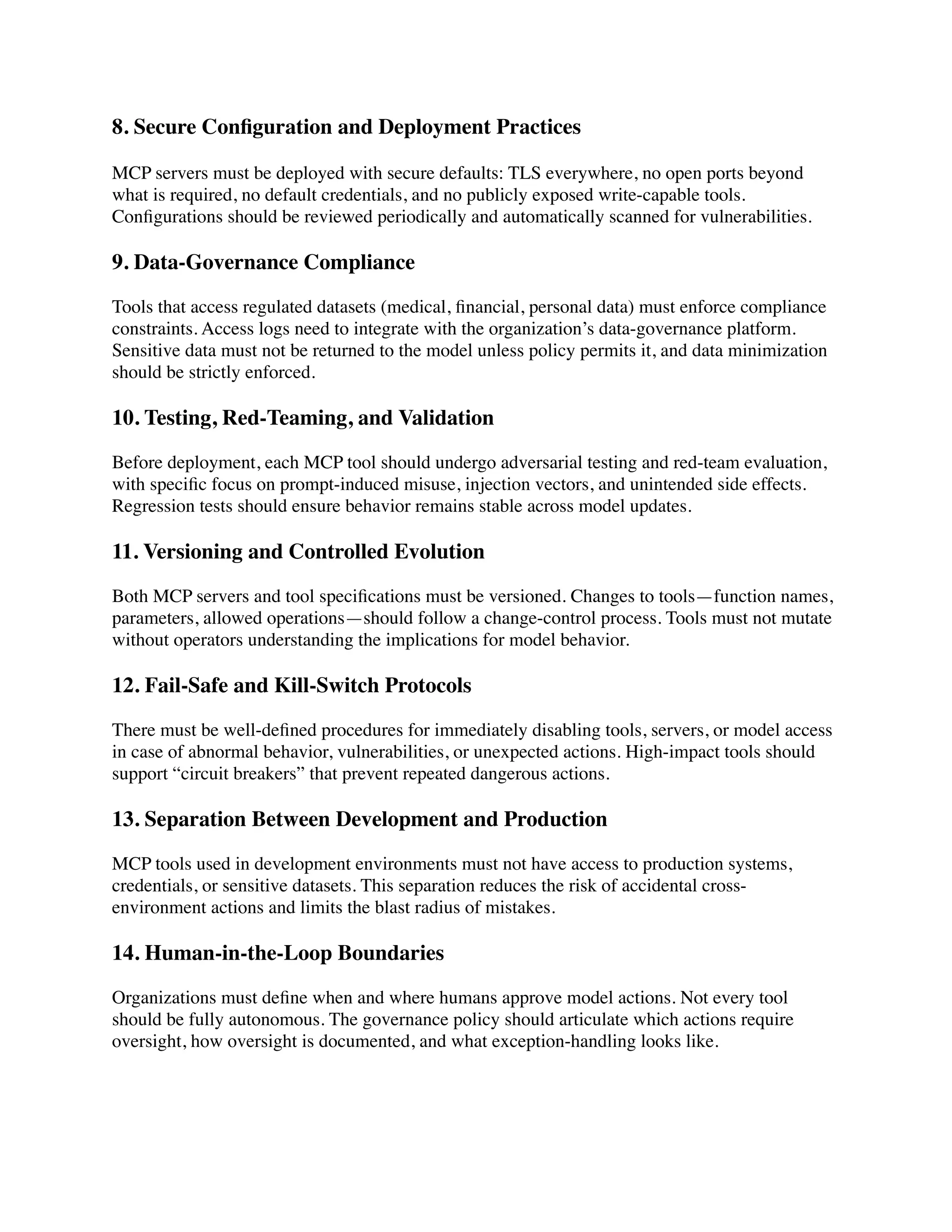
8. Secure Con
fi
guration and Deployment Practices
MCP servers must be deployed with secure defaults: TLS everywhere, no open ports beyond
what is required, no default credentials, and no publicly exposed write-capable tools.
Con
fi
gurations should be reviewed periodically and automatically scanned for vulnerabilities.
9. Data-Governance Compliance
Tools that access regulated datasets (medical,
fi
nancial, personal data) must enforce compliance
constraints. Access logs need to integrate with the organization’s data-governance platform.
Sensitive data must not be returned to the model unless policy permits it, and data minimization
should be strictly enforced.
10. Testing, Red-Teaming, and Validation
Before deployment, each MCP tool should undergo adversarial testing and red-team evaluation,
with speci
fi
c focus on prompt-induced misuse, injection vectors, and unintended side effects.
Regression tests should ensure behavior remains stable across model updates.
11. Versioning and Controlled Evolution
Both MCP servers and tool speci
fi
cations must be versioned. Changes to tools—function names,
parameters, allowed operations—should follow a change-control process. Tools must not mutate
without operators understanding the implications for model behavior.
12. Fail-Safe and Kill-Switch Protocols
There must be well-de
fi
ned procedures for immediately disabling tools, servers, or model access
in case of abnormal behavior, vulnerabilities, or unexpected actions. High-impact tools should
support “circuit breakers” that prevent repeated dangerous actions.
13. Separation Between Development and Production
MCP tools used in development environments must not have access to production systems,
credentials, or sensitive datasets. This separation reduces the risk of accidental cross-
environment actions and limits the blast radius of mistakes.
14. Human-in-the-Loop Boundaries
Organizations must de
fi
ne when and where humans approve model actions. Not every tool
should be fully autonomous. The governance policy should articulate which actions require
oversight, how oversight is documented, and what exception-handling looks like.
4. Concluding Perspective
The Model Context Protocol is arguably the most important interoperability innovation in the AI
ecosystem since the introduction of function calling. It enables LLMs to act, not just answer.
With that power comes responsibility: MCP dramatically expands what models can do, but also
how they can go wrong. The organizations that gain the most from MCP will be those that pair
its
fl
exibility with disciplined governance, consistent sandboxing, and clear operational policies.
As adoption continues to accelerate, a robust risk-management framework will be essential not
only for safety but for regulatory clarity, incident response, and long-term maintainability.

Overview of the Model Context Protocol (MCP)

  • 1.
    The Model ContextProtocol (MCP): 2025 Overview of Status, Adoption, Risks, and Governance Framework https://modelcontextprotocol.io/docs/getting-started/intro 1. Overview and Current Status of MCP The Model Context Protocol (MCP) has rapidly become one of the most important developments in the generative-AI ecosystem. Introduced by Anthropic in late 2024, MCP speci fi es a standardized, JSON-RPC-based interface allowing large language models to communicate with external tools, data sources, fi le systems, APIs, and services in a uniform, portable way. Within a year, it achieved unusually broad cross-vendor adoption. Support now exists not only within Anthropic’s models but across major platforms, including OpenAI, Google DeepMind, Microsoft’s agent systems, and a broad constellation of developer frameworks such as LangChain, LlamaIndex, Haystack, and numerous agent orchestration libraries. MCP has become the default way to connect models to live external context. This adoption momentum transformed MCP from a niche proposal into a de facto industry standard for tool-integrated LLM work fl ows. The protocol’s appeal lies in its conceptual simplicity: models issue structured JSON tool calls, MCP servers implement those tools, and the model can interact with databases, APIs, vector stores, search engines, fi le systems, and arbitrary enterprise services. MCP abstracts away the integration details, allowing model-centric applications to scale across heterogeneous systems with much less bespoke glue code than earlier agent frameworks required. Enterprises are beginning to build managed MCP infrastructures that centralize authentication, logging, permissions, and sandboxing. Cloud vendors, integration-platform companies, and automation tool providers are now offering hosted MCP servers or enterprise MCP layers, which further accelerates adoption. The protocol is also becoming central to multi-agent systems: researchers envision MCP as the connective tissue for agent ecosystems that span vendors and platforms, enabling LLMs to coordinate tasks and share context across different tools and environments. Despite its success, however, MCP is not yet a formal standard issued by ISO/IEC, NIST, or other bodies. It remains an open-source speci fi cation, evolving quickly and in fl uenced heavily by community practice. The pace of adoption has outstripped formal governance, which introduces challenges around security, risk management, auditability, and regulatory alignment. MCP makes it dramatically easier for models to act on external systems—an enormous capability boost, but also a new class of operational and security exposures that organizations need to manage carefully. Update: MCP problem and fi xes: https://medium.com/@cdcore/mcp-is-broken-and-anthropic- just-admitted-it-7eeb8ee41933
  • 2.
    2. Emerging Risksand Security Challenges Rapid adoption has revealed that MCP, like any protocol enabling tool invocation, is also a new attack surface. Because MCP moves from “human-coded API integration” to “model-mediated tool invocation,” new vulnerabilities arise from implicit trust in LLM requests. Third-party analyses of open-source MCP servers have already uncovered meaningful security issues, including miscon fi gured servers, overly permissive tools, unsafe fi le-system access, credential exposure, and insuf fi cient sandboxing. Several surveys indicate that a nontrivial fraction of public MCP servers contain exploitable fl aws, including “tool-poisoning” con fi gurations in which a malicious tool can hijack control fl ow or ex fi ltrate data. Another challenge appears at the policy level: neither existing AI risk frameworks nor cybersecurity standards were designed with “LLM-calls-tools-autonomously” as a fi rst-class concern. As a result, organizations adopting MCP must create their own policies or borrow from secure-automation practices, container-sandboxing guidelines, and human-in-the-loop operational patterns. Auditability is a particular concern: MCP enables chains of actions across multiple systems, and without meticulous logging, versioning, and traceability, it becomes dif fi cult to reconstruct what the model did, with what inputs, and under whose authorization. There are also governance gaps. MCP blurs boundaries between application logic, autonomy, and infrastructure. Enterprises must decide who approves which tools, who owns security review of MCP servers, how key material is managed, and whether models may trigger irreversible actions (database writes, fi nancial transactions, con fi guration changes). These policies cannot be improvised; they require explicit, structured governance to avoid accidental privilege escalation or unsafe automation. 3. MCP Risk & Governance Checklist (2025 Edition) Below is a consolidated checklist designed for enterprises, research labs, or developers deploying MCP in production. Each item represents a domain that requires explicit review before MCP is used in any environment involving sensitive data, costly operations, compliance requirements, or human-invisible automation. 1. Tool Governance and Registration Organizations should maintain a formal catalogue of approved MCP tools, with explicit owners, descriptions, capabilities, and risk classi fi cations. Tools should not be discoverable by default; they must be explicitly registered through a controlled review process. Every tool should have a clearly de fi ned scope and permission level to prevent “over-broad” interfaces, which are the most common source of exploit escalation.
  • 3.
    2. Authorization, Identity,and Access Control All MCP servers must authenticate clients, and tool invocation should be subject to fi ne-grained authorization. This includes per-user and per-role access control, API-key management, and token scoping. If an MCP tool grants access to external services (e.g., cloud storage or databases), those credentials must be isolated, time-scoped, and revocable. Identity must not be implicitly inherited from the LLM. 3. Sandboxing and Execution Isolation Any tool that executes code, accesses a fi le system, or calls external systems should run inside a hardened sandbox. Containers, VMs, or serverless execution environments provide clear boundaries. File-system access should be explicitly whitelisted, not globally accessible. Sandboxing is the cornerstone of safe MCP deployments and should be treated as non- negotiable. 4. Input/Output Validation All inputs from the model to tools must be validated before execution. This includes schema checks, type enforcement, regular expression fi ltering, and business-logic constraints. Similarly, all outputs should be sanitized before the model receives them. This protects against injection attacks, data-leakage pathways, and adversarial prompts. 5. Action Severity Classi fi cation Tools should be tagged by severity: information-retrieval, read-only operations, moderate-impact writes, or high-impact irreversible actions. High-severity tools should require human con fi rmation, multi-step validation, or policy-de fi ned approval work fl ows. This classi fi cation mirrors the safety protocols in robotics and industrial automation. 6. Audit Logging and Provenance All MCP interactions must generate structured logs, including tool names, arguments, user identity, timestamps, model versions, and outcomes. Logs should be immutable, centrally aggregated, and retained according to organizational policy. A key requirement is “explainable trace reconstruction”: one must be able to reproduce a chain of model-initiated actions. 7. Rate Limiting and Behavioral Monitoring MCP servers should include rate limits to prevent runaway loops or denial-of-service behavior from an LLM that mis fi res. Behavioral anomaly detection—e.g., unexpected tool-usage patterns, rapid- fi re API calls, or abnormal access spikes—helps detect miscon fi gurations and attacks.
  • 4.
    8. Secure Con fi gurationand Deployment Practices MCP servers must be deployed with secure defaults: TLS everywhere, no open ports beyond what is required, no default credentials, and no publicly exposed write-capable tools. Con fi gurations should be reviewed periodically and automatically scanned for vulnerabilities. 9. Data-Governance Compliance Tools that access regulated datasets (medical, fi nancial, personal data) must enforce compliance constraints. Access logs need to integrate with the organization’s data-governance platform. Sensitive data must not be returned to the model unless policy permits it, and data minimization should be strictly enforced. 10. Testing, Red-Teaming, and Validation Before deployment, each MCP tool should undergo adversarial testing and red-team evaluation, with speci fi c focus on prompt-induced misuse, injection vectors, and unintended side effects. Regression tests should ensure behavior remains stable across model updates. 11. Versioning and Controlled Evolution Both MCP servers and tool speci fi cations must be versioned. Changes to tools—function names, parameters, allowed operations—should follow a change-control process. Tools must not mutate without operators understanding the implications for model behavior. 12. Fail-Safe and Kill-Switch Protocols There must be well-de fi ned procedures for immediately disabling tools, servers, or model access in case of abnormal behavior, vulnerabilities, or unexpected actions. High-impact tools should support “circuit breakers” that prevent repeated dangerous actions. 13. Separation Between Development and Production MCP tools used in development environments must not have access to production systems, credentials, or sensitive datasets. This separation reduces the risk of accidental cross- environment actions and limits the blast radius of mistakes. 14. Human-in-the-Loop Boundaries Organizations must de fi ne when and where humans approve model actions. Not every tool should be fully autonomous. The governance policy should articulate which actions require oversight, how oversight is documented, and what exception-handling looks like.
  • 5.
    4. Concluding Perspective TheModel Context Protocol is arguably the most important interoperability innovation in the AI ecosystem since the introduction of function calling. It enables LLMs to act, not just answer. With that power comes responsibility: MCP dramatically expands what models can do, but also how they can go wrong. The organizations that gain the most from MCP will be those that pair its fl exibility with disciplined governance, consistent sandboxing, and clear operational policies. As adoption continues to accelerate, a robust risk-management framework will be essential not only for safety but for regulatory clarity, incident response, and long-term maintainability.