1
<Insert Picture Here>


The Java EE 6 Programming Model Explained:
How to Write Better Applications
Jerome Dochez
GlassFish Architect
Oracle
The following is intended to outline our general
product direction. It is intended for information
purposes only, and may not be incorporated into any
contract. It is not a commitment to deliver any
material, code, or functionality, and should not be
relied upon in making purchasing decisions.
The development, release, and timing of any
features or functionality described for Oracle’s
products remains at the sole discretion of Oracle.


                                                      3
Contents


• What's new in Java EE 6?
• The core programming model explained
• Features you should know about


                                         4
What's New in Java EE 6


                          5
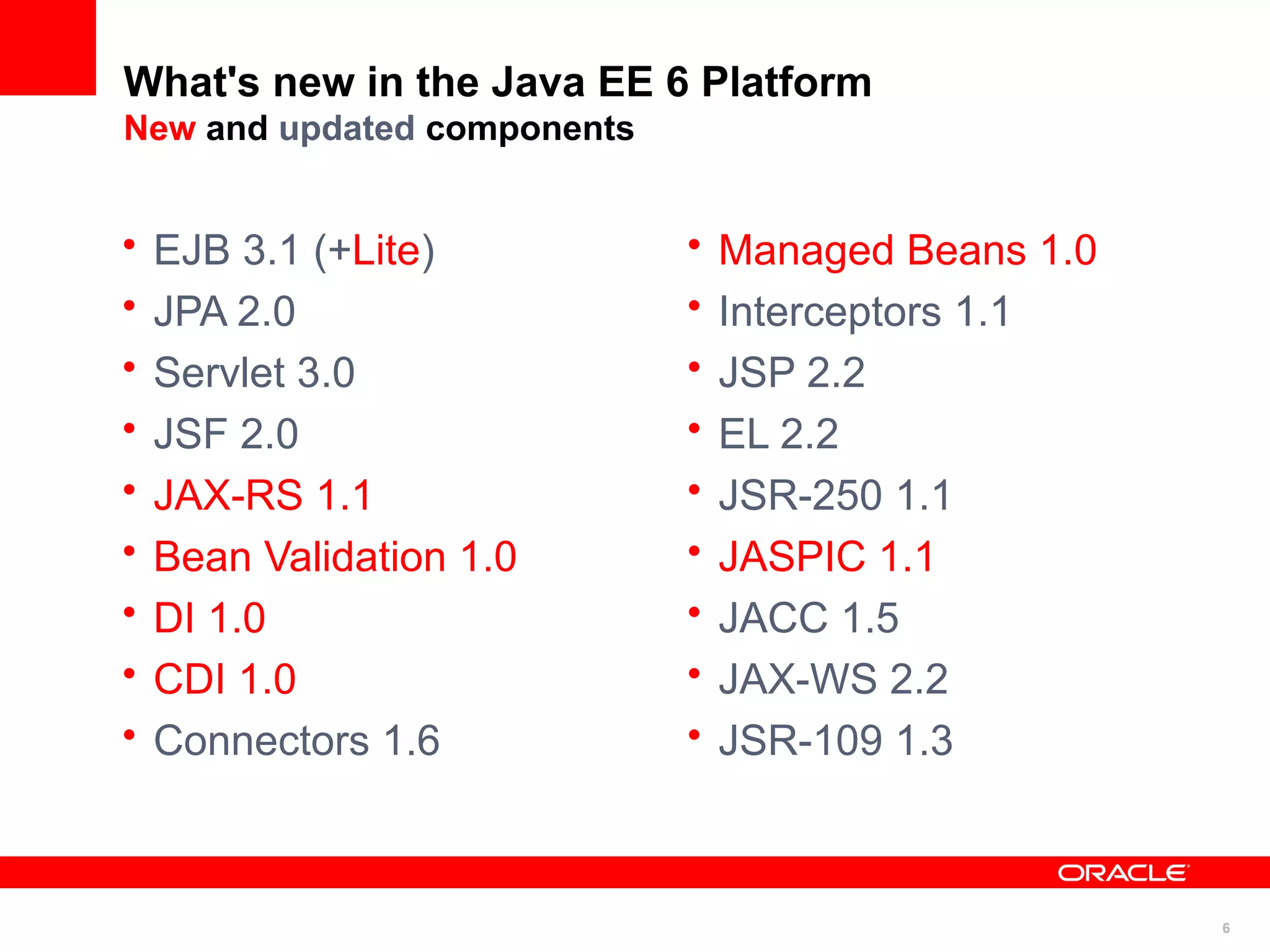
What's new in the Java EE 6 Platform
New and updated components


•   EJB 3.1 (+Lite)          •   Managed Beans 1.0
•   JPA 2.0                  •   Interceptors 1.1
•   Servlet 3.0              •   JSP 2.2
•   JSF 2.0                  •   EL 2.2
•   JAX-RS 1.1               •   JSR-250 1.1
•   Bean Validation 1.0      •   JASPIC 1.1
•   DI 1.0                   •   JACC 1.5
•   CDI 1.0                  •   JAX-WS 2.2
•   Connectors 1.6           •   JSR-109 1.3


                                                     6
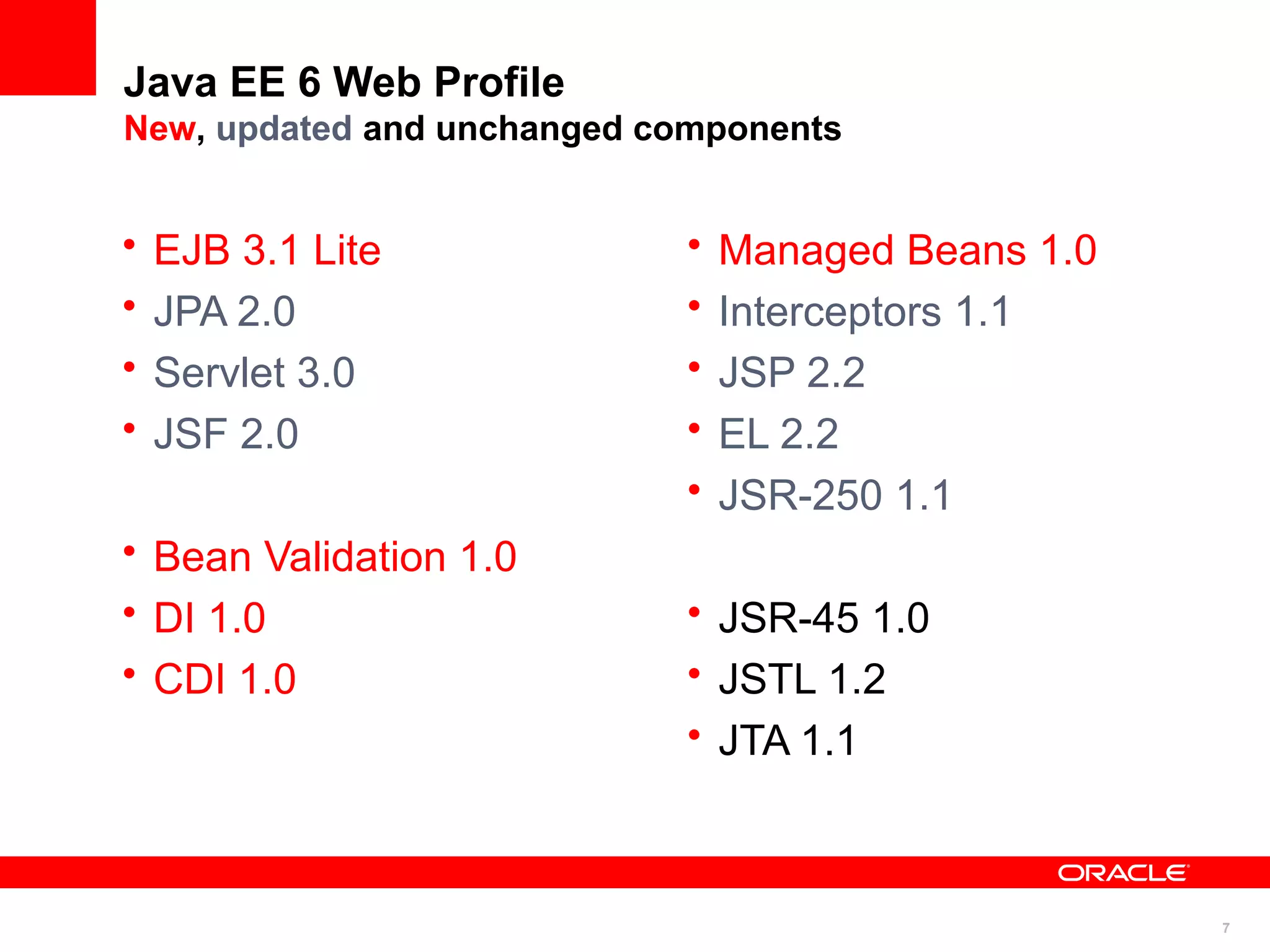
Java EE 6 Web Profile
New, updated and unchanged components


•   EJB 3.1 Lite            •   Managed Beans 1.0
•   JPA 2.0                 •   Interceptors 1.1
•   Servlet 3.0             •   JSP 2.2
•   JSF 2.0                 •   EL 2.2
                            •   JSR-250 1.1
• Bean Validation 1.0
• DI 1.0                    • JSR-45 1.0
• CDI 1.0                   • JSTL 1.2
                            • JTA 1.1


                                                    7
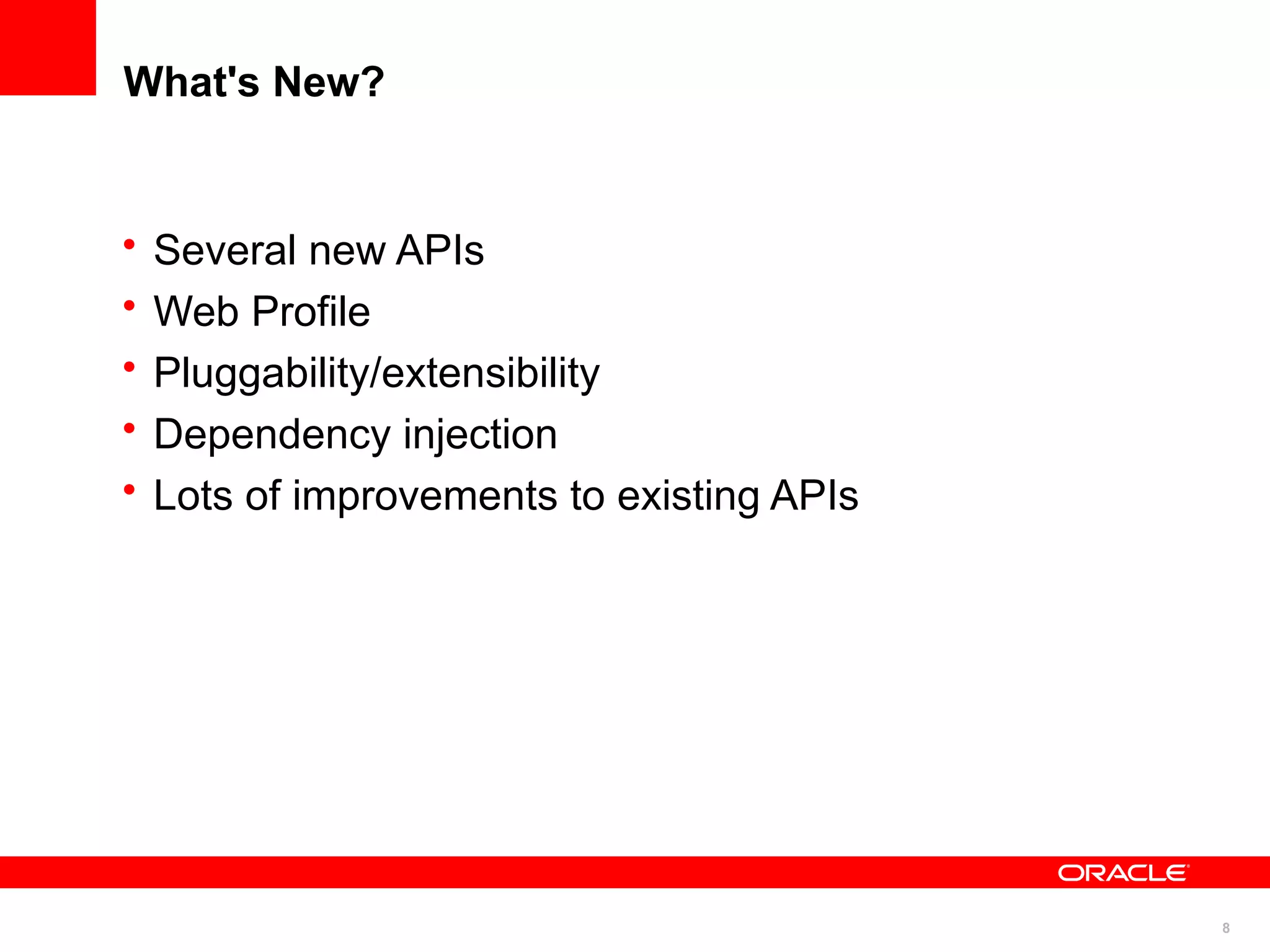
What's New?


•   Several new APIs
•   Web Profile
•   Pluggability/extensibility
•   Dependency injection
•   Lots of improvements to existing APIs


                                            8
The Core Programming Model Explained


                                   9
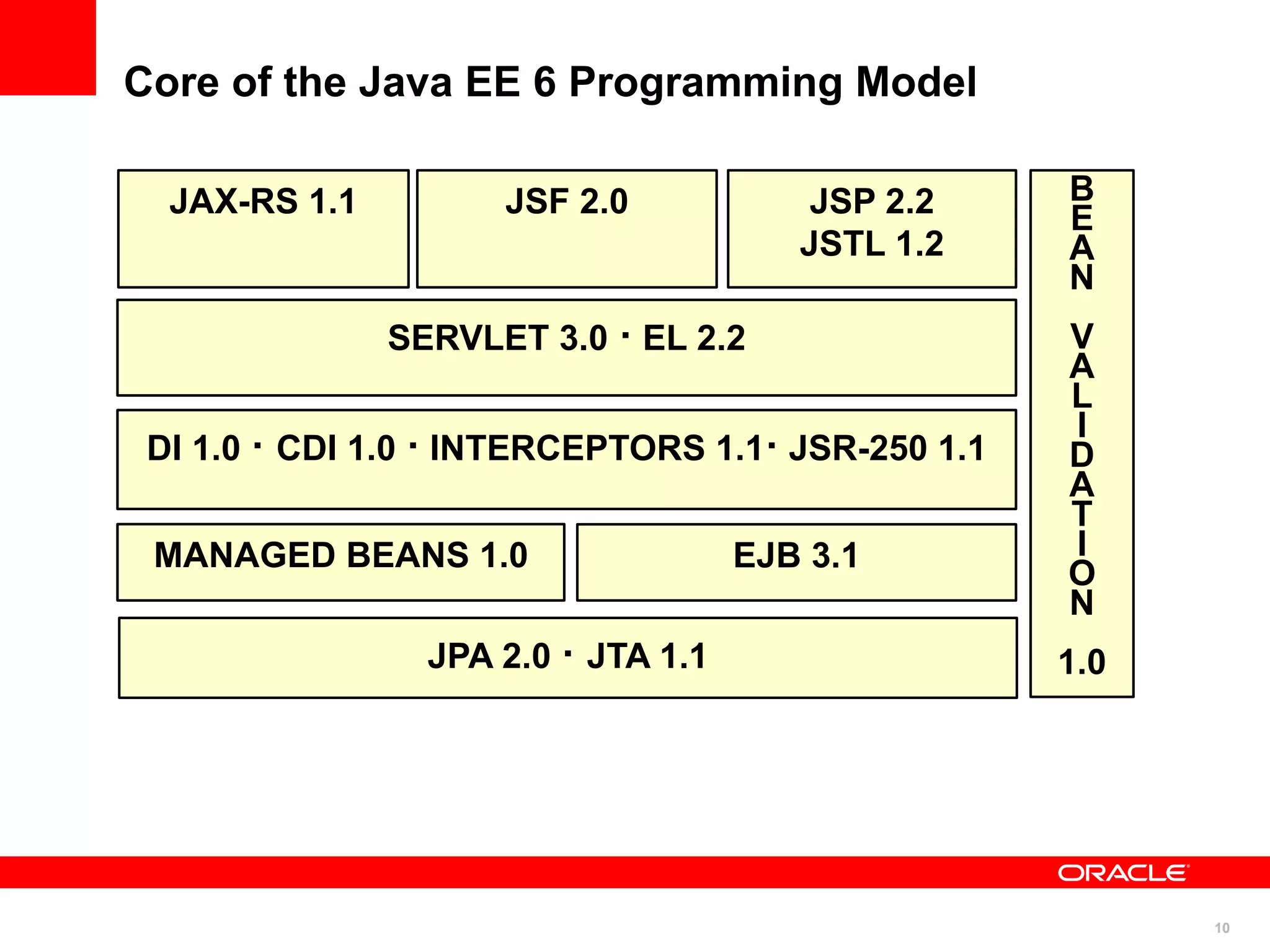
Core of the Java EE 6 Programming Model

  JAX-RS 1.1         JSF 2.0             JSP 2.2    B
                                                    E
                                        JSTL 1.2    A
                                                    N
               SERVLET 3.0 · EL 2.2                 V
                                                    A
                                                    L
                                                    I
 DI 1.0 · CDI 1.0 · INTERCEPTORS 1.1· JSR-250 1.1   D
                                                    A
                                                    T
 MANAGED BEANS 1.0                   EJB 3.1        I
                                                    O
                                                    N
                 JPA 2.0 · JTA 1.1                  1.0


                                                          10
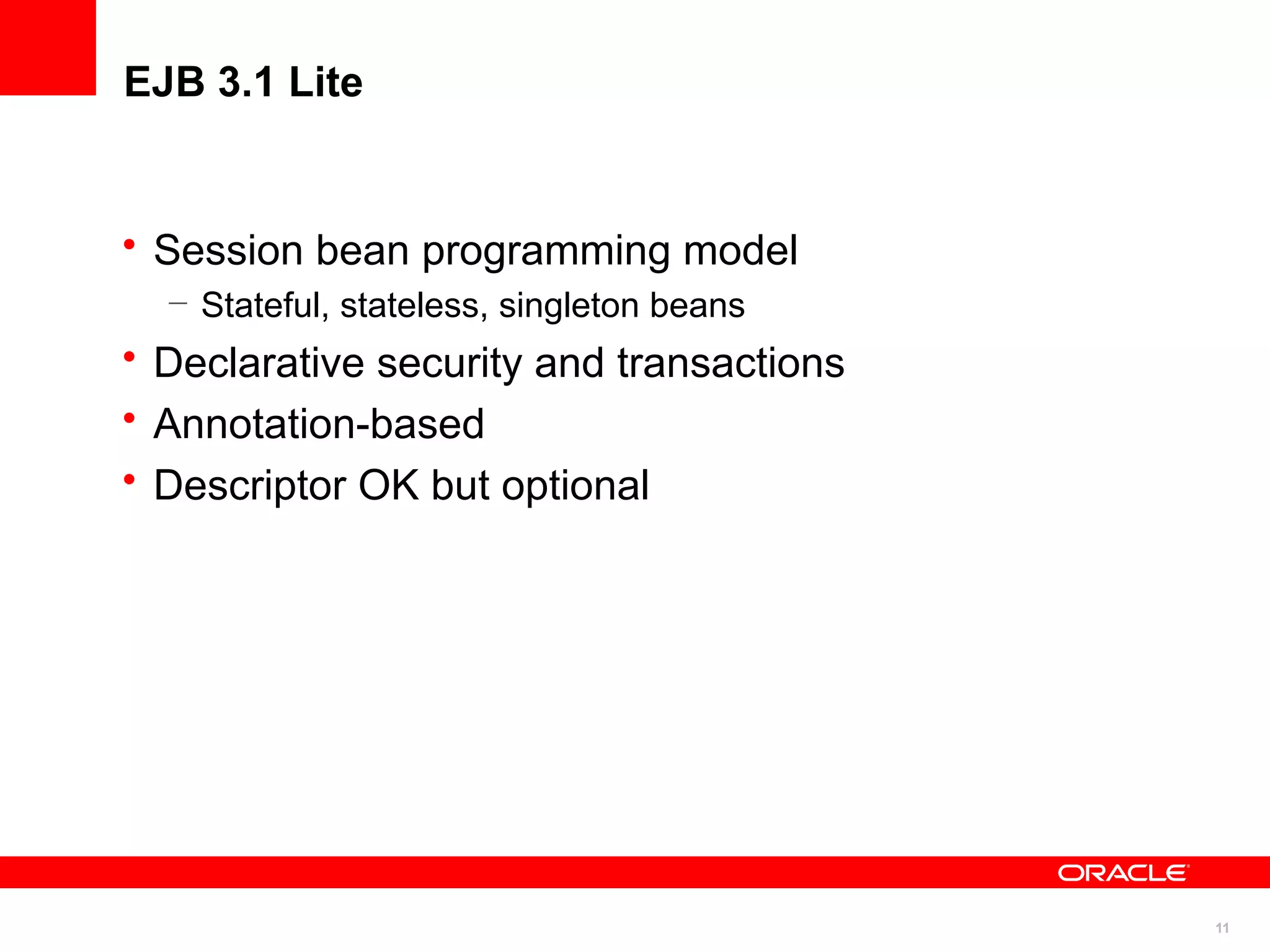
EJB 3.1 Lite


• Session bean programming model
  – Stateful, stateless, singleton beans
• Declarative security and transactions
• Annotation-based
• Descriptor OK but optional


                                           11
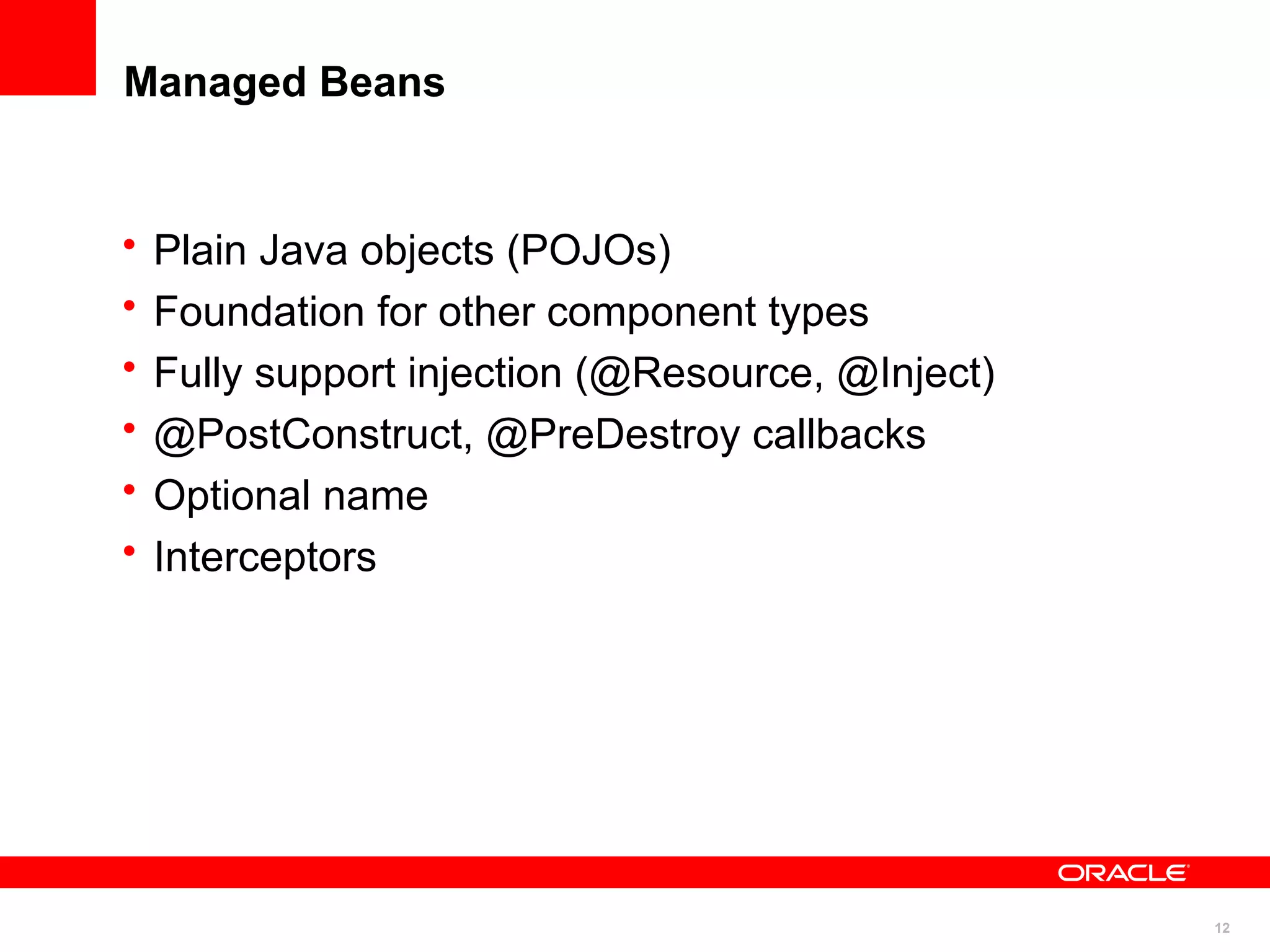
Managed Beans


•   Plain Java objects (POJOs)
•   Foundation for other component types
•   Fully support injection (@Resource, @Inject)
•   @PostConstruct, @PreDestroy callbacks
•   Optional name
•   Interceptors


                                                   12
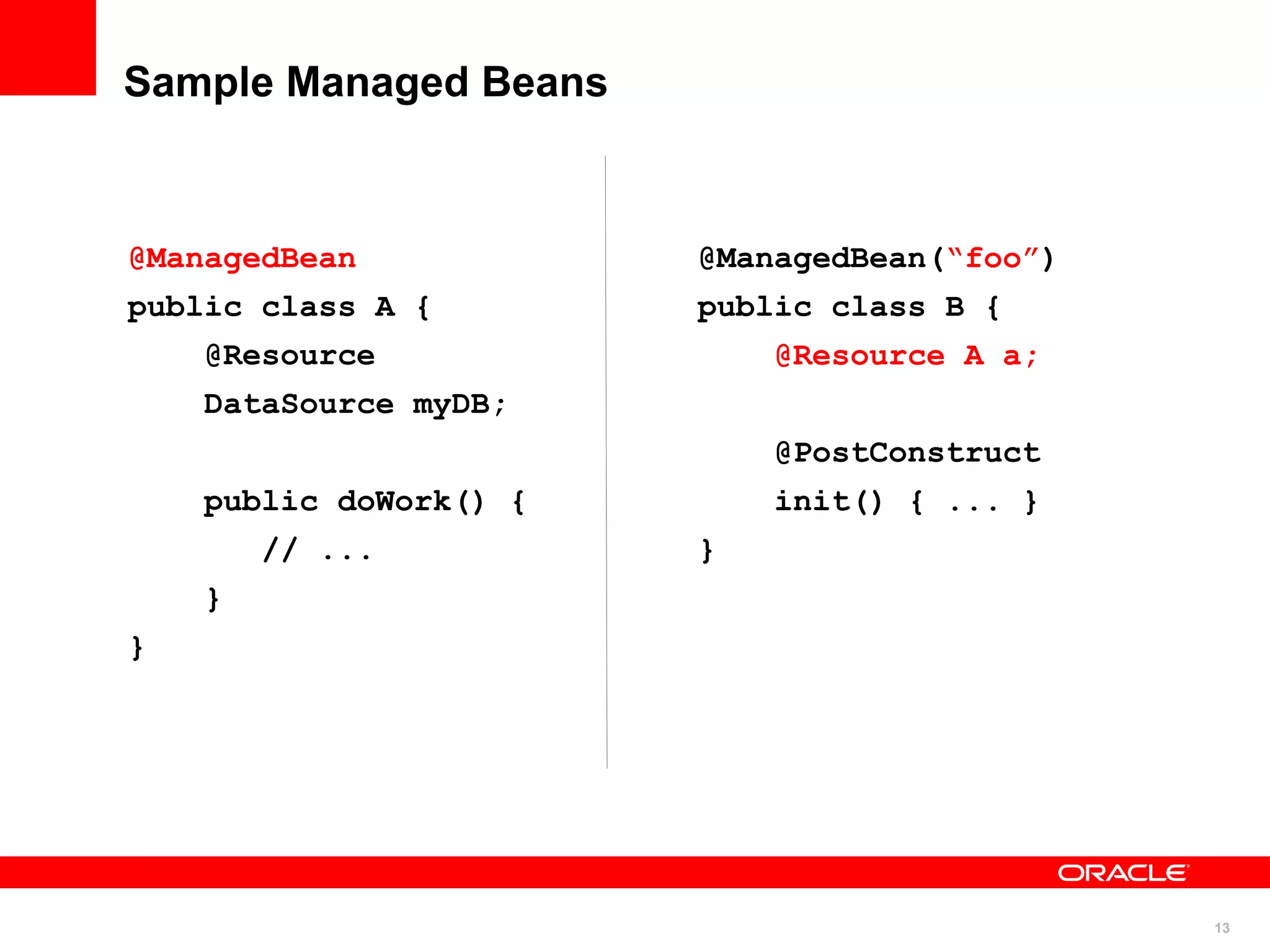
Sample Managed Beans


@ManagedBean            @ManagedBean(“foo”)
public class A {        public class B {
    @Resource               @Resource A a;
    DataSource myDB;
                            @PostConstruct
    public doWork() {       init() { ... }
        // ...          }
    }
}


                                              13
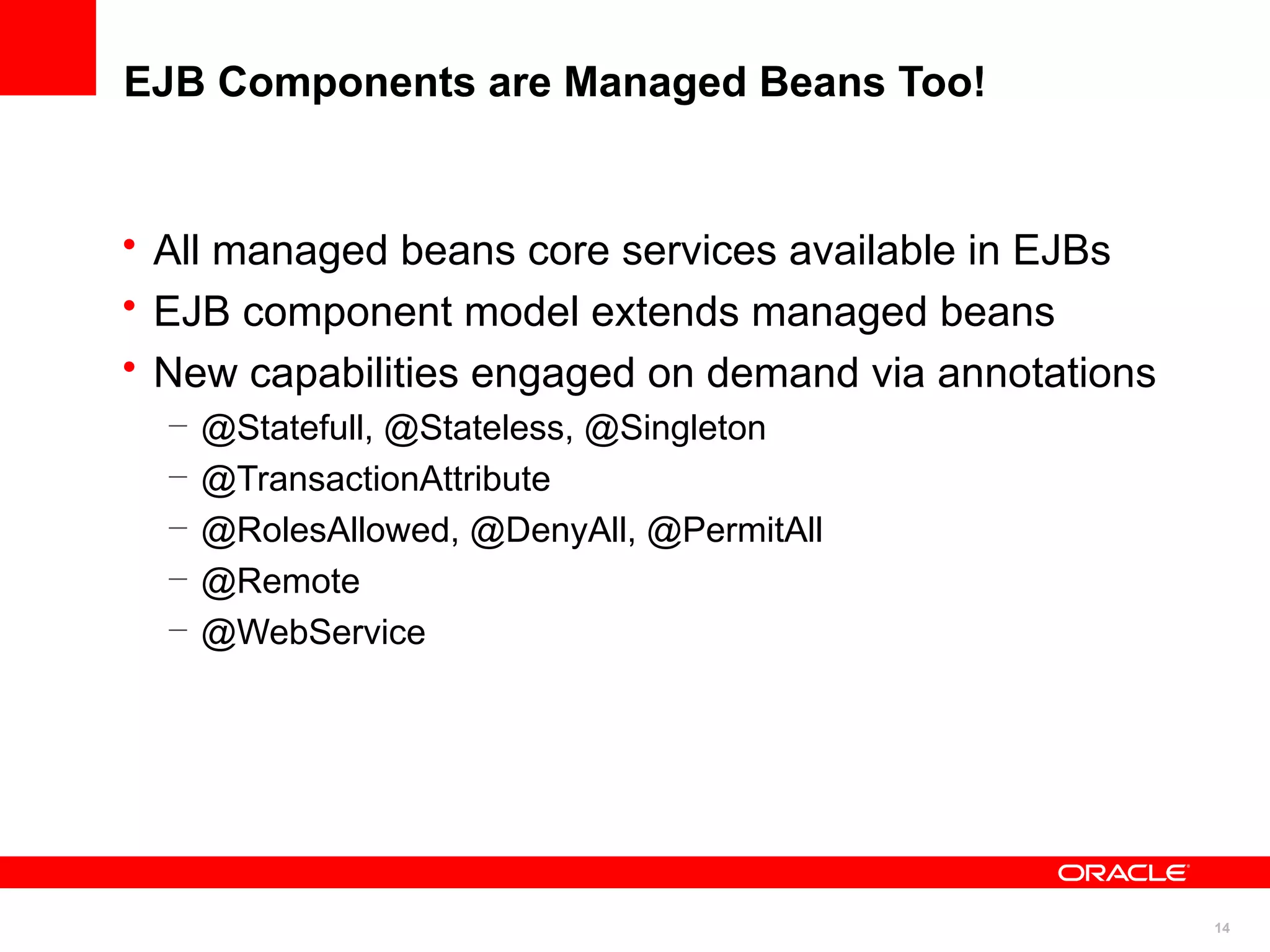
EJB Components are Managed Beans Too!


• All managed beans core services available in EJBs
• EJB component model extends managed beans
• New capabilities engaged on demand via annotations
  –   @Statefull, @Stateless, @Singleton
  –   @TransactionAttribute
  –   @RolesAllowed, @DenyAll, @PermitAll
  –   @Remote
  –   @WebService


                                                       14
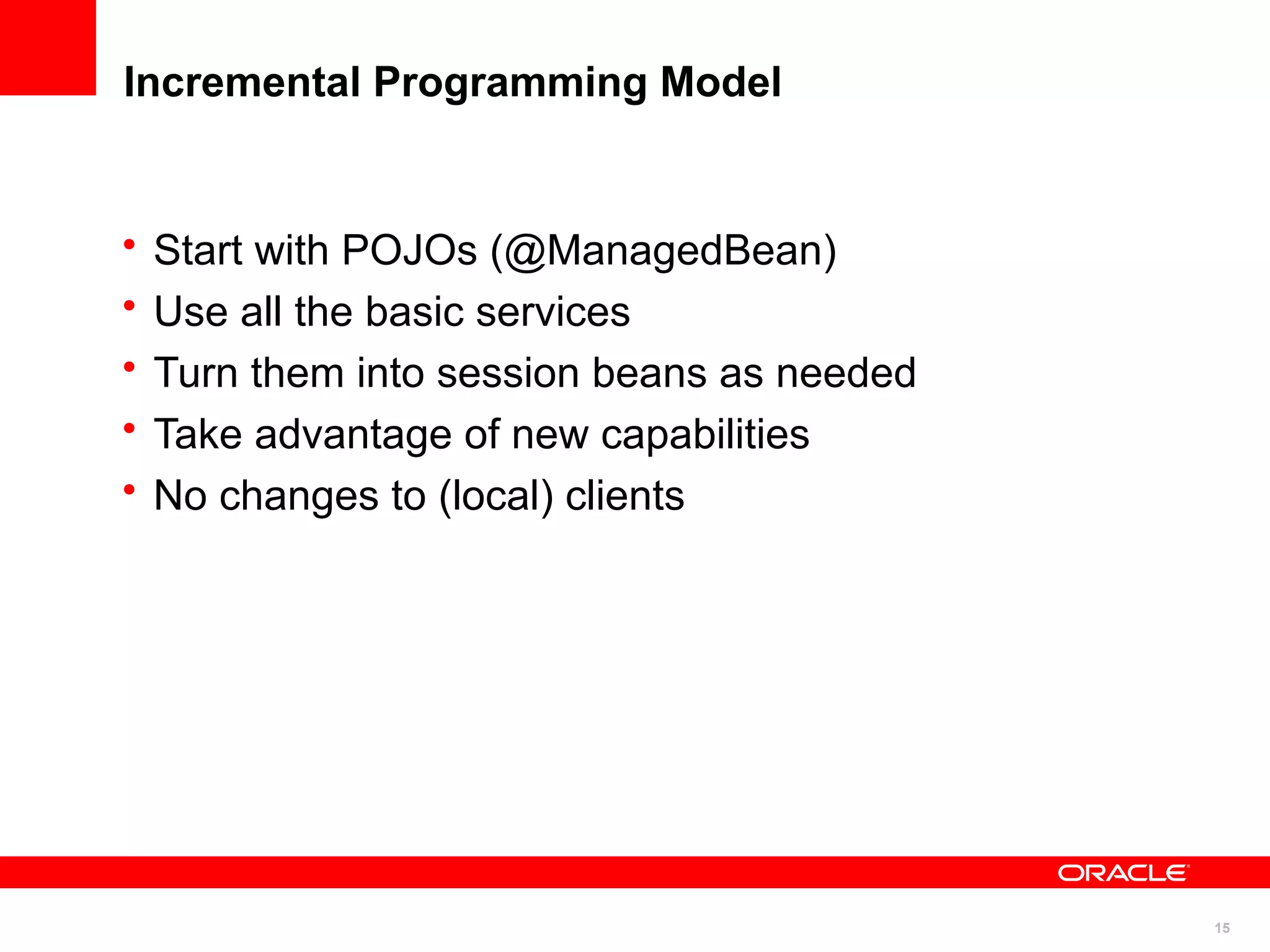
Incremental Programming Model


•   Start with POJOs (@ManagedBean)
•   Use all the basic services
•   Turn them into session beans as needed
•   Take advantage of new capabilities
•   No changes to (local) clients


                                             15
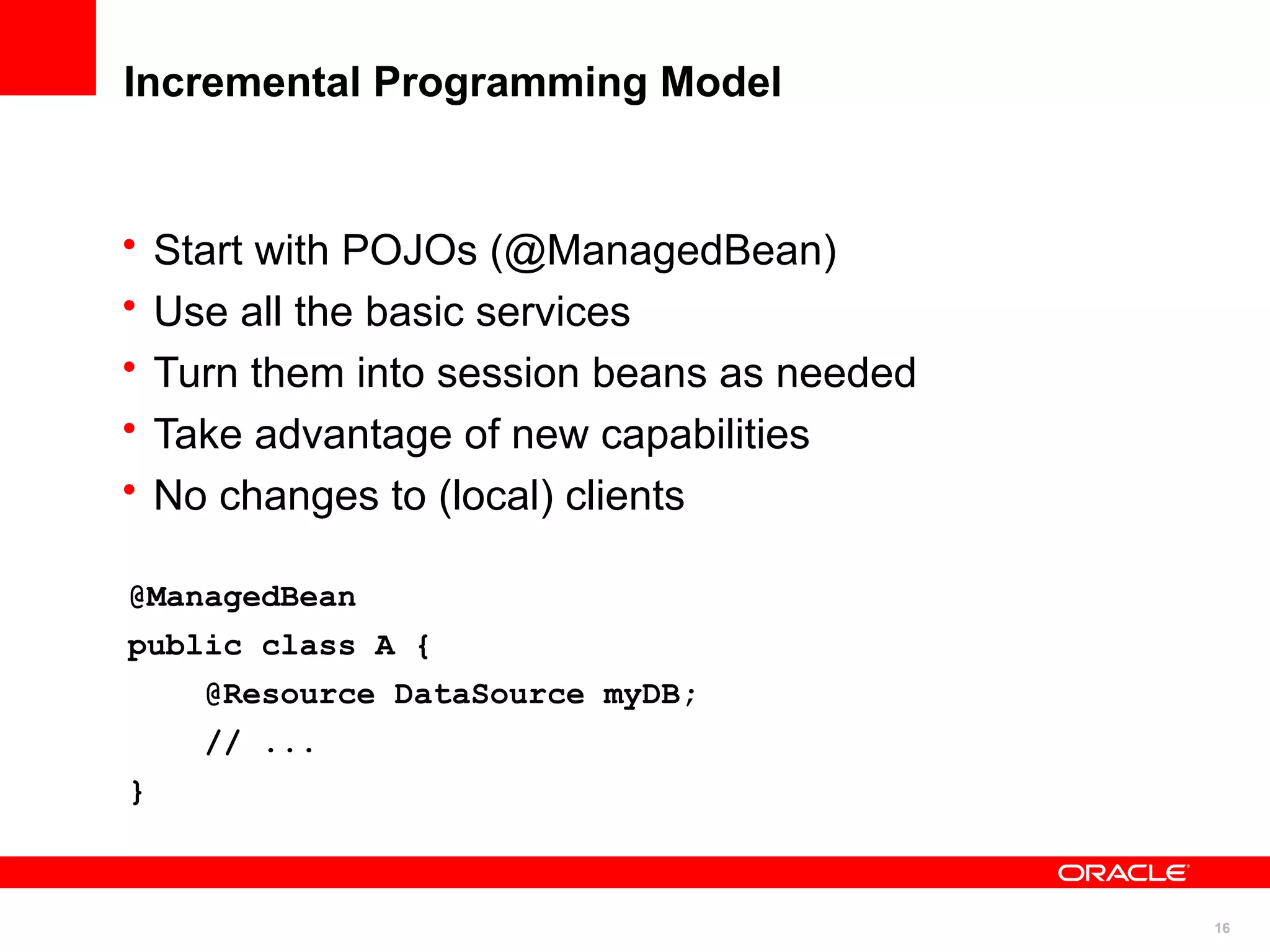
Incremental Programming Model


•   Start with POJOs (@ManagedBean)
•   Use all the basic services
•   Turn them into session beans as needed
•   Take advantage of new capabilities
•   No changes to (local) clients

@ManagedBean
public class A {
      @Resource DataSource myDB;
      // ...
}


                                             16
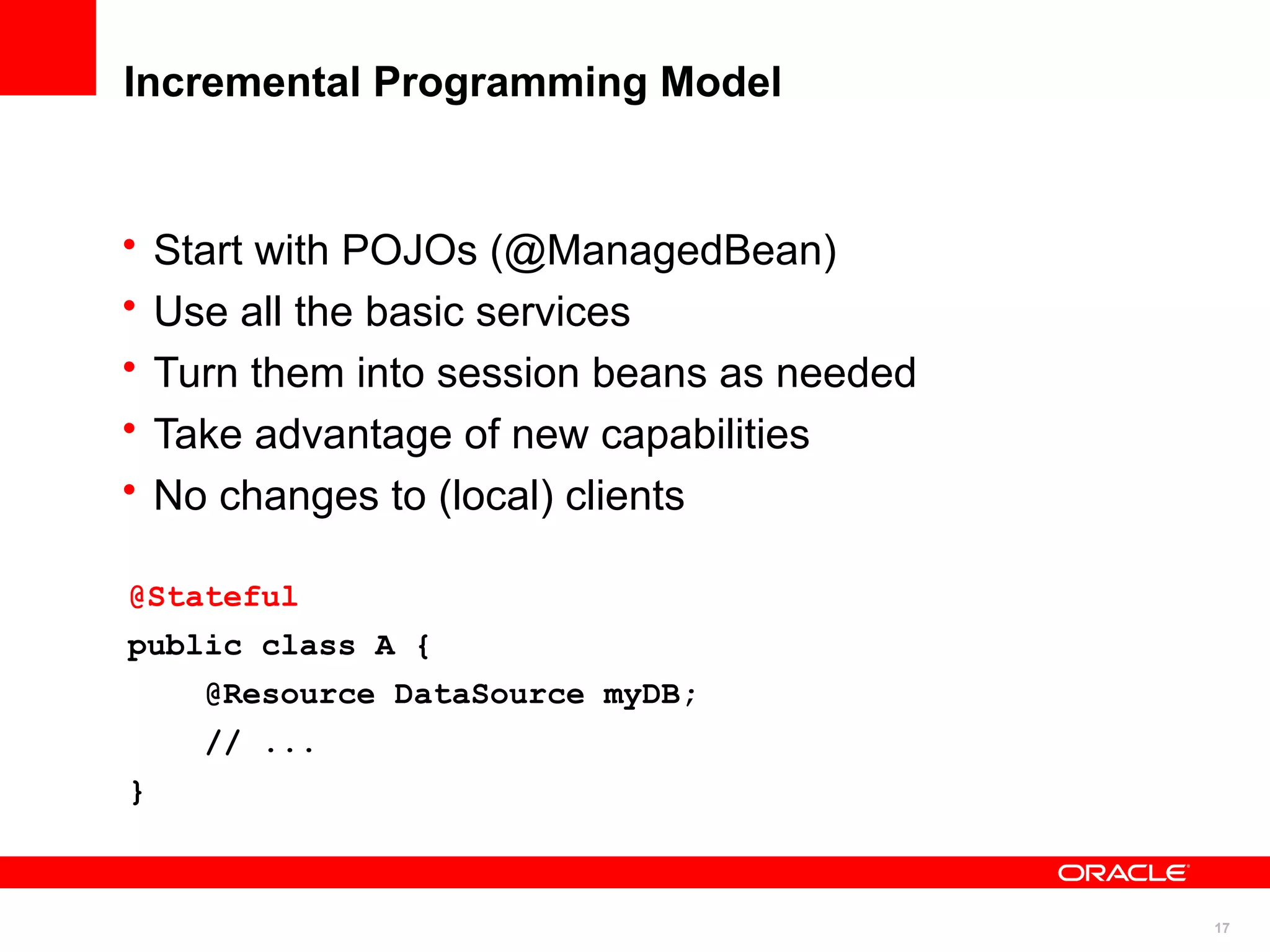
Incremental Programming Model


•   Start with POJOs (@ManagedBean)
•   Use all the basic services
•   Turn them into session beans as needed
•   Take advantage of new capabilities
•   No changes to (local) clients

@Stateful
public class A {
      @Resource DataSource myDB;
      // ...
}


                                             17
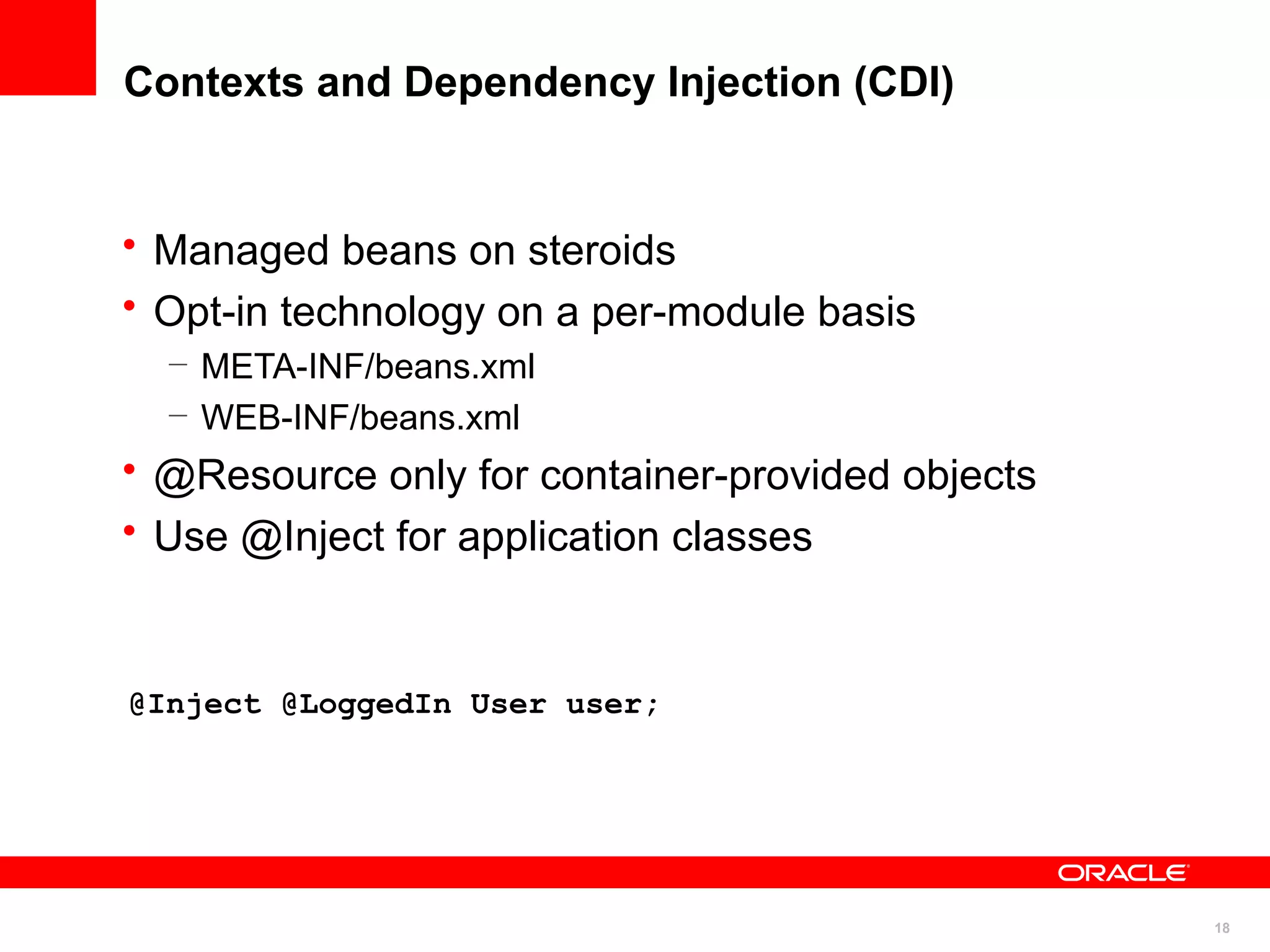
Contexts and Dependency Injection (CDI)


• Managed beans on steroids
• Opt-in technology on a per-module basis
  – META-INF/beans.xml
  – WEB-INF/beans.xml
• @Resource only for container-provided objects
• Use @Inject for application classes


@Inject @LoggedIn User user;


                                                  18
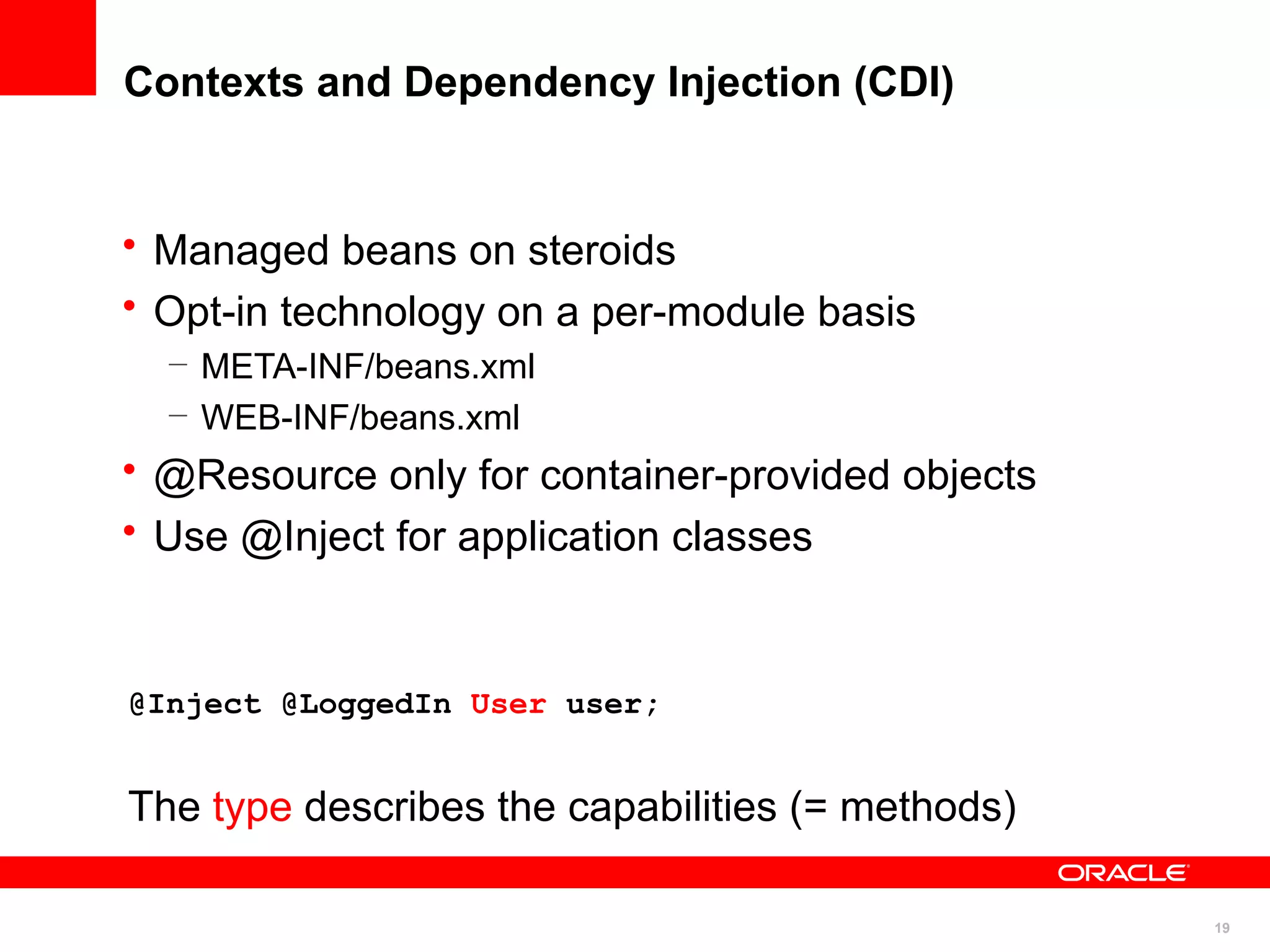
Contexts and Dependency Injection (CDI)


• Managed beans on steroids
• Opt-in technology on a per-module basis
  – META-INF/beans.xml
  – WEB-INF/beans.xml
• @Resource only for container-provided objects
• Use @Inject for application classes


@Inject @LoggedIn User user;


The type describes the capabilities (= methods)

                                                  19
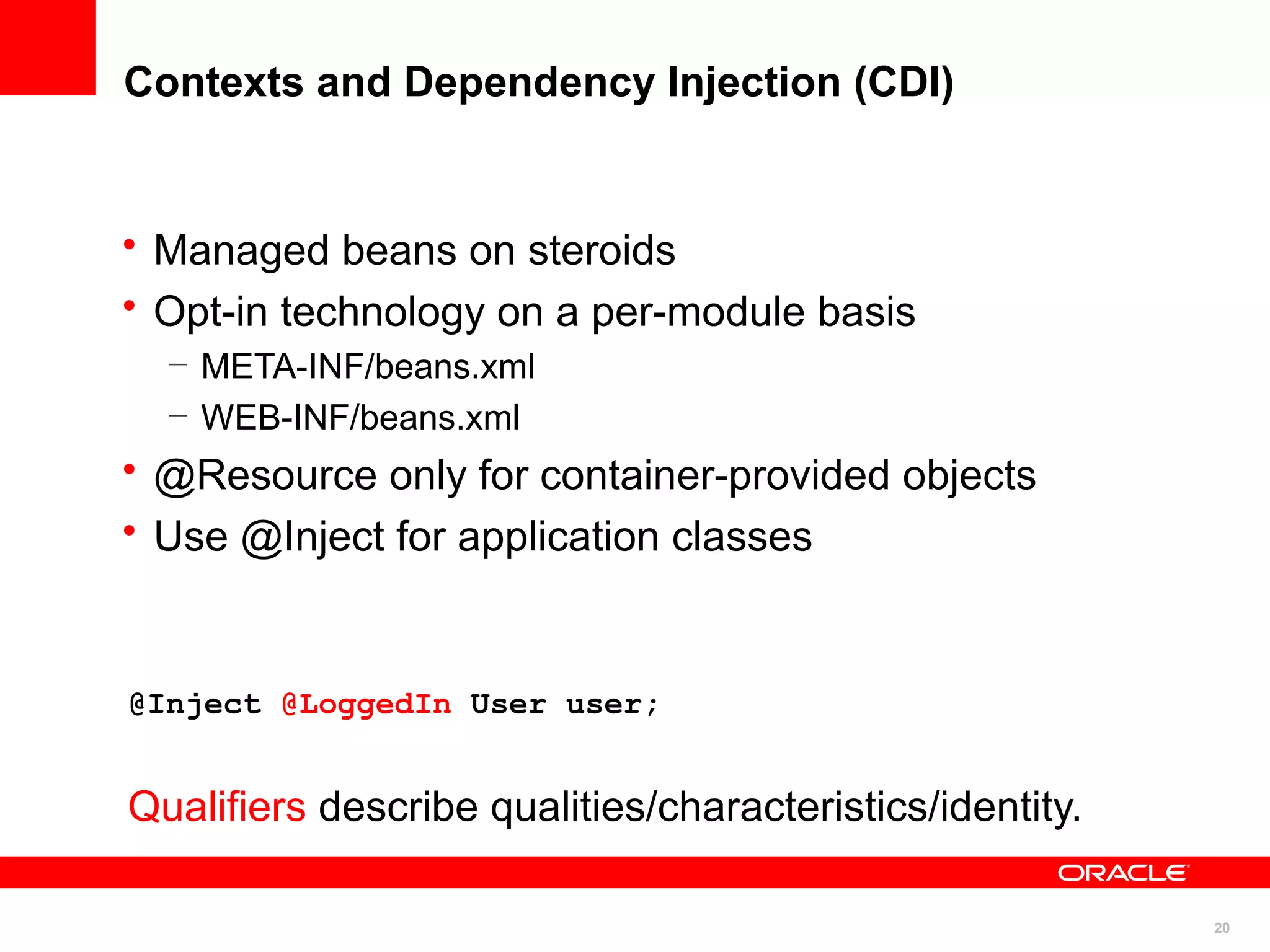
Contexts and Dependency Injection (CDI)


• Managed beans on steroids
• Opt-in technology on a per-module basis
  – META-INF/beans.xml
  – WEB-INF/beans.xml
• @Resource only for container-provided objects
• Use @Inject for application classes


@Inject @LoggedIn User user;


Qualifiers describe qualities/characteristics/identity.

                                                          20
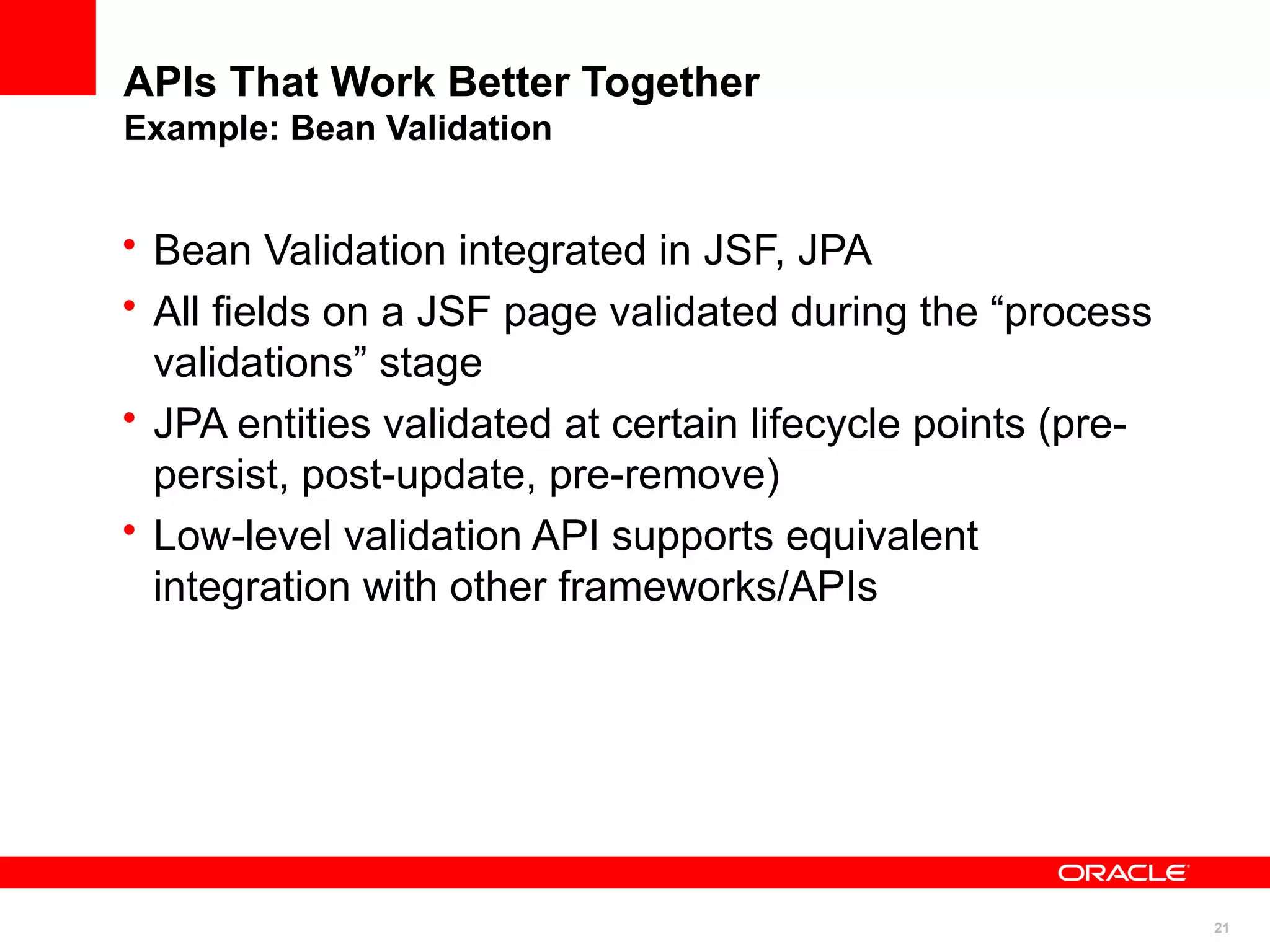
APIs That Work Better Together
Example: Bean Validation


• Bean Validation integrated in JSF, JPA
• All fields on a JSF page validated during the “process
  validations” stage
• JPA entities validated at certain lifecycle points (pre-
  persist, post-update, pre-remove)
• Low-level validation API supports equivalent
  integration with other frameworks/APIs


                                                             21
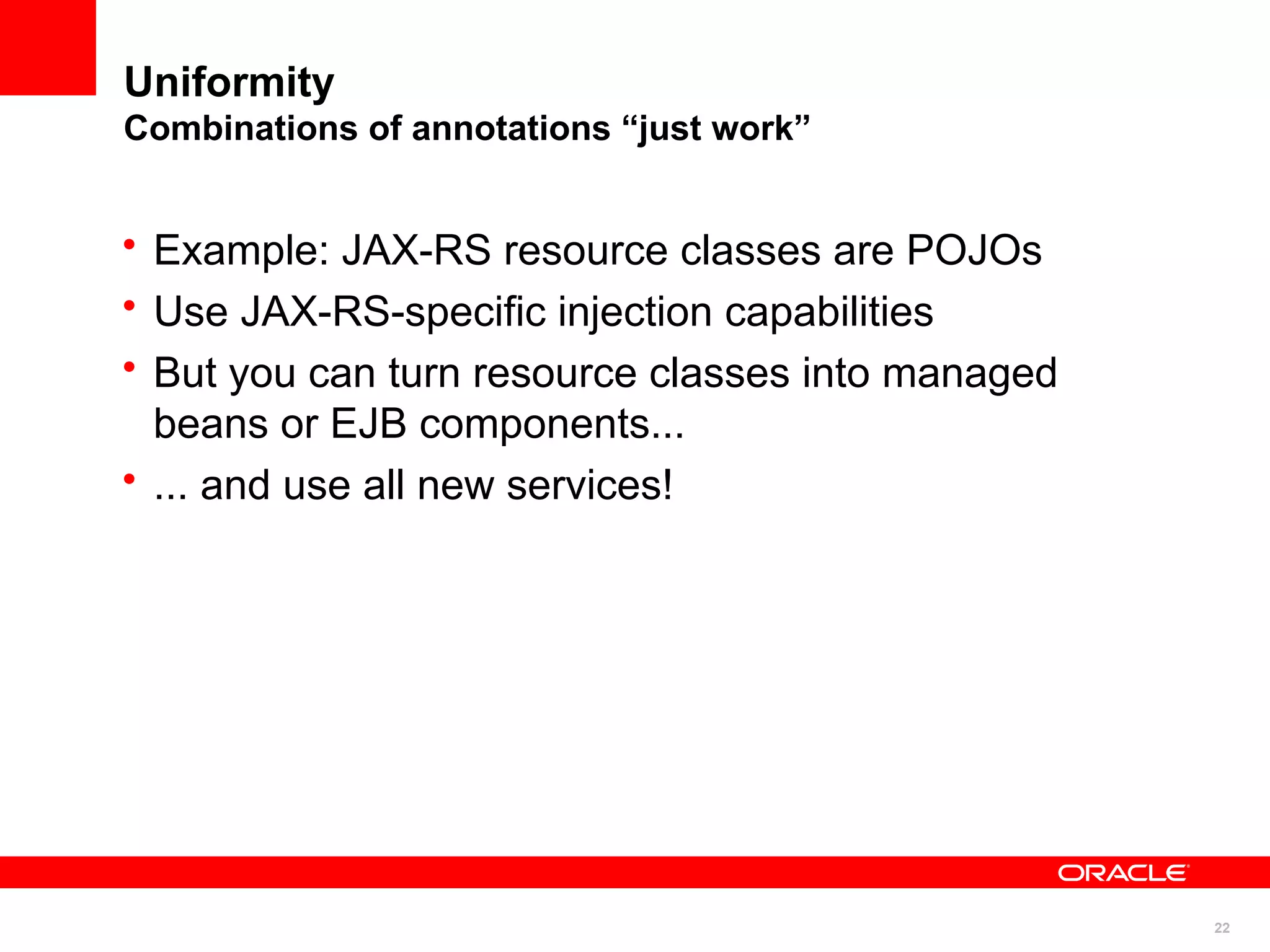
Uniformity
Combinations of annotations “just work”


• Example: JAX-RS resource classes are POJOs
• Use JAX-RS-specific injection capabilities
• But you can turn resource classes into managed
  beans or EJB components...
• ... and use all new services!


                                                   22
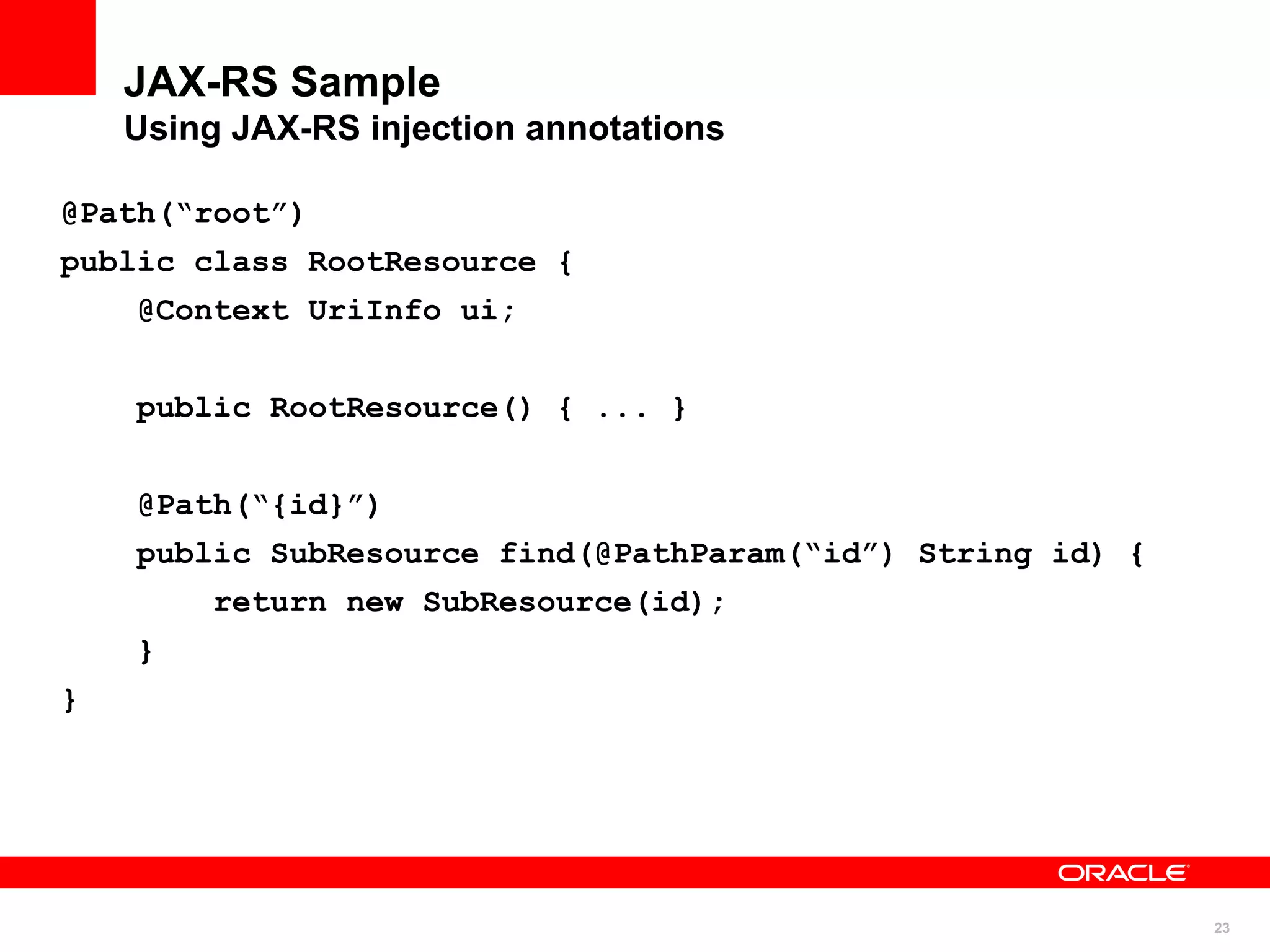
JAX-RS Sample
    Using JAX-RS injection annotations

@Path(“root”)
public class RootResource {
    @Context UriInfo ui;


    public RootResource() { ... }


    @Path(“{id}”)
    public SubResource find(@PathParam(“id”) String id) {
         return new SubResource(id);
    }
}


                                                            23
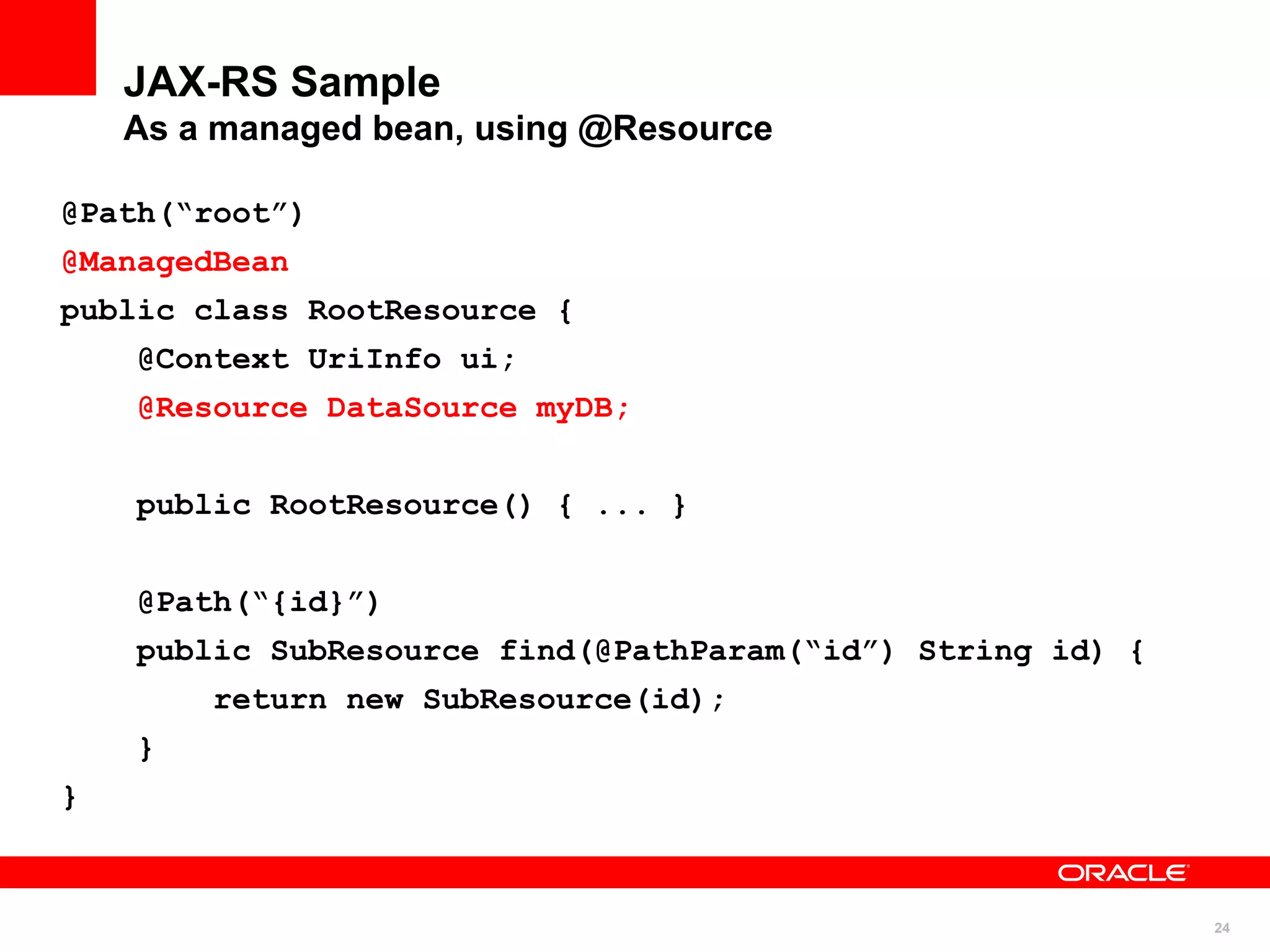
JAX-RS Sample
    As a managed bean, using @Resource

@Path(“root”)
@ManagedBean
public class RootResource {
    @Context UriInfo ui;
    @Resource DataSource myDB;


    public RootResource() { ... }


    @Path(“{id}”)
    public SubResource find(@PathParam(“id”) String id) {
        return new SubResource(id);
    }
}


                                                            24
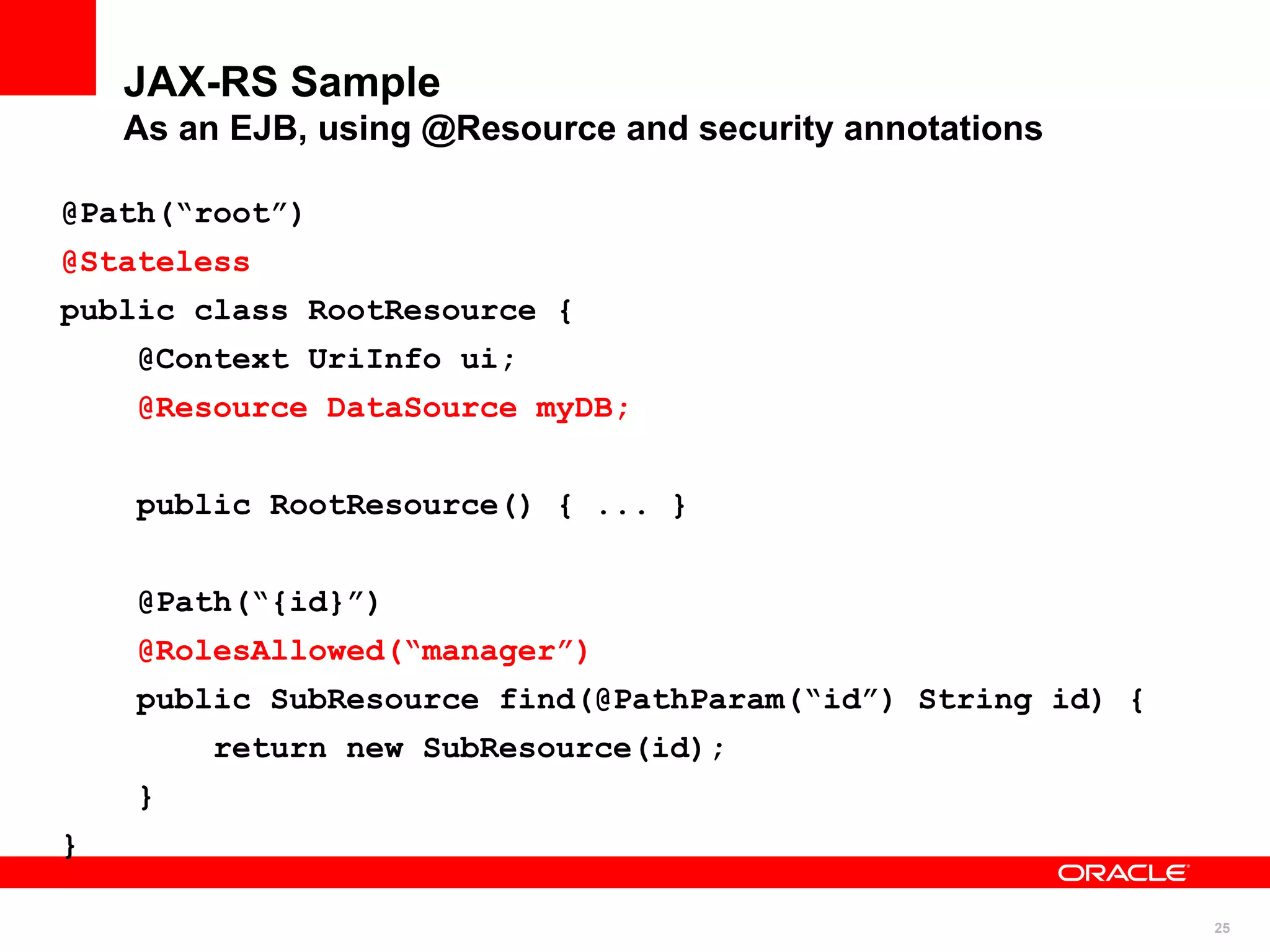
JAX-RS Sample
    As an EJB, using @Resource and security annotations

@Path(“root”)
@Stateless
public class RootResource {
    @Context UriInfo ui;
    @Resource DataSource myDB;


    public RootResource() { ... }


    @Path(“{id}”)
    @RolesAllowed(“manager”)
    public SubResource find(@PathParam(“id”) String id) {
        return new SubResource(id);
    }
}

                                                            25
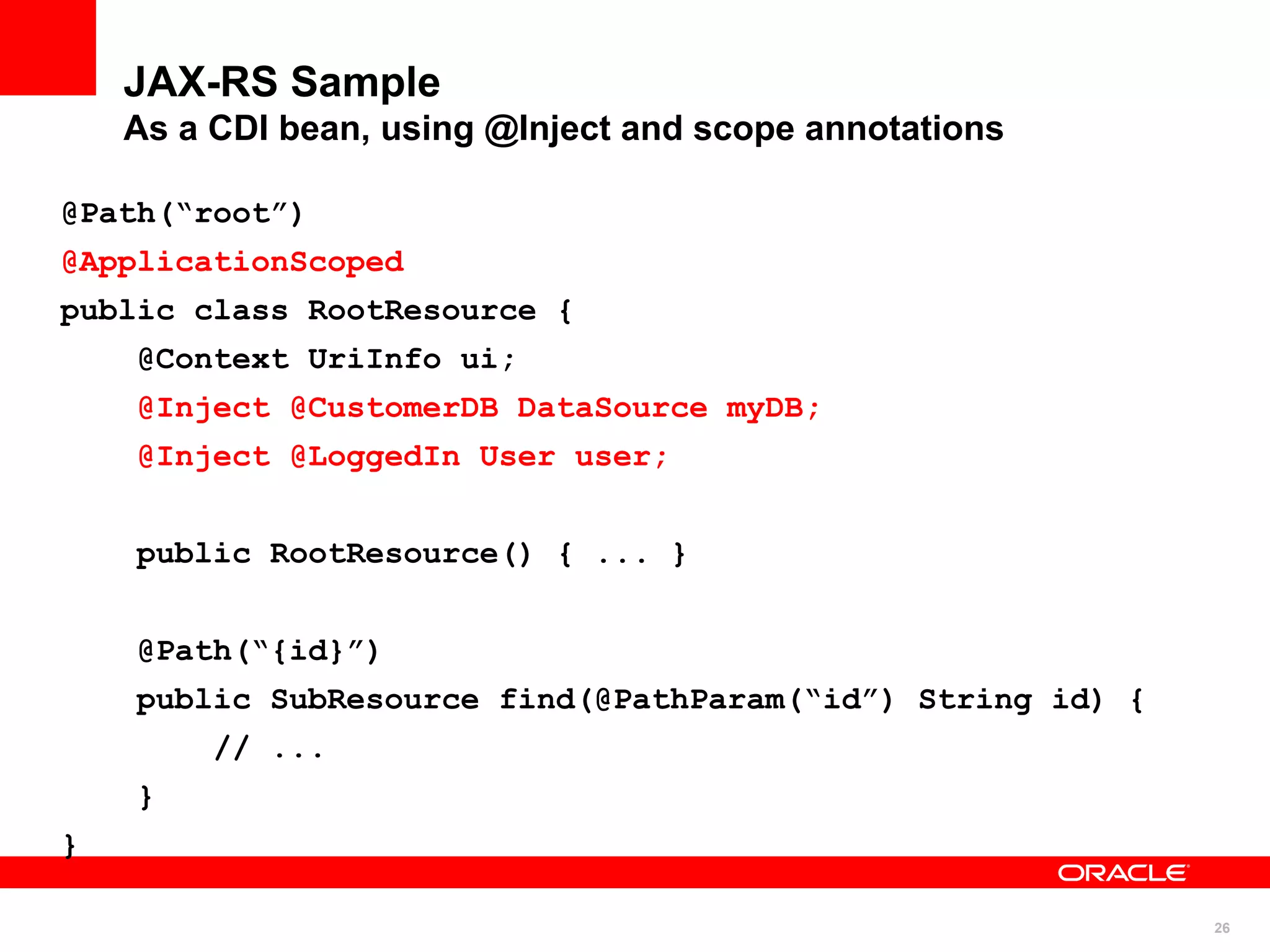
JAX-RS Sample
    As a CDI bean, using @Inject and scope annotations

@Path(“root”)
@ApplicationScoped
public class RootResource {
    @Context UriInfo ui;
    @Inject @CustomerDB DataSource myDB;
    @Inject @LoggedIn User user;


    public RootResource() { ... }


    @Path(“{id}”)
    public SubResource find(@PathParam(“id”) String id) {
         // ...
    }
}

                                                            26
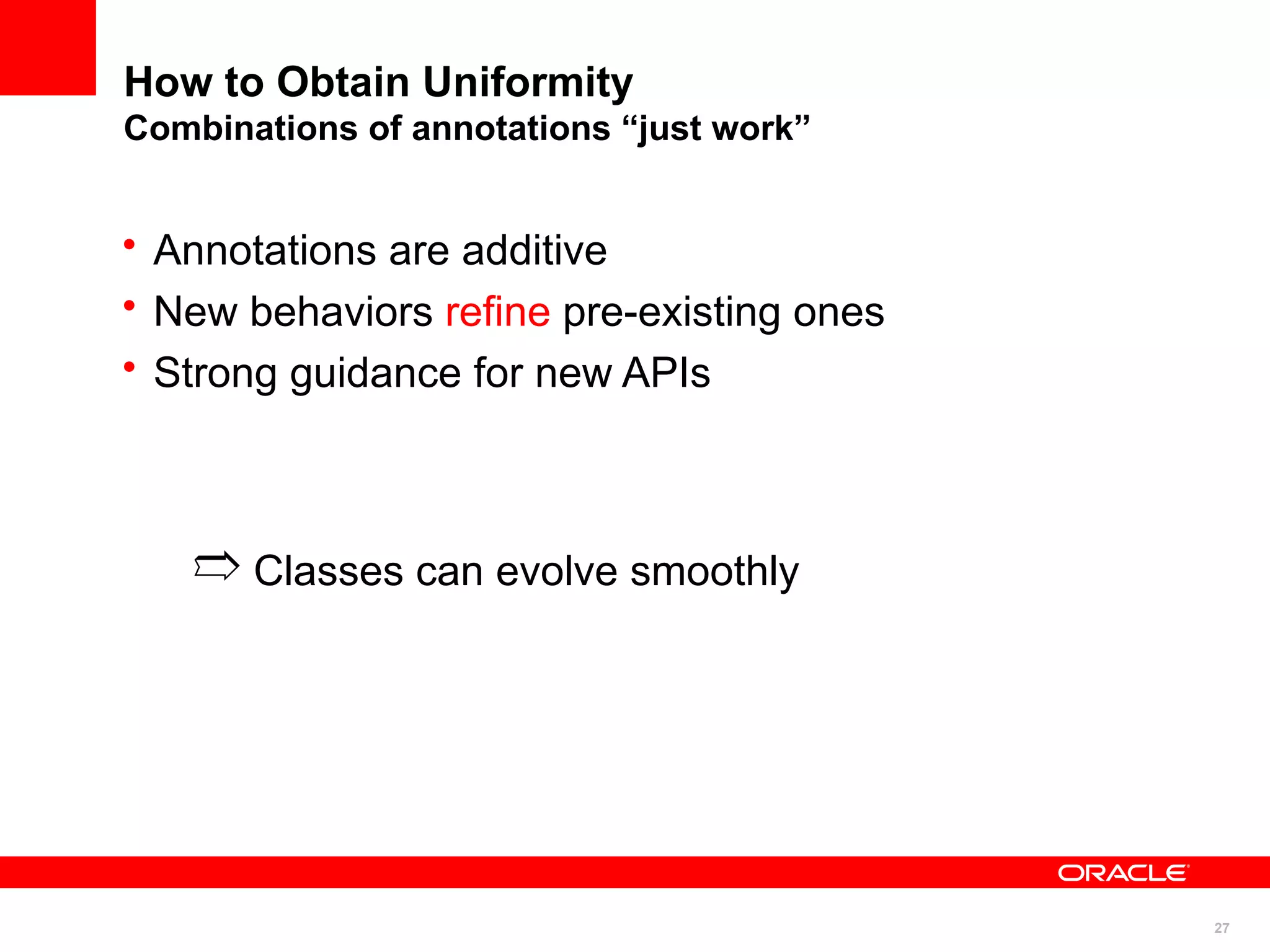
How to Obtain Uniformity
Combinations of annotations “just work”


• Annotations are additive
• New behaviors refine pre-existing ones
• Strong guidance for new APIs


   ➱ Classes can evolve smoothly


                                           27
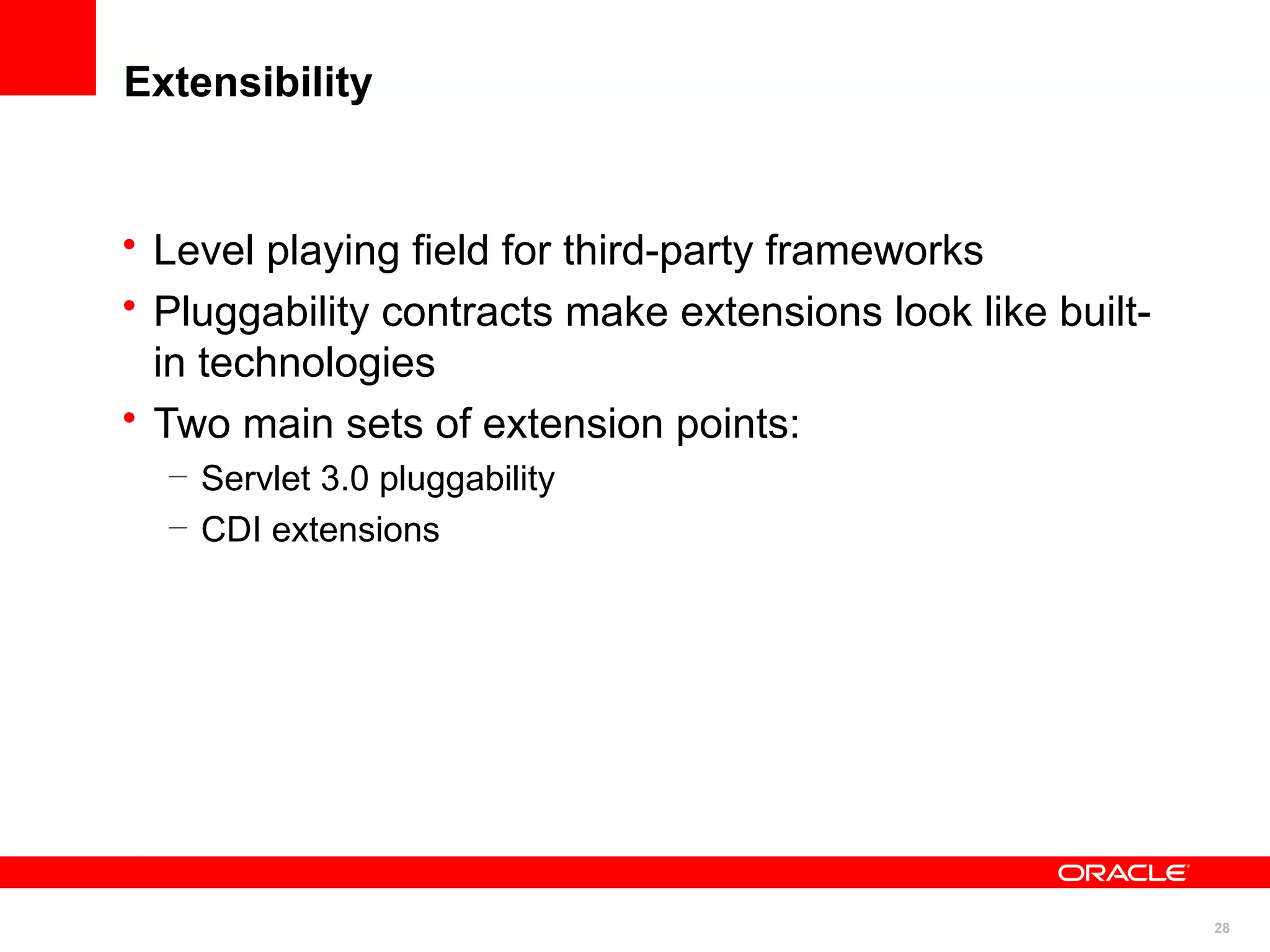
Extensibility


• Level playing field for third-party frameworks
• Pluggability contracts make extensions look like built-
  in technologies
• Two main sets of extension points:
  – Servlet 3.0 pluggability
  – CDI extensions


                                                            28
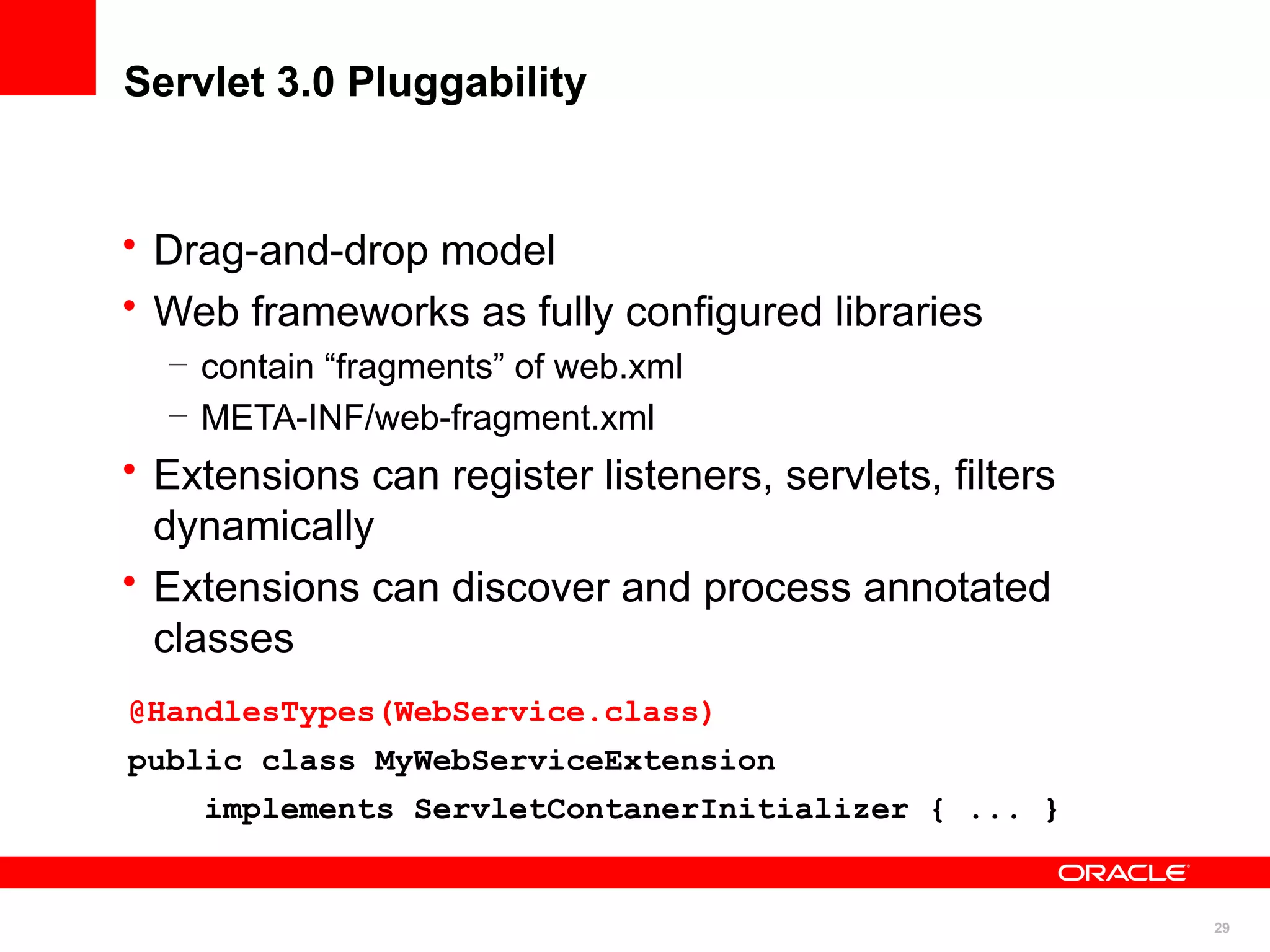
Servlet 3.0 Pluggability


• Drag-and-drop model
• Web frameworks as fully configured libraries
  – contain “fragments” of web.xml
  – META-INF/web-fragment.xml
• Extensions can register listeners, servlets, filters
  dynamically
• Extensions can discover and process annotated
  classes
@HandlesTypes(WebService.class)
public class MyWebServiceExtension
    implements ServletContanerInitializer { ... }


                                                         29
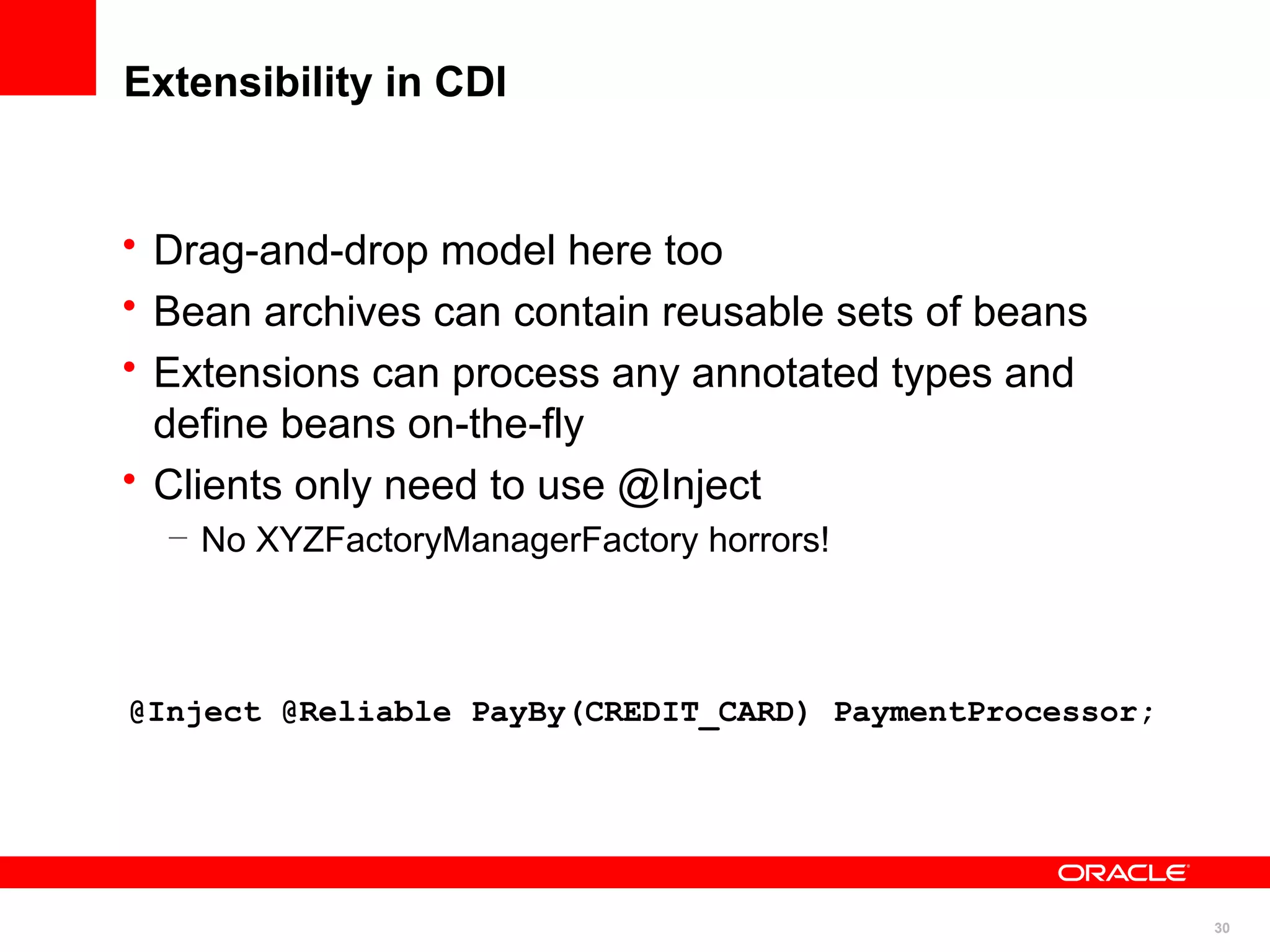
Extensibility in CDI


• Drag-and-drop model here too
• Bean archives can contain reusable sets of beans
• Extensions can process any annotated types and
  define beans on-the-fly
• Clients only need to use @Inject
  – No XYZFactoryManagerFactory horrors!


@Inject @Reliable PayBy(CREDIT_CARD) PaymentProcessor;


                                                         30
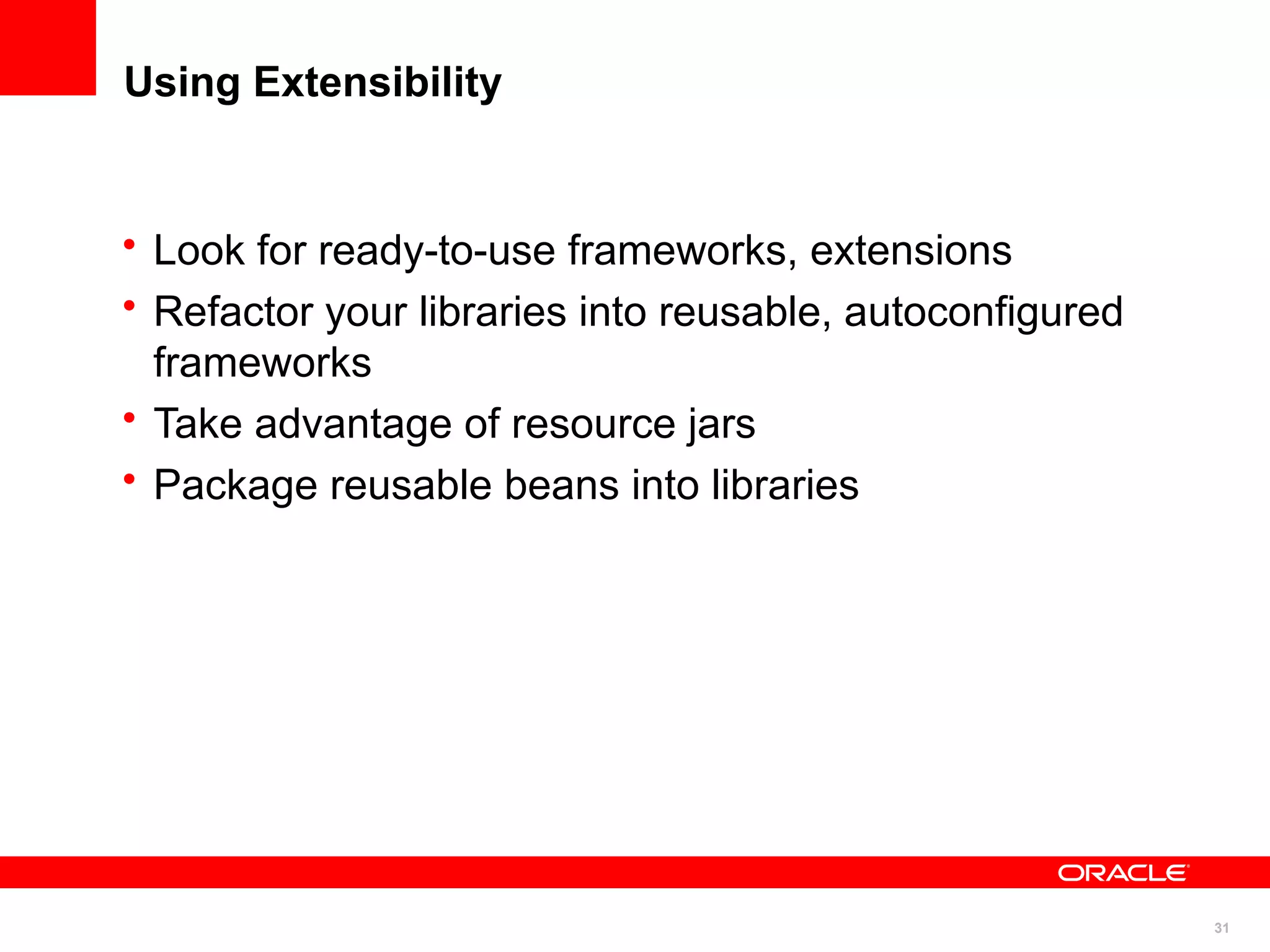
Using Extensibility


• Look for ready-to-use frameworks, extensions
• Refactor your libraries into reusable, autoconfigured
  frameworks
• Take advantage of resource jars
• Package reusable beans into libraries


                                                          31
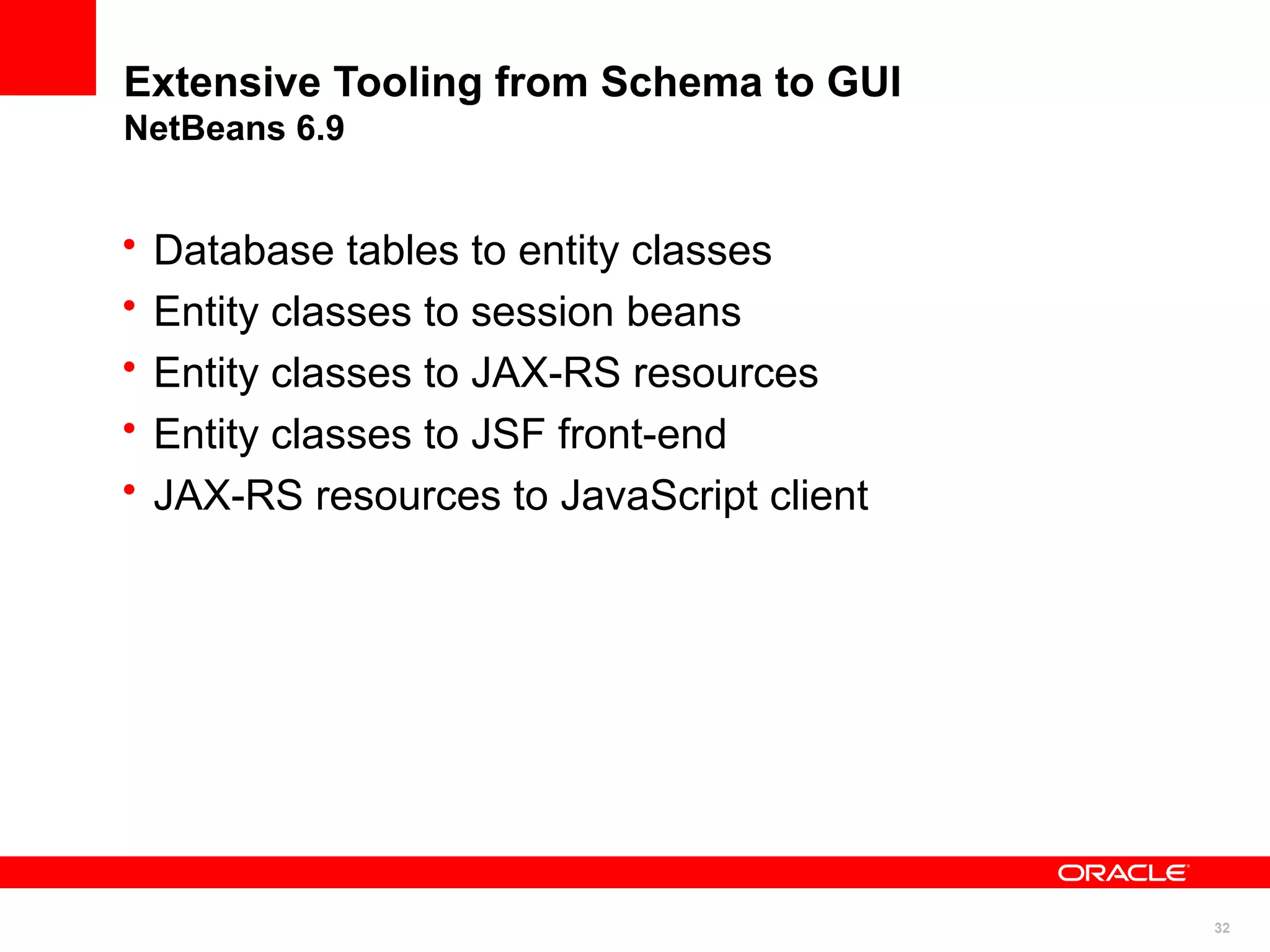
Extensive Tooling from Schema to GUI
NetBeans 6.9


•   Database tables to entity classes
•   Entity classes to session beans
•   Entity classes to JAX-RS resources
•   Entity classes to JSF front-end
•   JAX-RS resources to JavaScript client


                                            32
Features You Should Know About


                                 33
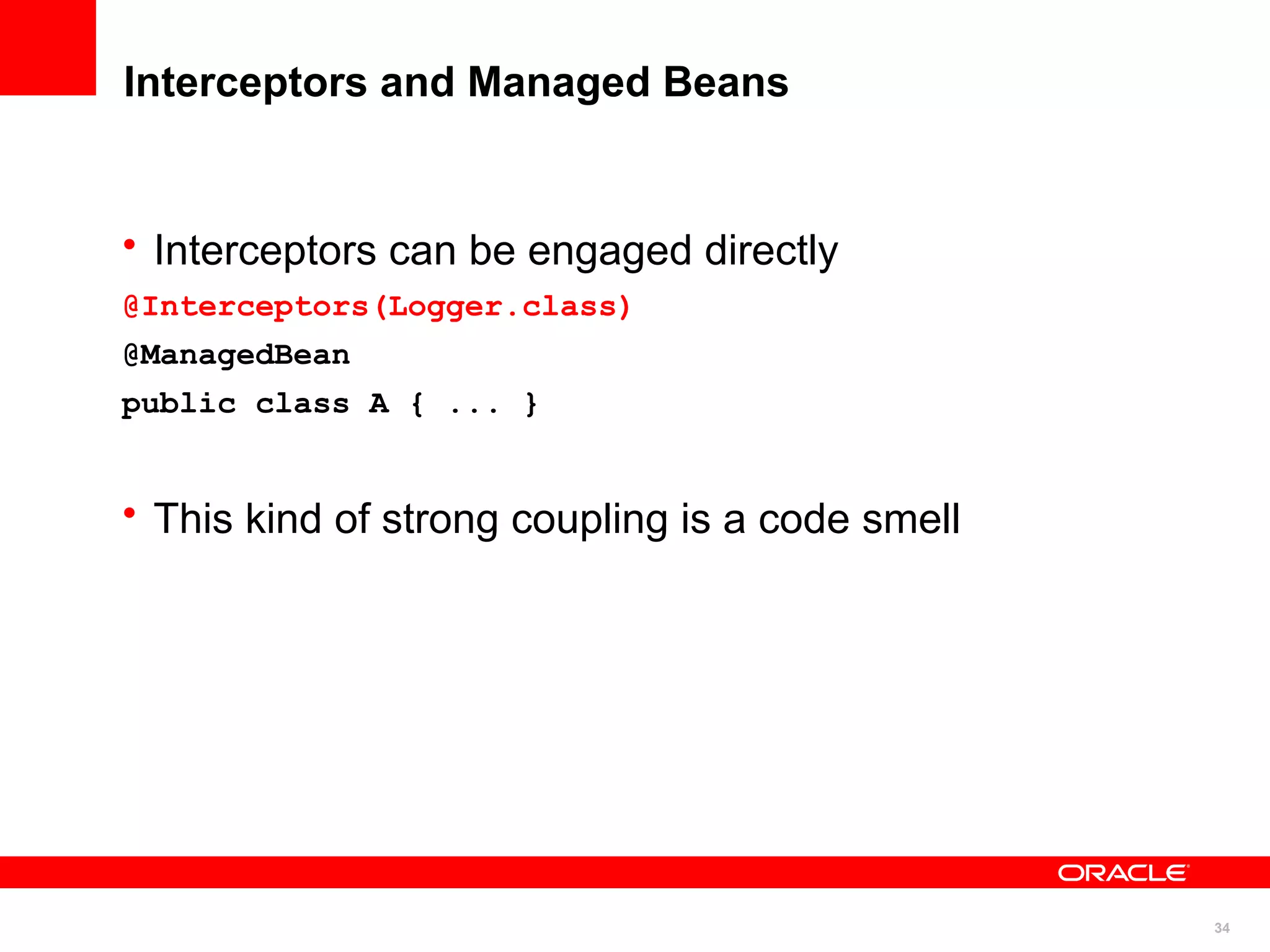
Interceptors and Managed Beans


• Interceptors can be engaged directly
@Interceptors(Logger.class)
@ManagedBean
public class A { ... }


• This kind of strong coupling is a code smell


                                                 34
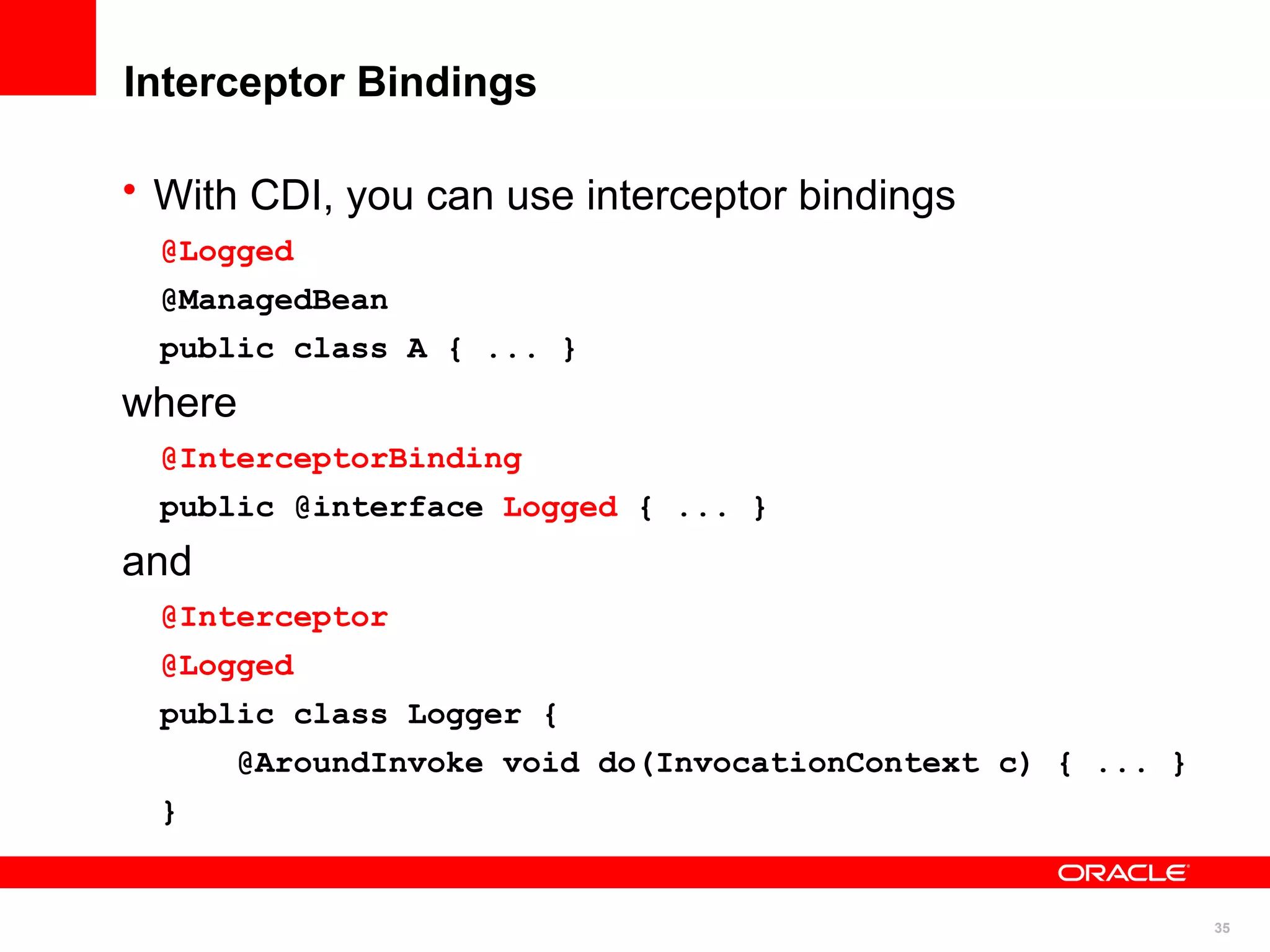
Interceptor Bindings

• With CDI, you can use interceptor bindings
  @Logged
  @ManagedBean
  public class A { ... }
where
  @InterceptorBinding
  public @interface Logged { ... }
and
  @Interceptor
  @Logged
  public class Logger {
      @AroundInvoke void do(InvocationContext c) { ... }
  }


                                                           35
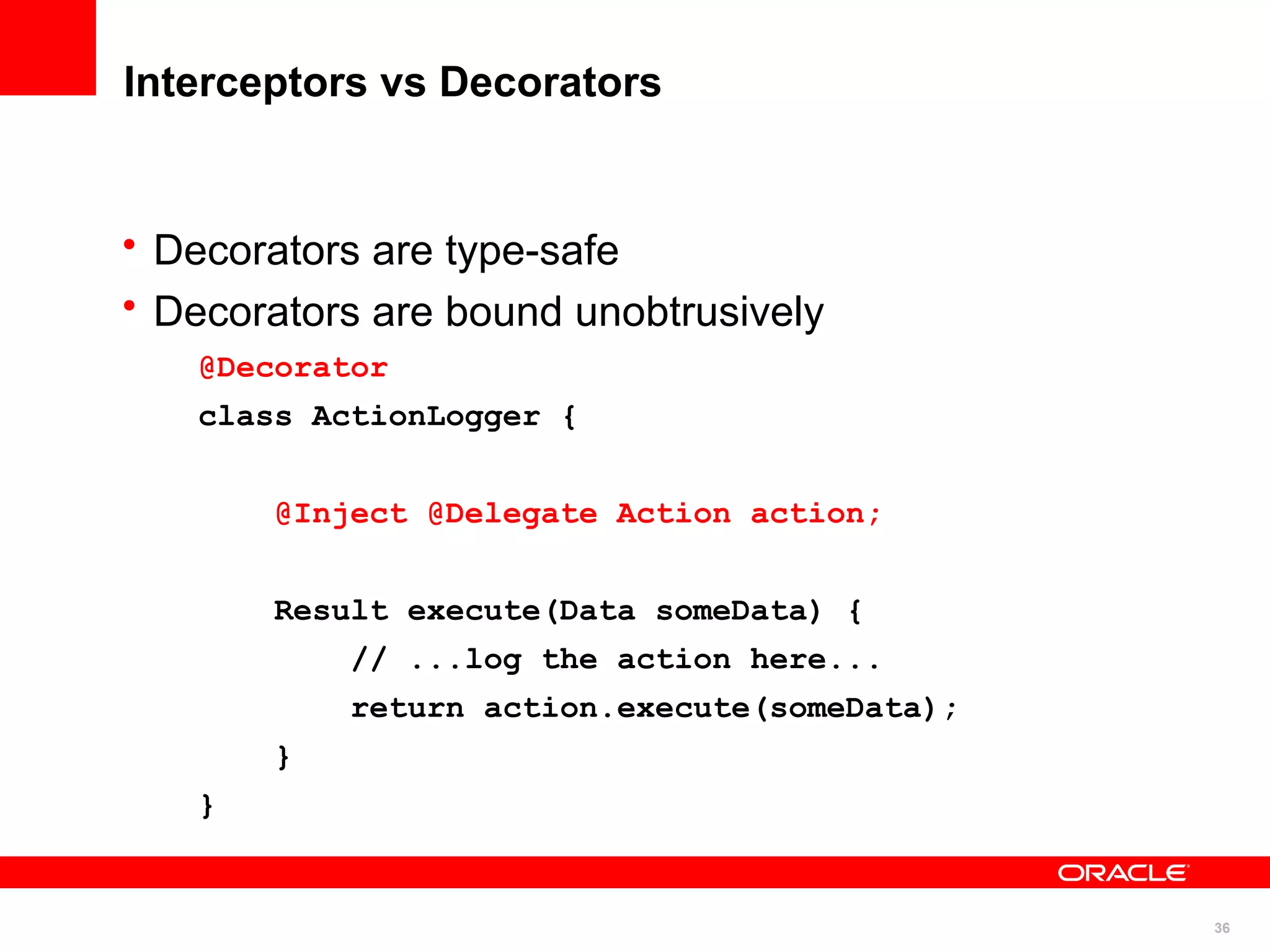
Interceptors vs Decorators


• Decorators are type-safe
• Decorators are bound unobtrusively
   @Decorator
   class ActionLogger {


       @Inject @Delegate Action action;


       Result execute(Data someData) {
           // ...log the action here...
           return action.execute(someData);
       }
   }


                                              36
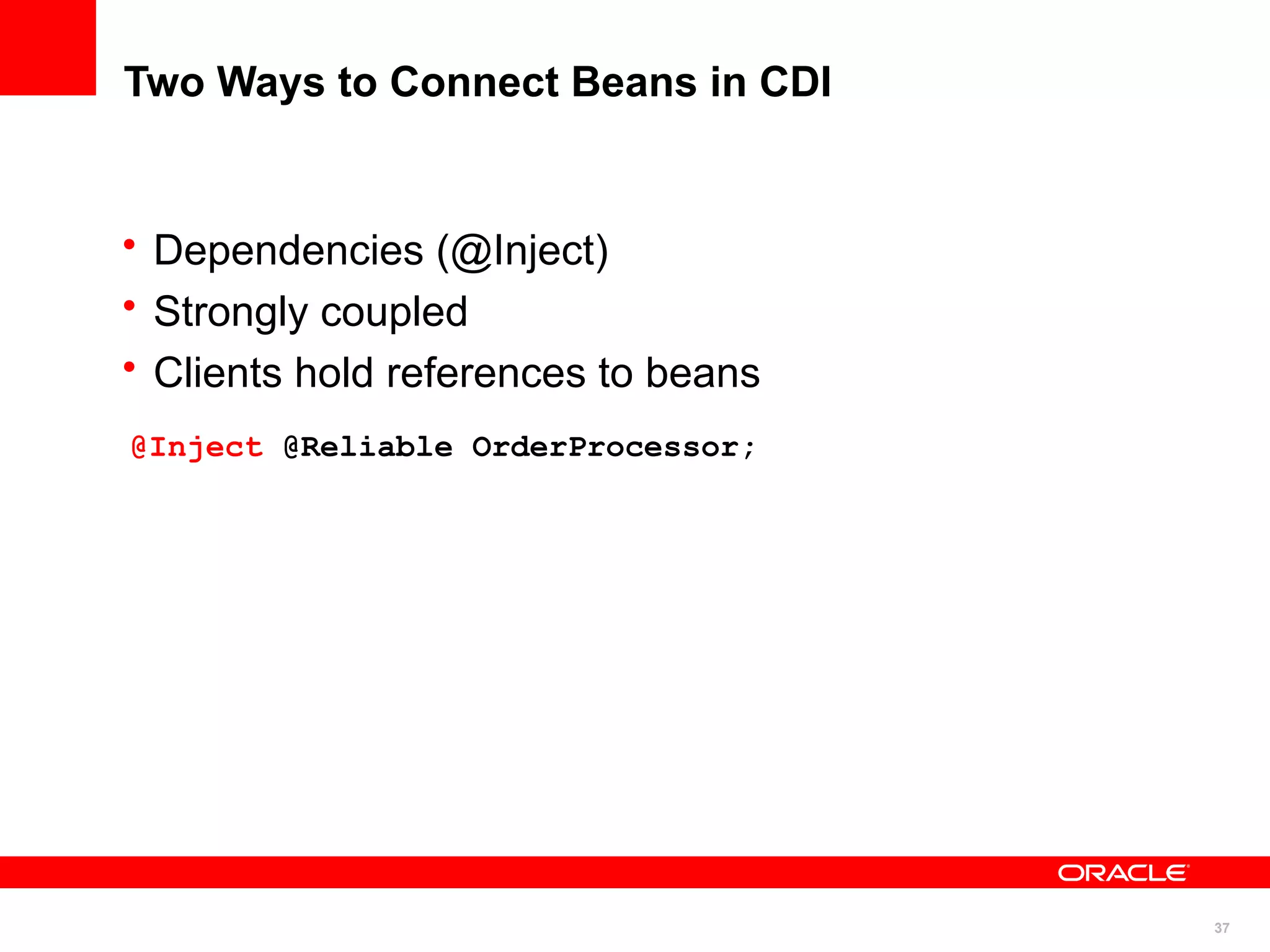
Two Ways to Connect Beans in CDI


• Dependencies (@Inject)
• Strongly coupled
• Clients hold references to beans
@Inject @Reliable OrderProcessor;


                                     37
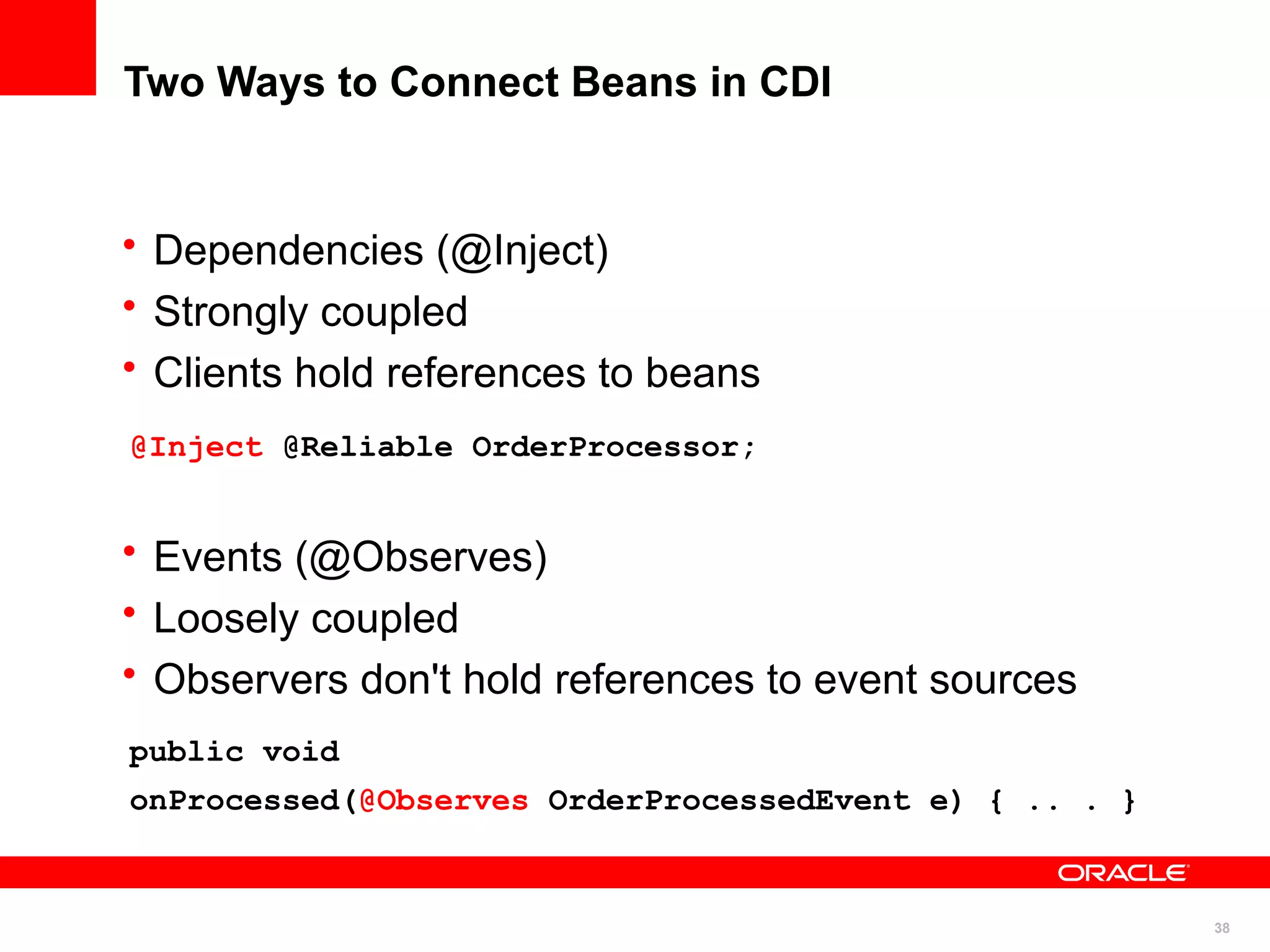
Two Ways to Connect Beans in CDI


• Dependencies (@Inject)
• Strongly coupled
• Clients hold references to beans
@Inject @Reliable OrderProcessor;


• Events (@Observes)
• Loosely coupled
• Observers don't hold references to event sources
public void
onProcessed(@Observes OrderProcessedEvent e) { .. . }


                                                        38
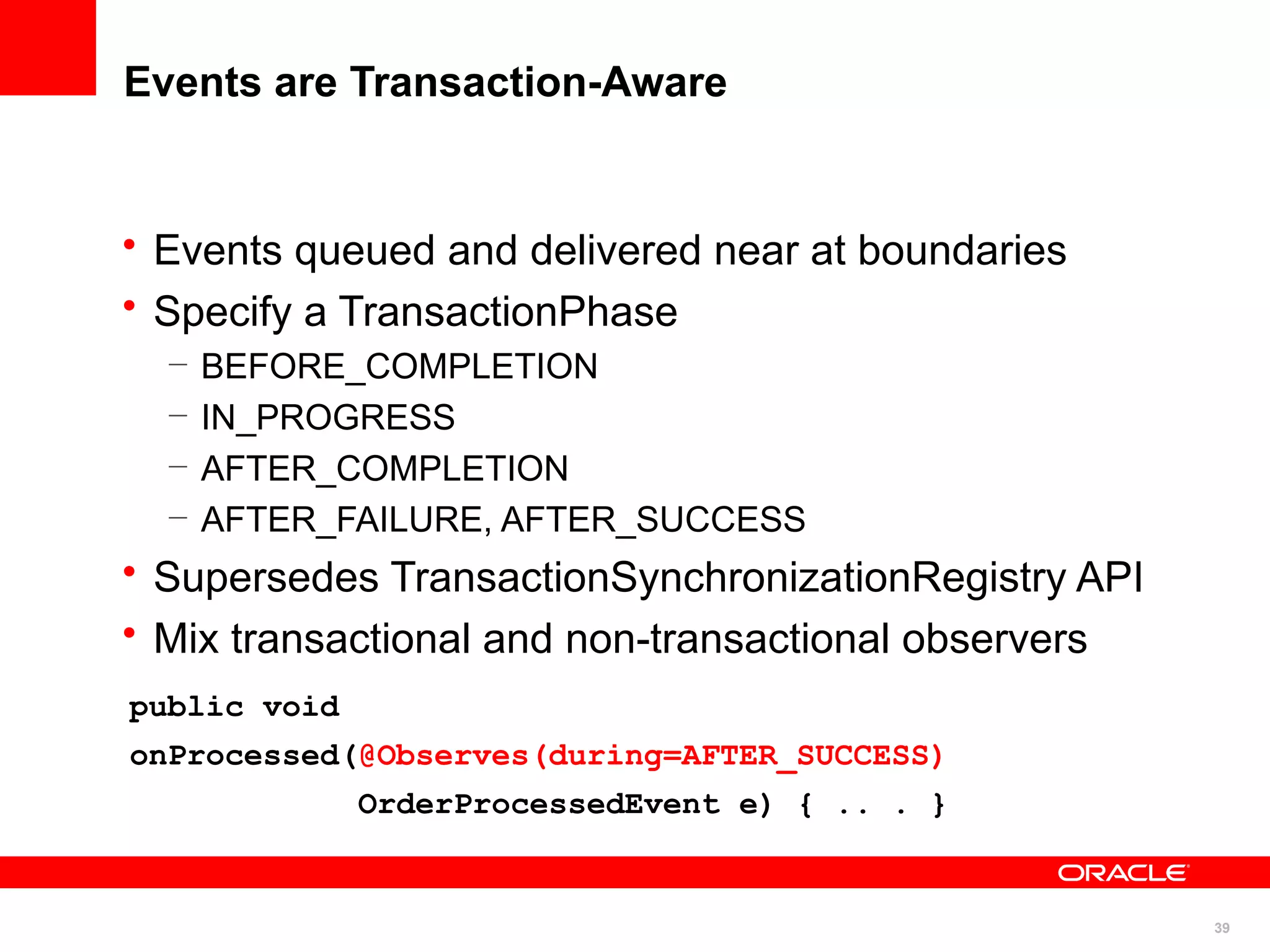
Events are Transaction-Aware


• Events queued and delivered near at boundaries
• Specify a TransactionPhase
  –   BEFORE_COMPLETION
  –   IN_PROGRESS
  –   AFTER_COMPLETION
  –   AFTER_FAILURE, AFTER_SUCCESS
• Supersedes TransactionSynchronizationRegistry API
• Mix transactional and non-transactional observers
public void
onProcessed(@Observes(during=AFTER_SUCCESS)
              OrderProcessedEvent e) { .. . }


                                                      39
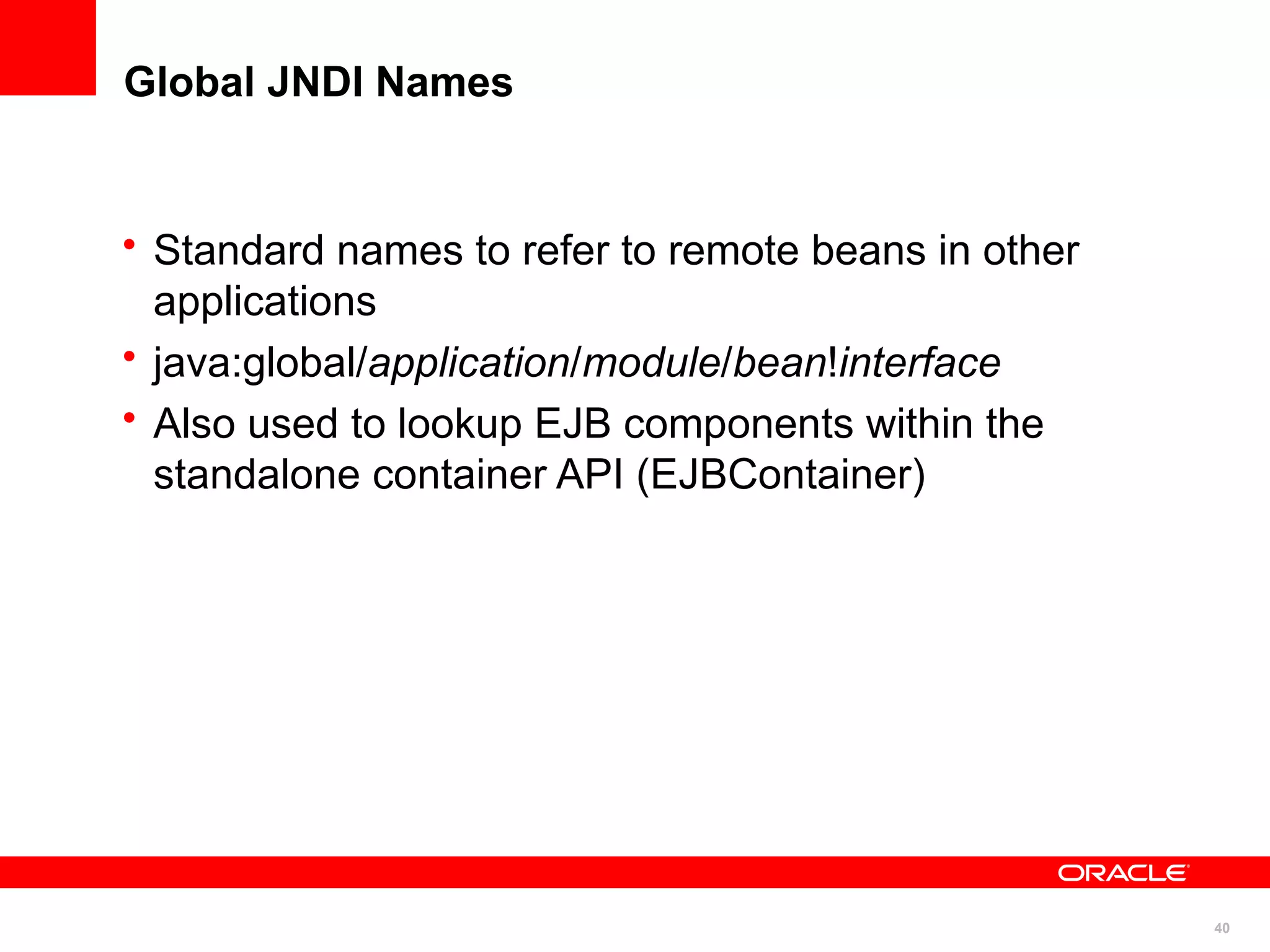
Global JNDI Names


• Standard names to refer to remote beans in other
  applications
• java:global/application/module/bean!interface
• Also used to lookup EJB components within the
  standalone container API (EJBContainer)


                                                     40
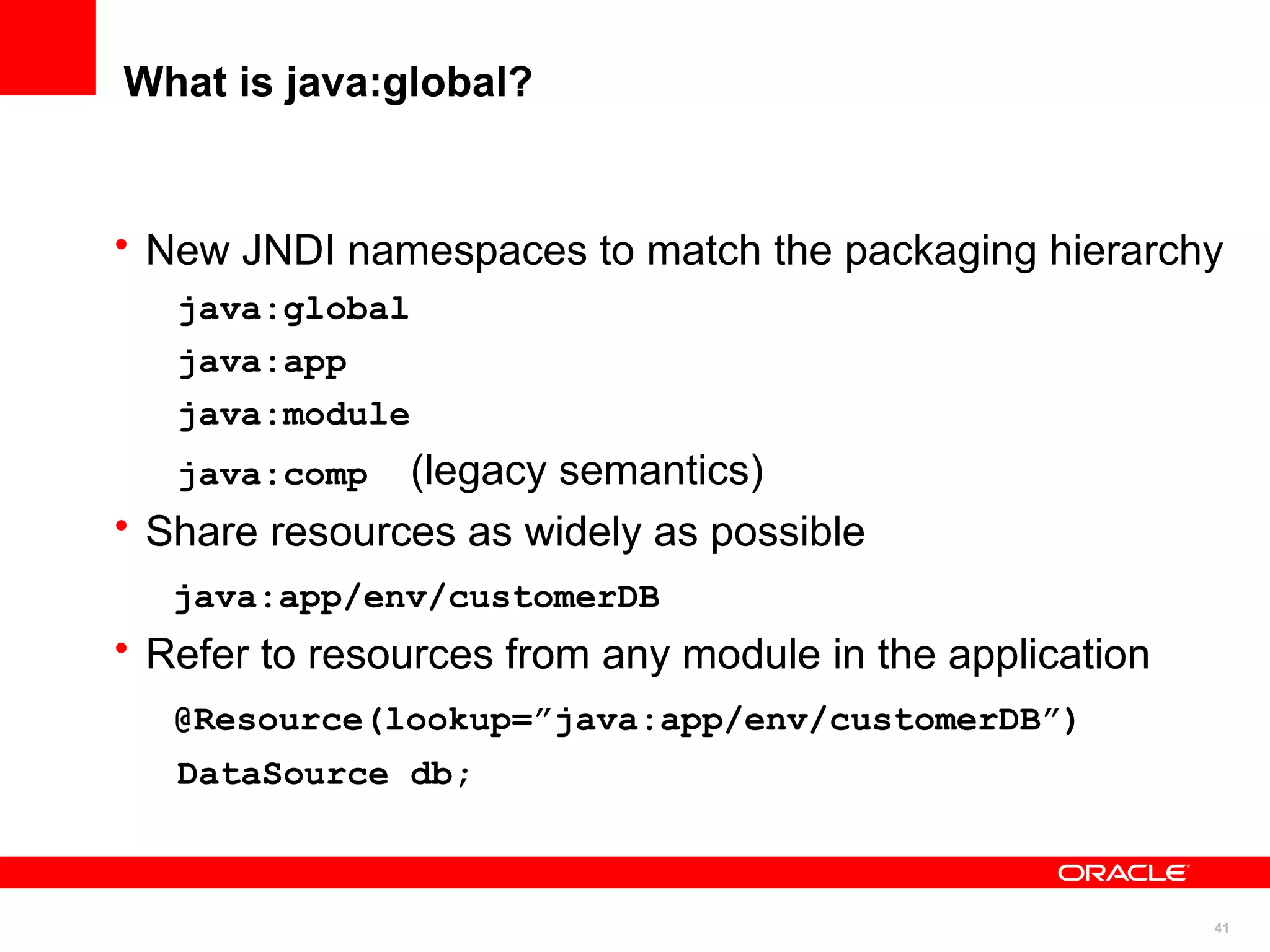
What is java:global?


• New JNDI namespaces to match the packaging hierarchy
   java:global
   java:app
   java:module
   java:comp   (legacy semantics)
• Share resources as widely as possible
   java:app/env/customerDB
• Refer to resources from any module in the application
   @Resource(lookup=”java:app/env/customerDB”)
   DataSource db;


                                                          41
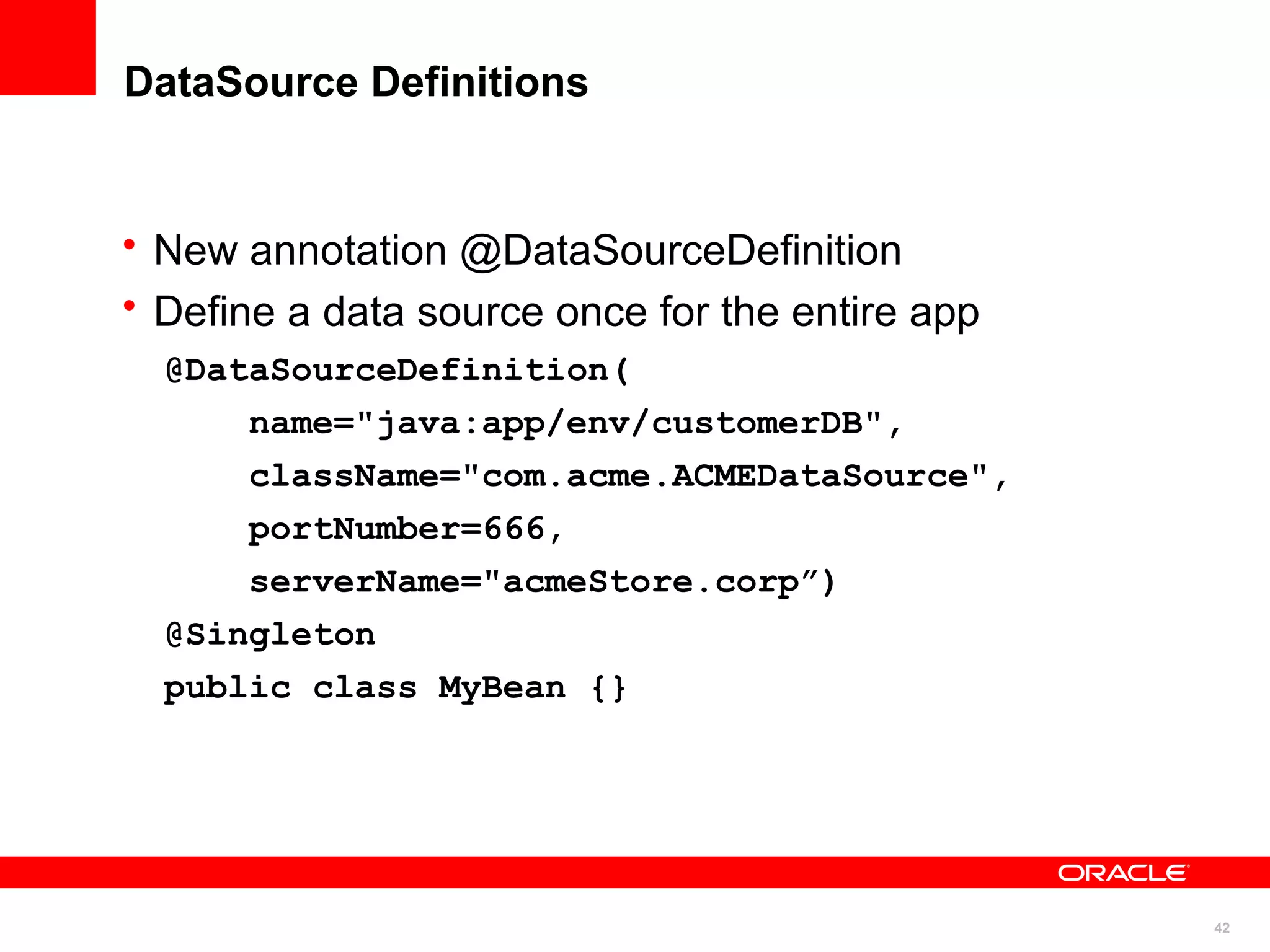
DataSource Definitions


• New annotation @DataSourceDefinition
• Define a data source once for the entire app
  @DataSourceDefinition(
      name="java:app/env/customerDB",
      className="com.acme.ACMEDataSource",
      portNumber=666,
      serverName="acmeStore.corp”)
  @Singleton
  public class MyBean {}


                                                 42
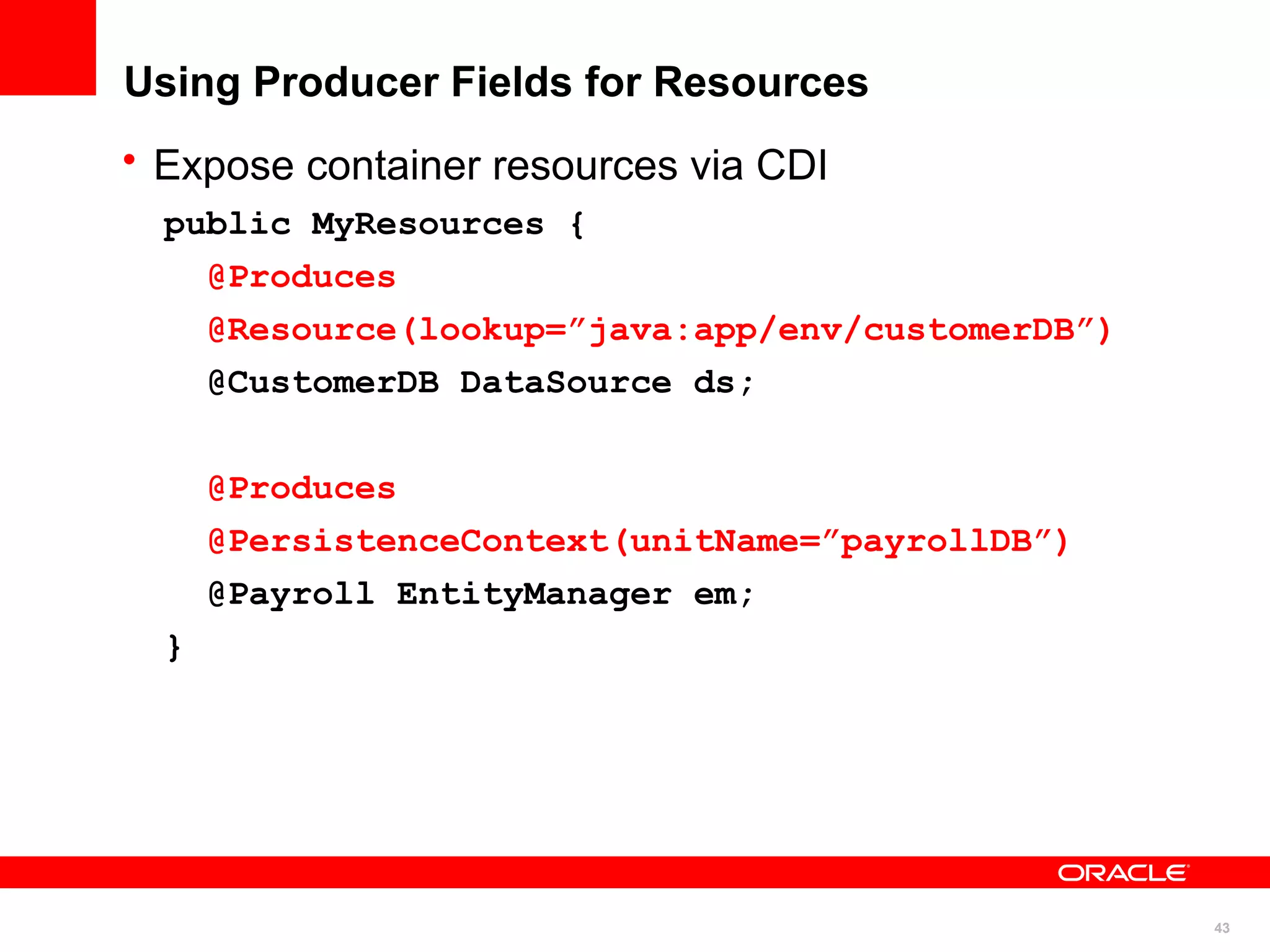
Using Producer Fields for Resources
• Expose container resources via CDI
  public MyResources {
    @Produces
    @Resource(lookup=”java:app/env/customerDB”)
    @CustomerDB DataSource ds;


      @Produces
      @PersistenceContext(unitName=”payrollDB”)
      @Payroll EntityManager em;
  }


                                                  43
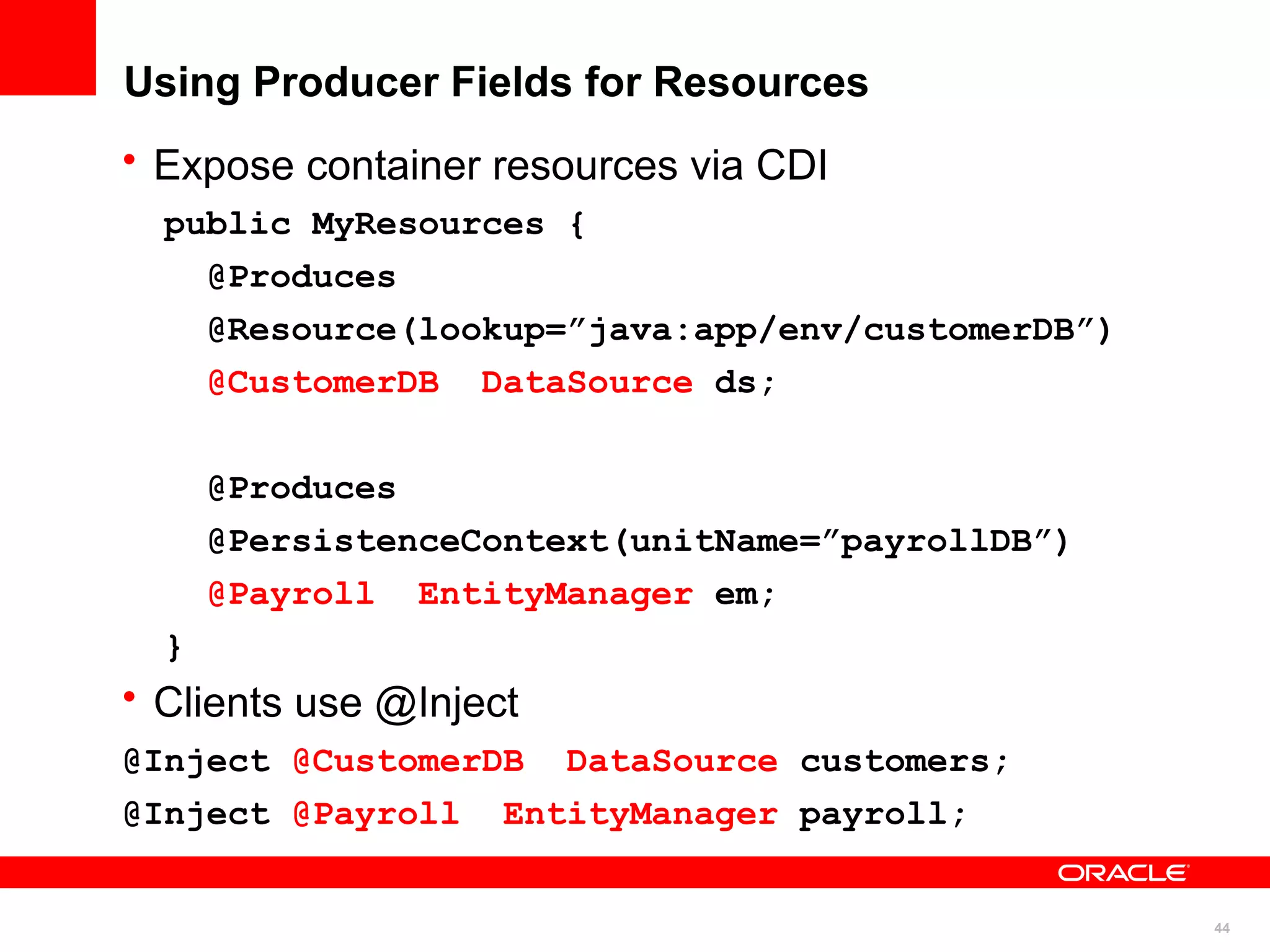
Using Producer Fields for Resources
• Expose container resources via CDI
  public MyResources {
    @Produces
    @Resource(lookup=”java:app/env/customerDB”)
    @CustomerDB DataSource ds;


      @Produces
      @PersistenceContext(unitName=”payrollDB”)
      @Payroll EntityManager em;
  }
• Clients use @Inject
@Inject @CustomerDB DataSource customers;
@Inject @Payroll EntityManager payroll;


                                                  44
The Verdict


              45
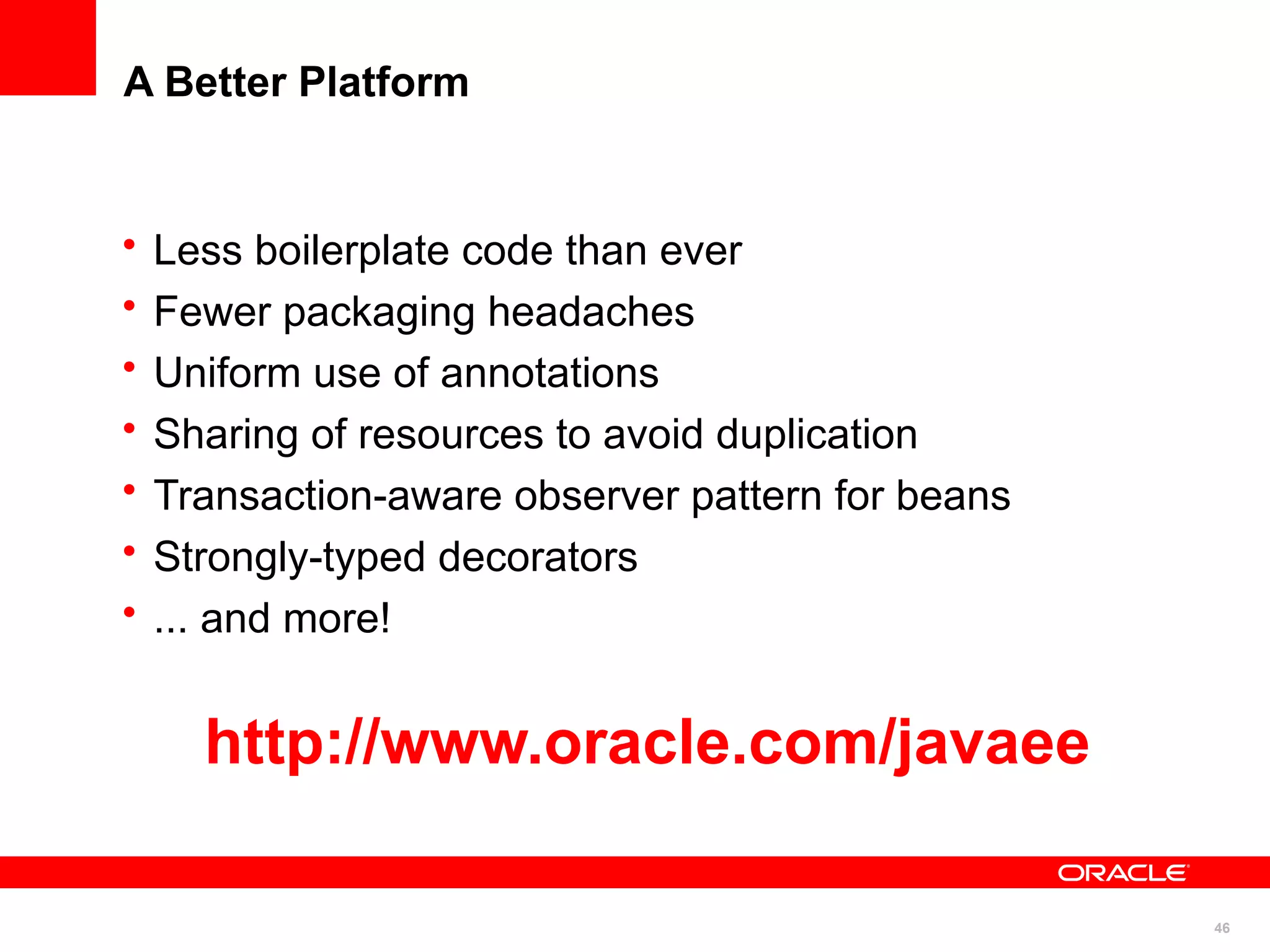
A Better Platform


•   Less boilerplate code than ever
•   Fewer packaging headaches
•   Uniform use of annotations
•   Sharing of resources to avoid duplication
•   Transaction-aware observer pattern for beans
•   Strongly-typed decorators
•   ... and more!


      http://www.oracle.com/javaee

                                                   46
We encourage you to use the newly minted corporate tagline
“Software. Hardware. Complete.” at the end of all your presentations.
This message should replace any reference to our previous corporate
tagline “Oracle Is the Information Company.”


                                                                        47

S313557 java ee_programming_model_explained_dochez

  • 1.
  • 2.
    <Insert Picture Here> TheJava EE 6 Programming Model Explained: How to Write Better Applications Jerome Dochez GlassFish Architect Oracle
  • 3.
    The following isintended to outline our general product direction. It is intended for information purposes only, and may not be incorporated into any contract. It is not a commitment to deliver any material, code, or functionality, and should not be relied upon in making purchasing decisions. The development, release, and timing of any features or functionality described for Oracle’s products remains at the sole discretion of Oracle. 3
  • 4.
    Contents • What's newin Java EE 6? • The core programming model explained • Features you should know about 4
  • 5.
    What's New inJava EE 6 5
  • 6.
    What's new inthe Java EE 6 Platform New and updated components • EJB 3.1 (+Lite) • Managed Beans 1.0 • JPA 2.0 • Interceptors 1.1 • Servlet 3.0 • JSP 2.2 • JSF 2.0 • EL 2.2 • JAX-RS 1.1 • JSR-250 1.1 • Bean Validation 1.0 • JASPIC 1.1 • DI 1.0 • JACC 1.5 • CDI 1.0 • JAX-WS 2.2 • Connectors 1.6 • JSR-109 1.3 6
  • 7.
    Java EE 6Web Profile New, updated and unchanged components • EJB 3.1 Lite • Managed Beans 1.0 • JPA 2.0 • Interceptors 1.1 • Servlet 3.0 • JSP 2.2 • JSF 2.0 • EL 2.2 • JSR-250 1.1 • Bean Validation 1.0 • DI 1.0 • JSR-45 1.0 • CDI 1.0 • JSTL 1.2 • JTA 1.1 7
  • 8.
    What's New? • Several new APIs • Web Profile • Pluggability/extensibility • Dependency injection • Lots of improvements to existing APIs 8
  • 9.
    The Core ProgrammingModel Explained 9
  • 10.
    Core of theJava EE 6 Programming Model JAX-RS 1.1 JSF 2.0 JSP 2.2 B E JSTL 1.2 A N SERVLET 3.0 · EL 2.2 V A L I DI 1.0 · CDI 1.0 · INTERCEPTORS 1.1· JSR-250 1.1 D A T MANAGED BEANS 1.0 EJB 3.1 I O N JPA 2.0 · JTA 1.1 1.0 10
  • 11.
    EJB 3.1 Lite •Session bean programming model – Stateful, stateless, singleton beans • Declarative security and transactions • Annotation-based • Descriptor OK but optional 11
  • 12.
    Managed Beans • Plain Java objects (POJOs) • Foundation for other component types • Fully support injection (@Resource, @Inject) • @PostConstruct, @PreDestroy callbacks • Optional name • Interceptors 12
  • 13.
    Sample Managed Beans @ManagedBean @ManagedBean(“foo”) public class A { public class B { @Resource @Resource A a; DataSource myDB; @PostConstruct public doWork() { init() { ... } // ... } } } 13
  • 14.
    EJB Components areManaged Beans Too! • All managed beans core services available in EJBs • EJB component model extends managed beans • New capabilities engaged on demand via annotations – @Statefull, @Stateless, @Singleton – @TransactionAttribute – @RolesAllowed, @DenyAll, @PermitAll – @Remote – @WebService 14
  • 15.
    Incremental Programming Model • Start with POJOs (@ManagedBean) • Use all the basic services • Turn them into session beans as needed • Take advantage of new capabilities • No changes to (local) clients 15
  • 16.
    Incremental Programming Model • Start with POJOs (@ManagedBean) • Use all the basic services • Turn them into session beans as needed • Take advantage of new capabilities • No changes to (local) clients @ManagedBean public class A { @Resource DataSource myDB; // ... } 16
  • 17.
    Incremental Programming Model • Start with POJOs (@ManagedBean) • Use all the basic services • Turn them into session beans as needed • Take advantage of new capabilities • No changes to (local) clients @Stateful public class A { @Resource DataSource myDB; // ... } 17
  • 18.
    Contexts and DependencyInjection (CDI) • Managed beans on steroids • Opt-in technology on a per-module basis – META-INF/beans.xml – WEB-INF/beans.xml • @Resource only for container-provided objects • Use @Inject for application classes @Inject @LoggedIn User user; 18
  • 19.
    Contexts and DependencyInjection (CDI) • Managed beans on steroids • Opt-in technology on a per-module basis – META-INF/beans.xml – WEB-INF/beans.xml • @Resource only for container-provided objects • Use @Inject for application classes @Inject @LoggedIn User user; The type describes the capabilities (= methods) 19
  • 20.
    Contexts and DependencyInjection (CDI) • Managed beans on steroids • Opt-in technology on a per-module basis – META-INF/beans.xml – WEB-INF/beans.xml • @Resource only for container-provided objects • Use @Inject for application classes @Inject @LoggedIn User user; Qualifiers describe qualities/characteristics/identity. 20
  • 21.
    APIs That WorkBetter Together Example: Bean Validation • Bean Validation integrated in JSF, JPA • All fields on a JSF page validated during the “process validations” stage • JPA entities validated at certain lifecycle points (pre- persist, post-update, pre-remove) • Low-level validation API supports equivalent integration with other frameworks/APIs 21
  • 22.
    Uniformity Combinations of annotations“just work” • Example: JAX-RS resource classes are POJOs • Use JAX-RS-specific injection capabilities • But you can turn resource classes into managed beans or EJB components... • ... and use all new services! 22
  • 23.
    JAX-RS Sample Using JAX-RS injection annotations @Path(“root”) public class RootResource { @Context UriInfo ui; public RootResource() { ... } @Path(“{id}”) public SubResource find(@PathParam(“id”) String id) { return new SubResource(id); } } 23
  • 24.
    JAX-RS Sample As a managed bean, using @Resource @Path(“root”) @ManagedBean public class RootResource { @Context UriInfo ui; @Resource DataSource myDB; public RootResource() { ... } @Path(“{id}”) public SubResource find(@PathParam(“id”) String id) { return new SubResource(id); } } 24
  • 25.
    JAX-RS Sample As an EJB, using @Resource and security annotations @Path(“root”) @Stateless public class RootResource { @Context UriInfo ui; @Resource DataSource myDB; public RootResource() { ... } @Path(“{id}”) @RolesAllowed(“manager”) public SubResource find(@PathParam(“id”) String id) { return new SubResource(id); } } 25
  • 26.
    JAX-RS Sample As a CDI bean, using @Inject and scope annotations @Path(“root”) @ApplicationScoped public class RootResource { @Context UriInfo ui; @Inject @CustomerDB DataSource myDB; @Inject @LoggedIn User user; public RootResource() { ... } @Path(“{id}”) public SubResource find(@PathParam(“id”) String id) { // ... } } 26
  • 27.
    How to ObtainUniformity Combinations of annotations “just work” • Annotations are additive • New behaviors refine pre-existing ones • Strong guidance for new APIs ➱ Classes can evolve smoothly 27
  • 28.
    Extensibility • Level playingfield for third-party frameworks • Pluggability contracts make extensions look like built- in technologies • Two main sets of extension points: – Servlet 3.0 pluggability – CDI extensions 28
  • 29.
    Servlet 3.0 Pluggability •Drag-and-drop model • Web frameworks as fully configured libraries – contain “fragments” of web.xml – META-INF/web-fragment.xml • Extensions can register listeners, servlets, filters dynamically • Extensions can discover and process annotated classes @HandlesTypes(WebService.class) public class MyWebServiceExtension implements ServletContanerInitializer { ... } 29
  • 30.
    Extensibility in CDI •Drag-and-drop model here too • Bean archives can contain reusable sets of beans • Extensions can process any annotated types and define beans on-the-fly • Clients only need to use @Inject – No XYZFactoryManagerFactory horrors! @Inject @Reliable PayBy(CREDIT_CARD) PaymentProcessor; 30
  • 31.
    Using Extensibility • Lookfor ready-to-use frameworks, extensions • Refactor your libraries into reusable, autoconfigured frameworks • Take advantage of resource jars • Package reusable beans into libraries 31
  • 32.
    Extensive Tooling fromSchema to GUI NetBeans 6.9 • Database tables to entity classes • Entity classes to session beans • Entity classes to JAX-RS resources • Entity classes to JSF front-end • JAX-RS resources to JavaScript client 32
  • 33.
    Features You ShouldKnow About 33
  • 34.
    Interceptors and ManagedBeans • Interceptors can be engaged directly @Interceptors(Logger.class) @ManagedBean public class A { ... } • This kind of strong coupling is a code smell 34
  • 35.
    Interceptor Bindings • WithCDI, you can use interceptor bindings @Logged @ManagedBean public class A { ... } where @InterceptorBinding public @interface Logged { ... } and @Interceptor @Logged public class Logger { @AroundInvoke void do(InvocationContext c) { ... } } 35
  • 36.
    Interceptors vs Decorators •Decorators are type-safe • Decorators are bound unobtrusively @Decorator class ActionLogger { @Inject @Delegate Action action; Result execute(Data someData) { // ...log the action here... return action.execute(someData); } } 36
  • 37.
    Two Ways toConnect Beans in CDI • Dependencies (@Inject) • Strongly coupled • Clients hold references to beans @Inject @Reliable OrderProcessor; 37
  • 38.
    Two Ways toConnect Beans in CDI • Dependencies (@Inject) • Strongly coupled • Clients hold references to beans @Inject @Reliable OrderProcessor; • Events (@Observes) • Loosely coupled • Observers don't hold references to event sources public void onProcessed(@Observes OrderProcessedEvent e) { .. . } 38
  • 39.
    Events are Transaction-Aware •Events queued and delivered near at boundaries • Specify a TransactionPhase – BEFORE_COMPLETION – IN_PROGRESS – AFTER_COMPLETION – AFTER_FAILURE, AFTER_SUCCESS • Supersedes TransactionSynchronizationRegistry API • Mix transactional and non-transactional observers public void onProcessed(@Observes(during=AFTER_SUCCESS) OrderProcessedEvent e) { .. . } 39
  • 40.
    Global JNDI Names •Standard names to refer to remote beans in other applications • java:global/application/module/bean!interface • Also used to lookup EJB components within the standalone container API (EJBContainer) 40
  • 41.
    What is java:global? •New JNDI namespaces to match the packaging hierarchy java:global java:app java:module java:comp (legacy semantics) • Share resources as widely as possible java:app/env/customerDB • Refer to resources from any module in the application @Resource(lookup=”java:app/env/customerDB”) DataSource db; 41
  • 42.
    DataSource Definitions • Newannotation @DataSourceDefinition • Define a data source once for the entire app @DataSourceDefinition( name="java:app/env/customerDB", className="com.acme.ACMEDataSource", portNumber=666, serverName="acmeStore.corp”) @Singleton public class MyBean {} 42
  • 43.
    Using Producer Fieldsfor Resources • Expose container resources via CDI public MyResources { @Produces @Resource(lookup=”java:app/env/customerDB”) @CustomerDB DataSource ds; @Produces @PersistenceContext(unitName=”payrollDB”) @Payroll EntityManager em; } 43
  • 44.
    Using Producer Fieldsfor Resources • Expose container resources via CDI public MyResources { @Produces @Resource(lookup=”java:app/env/customerDB”) @CustomerDB DataSource ds; @Produces @PersistenceContext(unitName=”payrollDB”) @Payroll EntityManager em; } • Clients use @Inject @Inject @CustomerDB DataSource customers; @Inject @Payroll EntityManager payroll; 44
  • 45.
  • 46.
    A Better Platform • Less boilerplate code than ever • Fewer packaging headaches • Uniform use of annotations • Sharing of resources to avoid duplication • Transaction-aware observer pattern for beans • Strongly-typed decorators • ... and more! http://www.oracle.com/javaee 46
  • 47.
    We encourage youto use the newly minted corporate tagline “Software. Hardware. Complete.” at the end of all your presentations. This message should replace any reference to our previous corporate tagline “Oracle Is the Information Company.” 47