-
-
Advolve
-
landing page
-
iterative tree
-
tribev2 output model
-
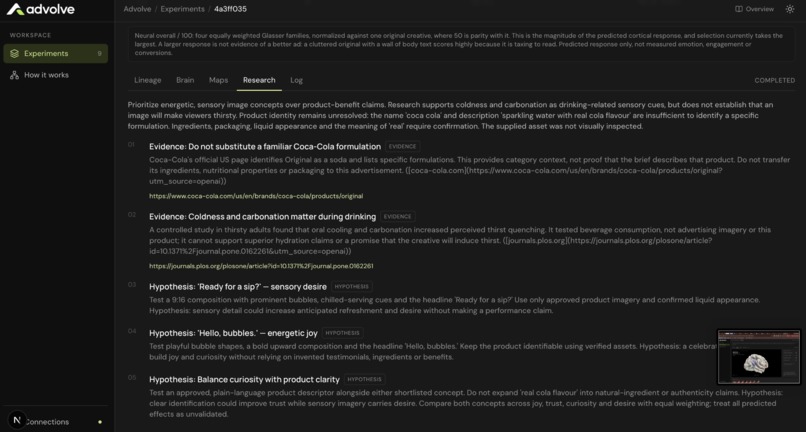
gpt-6 astra research


Advolve
A creative experimentation pipeline for merchants built to turn product knowledge into ads and explore better directions.
Inspiration
A/B testing helps merchants learn what resonates, but every experiment takes time, traffic, and money. Small merchants already manage products, inventory, and customer support. Marketing asks them to become researchers, copywriters, designers, and analysts too.
We built Advolve to put creative testing tools directly in their hands through the power of evolution and evaluation, especially when they do not yet have an established customer base or the capital for repeated paid experiments. Merchants can explore ideas, inspect feedback, and iterate themselves, building the knowledge and confidence to support their own growth.
What it does
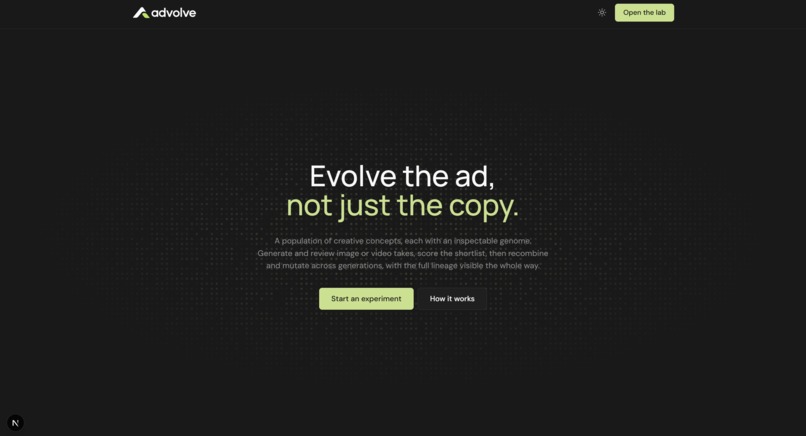
Advolve starts with an image and a product brief, then creates different versions of the ad and pits them against each other to try and discover good directions for the ad through an evolutionary algorithm.
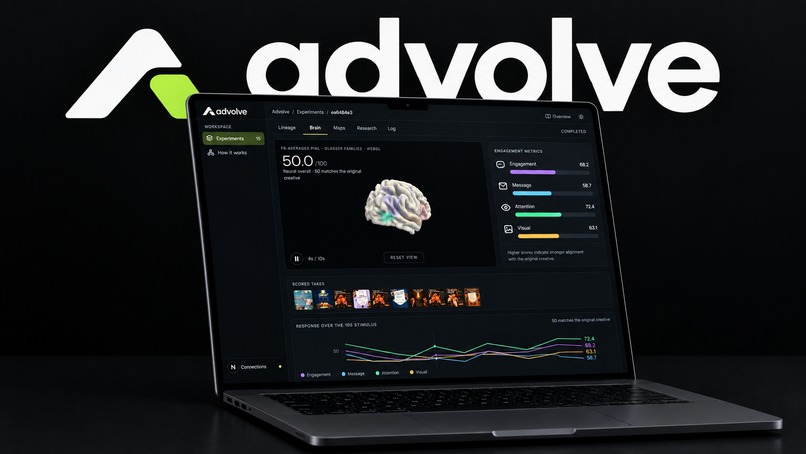
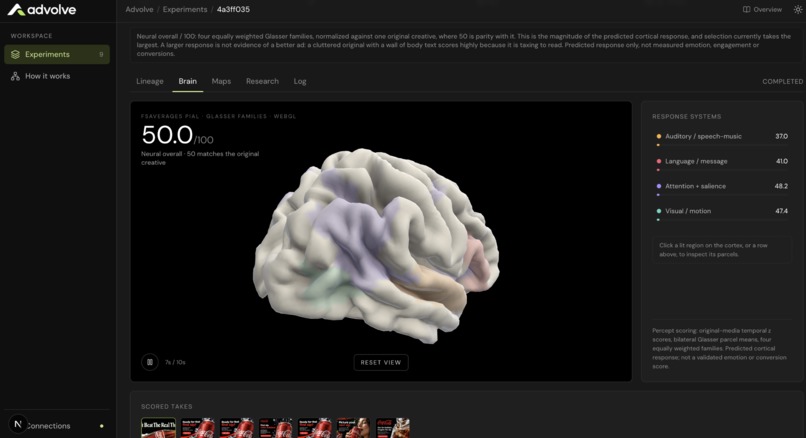
After generating variations on the base ad/product, they are scored by TRIBE v2, which predicts brain responses to the advertisement. The algorithm keeps the highest-scoring ad and chooses strong candidates to become parents, this is where the "evolution" happens.
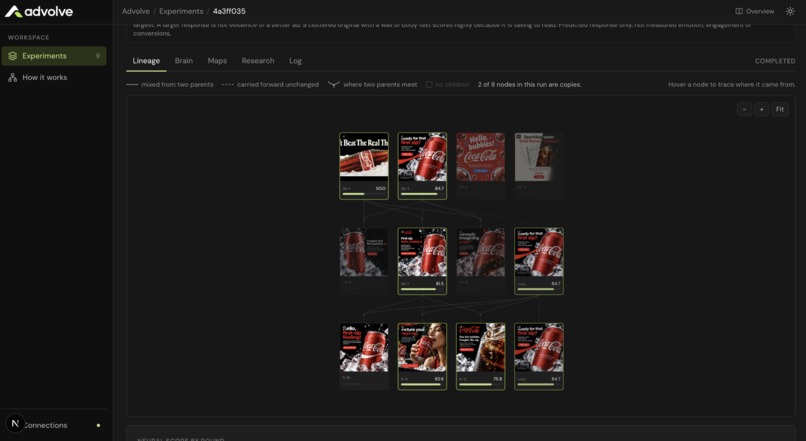
It then mixes the parents’ creative traits—such as their hook, visual style, colour palette, and call to action—to create new “children.” Each child also receives one trait change to explore a fresh direction.
The cycle repeats: create variations → review and score → select parents → mix and create again. Merchants can compare results across rounds and continue experimenting until they find a direction they want to take into market testing, and at the same time over multiple rounds, the advertisements converge towards an optimal neural response that can be used as a baseline for viewer attention/effectiveness.
A family tree records each ad’s parents, changes, and scores, making the process easy to follow.
How we built it
TRIBE v2 supplies the evolutionary feedback. It uses visual, audio, and language information to predict patterns of cortical activity over time. We organize those predictions using the Glasser atlas—a map of brain regions—and summarize four groups: auditory, language, attention, and visual motion.
Cloudflare makes the experience accessible. It hosts the application and provides the infrastructure for long-running experiments. Workers serve the API, Workflows coordinate durable stages, Durable Objects hold run state, R2 stores media, and D1 indexes experiments. These stage boundaries also support pauses where merchants can choose which candidates should breed.
OpenAI supports the creative process. Its models research the product with source provenance, write copy within the traits selected by our algorithm, generate image ads, and inspect the finished media. Reviewing the actual pixels helps merchants catch production mistakes and unsupported claims before distributing a creative.
Baseten provides the neural inference. It serves Meta’s TRIBE v2 on remote GPUs, so merchants can access the model without managing hardware. TRIBE v2 predicts cortical responses to media; we summarize those predictions across four families of Glasser brain parcels. Still images become controlled 10-second clips, and candidates are evaluated against one fixed original-media baseline. Cached results avoid repeating completed inference.
The interface uses Next.js, React, and Tailwind CSS. Pika’s Seedance generates video ads, while DeepGaze IIE supplies predicted attention for the mapping pipeline. Node.js supports local hosting, and Python handles inference workloads.
Challenges we ran into
The first challenge was making the loop practical to run.
TRIBE inference takes minutes. Batching several creatives into one request exceeded gateway timeouts, so we switched to one stimulus per request with bounded concurrency. Caching also became essential: repeating expensive work would quickly make experimentation frustrating.
We also tried training an emotional-response decoder using TRIBE features and human ratings from the OASIS dataset.
Preparing those features was slow because every training image required inference. The resulting decoder then performed worse on held-out images than simply predicting the average rating.
We archived the experiment. A reliable decoder remains worth exploring, but collecting suitable data and validating it properly was beyond the hackathon’s scope.
Accomplishments that we're proud of
We built an evolutionary loop that generates real media, reviews it, scores selected candidates, and uses those results to produce another generation.
The family tree makes that process visible. A merchant can follow an idea from its first version through its descendants and use that history to guide the next experiment.
We are also proud that OpenAI, Baseten, and Cloudflare each serve a concrete merchant need: creative assistance, access to GPU inference, and a hosted workflow they can use without managing the infrastructure.
What we learned
Helping merchants means giving them the tools and context to make their own decisions. A score becomes more useful when it comes with the creative, its history, and an explanation of its limits.
TRIBE provides an experimental prediction of cortical response. Whether a creative connects with customers still needs human evaluation and market testing.
We also learned that latency, inference cost, and recovery behavior shape the product. Each affects how affordably and confidently a merchant can keep experimenting.
What's next for Advolve
- Import products and assets directly from merchant storefronts.
- Improve retries and recovery while preserving completed work.
- Validate model scores against human judgments.
- Reduce inference costs so merchants can explore more candidates.
- Give merchants more control over creative constraints and selection between rounds.


Log in or sign up for Devpost to join the conversation.