-
-
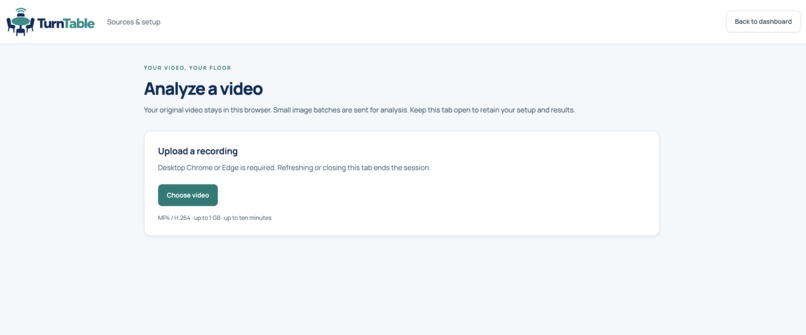
Deployment
-
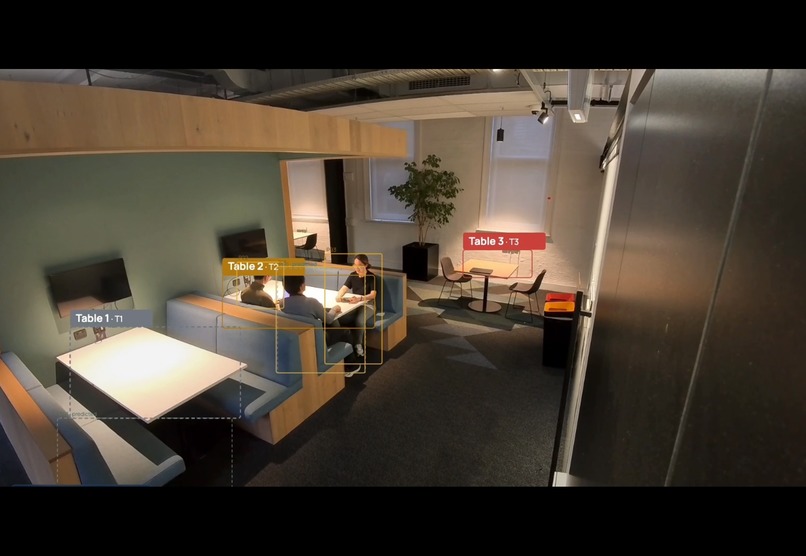
Result: Each table has a coloured box and label. Green means ready to serve; yellow means occupied; red means need cleaning


Project TurnTable
Inspiration
The idea for TurnTable came from our own dining experiences.
We've often arrived at a restaurant, seen a long queue, and been told the wait could be 30 minutes or more. Sometimes, we simply became impatient and decided to give up and eat somewhere else.
This made us think about the problem from both sides.
For customers, long and uncertain waiting times can be frustrating enough to make them leave. For restaurants, every customer who walks away because of the queue represents a potential loss of revenue.
At the same time, we noticed that restaurant seating is not always used as efficiently as it could be. Some tables may become available without being noticed immediately, while other tables may be assigned in a way that creates longer waits for future customers.
This led us to ask:
What if a restaurant could understand what is happening on its dining floor in real time and use AI to make smarter seating decisions?
That question became the starting point for TurnTable — an AI-powered restaurant seating and waitlist management system designed to reduce unnecessary waiting, improve table utilisation, and help restaurants serve more customers with the space they already have.
What it does
TurnTable is a vision-to-state engine that transforms existing venue security camera feeds into real-time operational information.
It detects when tables move between different stages of the dining lifecycle and automatically triggers the next operational action.
The goal is to eliminate the gap between:
A customer leaving a table → staff noticing it → the table being cleaned → the next customer being seated.
TurnTable achieves this without requiring additional screens, sensors, or major changes to the restaurant's existing workflow.
Instead, it works quietly in the background using infrastructure that many venues already have.
Our Solution — End-to-End Execution
TurnTable runs continuously in the background:
1. Ingests RTSP Camera Feeds
TurnTable connects to existing IP security cameras through RTSP streams and processes the video locally.
Instead of treating cameras purely as security devices, TurnTable turns them into operational sensors for the restaurant floor.
2. Tracks Table States Using a State Machine
Computer vision detects activity around each table and converts raw video observations into meaningful operational states.
Each table progresses through three core states:
Ready to serve → Occupied → Needs cleaning
This state-machine approach helps prevent unstable decisions caused by individual frames or temporary movement around a table.
For example, someone simply walking past a table should not immediately cause its state to change.
3. Dispatches Silent Automation
Once the system confirms a state change, TurnTable can automatically trigger operational actions.
For example:
- If
Needs cleaningis confirmed for more than 60 seconds, TurnTable can alert a floor runner through a smartwatch, pager, or staff notification system. - Once the table reaches
Ready to serve, TurnTable can trigger a webhook to an existing table-management platform such as SevenRooms or Resy. - The system can then notify the next suitable guest on the waitlist or alert the host that the table is ready.
This reduces the need for staff to constantly scan the restaurant floor manually.
4. Interactive Live Operations Dashboard
TurnTable provides restaurant staff with a live digital floor plan showing the state of every monitored table.
The dashboard includes:
- Live SVG restaurant floor plan
- Real-time table-state synchronisation
- Tables ready for service
- Occupied tables
- Recently vacated tables
- Live camera views for selected tables
- Operational alerts
The objective is to give staff a single, clear view of what is happening across the venue.
Challenges we ran into
Technical Challenges: Training the model
One of our biggest challenges was obtaining suitable data.
Restaurant-table occupancy is a highly specific computer-vision problem. Public datasets do not always reflect the conditions found in real restaurants, such as:
- Occlusion between customers
- Different camera angles
- Low or changing lighting
- Staff walking between tables
- Customers standing temporarily
- Different table layouts and capacities
Accomplishments that we're proud of
We're proud that TurnTable developed from a simple idea about restaurant waiting times into an end-to-end operational system.
During the hackathon, we were able to bring together multiple components:
- Computer-vision-based occupancy detection
- Table-level region monitoring
- A temporal state machine
- Real-time state synchronisation
- A live restaurant floor dashboard
- A deployable web application
We focused on showing how computer vision could become part of an actual restaurant workflow.
We are also proud that the solution does not require facial recognition or intrusive customer tracking.
TurnTable only needs to understand one thing: What is happening to the table?
That allows the technology to create operational value while minimising the collection of unnecessary personal information.
What's next for TurnTable
- Integration with a queuing app, which directly benefits customers with a real-time tracker of their waiting time
- Solidified our position in the market by developing advanced features
Built With
- claude
- css
- python
- typescript


Log in or sign up for Devpost to join the conversation.