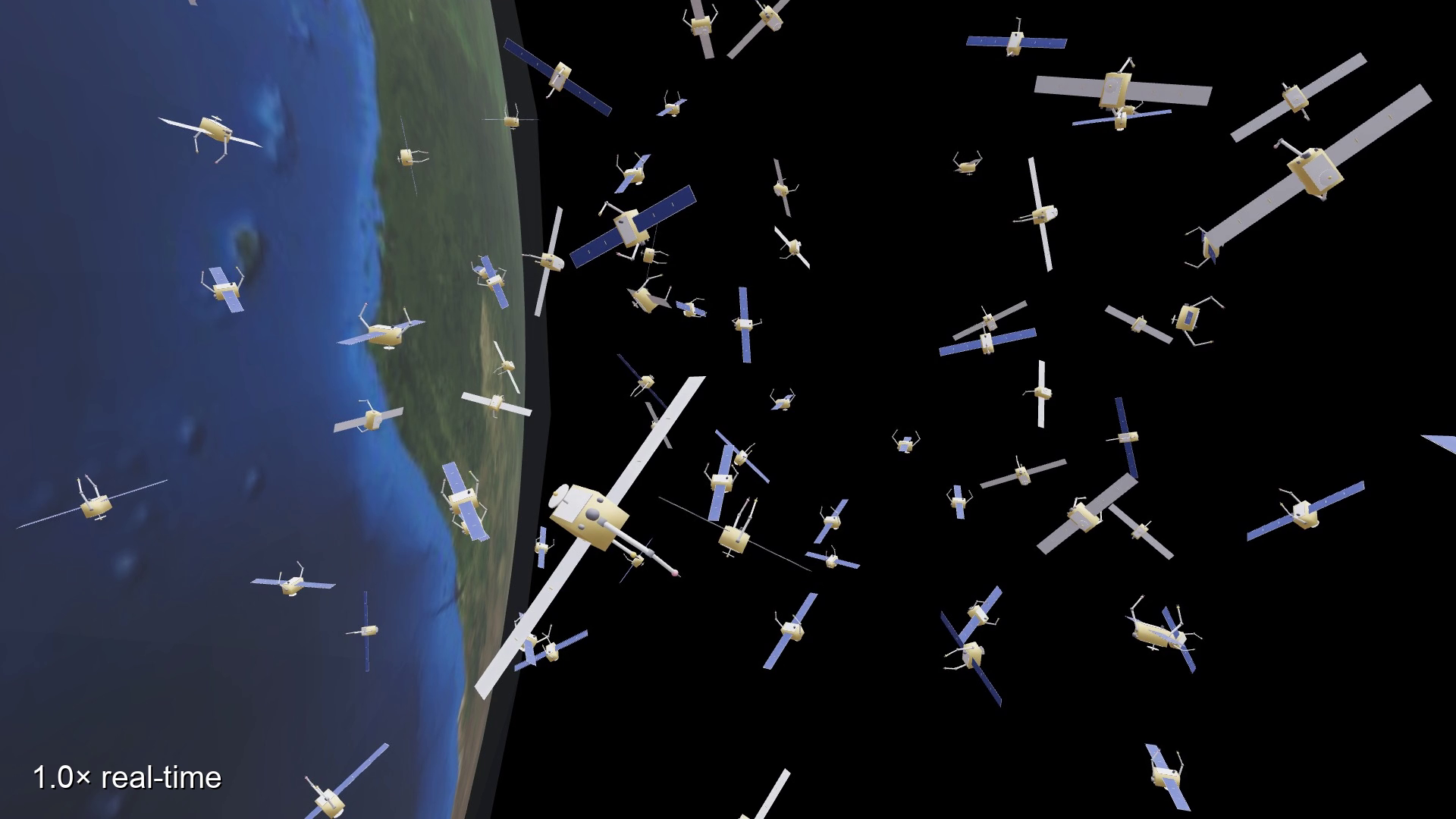
Coupled orbital and multibody dynamics for space robotics.
mjorbit extends MuJoCo with a propagated reference orbit and spacecraft interaction with gravity gradients, J2, drag, solar radiation pressure, and magnetic fields. It supports articulated spacecraft, contact, spacecraft actuators, and parallel rollouts for control and learning.
Project page · Paper · Documentation · Examples · Paper reproduction
Install Pixi, then run:
git clone https://github.com/johnzhang3/mjorbit.git
cd mjorbit
pixi install
pixi run viewer --task free_drift
Open the printed URL, normally http://localhost:8080, to see a dual-arm spacecraft orbiting Earth. Use Pause, Reset, and the task dropdown to explore. The initial installation builds the C++ extension; Pixi supplies the compiler and build tools. No GPU or trained checkpoint is needed for this demo.
For a numerical example without a browser:
pixi run example-minimal
pixi run example-free-drift  # comparison with a Clohessy–Wiltshire reference
Python 3.11–3.12 is supported. The CPU environments cover Linux x86-64 and macOS Intel/Apple Silicon. GPU and RL environments target Linux x86-64 with an NVIDIA GPU. See installation for optional environments and instructions for using mjorbit from another project.
import numpy as np

from mjorbit import MjoModel, OrbitInit, mjo_forward, mjo_step
from mjorbit.constants import GM_EARTH, R_EARTH
from mjorbit.testdata import FREE_BODY_XML

radius_km = R_EARTH + 400.0
model = MjoModel.from_xml_path(FREE_BODY_XML, mj_timestep=0.01)
data = model.make_data(
    orbit=OrbitInit(
        R_eci=[radius_km, 0.0, 0.0],
        V_eci=[0.0, np.sqrt(GM_EARTH / radius_km), 0.0],
    )
)
data.qpos[:3] = [10.0, 0.0, 0.0]  # offset from the chief, in meters
mjo_forward(model, data)

for _ in range(100):
    mjo_step(model, data)

print(f"Time: {data.time:.2f} s")
print("Chief position (km):", data.orbit.R_eci)
print("Spacecraft offset (m):", data.qpos[:3])
This advances one second. The chief moves along its orbit while the spacecraft stays approximately 10 m away. The quick-start tutorial explains the XML model, initial conditions, and output.
Frames and units: OrbitInit and data.orbit use absolute ECI position in
km and velocity in km/s. MuJoCo world is a chief-centered local inertial frame
with axes parallel to ECI; qpos and qvel use SI offsets. LVLH is a derived
rotating frame. Spacecraft actuator commands use SI units (N·m, A·m², N,
rad/s); see frames and units before applying forces or torques.
Choose a backend explicitly by import path. Both use the
MjoModel → model.make_data(...) → mjo_step(...) workflow.
| Capability | mjorbit |
mjorbit_warp |
|---|---|---|
| Simulation | Float64 CPU reference; threaded rollouts | Batched device simulation with nworld=N |
| Browser viewer and MPPI planner | Supported | Use the CPU viewer; GPU/RL examples have separate workflows |
| Reaction wheels, magnetorquers, thrusters | Supported | Supported |
| Control moment gyros | Supported | Not implemented |
| Noisy sensor measurement namespace | Supported | Not implemented; native sensor buffers are available |
| Public NumPy state | Live runtime buffers | Host mirrors; explicit upload/pull for state changes and reads |
pixi install -e warp
pixi run -e warp example-batched
The complete batched example uses a bundled model and
shows mjo_upload and mjo_pull. The GPU guide explains shapes,
precision, synchronization, and current limitations.
| Example | Run |
|---|---|
| Free-body drift and analytical comparison | pixi run example-free-drift |
| Floating-base arm reach with MPPI | pixi run example-mppi-arm-reach |
| Dual-arm attitude reorientation | pixi run example-reorient |
| ISS–Soyuz docking | pixi run example-docking |
| Capture and gravity-gradient stabilization | pixi run example-mppi-capture |
| PPO truss pointing | pixi run -e rl ppo-truss-train |
See the example catalog for viewer options, duration, requirements, and training/playback instructions. Experiments contains paper benchmarks and figure generators. Recording tools produce videos from simulated trajectories. These remain in the source repository and source distribution; they are not installed as runtime packages.
Browse the documentation sources, or build a local site:
pixi run -e docs docs-build
pixi run -e docs docs-serve  # http://localhost:8000
pixi run lint
pixi run typecheck
pixi run test
pixi run cpp-test
pixi run package-check # isolated wheel and source-distribution installsSee CONTRIBUTING.md for development guidance and RELEASING.md for release checks.
If you use mjorbit in your research, please cite mjorbit: A Simulation Framework for Space Robotics. Software and preferred paper citation metadata are in CITATION.cff.
@article{zhang2026mjorbit,
  title   = {mjorbit: A Simulation Framework for Space Robotics},
  author  = {Zhang, John Z. and Verhagen, Joris and Vega, Fausto
             and McKeen, Patrick and Manchester, Zachary},
  journal = {arXiv preprint arXiv:2609.08010},
  year    = {2026},
  eprint  = {2609.08010},
  archivePrefix = {arXiv},
  primaryClass = {cs.RO},
  url     = {https://arxiv.org/abs/2609.08010}
}
Original project code and documentation are licensed under Apache 2.0. Third-party assets retain their own terms; see NOTICE and the docking asset provenance notes.
