Turning frontier model science into trusted autonomous systems for the real world.



- Lexsi Labs is the research engine behind our work in frontier AI. We study how increasingly capable models learn, reason, fail and change — and turn that understanding into methods for alignment, interpretability, correction, evaluation and autonomous systems.
- Much of this work is already moving beyond research into usable infrastructure, including the Lexsi Alignment & Safety Stack. At the same time, we continue to work on harder questions at the frontier: how systems can reason and act over longer horizons, learn from their environment, understand their own constraints and remain aligned as autonomy increases.
- Our purpose is not only to advance the science, but to carry it far enough that what works can become reliable technology for the systems that come next.
To Expand and Collaborate with global frontier talent, we have carefully established our AI Lab in key locations:



The Lexsi Alignment & Safety Stack
The Lexsi Alignment & Safety Stack is a full-lifecycle system for understanding and improving the safety of advanced models — from data and post-training through red-teaming, interpretability, correction and deployment verification.
Unlike safety layers that only filter outputs or restrict behaviour at runtime, the stack works at the model level. It helps teams identify what changed, trace the mechanisms behind failure, intervene on learned behaviour, and verify that the correction still holds after fine-tuning, quantisation, optimisation or other model transformations.
The result is a continuously verifiable safety layer for teams that need to do more than contain risk — they need to understand it, correct it and prove that the correction survives.
.jpg)
Specialized Models:
Lexsi Labs develops Tabular Foundation Models for structured data — bringing foundation-model capabilities to predictive problems traditionally solved with task-specific machine learning. Our research focuses on building models that generalise across datasets, adapt with less task-specific training, and make advanced predictive AI easier to deploy across real-world systems.
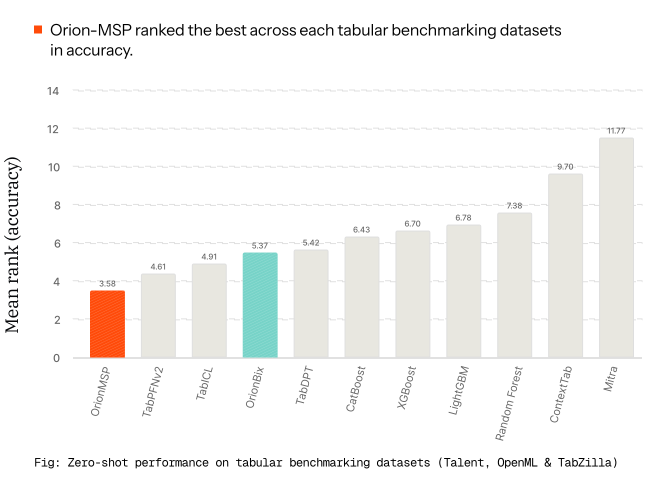
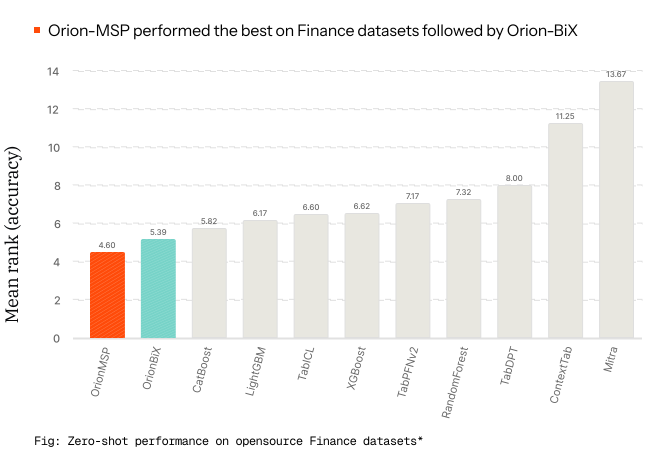
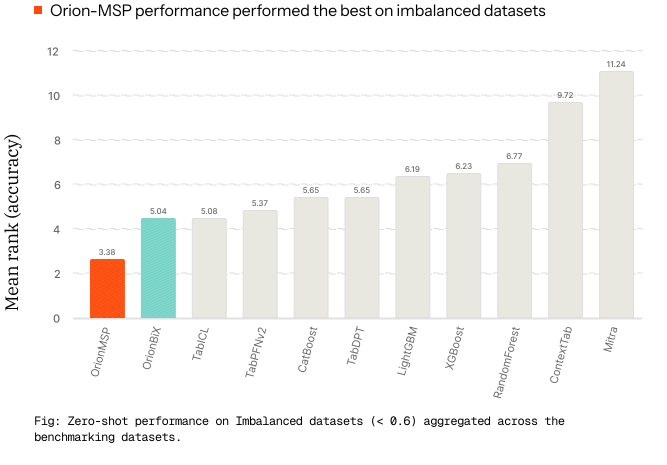
ORION-MSP
Orion-MSP is a tabular foundation model for in-context learning. It uses multi-scale sparse attention and Perceiver-style memory to process tabular data at multiple granularities, capturing both local feature interactions and global dataset-level patterns.
Try them today using our ‘TabTune’.
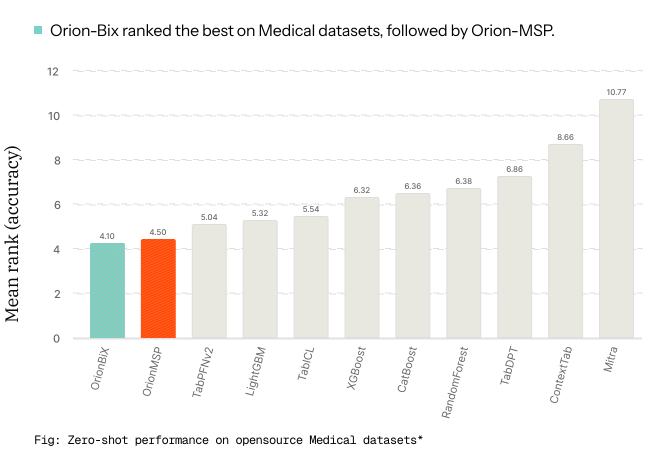
ORION-BIX
Orion-BiX is a tabular foundation model for in-context learning that combines bi-axial attention with meta-learning. It processes tabular data through alternating attention patterns to capture multi-scale feature interactions.
Try them today using our TFM fine-tuning library ‘TabTune’.

CuratorKIT is Lexsi's synthetic post-training data curation library — pairing provenance-grounded hallucination gating with an adaptive diagnose-and-repair pipeline to filter and recover LLM training data instead of just discarding failures.
A mechanistic interpretability toolkit that discovers the circuit behind a specific model behaviour, scores its faithfulness, then lets you prune, quantize, edit, steer, or fine-tune around it.
A model-agnostic explainability library that works across text, image, and tabular deep learning models. Unlike traditional surrogate methods, DL Backtrace calculates relevance directly from model weights and inputs, ensuring consistency and faithfulness.
A single, uniformed tool for inference and fine-tuning tabular foundational models (TFMs) and the TFM lifecycle management, from model-aware preprocessing to flexible adaptation (Zero-Shot, Meta-Learning, PEFT).
Research Papers
Building or Deploying AI Solutions for Mission-Critical Use Cases?
Work with Lexsi Labs to leverage the frontier AI research in building ‘AI’ that is interpretable, aligned, and safe to scale.