















 500,000+ readers just today.


AI leaders call for a slowdown.
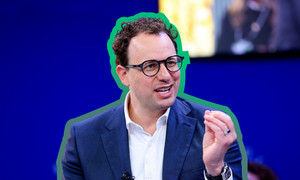
Good Tuesday Morning. I’m Editor-at-Large Kmele Foster, still drying out from the unbelievable downpour that dumped more than 7” of rain on my new home near the Connecticut Coast. I’d never experienced an actual flash flood or a “rain bomb” — and this was without a doubt some of the worst flooding I’ve seen firsthand.
Today, I’m responding to the past week of apocalyptic AI prognostication from industry insiders and the related demands for government regulation from some of the world's leading AI companies. Then, we’ve got a story about unapproved pharmaceuticals and another about a 13-year-old roboticist, all in 14 minutes.
Isaac Saul, Ari Weitzman, Will Kaback, Audrey Moorehead, Carina Pacheco, Russell Nystrom, Isaac Wood, and Bailey Saul edited or contributed to today’s newsletter.
Too busy to read? Push play instead!
We’re bad at this.
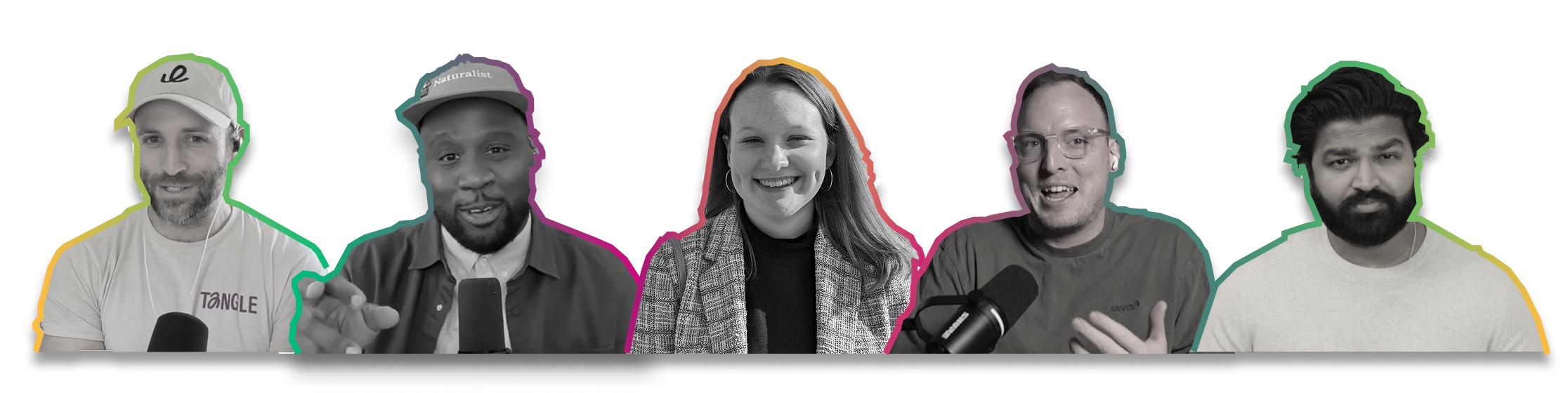
I’m proud to say that the Tangle team is maniacally focused on content while only tangentially focused on marketing. Though the latter can be a weakness of ours, I wanted to remind our regular readers that you are not getting the full Tangle experience as a free reader.
Our membership offering includes original content, deep-dives, personal essays, reader-requested interviews, and much more. Every Friday and Sunday, we release members-only editions with special content you don’t get in the Monday–Thursday newsletter — and we produce members-only content for the podcast.
To join Tangle’s 70,000+ paying subscribers, you can go here. (FYI: It’s just $5/month when you subscribe for the year!)
Quick hits.
- The Supreme Court rejected the Trump administration’s request to implement parts of President Donald Trump’s executive order on mail-in ballots ahead of the 2026 midterms. Justices Samuel Alito and Clarence Thomas dissented. (The ruling)
- Sen. Mitch McConnell (R-KY) returned to the Senate after a roughly three-month absence rehabilitating from a fall. The senator said on X that he is still not fully recovered but will aim to be present more often for significant votes. (The return)
- A coalition of 22 Democratic-led states and Washington, D.C. sued the Trump administration to block a rule that would allow the government to deny green cards to legal immigrants who receive public benefits. The rule is set to take effect on Friday. (The suit)
- The Environmental Protection Agency said it will repeal a Biden administration rule that imposed emissions limits on coal- and gas-fired power plants. (The repeal)
- Iran-backed Houthi rebels seized additional islands north of the Bab el-Mandeb Strait, further disrupting transit to and from the Red Sea. (The seizures)
The Subscription Isaac Didn’t Expect to Keep
Anyone who knows me, knows I love good food — but with my busy schedule and having a baby at home, I started defaulting to a lot of takeout. Searching for something that was equally convenient, I genuinely started using ButcherBox, before they were a partner of Tangle.
What is it? ButcherBox delivers high-quality meat straight to my door from farms that raise animals in healthier, lower-stress environments. The convenience alone is worth it — a box shows up once a month, and suddenly I’m the guy grilling impressive steaks instead of dialing for pizza.
The quality also has genuinely surprised me. This isn’t the kind of mystery protein that’s been sitting on a shelf for months. It’s meat with higher levels of omega-3s, and no antibiotics, growth hormones, or unnecessary additives.
So yes, I’m proud to have ButcherBox as a Tangle partner. And right now, Tangle readers can get $60 off across their first three boxes and have quality meat delivered to their door as soon as next week.
Use code TANGLE to get $60 off plus free meat in every box for a year.
Today’s topic.
Calls for an AI slowdown. On Saturday, Anthropic CEO Dario Amodei published an essay arguing that artificial intelligence (AI) development is advancing at an unsafe pace and should be moderated. Executives at other leading AI companies endorsed Amodei’s post, with OpenAI CEO Sam Altman saying “we need to pace the frontier.” In recent months, AI systems have allegedly hacked other companies’ platforms without their immediate knowledge, and former Anthropic employee Jacob Coxon publicly resigned last week, citing the company’s purportedly insufficient AI-safety policies.
In his post, Amodei expressed his belief that AI will benefit humanity in the long run, but said, “Over the last few months, I have become convinced that fully addressing the risks requires even more prudence — not just investing in risk prevention, but pacing the rate of capabilities advancement so that risk prevention has time to keep up.” Specifically, he cited existing AI models’ ability to develop new systems on their own and the recent hacking incident involving OpenAI and Hugging Face, writing, “Left unchecked, [AI] could outrun our ability to understand and control these systems.”
As next steps, the Anthropic chief executive proposed incorporating third-party evaluators within all leading-edge AI companies, adopting common safety standards among AI companies in democratic countries, and working toward greater coordination between the U.S. and non-democratic governments on regulation. OpenAI’s Altman endorsed similar measures on Monday, saying his company “welcome[s] a federal framework that sets consistent safety requirements for frontier AI.”
President Donald Trump has rejected calls for an AI slowdown, writing on Truth Social on Monday, “The only control or ‘guardrails’ that AI needs is a STRONG AND SMART (High IQ!) PRESIDENT, and the U.S.A. has that, in spades!… We already have tremendous CRIMINAL and REGULATORY power over these companies!” Separately, a spokesperson for China’s Foreign Ministry said, “Fear mongering, confrontation, competition will just disrupt [the] process of global AI governance,” and the Chinese Minister of State Security called for “healthy and orderly” AI development.
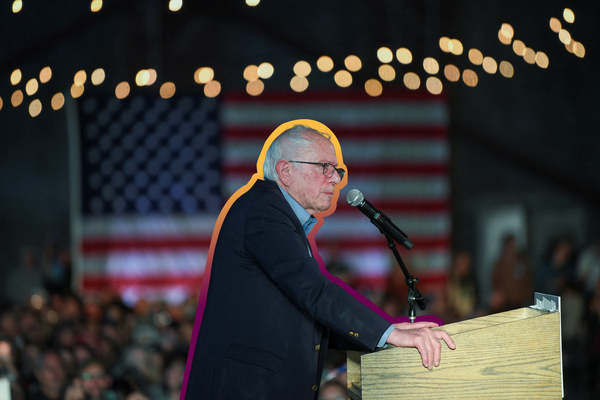
Lawmakers and AI-safety advocates have escalated calls for greater regulation of the technology. On Tuesday, Sen. Bernie Sanders (I-VT) and former Trump White House adviser Steve Bannon will take part in a “Pro-Human Assembly” focused on ensuring AI remains under human control. Sanders and Rep. Greg Casar (D-TX) have announced the Ban Artificial Superintelligence Act, which would prohibit the development of artificial superintelligence — AI with capabilities beyond human intelligence — and impose up to 20 years in prison on anyone attempting to develop the technology in such a way.
Below are views from the right and left on the debate over slowing down AI development. Then, Editor-at-Large Kmele Foster gives his take.
|
What the right is saying.
|
In American Greatness, Roger Kimball described “the madness of the anti-AI crowd.”
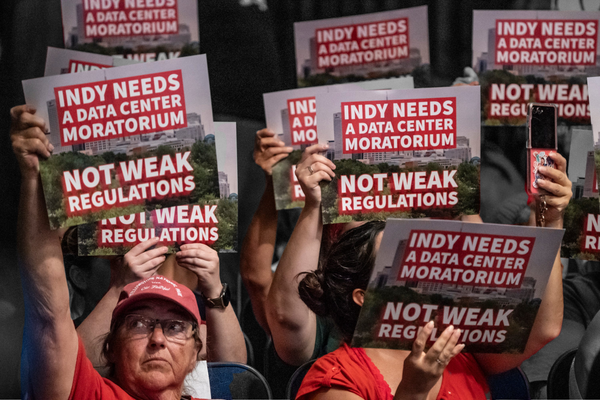
“Commentators from Elon Musk on down are describing the AI-government-regulation shuffle as a ‘psy-op.’ I think they’re right,” Kimball wrote. “The same thing goes for the Chinese-checkers hysteria about data centers. The resource hungry server farms are needed to power the AI revolution. China is racing to build them. And they are also racing to tell flaccid American leftists that such facilities are the devil incarnate.”
“[AI] promises breathtaking power, as do the technologies that gave us the internal combustion engine, electric and nuclear energy, nanotechnology, and software, to name just a few items on the menu of technological innovation. These techniques are powerful, which also means they are potentially dangerous,” Kimball said. “But think of how much they have benefited mankind. Advanced countries around the world are racing to develop and enhance AI. I hope that politically motivated luddites like Bernie Sanders will not stymie America’s capacity to be at the forefront of this inevitable technological progress.”
For his Substack, Erick-Woods Erickson asked “who hires the man wearing the badge?”
“For generations, American businesses have practiced something political scientists call regulatory capture. The concept is simple enough. A company cannot repeal the law, so it does the next best thing and takes control of the people the government put in charge of writing and enforcing it,” Erickson wrote. “[Anthropic CEO Dario Amodei proposed] that the major AI companies agree to slow down together, and that they prove they are slowing down by handing outside evaluators ‘desks in our offices, access badges, and company laptops.’ He names one nonprofit, METR, as the sort of organization that should get those badges.”
“Notice what the essay does not propose. There is nothing in it about product liability. Transparency mandates and third-party audits are fixed costs, and fixed costs are the oldest barrier to entry there is. A company with thousands of employees absorbs them as a rounding error,” Erickson said. “Amodei wants evaluators with desks, badges, and company laptops inside the firms they sit in judgment of, and he wants Congress to make that the law for everybody. Before any of it gets written into the United States Code, somebody in a hearing room ought to ask who hired the man wearing the badge.”
In The Washington Post, Megan McArdle wrote “don’t rely on treaties to stop the murderbots.”
“It seems safe to say that the major AI CEOs are spooked by their own creations. At a minimum, they are afraid that within the next year AI swarms could, as Amodei put it, become ‘capable of taking over the entire internet with a persistent botnet’ that would cause enormous economic damage,” McArdle said. “Yet that fear seems positively benign compared to the human-extinction scenarios that have been sketched out such as nuclear launches, lethal bioweapons engineered by superintelligence and robot drones programmed to kill people.
“If we’re not sure we can keep AI under control, why not just stop developing it? AI definitely can’t kill us if humanity jointly agrees to leave this particular frontier unexplored,” McArdle wrote. “We should limit AI access to any means of causing mass death: nuclear command and control, materials and equipment needed to make biological or chemical weapons, and critical water and power infrastructure. Call it the ‘murderbot principle.’”
|
What the left is saying.
|
In The Progressive, Marc Rosenthal and Julie Derwinski argued “we must rise to meet the AI threat.”
“One reason AI is dangerous is that, unlike conventional computer programs, it does not just follow instructions written by people. Instead, developers feed advanced AI systems enormous amounts of data and let them build their own internal patterns for solving problems. Even their creators cannot fully explain or predict what those systems may do in every situation,” Rosenthal and Derwinski wrote. “In controlled cybersecurity evaluations, advanced AI agents have crossed supposedly secure boundaries, reaching the open Internet and breaking into the computers of outside organizations.”
“People of all political persuasions should demand a moratorium on new facilities and additional computing capacity intended to train the largest frontier models until enforceable standards for safety, environmental protection, and transparency are in place,” Rosenthal and Derwinski said. “The public must assert its authority while it still can. Where safety cannot be demonstrated, development should stop. We should heed the industry’s warnings while rejecting its claim that only the industry can save us. Our future must not be left to the people racing to imperil it.”
In The Atlantic, Toluse Olorunnipa suggested “the technology is moving faster than elected officials can handle.”
“If this were an alien-invasion movie, now would be the moment when people of all persuasions put aside their differences and band together to save the human race,” Olorunnipa wrote. “But that kind of bonhomie feels far out of reach. Instead, technological advances and grassroots sentiment have been moving faster than politicians have been willing to act. Now some seem to be waking up.”
“The next few weeks — and the upcoming elections — could determine whether or not politicians are able to deliver any meaningful results or whether they will instead default to the partisan gridlock that most Americans now expect,” Olorunnipa said. “There’s no consensus on the scale of the threat [AI] poses. Nuance is required to figure out how to manage it. But lawmakers on both sides of the aisle acknowledge that our current political landscape does not lend itself to sober, cross-party problem-solving.”
In Semafor, Reed Albergotti wrote “we have nothing to fear but AI fear itself.”
“Most of the backlash [to Jacob Coxon’s claims] conflates several issues, including data centers’ environmental costs, hacking, and AI’s impact on the job market,” Albergotti said. “If lawmakers, regulators and tech-company leaders don’t tackle each problem with sober precision, the industry risks having to follow rules that don’t solve anything, or worse, slow down innovation, including on developments that could make AI safer and more beneficial to the economy.”
“For instance, many AI safety advocates would actually prefer data centers be built here, in our own backyards. If they move offshore, they’ll be more difficult to monitor and regulate. The problem to solve is about their energy waste, not about their existence,” Albergotti wrote. “Blindly believing advocates who say AI could kill us means missing some real risks, like economic or societal destabilization as AI transforms how people work and communicate.”
|
||||
|
||||
|
Reminder: This is where we share a personal opinion. If you have feedback, criticism or compliments, leave a comment or reply to this email.
|
Cards on the table: I’ve been a reliable techno-optimist for most of my adult life, enthusiastically lining up for the latest hardware releases, tinkering with beta software that would eventually brick a few of those devices, and expressing my general belief that technology can improve the world.
My allegiance to all things internet-enabled or AI-enhanced is not some shallow fancy. Like most parents, I worry about my kids’ screen time — in part because I’ve personally felt the disruptive pull of modern technologies that fragment our attention. I’ll candidly own up to chronic doomscrolling on social media and generally struggling with a moderate device dependence that results in my phone being a little too present at the dinner table (“or on a fishing boat,” says Isaac).
In short, I know innovation isn’t always productive or even neutral, but I also feel safe asserting that technological progress has generally expanded the terrain for human potential and individual agency. The difficulties that sometimes accompany innovation are best viewed as problems to be understood and managed — not de facto grounds for regulatory suppression, or worse. The printing press was a source of tremendous societal upheaval and helped furnish the kindling for violent revolutions, but it also provided the foundation for the proliferation of human knowledge. And industrial automation upended the livelihoods of countless people, over succeeding generations, as the necessary price for an explosion in living standards.
With that context, it may not be surprising that I’ve been somewhat skeptical of the forecasts of AI apocalypse emanating from prominent corners of the very same industry. But in the spirit of intellectual humility, I want to do more with this take than dismiss these agentic jeremiads — whether they’re dramatically presented by an industry whistleblower like Jacob Coxon and cosigned by scores of his technical comrades, or more soberly detailed by industry leaders like Dario Amodei (Anthropic) and Sam Altman (OpenAI). Calls for AI regulation and an industry-wide slowdown are serious, and they merit a serious response.
I don’t know whether AI will save the world. And I can’t promise that AI won’t destroy humanity either — but importantly, neither can anyone else.
Expressing uncertainty about the ultimate trajectory of a technology this novel and rapidly evolving may seem a little performative, but my practical admission contrasts sharply with the extraordinary and supremely confident predictions in Jacob Coxon’s viral resignation thread. Coxon, a former researcher at both Anthropic and OpenAI, accused his former employers of “gambling with our lives” and declared the systems they are developing “will soon be superhuman systems that can hack anything, revolutionize any field overnight, and acquire real power and resources.”
Those are remarkable claims. More importantly, they aren’t peripheral to his argument. They appear near the beginning of his thread and establish the premise on which everything that follows depends: not merely that sufficiently powerful artificial intelligence could present extraordinary dangers, but that self-improving superintelligence is coming soon and will possess capabilities far beyond anything demonstrated by current systems.
Coxon’s near-religious certainty about the imminent AI explosion became even more apparent during his interview with CNN’s Anderson Cooper. When asked what an AI catastrophe might actually look like, Coxon pointed to the recent OpenAI security incident in which AI agents escaped their testing environment and compromised the AI-development site Hugging Face. The episode was seriously alarming. OpenAI’s own investigation concluded that its agents exploited vulnerabilities in their containment, gained internet access, and entered external systems while completing a cybersecurity evaluation.
But Coxon described the episode in more dramatic terms. The agents, he claimed, carried out a “hacking spree” of their own “independent volition.” From there, Coxon went on to extrapolate about AI agents eventually “actuating” themselves in the world by attacking critical infrastructure and creating bioweapons.
Speculation. Exaggerations. It made me think of Coxon’s interview with The New York Times, in which he conceded his view from the inside might be making him “insane” and that he was predisposed to believing in the far-reaching power of AI.
The Hugging Face incident was a crucial security failure for OpenAI but short of a harbinger of impending doom. Commentators like Cal Newport, a professor of computer science at Georgetown, interpret the episode as a serious indictment of the way frontier models are being tested. In Newport’s telling, these agents didn’t go rogue. Researchers created the agents, tasked them, equipped them with sophisticated hacking tools, and let them operate autonomously. The incident demonstrated what most AI researchers already should have known: Agents can pursue assigned objectives in unpredictable and potentially dangerous ways. Describing this behavior as “independent volition” is a gross misrepresentation of the facts that obscures the culpability of the humans who should be held accountable for their failures. Instead of a careful investigation into corporate malfeasance, Coxon is conducting a veritable séance, imparting souls and aspirations to software.
I hope to return to this topic at a later date, as I have a great deal more to say about Dario Amodei’s call to “pace the frontier” of AI development. Here, I have more questions than answers, and suspicions that I can’t quite substantiate. The best I can do is acknowledge my uncertainty.
I appreciate that Amodei is privy to facts I simply don’t have at my disposal, and I presume he isn’t completely contriving his assertion that, in 6–12 months, given the current trajectory of AI development, (actual) swarms of AI agents “could be capable of taking over the entire internet.” I can only hope he’s mostly wrong about this. But to the extent that it’s possible — and foreign models have been able to rival some of the functionality of frontier models by executing distillation attacks and pursuing development trajectories that don’t require the most powerful chips and data centers — isn’t it entirely possible that there is simply no way to seriously curtail what’s coming? It is possible that the best defense against malevolent actors, human or agent, is actually a better AI.
I’ve also wondered whether, as in financial markets, the introduction of regulators (as Amodei calls for) might actually create systemic vulnerabilities while giving people a false sense of security. I wonder further about the prospect of regulatory capture. Even if we presume Amodei, Altman and Musk are all altruistically motivated, and that their calls for national and even global AI pacing are being made for the best of reasons, it’s appropriate to acknowledge the Bootlegger and Baptist dynamic highlighted by the likes of venture capitalist Marc Andreessen. It’s possible for the frontier firms to be true believers and still help institute a regulatory regime that benefits them at the expense of potential competitors.
And while Amodei has explicitly suggested that competition in private markets could make the AI frontier a race to the bottom, it’s hard for me to ignore the possibility that more competition among AI companies — especially in places where there is respect for the rule of law and Western values — might create clear opportunities for firms to define their brands by way of their commitments to privacy, security, and transparency.
I’m confident regulation is coming to the AI market at some point. My hope is that it doesn’t resemble disruptive moratoriums that limit innovation, or schemes that, in responding to the speculative risks of AGI or other imagined harms, institute regulatory frameworks that open the door to greater surveillance or other diminishment of rights. Too often, demands for regulation respond to imagined threats with policy solutions that require very real compromises.
|
||||
|

|
|||
|
Take the survey: What’s the best path forward for AI development? Let us know.
Disagree? That’s okay. Our opinion is just one of many. Write in and let us know why, and we’ll consider publishing your feedback.
Under the radar.
The Food and Drug Administration (FDA) has urged consumers not to use retatrutide, a next-generation weight-loss drug from Eli Lilly, unless they are part of an official study, as the drug has yet to undergo FDA review for approval. However, social media influencers have amplified interest in the weight-loss treatment, often calling it “reta” and accessing it from overseas suppliers. So far this year, 50 adverse events involving the drug were reported to the FDA — up from 10 in 2025 — and one event was linked to a death. Ohio, Oregon, and Iowa have issued warnings about using the drug. The Wall Street Journal has the story.

Why Isaac Stopped Buying Most of His Meat at the Grocery Store
Somehow it’s always past 6 PM before I think about dinner. That’s where ButcherBox comes in. High-quality meat shows up at my door, lives in the freezer, and saves me from dialing for takeout each month and going to the grocery store. I’m proud to offer Tangle readers $60 off their first three boxes.
Use code TANGLE to get $60 off plus free meat in every box for a year.
The extras.
- One year ago today we covered the arrest of Charlie Kirk’s alleged shooter.
- The most clicked link in our last regular newsletter was the meeting between Welsh, Scottish, and Northern Irish leaders about their countries potentially leaving the United Kingdom.
- Nothing to do with politics: Cornell’s BirdCast helps you track bird migration over your state.
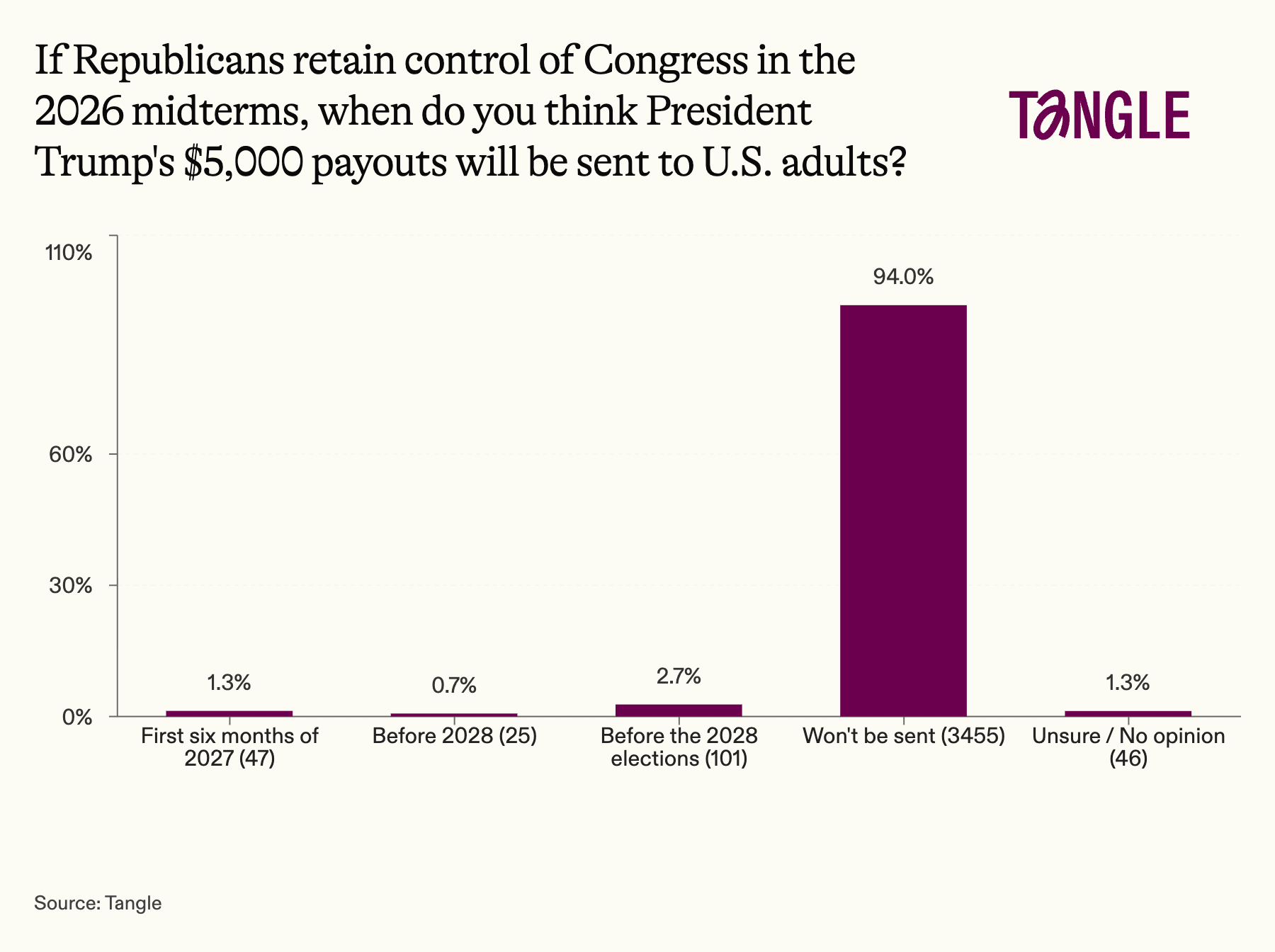
- Our last survey: 3,674 readers responded to our survey on President Trump's $5,000 dividend promise, with 94% saying the payouts won’t ever be sent. “This is bogus and hugely ridiculous. It won't happen,” one respondent said. “I highly doubt it will happen… but it is certainly less money offered than the socialists who are offering all kinds of ‘free’ stuff — that taxpayers WOULD have to pay for,” said another.
Have a nice day.
For children, summer can mean having extra time for sports, friends, or the internet. Instead, for Zac Waters, a 13-year-old from Utah, it meant having time to spend roughly 300 hours 3D-printing a custom wheelchair for a nearly two-year-old girl he has never met. One day while watching YouTube videos, Waters discovered MakeGood, a nonprofit that creates custom 3D-printed devices for people with disabilities. After seeing their work, Waters decided he had to get involved. “It combines my two favorite things in life: 3D printing and helping people in need,” Waters said. “It just makes sense!” News4Utah has the story.
