







In This Article
- List of the Best Crypto Margin Trading Platforms
Reviewing the Top Crypto Margin Trading Platforms
- 1. Bitpanda – Trade 120+ Cryptos with Up to 10x Margin
- 2. PrimeXBT - Popular Crypto Margin Trading Platform
- 3. MEXC - Trade 500+ Crypto Margin Products at 0% Commission
- 4. Binance - Passively Trade Leveraged Crypto Markets via Automated Bots
- 5. Kraken - Trade 100+ Crypto Margin Pairs With Up to 5x Leverage
- 6. WEEX - Global Crypto Margin Trading Platform with Shared Margin
- 7. Margex - Top-Rated Futures Platform With Copy Trading and Margin Facilities
- 8. BloFin - A Great Option for Trading Meme Coins With Margin
- 9. KCEX - Low-Fee Crypto Futures Trading with No-KYC Access
- 10. Bybit - Speculate on 1,000+ Margin Products Including Pre-Market Perps
- 11. CEX.IO - Pioneering Crypto Exchange Offering Multi-Collateral Margin Trading and Enhanced Liquidity
- 12. OKX - Margin Accounts Support Delivery Futures and Options
- 13. KuCoin - Trade Long and Short on Margin Without Being Liquidated
- Our Methodology for Ranking Crypto Margin Trading Platforms
- Best Crypto Margin Trading Platforms Compared
- What Is Crypto Margin Trading?
- How Does Crypto Margin Trading Work?
- Pros & Cons of Trading Crypto Margin
- Are Crypto Margin Trading Platforms Legal?
- Tips for Staying Safe When Trading Crypto Margin
- How to Trade Crypto Margin - Step-by-Step Guide
- Conclusion
Leverage trading is like adding extra firepower to your crypto trades by giving you access to additional capital. This means you can open positions far larger than your initial investment, ideal for amplifying potential profits. But remember, just as gains are supercharged, so are losses, so tread carefully.
This article looks at the best platforms for crypto leverage trading, highlighting those that offer high leverage limits, low fees, strong security, and user-friendly interfaces. It also includes tools for detailed market analysis and strategies for managing risk effectively.


If that weren’t enough, I also cover insights on setting stop-losses to protect your investment.
If you’re new to margin trading or want a quick refresh, stick around as I break down the basics. I look at best crypto margin trading platforms for maximizing rewards while minimizing potential downsides. Buckle up and let’s explore the tools and platforms that can help you trade like a pro!
List of the Best Crypto Margin Trading Platforms
My research shows the best crypto margin trading platforms are listed below:
- Bitpanda – #1 Platform to Trade 120+ Cryptos with Up to 10x Margin and Competitive Fees
- PrimeXBT – Popular Crypto Margin Platform in 2026
- MEXC – Trade Thousands of Crypto Margin Products at 0% Commission
- Binance – Passively Trade Leveraged Crypto Markets via Automated Bots
- Kraken – A Top Crypto Exchange With Secure Margin Trading and Deep Liquidity
- WEEX – Global Crypto Margin Trading Platform with Shared Margin
- Margex – Top-Rated Futures Platform With Copy Trading and Margin Facilities
- BloFin – A Great Option for Trading Meme Coins With Margin
- KCEX – Low-Fee Crypto Futures Trading with No-KYC Access
- Bybit – Speculate on 1,000+ Margin Products, Including Pre-Market Perps
- CEX.IO – Pioneering Crypto Exchange Offering Multi-Collateral Margin Trading and Enhanced Liquidity
- OKX – Margin Accounts Support Delivery Futures and Options
- KuCoin – Trade Long and Short on Margin Without Being Liquidated
Reviewing the Top Crypto Margin Trading Platforms
Margin accounts carry considerably more risk when compared to traditional spot trading. Traders should consider various metrics when selecting a platform, including financing fees, leverage caps, risk-management tools, and supported markets.
I’ll now review the best crypto margin trading exchanges listed above, ensuring the most important factors are discussed.
1. Bitpanda – Trade 120+ Cryptos with Up to 10x Margin
- Minimum margin: 2x
- Maximum leverage: 10x
- Supported margin markets: 120+
- Crypto margin trading fees: 0% buy fee, daily fee of 0.18%, 0.3% sell fee
- Minimum deposit: €10
- Withdrawal fees: None
Bitpanda tops our list of the best crypto margin trading platforms in April 2026. It is a trusted all-in-one brokerage platform that offers trading on more than 120 popular cryptocurrencies with up to 10x margin. It offers deep liquidity and competitive fees, including no fee when you buy and just a 0.3% fee when you sell. For holding a 10x position for 24 hours, you’ll pay a total of just 0.48%.
We appreciated the simplicity and transparency of this fee structure as well as the overall user-friendliness of Bitpanda’s interface. The platform is available for web and mobile, and while it’s not the most advanced platform we’ve seen, it offers a wide range of risk management tools such as limit and stop-loss orders.
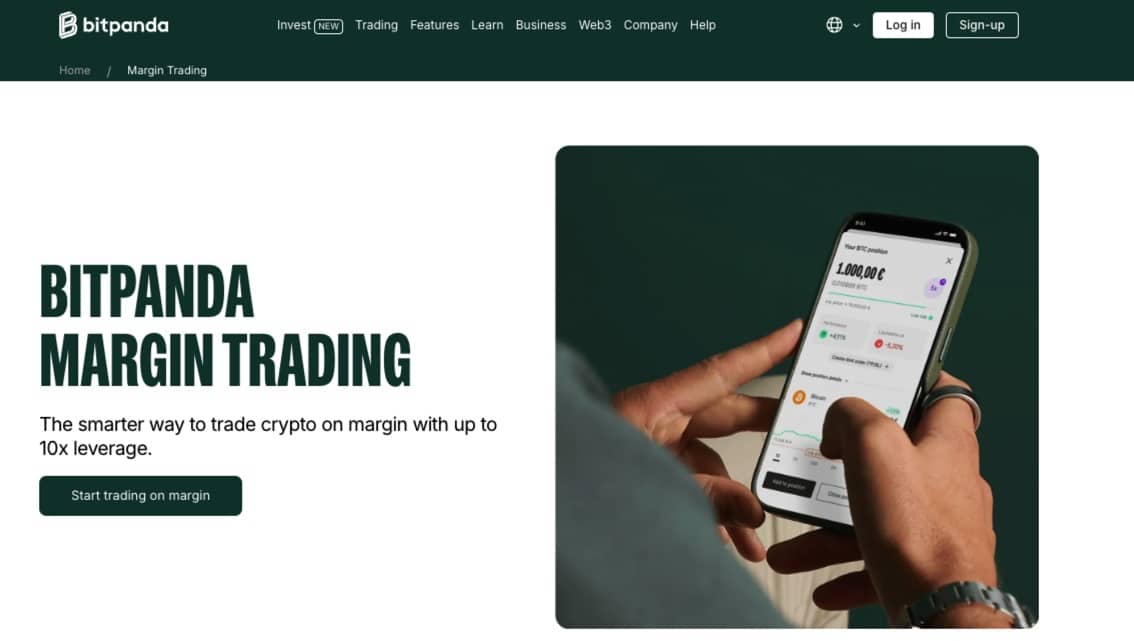
Another thing that stands out about Bitpanda is that it aggregates price data from all the biggest crypto exchanges, including Binance, Coinbase, and Kraken. That means you’re guaranteed to get the best execution and lowest spreads for every trade, giving you an edge in fast-moving markets.
Pros
-
Trade 120+ cryptocurrencies with up to 10x leverage
-
Very low margin rates and transparent pricing
-
Earn interest on USD, GBP, and EUR account balances
-
Aggregates price data and liquidity from major exchanges
-
24/7 customer support by email and live chat
Cons
-
Only available in Europe
-
Trading platform has limited technical analysis tools
Bitpanda Review


2. PrimeXBT – Popular Crypto Margin Trading Platform
- Minimum margin: 0.5%
- Maximum leverage: 200x
- Supported margin markets: 30
- Crypto margin trading fees (per slide): 0.01% (makers), 0.02% (takers)
- Minimum deposit: $1
- Withdrawal fees: From $0.5 (depending on the vendor or blockchain)
PrimeXBT offers margin facilities when trading crypto futures. These are perpetual contracts without settlement dates, and both long and short positions are supported. The minimum margin requirement is 0.5%. This amounts to leverage of 200x, meaning $20,000 worth of capital for every $100 risked.
However, only Bitcoin and Ethereum futures get the maximum leverage amount. Other cryptocurrencies come with lower limits. Nonetheless, the best altcoins are supported, including Litecoin, Cardano, BNB, Chainlink, Uniswap, Cosmos, and Solana. PrimeXBT is also renowned for its low-fee policy.
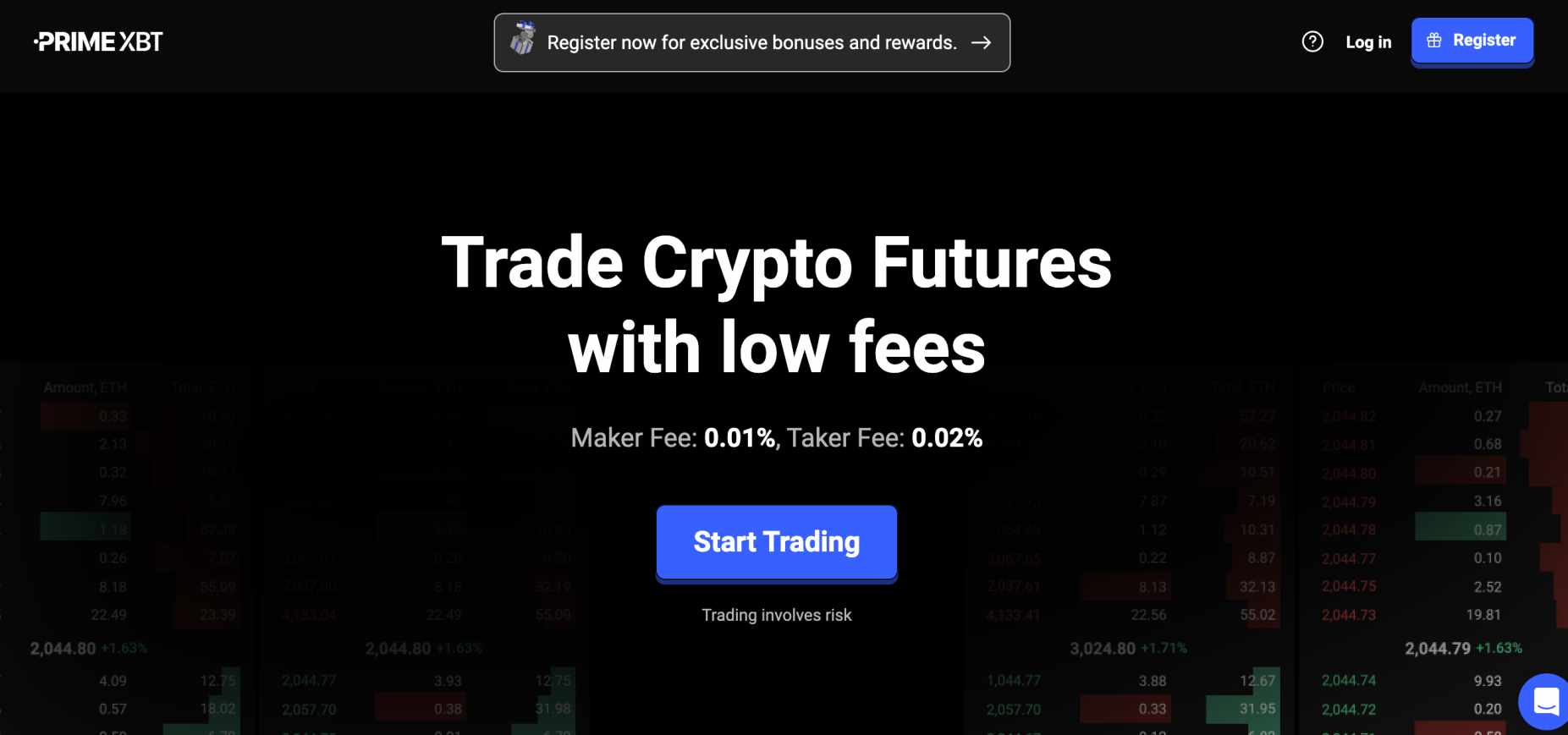
Like many margin platforms, it offers a market maker (limit orders) and taker (market orders) system. Commissions are 0.01% and 0.02% per slide, respectively. Funding fees also apply, varying depending on the crypto and trading conditions. PrimeXBT also offers contracts-for-differences (CFDs), covering forex, gold, silver, oil, indices, and more.
Pros
-
Excellent exchange for crypto margin trading
-
Minimum margin requirement of 0.5%
-
Low trading commissions from 0.01% per slide
-
Get started with just $1
-
Accepts fiat money payments
Cons
-
Isn’t available in all countries, including the US
-
Supports just 30 margin futures products
PrimeXBT Review
3. MEXC – Trade 500+ Crypto Margin Products at 0% Commission
- Minimum margin: 0.5%
- Maximum leverage: 200x
- Supported margin markets: 503
- Crypto margin trading fees (per slide): 0% (makers), 0.02% (takers)
- Minimum deposit: Depends on the asset (e.g., 0.0001 BTC for Bitcoin)
- Withdrawal fees: Depends on the asset (e.g., 0.0001 BTC for Bitcoin)
MEXC is one of the largest margin trading platforms for daily volume. It offers some of the lowest commissions in the industry, with market takers paying just 0.02% per slide. This can be reduced to 0.01% when holding MX, MEXC’s native token. Market makers avoid commissions completely, meaning only financing fees must be covered.
MEXC, which boasts over 15 million users, offers a huge range of markets. This includes over 500 perpetual futures, covering the best cryptocurrencies like Bitcoin, Ethereum, Solana, and BNB. Low-cap and new cryptocurrencies are supported too, not to mention meme coins like Pepe, FLOKI, and dogwifhat.
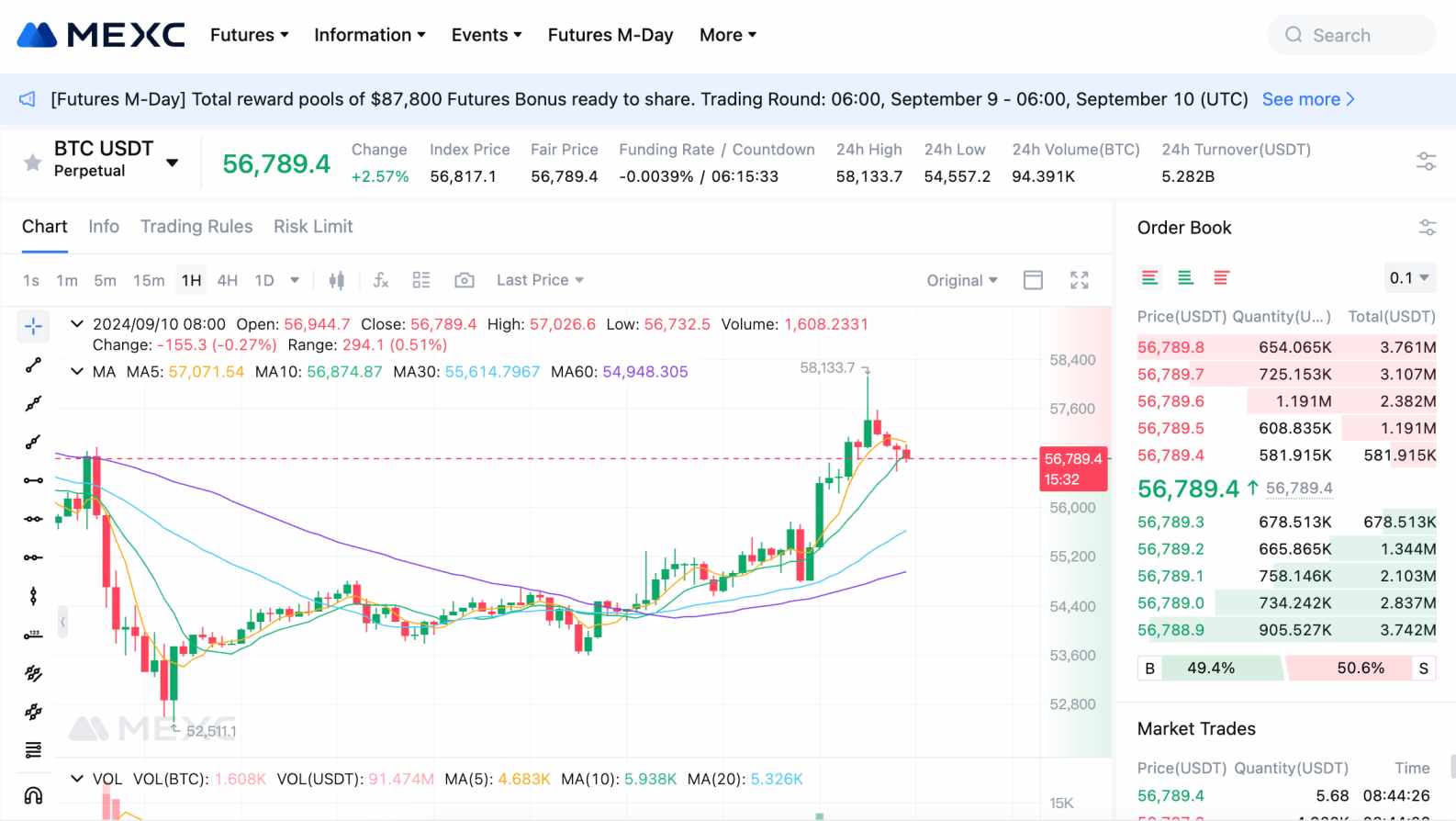
MEXC has a minimum margin requirement of 0.5%, meaning 200x leverage. However, smaller caps are in place on less liquid markets. Users can easily deposit funds, with both fiat money and crypto supported. MEXC also offers 24/7 customer support and copy trading tools. However, US clients aren’t accepted.
Pros
-
Trade over 500 margin products with up to 200x leverage
-
Ultra-low fees with 0% for makers and just 0.02% for takers
-
Supports both fiat and crypto deposits, including SEPA and cards
-
Advanced trading tools like copy trading, demo trading, and savings
-
Powerful matching engine processing 1.4 million transactions per second
Cons
-
Unavailable in some regions
-
User complaints about slow withdrawals and limited customer support
MEXC Review
4. Binance – Passively Trade Leveraged Crypto Markets via Automated Bots
- Minimum margin: 0.8%
- Maximum leverage: 125x
- Supported margin markets: 384
- Crypto margin trading fees (per slide): 0.02% (makers), 0.05% (takers)
- Minimum deposit: Depends on the asset (e.g. 0.000006 BTC for Bitcoin)
- Withdrawal fees: Depends on the asset: (e.g. 0.0001 BTC for Bitcoin)
Binance is the world’s largest exchange for margin trading. It has over 235 million users and more than $60 billion worth of derivatives were traded in the past 24 hours. This ensures that Binance traders have access to premium liquidity and ultra-tight spreads. A wider range of margin markets are available, including hundreds of futures.
This covers perpetual and delivery contracts. The minimum requirement is 0.8%, meaning leverage of up to 125x. Futures trading fees are 0.02% for makers and 0.05% for takers, per slide. Discounts are available when holding BNB or meeting monthly volume targets. Binance also enables users to trade leveraged options.
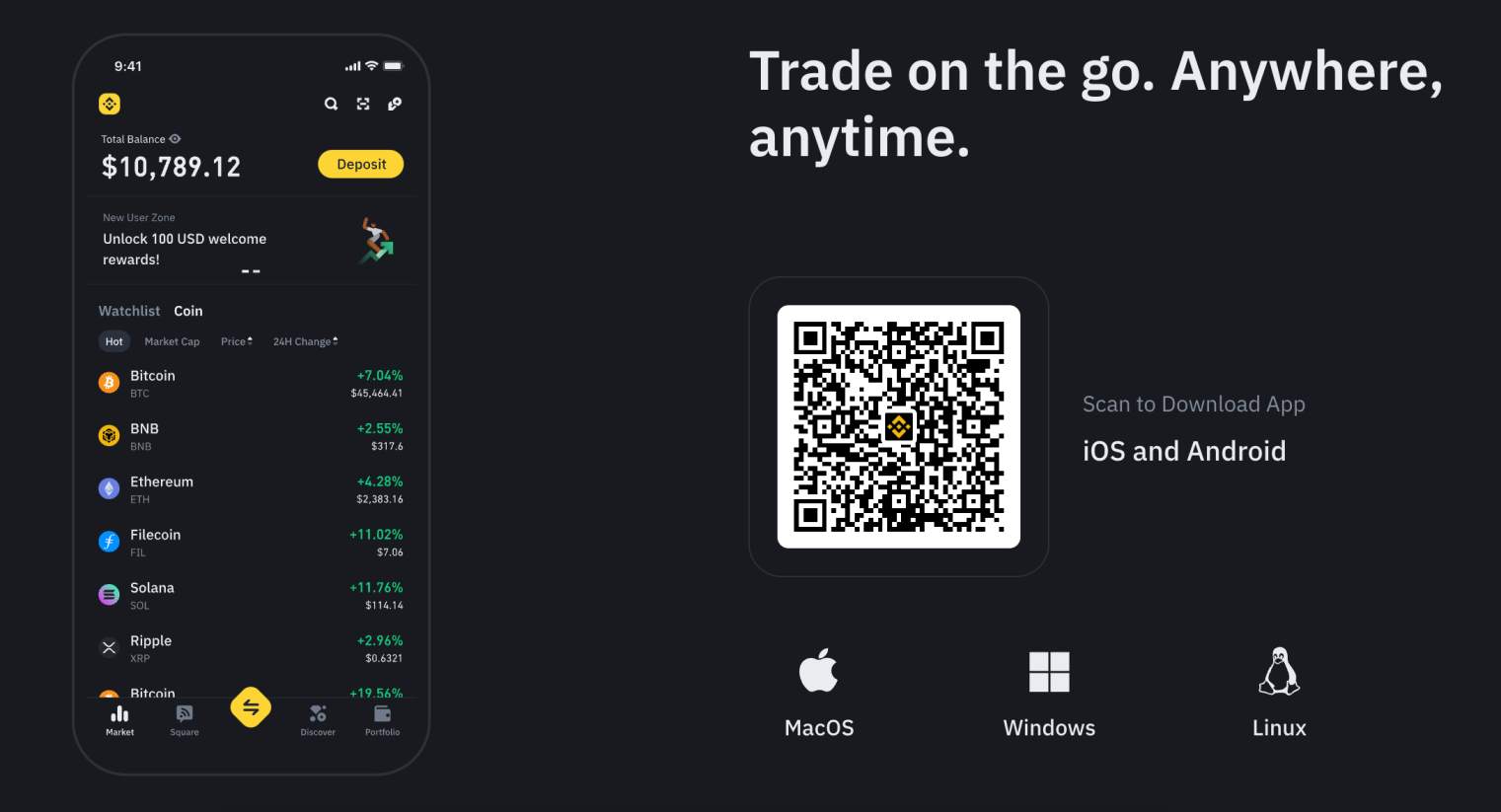
This covers Bitcoin, BNB, Dogecoin, XRP, and Ethereum. That said, one of Binance’s best features is its in-house bots. These can trade margin products autonomously. Thousands of bot strategies are available and key metrics can be customized, such as stop-loss and leverage levels. Binance also offers copy trading, which is another passive investing tool.
Pros
-
Choose from thousands of automated bot strategies
-
Bots can trade with margin
-
Maximum leverage of up to 125x
-
Offers options, perpetual, and delivery futures
-
The largest derivative platform for trading volume
Cons
-
Margin facilities are blocked in multiple countries
-
Some fiat currencies aren’t accepted (including GBP)
Binance Review

5. Kraken – Trade 100+ Crypto Margin Pairs With Up to 5x Leverage
- Minimum margin: 20% (5x leverage)
- Maximum leverage: 5x
- Supported margin markets: 100+
- Crypto margin trading fees: 0.01% to 0.02% to open a position; the same rate applies as a rollover fee every 4 hours
- Minimum deposit: Varies by asset (e.g., 0.0001 BTC for Bitcoin)
- Withdrawal fees: Depends on the asset (e.g., 0.0001 BTC for Bitcoin)
Kraken is a well-known crypto exchange. Security and regulation are among its top priorities. It offers margin trading on 100+ pairs, including Bitcoin, Ethereum, and Solana. Traders get up to 5x leverage, allowing bigger positions with less capital. Its margin trading fees are fair, 0.01% to 0.02% to open a position, plus the same every four hours as a rollover fee.
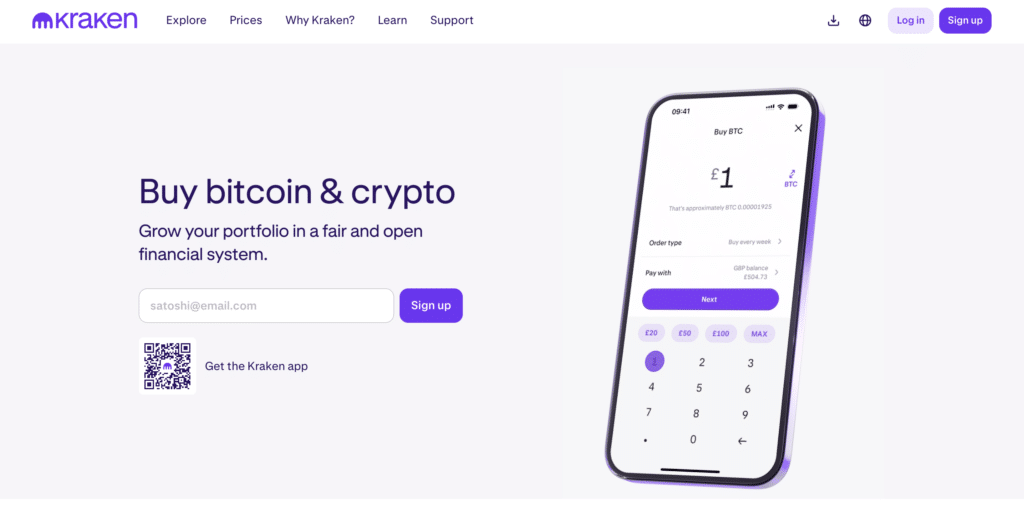
But Kraken isn’t just about margin trading. It has plenty of tools, including spot trading, futures, and staking. Deposits and withdrawals are smooth, supporting both fiat and crypto funding. Moreover, Kraken’s interface works for both beginners and pros alike.
There are also advanced order types, APIs, and trading bots. However, like other margin trading platforms, Kraken doesn’t offer margin trading in all countries. Its margin trading services are rather limited in the United States, United Kingdom, and Canada. Those who want access to these countries must meet certain requirements. For more details on Kraken, head over to our full Kraken review.
Pros
-
One of the most secure and regulated crypto exchanges
-
Deep liquidity on major trading pairs
-
100+ margin trading pairs, including Bitcoin, Ethereum, and Solana
-
Competitive fees, ranging from 0.01% to 0.02% per trade
-
Available on web and mobile app for seamless access
-
24/7 customer support with extensive educational resources
Cons
-
Maximum leverage is capped at 5x, lower than some competitors
-
Margin trading is restricted in certain regions, including some U.S. states
-
No 0% commission on margin trades
-
KYC verification required for trading access
-
Rollover fees apply every 4 hours, adding to trading costs
Kraken Review
6. WEEX – Global Crypto Margin Trading Platform with Shared Margin
- Minimum margin: Varies by contract
- Maximum leverage: 400x
- Supported margin markets: 1,700+ trading pairs
- Crypto margin trading fees: 0% (makers), 0.06% (takers)
- Minimum deposit: No minimum specified
- Withdrawal fees: Varies by crypto and network conditions
WEEX provides margin capabilities through perpetual futures contracts across over 1,700 trading pairs. Founded in 2018, the platform serves over 6.2 million traders across 130 countries with a focus on security and capital efficiency. The shared margin system allows traders to allocate collateral across multiple positions simultaneously, eliminating the need for isolated margin pools on each contract.

The platform supports leverage up to 400x on select cryptos, giving traders massive position control with smaller capital commitments. WEEX has positioned itself around three core advantages: deep liquidity for fast execution, a 1,000 BTC Protection Fund for user security, and zero maker fees.
Like traditional margin exchanges, WEEX operates a maker-taker fee structure. Makers who provide liquidity through limit orders pay 0%, while takers executing market orders pay 0.06% per trade. The platform also features an extensive copy trading network with over 5,000 elite traders managing more than $800 million in copy volume, allowing newcomers to mirror proven strategies.
Pros
-
Shared margin system lets traders manage multiple futures positions efficiently without constant rebalancing
-
Access to 1,700+ trading pairs provides extensive market coverage
-
Copy trading network with 5,000+ elite traders
-
1,000 BTC Protection Fund adds security layer for user deposits
-
Zero maker fees reduce costs for traders using limit orders
Cons
-
400x maximum leverage may be lower than the competitors’
-
Taker fees at 0.06% are higher than some competing platforms
WEEX Review
7. Margex – Top-Rated Futures Platform With Copy Trading and Margin Facilities
- Minimum margin: 1%
- Maximum leverage: 100x
- Supported margin markets: 49
- Crypto margin trading fees (per slide): 0.019% (makers), 0.06% (takers)
- Minimum deposit: $10
- Withdrawal fees: Depends on the asset (e.g. 0.002 BTC for Bitcoin)
Margex is considered one of the best crypto futures trading platforms. It offers 49 perpetual futures contracts, with new markets being added regularly. The minimum margin requirement is 1% on Bitcoin, Ethereum, BNB, and TRON. This converts to 100x leverage crypto trades. Other futures markets have a higher margin requirement of 2% (50x) or 4% (25x).
Nonetheless, Margex is another margin platform offering low fees. Market makers and takers pay 0.019% and 0.06% per slide, respectively. No discounts are available when meeting 30-day milestones, which could be a drawback for large-scale traders. Margex offers fee-free crypto deposits but withdrawal charges depend on the asset.
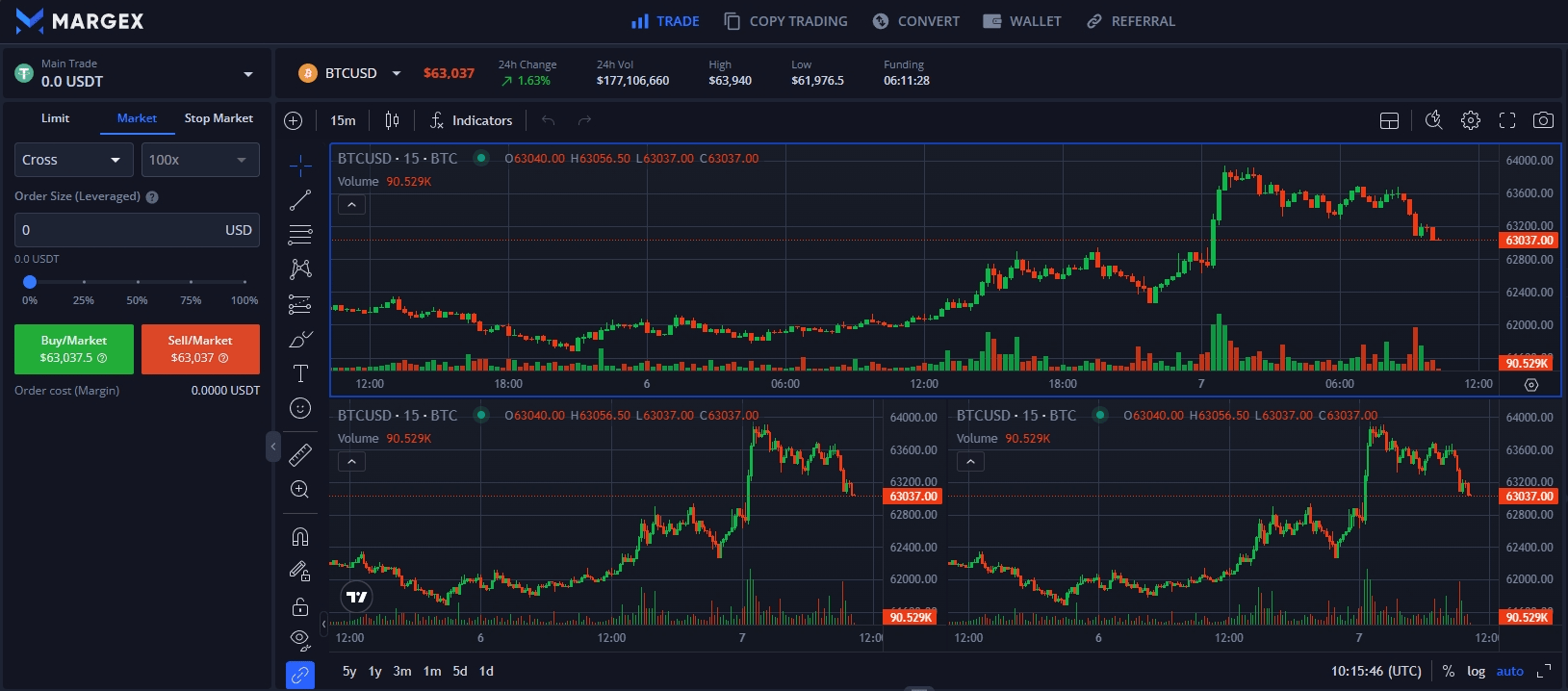
For example, Bitcoin withdrawals cost 0.002 BTC. Margex is also a good option for copy trading. This means beginners can automatically replicate experienced margin traders passively. It also supports instant crypto purchases via debit/credit cards and e-wallets. Margex is a no-KYC exchange, so getting started doesn’t require personal information.
Pros
-
Trade major cryptocurrencies with a 1% margin requirement
-
Get $10,000 worth of trading capital for every $100 deposited
-
Supports 49 perpetual futures markets
-
Trading commissions start from just 0.019%
-
A great option for copy trading
Cons
-
Less popular markets have a higher margin requirement of 4%
-
Doesn’t offer commission discounts to large-scale traders
Margex Review
8. BloFin – A Great Option for Trading Meme Coins With Margin
- Minimum margin: 0.67%
- Maximum leverage: 150x
- Supported margin markets: 300+
- Crypto margin trading fees (per slide): 0.02% (makers), 0.06% (takers)
- Minimum deposit: Depends on the asset (e.g., 0.0002 BTC for Bitcoin)
- Withdrawal fees: Stated when requesting the withdrawal
BloFin is another top-rated margin trading platform offering multiple benefits. To start with, BloFin is a no-KYC exchange; users can withdraw up to 20,000 USDT without providing personal information or ID documents. Accounts take seconds to open, considering only an email address or mobile number is needed.
What’s more, BloFin accepts debit/credit cards and other convenient payment methods. BloFin – which also supports spot trading, offers more than 300 perpetual futures markets. This covers the best meme coins, ranging from FLOKI, Shiba Inu, Pepe, Turbo, Myro, dogwifhat, and Dogecoin.

The minimum margin requirement at BloFin is approximately 0.67%, meaning leverage of up to 150x. That said, trading commissions are slightly higher than other margin platforms. Market makers and takers pay 0.02% and 0.06%, respectively. Lower commissions are available when trading higher amounts.
Pros
-
Trade meme coins with low margin requirements
-
Leverage of up to 150x is available
-
Withdrawal up to 20,000 USDT without KYC requirements
-
Accepts crypto and fiat money payments
-
More than 300 perpetual futures supported
Cons
-
Futures commissions are slightly higher than other margin platforms
-
Operates without a regulatory license
BloFin Review
9. KCEX – Low-Fee Crypto Futures Trading with No-KYC Access
- Minimum margin: Varies by futures contract
- Maximum leverage: 125x
- Supported margin markets: 790+ futures contracts
- Crypto margin trading fees: 0% spot, 0% futures maker, 0.01% futures taker
- Minimum deposit: No minimum required
- Withdrawal fees: 0% across all trading pairs
Next on our list is KCEX, which stands out as one of the most cost-efficient crypto futures platforms operating today. Launched in 2021 and registered under FinCEN in the US, this Seychelles-based exchange serves over 1 million traders with a straightforward value proposition: ultra-low fees and instant access without identity verification.

You can sign up on KCEX with just an email and start trading right away. On average, the platform handles about $17 billion in trades per day, which confirms deep liquidity. This makes KCEX great for high-frequency strategies, scalping, and testing leverage positions without incurring fees.
And the transparency? KCEX delivers it through one of the simplest fee structures in crypto trading. Spot trading is entirely free, while futures makers pay zero, and takers pay 0.01%. There are no funding rate markups or hidden spreads, and the platform waives withdrawal fees across all listed assets. For high-volume accounts, that structure can save thousands from monthly costs compared with exchanges that charge both sides of the book.
Pros
-
0% fees on spot trades and futures maker orders
-
Email-only registration enables instant trading access
-
Up to 125x leverage with robust risk controls
-
TradingView integration for advanced charting
-
Highly rated mobile app
Cons
-
No-KYC model may limit access to certain fiat on-ramps or advanced features
-
Relatively new platform compared to established exchanges
KCEX Review
10. Bybit – Speculate on 1,000+ Margin Products Including Pre-Market Perps
- Minimum margin: 0.5%
- Maximum leverage: 200x
- Supported margin markets: 1,000+
- Crypto margin trading fees (per slide): 0.02% (makers), 0.055% (takers)
- Minimum deposit: No minimum (except Solana; 0.01 SOL)
- Withdrawal fees: Stated when requesting the withdrawal
Bybit is a popular crypto trading platform with tier-one liquidity and 1,000+ margin products. This includes pre-market futures, enabling traders to speculate on new cryptocurrencies before launching on Bybit. For instance, it currently offers pre-market contracts on Scroll, traded as SCR/USD.
Over $16 million worth of SCR/USD has been traded in the past 24 hours, covering almost 5,000 market participants. Bybit also offers perpetual futures with a minimum margin requirement of 0.5%. This converts to $20,000 worth of trading capital for every $100 deposited.
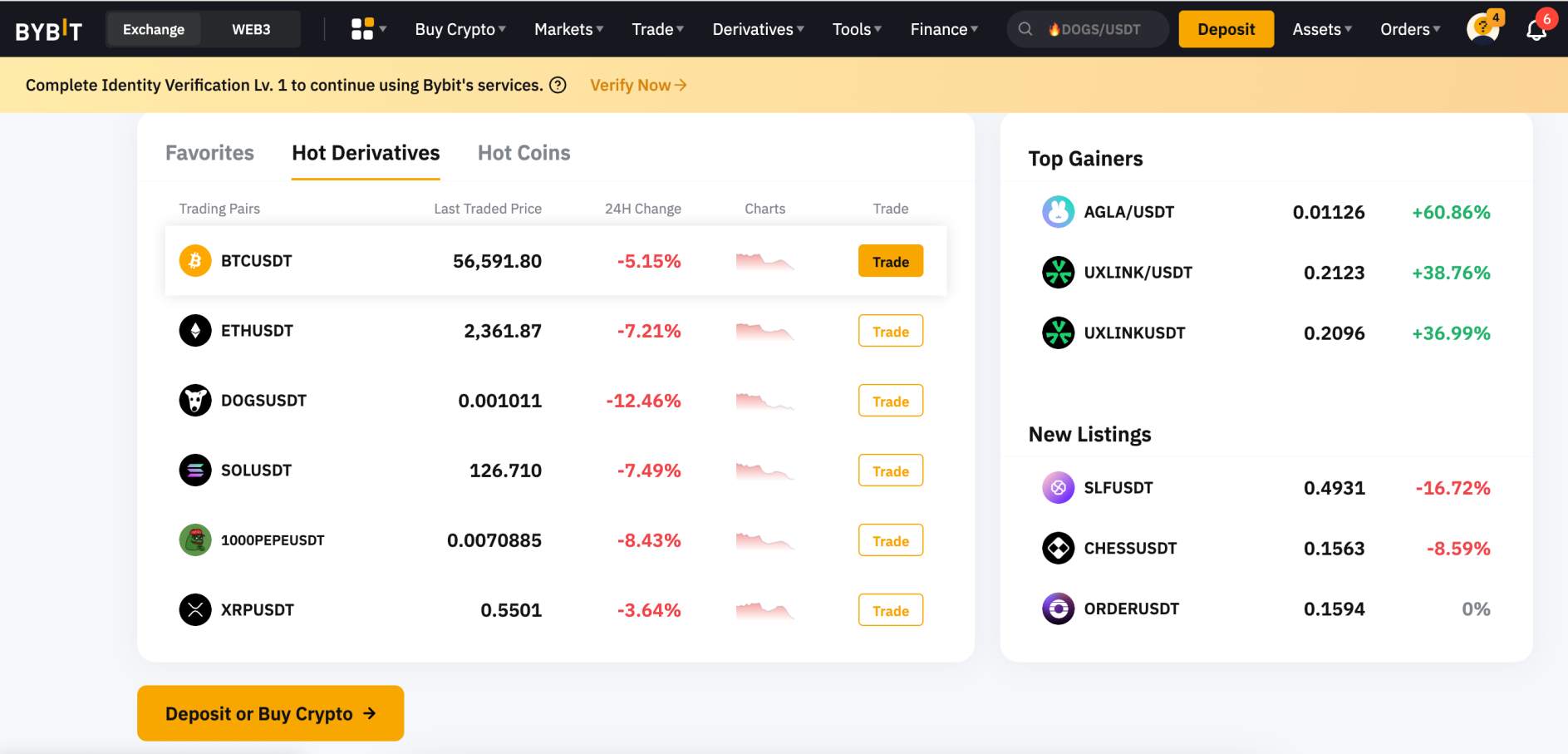
Margin traders will also find delivery futures for Bitcoin, Ethereum, and Solana. Settlement dates extend to 12 months, making them ideal for long-term speculation with leverage. Options markets are also supported for these three cryptocurrencies. Bybit charges 0.02% and 0.055% to makers and takers, respectively.
Important Note: ByBit was recently compromised on February 21, 2025, with $1.5 billion in customer funds lost. We do not recommend Bybit at this time and recommend users take self-custody using a wallet like Best Wallet.
Pros
-
One of the best crypto margin trading platforms for pre-market futures
-
Speculate on new cryptocurrencies before they launch
-
Also offers perpetual/delivery futures and options
-
Traders have 1,000+ margin markets to choose from
-
No minimum deposit requirements for most cryptocurrencies
Cons
-
The lowest trading commissions require significant volumes
-
Debit/credit card payments come with high fees
ByBit Review
11. CEX.IO – Pioneering Crypto Exchange Offering Multi-Collateral Margin Trading and Enhanced Liquidity
- Minimum margin: 25%
- Maximum leverage: 10x
- Supported margin markets: 30
- Crypto margin trading fees: 0.1% for opening and closing trades, 0.005% rollover fee, 1% liquidation fee
- Minimum deposit: $20, crypto varies
- Withdrawal fees: 0.49%-4.99% for card, 0.3% + $25 for SWIFT, $2.99 for Wire Transfers, Crypto varies
CEX.IO is one of the pioneers in the industry. Founded in 2013 and headquartered in London, CEX.IO is available in most countries and allows users to buy and sell crypto using multiple options such as credit/debit card, Google/Apple Pay, Swift, wire transfer, PayPal, Skrill, and more.

Boasting over 15 million users worldwide, CEX.IO offers margin trading that supports multi-collateral functionality. By enabling traders to provide multiple collateral assets, CEX.IO enhances the user’s trading experience, improving efficiency and reducing costs for traders. Accessing up to 10x leverage depending on location, the CEX.IO trading engine is top-tier, aggregating liquidity from multiple external sources, which ensures accurate price alignment and near-zero spreads on most trading pairs. You can learn more about this top-tier exchange in our dedicated CEX.IO Review
Pros
-
Multi-Collateral Functionality – Traders can choose from USDT, ETH, or BTC as collateral
-
Hourly Rollover Fee Calculation – Significantly reduces costs for short-term traders
-
Top 5 Exchange in the World for Deep Liquidity
-
Supports over 30 Tradeable Markets
-
Available on Desktop and Mobile App
-
One of the Longest-Standing, Reputable and Trustworthy Exchanges
Cons
-
All trading accounts must complete KYC
CEX.io Review
12. OKX – Margin Accounts Support Delivery Futures and Options
- Minimum margin: 1%
- Maximum leverage: 100x
- Supported margin markets: 208
- Crypto margin trading fees (per slide): 0.02% (makers), 0.05% (takers)
- Minimum deposit: Depends on the asset (e.g., 0.0005 BTC for Bitcoin)
- Withdrawal fees: Depends on the asset (e.g., 0.00005 BTC for Bitcoin)
OKX is one of the largest crypto exchanges globally. In addition to spot trading, it also offers 208 margin products. This includes perpetual futures with leverage of up to 100x. OKX also supports delivery futures for Bitcoin and Ethereum. These are ideal for longer-term margin positions, with settlement dates of over six months.
What’s more, delivery futures save fees, as overnight financing doesn’t apply. OKX also offers margin facilities via Bitcoin and Ethereum options. These come with short and long-term maturity dates and multiple strike prices. Trading commissions for futures markets are 0.02% for makers and 0.05% for takers.
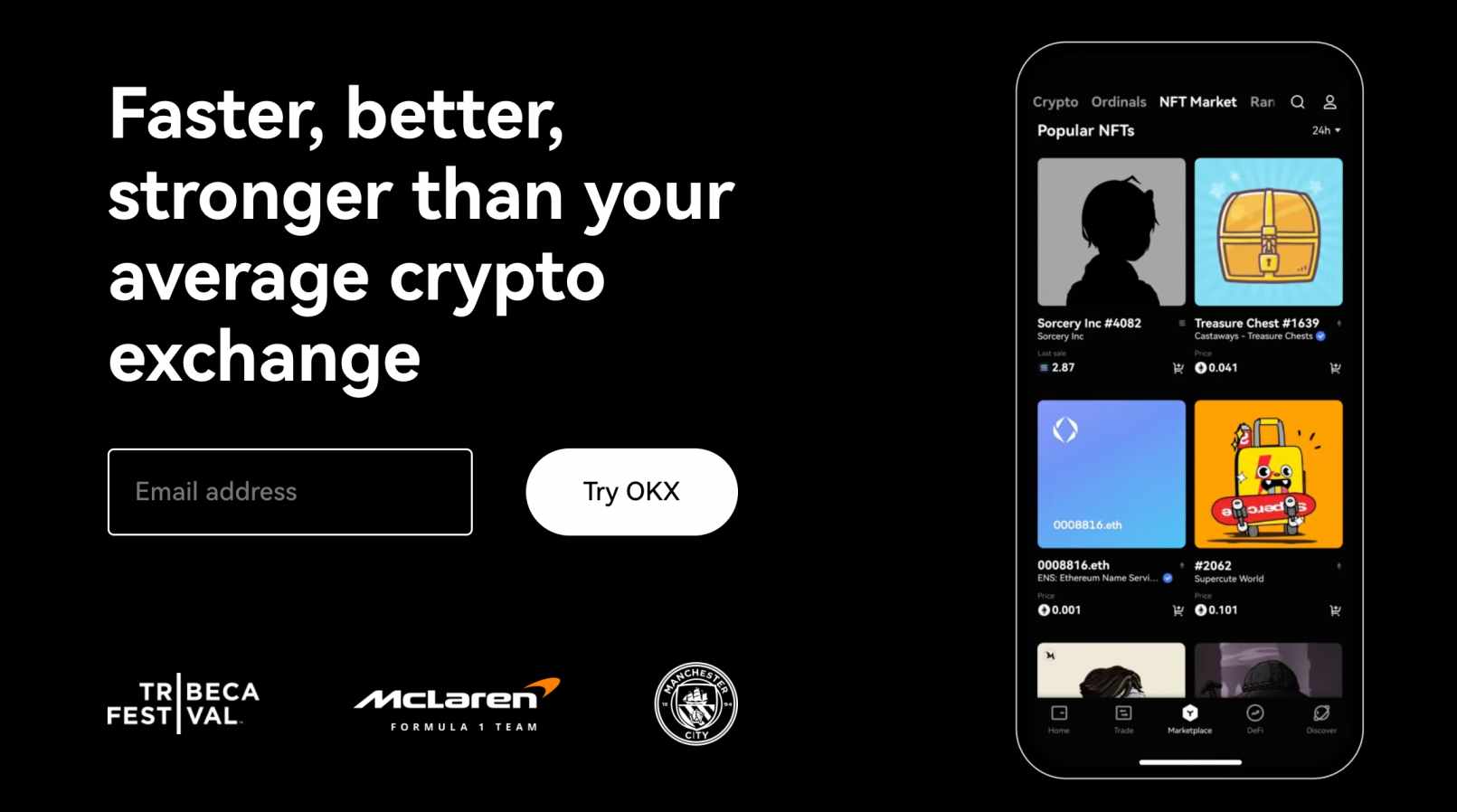
Makers also get 0.02% commissions when trading options, although takers pay 0.03%. OKX – which requires KYC for all registered users, accepts fiat and crypto deposits. The former includes local bank transfers and debit/credit cards. Other features include automated bots, copy trading, earning tools, and a decentralized wallet.
Pros
-
One of the best margin trading platforms for delivery futures
-
Also offers perpetuals and options
-
Supports 208 leveraged markets
-
Available on desktops and mobiles
-
Premium liquidity is available around the clock
Cons
-
All trading accounts must complete KYC
-
No longer offers services in the US
OKX Review
13. KuCoin – Trade Long and Short on Margin Without Being Liquidated
- Minimum margin: 0.8%
- Maximum leverage: 125x
- Supported margin markets: 187
- Crypto margin trading fees (per slide): 0.01% (makers), 0.01% (takers)
- Minimum deposit: $5
- Withdrawal fees: Depends on the asset: (e.g. 0.0005 BTC for Bitcoin)
KuCoin is an established crypto exchange that supports 187 derivative markets. This includes USD and Coin-margined perpetuals, with popular assets including Bitcoin, Ethereum, Solana, and XRP. However, a more unique offering is KuCoin’s leveraged tokens. These replicate spot trading prices but with a 2x or 3x multiple.
Crucially, traders can go long or short without being liquidated. This is because positions are simply multiplied by the price movement. For example, suppose you risk $100 on a ‘3x Bitcoin long’. If Bitcoin increases by 5%, your position would rise by 15%. And, if Bitcoin declined by 10%, your position would drop by 30%.

This is a more risk-averse way of trading crypto on margin. KuCoin charges 0.1% per slide on leveraged tokens, which align with spot trading prices. Alternatively, those seeking higher leverage limits can trade futures – which come with a margin requirement of just 0.8%. This translates to 125x leverage.
Pros
-
Leveraged tokens can be traded without liquidation risks
-
Futures come with a minimum margin requirement of 0.8%
-
Choose from 187 derivative markets
-
Offers crypto bots for automated trading
-
Earn competitive APYs on idle balance
Cons
-
Sign-up bonuses come with unfavorable terms
-
High deposit fees when using a debit/credit card
KuCoin Review
Our Methodology for Ranking Crypto Margin Trading Platforms
I conducted extensive research when ranking the best crypto margin trading platforms.
My research methodology is summarized below:
- Minimum Margin Requirement: I initially shortlisted platforms based on the minimum margin requirement. The lower the percentage, the higher the leverage multiple. For example, PrimeXBT and MEXC require just 0.5% when entering trades. This translates to 200x leverage, meaning $20,000 for every $100 risked.
- Available Margin Products: I also examined what margin products traders can access. Most margin platforms support perpetual futures. Others also offer delivery futures and options. Leveraged tokens were also included, considering they come without liquidation risks.
- Supported Cryptocurrencies: I prioritized margin trading platforms with the widest range of supported cryptocurrencies. Most offer large caps like Bitcoin, XRP, and BNB, while some also niche down to meme coins like FLOKI, dogwifhat, and Bonk. This ensures traders have ample choice when finding market opportunities.
- Trading Commissions and Margin Fees: Margin platforms were compared for trading commissions, covering rates for market makers and takers. I also assessed whether discounts are offered when meeting 30-day volume targets. Margin fees were also assessed, including the interest rate and funding frequency.
- Payments: The payment department was analyzed extensively, including accepted payment methods, account minimums, and fees. The best platforms support convenient deposit methods, such as debit/credit cards, bank transfers, and even e-wallets like Google/Apple Pay.
- KYC Requirements: Some margin traders favor privacy, so I evaluated the required KYC processes. Some platforms offer an anonymous trading experience, up to a maximum withdrawal amount. For instance, BloFin allows KYC-free accounts to withdraw up to 20,000 USDT. Conversely, all OKX clients must upload ID verification.
- Safety and Reputation: Only safe and reputable providers were considered when ranking the top margin trading crypto sites. I prioritized platforms that offer robust security tools and verifiable proof of reserves. I also analyzed reviews from public forums for a deeper understanding of the user experience.
Best Crypto Margin Trading Platforms Compared
Let’s recap the best margin trading crypto providers, summarizing their key metrics:
Platform
Min. Margin & Max. Leverage
No. Margin Markets
Margin Trading Fees
Min. Deposit
Withdrawal Fee
Bitpanda
2x & 10x
120+
0% buy fee, 0.18% daily fee, 0.3% sell fee
$10
None
PrimeXBT
0.5% & 200x
30
0.01% (makers), 0.02% (takers)
$1
MEXC
0.5% & 200x
503
0% (makers), 0.02% (takers)
Depends on the asset (e.g., 0.0001 BTC for Bitcoin)
Binance
0.8% &125x
384
0.02% (makers), 0.05% (takers)
Depends on the asset (e.g., 0.000006 BTC for Bitcoin)
Kraken
20% (5x leverage)
100+
0.01% to 0.02% per position opening; same rate applies as a rollover fee every 4 hours
Varies by asset (e.g., 0.0001 BTC for Bitcoin)
WEEX
Varies by contract & 400x
1,700+
0% (makers), 0.06% (takers)
No minimum specified
Margex
1% & 100x
49
0.019% (makers), 0.06% (takers)
$10
BloFin
0.67% & 150x
300+
0.02% (makers), 0.06% (takers)
Depends on the asset (e.g., 0.0002 BTC for Bitcoin)
KCEX
Varies by futures contract & 125x
790+
0% spot; 0% (makers), 0.01% (takers) on futures
No minimum required
Bybit
0.5% & 200x
1,000+
0.02% (makers), 0.055% (takers)
No minimum (except Solana; 0.01 SOL)
CEX.IO
25% & 10X
30+
0.1% opening/closing, 1% liquidation
$20 fiat, crypto varies
OKX
1% & 100x
208
0.02% (makers), 0.05% (takers)
Depends on the asset (e.g., 0.0005 BTC for Bitcoin)
KuCoin
0.8% & 125x
187
[Leveraged tokens] 0.01% (makers), 0.01% (takers)
$5
What Is Crypto Margin Trading?
If you’re wondering what is margin trading in crypto, it is a way to trade using borrowed capital. As a financing product, it is offered by many crypto exchanges. It enables traders to buy and sell cryptocurrencies with leverage, meaning position sizes are boosted.
A simple example:
- You want to trade Bitcoin on margin
- The platform has a minimum margin requirement of 1%
- This means you only need to put up 1% of the total trade size
- You enter a position worth $10,000
- The 1% upfront margin amounts to just $100
The above example highlights the power of margin; you amplified a $100 balance to $10,000 in trading capital. Margin is also known as leverage; the two terms are related but mean slightly different things.
- Margin is the amount of money needed to enter the position
- Leverage is the multiplier amount
For example, suppose you place a $50 trade with 20x leverage. This increases the position from $50 to $1,000. This represents a 5% margin, as the $50 stake is 5% of the $1,000 position.
It is also important to understand how spot vs futures crypto trading differs when using margin. Spot trading involves immediate asset exchange, while futures allow you to speculate on price without owning the underlying crypto, often with higher leverage.
How Does Crypto Margin Trading Work?
In a nutshell, margin trading requires traders to borrow funds from their crypto exchange. This attracts financing fees, just like interest on a loan. The majority of crypto margin traders opt for perpetual futures. These are derivative products that track crypto spot prices. Perpetuals come without settlement dates, so can be held indefinitely.
However, financing fees are often charged every few hours, so longer-term margin trades would better suit delivery futures. These replicate traditional futures with settlement dates, often anywhere from a day to over six months. Another method is options trading, which is a lower-risk way to trade on margin.

This is because you can only lose the upfront ‘premium’, often just a few percent of the overall trade size. Crucially, while margin trading offers access to substantially more capital, ‘liquidation’ is the biggest risk. This means the trade is automatically closed when it declines by a specific percentage. Any upfront funds put up will be kept by the exchange.
The liquidation percentage depends on the amount of margin taken. For example, if you put up a 2% margin, the trade will be liquidated if it declines by about 2%. This is why risk mitigation tools like bankroll management and stop-loss orders should be explored. Ultimately, margin trading is a lot riskier than standard trading, so beginners should tread with caution.
Crypto Margin Trading vs. Regular Crypto Trading
Let’s take a closer look at how margin and regular trading differ.
Upfront Capital
Regular crypto trading is known as ‘spot trading.’ This means trades are ‘settled on the spot,’ meaning the full amount is required by both parties. For example, suppose you’re trading BTC/USD. You want to buy $1,000 worth of BTC. You would need the full $1,000 to execute the trade.
Conversely, margin trading doesn’t require the full amount upfront. On the contrary, only a small percentage of the trade value is needed. The specific amount varies depending on the platform. For example, PrimeXBT has a minimum margin requirement of 0.5%. So, to execute that $1,000 BTC/USD trade, you’d only need $5.
Asset Ownership
Another difference between regular and margin trading is the ownership structure. I mentioned that regular crypto trades are settled on the spot, meaning assets are exchanged instantly. Put otherwise, when you trade USD for BTC, you own that BTC. This means you can withdraw that BTC to a private wallet.

In contrast, margin trades are derivative products, meaning you don’t own the underlying asset. For example, suppose you place a $100 BTC trade with 100x leverage. You don’t own $10,000 worth of BTC. Instead, you merely hold $10,000 worth of derivative products.
Risk
All forms of crypto trading are risky. However, margin trading increases the risk spectrum by considerable amounts. This is because of liquidation, meaning the upfront margin paid will be kept by the exchange. This will happen if the trade declines by the same percentage of the margin percentage taken.
Regular crypto trades can’t be liquidated. This is because you own the underlying assets, so the value rises and falls based on spot prices.
Fees
Another consideration is fees. Regular trading typically incurs a commission, paid when entering (buying) and exiting (selling) the market. No holding fees apply, ensuring long-term investors can hold indefinitely without charge.
Margin trading requires a loan from the exchange, so interest is paid. This is often every eight hours, meaning margin products aren’t ideal for longer-term strategies.
Pros & Cons of Trading Crypto Margin
Let’s summarize the pros and cons of crypto margin trading:
Pros
-
Enter large crypto trades by paying a small percentage upfront
-
Access substantially more capital than is available in your exchange account
-
Choose from a long or short position
-
Some margin platforms have scrapped KYC requirements
-
Ideal for strategies with low profit margins (e.g., scalping)
-
Margin products include perpetual/delivery futures and options
-
Traders often have access to thousands of markets
Cons
-
Crypto margin platforms are largely unregulated
-
Some countries restrict their citizens from trading crypto on margin
-
Liquidation means you lose the upfront margin
-
Higher leverage levels increase the liquidation risk
-
Not suitable for beginners
-
Margin fees are much higher than traditional trading
-
Best-suited for short-term traders
Crypto Margin Trading Platforms Fees Explained
Let’s explore what fees to expect when trading crypto on margin.
Commissions
Similar to regular crypto trading, margin positions incur commissions. This is almost always ‘per slide,’ meaning commissions are paid when entering and exiting the position. Crucially, the commission is calculated against the total trade size.
For example:
- You place a $500 trade with 20x leverage
- Your position is valued at $10,000 ($500 x 20)
- The margin platform charges a commission of 0.3%
- You pay a $30 commission to enter the market
- You close the trade when it’s valued at $12,000
- You pay a 0.3% commission on that $12,000, which is $36
- In total, you’ve paid commissions of $66
Do note that commission structures can vary depending on whether you’re a market maker or taker.
- Market makers place limit orders, meaning they provide liquidity and get the lowest rates.
- Market takers place market orders, so can pay a slight premium.
Commissions are often based on trading volumes, too. This means discounted fees are available when trading higher amounts.
Financing
Financing is a trading fee associated with margin products, which includes derivatives like futures and options. This fee is tied to the amount borrowed from the exchange, just like a loan. In many cases, financing fees are charged every few hours, making long-term positions unviable.

The specific charge depends on the interest rate set by the exchange and the amount of leverage taken. In the example above, I mentioned that a $500 margin was amplified to $10,000. Subtracting the $500 margin, financing fees would be charged in the $9,500 loan.
Spreads
Spreads are charges incurred with both regular and margin trading. It’s the difference between the bid and ask prices for the crypto being traded.
- For example, suppose you’re trading ETH/USD. The bid price is $2,500.
- The ask price is $2,600. The spread is $100.
- This means you’re immediately at a disadvantage when entering the market, considering the $100 spread must be covered to break even.
The best crypto margin trading platforms offer tight spreads. This means the gap between the bid and ask prices is minute, ensuring traders save on fees.
Are Crypto Margin Trading Platforms Legal?
The legalities of crypto margin trading are complex. In some countries, retail clients are prohibited from trading leveraged products unless offered by a regulated platform. This includes crypto margin trading in the USA, which is why so many platforms restrict American clients.
In other countries, such as the UK, even more stringent steps have been taken. This is because there’s a complete blanket ban on crypto derivatives for UK retail clients. In Europe, crypto derivatives are permitted, but ESMA states that retail clients are capped at 2x, which is a 50% margin requirement.
Crucially, many crypto margin platforms operate offshore, where regulations are much weaker. They often provide margin accounts without KYC, meaning traders could be from anywhere. This makes FCA, ESMA, and other regulatory demands difficult to enforce, especially when users open an account with a VPN, which further hinders their true nationality.
Tips for Staying Safe When Trading Crypto Margin
Crypto margin is best suited for experienced traders who understand risk management.
Nonetheless, the tips below will ensure your margin trading activities get off to a good start:
- Learn the Fundamentals: Before trading on margin, ensure you understand the fundamentals of how this market works. Learn about margin requirements, leverage, liquidation, financing fees, and settlement. You should also understand the underlying trading product, whether that’s perpetual/delivery futures or options.
- Start With a Demo Account: If you’re unsure what is leverage in crypto, start without risking real funds. The best crypto margin trading platforms offer demo facilities. This is ideal for beginners learning the ropes, as traders can enter positions with paper funds. Remain in demo mode until you’re seeing consistent gains.
- Keep Leverage Levels Low: There’s a direct correlation between the amount of leverage taken and the risk of liquidation. For instance, 100x leverage converts to a margin requirement of 1%. This means liquidation will happen if the trade declines by just 1%. As such, beginners should avoid trading with too much leverage.
- Always Place Stop-Loss Orders: Never trade on margin unless you’re setting up stop-loss orders. This vastly reduces the risk of liquidation, as the trade will be closed automatically when the stop-loss level is triggered. For example, a 2% stop-loss will exit the position if it declines by 2%, preventing further losses.
- Trade Large-Cap Markets: Beginners should initially focus on large-cap markets when trading on margin, such as Bitcoin and Ethereum. These are less volatile than most cryptocurrencies and attract the most liquidity. This reduces the risks of wild pricing swings, which can result in liquidation.
How to Trade Crypto Margin – Step-by-Step Guide
Crypto margin trading can offer massive upside. For this, we would suggest Bitpanda, our top pick for straightforward crypto margin trading. Follow the steps below to get started in minutes:
-
Create Your Account on Bitpanda
Visit the official Bitpanda website and complete the sign-up process. Once your account is ready, you can access Bitpanda’s trading interface on web or mobile.
-
Fund Your Account
Deposit funds using one of Bitpanda’s supported payment methods and add capital to your account before opening a margin position.
-
Choose a Margin Market
Select your preferred cryptocurrency from the available margin markets and review the leverage options, fees, and risk controls before entering a trade.
-
Place and Manage Your Trade
Choose your position size, apply your preferred leverage, and use tools like stop-loss and limit orders to manage risk once the trade is live.
Conclusion
Some platforms cap leverage, but traders who value transparency, straightforward pricing, and a cleaner user experience may prefer Bitpanda. This comprehensive guide has explained how to trade crypto on margin, the risks to consider, and which platforms are worth exploring. My top pick is Bitpanda.
PrimeXBT is also a popular platform that supports 30 perpetual futures, enabling traders to go long or short with low fees. Importantly, PrimeXBT offers a free demo account, so you can trade on margin without risking capital.
See Also:
- Top 7 Crypto Options Trading Platforms in 2026
- The Best Crypto Leverage Trading Platforms 2026
- XRP Futures: Ripple Trading Guide for 2026
- Top-Rated Crypto Day Trading Platforms in 2026
- Top-Rated Crypto Futures Trading Platforms in the UK
- Popular Crypto Futures Trading Platforms in Canada
- Popular 100x Leverage Crypto Trading Platforms
- Top-Rated 1000x Leverage Crypto Trading Platforms
FAQs
Is margin the same as leverage?


Margin and leverage aren’t quite the same, but they’re closely connected. Margin is the upfront percentage (e.g. 2%) required to place the trade, while leverage is the trade multiplier (e.g. 50x).
What is the best site to margin trade crypto?
PrimeXBT is a great choice, considering its 0.5% margin requirement (200x leverage) and low trading fees. Other popular options include Margex, MEXC, and OKX.
Is crypto margin trading profitable?
Crypto margin trading amplifies profits and losses, so success is determined by whether you’re able to consistently predict the markets. The profit potential is also based on how much you risk.
Is margin trading good for beginners?
No, margin trading isn’t ideal for beginners, considering losses will be amplified. Newbies should start with a demo platform to get comfortable with how margin trading works.
What are the typical margin requirements on crypto exchanges?
Many crypto exchanges have a minimum margin requirement of 1%, which means 100x leverage. PrimeXBT and MEXC are even lower at 0.5%, which amplifies trades by 200x.
What is a margin call in cryptocurrency trading?
Exchanges send margin calls when leveraged positions are close to being liquidated. They provide an opportunity to deposit additional margin to keep the trade open for longer.
How are profits from crypto margin trading taxed?
Crypto margin positions are typically taxed based on capital gains. This is the net profit made from margin trades, after fees.
References
- Basics of buying on margin: What’s margin trading? (Charles Schwab)
- Margin: Know what’s needed (CME Group)
- Top cryptocurrency derivatives exchanges (CoinMarketCap)
- FCA bans the sale of crypto-derivatives to retail consumers (FCA)
- ESMA adopts final product intervention measures on CFDs and binary options (ESMA)

Why you can trust 99Bitcoins
Established in 2013, 99Bitcoin’s team members have been crypto experts since Bitcoin’s Early days.
Weekly Research
100k+Monthly readers
Expert contributors
2000+Crypto Projects Reviewed