







In This Article
Decentralized exchanges (DEXs) offer an anonymous, non-custodial way to trade cryptocurrencies directly from a self-custody wallet. In 2026, the “not your keys, not your coins” rule has shifted from a community meme to a survival strategy as centralized platforms face increasing regional freezes and identity taxes through aggressive KYC.
Unlike centralized platforms, reputable DEXs reduce counterparty risk by executing trades through smart contracts and decentralized liquidity pools rather than a central intermediary. The rankings below are based on fees, liquidity, supported networks, and overall reliability when trading Bitcoin, Ethereum, Solana, and other major cryptocurrencies.
Best Decentralized Exchanges Key Takeaways
The Best Decentralized Exchanges Listed: Our Top Picks
Decentralized exchanges (DEXs) allow users to trade cryptocurrencies directly from a self-custody wallet without relying on a centralized intermediary. Below, we compare the top decentralized exchanges in 2026, focusing on use case, core features, and overall trading experience.
| Exchange Name | Best For | Main Features | Our Rating |
| Best Wallet | All-around DEX access | Multi-chain swaps, non-custodial storage, mobile-first UX | 9.8/10 |
| MEXC DEX+ | Advanced traders | Decentralized trading, deep liquidity access, strong security tooling | 9.4/10 |
| OKX | Cross-chain liquidity | DEX and bridge aggregation, 400+ liquidity sources | 8/10 |
| The True Trade | Perpetuals trading | Non-custodial perps, high-leverage markets, on-chain settlement | 9/10 |
| Changelly | Beginners | Simple swaps, optional KYC, broad asset support | 7.6/10 |
| Exodus | Wallet-based swaps | Built-in swap feature, self-custody, beginner-friendly interface | 9/10 |
| Uniswap | ERC-20 trading | Deep Ethereum liquidity, permissionless pools | 9.2/10 |
| Jupiter | Solana tokens | Solana aggregation, smart routing, limit orders | 8.9/10 |
| PancakeSwap | BNB Chain assets | High liquidity, active markets, broad DeFi tools | 9/10 |
| dYdX | Leverage trading | On-chain order books, up to 20× leverage on BTC & ETH | 8.9/10 |
| SushiSwap | Dollar-cost averaging | Multi-chain support, recurring swap features | 8.4/10 |
Best Decentralized Exchanges for 2026: Detailed Reviews and Analysis
In the section that follows, you’ll find in-depth reviews of the best decentralized exchanges (DEXs) available today. I’ve carefully evaluated each platform with traders in mind, covering everything from integrated DEX wallets and multi-chain aggregators to cross-chain bridges that simplify asset transfers. You’ll also discover essential details about supported blockchains, token availability, transaction fees, security standards, ease of use, and standout features. This way, you’ll get a clear view of which DEXs deliver the most value.
1. Best Wallet – The Overall Best DEX With Multi-Chain Trading and Non-Custodial Storage
Best Wallet is currently the highest-rated DEX aggregator in our testing due to its support for 60+ chains and zero-fee commission structure.
The platform is primarily a non-custodial wallet that supports popular blockchains, such as Bitcoin (BTC), Ethereum (ETH), BNB Chain (BNB), Polygon (POL), and Base. Support for Solana (SOL), Avalanche (AVAX), and over 60 crypto blockchains is expected to be introduced shortly.
What sets Best Wallet apart in the market today is its in-built decentralized exchange aggregator, which connects users to the best exchange rates and lowest fees across on-chain decentralized exchanges when making token swaps and cross-chain crypto purchases. What’s more, Best Wallet doesn’t charge commissions or markups. The quoted exchange rate plus the blockchain transaction fees is the price you pay.

No account or personal information is required—DEX trades occur instantly through smart contracts. The cryptocurrencies you purchase are swiftly added to your wallet balance. Best Wallet is available as a mobile app for iOS and Android, with a desktop version on the way. Extra features include staking, portfolio management, and token analysis. As we will detail below, the brand has the leading DEX aggregator. With all these helpful features, it’s easy to see why this platform offers the best DEX exchange services.
Read more about this decentralized crypto wallet in our Best Wallet review.
Pros and Cons of Best Wallet
Pros
-
The overall best decentralized exchange
-
Backed by one of the best decentralized crypto wallets
-
Supports thousands of tokens on over 60 networks
-
Comes as a user-friendly app for iOS and Android
-
Traders get the best prices via external liquidity pools
Cons
-
The desktop version is still being developed
-
Does not offer perpetual futures
Best Wallet Review


2. MEXC DEX+ – Features Decentralized Trades With Institutional-Grade Security
Next on the list is MEXC DEX+, the decentralized arm of MEXC’s trading platform that features more than 10,000 assets. The platform currently supports Solana, BNB Chain, Base, and TRON networks, with Ethereum and others on the way. DEX+ actually works like a liquidity aggregator, scanning multiple liquidity sources to find the best prices for each trade.
One standout feature is its easy handling of gas fees for users who already fund trades through their MEXC spot account. For context, there’s no need to hold MEXC’s native tokens for gas, as the platform handles this automatically (alongside a 1% service fee). More importantly, the exchange’s system will handle all the complexities of private keys and approvals, eliminating the learning curve relating to DeFi swaps.
And for advanced users, there is still the option to connect Web3 wallets such as MetaMask or Phantom directly. From a security perspective, MEXC is already known for providing institutional-grade tools. Its initiative to partner with GoPlus allows it to uncover potential risks, such as honeypots, in real time. In fact, the platform’s long-term history and reputation add even more credibility, which is often lacking in typical DEXs.
Pros and Cons of MEXC DEX+
Pros
-
Decentralized access to thousands of tokens
-
Aggregates liquidity for better pricing
-
Supports popular external Web3 wallets
-
Simplified gas fee handling
-
No private key management needed
Cons
-
Not fully non-custodial if using the internal account mode
-
Limited blockchain support
MEXC DEX+ Review
3. OKX – Trusted DEX and Bridge Aggregator Connecting to 400+ Liquidity Providers
OKX, the popular spot trading and derivative exchange, is also one of the best DEXs in the market. It operates an aggregator model, meaning it is one of the top liquidity providers around, counting over 400 external ones that it connects with. Traders get the most competitive prices in real time. This almost always works out cheaper than using a standalone DEX platform.
What’s more, OKX has also developed a cross-chain bridge. This supports over 100 blockchain networks, ranging from Litecoin, Bitcoin Cash, and Ethereum to Cronos, Dogecoin, and Zcash. It also makes cross-network swaps seamless and cost-effective. For instance, you can instantly swap BONK (on the Solana network) for Pepe (on Ethereum), or Mochi (on Base) for BNB (Binance Smart Chain).

OKX doubles as a non-custodial wallet with MPC (Multi-Party Computation) security. It comes as desktop software for Windows and Mac and a mobile app for iOS and Android. Browser extensions for Chrome are also supported. OKX is also a great choice for DeFi (Decentralized Finance) features, including staking and liquidity farming. These are just some of the reasons why it has made our hottest decentralized exchange crypto list.
Pros and Cons of OKX
Pros
-
Connects with over 400 DEX liquidity providers
-
The best available rates are sourced in real-time
-
Offers a cross-chain bridge for over 100 networks
-
Doubles up as a non-custodial wallet
-
MPC security offers a safe user experience
Cons
-
Suitable liquidity won’t always be available on micro-cap tokens
-
Doesn’t offer a browser extension for Firefox
OKX Review

4. The True Trade – Trade Crypto Perpetuals on a Non-Custodial DEX With Up to 1001x Leverage
Another DEX that has made it to our list is The True Trade. It’s built on the BNB Chain and specializes in perpetual futures trading, impressively offering up to 1001x leverage. Onboarding of new users on the platform is generally quick because it is compatible with any standard Web3 wallet. One of the biggest draws for traders is its low trading fees, currently sitting at 0.02% for makers and 0.04% for takers.
Another key reason why many traders have begun using the platform is the True Trade’s matching engine, which delivers millisecond-level latency for instant trades. It also lets you easily integrate with the entire DeFi ecosystem without having to go through KYC requirements.
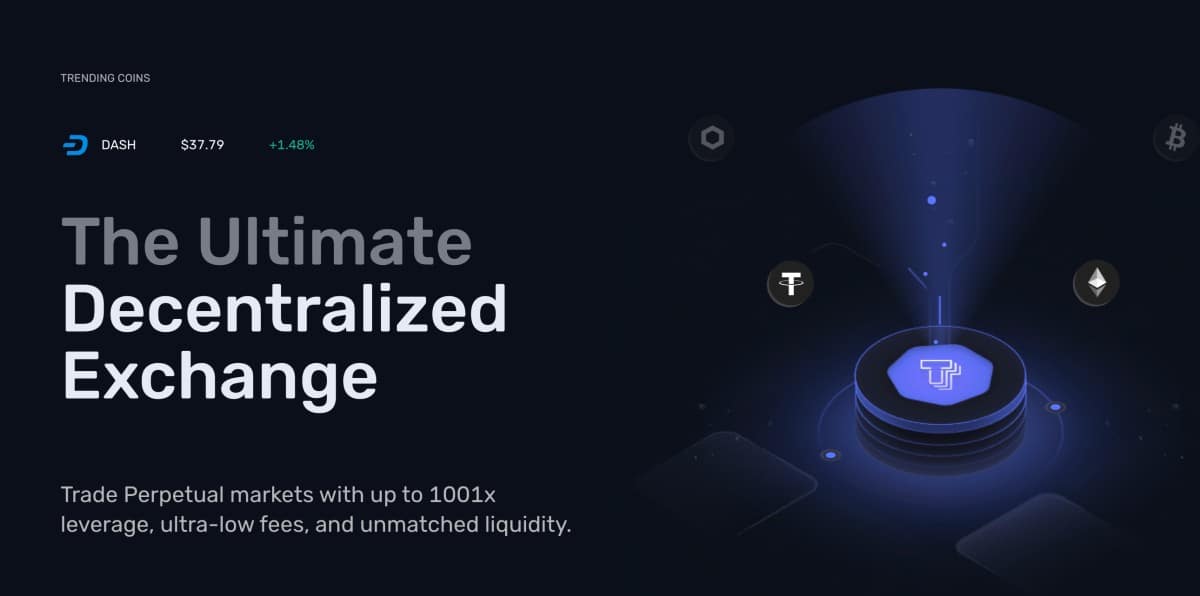
The exchange basically operates in two modes to offer you high flexibility. You can choose either “Web3 mode” to retain full control of your private keys or “Gasless mode” to eliminate gas fees but adopt a custodial approach. Users can even benefit from the platform’s demo trading mode to test their strategies without risking initial capital.
Pros and Cons of The True Trade
Pros
-
Offers relatively high leverage on major crypto pairs
-
Low trading fees
-
Features a demo trading mode
-
High-performance matching engine for trades
-
Ideal for both casual as well as pro traders
Cons
-
Does not have a dedicated mobile app
-
Regional restrictions in a few countries
The True Review
5. Changelly – A Beginner-Friendly and Anonymous Exchange Supporting 500+ Cryptocurrencies
Changelly is one of the top decentralized exchanges for beginners. It offers a simple user experience that will appeal to first-time DEX traders. This brand doesn’t leverage automated market makers (AMMs) like other DEXs. Instead, Changelly aggregates liquidity from centralized and decentralized platforms. This hybrid model often results in industry-leading pricing.
Moreover, Changelly supports over 500 cryptocurrencies. This includes some of the best altcoins, including Stellar, BNB, Dogecoin, Cardano, Ethereum, and Chainlink. Bitcoin and a full range of stablecoin trading options are also supported. Traders can swap cryptocurrencies on any compatible chain. Such actions don’t require a bridging tool, meaning fees are super competitive.

Instead, cross-network trades are conducted manually via wallet transfers. For example, suppose you’re trading XRP for Litecoin. You’d transfer XRP to Changelly and provide the receiving Litecoin wallet address. The Litecoin will be transferred to the wallet once Changelly receives the XRP. Trading commissions cost 0.25%.
Pros and Cons of Changelly
Pros
-
One of the best crypto swap sites for beginners
-
Trade over 500 cryptocurrencies from multiple blockchains
-
No additional fees when making cross-network swaps
-
Transparent trading commission of 0.25%
-
Obtains liquidity from over 20 trading platforms
Cons
-
Trades can take up to 40 minutes to complete
-
Lacks advanced analysis tools for seasoned traders
Changelly Review
How We Tested These DEXs
We tested decentralized exchanges using live on-chain swap scenarios to assess how each platform performs in real trading conditions.
- Swap execution and pricing
We compared real swap quotes for common pairs (e.g., ETH/USDC, SOL/USDC, and one mid-cap token) at the time of review in April 2026, noting price impact and execution behavior. - Network and routing support
We checked which blockchains are supported, whether trades are routed via DEX aggregators, and how clearly routing logic is presented to users. - Fee transparency
We reviewed what fees are shown before confirmation, including network costs and any service fees, to identify platforms with unclear or misleading pricing. - Security and user safeguards
We examined publicly verifiable signals, including documentation quality, smart contract transparency, and how platforms explain approvals, slippage settings, and transaction reverts. - Exclusions
We excluded tools with unclear custody models, missing documentation, or claims of “zero fees” that did not account for network or gas costs.
CoinFutures – An Alternative DEX-Free Crypto Futures Simulator
CoinFutures isn’t a decentralized exchange, but it offers a unique alternative for traders who want to experience high-risk crypto strategies without using one. This simulator mimics real crypto price volatility and lets users open “long” or “short” trades on popular assets like Bitcoin, Ethereum, Dogecoin, and Solana.
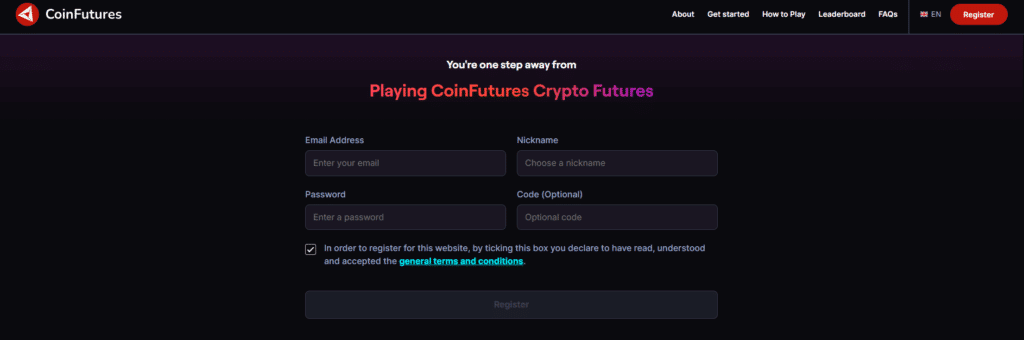
The key difference? You don’t need to connect a DEX wallet like MetaMask. There’s no KYC, no market contracts, and no real-time swaps. Instead, CoinFutures uses a high-speed simulation engine where you select your asset, choose a multiplier up to 1000x leverage, and decide when to cash out. It’s designed to ease volatile trading strategies in a fast-paced, exchange-free environment.
Although it’s not a substitute for real on-chain trading, CoinFutures is ideal for sharpening your timing and volatility instincts.
Pros and Cons of CoinFutures
Pros
-
Trade simulated crypto futures without a wallet or DEX
-
No KYC, onboarding, or wallets required
-
Multipliers up to 1000x for extreme volatility training
-
Cash out anytime before the price busts
-
Supports BTC, ETH, SOL, DOGE, and more
Cons
-
No ownership of assets as it is purely a simulator
Refer to our detailed CoinFutures Review for more info.
CoinFutures Review
What is a Crypto DEX and How Do They Work?
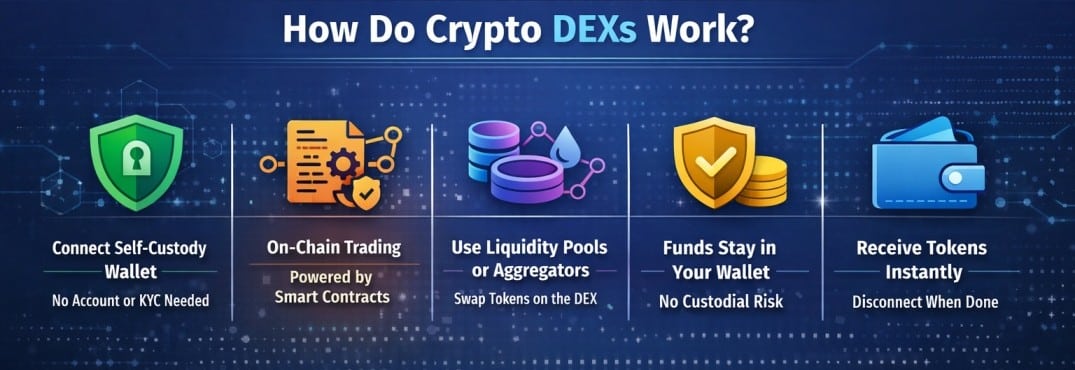
If you’ve often wondered how to buy crypto on decentralized exchanges, this section of the article has you covered. By this point in time, you know that decentralized exchanges allow users to trade cryptocurrencies. However, unlike centralized exchanges, such as Binance and Coinbase, trades are executed via the blockchain network using decentralized protocols. This means traders can remain on-chain, and swaps are facilitated by smart contracts.
How DEXs Differ From Centralized Exchanges
Decentralized exchanges never hold client-owned cryptocurrencies, which removes the counterparty risk. For example, consider that FTX filed for bankruptcy in 2022. Billions of dollars in customer funds were subsequently mishandled, resulting in significant and life-changing losses. These risks aren’t prevalent when using a decentralized exchange.
The process itself is straightforward.
Why Traders Choose Decentralized Exchanges
Not only are decentralized exchanges a safer alternative to centralized platforms, but they’re also a great way to invest in new cryptocurrencies. This is because newly launched tokens often begin trading on decentralized exchanges before they’re added to mainstream platforms.
DEXs also tend to charge more reasonable fees than centralized rivals, as well as offering rewards to liquidity providers by gifting them with a stake in trading fees or native tokens. In this way, clients are maximizing their chance to earn passive income, particularly users who may want to stake or farm their assets within liquidity pools.
Beginners may appreciate the ease of swapping small amounts of tokens without restrictions. On the other hand, advanced traders can take advantage of features like slippage control and customizable gas fees.
Different Types of Decentralized Exchanges
There are various kinds of decentralized exchanges available today. Some platforms feature a native DEX, allowing trades to happen without the need for third-party liquidity pools. Instead, native DEXs utilize the Automated Market Maker (AMM) model, which updates prices in real-time based on volume, market cap, and other data metrics.
Some decentralized exchanges operate on the aggregator model. This means they source cryptocurrencies from outside liquidity pools. Because of this, you frequently receive better pricing since pools are selected based on current exchange rates. Aside from this, there are decentralized exchanges that provide leveraged derivatives like perpetual futures, delivery futures, and options.
Advanced users may also take advantage of cross-chain DEXs, which enable the swapping of assets between different blockchains without the need for a centralized bridge or intermediary.
Additionally, many leading DEXs now support features like limit orders, staking integrations, and governance token voting, giving users more control over their trading environment. As innovation accelerates, DEXs continue to close the gap with CEXs in terms of functionality while maintaining superior privacy and decentralization.
Increase in DEX Volume
The DEX-to-CEX volume ratio reached a record 0.23 in Q2 2025 as spot trading volume on DEXs increased by 25% while centralized exchange volumes fell by about 28%.
The shift toward decentralized trading is happening for three main reasons:
- Better Privacy: New DEXs use zero-knowledge tech, which lets you trade without exposing your full wallet history.
- Easier Fees: With account abstraction, you can pay gas fees using the token you’re trading, so you don’t always need ETH or other native coins in your wallet.
- Gasless Trading: Some platforms now include the gas fee in the trade itself. This makes decentralized trading feel more like a regular exchange, with no separate fee approvals.
Types of Decentralized Exchanges: Which Option is Best?
Let’s take a closer look at the different types of decentralized exchanges. This will help you choose the best DEX for your trading goals and experience level.
Whether you’re seeking lower fees, deeper liquidity, or multi-chain access, each type of DEX exchange offers a unique benefit depending on your specific needs. Understanding these distinctions is essential for building an efficient crypto trading strategy.
Native DEX
Some decentralized exchanges offer a native trading experience. Uniswap is a great example of an Ethereum exchange. Uniswap is built on the Ethereum blockchain, so it supports thousands of ERC-20 tokens. Anyone can provide Uniswap with liquidity, allowing investors to earn passive income on idle wallet balances.
For example, suppose an investor holds Ethereum and USDC. They would add equal amounts of ETH/USDC to the Uniswap liquidity pool. Whenever someone uses that liquidity pool to trade, the investor receives a small percentage of the trading fees.
Other notable native DEXs include PancakeSwap for Binance Smart Chain, Trader Joe for Avalanche, and Raydium for Solana. Each native DEX typically aligns with the underlying blockchain’s ecosystem, offering better liquidity and lower fees for native tokens.
For traders focused on a specific chain, using its corresponding native DEX often provides the most efficient and cost-effective experience. Native DEXs also tend to offer governance tokens, giving users voting rights on platform upgrades and fee structures.
DEX Aggregators
You can also trade cryptocurrencies by using DEX aggregators. A few of the better brands out there include Best Wallet, OKX, and Exodus. Such sites collaborate with many external liquidity providers, including native DEXs like Uniswap, PancakeSwap, Jupiter, and Raydium.
Users fill out the DEX trading form, selecting which cryptocurrencies they want to swap and the amount. The DEX aggregator will immediately evaluate the best exchange rates from its partnered liquidity providers.
You can use multiple providers for the same transaction if this makes pricing more competitive. Let’s say you want to swap $5,000 worth of BNB for Chainlink. In this case, the aggregator could use two DEXs for this process, getting $3,000 from one and the remaining $2,000 from a second one.
This type of intelligent routing not only improves price execution but also helps reduce slippage and optimize gas efficiency, especially for large trades or highly volatile assets.
Order Book DEX
A newer breed of decentralized trading leverages the conventional order book system. However, unlike centralized exchanges, order books remain on-chain. This model is particularly useful for trading derivative products such as perpetuals.

AlphaX is a great example. It’s an on-chain DEX that supports leveraged futures. Traders can go long or short with leverage of up to 125x. No account needs to be opened; traders simply connect a self-custody wallet and begin placing orders.
Since these platforms operate entirely on-chain, users maintain full custody of their funds while gaining access to advanced tools like limit orders, margin positions, and isolated leverage options.
Cross-Chain DEX
Cross-chain DEXs are another option to consider. You can find the best cross-chain bridges in decentralized exchanges that support multiple blockchain standards, meaning traders can convert one cryptocurrency for another, even if they operate on different networks.
- For example, suppose you want to swap Bonk for Shiba Inu.
- These meme coins operate on the Solana and Ethereum blockchains, respectively.
- Cross-chain DEXs facilitate trades via bridging tools.
- Everything happens behind the scenes, meaning the DEX connects with Solana and Ethereum simultaneously and swaps the required tokens.
This offers a smooth and seamless user experience. Cross-chain functionality also allows traders to diversify their portfolios across multiple ecosystems without the need to move assets manually between different blockchains. As a result, users save significantly on time, transaction fees, and potential bridge risks.
Additionally, the best cross-chain DEXs often integrate liquidity pools from multiple chains, providing deeper liquidity and better price execution for less common token pairs. Traders can therefore gain access to a broader market, unlocking arbitrage opportunities and improving trade efficiency.
Finally, emerging technologies like zero-knowledge proofs and decentralized bridge protocols are being incorporated into next-generation cross-chain DEXs, offering even greater security and trustless interoperability between different blockchain networks. This evolution makes cross-chain DEXs a critical piece in the future of decentralized finance.
Non-Custodial Exchange
Non-custodial exchanges offer a similar user experience to DEXs. However, the process is slightly different. Changelly is a great example. Although Changelly is a centralized platform that operates off-chain, it still offers a decentralized experience for traders.
You don’t need to register for an account or enter any payment information. Instead, trades happen through manual wallet transfers. For example, if a trader wants to exchange Bitcoin for Avalanche, Changelly creates a unique Bitcoin wallet address. The trader then transfers the coins and waits for the blockchain to confirm the transaction.
Then, Changelly automatically transfers Avalanche to the trader’s wallet. Cryptocurrencies are obtained from over 20 liquidity providers, including centralized and decentralized platforms. This often results in industry-leading prices and spreads.
Ranking the Best Decentralized Crypto Exchanges: Methodology
CoinGecko data shows that over 850 decentralized exchanges are currently active. This can make it challenging to choose the right DEX.
Our methodology explored the most important metrics, including security, supported networks, fees, liquidity, and liquidity. We discuss these factors in more detail below.
Type of DEX
Traders should initially determine the type of DEX they want to trade on. For example, one of the most common options is to use an aggregator DEX like Best Wallet. Traders frequently get the best exchange rates, considering Best Wallet aggregates prices from hundreds of different liquidity pools.
Alternatively, you might want to trade on a standalone DEX that specializes in a specific network standard. Suppose you’re looking to trade meme coins on the BNB chain. In this case, you should consider PancakeSwap. Alternatively, if you’re more interested in Ethereum-based projects, check out Uniswap and SushiSwap.

That said, some DEX traders seek derivative products, especially those deploying short-term strategies. For example, scalpers and day traders can speculate on perpetual futures on AlphaX. Hundreds of leveraged markets are supported, and long and short positions can be entered. A DEX-free simulator with CoinFutures is also a great example in this category.
Supported Networks
Our methodology prioritized decentralized exchanges supporting the widest range of networks. This is ideal for diversification, as you can trade thousands of tokens from multiple blockchain ecosystems, all without leaving the DEX interface.
Once again, Best Wallet is a good option here. It supports over 60 blockchains, including Bitcoin, Ethereum, BNB Chain, Solana, Polygon, and Avalanche. Traders can buy and sell tokens from any of these blockchains at the best market rates.
Similarly, traders should also explore which specific tokens are supported. For example, Jupiter only supports cryptocurrencies from the Solana ecosystem. Conversely, AlphaX supports every crypto asset imaginable. This includes everything from Dogecoin and Aave to Ethereum, Filecoin, and Bonk.
It’s also worth noting that some DEXs offer seamless bridging tools, making it easier to swap assets across different chains without using a separate cross-chain platform. This streamlines the trading process and enhances capital efficiency, especially for DeFi power users.
Liquidity
Both centralized and decentralized exchanges need liquidity. However, liquidity sits at the heart of the decentralized exchange phenomenon. It’s important to note that liquidity levels represent a micro fraction of traditional spot trading exchanges.
- For example, consider that in the prior 24 hours, Uniswap, the largest DEX for Ethereum-based tokens, attracted $461 million in volume.
- In contrast, Binance, the biggest centralized exchange, facilitated almost $10 billion worth of volume over the same period.
As such, our methodology explored average liquidity levels when ranking DEXs. This is why aggregators were prioritized. As mentioned, aggregators partner with hundreds of different liquidity providers.
This means traders always have enough liquidity to trade, which translates to competitive pricing and wafer-thin spreads. It also reduces slippage risks. Conversely, DEXs with limited liquidity offer a subpar trading experience, leading to high slippage and volatile pricing swings.
On-Chain Only
As someone who values security and transparency in cryptocurrency trading, we also favor DEXs that operate 100% on-chain. This design means traders can buy and sell cryptocurrencies without relying on centralized order books. Instead, trades are executed via self-executing smart contracts directly on the blockchain network, a feature that we find significantly increases both security and transaction transparency. This on-chain execution ensures that all transactions are recorded publicly and immutably, enhancing trust and verifiability.
Furthermore, the on-chain nature of these DEXs provides users with complete custody of their funds, eliminating the risks associated with holding assets on a centralized exchange. Because trades are peer-to-peer and governed by code, no intermediary could potentially be hacked or act maliciously. This direct interaction with the blockchain also often leads to greater censorship resistance, as no single entity can easily prevent or reverse transactions.
Core Features
Another important metric when choosing a DEX is whether any notable features are offered.
For instance, SushiSwap, known for ERC-20 tokens, enables traders to use a dollar-cost averaging strategy. This lets traders buy their preferred cryptocurrencies regularly in smaller amounts. For example, a trader might choose to invest $300 in Shiba Inu each week. This helps average the purchase price and lowers volatility risks.

Another top feature is decentralized exchanges that double up as non-custodial wallets. Best Wallet, OKX, and Exodus are good examples. They offer native wallet software for mobiles and desktops. This allows traders to buy and sell cryptocurrencies without leaving the wallet interface.
Some DEXs also come equipped with built-in portfolio trackers, real-time analytics, and tax reporting tools—features that help traders stay organized and compliant, especially during volatile or high-frequency trading sessions.
Anonymity
The best decentralized exchanges offer a private and anonymous experience. Unlike centralized platforms, users won’t be asked to open an account. Trades are conducted by connecting a self-custody wallet, ensuring personal details and ID documents will never be required.
This is a great benefit for traders based in countries where crypto trading is illegal or vastly restricted. DEXs are inclusive and never ask for the trader’s location.
In addition, since there is no central entity maintaining user records, DEXs reduce the risk of data breaches and identity theft. Users are in full control of their transaction history, which remains visible only on the public blockchain ledger. Some privacy-conscious traders also opt for DEXs that support shielded tokens or are compatible with privacy-focused wallets like Samurai or Wasabi, further enhancing anonymity during transactions.
How to Use a Cryptocurrency DEX: Step-by-Step Guide
Decentralized exchanges can be intimidating for first-time users. The good news is that once you know the basics, DEX trading is seamless. It rarely takes more than a couple of minutes to complete a trade.
I’ll now walk you through the step-by-step process, using Best Wallet’s DEX for the tutorial. However, the steps are much the same as with most other DEXs.
-
Download Best Wallet
Get the Best Wallet app from the App Store or Google Play. Open it and tap “Get Started” to begin setup.
-
Back Up Your Wallet
Securely save your recovery phrase and back up your wallet to iCloud or Google Drive. This ensures you can recover your wallet if you lose your device.
-
Fund Your Wallet
To begin DEX trading on Best Wallet, you will need to fund your wallet. You can either transfer cryptocurrencies on-chain to your Best Wallet address or buy crypto on Best Wallet using your credit card or debit card.
-
Tap “Trade” on the Home Screen
Once your Best Wallet is funded, tap the “trade” button to start your DEX trading. Tap on “Swap” next.
-
Select the token you want to purchase
From the token list, choose the crypto you want to purchase and select your preferred blockchain network.
-
Select the token you want to sell
Select the crypto you want to swap in exchange for the token you want to acquire. Best Wallet will automatically show you the exchange rate and gas fees required to complete the token swap.
-
Complete Your Purchase
Review all details, then tap “Swap.” After transaction processing, your tokens will be automatically credited to your wallet.
Why Did Our DEX Transaction Revert?
- Some DEX trades will get the ‘Transaction Reverted’ error. This isn’t unique to Best Wallet; it can happen on any DEX platform.
- This often happens when trading cryptocurrencies with limited liquidity, meaning the trade executes at an unfavorable price, resulting in high slippage.
- If you want to proceed anyway, you can increase the slippage percentage. It’s set at 0.5% by default, meaning trades will revert if slippage is above 0.5%. Continue increasing the slippage until you receive confirmation of the trade.
Crypto DEXs: The Key Benefits
Those new to decentralized exchanges might not be fully aware of the key benefits. This section takes a closer look at the standout advantages of DEX trading.
Anonymous and Private Trading
The first benefit of decentralized exchanges is the private and anonymous experience offered. To understand why this is advantageous, let’s briefly consider the traditional process when joining a centralized exchange. Let’s use Coinbase for this example.
- First, users must complete an application form, including their full name, nationality, residential address, date of birth, and other personal information.
- Next, Coinbase will initiate a KYC process. This requires some documents, including a government-issued ID.
- Then, Coinbase will verify the documents before providing access to its exchange.
- Only then can you start buying, selling, and trading cryptocurrencies.
Now, compare this to a no KYC exchange like Best Wallet. There is no account opening process, let alone requests for personal information or a government-issued ID.
Traders link a non-custodial wallet to the DEX, select the cryptocurrencies they want to trade, and wait a few moments for the swap to complete. After that, the trader disconnects the wallet, finishing the process. This kind of anonymity is not often provided by centralized platforms due to growing pressures from regulatory agencies.
Avoid Counterparty Risks
Another major benefit offered by decentralized exchanges is the removal of counterparty risk. This is because traders don’t need to worry about misplaced cryptocurrencies. As mentioned earlier, holders “lost” billions of dollars worth of cryptocurrencies when FTX declared bankruptcy in 2022.
If you were an FTX user back then, you might still not have recovered some or all of your cryptocurrencies. This is a risk you face when using a centralized exchange since custodial wallets contain cryptocurrencies. This means only the exchange has access to the wallet’s private keys, so you never truly own those coins.

The experience is completely different when using a decentralized exchange. Crucially, DEXs never hold client-owned cryptocurrencies. Immutable and transparent smart contracts execute trades on the blockchain.
For instance, think about a trader who wishes to exchange Solana for dogwifhat. The trader links a wallet to the DEX, and a smart contract automatically changes Solana for dogwifhat using liquidity pools. The acquired dogwifhat tokens are placed into the same wallet address. The DEX cannot manage this transaction, so it can’t freeze or alter the smart contract. In the end, this provides you with complete control over your cryptocurrencies.
Beyond eliminating counterparty risks, using a decentralized exchange also reduces the risk of regulatory intervention freezing your funds. Unlike centralized exchanges, which can receive pressure from governments to comply with asset seizures or account suspensions, DEXs operate without permission.
Inclusive and Accessible
Not everyone can easily access the crypto markets. In some countries, there is a total ban on owning crypto. This means centralized exchanges won’t accept clients from those nations. As a result, decentralized exchanges become very attractive. DEXs do not require the trader’s country of residence, personal information, or ID verification.
Such an inclusive framework ensures that anyone, no matter where they’re from, can trade on decentralized exchanges. Similarly, some nationalities have restricted access to certain crypto products. For example, US and UK retail clients have limited access to crypto derivatives such as perpetual futures.
Decentralized exchanges are a great way to avoid this censorship. For instance, AlphaX offers hundreds of perpetual futures with high leverage limits. Anyone can join the platform, just connect a wallet and start trading. Other popular DEXs, such as Jupiter, dYdX, and PancakeSwap, also offer perpetual futures.
Another way DEXs support investing is by increasing multi-chain and layer-2 integrations, allowing users from different blockchain networks to connect easily. With the growth of cross-chain liquidity protocols, traders can now obtain tokens on various blockchains without having to convert assets many times or depend on centralized gateways. This improvement lowers transaction fees and boosts overall trading efficiency, solidifying DEXs as the preferred platforms for open, borderless crypto trading.
Ideal for Investing in Newly Launched Tokens
Newly launched tokens offer the best chance of finding the next 1000x crypto. This is because the majority of new cryptocurrencies have a micro-cap valuation, which is often below $1 million. You then get the perfect balance between high volatility and price potential for speculative traders. Crucially, new tokens rarely appear on centralized exchanges.
On the contrary, they opt for decentralized platforms. Anyone can add cryptocurrencies to a DEX; the only requirement is to provide liquidity. As such, decentralized exchanges list thousands of undervalued tokens. This enables investors to get a first-mover advantage before they list on more prominent centralized exchanges.
Additionally, trading on DEXs allows investors to bypass the stringent listing requirements of centralized exchanges, which often delay access to high-potential projects. Many newly launched tokens also debut with exclusive staking and farming incentives, rewarding early adopters with high APYs.
Furthermore, since liquidity pools determine pricing on decentralized exchanges, savvy investors can leverage arbitrage opportunities before prices stabilize across broader markets. With real-time access to emerging tokens, DEX users can enter positions early and maximize their profit potential before mainstream adoption.
Transparency
One major downside of using a centralized exchange is the lack of transparency, particularly regarding order books. Some analysts claim that even top-tier exchanges manipulate prices, leading to unfair trading conditions. While we can’t definitively prove or disprove this idea, it is clear that order books are highly centralized and unclear.
This is in contrast to decentralized exchanges. Every transaction, whether that’s a buy or sell order, is transparently viewable on the blockchain network. This includes the token amount, wallet address, timestamp, and other key metrics. This means decentralized exchanges offer a far more credible and trustworthy trading experience.
Cross-Chain Simplification
Trading cryptocurrencies from different blockchains used to be a cumbersome process. For example, centralized exchanges like Coinbase and Binance support some crypto cross pairs, such as LTC/BTC, ETH/BTC, and EOS/BTC. However, outside of Bitcoin and Ethereum, cross-chain trading is no easy feat.
- Let’s say you’re currently holding ATOM, but you want to purchase DASH.
- Centralized exchanges won’t offer an ATOM/DASH pair, considering the almost non-existent demand from users.
- This means you’d need to sell ATOM for another crypto, such as USDT.
- You would then need to exchange that USDT for DASH.
- This means two trading commissions.
Traders can complete the same transaction in just one step when using a suitable DEX. Best Wallet, for example, supports cross-chain trading for more than 60 blockchains. This means you can immediately swap ATOM for DASH, with the transaction taking less than 60 seconds to complete.
DEX-to-CEX Volume Ratio
In 2025, the DEX-to-CEX spot volume ratio reached its highest level on record. Over the past five years, decentralized exchange spot volume has more than tripled relative to centralized exchanges.
While centralized exchanges still dominate derivatives and high-frequency trading, DEXs now account for a meaningful share of global spot volume.
Crypto DEXs: Drawbacks and Risks
Decentralized exchanges solve many issues prevalent on centralized platforms. However, traders should also consider the risks. This section explores the main drawbacks of DEX trading.
Liquidity Issues
We previously noted that DEX trading volumes are much lower than those of centralized exchanges. This leads to liquidity problems, making it hard to execute trades at good prices. While this is usually not a concern with large-cap pairs like ETH/USDC or SOL/BONK, trading micro-cap tokens can lead to a less satisfying experience.
- For instance, suppose a newly launched token has $50,000 in DEX liquidity.
- A new investor purchases $10,000 in that token.
- That amounts to 20% of the overall liquidity, meaning just one buy order will have a significant impact on its price.
- Similarly, that trader will also influence the token’s price when they eventually decide to sell.
Limited liquidity also results in high slippage. This means traders must accept a worse-than-expected exchange rate to execute their buy or sell order. It shouldn’t come as a surprise that users need slippage of over 10% when trading micro-cap tokens.
Moreover, limited liquidity makes it difficult for investors to implement advanced trading strategies such as stop-loss orders or limit orders effectively. On many DEXs, thin order books or fragmented liquidity across multiple pools can lead to unpredictable execution prices or delayed transactions, further compounding the risks.
Aside from this, arbitrageurs often capitalize on these inefficiencies, creating unfavorable conditions for retail investors. To mitigate these perils, always review the liquidity pool risks by checking the size and trading volume of the token pair before executing trades.
Learning Curve for Beginners
We’ve established that DEX trading utilizes a completely different process from centralized platforms. Traders need a non-custodial wallet that they’ve funded with cryptocurrencies. Smart contracts then execute trades on the blockchain.

This procedure will likely be new to traditional investors who are more familiar with brokerage accounts and order books. The key issue is that DEX traders with limited experience can make costly mistakes. For instance, they could trade the wrong token or transfer funds to an incorrect wallet address.
Network Fees
When trading on the best decentralized exchanges (DEXs), every buy or sell order triggers an on-chain transaction, which incurs a network fee. These fees are paid directly to the blockchain that processes the trade, and vary depending on network congestion and transaction complexity.
For instance, Ethereum often experiences elevated fees during peak activity periods, with gas costs occasionally exceeding $100 per transaction. This has led many traders and new token projects to migrate to more affordable networks like Solana or BNB Chain, where fees are typically just a fraction of a cent.
However, high network fees can make decentralized trading less practical for smaller investors, as they directly reduce potential profit margins. Fee amounts also depend on the type of transaction. For instance, basic token swaps generally cost less, while complex operations such as adding liquidity, bridging assets, or interacting with advanced smart contracts can be significantly more expensive.
No Access to Fiat Facilities
Decentralized exchanges only offer crypto-to-crypto trading pairs. For example, you can trade Ethereum against USDC. But you can’t trade Ethereum against USD or GBP.
This also means users must make deposits in cryptocurrencies rather than convenient payment methods like Visa, Mastercard, and PayPal. As such, first-time investors will need to obtain cryptocurrencies elsewhere before they start trading.
Lack of Customer Support
Another drawback with DEX trading is the lack of accessible customer support. After all, decentralized exchanges operate autonomously, using smart contracts to buy and sell orders.
This makes it challenging to obtain assistance if things go wrong. However, it wouldn’t be the case when using a centralized exchange, which typically offers 24/7 support via live chat.
Therefore, despite the growth of decentralized exchanges and their clear benefits, experts believe DEXs still face some hurdles when it comes to widespread, everyday adoption. In an interview with 99Bitcoins, Steven Pu, co-founder and CEO of Taraxa—a PoS, blockDAG-based, EVM-compatible Layer-1 blockchain—explained:
“Pure DEXs (fully decentralized) as they stand today do not and most likely will never have decent mainstream adoption because of the complexity of crypto wallets, key management and asset management. We are seeing the emergence of hybrid exchanges that have elements of centralized convenience coupled with access to the vast liquidity on DEXs that might eventually gain both institutional as well as end-user adoption.”
Conclusion
DEX trading will play a major role in the Web 3.0 era. Traders no longer face counterparty risks on centralized exchanges. Instead, users can instantly buy and sell cryptocurrencies without the DEX ever touching their funds.
Overall, our top DEX pick is Best Wallet. It supports thousands of cryptocurrencies from over 60 blockchains, not to mention an anonymous experience. Best Wallet obtains industry-leading exchange rates from hundreds of liquidity providers.
See also:
- 8 Best Crypto Exchanges With Lowest Fees
- What is Photon Crypto? Beginner’s Guide to Photon DEX
- Top Perpetual Decentralized Exchanges in 2026
FAQs:
What is a decentralized exchange (DEX)?


Decentralized exchanges (DEXs) are crypto exchange that allows users to conduct token swaps without depending on a centralized operator. Instead of relying on a centralized operator to match traders and maintain an orderbook, DEXs facilitate crypto trades using liquidity pools. When a user conducts a token swap, they are actually swapping their tokens against a pool of cryptocurrencies. The biggest advantage of using DEXs is that they are permissionless, globally accessible, and censorship-resistant.
Is Binance DEX or CEX?
Binance is a centralized exchange (CEX) where crypto trades are facilitated using traditional order books.
What is the best decentralized crypto exchange?
The best decentralized crypto exchange is undoubtedly Best Wallet. With its native DEX and multi-chain support, this crypto tool ensures that you get the fairest and most reasonable prices when you’re trading crypto. Other popular decentralized exchanges 2025 include Exodus, AlphaX, and OKX.
What is the biggest DEX crypto?
The list of decentralized exchanges with the most volume includes Kine Protocol, Hyperliquid, Uniswap, Orca, and Raydium.
Can a DEX get hacked?
DEXs aren’t 100% safe, as the underlying smart contract can be hacked. That said, leading DEXs have open-source contracts and are regularly audited.
Is CEX safer than DEX?
DEXs are safer than CEXs. They never touch client-owned funds, and trades go through the blockchain network.
Is Uniswap a DEX or CEX?
Uniswap is a fully-fledged DEX. It’s the largest DEX for trading Ethereum-based tokens.
What is the downside of DEXs?
Some of the drawbacks of DEXs include limited liquidity, a lack of accessible support, and a required learning curve for beginners. Another downside is that DEXs don’t support fiat payments.
Do decentralized exchanges have KYC?
No, decentralized exchanges don’t have a KYC process. Traders aren’t even required to open an account as trading is done by connecting a private wallet.
Is the decentralized exchange Changelly legit?
Absolutely. Despite complaints from some users on Reddit that Changelly has taken long to process their funds, it mostly enjoys an uncheckered reputation. Since it is a non-custodial platform, there is also less risk for clients’ funds to be lost. However, be aware that Changelly is not available to customers domiciled in the US.
Do any of the best DEXs support gasless swaps in 2026?
Yes, some leading DEX platforms now offer gasless or fee-sponsored swaps through smart wallet technology or relayers. This means users may not need to hold the network’s native token just to complete a trade. However, support varies by platform and network. When comparing DEXs, check whether gasless swaps are available or if standard on-chain gas fees still apply.
References:
- Chainlink. “What Is an Automated Market Maker (AMM)?” Chainlink, https://chain.link/education-hub/what-is-an-automated-market-maker-amm.
- CoinGecko. “Top Decentralized Exchanges Ranked by Trust Score.” CoinGecko, https://www.coingecko.com/en/exchanges/decentralized.
- Finance Magnates. “Decentralized Exchanges (DEX) Explained.” Finance Magnates, https://www.financemagnates.com/cryptocurrency/education-centre/decentralized-exchanges-dex-explained/.
- Kalyeena Makortoff. “Where Did FTX’s Money Go?” The Guardian, 27 Mar. 2024, https://www.theguardian.com/business/2024/mar/27/where-did-ftx-money-go.
- Financial Conduct Authority. “FCA Bans Sale of Crypto Derivatives to Retail Consumers.” FCA, https://www.fca.org.uk/news/press-releases/fca-bans-sale-crypto-derivatives-retail-consumers.

Why you can trust 99Bitcoins
Established in 2013, 99Bitcoin’s team members have been crypto experts since Bitcoin’s Early days.
Weekly Research
100k+Monthly readers
Expert contributors
2000+Crypto Projects Reviewed