
OpenMark AI
OpenMark AI instantly benchmarks over one hundred LLMs on your specific task for cost, speed, and quality without requiring API keys.
Visit
About OpenMark AI
OpenMark AI is the definitive platform for empirical, task-level benchmarking of large language models. It transforms the complex, often speculative process of model selection into a precise, data-driven science. Designed for developers, product teams, and AI engineers, it eliminates the guesswork from deploying AI features by providing side-by-side comparisons grounded in real-world performance. The core value proposition is elegant in its simplicity: describe your specific task in plain language, and OpenMark executes it against a vast catalog of over 100 models in a single, unified session. You receive comprehensive metrics on scored quality, actual API cost per request, latency, and—critically—output stability across multiple runs. This last dimension reveals variance and consistency, ensuring decisions are based on reliable performance, not a single fortunate output. By operating on a hosted credit system, it removes the administrative burden of managing multiple API keys, offering a seamless gateway to objective truth in a landscape often clouded by marketing claims and fragmented testing.
Features of OpenMark AI
Plain Language Task Configuration
Describe the exact task you need an AI model to perform—be it classification, data extraction, creative writing, or complex reasoning—using simple, natural language instructions. OpenMark's intelligent system interprets your intent and constructs the appropriate benchmarking prompts, removing the need for manual, error-prone prompt engineering. This allows you to focus on defining the problem domain rather than the technical intricacies of interfacing with each model's unique API and expected input format.
Multi-Model, Real-API Benchmarking
Execute your defined task against a meticulously curated catalog of over 100 leading models from providers like OpenAI, Anthropic, Google, and open-source communities in one coordinated session. Crucially, every test makes a live API call, ensuring you compare real latency, real costs, and real, current model performance—not cached or idealized marketing numbers. This delivers an authentic, apples-to-apples comparison under identical conditions.
Comprehensive Performance Analytics
Gain insights beyond simple pass/fail metrics with a detailed analytics dashboard. View side-by-side comparisons of each model's quality score (as defined by your task), the actual cost per request, response latency, and token usage. This holistic view enables you to evaluate the true cost-efficiency of a model: the quality it delivers relative to the price you pay for each API call.
Variance and Stability Testing
Understand not just if a model can complete a task, but if it will do so reliably every time. OpenMark runs your prompts multiple times for each model, analyzing the variance in outputs. This reveals consistency—or a lack thereof—highlighting models that may produce a stellar result once but fail unpredictably, a critical factor for production systems where stability is non-negotiable.
Use Cases of OpenMark AI
Pre-Deployment Model Validation
Before integrating an AI model into a live application or feature, product teams can use OpenMark to validate its performance on the exact tasks it will handle. This mitigates the risk of post-launch failures, unexpected costs, or poor user experience by providing empirical evidence that the chosen model meets the specific requirements for quality, speed, and budget.
Cost-Efficiency Optimization for Scaling Applications
For applications already using AI, OpenMark is instrumental in optimizing operational costs at scale. Developers can benchmark alternative, potentially more cost-effective models against their current solution to identify opportunities for reducing per-request expenses without sacrificing output quality, ensuring sustainable growth as user volume increases.
Building Reliable RAG and Agentic Systems
When constructing Retrieval-Augmented Generation pipelines or multi-agent workflows, the choice of LLM for routing, synthesis, or final answer generation is paramount. OpenMark allows architects to test candidate models on representative chunks of their actual logic, ensuring selected models provide consistent, accurate, and contextually appropriate outputs that maintain the integrity of the entire system.
Comparative Research and Academic Study
Researchers and analysts can leverage OpenMark's structured environment to conduct controlled, reproducible studies on model capabilities across different providers and model families. The platform's ability to run identical prompts across many models and measure multiple dimensions of performance makes it an invaluable tool for generating unbiased, comparative insights into the evolving AI landscape.
Frequently Asked Questions
How does OpenMark AI calculate the quality score for a model's output?
OpenMark employs a sophisticated, task-aware evaluation system. For many standard tasks, it can use automated metrics or LLM-as-a-judge scoring against your defined success criteria. For highly custom evaluations, you can implement manual scoring or rubric-based checks within the platform. The score reflects how well the output meets the specific objectives of your described task, not a generic capability.
Do I need API keys for the models I want to test?
No, one of OpenMark's primary advantages is that it abstracts away API key management. You operate using OpenMark credits. The platform handles all the underlying API calls to the various model providers on your behalf. This simplifies setup dramatically and allows for instantaneous testing across competitors without configuring multiple accounts.
What is meant by testing "stability" or "variance"?
Stability testing refers to running the same prompt against the same model multiple times (in parallel or sequentially) and analyzing the differences in the outputs. A model with low variance produces very similar, high-quality results each time, which is crucial for production. High variance indicates unpredictability, where a model might give a perfect answer once but a poor or irrelevant one the next, representing a significant operational risk.
Can I benchmark private or fine-tuned models?
The current public catalog focuses on widely available, hosted foundation and proprietary models from major providers. For benchmarking private, fine-tuned, or self-hosted models, you would typically need to integrate them via a compatible API endpoint, which may be available through enterprise or custom plans. The platform's architecture is designed to accommodate a wide range of model sources.
Similar to OpenMark AI
ProcessSpy
ProcessSpy is the definitive macOS process monitor, offering advanced real-time insights with a refined, native Mac experience.

Claw Messenger
Claw Messenger grants your AI agent a dedicated iMessage number for seamless, native communication.
Datamata Studios
Datamata Studios empowers developers with free utilities, premium tools, and live market intelligence to build data-driven careers.
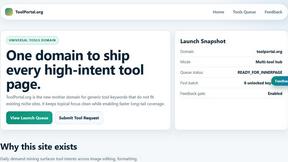
ToolPortal
ToolPortal offers a suite of browser-based tools for effortless formatting, validation, conversion, and image management tasks.

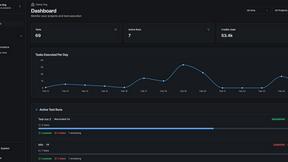
qtrl.ai
qtrl.ai empowers QA teams to scale testing efficiently with AI-driven agents while maintaining complete control and.
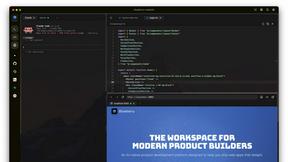
Blueberry
Blueberry is a unified Mac app that seamlessly integrates your editor, terminal, and browser for streamlined product.
