Recent Content

USING SIGNAL TAP TO MONOTOR AVALON_BUS WITH NIOS DESIGN
hii i need to use signal tap to see what's happening on avalon bus , i have a qsys system that is working fine , its the remote update example , and when i add a signal tap file and add for example the avalon bus signals the connects to the on chip flash ip , and i try to write the cfm0 the signal tap does not work . i put the trigger on a rising edge of a avalon_write and nothing seems to happen , i be glad for help :)4Views0likes0Comments
MAX10 Dual Configuration
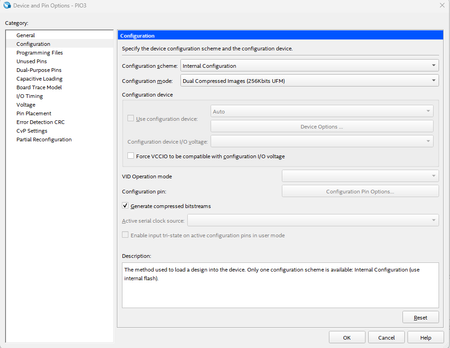
I am using the MAX10 Dual Configuration. The device settings in the Quartus are shown in the image below. The settings for the generation of the .pof file and the .rpd files are shown below: The CONFIG_SEL file is set by a jumper via a 10K resistors either high or low. I can update the flash memory, but it appears that both CFM0 and CFM1 are programmed with the same image. Also, when I use JTAG to program CFM0 and CFM1 with two different images, it seems that the programming of CFM1 overwrites the CFM0 image. What could be wrong?23Views0likes4Comments
Cyclone I (EP1C3) Configuration Issues: Sequence and Environment Dependent Failures
Hi, I am aware that Cyclone I is a legacy device, but we are maintaining a long-life product and would appreciate any insights from experienced engineers. [ Environment and System Configuration ] I am maintaining a legacy system developed 20 years ago. I am facing inexplicable configuration and boot issues that depend on the programming environment (PC/location) and the sequence of file versions written. FPGA: Cyclone EP1C3T100C8 Configuration Device: EPCS4SI8 Software: Quartus II 9.1sp2 Web Edition OS: Windows 7 Professional SP1 Download Cable: Terasic USB Blaster Setup Locations: A) Design Office (Me): 2 boards (with JTAG access), PC "A" B) Factory: Multiple boards (AS mode only, no JTAG), PC "B" [ Description of Phenomena ] Phenomenon 1: Spontaneous Mode Change (Factory / 2-year-old board) In Dec 2025, a board worked correctly. In March 2026, it behaved as if it were in a different operation mode. Details: The mode is hard-wired within the internal logic and should not transition. Action: Re-writing the same POF file restored normal operation. Note: This happened within only a few months of storage. Phenomenon 2: Failure to Transition from Initial State (Office / 10-year-old board) A JTAG-enabled board was stored for one year. Now, it fails to function even with known-good files. Details: Even writing the original SOF that worked in Feb 2025, the FPGA stays in its initial state and fails to perform state transitions. Quartus reports "Success," but the hardware logic does not execute. Phenomenon 3: Sequence-Dependent Success (Factory / New 2026 boards) When writing a Dec 2025 POF to five new boards: Behavior A (3 boards): Initially stayed in the initial state. However, after writing an older Feb 2025 POF, they started working. Over-writing them with the Dec 2025 POF then resulted in success. Behavior B (2 boards): Worked perfectly from the first attempt. Why would a specific version history be required for some boards to work? Phenomenon 4: Lack of Compatibility (Office vs. Factory) A POF verified to work when written by Factory PC (B) does not work when written by Office PC (A). Details: When written by PC A, the board stays in the initial state and fails to transition, identical to Phenomenon 2. [ Discussion and Questions ] Incomplete Initialization: Is it possible for the configuration to reach "Done" while internal registers fail to initialize correctly due to power supply slew rates or noise? Silent Data Corruption: Are there known issues with Quartus 9.1sp2 and Terasic Blasters where bit errors occur during programming without being caught by the verification process? EPCS4 Residual State: Why would writing an older version "prime" the board to accept a newer version? Could this be related to EPCS sector erase issues? Since these are legacy devices, any insights would be greatly appreciated. Regards, HKana1727Views0likes3Comments
EMIF Pin Assignment for Agilex 7 FPGA I-Series DevKit (DK-DEV-AGI027R1BES)
Hi Altera Support Team, We are trying to install two Micron 32GB 2Rx4 RDIMMs on the Agilex 7 I-Series FPGA Development Kit, PCB Rev. A (DK-DEV-AGI027R1BES), and would like to confirm the correct EMIF pin assignment for this board. We have already enabled these two DIMMs on a DK-DEV-AGI027RBES board. However, we noticed that the golden pin assignment provided in the installer package appears to be the same for both FPGA boards. Since these two boards use different power solutions and different pin assignments, we believe the DK-DEV-AGI027R1BES should require a different EMIF pin assignment. At the moment, we have not been able to find the correct pin assignment for the DK-DEV-AGI027R1BES board. Could you please provide this information, or point us to the appropriate documentation? Best regards, Yang18Views0likes2CommentsQuartus Prime Pro 25.1 fatal error during fitter: Windows "Efficiency mode" required
Quartus 25.1 usually crashes during fitter, with a number of different crash reports. Here below are two examples: Problem Details Error: *** Fatal Error: Access Violation at 000000BC2DC1E830 Module: quartus_fit.exe Stack Trace: Other 0xbc2dc1e82f: Other 0xbc2dc1e6af: Other 0x1bf404d29ff: End-trace Executable: quartus Comment: None System Information Platform: windows64 OS name: Windows 11 OS version: 10.0.22631 Quartus Prime Information Address bits: 64 Version: 25.1.0 Build: 129 Edition: Pro Edition ------------------------------- Problem Details Error: *** Fatal Error: Module: quartus_fit.exe Stack Trace: Quartus 0x5fb4b: RaiseException + 0x6b (KERNELBASE) Quartus 0x26ad: __ExceptionPtrRethrow + 0x15d (MSVCP140) Quartus 0x19cfe: tbb::detail::r1::current_context + 0x277e (tbb12) Quartus 0x19d78: tbb::detail::r1::current_context + 0x27f8 (tbb12) Quartus 0x17695: tbb::detail::r1::current_context + 0x115 (tbb12) Quartus 0xa2567: FDRGN_EXPERT::run_place_flow + 0xd17 (fitter_fdrgn) Quartus 0xa0018: FDRGN_EXPERT::run_place + 0x188 (fitter_fdrgn) Quartus 0x95135: FDRGN_EXPERT::place + 0x195 (fitter_fdrgn) Quartus 0x2c120: fit2_fit_place_auto + 0xc0 (comp_fit2) Quartus 0x16442: TclNRRunCallbacks + 0x62 (tcl86) Quartus 0x4e6b: fit2_fit_place + 0x33b (comp_fit2) Quartus 0x16442: TclNRRunCallbacks + 0x62 (tcl86) Quartus 0x17c4d: TclEvalEx + 0x9ed (tcl86) Quartus 0xa6a8b: Tcl_FSEvalFileEx + 0x22b (tcl86) Quartus 0xa5136: Tcl_EvalFile + 0x36 (tcl86) Quartus 0x230ac: qexe_evaluate_tcl_script + 0x66c (comp_qexe) Quartus 0x21be9: qexe_do_tcl + 0x8f9 (comp_qexe) Quartus 0x2a1ad: qexe_run_tcl_option + 0x6cd (comp_qexe) Quartus 0x4119f: qcu_run_tcl_option + 0x6ef (comp_qcu) Quartus 0x29969: qexe_run + 0x629 (comp_qexe) Quartus 0x2abd6: qexe_standard_main + 0x266 (comp_qexe) Quartus 0xbd32: qfit2_main + 0x82 (quartus_fit) Quartus 0x28708: msg_main_thread + 0x18 (ccl_msg) Quartus 0x29912: msg_thread_wrapper + 0x82 (ccl_msg) Quartus 0x2b063: mem_thread_wrapper + 0x73 (ccl_mem) Quartus 0x265df: msg_exe_main + 0x17f (ccl_msg) Quartus 0xcfab: __scrt_common_main_seh + 0x10b (quartus_fit) Quartus 0x1259c: BaseThreadInitThunk + 0x1c (KERNEL32) Quartus 0x5af37: RtlUserThreadStart + 0x27 (ntdll) End-trace Executable: quartus Comment: None System Information Platform: windows64 OS name: Windows 11 OS version: 10.0.22631 Quartus Prime Information Address bits: 64 Version: 25.1.0 Build: 129 Edition: Pro Edition ----------------------------- this happens with every design and with Arria10, Stratix 10 and also Agilex 7. The only way to avoid these Quartus crashes is to run the fitter in Windows "Efficiency Mode", but that makes fitting time more or less double. Any hints?1.8KViews0likes22Comments
Inquiry: Reference Clock Jitter Limits for 1G Operation on Agilex 5
Hello, According to GTS transceiver reference clock specifications of the Agilex 5 (GTS Transceiver Performance • Agilex™ 5 FPGAs and SoCs Device Data Sheet • Altera Documentation and Resources Center), the RMS jitter integrated from 10 kHz – 20 MHz, including spurs, is indicated as 522fs (maximum value). We are using in our design a 156.25MHz clock (AX3DAF1-156.2500 from abracon), and the measured jitter is ~1ps currently. We would like to know if this specification is for specific performances or if it’s a strict specification. (in our case, it’ll be for a 1G operation) Thanks, Best Regards12Views0likes0CommentsR-Tile Avalon Streaming PIPE Direct x16: Locks COM(K28.5) Symbols correctly but some lanes do not.
Hello, I am implementing a custom soft PCIe/CXL link layer and LTSSM using R-Tile Avalon Streaming IP in PIPE Direct mode, configured as x16. At the moment, link training does not reliably move forward because some lanes receive valid COM/K-code alignment, but the following ordered-set symbols are corrupted. Environment Device / board: AGIB027R29A IP: R-Tile Avalon Streaming FPGA IP for PCI Express Mode: PIPE Direct Link width: x16 Current focus: Gen1 training / Polling / Configuration Custom implementation: custom LTSSM custom symbol lock using COM (K28.5) custom TS1/TS2 decode logic Symptom In Polling.Active and Polling.Configuration , I can see that some lanes captures/decodes TS1/TS2 correctly, but some lanes do not. For example, in the attached SignalTap screenshot: Lane 9 appears to decode the TS2 sequence correctly. Lane 8 shows COM (K28.5) and PAD (K23.7) correctly, but the symbols after that are unstable / corrupted. From the screenshot: Lane 9 example: K28.5, K23.7, K23.7, D24.0, D30.0 D00.0, repeated Lane 8 example: K28.5, K23.7 are visible, but the following TS2 fields fluctuate and do not remain valid/stable. So it looks like: COM-based symbol lock is working at least partially but after COM/PAD, the ordered-set contents on some lanes(random) are corrupted before my soft IP can decode them correctly To verify whether this was caused by my own logic, I captured the affected lanes directly in SignalTap using the first raw 10-bit RX data from the PIPE Direct IP (`ln*_pipe_direct_pipe_rxdata_o`), before any symbol lock/decoding stage in my soft IP. I searched for the COM symbol directly in this raw 10-bit stream and confirmed that the corruption is already present at the PIPE Direct IP output. So this does not appear to be caused by my combinational decode logic; the raw RX data delivered by the IP is already corrupted on those lanes. What I already checked I already checked the following items carefully: Gen1 rxdata interpretation I only decode valid 10-bit portions for Gen1 I do not interpret the don't-care bits in rxdata[31:10] and rxdata[63:42] rxdatavalid qualification TS decode / symbol shift only happens when rxdatavalid0/1 are valid Sampling clock SignalTap capture is done in the corresponding lane RX clock domain not with a shared TX/fabric clock Reset sequence pld_pcs_rst_n_i release is gated after per-lane tx_transfer_en_o I also reviewed cdrlock2data, reset_status_n, phystatus, powerdown sequencing Deskew-related status active channels are detected Current question At this point, I suspect one of the following: lane-specific analog/RX quality issue inside or before PIPE Direct output lane-specific reset/power-up timing issue internal alignment / deskew behavior that I am misunderstanding some required PIPE Direct control/sideband setting that I am missing What I would like to ask In PIPE Direct x16 Gen1, if one lane shows valid K28.5 / K23.7 but the following TS2 symbols are corrupted, what should I check first on the R-Tile side? Are there any lane-specific PMA / RX / PIPE Direct controls that should be reviewed for this symptom? Is there any recommended way to determine whether this is: a true lane analog/RX problem, a deskew/alignment issue, or a reset/bring-up sequence issue? Are there any known recommendations for validating lane integrity directly at the PIPE Direct output during Polling.Configuration?
Agilex 5 – Critical HSSI Error in JESD204B Example Design
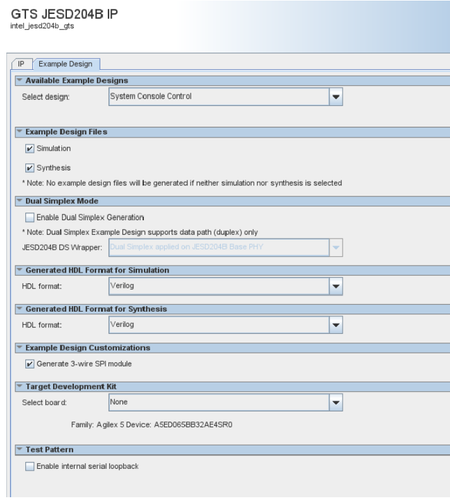
Hi, I am bringing up the JESD204B interface on the dev kit. For this, I used the "Generate Example Design" option with the following parameters: When I generate the project and start synthesis, it reaches the "HSSI Support Logic Generation" stage, and Quartus reports the following critical error: It turns out that the generated file contains an inconsistency in the generated HSSI metadata. My fix was to replace the entry in: The problem is that after updating the Qsys file, it gets changed back to intel_jesd_RX, and HSSI reports the critical error again. If there is already a fix or workaround for this issue, please let me know. For now, I added a simple script that I run from PowerShell: that replaces this value with the correct one:12Views0likes0Comments


Featured Places
Community Resources
Check out the support articles on personalizing your community account, contributing to the community, and providing community feedback directly to the admin team!Tags
- troubleshooting10,336 Topics
- fpga dev tools quartus® prime software pro4,226 Topics
- FPGA Dev Tools Quartus II Software3,160 Topics
- stratix® 10 fpgas and socs1,532 Topics
- agilex™ 7 fpgas and socs1,424 Topics
- arria® 10 fpgas and socs1,349 Topics
- stratix® v fpgas1,314 Topics
- arria® v fpgas and socs1,226 Topics
- cyclone® v fpgas and socs1,053 Topics
- Configuration971 Topics
Recent Blogs

2 MIN READ
Altera is extending the availability of its Agilex®, MAX® 10, and Cyclone® V FPGA families through 2045 to support long-lifecycle applications like industrial, aerospace, and medical systems. This helps customers avoid costly redesigns and ensures reliable, long-term supply, reinforcing Altera as a trusted partner for decades-long deployments.
10 days ago1like

In a world where technological complexity is rising, standards are evolving, and differentiation is critical, customers need partners who can move fast, stay focused, and innovate without compromise. At Altera™, operating as an independent pure play FPGA solutions provider is more than a corporate structure. It’s a strategic advantage. For more than four decades, Altera has been at the forefront of FPGA innovation, helping customers push the boundaries of what’s possible across the most demanding applications. With our recent operational independence and singular focus on pioneering FPGA innovations, we are uniquely positioned to deliver FPGA solutions that enable customers to differentiate, innovate, and grow in rapidly changing markets. Why Demand for FPGAs is Accelerating The FPGA industry is entering a period of strong, sustained growth, driven by powerful forces across cloud, networking, and edge applications. As enterprises race to process and monetize exploding volumes of data, FPGAs have become a critical enabling technology, uniquely suited for workloads where flexibility, re-programmability, and real-time performance matter most. Over the next five years, the market is expected to grow at roughly 10% CAGR, expanding from an estimated ~$7B in 2025 to more than $13B by 2030¹. Demand is accelerating across data center and networking, telecom, aerospace and government, industrial automation, robotics, medical, and beyond. Growth is being driven by AI infrastructure modernization, 5G-Advanced and early 6G deployments, and the rise of physical AI and real-time, low-latency edge computing. At the same time, escalating development costs for ASIC and ASSPs, longer development cycles, and the need for post-deployment flexibility are pushing more customers toward programmable solutions that reduce risk while maintaining performance and differentiation. Altera is uniquely positioned to help drive this next phase of growth. As the largest independent, pure-play FPGA solutions provider, our agility and focus allow us to move faster, invest deeply in a thriving ecosystem, and deliver differentiated, end-to-end solutions backed by strong customer support. By partnering closely with customers, we enable them to seize opportunities across AI, cloud, networking, and edge applications. While at the same time allowing customers to stay ahead as new technology inflection points emerge. Let’s take a closer look at how Altera’s independence strengthens the five strategic pillars that matter most to our customers: Innovation, Quality, Ecosystem Partnerships, Solutions, and Community Support. Faster Decisions Enable Faster FPGA Innovation Altera’s independence means customers benefit from faster decisions, quicker execution, and a partner that can adapt as requirements evolve. Free from competing priorities or broader corporate agendas, we respond rapidly to market shifts, delivering new capabilities sooner, resolving challenges faster, and helping customers stay on track with demanding development timelines. This momentum is reflected in Altera’s renewed commitment to the broad-based FPGA market and the launch of our power- and cost-optimized Agilex® 3 FPGAs, supported by an expanding ecosystem of partner boards. Altera’s first power- and cost-optimized FPGA since the launch of Cyclone 10, Agilex 3 enables industrial, automotive, and edge AI customers to accelerate differentiation and reduce time-to-market. Our investments are not stopping here. We are advancing a next-generation FPGA roadmap that delivers new levels of performance while introducing the next wave of power- and cost-optimized devices, providing a clear and scalable path forward across the Agilex portfolio. A Relentless Focus on FPGA Quality Because Altera is singularly focused on FPGAs, our priority is to ensure our programmable solutions meet the industry’s most demanding quality and lifecycle requirements. Every investment, engineering decision, and roadmap commitment is dedicated to delivering rigorously validated silicon, dependable software tools, long-term product availability, and sustained support that customers designing mission-critical systems require, including long-term supply commitments extending to 2035 and 2040 for select product families. This unwavering focus allows us to provide the stability, reliability, and multi-decade lifecycle assurance FPGA customers depend on, with no competing agendas and no compromise. Additional information about Altera’s quality and reliability can be found at: https://www.altera.com/quality/overview Accelerating FPGA Innovations Through a Robust Ecosystem FPGA value is unlocked faster through a strong, connected ecosystem. Altera supports a global network of more than 300 validated FPGA partners delivering over 1,400 proven solutions spanning IP, development tools, system integration, and turnkey platforms. By leveraging these pre-validated solutions, customers can reduce development time by up to 50%, lower risk, and accelerate time-to-market. Through deep ecosystem investments, we extend the power and usability of Altera FPGAs, enabling faster system-level innovation and helping customers move from concept to deployment with greater speed and confidence. Learn more about the Altera Solution Acceleration Program at: https://www.altera.com/asap Purpose-built Investments Across the FPGA Stack Every dollar we invest is directed toward advancing FPGA innovation. A recent example includes expanding our MAX® 10 FPGA family with new high-I/O density Variable Pitch BGA (VPBGA) packages, which deliver up to 485 I/Os in a compact 19 x 19 mm footprint, reducing board size by 50% compared to traditional 27 x 27 mm packages and enabling more space-efficient Type III PCB designs. We are also accelerating productivity through tools like Visual Designer Studio, which dramatically reduces development cycles by reducing system creation time from five days to as little as two hours. In parallel, we continue to invest in a broad portfolio of FPGA IP, spanning interfaces, memory, DSP, embedded processing, and connectivity. An extensive portfolio of Altera and parter IP provide pre-validated building blocks that reduce design complexity and speed integration. Together, these investments across silicon, packaging, software, and IP ensure continuous gains in performance, power efficiency, programmability, and ease of use. Customer Support Focused Exclusively on Solving FPGA Challenges Support is another area where independence makes a meaningful difference. Altera’s teams are entirely dedicated to solving the real-world challenges customers face. Our commitment to our customers is reinforced by the recently launched Altera Premier Support (APS) and Altera Community portals. These platforms provide streamlined access to engineering assistance, service request tracking, technical resources, and peer collaboration, ensuring customers have both direct expert support and 24/7 self-service capabilities. This deep specialization enables faster issue resolution, more relevant guidance, and a true partnership mindset. Whether optimizing designs, debugging complex systems, or scaling into production, customers can rely on experts who live and breathe FPGA solutions. Learn more about Altera communities, visit https://community.altera.com/ Enabling Innovators to Shape What’s Next As the largest independent, pure-play FPGA solutions provider, Altera is entering a new era defined by agility, focus, and the freedom to innovate at the pace of change. Our independence allows us to invest with intention, strengthen our ecosystem, and deliver complete solutions backed by deep customer engagement. By working side-by-side with our customers, we’re not just responding to technology inflection points across AI, cloud, networking, security and the edge… We’re helping customers shape what’s next. Visit Altera at www.altera.com (1) Source: Based on Altera and 3rd-party data
18 days ago1like
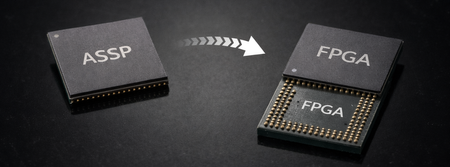
Modern infrastructure systems are facing growing challenges as many legacy ASSPs and ASIC devices reach end-of-life, creating pressure to find scalable and future-ready alternatives. FPGAs are emerging as a powerful replacement platform, offering programmability, lifecycle extension, and adaptability to evolving standards such as DDR5 and post-quantum security. With platforms like Altera’s Agilex family, organizations can replace fixed-function silicon while maintaining high performance, flexibility, and long-term production viability.
19 days ago0likes

Agilex® 7 FPGAs push FPGA fabric performance toward the gigahertz range by combining the HyperFlex® architecture with Quartus® Prime Pro software optimization. In Altera testing, a 32-bit SIMT soft processor implemented on Agilex 7 operated above 950 MHz, demonstrating how high-performance soft logic can be achieved in real designs. Hyper-registers distributed throughout the routing fabric enable deeper pipelining and advanced retiming, while Quartus Prime Pro optimizes synthesis, placement, routing, and timing to reach aggressive clock targets—allowing compute-intensive FPGA workloads to run faster and scale more efficiently.
20 days ago0likes
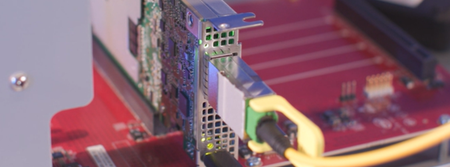
Linear Pluggable Optics (LPO) is gaining traction for AI/cloud infrastructure because it removes DSPs from optical modules, shifting signal conditioning to the host—cutting power by 30–40%, simplifying design, and lowering latency. Altera demonstrated public LPO interoperability using Agilex™ 7 devices running 400GbE (4×100G) with performance well beyond LPO spec thresholds in lab testing. Agilex 7’s high-speed transceivers and integrated capabilities make it a strong fit for SmartNICs, DPUs, and AI offload, with a roadmap toward next-gen 200G/224G LPO standards.
22 days ago0likes
