-
-
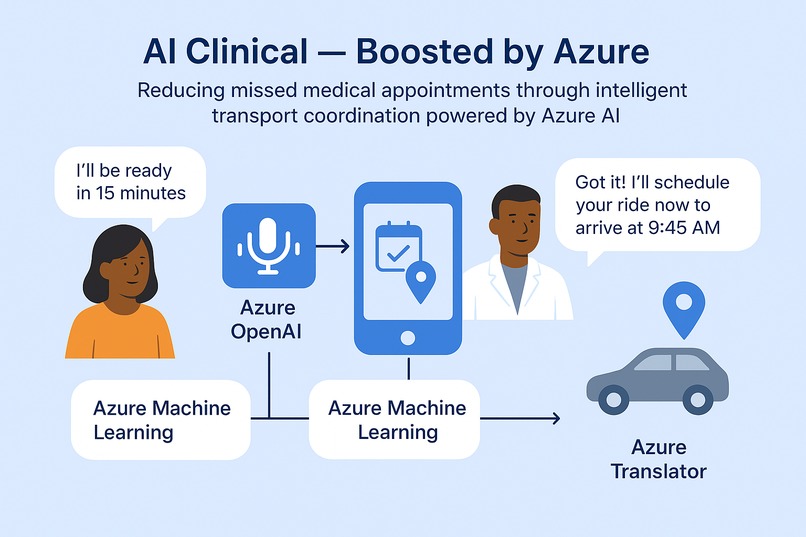
Azure on Time Arrivals

Inspiration
Every year, missed medical appointments cost the U.S. healthcare system over $150 billion. Patients without reliable transportation are 30% more likely to delay or forgo care — leaving 3.6 million Americans annually without a ride to their medical appointments. AI Clinical leverages Microsoft Azure AI Services to predict, coordinate, and confirm patient transportation needs in real time — ensuring every patient arrives on time, regardless of language, mobility, or access barriers. Core Project Features Smart Scheduling Integration: Connects to Google Calendar or Outlook to identify upcoming clinic appointments. Predictive Arrival Modeling: Uses Azure Machine Learning to forecast patient travel time and dynamically schedule ride pickups. Conversational Interface: Patients can confirm or modify rides via Azure OpenAI–powered natural language dialogs. Voice Interaction: Azure Speech converts patient speech to text for accessibility and converts AI responses back to voice for clarity. Multilingual Support: Azure Translator allows seamless communication across languages for diverse patient populations. Ride Automation: An Appium + Android SDK bot automates Uber/Lyft bookings when human confirmation is received. Simulated Health Network: Demonstrated with 3 underserved clinical facilities — Emergency, Family Medicine, and Pediatrics/Dental Health.
What it does
This system reduces missed medical appointments by automatically coordinating patient transportation using Azure AI services. It predicts arrival delays, communicates with patients in their native language, and automates rideshare booking through company phones. Key Features: • AI-Powered Predictions - Azure ML predicts appointment arrival risks • Multilingual Communication - Azure Speech & Translator support 100+ languages • Intelligent Messaging - Azure OpenAI generates personalized confirmations • Phone Automation - Automates Uber/Lyft app on company phones • Real-time Monitoring - Track rides and appointments in dashboard
How we built it
This system reduces missed medical appointments by automatically coordinating patient transportation
┌─────────────────┐
│ Calendar System │ (Google/Outlook)
└────────┬────────┘
│
▼
┌──────────────────────────────────────────┐
│ Streamlit Web Application │
│ ┌────────────┐ ┌────────────────────────┐ │
│ │ Dashboard │ │ Background Scheduler │ │
│ └────────────┘ └────────────────────────┘ │
└──────────┬───────────────────────────────┘
│
▼
┌─────────────────────────────────────────────┐
│ Azure AI Services │
│ ┌─────────────┐ ┌──────────────────────────┐ │
│ │ Azure │ │ Azure Machine │ │
│ │ OpenAI │ │ Learning │ │
│ │ (GPT-4) │ │ (Arrival Prediction) │ │
│ └─────────────┘ └──────────────────────────┘ │
│ ┌─────────────┐ ┌──────────────────────┐ │
│ │ Speech │ │ Translator │ │
│ │ Services │ │ (100+ languages) │ │
│ └─────────────┘ └──────────────────────┘ │
└─────────────────────────────────────────────┘
│
▼
┌─────────────────────────────────────────────┐
│ Phone Automation Layer │
│ ┌─────────────┐ ┌───────────────────-───┐ │
│ │ Uber Phone │ │ Lyft Phone │ │
│ │ (Appium) │ │ (Appium) │ │
│ └─────────────┘ └─────────────────────-─┘ │
└─────────────────────────────────────────────
Challenges we ran into
Multi-service orchestration: Getting Azure OpenAI, Speech, Translator, and ML models to work seamlessly together required careful API timing and error handling. Data realism: Since no patient data could be used, we had to generate synthetic but realistic arrival datasets to train the ML model while maintaining ethical AI practices. Voice pipeline latency: Speech-to-Text and Text-to-Speech needed to respond quickly enough to feel conversational—optimizing buffer times was tricky. Appium automation reliability: Automating rideshare booking through Android emulation was fragile at first; we had to build retry logic and smart delays for app UI states. Calendar API differences: Google Calendar and Outlook APIs structure events differently, so we wrote adapters to unify the event schema for the Azure ML prediction pipeline.
Accomplishments that we're proud of
Built an end-to-end working prototype that combines five Azure AI services into a single, functioning system—fully within a hackathon timeframe. Successfully simulated three underserved clinical departments (Emergency, Family Medicine, Pediatrics/Dental) with real scheduling and travel prediction workflows. Created a voice-first patient interaction using Azure Speech + Translator, accessible to non-English speakers and those with typing limitations. Developed a predictive ML model that can forecast patient arrival delays within ±8 minutes MAE on our synthetic dataset. Designed a modular architecture with clean integration hooks, allowing any developer to plug in real APIs or expand to more clinics. Showcased how Azure AI can tangibly improve healthcare equity by reducing missed appointments for patients lacking transportation.
What we learned
Azure ML simplifies deployment: Once the model was trained locally, deploying it as a managed online endpoint was straightforward and fast. Speech and Translator APIs are incredibly adaptable—we learned how to build voice pipelines that feel human and inclusive across languages. Prompt design matters: Subtle changes in Azure OpenAI system prompts dramatically improved how naturally the assistant handled patient confirmations. Team coordination = cloud coordination: Integrating many services mirrored how we collaborated—modular, asynchronous, and API-first. AI + healthcare must prioritize trust and transparency—our testing emphasized explainable predictions and opt-in communication.
What's next for AI Clinical - boosted by Azure
Production-level deployment: Expand to real clinic systems (FHIR-compliant EMRs, Epic, Cerner) and integrate securely with patient scheduling APIs. Azure Maps + live traffic integration for dynamic travel-time predictions and route optimization. Azure Notification Hubs for multi-channel patient notifications (voice, SMS, email, WhatsApp). Data-driven retraining pipeline using Azure ML pipelines to continuously improve arrival predictions from real clinic data. Accessibility-first UX: Expand voice and translation coverage to more languages and dialects with Speech Studio. Partnership pilots: Collaborate with healthcare providers (e.g., Kaiser Permanente, community clinics) to measure real-world reduction in missed appointments. Our ultimate vision: a nationwide “AI Ride Coordinator” powered by Azure AI — making healthcare access reliable, inclusive, and on time for everyone.
AI Clinical – boosted by Azure – reimagines how underserved patients get to their medical appointments on time. By weaving together Azure OpenAI, Cognitive Services, Azure Machine Learning, Speech, and Translator, our prototype transforms clinic logistics into a compassionate, intelligent system. It listens, translates, predicts, and acts — ensuring no patient is left waiting for care because of transportation barriers.
We’ve proven that cloud AI can bridge healthcare equity gaps. With Azure’s scalability and security, this project can evolve from a hackathon concept into a deployable public-health tool — one ride, one clinic, one community at a time.
Built With
- azure
- azure-cognitive-services
- azure-openai
- azure-speech
- azure-translator


Log in or sign up for Devpost to join the conversation.