-
-
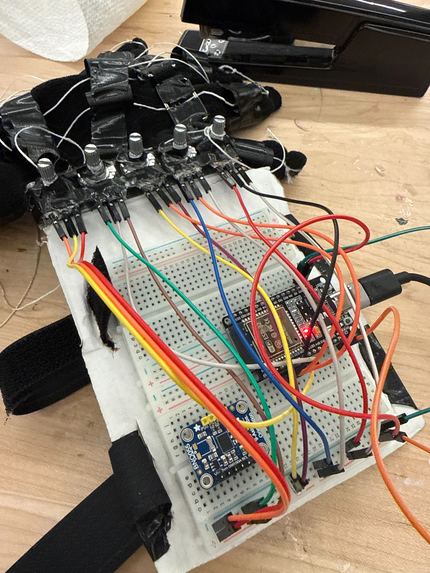
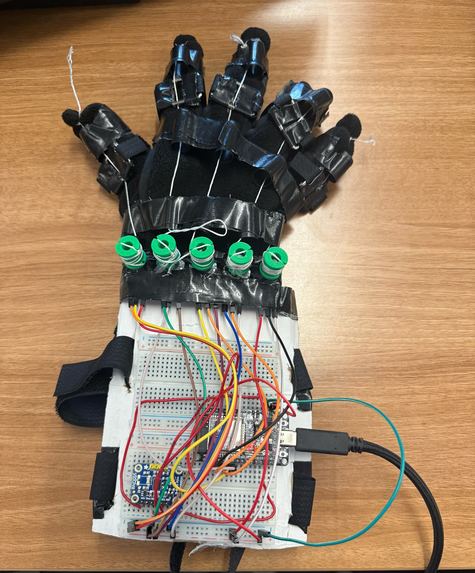
Connecting the gloves and breadboard together
-
MVP
-
MVP
-
MVP
-
MVP


Inspiration
Millions of people struggle with arthritis and joint stiffness, making daily tasks painful and physical therapy a frustrating, unmeasured process. We wanted to build an accessible, data-driven tool to help patients actively track their recovery, visualize their progress, and regain their mobility with confidence.
What it does
ArthAi is a hardware and software platform designed to quantify hand rehabilitation. The wearable glove tracks a user's finger flexibility in real-time, translating mechanical movement into digital metrics. Currently, our software platform acts as a diagnostic MVP, capturing this high-resolution flexion data to provide users with an objective baseline of their hand health alongside a library of targeted exercises.
How we built it
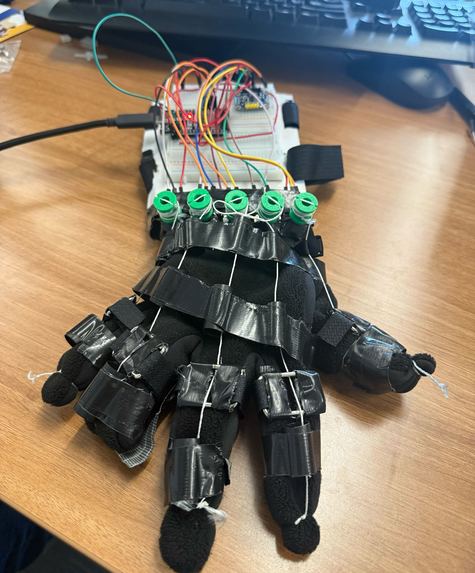
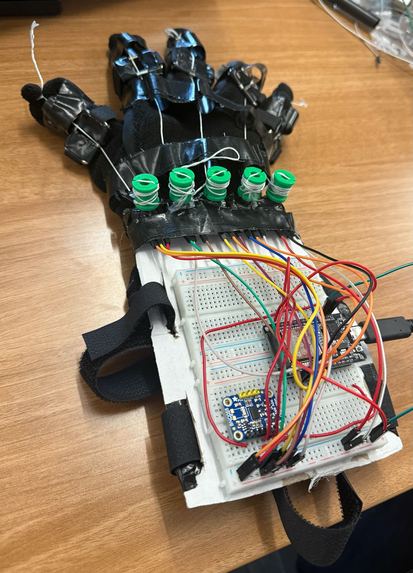
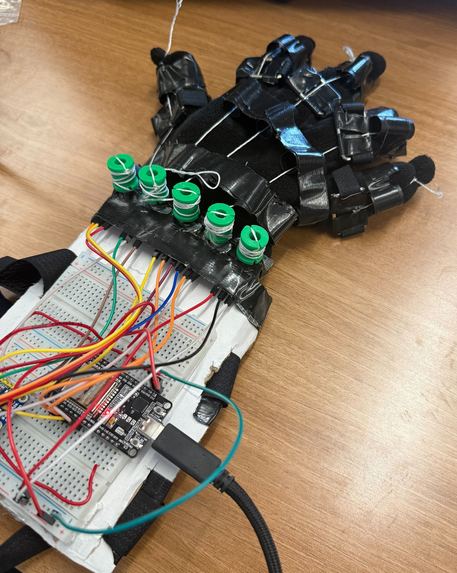
We engineered a custom cable-driven glove using string, duct tape, and an array of five potentiometers wired to an ESP32 microcontroller on a breadboard. Using the draw-wire mechanism we built, as the user flexes their fingers, the strings pull and rotate the potentiometers. The ESP32 measures the resulting changes in voltage, mathematically mapping those analog readings into precise digital representations of the user's finger flexibility.
Challenges we ran into
There were countless engineering hurdles during this project. Our initial architecture originally wanted to use servos to apply physical pressure and actively aid the hand in flexion. However, we quickly discovered that standard servos lacked the necessary torque and rotational range to be effective, forcing us to pivot to a diagnostic tracking model.
This pivot introduced new physical challenges. Building the glove and securely wiring the finger strings to the potentiometers was incredibly delicate. We also ran into a mechanical "return" issue: because of the nature of the string linkages, extending the fingers caused the string to go slack, requiring us to manually reset the potentiometers instead of them automatically retracting.
Accomplishments that we're proud of
We are incredibly proud that we successfully bridged the gap between raw hardware and digital tracking. Getting a handmade, custom-crafted mechanical glove to reliably communicate with an ESP32 breadboard circuit and output measurable flexibility data was a massive hurdle. Proving that this core, functional loop works is a huge win for us.
What we learned
We learned a hard lesson in systems integration: combining several simple components into a single, fluid ecosystem is much more difficult than building them in isolation. The physical challenge of fluidly combining the wearable glove with the electronic sensor array was a daunting task that consumed the vast majority of our development time.
What's next for ArthAi
We hope to continue to develop both our hardware and software skills. On the software side, we want to build out the algorithmic logic so the website can actively analyze the user's specific flexibility deficits and automatically generate a personalized exercise routine. For the hardware, we aim to design a mechanical auto-retraction system for the strings, and potentially integrate higher-torque motors to re-explore our original idea of providing physical, robotic aid to the hand.
Built With
- c++
- css
- github
- hardware
- html
- javascript
- mediapipe
- next.js
- node.js
- react
- typescript


Log in or sign up for Devpost to join the conversation.